Custom Backpack Manufacturing: The Complete B2B Guide (2026)

The global backpack market is projected to exceed $25 billion by 2027, driven by demand from outdoor recreation, corporate branding, education, and travel sectors. For brands, retailers, and e-commerce operators, partnering with a custom backpack manufacturer is one of the fastest ways to enter or expand in this market — without investing in production infrastructure.
The barrier to entry has never been lower. Advances in material science, digital sampling tools, and streamlined logistics mean a brand can go from concept to first shipment in under six months. Meanwhile, consumer expectations for quality, sustainability, and brand authenticity continue to rise — making manufacturing partnerships more strategic than ever.
But sourcing from a backpack factory in China or any overseas manufacturing hub involves decisions that directly affect product quality, lead time, compliance risk, and profit margin. Material selection, factory vetting, quality control protocols, and branding specifications all require clear understanding before placing a production order. One misstep — a wrong fabric choice, an untested zipper supplier, or a skipped inspection — can cost thousands of dollars in rework or reputational damage.
This guide covers the full scope of backpack OEM manufacturing: from choosing the right product type and materials, to understanding OEM vs. ODM models, vetting factories, managing production, controlling quality, meeting compliance standards, and building a recognizable brand. Whether you are launching a private label backpack line or scaling an existing product range, this page serves as your reference for every stage of the process.
Types of Custom Backpacks You Can Manufacture
Backpack manufacturing spans a wide range of end-use categories. Each type has distinct design requirements, material specifications, and price points. Choosing the right category is the first strategic decision in product development.
Hiking & Outdoor Backpacks
Outdoor backpacks require durable fabrics (typically 600D–1680D nylon or Cordura), reinforced stitching, load-bearing hip belts, and hydration-compatible compartments. High-volume hiking models often include frame sheets, ventilated back panels, and multiple attachment points for gear. If you are sourcing hiking backpack OEM production, expect factories to offer modular designs with customizable compartment layouts. Technical outdoor backpack manufacturing demands precision in seam placement and waterproofing treatments.
Travel & Carry-On Backpacks
Travel backpacks must meet airline carry-on dimensions (typically 55 × 40 × 20 cm for international flights) while maximizing internal organization. Key features include clamshell or panel-loading openings, padded laptop sleeves (fitting up to 17-inch devices), hidden security pockets, and luggage pass-through straps. Popular fabrics include 600D polyester and tarpaulin for water resistance. The carry-on backpack subcategory has particularly strong margins due to the premium travelers are willing to pay for airline-compliant designs with smart organization.

Laptop & Everyday Carry (EDC) Backpacks
The EDC and laptop backpack segment has grown rapidly with hybrid work models. These packs prioritize padded electronics compartments, cable management, streamlined aesthetics, and comfortable shoulder straps for daily commuting. Fabrics tend toward lighter weights (300D–600D) with premium finishes. Many brands target this segment for its high margin and repeat purchase potential.
Tactical & Military Backpacks
Tactical backpacks follow MOLLE/PALS webbing standards, use 1000D Cordura or similar military-spec fabrics, and feature modular attachment systems. Buyers in this segment often require color-matched hardware, IR-reflective treatments, and compliance with specific military procurement standards. Production tolerances are tighter than consumer products.
School & Promotional Backpacks
High-volume, lower-cost segments. School bags often use polyester (210D–420D) with screen-printed graphics. Promotional backpacks for corporate events or brand giveaways follow similar construction but may include branded zippers and custom hang tags. MOQs in this category can start as low as 300–500 units per design.
Sports & Specialty Backpacks
Sport-specific packs — for cycling, skiing, running, or camera equipment — require specialized features like helmet holders, hydration bladder compatibility, or shock-absorbing cradles. These often involve additional tooling for custom molded back panels or proprietary closure systems.
Choosing the Right Materials for Custom Backpacks
Material selection directly determines durability, weight, water resistance, cost, and the sustainability profile of a backpack. Most backpack material choices fall into five primary fabric categories, each with specific denier weights and treatment options.
Nylon: The Industry Standard
Nylon remains the most widely used backpack fabric due to its strength-to-weight ratio and abrasion resistance. Common specifications include:
- 210D–420D nylon: Light-duty packs, school bags, promotional items. Lightweight (80–120 g/m²), low cost.
- 600D nylon: Mid-range workhorse fabric for daypacks and travel bags. Good balance of durability and weight (~200 g/m²).
- 900D–1680D nylon: Heavy-duty applications — hiking packs, tactical bags, tool carriers. High abrasion resistance (~350–500 g/m²).
Nylon can be treated with PU coating, PVC backing, or DWR (Durable Water Repellent) finishes for water resistance. Silicone-coated nylon offers higher waterproof performance but at increased material cost.
Polyester: Cost-Effective Alternative
Polyester is less abrasion-resistant than nylon but offers better UV resistance and lower cost. 600D polyester is the standard fabric for mass-market school bags and promotional backpacks. It accepts dye-sublimation printing well, making it suitable for full-color branded designs.
Canvas & Cotton Blends
Canvas backpacks target the fashion and lifestyle segments. Cotton canvas (10–18 oz) offers a natural aesthetic that appeals to premium and heritage-style brands. Waxed canvas provides water resistance without synthetic coatings. Blends with polyester improve dimensional stability and reduce weight.
Cordura® & Technical Fabrics
Cordura, originally developed by DuPont (now INVISTA), is a brand of high-tenacity nylon fabric. Cordura 500D and 1000D are industry benchmarks for premium outdoor and tactical packs. Other technical fabrics include ripstop nylon (used in ultralight packs), X-Pac laminates (sailing and fastpack applications), and Dyneema composite fabrics for extreme weight savings.
RPET & Recycled Materials
Consumer demand for sustainable products is driving adoption of RPET (Recycled Polyethylene Terephthalate) fabrics made from post-consumer plastic bottles. RPET backpack manufacturing follows the same production processes as virgin polyester but requires GRS (Global Recycled Standard) certification for material traceability. Recycled nylon (such as ECONYL®) is also available at a premium.

OEM vs. ODM: Which Model Fits Your Brand?

When sourcing from a backpack factory, you will encounter two primary engagement models. Understanding OEM vs. ODM differences helps you choose the right partner for your stage of business.
OEM (Original Equipment Manufacturing)
In OEM production, you provide the complete design — including tech packs, patterns, material specs, and branding files — and the factory manufactures to your exact specifications. You retain full intellectual property ownership. OEM is the standard model for established brands with in-house design teams who need manufacturing capacity without design input from the factory.
Typical OEM requirements: detailed tech packs with construction diagrams, Bill of Materials (BOM), approved colorways, logo placement files, and packaging specifications. The factory’s role is strictly production execution.
ODM (Original Design Manufacturing)
In ODM, the factory provides existing designs that you customize with your branding, color choices, and minor modifications. This model reduces development time and cost, as the base design is already tested and proven. Many custom bag design processes start with ODM when brands are in early stages or testing new product categories.
ODM is ideal for startups, retailers adding backpacks to their product mix, and brands entering new markets where speed-to-market matters more than design exclusivity. The trade-off is less differentiation — the same base design may be available to other buyers.
Cost Comparison
OEM development typically costs $500–$2,000 per style for sampling (including pattern drafting, first sample, revision rounds, and pre-production sample). ODM sampling is often free or $100–$300 per style since the design already exists. Unit pricing for OEM may be 10–25% higher due to smaller initial runs and development amortization.
How to Find and Vet a Backpack Manufacturer
Choosing the right manufacturing partner is the single most impactful decision in your backpack sourcing process. A reliable factory ensures consistent quality, on-time delivery, and compliance with regulations. When choosing a bag manufacturer, evaluate these core criteria:
Key Vetting Criteria
- Industry experience: Minimum 5+ years in backpack or bag manufacturing. Specialization matters — a factory producing leather handbags may not have the equipment or expertise for technical nylon packs.
- Production capacity: Monthly output should align with your volume needs. A mid-size backpack factory typically produces 50,000–150,000 units per month.
- Equipment: Computer-controlled cutting machines, automated sewing stations, bar-tack machines for stress points, and heat-press equipment for logo application.
- Quality systems: ISO 9001 certification, in-line and final inspection protocols, AQL sampling procedures.
- Compliance: BSCI, Sedex, or SA8000 social audits; REACH/CPSIA testing capability; OEKO-TEX certification for fabric.
- References: Request a client list and ask for 2–3 verifiable references from brands in your target market.

The Factory Audit Process
A thorough factory audit goes beyond a facility tour. When auditing a bag factory in China, focus on production floor organization, raw material storage conditions, in-process quality checkpoints, worker skill levels, and finished goods packaging standards. Request to see defect logs and corrective action records — these reveal more about quality culture than any sales presentation.
Remote vetting through video calls, third-party inspection reports (SGS, Bureau Veritas, Intertek), and verified business platform profiles (Alibaba Gold Supplier, Global Sources) can narrow your shortlist before committing to an on-site visit.
From Design to Production: The Custom Backpack Process
The journey from concept to finished product follows a structured workflow. Each stage has specific deliverables and approval gates. Understanding this process helps you plan timelines and avoid costly revisions.
Step 1: Concept & Design Brief
Start with a clear design brief covering target market, price point, feature requirements, and competitive references. If your design team provides artwork and specs in standard formats (AI, PDF for artwork; Excel for BOM), factories can quote accurately and produce samples faster.
Step 2: Tech Pack Development
A tech pack is the blueprint for production. It includes dimensional drawings, construction details, material callouts, stitch-per-inch (SPI) specifications, hardware lists, Pantone color codes, and labeling instructions. Incomplete tech packs are the #1 cause of sampling delays and quality disputes.
Step 3: First Sample (Proto Sample)
The factory produces a first sample based on your tech pack. This sample validates proportions, material choices, and construction methods. Expect 7–15 working days for the first sample. Review it for fit, function, and aesthetics. Provide specific, written feedback — not vague comments like “make it better.”
Step 4: Revised Sample & Approval
Based on your feedback, the factory produces a revised sample. Most products require 2–3 sampling rounds before approval. Once you approve the sample, it becomes the “golden sample” — the quality benchmark for mass production.
Step 5: Pre-Production Sample (PPS)
Before mass production begins, the factory produces a pre-production sample using actual production materials and processes. This confirms that the factory can replicate the approved sample at production scale. Never skip the PPS stage.
Step 6: Mass Production
Once the PPS is approved, mass production begins. Standard lead time is 30–60 days depending on order quantity and complexity. During production, request progress photos or video updates at key milestones — after cutting, after sewing, and during packing. This keeps you informed without requiring constant on-site presence. Plan your seasonal production timeline backward from your target delivery date, accounting for sampling (4–8 weeks), production (4–8 weeks), and shipping (2–6 weeks by sea). Peak production seasons in China (February–May and August–October) may extend lead times by 1–2 weeks due to factory capacity constraints.
Step 7: Quality Inspection & Shipping
Conduct in-line inspection when 20–30% of production is complete, and final inspection when 100% is packed. Ship only after final inspection passes AQL standards. Coordinate with your freight forwarder for container booking and customs documentation.

Quality Control & Inspection Standards

Quality control in backpack manufacturing relies on statistical sampling rather than 100% inspection. The industry standard is AQL (Acceptable Quality Limit), typically set at 2.5 for major defects and 4.0 for minor defects in backpacks.
AQL Sampling Explained
AQL sampling follows ISO 2859-1 (ANSI/ASQ Z1.4). For an order of 3,000 backpacks at General Inspection Level II, the sample size is 200 units. The accept/reject numbers at AQL 2.5 are 14 accept / 15 reject for major defects. Detailed AQL quality control procedures should be agreed upon with your factory before production begins.
Common Defect Categories
- Critical defects: Broken zippers, wrong size, safety hazards (sharp edges, choking hazards for children’s products). Zero tolerance.
- Major defects: Uneven stitching (>3mm deviation), incorrect color, misaligned logo, missing hardware, open seams at stress points.
- Minor defects: Loose thread ends (<10mm), slight color variation within tolerance, minor packaging defects.
Inspection Timing
In-line inspection (during production) catches problems early when corrections are still possible. Final random inspection (after 100% production and 80% packing) is the last gate before shipment. Third-party inspection services (SGS, QIMA, AsiaInspection) typically charge $250–$350 per man-day for on-site inspection in China.
Building a Quality Culture with Your Factory
Effective quality control is not just about inspection — it starts with clear specifications and a collaborative relationship. Provide your factory with a quality manual that defines acceptable tolerances for every critical dimension, stitch count, and color match. Conduct regular production meetings (even via video call) to address issues before they compound. Factories that invest in worker training programs and maintain detailed production logs consistently deliver better results than those that rely solely on end-of-line inspection.
Quick Specification Reference
| Parameter | Details |
|---|---|
| Material Options | 600D polyester, nylon, RPET recycled fabric, canvas, CORDURA, TPU waterproof membrane |
| Backpack Types | Laptop backpacks, daypacks, travel packs, tactical, school bags, anti-theft, roll-top |
| MOQ | 50 units (test order), 300-500 units (mass production) |
| Sample Lead Time | 7 days |
| Mass Production Lead Time | 25-35 days |
| Certifications Available | ISO 9001, BSCI, GRS, OEKO-TEX, REACH, CPSIA, GOTS, SGS |
| Customization Options | Custom compartments, laptop sleeves up to 17 inch, embroidered/screen-printed logos, custom zippers, branded pulls |
| Packaging Options | Individual poly bags, branded boxes, hang tags, retail-ready packaging, bulk carton |
| Quality Standards | Laptop compartment padding 15mm+, strap strength 250N+, zipper 5000+ cycles, waterproof 2000mm+, AQL 2.5 |
Understanding Backpack Manufacturing Costs
Backpack pricing varies widely — from $3–$5 for basic polyester school bags to $35–$80+ for technical hiking packs with specialized materials. A detailed cost breakdown helps you evaluate quotes and negotiate effectively.

Cost Components
- Fabric & lining (30–45%): The largest cost driver. 600D nylon costs roughly $2.50–$4.00 per meter; 1680D nylon $4.00–$7.00. RPET fabrics carry a 15–30% premium over virgin materials.
- Hardware & trims (10–20%): Zippers (YKK $0.50–$2.00 each; generic $0.10–$0.40), buckles, D-rings, webbing, and cord locks.
- Labor (15–25%): Varies by factory location. Quanzhou and Xiamen factories in Fujian province typically range $1.50–$4.00 per unit in direct labor for mid-complexity packs.
- Printing & branding (5–10%): Screen printing $0.20–$0.50 per color; embroidery $0.50–$1.50; custom molded pulls $0.30–$0.80.
- Packaging (3–5%): Poly bags $0.05–$0.15; hang tags $0.03–$0.08; gift boxes $0.30–$1.00.
- Overhead & profit (10–20%): Factory margin, typically 12–18% for established manufacturers.
MOQ Impact on Pricing
MOQ (Minimum Order Quantity) significantly affects unit cost. At 500 units, expect to pay 20–40% more per unit than at 3,000-unit quantities due to fixed cost amortization (sampling, pattern making, material sourcing). Effective MOQ strategies for small brands include consolidating color variations into a single order, committing to multi-style orders that share materials, or paying a modest surcharge for lower minimums during initial launches.
Branding & Customization Options
Branding transforms a generic backpack into a recognizable product that commands premium pricing. Multiple hardware and branding options are available at different price points and visual impact levels.
Logo Application Methods
- Silk screen printing: Most cost-effective for large runs. Best on flat surfaces. $0.20–$0.50 per color per unit.
- Embroidery: Premium look, durable. Ideal for logos on front panels or straps. $0.50–$2.00 depending on stitch count.
- Woven labels: Sewn-in labels for necklines or interior branding. $0.05–$0.15 each.
- Rubber/silicone patches: Molded 3D patches with high visual impact. $0.30–$0.80 each. Minimum tooling cost $100–$300 per design.
- Heat transfer: Full-color photographic quality. $0.30–$1.00 per unit. Best for complex multi-color artwork.
- Metal badges: Zinc alloy or stainless steel badges attached with rivets or adhesive. $0.50–$2.00 each. Premium positioning.
Custom Hardware
Custom zipper pulls, branded buckles, engraved D-rings, and embossed webbing elevate perceived quality. YKK zippers with custom pull tabs cost $0.80–$2.00 each (vs. $0.10–$0.30 for generic). Custom metal buckles require a mold ($200–$500) but cost $0.30–$0.60 per piece at volume.

Packaging & Tags
Custom packaging reinforces brand identity. Options include printed poly bags with brand messaging, recycled kraft paper hang tags, branded care cards, and retail-ready boxes. Eco-conscious brands increasingly use compostable poly bags made from cornstarch-based materials.
Compliance & Certifications for Global Markets
Backpacks sold in different markets must meet specific regulatory requirements. Non-compliance can result in customs seizures, product recalls, or fines. Understanding compliance requirements for REACH, CPSIA, and Prop 65 is essential before your first shipment.

European Union: REACH Regulation
REACH (Registration, Evaluation, Authorisation and Restriction of Chemicals) restricts hazardous substances in consumer products. Backpacks must comply with SVHC (Substances of Very High Concern) limits, currently covering 240+ substances. Testing focuses on phthalates in PVC coatings, azo dyes in fabrics, nickel release from metal hardware, and formaldehyde in textiles. Typical testing cost: $300–$600 per material group.
United States: CPSIA & California Prop 65
CPSIA (Consumer Product Safety Improvement Act) applies to children’s products (age 12 and under), requiring third-party testing for lead content (<100 ppm substrate, <90 ppm paint) and phthalates. All children’s backpacks need a Children’s Product Certificate (CPC).
California Prop 65 requires warning labels for products containing chemicals known to cause cancer or reproductive harm. Many brands choose to comply with Prop 65 limits universally rather than creating separate SKUs for the California market.
Other Key Certifications
- OEKO-TEX Standard 100: Tests for harmful substances in textiles. Widely accepted globally. Required by many EU retailers.
- BSCI / Sedex: Social compliance audits covering labor practices, workplace safety, and environmental management. Required by major retail buyers.
- ISO 9001: Quality management system certification. Demonstrates factory commitment to consistent processes.
- GRS (Global Recycled Standard): Required to make recycled content claims. Includes chain-of-custody verification.
Sustainability in Backpack Manufacturing
Sustainability has shifted from a marketing trend to a procurement requirement. Major retail buyers — including Amazon, REI, and Decathlon — now require suppliers to demonstrate measurable sustainability commitments.
Sustainable Material Choices
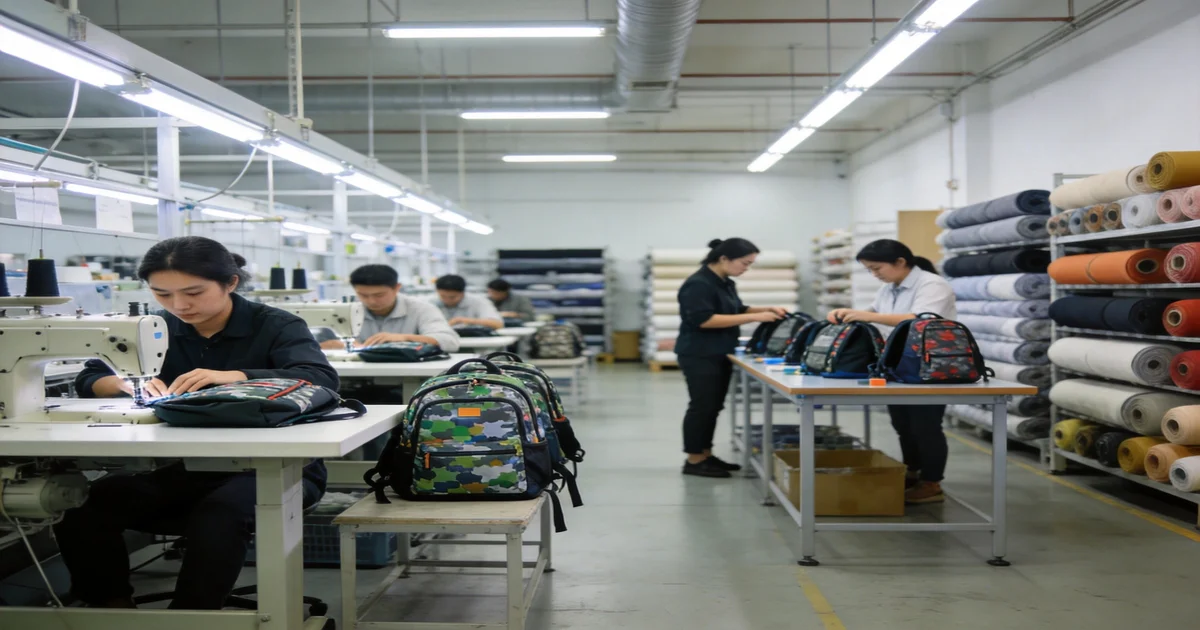
RPET fabrics made from recycled plastic bottles are the most widely adopted sustainable option. A typical backpack uses the equivalent of 15–25 recycled bottles. RPET backpack manufacturing is now available at scale in most Chinese backpack factories, with material costs approaching parity with virgin polyester. Other sustainable options include organic cotton canvas, recycled nylon (ECONYL®), and plant-based alternatives like Piñatex (pineapple leaf fiber) for accent panels.
Production Process Improvements
Forward-looking factories invest in water recycling systems for dyeing processes, solar-powered facilities, laser cutting to reduce fabric waste (typically 8–15% waste rate with manual cutting), and zero-discharge wastewater treatment. When vetting factories, ask specifically about their environmental management practices — BSCI and Sedex audits include environmental criteria.
Packaging & Logistics
Reducing packaging weight and switching to recycled or compostable materials cuts both environmental impact and shipping costs. Some brands eliminate individual poly bags entirely, using recycled tissue paper and cardboard belly bands instead. Flat-pack shipping designs that reduce carton volume by 20–30% lower per-unit freight costs and carbon emissions.
Waterproof & Technical Backpack Manufacturing
Waterproof backpacks represent a growing premium segment, particularly in outdoor, cycling, and urban commuting categories. Manufacturing waterproof backpacks requires specialized materials, construction techniques, and testing protocols.

Waterproof Ratings & Standards
Waterproof backpacks are rated by IP (Ingress Protection) standards or hydrostatic head measurements. IPX4 covers splash resistance; IPX6 handles heavy seas; IPX7 allows temporary submersion. For outdoor use, a hydrostatic head of 5,000–10,000mm is typical for water-resistant packs, while fully waterproof roll-top packs achieve 10,000mm+.
Construction Techniques
Key waterproofing methods include:
- Seam sealing: Taping or welding all needle holes in stitched seams. The most critical step — unsealed seams are the primary water entry point.
- TPU lamination: Thermoplastic polyurethane membrane bonded to fabric interior. Provides waterproof barrier while maintaining some breathability.
- DWR treatment: Durable Water Repellent coating on fabric exterior. Causes water to bead and roll off. Requires reapplication over time.
- Waterproof zippers: YKK AquaGuard or similar coated zippers. Cost $1.50–$4.00 each vs. $0.20–$0.50 for standard zippers.
- RF welding: High-frequency welding replaces stitching for fully waterproof construction. Used in roll-top packs and dry bags. Requires specialized equipment.
Factories specializing in waterproof backpack manufacturing invest in welding equipment, waterproof testing chambers, and hydrostatic head testing machines. When evaluating waterproof backpack manufacturers, verify their testing capabilities and request test reports for previous production runs.
Starting Your Custom Backpack Brand: Step-by-Step
Launching a backpack brand is accessible with the right manufacturing partner. Here is a practical roadmap for entrepreneurs entering the market.

Phase 1: Market Research (Weeks 1–4)
Identify your target customer, price position, and product differentiation. Study competitors on Amazon, REI, or your target retail channel. Define 2–3 key features that distinguish your product.
Phase 2: Design & Sourcing (Weeks 5–12)
Develop your design concept and create tech packs (or select ODM designs). Research and contact 5–10 factories. Request samples from your top 3 choices. Evaluate sample quality, communication responsiveness, and pricing transparency.
Phase 3: Sampling & Approval (Weeks 13–20)
Complete 2–3 sampling rounds. Test prototypes for durability, comfort, and functionality. Consider sending samples to potential customers for feedback. Finalize materials, colors, and branding details.
Phase 4: First Production Run (Weeks 21–32)
Place your first order. For new brands, a practical starting quantity is 500–1,000 units per SKU. Arrange in-line and final inspections. Coordinate shipping (sea freight for cost efficiency; air freight for initial inventory replenishment).
Phase 5: Launch & Iterate (Weeks 33+)
Launch your product through your chosen sales channels. Collect customer feedback actively — monitor reviews, return reasons, and support tickets for patterns. Plan your next product iteration based on real-world usage data. Many successful backpack brands start with 1–2 hero products and expand based on customer demand. Consider A/B testing different colorways or feature variations to optimize conversion rates.
Building a private label backpack brand requires patience — the first 12 months focus on product-market fit and review generation. Brands that reinvest early profits into product improvements and customer service build sustainable competitive advantages over those who chase volume prematurely.
RPET Backpack Manufacturing: Sustainable Materials & Processes
As a leading RPET backpack manufacturer, JUNYUAN Bags is at the forefront of sustainable bag production. Our GRS-certified RPET (Recycled Polyester from PET) fabric is made from post-consumer plastic bottles, diverting waste from landfills while delivering the same durability and performance as virgin polyester. Each RPET backpack we produce saves approximately 20-30 plastic bottles from entering the environment.
Our sustainable backpack manufacturing process covers the entire product lifecycle. The RPET fabric is sourced from certified recycling facilities, dyed using water-saving techniques that reduce water consumption by up to 50%, and assembled in our BSCI-audited factory that maintains strict environmental management practices. We also offer OEKO-TEX Standard 100 certified RPET options, guaranteeing the absence of harmful substances in the finished product.
As a custom laptop backpack factory in China, we combine sustainability with functionality. Our RPET backpacks feature dedicated laptop compartments with 15mm+ EPE foam padding (accommodating laptops up to 17 inches), ergonomic S-curve shoulder straps with breathable mesh, anti-theft hidden pockets, USB charging port pass-throughs, and luggage strap compatibility. Every design element can be customized to your brand’s specifications — from compartment layout to zipper pulls to interior organization systems.
We design and manufacture 200+ backpack styles per year, including an expanding range of RPET options. Our R&D team continuously develops new sustainable constructions, such as seamless knitting technology that reduces material waste by 15% and biodegradable YKK zippers. Current RPET options include 300D, 450D, and 600D weights, all available in custom Pantone-matched colors.
With MOQ from 50 units and 7-day sample turnaround, transitioning to sustainable RPET backpacks is accessible for brands at any scale. We currently manufacture RPET backpacks for eco-conscious brands across Europe, North America, and Asia. Request your RPET backpack sample and see the quality difference.
FAQ
What is the MOQ for custom backpacks?
MOQ varies by factory and product complexity. For OEM (fully custom) backpacks, typical MOQs range from 500 to 1,000 units per style per color. ODM (existing design with custom branding) MOQs can be as low as 200–300 units. Smaller brands should look for factories that offer flexible MOQ strategies for startup brands, such as combining multiple styles into a single order to meet minimum thresholds.
How long does backpack sampling take?
First samples typically take 7–15 working days after the factory receives complete tech packs and materials. Revised samples take 5–10 working days. The full sampling process from initial concept to approved golden sample usually spans 4–8 weeks, depending on design complexity and the number of revision rounds required.
What is the difference between OEM and ODM backpack manufacturing?
OEM means the factory produces your custom design exactly to your specifications. You own the design and intellectual property. ODM means you select from the factory’s existing designs and customize them with your branding and color choices. OEM offers full design control but requires higher development investment. ODM is faster and cheaper to start. Learn more about choosing the right supplier model for your business.
How much does it cost to manufacture a custom backpack?
Unit cost depends on materials, complexity, features, and order quantity. Basic polyester school bags: $3–$7. Mid-range nylon daypacks: $8–$18. Technical hiking backpacks: $18–$45. Premium waterproof or tactical packs: $35–$80+. These are FOB (Free on Board) China port prices. See a detailed manufacturing cost breakdown for specific component pricing.
What materials are best for outdoor backpacks?
The best materials balance durability, weight, and water resistance. For mainstream outdoor packs, 600D–900D nylon with PU coating offers the best value. For premium products, 500D or 1000D Cordura provides exceptional abrasion resistance. For ultralight applications, ripstop nylon or X-Pac laminates reduce weight significantly. Fabric choice should align with your target price point and intended use environment.
How do I find a reliable backpack manufacturer in China?
Start with verified supplier platforms (Alibaba, Global Sources, Made-in-China), trade shows (Canton Fair, Hong Kong Gifts & Premium Fair), or industry referrals. Narrow candidates by checking 10 key criteria for choosing a bag manufacturer, then conduct a thorough factory audit — either in person or through a third-party service like SGS or Bureau Veritas. Request references from current clients and verify production claims with sample orders before committing to large volumes.
Why Choose JUNYUAN as Your Backpack Manufacturing Partner

JUNYUAN has been manufacturing custom backpacks and bags led by a founder with bag industry experience dating from 2004 from our facility in Quanzhou, Fujian — one of China’s largest bag manufacturing clusters. With a founder in the bag industry since 2014 and a company founded in 2014, we serve brands across outdoor, travel, corporate, and promotional segments worldwide.
Our capabilities include both OEM and ODM production, in-house sampling and pattern development, fabric sourcing from certified suppliers, and comprehensive quality control from incoming material inspection through final random inspection. We hold BSCI, ISO 9001, and OEKO-TEX certifications, and our factory is equipped for waterproof construction, RF welding, and custom hardware production.
Whether you are launching your first backpack line or scaling an established brand, our team provides end-to-end support from design consultation through delivery. We work with brands at every stage — from startups placing their first 500-unit order to established companies running 50,000+ unit seasonal programs.
Ready to start your next backpack project?
Contact us for a free quote and production consultation:
Email: [email protected]
WhatsApp: +86 17750020688
Visit our custom backpack manufacturing page to learn more about our factory capabilities, or explore our specialized production lines for waterproof backpacks and travel bags.