
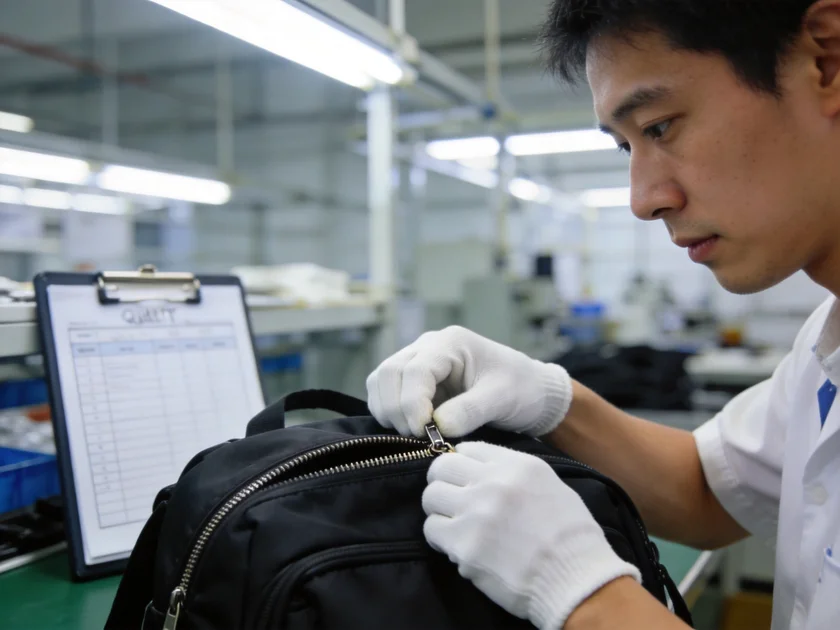
Quality control is the single most important factor determining whether your bulk bag order arrives ready for retail or triggers costly returns, rework, and brand damage. For B2B buyers sourcing bags from overseas manufacturers, understanding quality control frameworks — particularly AQL (Acceptable Quality Level) standards — is essential for protecting your investment and your brand reputation.
At Junyuan Bags, led by a founder with bag industry experience dating from 2004, serving 200+ brands across 100+ countries, quality control is embedded into every stage of our production process. This guide provides a comprehensive overview of bag quality control standards, inspection methodologies, and best practices for B2B procurement professionals.
Understanding AQL Standards for Bag Manufacturing
AQL (Acceptable Quality Level) is an internationally recognized statistical sampling methodology defined in ISO 2859-1 (formerly MIL-STD-105E). It establishes the maximum number of defective units acceptable in a random sample drawn from a production lot.
How AQL works: Instead of inspecting every single unit (which is impractical for large orders), inspectors examine a statistically significant sample. If the number of defects found falls below the AQL threshold, the entire lot passes. If it exceeds the threshold, the lot is rejected or requires 100% rework.
Common AQL levels for bag manufacturing:
• Critical defects (AQL 0): Safety hazards such as broken needles, sharp edges, or toxic materials. Zero tolerance.
• Major defects (AQL 2.5): Functional issues like broken zippers, separated seams, incorrect dimensions, or misaligned hardware. These affect usability and customer satisfaction.
• Minor defects (AQL 4.0): Cosmetic imperfections such as slight color variation, minor stitching irregularities, or small surface marks that don’t affect function.
The sample size depends on your order quantity. For a 1,000-piece order under General Inspection Level II, you’d typically inspect 80 units. For a 5,000-piece order, the sample size increases to 200 units.
The Four Stages of Bag Quality Control
Effective quality control for bulk bag orders isn’t just a final inspection — it’s a continuous process spanning the entire production cycle.
Stage 1: Incoming Material Inspection (IQC)
Before production begins, all incoming materials are inspected: fabric weight (GSM verification), color fastness (crocking test, washing test, light fastness), hardware functionality (zipper cycle testing, buckle tensile strength), and accessory specifications (webbing width, thread count, label accuracy). At our Quanzhou facility, we maintain incoming inspection records for every material batch, providing full traceability.
Stage 2: In-Process Quality Control (IPQC)
During production, trained inspectors monitor key operations at defined checkpoints: cutting accuracy (pattern alignment, margin tolerance), stitching quality (SPI — stitches per inch, seam strength, thread tension), assembly verification (correct panel orientation, pocket placement, lining attachment), and hardware installation (zipper alignment, buckle positioning, rivet security). First article inspection ensures the first units match the approved pre-production sample before full production commences.
Stage 3: Final Random Inspection (FRI)
When 80-100% of the order is packed, a final random inspection is conducted following AQL sampling plans. Inspectors check: appearance (color consistency, surface cleanliness, symmetry), dimensions (measured against tech pack tolerances, typically ±1-2cm), functionality (zipper operation, closure mechanisms, adjustable straps), workmanship (stitching quality, seam strength, edge finishing), packaging (correct poly bags, hang tags, barcodes, carton labeling), and weight verification.
Stage 4: Pre-Shipment Audit
Before containers are sealed, verify: carton quantity matches packing list, shipping marks are correct, container loading follows proper procedures (no moisture, proper stacking, weight distribution), and all required documentation is complete (commercial invoice, packing list, certificate of origin, test reports).
Key Quality Tests for Bag Manufacturing
Beyond visual inspection, several laboratory and mechanical tests are critical for ensuring bag durability and compliance:
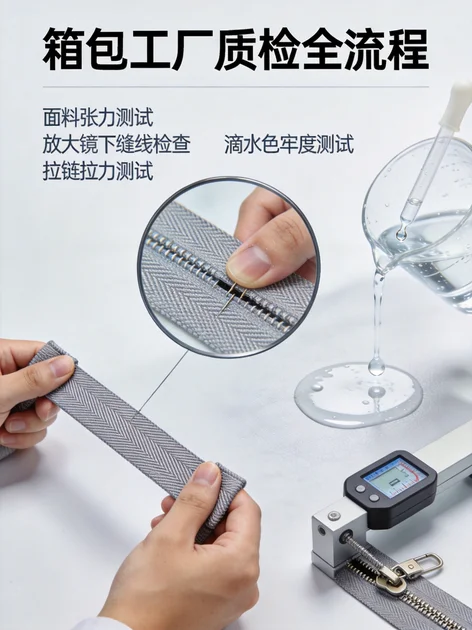
Fabric and Material Tests: Tensile strength testing (fabric breaking force per ASTM D5034), abrasion resistance (Martindale or Taber test), color fastness to washing, rubbing, and light (ISO 105 standards), and water resistance testing (hydrostatic head measurement in mm).
Hardware and Component Tests: Zipper durability (minimum 3,000 open-close cycles for standard zippers, 5,000+ for premium), buckle breakaway strength (load testing per ASTM standards), slider pull-off force, and webbing tensile strength.
Finished Product Tests: Seam strength testing (pull force on load-bearing seams), handle/strap load testing (simulating maximum weight capacity), drop testing (filled bag dropped from specified height), and compression testing (for structured bags and backpacks).
Chemical and Safety Tests: Restricted substance testing per RoHS, REACH, CPSIA (for children’s products), AZO dye testing, formaldehyde content, and heavy metal screening. At Junyuan Bags, all our products comply with RoHS standards, and we can provide test reports upon request.
Building Your Quality Control Checklist
A comprehensive QC checklist ensures nothing is overlooked during inspection. Here are the essential elements:
Pre-Production Checklist: Approved pre-production sample signed by both parties, confirmed tech pack with all specifications, material inspection reports on file, production schedule agreed upon, and QC inspection points defined and communicated.
During Production Checklist: First article inspection completed and approved, in-line inspection records maintained, production photos shared at key milestones, any deviations documented and approved, and mid-production sample sent for buyer approval (for large orders).
Pre-Shipment Checklist: Final inspection report with pass/fail determination, defect photos and categorization, packing list verification, shipping documentation review, and container loading supervision (for full container loads).
Working with Third-Party Inspection Services
For brands that don’t have dedicated quality teams, third-party inspection companies provide professional QC services. Key considerations when engaging a third-party inspector:
Timing: Schedule inspections when production is 80-100% complete. Too early, and you’re inspecting unfinished goods. Too late, and there’s no time for rework if issues are found.
Scope: Clearly define what the inspector should check — visual defects, functional tests, dimension verification, packaging compliance, and AQL sampling plan.
Reporting: Expect a detailed inspection report with defect photos, categorized findings (critical/major/minor), measurement data, and a clear pass/fail recommendation.
Re-inspection: If the initial inspection fails, budget for a re-inspection fee after the factory completes rework. Re-inspection typically costs 70-80% of the original inspection fee.
Common Quality Issues in Bag Manufacturing and How to Prevent Them
Based on our experience manufacturing for 200+ brands, these are the most frequently encountered quality issues:
Color inconsistency between production runs: Prevent by approving lab dips and bulk fabric swatches before production. Use Pantone references for all color specifications.
Zipper malfunction: Specify zipper brand and type in your tech pack (YKK, SBS, or custom). Require zipper cycle testing reports for bulk orders.
Seam failure under load: Specify stitch type (lockstitch vs. chain stitch), SPI requirements, and seam allowance in your tech pack. Conduct seam pull tests during in-process QC.
Dimensional inaccuracy: Provide detailed dimension drawings with tolerance ranges. Verify first article dimensions before allowing full production to proceed.
Packaging errors: Provide exact packaging specifications including poly bag thickness, hang tag design, barcode placement, and carton labeling. Request packaging samples before bulk packing.
Quality Control Documentation You Should Request
Proper documentation protects both buyer and manufacturer. Essential documents include: material test reports (fabric, hardware, accessories), in-process inspection records, final inspection report with AQL results, certificate of compliance (RoHS, REACH, etc.), certificate of origin, and packaging compliance documentation.
At Junyuan Bags, we maintain comprehensive quality documentation for every order and can provide GRS certificates for recycled material products, ISO 9001 quality management system certification, BSCI social compliance audit reports, and RoHS test reports for material compliance.
Frequently Asked Questions About Bag Quality Control
What AQL level should I use for bag inspection?
For most bag orders, we recommend AQL 2.5 for major defects and AQL 4.0 for minor defects under General Inspection Level II. For premium or luxury brands, consider tightening to AQL 1.5 for major defects. Critical defects should always have zero tolerance (AQL 0).
How much does a third-party bag inspection cost?
Third-party inspections typically cost $200-$400 per inspector-day in China. A standard final random inspection for a bag order takes 1 day. Re-inspections cost 70-80% of the original fee. Many manufacturers, including Junyuan Bags, conduct internal QC at no additional charge to the buyer.
What happens if my bag order fails inspection?
If an order fails AQL inspection, the manufacturer must rework or replace defective units until the lot passes re-inspection. The contract should specify who bears rework costs — typically the manufacturer for defects within their control, or the buyer if issues stem from unclear specifications. Build rework time (3-7 days) into your production timeline as a contingency.
How do I verify my manufacturer’s quality certifications?
Request copies of certification documents and verify them through the issuing authority’s database. ISO 9001 certificates can be verified through the certifying body’s website. BSCI reports are accessible through the amfori platform. GRS certificates are verifiable through Textile Exchange. At Junyuan Bags, all our certifications are current and verifiable.
Custom Bag Manufacturing. Led by a founder with bag industry experience dating from 2004
led by a founder with bag industry experience dating from 2004, serving 200+ brands across 100+ countries. Factory-direct OEM/ODM with full certification support.
MOQ 500pcs · Factory Direct · Free Sample Available
Looking for a reliable manufacturing partner? Explore our complete guide to custom backpack manufacturing — covering materials, supplier vetting, quality control, cost analysis, compliance, and branding from JUNYUAN, an OEM/ODM factory led by a founder with bag industry experience dating from 2004.