
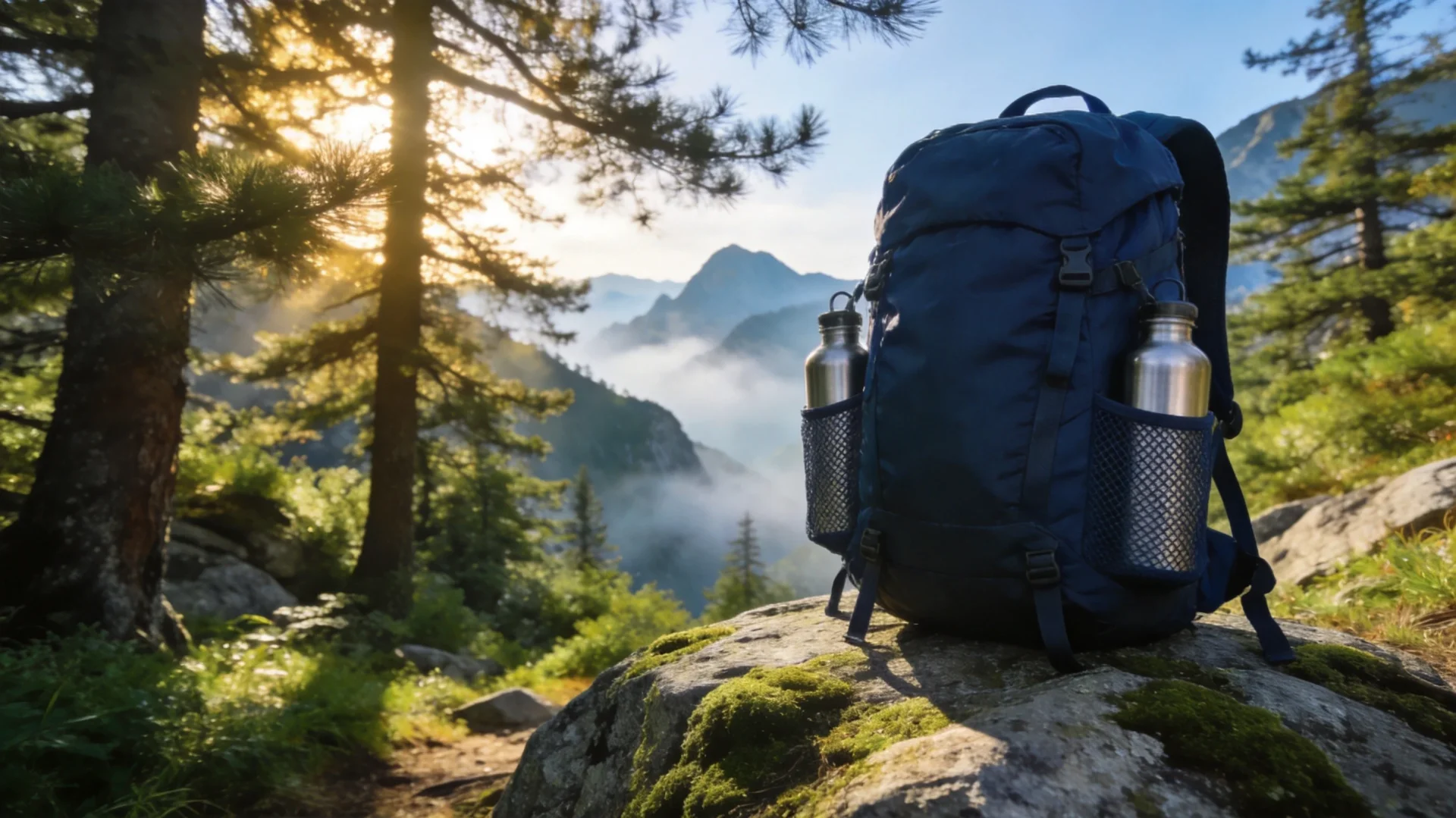
Water Bottle Holder Backpack OEM: Insulated Pockets, Mesh Design & Custom Manufacturing Guide (2026)
Few design features on an outdoor or everyday carry backpack are used more frequently, or designed more poorly, than the water bottle holder. It is the single most interaction-intensive pocket on any pack: accessed dozens of times per day, exposed to condensation, UV degradation, and the mechanical stress of inserting and extracting bottles of varying sizes. For B2B buyers, brand owners, and product developers sourcing backpacks with water bottle holders from OEM manufacturers, understanding the engineering decisions behind this deceptively simple feature is essential to building products that earn five-star reviews rather than return requests.
JUNYUAN Bags, based in Quanzhou, Fujian, China, drawn on over a decade of expertise mastering every component of OEM/ODM bag manufacturing and the water bottle holder is no exception. From stretch mesh pockets on entry-level school packs to triple-insulated hydration systems on premium hiking backpacks, our wholesale factory has produced every configuration imaginable. This guide covers the complete spectrum of water bottle holder design, material science, manufacturing techniques, and OEM customization processes, equipping you with the technical knowledge to spec the perfect solution for your 2026 product line.
Water Bottle Holder Position Design: Side, Front, and Hip Belt Configurations
The placement of a water bottle holder on a backpack is the first and most consequential design decision. Each position offers distinct advantages in terms of accessibility, weight distribution, and target use case. Most commercial backpacks use side-mounted pockets, but innovative brands are exploring alternative positions to differentiate their products and better serve specific user segments.
Side-Mounted Pockets (The Industry Standard)
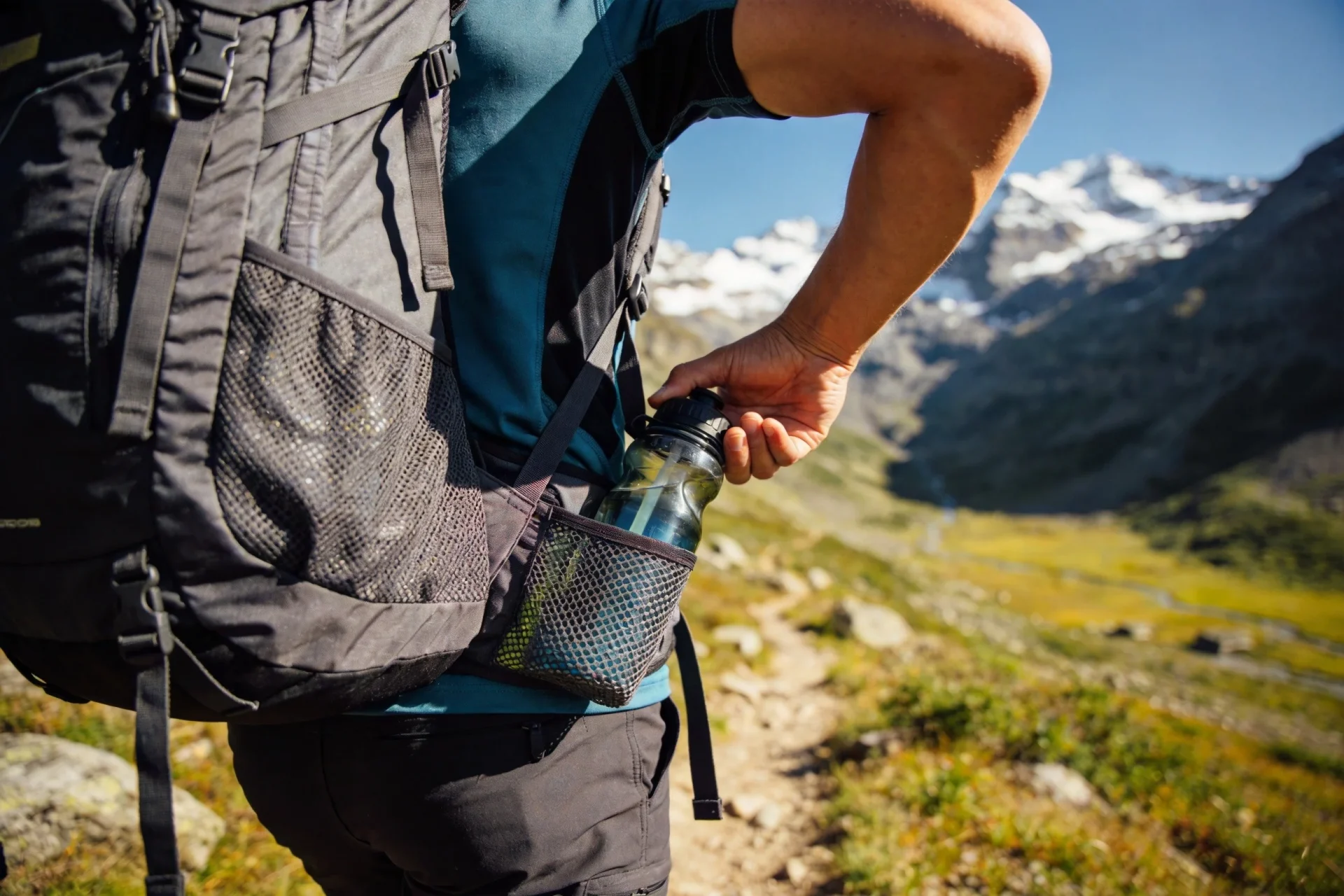
Side-mounted water bottle pockets are the default configuration for good reason: they provide easy one-handed access while the pack is worn, distribute weight symmetrically when used in pairs, and do not interfere with the main compartment opening mechanism. The standard side pocket is positioned between 15cm and 25cm from the base of the pack, angled slightly forward (5 to 10 degrees) to facilitate bottle insertion and extraction without removing the backpack.
For custom bag design projects targeting outdoor and hiking segments, we recommend dual side pockets with differentiated sizing, a larger pocket (accommodating up to 1L Nalgene-style bottles) on the dominant side and a smaller security pocket on the non-dominant side. This approach, seen in premium packs from Osprey and Gregory, provides hydration access without sacrificing storage flexibility.
Front-Facing Pockets
Front-mounted bottle pockets, positioned on the shoulder strap chest panel or the lower front face of the pack, are gaining traction in the running and cycling segments. The advantage is visual monitoring, the user can see their water level at a glance, and front-weight distribution that counterbalances a hydration bladder in the main compartment. However, front pockets reduce usable front-panel real estate for other features and can interfere with chest straps if not carefully positioned.
Hip Belt Pockets
For multi-day hiking and mountaineering packs, hip belt-mounted bottle holders provide access without stopping or removing the pack. These are typically small elasticized pouches integrated into the hip belt wings, designed to hold 350 to 500ml bottles or soft flasks. The engineering challenge is maintaining hip belt comfort and load transfer function while adding a pocket that must resist bounce during dynamic movement. JUNYUAN engineering team has developed a compression-molded EVA hip belt pocket that integrates seamlessly with our load-bearing hip belt structures.
Insulation Technology: Neoprene, Thermal Foil, and Double-Layer Mesh Systems
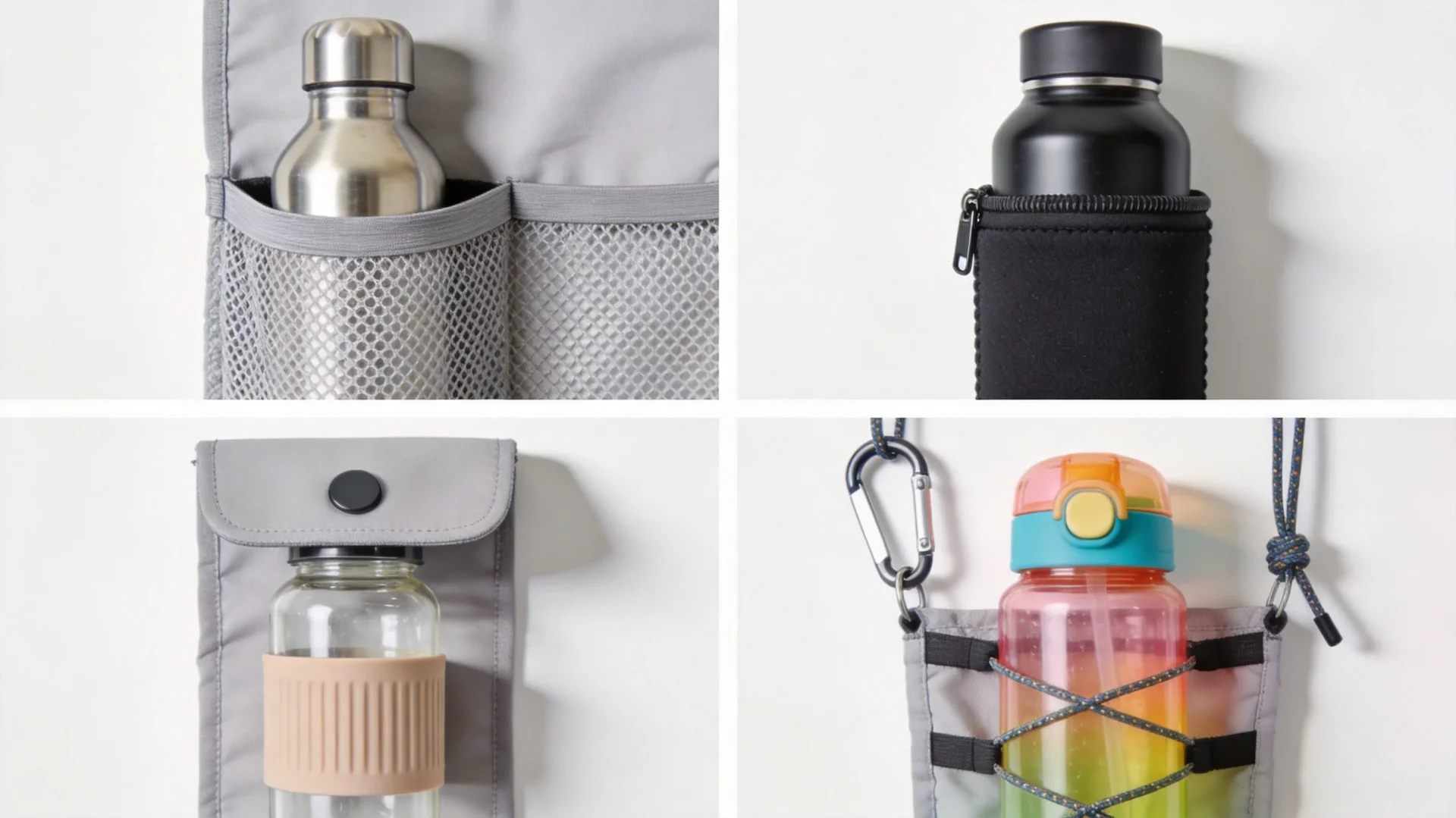
For brands targeting the outdoor, fitness, and commuter segments, insulated water bottle pockets are becoming a key differentiator. An insulated pocket keeps beverages cold for hours, prevents exterior condensation from soaking the backpack contents, and signals premium quality to the buyer. Let us examine the three dominant insulation approaches used in OEM manufacturing.
Neoprene (Chloroprene Rubber) Lining
Neoprene is the gold standard for insulated water bottle pockets. At 3 to 5mm thickness, closed-cell neoprene provides an R-value of approximately 0.5 to 0.8, keeping a cold bottle 8 to 12 degrees cooler than ambient for 4 to 6 hours. The material is inherently water-resistant, preventing condensation from reaching the outer shell fabric. Neoprene-lined pockets also provide excellent bottle grip, preventing slippage even when the bottle is wet. The cost impact is approximately $0.60 to $1.20 per pocket, making it suitable for mid-to-premium product lines ($50+ retail). For brands exploring material options further, our backpack material selection guide covers the full range of performance fabrics.
Aluminum Thermal Reflective Lining
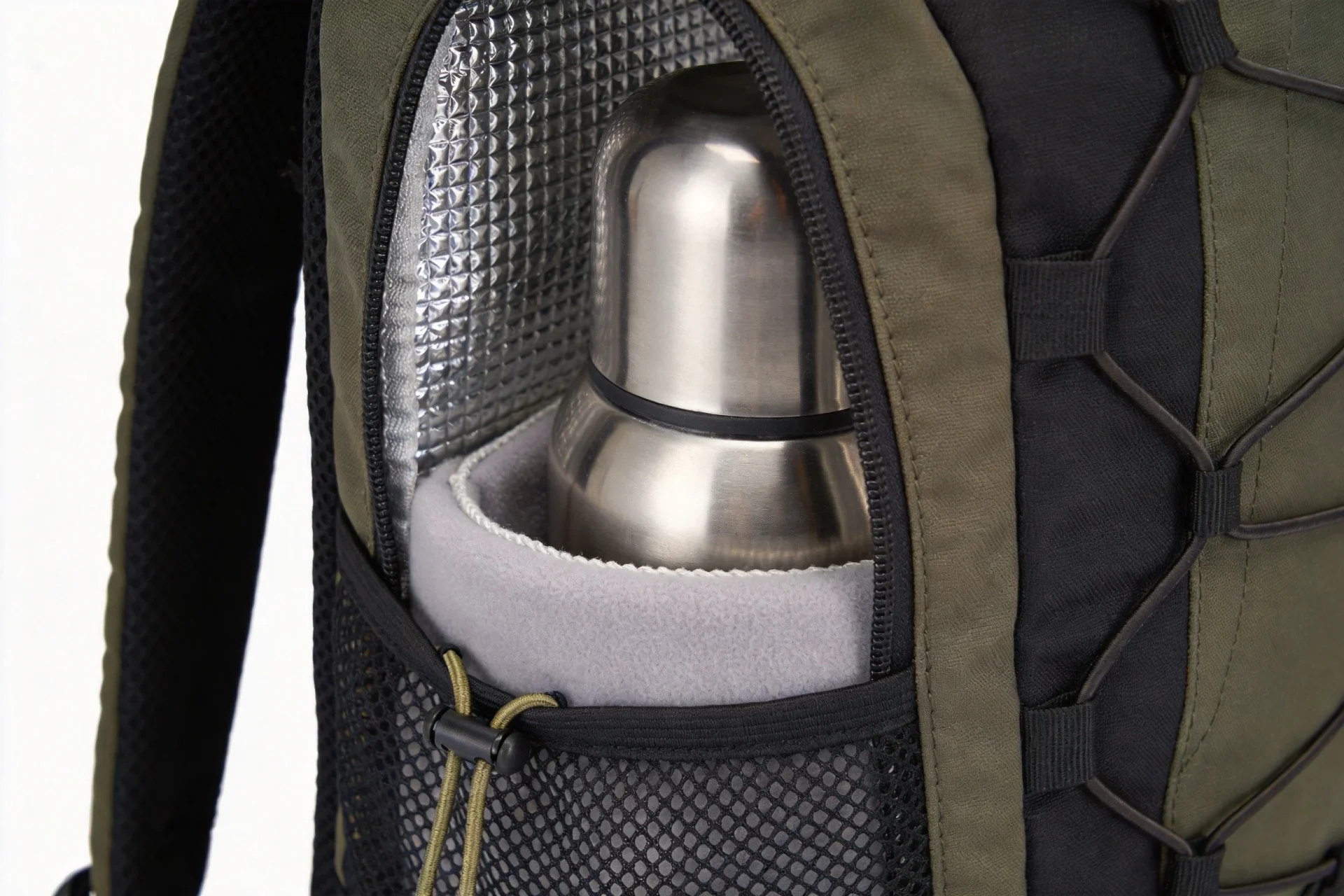
For budget-conscious product lines, aluminum-foil laminated fabric offers a cost-effective insulation alternative. The thin metallic layer reflects radiant heat, reducing temperature transfer by approximately 30 to 40% compared to uninsulated pockets. While less effective than neoprene for sustained temperature retention (2 to 3 hours of meaningful cooling vs. 4 to 6 hours), aluminum-lined pockets are 50% lighter and add only $0.20 to $0.40 to unit cost. They are commonly paired with polyester shell fabrics in value-oriented outdoor and school backpack lines.
Double-Layer Mesh with Air Gap
The most innovative approach to bottle pocket insulation uses a double-layer mesh construction with a sealed air gap between the inner and outer mesh walls. The trapped air acts as a natural insulator, while the mesh construction ensures rapid drying and breathability. This design adds almost no weight (under 15g per pocket) and minimal cost ($0.15 to $0.30), making it ideal for lightweight hiking and trail running backpacks where every gram matters. For brands focused on weight optimization, pairing this with sustainable lightweight materials creates a compelling eco-performance narrative.
| Insulation Type | Temperature Retention | Weight per Pocket | Cost Impact | Best Application |
|---|---|---|---|---|
| Neoprene 3mm | 4-6 hours (8-12F delta) | 40-60g | +$0.60-$1.20 | Premium outdoor, commuter |
| Aluminum Foil Laminate | 2-3 hours (5-8F delta) | 15-25g | +$0.20-$0.40 | Value outdoor, school |
| Double-Layer Mesh Air Gap | 1-2 hours (3-5F delta) | 8-15g | +$0.15-$0.30 | Ultralight hiking, running |
Pocket Opening Mechanisms: Elastic Mesh, Drawcord, and Magnetic Closures Compared
The opening mechanism of a water bottle pocket determines how easily users can insert and extract bottles, how securely bottles are retained during movement, and how well the pocket accommodates different bottle sizes. Choosing the right mechanism is critical for user satisfaction.
Full-Stretch Mesh Pockets
The most common pocket type uses a single layer of elasticized mesh fabric stretched over a frame sewn into the backpack side panel. The mesh stretches to accommodate bottles of varying diameters and snaps back to grip the bottle when released. This design is simple, lightweight, and inexpensive to manufacture. However, mesh degrades over time, especially when exposed to UV, chlorine from sports drinks, and repeated abrasion from stainless steel bottles.
Elastic Drawcord (Bungee) Closure
A drawcord or bungee closure uses a length of elastic cord with a cord lock at the top of the pocket, allowing the user to cinch the opening around the bottle neck for secure retention. This design excels in high-movement scenarios (trail running, cycling, scrambling) where bottles might otherwise bounce out. The trade-off is slightly slower access, two hands are needed to open the cord lock and extract the bottle. Drawcord closures pair well with waterproof fabric technology in premium hiking applications.
Magnetic Flap Closure
The most innovative closing mechanism uses embedded magnets in a fabric flap that folds over the bottle opening. When a bottle is inserted, the flap parts around it; when removed, the magnets snap the flap closed. This provides a clean aesthetic, one-handed operation, and excellent debris protection. JUNYUAN uses N35-grade neodymium magnets with silicone-coated housing to prevent corrosion. For more on hardware innovation, see our custom hardware and branding guide.
| Mechanism | Access Speed | Retention Security | Durability | Cost Impact |
|---|---|---|---|---|
| Full-Stretch Mesh | Excellent (one-hand) | Good | Moderate (2-3 years) | +$0.10-$0.30 |
| Elastic Drawcord | Moderate (two-hand) | Excellent | High (3-5 years) | +$0.25-$0.50 |
| Magnetic Flap | Good (one-hand) | Very Good | High (5+ years) | +$0.80-$1.50 |
Bottle Diameter Compatibility: Designing for 350ml to 1.5L
The global water bottle market offers an enormous range of bottle diameters, from slim 60mm fitness bottles to wide-mouth 89mm Nalgene containers to oversized 95mm HydroFlask vessels. A well-designed pocket must accommodate the bottle sizes most commonly used by its target demographic without being so loose that smaller bottles rattle around or so tight that larger bottles cannot be inserted.
Diameter Specifications by Bottle Category
| Bottle Type | Typical Volume | Outer Diameter | Pocket Min Diameter |
|---|---|---|---|
| Smartwater / Fitness | 500-700ml | 60-65mm | 65mm (stretched) |
| Standard Sports Bottle | 750ml | 70-75mm | 75mm (stretched) |
| Nalgene Wide-Mouth | 1L (32oz) | 89mm | 90mm (stretched) |
| HydroFlask Wide | 32oz / 40oz | 89-93mm | 95mm (stretched) |
| Insulated Growler | 1.5L (64oz) | 95-105mm | 110mm (stretched) |
Elasticity Recovery and Long-Term Performance
The critical specification for any stretch pocket is not initial elasticity, it is elasticity recovery after repeated use. A pocket that stretches easily on day one but becomes loose and baggy after 200 insertions will generate negative reviews regardless of how well it performed initially. JUNYUAN specifies mesh fabrics with a minimum 85% elasticity recovery rate after 1,000 stretch cycles (tested at 120% extension). Our quality control framework includes random sampling of production units for elasticity testing, ensuring consistent performance across every bulk order.
Drainage and Leak-Proof Design Considerations
Condensation from cold bottles, accidental cap failures, and rain exposure all introduce water into bottle pockets. How that water is managed, whether it drains freely or is contained, is a design decision that significantly impacts user satisfaction and the longevity of the backpack.
Drainage Hole Design
Most mesh bottle pockets drain naturally through the mesh fabric itself. However, pockets with waterproof or insulated linings require dedicated drainage features. The standard approach is a pair of 5mm grommets at the base of the pocket, positioned at the lowest point when the backpack is worn. These grommets allow accumulated water to escape while being small enough to prevent bottle bases from pushing through. For products targeting the waterproof backpack segment, drainage design must be balanced against overall water resistance goals. See our waterproof zippers and seams engineering guide.
Leak-Proof Pocket Systems
Premium designs for commuter and tech-carry backpacks use a fully sealed pocket system with a welded TPU lining and a one-way drain valve. Condensation collects in the pocket liner and is periodically released through the valve when the user presses the pocket base. This approach protects laptops and electronics in adjacent compartments from water damage, a critical feature for the urban commuter segment that represents the fastest-growing buyer demographic in 2026.
Impact on Backpack Balance and Ergonomics
Water is heavy. One liter weighs exactly 1 kilogram. Two filled 1L bottles add 2kg of weight to the sides of a backpack, creating lateral load that affects balance, especially during dynamic movement. This is not merely a comfort issue; improper weight distribution can cause the backpack to pull asymmetrically on the spine, leading to discomfort during extended wear.
Center of Gravity Management
The key engineering principle is keeping bottle weight as close to the wearer back as possible. This means the pocket should be positioned with its center no more than 8 to 10cm from the back panel surface. Pockets that protrude further create a larger moment arm, amplifying the perceived weight and causing the pack to pull sideways. JUNYUAN ergonomic design team uses 3D body scanning data to optimize pocket position relative to the wearer center of gravity.
Compression Strap Integration
For hiking and mountaineering packs, compression straps that pass over the bottle pockets serve dual purposes: they secure the bottle in the pocket during high-movement scenarios, and they compress the loaded bottle toward the pack body, reducing the lateral moment arm. This is a simple but highly effective engineering solution that adds minimal cost ($0.30 to $0.50 for two webbing compression straps with buckles) while significantly improving loaded stability. This attention to detail reflects the kind of engineering excellence covered in our guide to choosing the right bag manufacturer.
Multi-Bottle Holder Systems: Hiking, Running, and Cycling Configurations
Different activities demand fundamentally different hydration access solutions. Forward-thinking brands are developing activity-specific bottle holder systems rather than relying on a single universal design.
Hiking Backpack Systems
Multi-day hiking packs typically feature dual side mesh pockets (for 1L bottles), a rear hydration sleeve (for 2 to 3L bladder), and optionally hip belt pockets (for 500ml soft flasks). This triple-system approach provides redundancy. For brands developing hiking-specific packs, consider our expertise in protective padding systems that can be integrated alongside hydration storage.
Trail Running Vest and Pack Systems
Trail running vests prioritize front-mounted soft flask pockets (typically two 500ml flasks in chest pockets) plus a rear bladder sleeve. Side pockets are eliminated to reduce weight and prevent chafing during running motion. The pocket design focuses on compression-fit soft flask holders that prevent bounce while allowing one-handed extraction.
Cycling Backpack Systems
Cycling backpacks face a unique constraint: the rider back is horizontal, making traditional side pockets inaccessible. Solutions include a lower side pocket accessible only when stopped, a hip belt pocket positioned for access while in riding posture, or integration with the bike frame bottle cage mounts. This system design thinking reflects the broader trend toward user-preference-driven bag design reshaping the industry.
OEM Custom Manufacturing: Tooling, Processes, and Quality Control
Manufacturing a high-quality water bottle holder pocket involves more than simply sewing a piece of mesh onto a backpack side panel. The process requires attention to material preparation, precision cutting, edge finishing, and multi-step assembly.
Mesh Cutting and Edge Binding
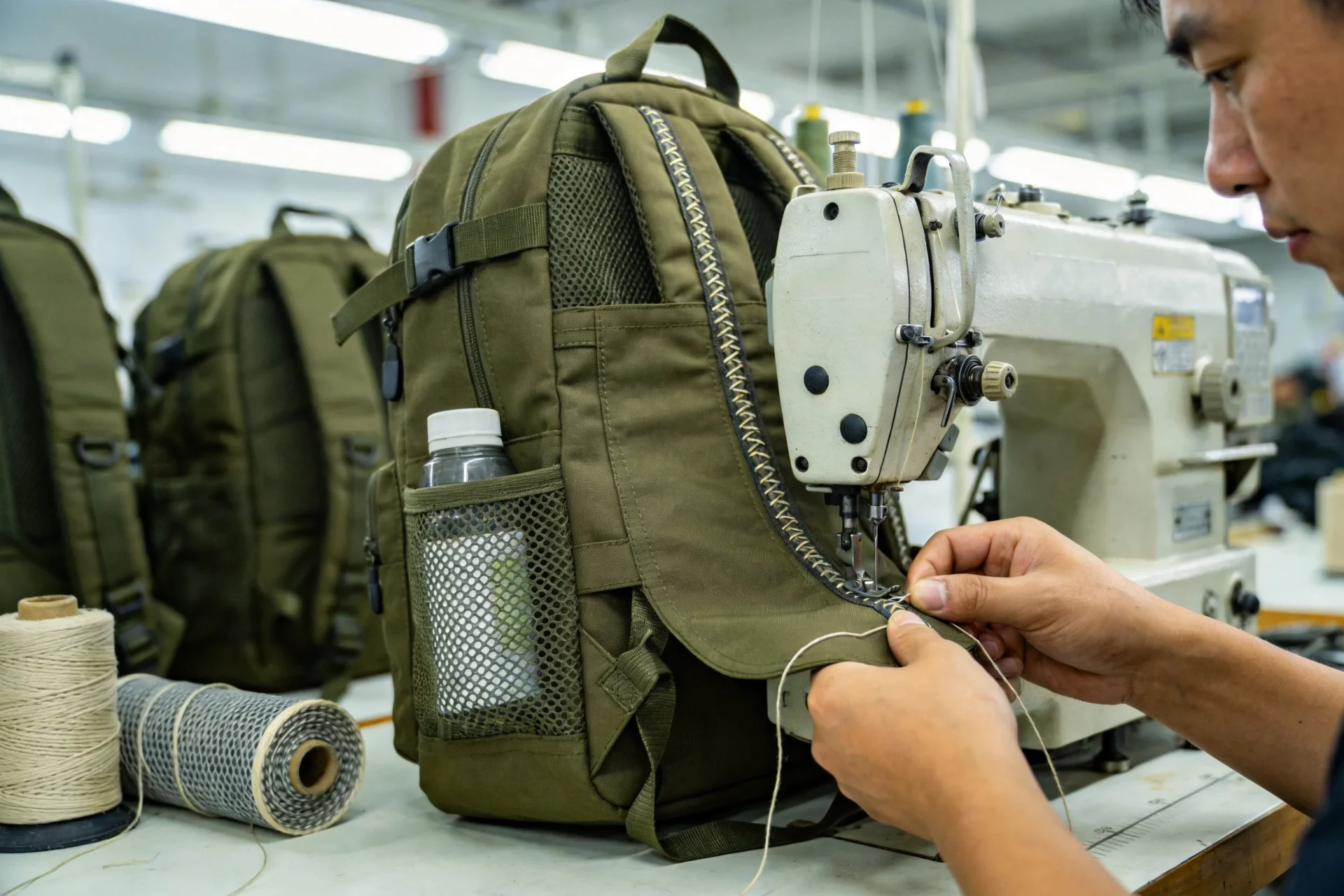
Elastic mesh fabric must be cut with precision laser or ultrasonic cutters to prevent edge fraying that would compromise elasticity over time. At JUNYUAN, we use ultrasonic cutting for all bottle pocket mesh components. This seals the edge as it cuts, eliminating the need for additional edge binding and reducing assembly time by approximately 30%. Our commitment to efficient OEM/ODM production models ensures competitive pricing without quality compromise.
Attachment Reinforcement
The seam where the pocket attaches to the backpack side panel is a high-stress location. JUNYUAN specifies a double-needle lockstitch seam with 10 stitches per centimeter, reinforced at the top and bottom with bar-tack stitching. For heavy-duty applications, we add an internal webbing tape behind the seam for additional tear resistance.
Molded Pocket Components
For premium product lines, injection-molded or thermoformed pocket frames provide a rigid structure that maintains pocket shape regardless of whether a bottle is inserted. The mold cost ($800 to $2,000 per size) is a one-time investment amortized across the production run. JUNYUAN offers a library of existing mold designs that clients can use at no additional tooling cost. Our manufacturing cost breakdown guide provides detailed pricing transparency for these investments.
2026 Outdoor Water Bottle Backpack Market Trends
The intersection of hydration technology, sustainability mandates, and shifting consumer preferences is creating several key trends for OEM buyers to factor into their 2026 product development decisions.
Self-Cleaning Pocket Linings
Antimicrobial pocket linings treated with silver-ion or zinc-oxide nanoparticles prevent the growth of odor-causing bacteria in the pocket. This is a common complaint when bottles leak or when pockets remain damp between uses. The treatment adds approximately $0.40 to $0.70 per pocket. For brands interested in antimicrobial features, our guide to antimicrobial materials for sports bags provides detailed technical comparisons.
RPET and Sustainable Pocket Materials
Recycled polyester mesh made from post-consumer PET bottles is increasingly specified for water bottle pockets. Brands targeting eco-conscious consumers can leverage RPET pockets as part of a broader sustainability narrative. JUNYUAN experience in RPET backpack manufacturing ensures sustainable pocket options meet the same performance standards as conventional materials.
Modular and Replaceable Pocket Systems
A growing number of brands offer backpacks with user-replaceable bottle pockets. When the mesh wears out, the user can purchase a replacement pocket that snaps or zips into the same mounting points. This extends the backpack usable life, reduces waste, and creates a recurring revenue stream for the brand. JUNYUAN has solved the standardized mounting interface challenge through a proprietary rail-and-channel attachment system.
Temperature-Indicator Pockets
A novel innovation for 2026 is the integration of thermochromic fabric patches on bottle pockets that change color when the pocket interior drops below a certain temperature, giving the user a visual cue about their water temperature. While currently limited to premium lines, the technology is advancing rapidly and may become mainstream within 2 to 3 years. Brands building a complete product ecosystem can explore how this integrates with broader luxury features for custom travel bags.
Why JUNYUAN for Your Water Bottle Holder Backpack OEM Project
Designing and manufacturing backpacks with exceptional water bottle holders requires a manufacturer that understands the intersection of material science, ergonomic design, and production efficiency. JUNYUAN Bags brings all three competencies together under one roof in our Quanzhou, Fujian facility.
Our expertise dating from 2004 in OEM/ODM experience spans every segment that uses bottle holders, from school and commuter packs to technical hiking and cycling backpacks. We maintain an in-house material testing lab that evaluates every mesh roll for elasticity retention, every neoprene batch for thermal performance, and every seam assembly for pull-out strength. Our factory audit readiness and international compliance certifications ensure smooth market entry across the US, EU, UK, Australia, and Japan.
With a MOQ of just 500 pieces per design, JUNYUAN serves both established outdoor brands expanding their hydration offerings and emerging DTC brands launching their first backpack collection. Whether you need a simple mesh pocket for a value-packed Amazon launch or a triple-insulated magnetic-closure hydration system for a premium brand flagship, our team is ready to engineer the solution. Visit our private label backpack brand guide for insights on building a complete product line from concept to market. Our facility near strategic shipping hubs ensures efficient FOB Xiamen logistics for global distribution.
Frequently Asked Questions
What is the most durable water bottle pocket material for outdoor backpacks?
For maximum durability, we recommend 420D high-elastic polyester mesh with reinforced edge binding and bar-tack stitching at all stress points. This combination withstands 3 to 5 years of daily use with less than 10% elasticity loss. For premium lines, adding a neoprene inner lining further extends pocket life while providing insulation.
How much does an insulated water bottle pocket add to backpack manufacturing cost?
Depending on the insulation type chosen, an insulated pocket adds $0.35 to $1.50 per pocket to manufacturing cost. Aluminum foil lining is the most cost-effective option (+$0.20 to $0.40), while neoprene lining represents the premium option (+$0.60 to $1.20). The insulation typically adds 15 to 60g of weight per pocket.
Can the water bottle pocket be customized with our brand logo?
Yes. Bottle pockets offer several branding options: embroidered logos on the pocket face, woven labels sewn into the pocket seam, custom zipper pulls, or custom-shaped mesh patterns that incorporate your brand icon. See our custom branding guide for comprehensive options.
What bottle sizes should a universal backpack pocket accommodate?
A well-designed universal pocket should accommodate bottles from 60mm diameter (slim fitness bottles, 500ml) to 93mm diameter (HydroFlask wide-mouth, 32oz). Specify a pocket opening of 90mm with mesh stretch capacity to 110mm to cover 94% of popular bottles in the market.
How does JUNYUAN ensure water bottle pocket quality in bulk production?
Every production batch undergoes our AQL inspection framework with specific checkpoints for pocket elasticity, seam strength, and drainage function. We also conduct accelerated aging tests that simulate 2 years of daily use in a compressed timeframe.
What is the MOQ for custom water bottle holder backpacks?
Our MOQ is 500 pieces per color per design. This applies to both OEM (your design, our manufacturing) and ODM (our designs, your branding) models. For first-time customers, we offer flexible trial order terms to support market testing before full-scale production.
Ready to Engineer the Perfect Water Bottle Holder Backpack?
Partner with JUNYUAN Bags, expertise dating from 2004 in OEM/ODM excellence from Quanzhou, China. From mesh pockets to triple-insulated hydration systems, we deliver bottle holder solutions that win customer loyalty.