
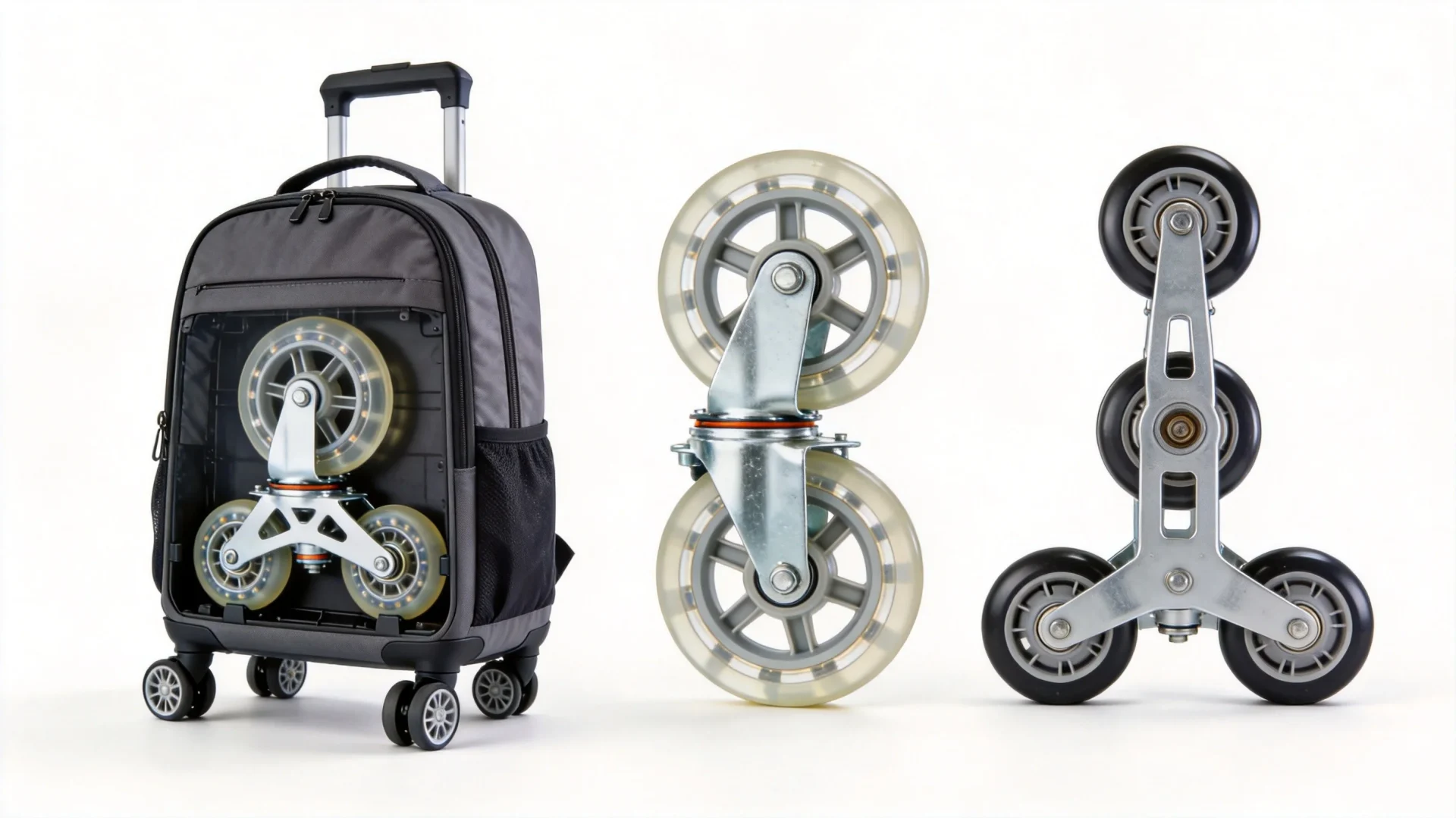
Rolling Backpack Manufacturing: Wheel Systems, Telescoping Handles & OEM Production Guide (2026)
The rolling backpack sits at the intersection of traditional backpack ergonomics and hard-shell luggage engineering. Unlike standard carry bags, a rolling backpack must accommodate wheel assemblies, telescoping handle mechanisms, reinforced base plates, and rigid frame structures — all while staying within a target weight of 2.5–4 kg. For B2B buyers sourcing from OEM manufacturers in Quanzhou, Fujian, understanding these engineering requirements is critical before placing bulk orders.
At JUNYUAN Bags, we drawn on over a decade of expertise mastering the manufacturing complexities of hybrid carry systems. From our factory near FOB Xiamen port, we produce rolling backpacks for business travel brands, airline crew suppliers, school bag companies, and mobility-assist device manufacturers worldwide. This guide covers every manufacturing decision you will face when developing a rolling backpack product line.
What Is a Rolling Backpack? (Quick Guide for 2026)
A rolling backpack is a hybrid bag that combines the storage and carrying comfort of a traditional backpack with the convenience of wheels and a telescoping handle. When you need to move fast on uneven terrain, you wear it like a backpack. When you’re navigating smooth surfaces — airports, train stations, city sidewalks — you extend the handle and roll it effortlessly.
As a manufacturer that has produced rolling backpacks for 200+ brands since 2014, we’ve identified the key factors that determine rolling backpack quality:
- Wheel system: Inline skate wheels (best for smooth surfaces) vs. spinner wheels (360° multi-directional)
- Frame material: Aluminum (premium), ABS (mid-range), or polycarbonate (hard shell)
- Handle system: 2-stage telescoping handles are standard; 3-stage for taller users
- Dual-mode carry: Wheels + backpack straps + top handle for maximum versatility
- Capacity: 25-35L for daily use, 35-45L for travel, 45L+ for extended trips
| Rolling Backpack Type | Best For | Typical Price | Key Feature |
|---|---|---|---|
| Business Travel | Airport/city travel, laptop carry | $80–$250 | Laptop compartment, sleek design, inline wheels |
| Student/School | Daily school use, campus carry | $40–$120 | Book organization, durable fabric, medium wheels |
| Outdoor/Travel | Multi-day trips, adventure travel | $100–$300 | Large capacity, rugged wheels, weather-resistant |
| Mobility/Elderly | Seniors, medical equipment transport | $50–$150 | Lightweight, easy-access, stable base |
| Kids | Elementary school, lightweight carry | $30–$80 | Small size, fun designs, easy-grip handle |
Pro tip from a manufacturer: The wheel quality is the #1 differentiator. Cheaper rolling backpacks use 50mm plastic wheels that crack after 6 months. Premium models use 75-80mm inline skate wheels with ABEC-7 bearings that last 3-5 years. Always check wheel size and bearing quality before purchasing.
1. Wheel System Engineering: The Foundation of Rolling Performance
The wheel system is the single most important differentiator between a quality rolling backpack and one that generates warranty claims. At JUNYUAN, we engineer two primary wheel configurations, each with distinct manufacturing requirements and target use cases.
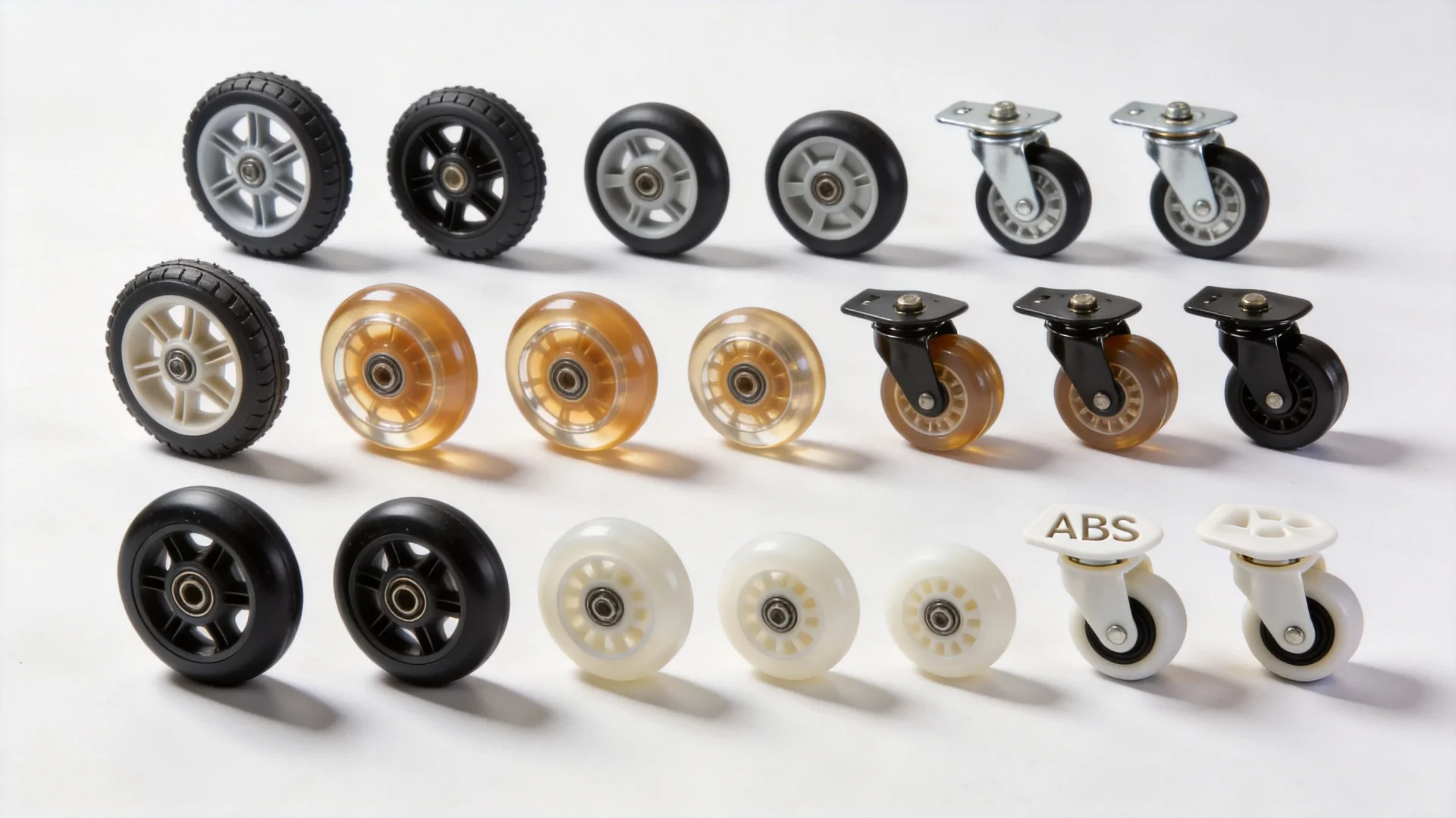
1.1 Inline Skate Wheels (Single-Row Configuration)
Inline skate wheels mount two or three wheels in a straight line along the bottom edge of the bag, similar to inline skates. This configuration excels on smooth surfaces — airport terminals, hotel lobbies, and paved pathways. The key manufacturing specifications include:
- Wheel diameter: 60mm–80mm (larger rolls over thresholds more easily)
- Bearing type: 608ZZ sealed bearings (standard) or 608RS rubber-sealed (premium)
- Axle material: Stainless steel 304, M8 thread
- Wheel material: Polyurethane (PU) 85A–95A hardness for optimal roll-resistance and noise reduction
- Mounting: Through-bolt with nylock nut, reinforced with ABS injection-molded wheel housing
Inline wheels add approximately 180–250g to total bag weight but provide superior straight-line stability. They are the preferred choice for lightweight travel bag designs targeting frequent flyers.
1.2 Spinner Wheels (360° Multi-Directional Configuration)
Spinner wheels use four twin-wheel assemblies mounted at the four corners of the bag base, each rotating 360 degrees independently. This allows the bag to move laterally, spin in place, and navigate tight spaces with minimal effort.
| Specification | Inline Skate | Spinner (4x 360°) |
|---|---|---|
| Mobility direction | 2 (forward/back) | 360° omnidirectional |
| Weight addition | 180–250g | 320–480g |
| Terrain performance | Smooth surfaces only | Smooth + light uneven |
| Tipping resistance | High (must tilt to roll) | Moderate (upright rolling) |
| Mold tooling cost | $1,200–$2,500 | $3,000–$5,500 |
| Failure rate (2-yr avg) | <2% | 3–5% (more moving parts) |
| Ideal segment | Business travel, airline crew | Student, elderly, urban commute |
Spinner wheel housings require precision injection molding with glass-filled nylon (PA66-GF30) to withstand lateral stress. At JUNYUAN’s wholesale factory, we use CNC-machined aluminum molds with ±0.05mm tolerance for wheel housing components, ensuring consistent fit across production runs of 5,000+ units.
1.3 Wheel Material Selection Guide
The wheel material directly impacts noise level, floor marking, grip, and durability. Here is our material comparison for OEM buyers:
- Thermoplastic Rubber (TPR): Economical, quiet, good grip on tile/marble. Shore A 70–80. Best for indoor-focused products. Cost: $0.40–$0.80/pair.
- Polyurethane (PU): Premium choice. Excellent abrasion resistance, no floor marking, handles outdoor transitions. Shore A 85–95. Cost: $0.90–$1.80/pair.
- ABS Plastic: Ultra-budget option for promotional products. Prone to cracking on impacts below -5°C. Cost: $0.15–$0.30/pair.
- Rubber-Coated PU: Hybrid solution with soft rubber tread over PU core. Quietest option, ideal for hospital and hotel segments. Cost: $1.20–$2.50/pair.
2. Telescoping Handle Design: Materials, Stages & Load Engineering
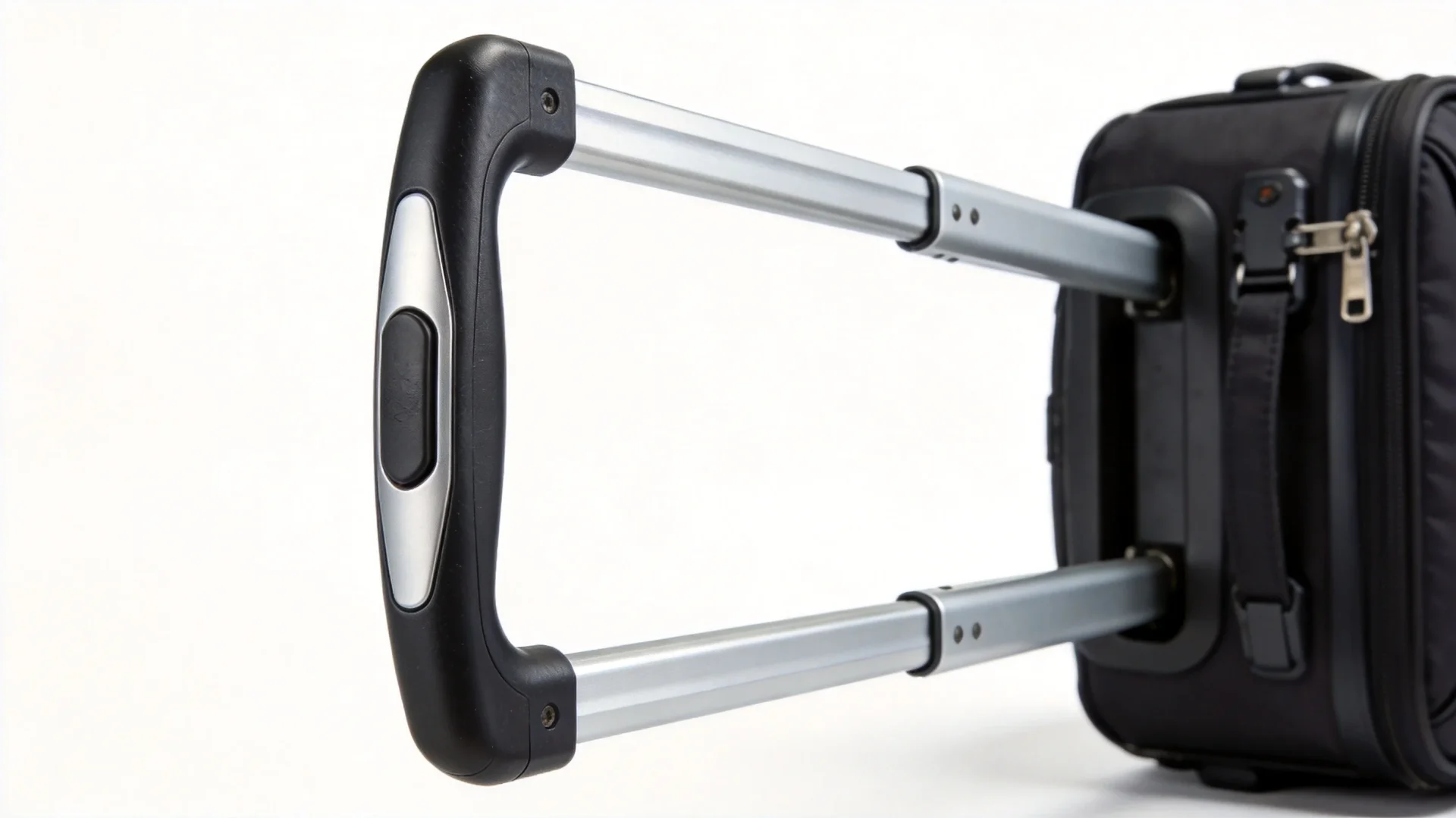
The telescoping handle converts a rolling backpack from pull-mode to upright standing. Its design involves balancing extension height, weight, structural rigidity, and manufacturing cost. This is one area where material selection expertise pays enormous dividends in product quality.
2.1 Handle Tube Materials
| Material | Weight (per tube set) | Max Load | Corrosion | Cost |
|---|---|---|---|---|
| 6061 Aluminum Alloy | 280–350g | 15 kg | Anodized surface | $3.50–$6.00 |
| Carbon Fiber Composite | 150–200g | 10 kg | Inert | $18.00–$35.00 |
| Stainless Steel 304 | 420–500g | 25 kg | None | $5.00–$9.00 |
| Reinforced Nylon (PA66-GF50) | 180–220g | 8 kg | None | $2.00–$3.50 |
For most custom bag designs targeting mid-market segments, 6061 aluminum alloy with T6 temper offers the best cost-to-performance ratio. The tubes are drawn to 22mm outer diameter (OD) for the outer section and 18mm OD for the inner sliding section, with a wall thickness of 1.2mm.
2.2 Stage Configuration (Extension Levels)
- 2-stage: Collapsed length ~38cm, extended height ~85cm. Most compact. Ideal for carry-on compliance. Adds ~250g.
- 3-stage: Collapsed length ~32cm, extended height ~100cm. Accommodates taller users (up to 190cm). Adds ~350g.
- 4-stage: Collapsed length ~28cm, extended height ~108cm. Maximum adjustability. Used in premium and airline crew models. Adds ~420g.
Each additional stage adds approximately $1.50–$2.50 in component cost and 80–120g in weight. The push-button release mechanism requires a separate spring assembly (typically stainless steel compression springs, 15N force rating) and a machined aluminum release collar.
2.3 Ergonomic Grip Design
The top grip should follow human factors standards: 120–140mm grip width, 25–30mm diameter, with TPE (thermoplastic elastomer) overmolding for comfort. The grip angle should be set at 15° backward tilt to align with natural wrist position during pulling. At JUNYUAN, we design grips using digital pattern creation tools to optimize ergonomics before committing to injection molds.
3. Frame & Shell Construction: Rigid vs. Semi-Rigid Architectures
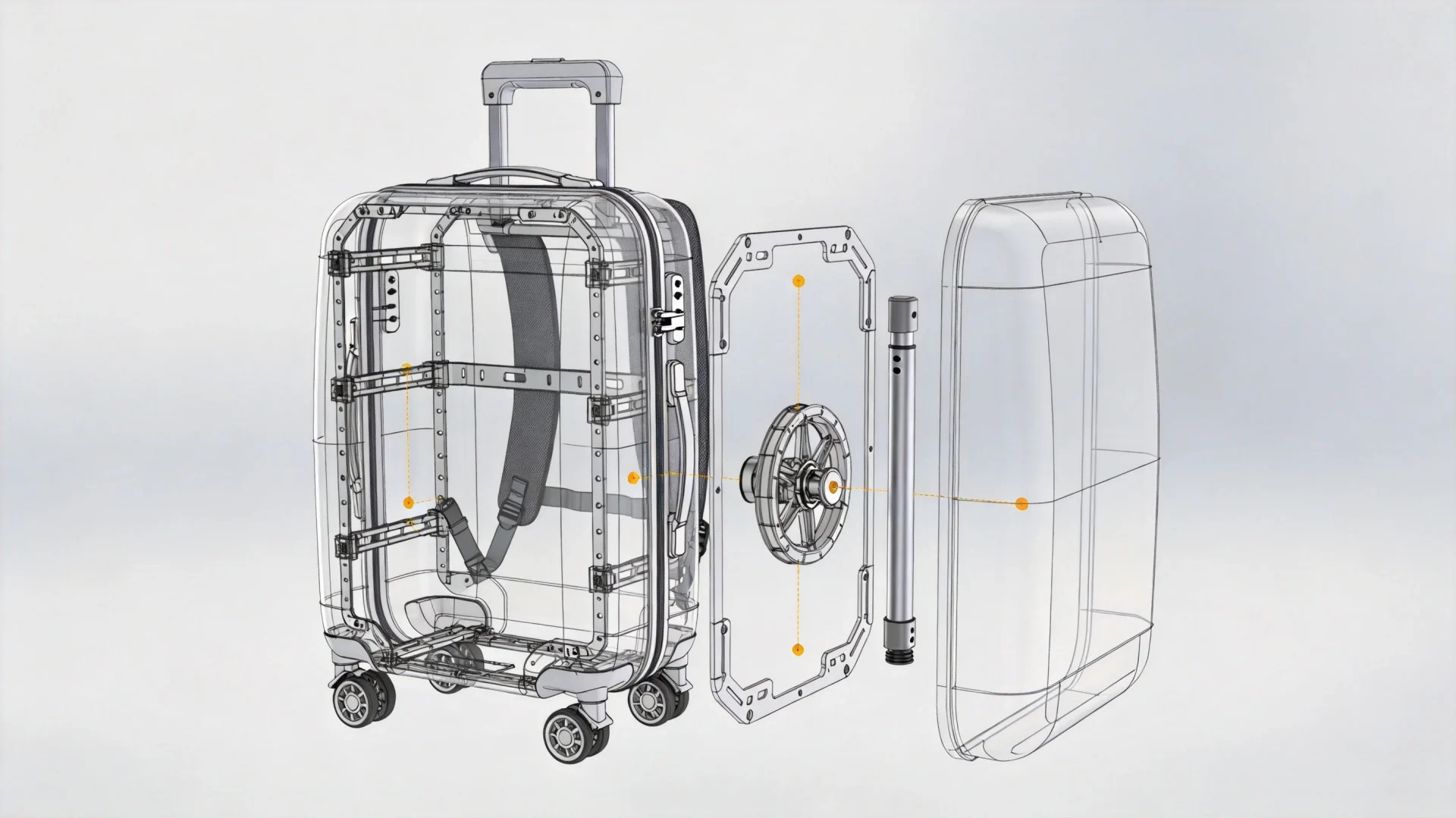
A rolling backpack’s frame determines its structural integrity, weight, and protection level. The frame architecture also dictates how the bag behaves when transitioning between rolling and backpack modes.
3.1 Polycarbonate (PC) Hard Shell
Full PC shells provide maximum protection for electronics and fragile items. Manufacturing process: thermoforming from 1.5–2.5mm PC sheets at 180–200°C, followed by CNC trimming and edge finishing. PC shells resist impacts down to -20°C without cracking. Typical weight: 600–900g for a 40L backpack shell.
3.2 ABS Frame with Fabric Body
A semi-rigid approach using an ABS internal frame plate (2–3mm thick) combined with 600D polyester or 1680D ballistic nylon fabric panels. This reduces overall weight to 1.2–1.8kg for the frame + body assembly while maintaining enough rigidity to support the telescoping handle load.
3.3 Aluminum Frame (Premium Segment)
Aerospace-grade 6063 aluminum extrusion profiles create the lightest, strongest frames. Used in premium business travel rolling backpacks priced above $150 retail. Frame weight: 400–600g. Requires TIG welding and powder coating as secondary processes.
4. Multi-Mode Carry: Backpack + Rolling + Hand Carry Integration
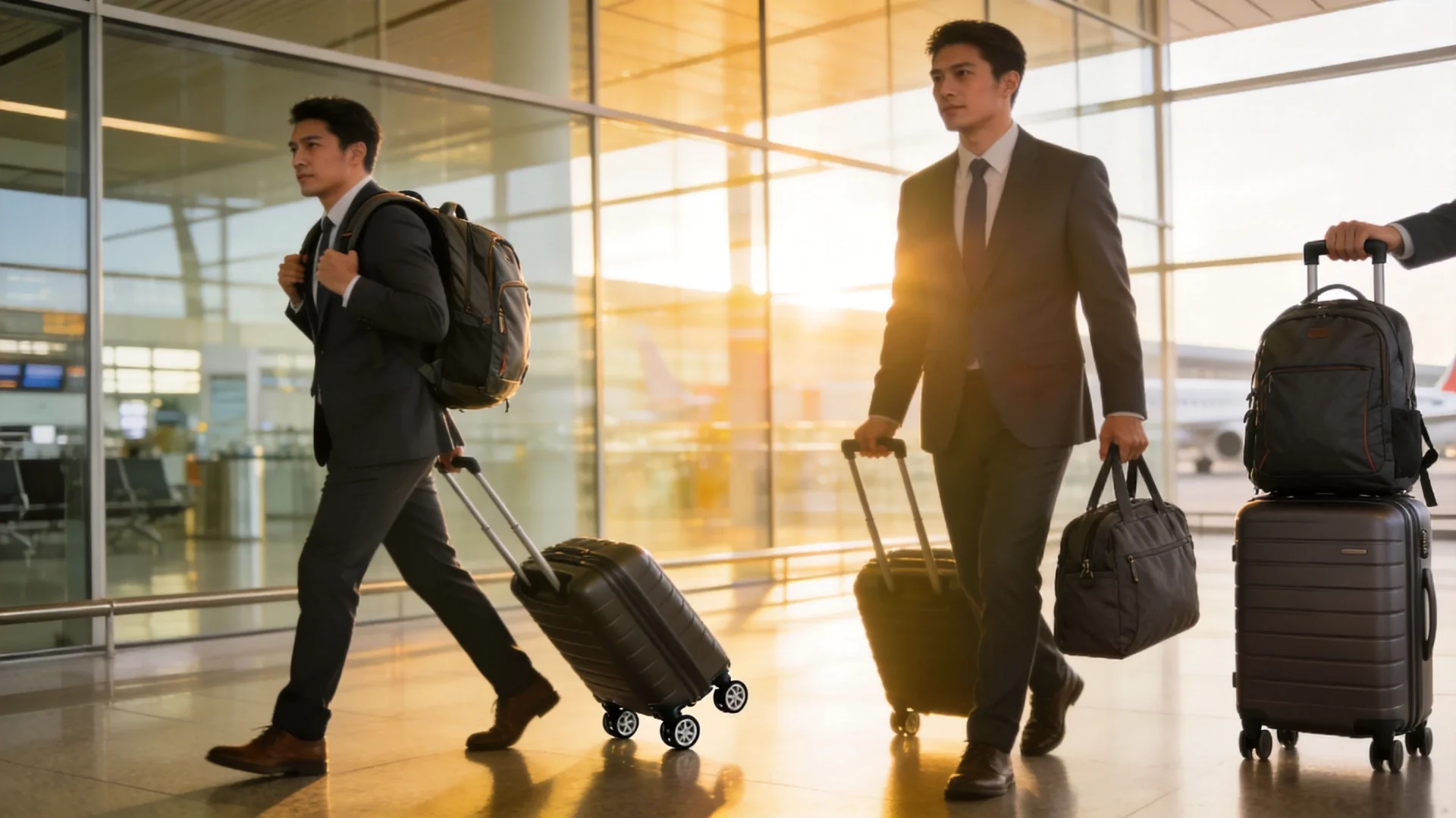
Modern rolling backpacks must seamlessly transition between at least three carry modes. This multi-mode requirement drives several critical design decisions that OEM manufacturers must address during the sample development phase.
4.1 Retractable Strap System
Shoulder straps must tuck completely behind a zippered panel when in rolling mode to prevent snagging on escalators and conveyor belts. The panel closure uses either:
- YKK #5 reverse coil zipper — Most reliable, rated for 5,000+ cycles. Cost adds $1.20–$2.00 per bag.
- Magnetic snap flap — Faster access, fewer mechanical failures. Best for lightweight models under 8kg loaded.
- Velcro hook-and-loop panel — Most economical but wears after 2,000+ cycles. Acceptable for budget segments.
4.2 Handle Integration Points
A properly engineered rolling backpack needs three grab handles: top carry handle (padded, 120mm × 35mm), side carry handle (unpadded webbing, 150mm), and bottom assist handle (for lifting into overhead bins). Each handle must be tested to 3× the rated bag weight — so for a 10kg-rated bag, each handle endures a 30kg pull test for 60 seconds.
4.3 Weight Distribution Engineering
When configured as a backpack, the rolling hardware (wheels, handle tubes, base plate) adds 1.2–2.0kg concentrated at the bottom panel. This shifts the center of gravity downward compared to standard backpacks. To compensate, we recommend:
- Padding thickness of 15–20mm at shoulder straps (vs. standard 8–10mm)
- Sternum strap positioned at 40% of torso height
- Load-bearing hip belt optional for models above 3.5kg empty weight
This ergonomic approach aligns with principles we apply in our research on ergonomic bag design and team performance outcomes.
5. Base Plate & Abrasion Protection: Engineering the Ground Contact Zone
The bottom panel of a rolling backpack experiences more abrasion than any other surface. When dragged over thresholds, gravel, and curbs, the base plate is the first line of defense.
5.1 Material Options for Base Plates
- Molded ABS shell (3mm): Standard for hard-bottom designs. Injection molded with integrated wheel housing. Replaces the entire bottom panel. Cost: $2.50–$4.50/unit at MOQ 500.
- Hypalon-coated nylon base: Flexible yet abrasion-resistant. Bonded to the fabric shell. Used in semi-soft designs. Cost: $1.50–$3.00/unit.
- Thermoplastic polyurethane (TPU) skid plate: Ultra-durable, chemical resistant, operates from -30°C to +80°C. The premium option for expedition and military-spec products. Cost: $4.00–$7.00/unit.
5.2 Corner Protectors
Corner impacts are the most common failure point. Rubber corner bumpers (TPE, Shore A 60–70) absorb impact energy and prevent the shell from cracking. Each corner protector is either riveted with aluminum rivets or ultrasonically welded to the base plate. Testing standard: 500 drop cycles from 60cm height onto concrete without visible damage.
6. Internal Organization: TSA Locks, Compartments & Access Systems
Rolling backpacks serve specific use cases that demand thoughtful internal organization. Unlike standard backpacks, the rigid frame enables structured compartment designs that maintain their shape regardless of fill level.
6.1 TSA-Approved Locking Systems
For the US-bound travel segment, TSA-approved combination locks are essential. Two integration approaches:
- Recessed TSA lock (Travel Sentry certified): Flush-mounted into the hard shell. Requires a dedicated lock housing mold ($800–$1,500 tooling cost). Provides the cleanest aesthetic.
- Cable-loop TSA lock: Attaches to existing zipper pulls via a retractable steel cable. No additional tooling needed. Cost: $1.50–$3.00/lock. Suitable for fabric-body designs.
For more information on hardware and custom bag hardware branding, including zipper and buckle options, see our detailed hardware guide.
6.2 Compartment Layout for Target Segments
| Segment | Key Compartments | Access Points | Special Features |
|---|---|---|---|
| Business Travel | Laptop sleeve (up to 17″), document pocket, accessory organizer | Clamshell (180°), front quick-access | TSA lock, USB pass-through, luggage tag window |
| Student | Textbook divider, tablet sleeve, lunch bag pocket | Top-loading, side water bottle pocket | Lightweight frame, reflective strips |
| Elderly/Mobility | Medication pouch, easy-grip zippers, front panel pocket | Full front zip (270° opening) | Lightweight (under 2.5kg), anti-tip base |
| Airline Crew | EFB tablet pocket, pen holder, badge clip, headset compartment | Clamshell, top quick-access | FAA-compliant size, reinforced handle |
7. Weight Engineering: The 2.5–4 kg Target Challenge
Weight is the most contested specification in rolling backpack design. Buyers want more features; end users want less weight. Here is where every gram is accounted for in a typical 35L business rolling backpack:
| Component | Weight Range | Optimization Strategy |
|---|---|---|
| Wheel assembly (2 or 4) | 180–480g | Switch from steel bearings to ceramic hybrid; reduce wheel count from 4 to 2 |
| Telescoping handle | 250–420g | Use aluminum instead of steel; reduce from 4-stage to 3-stage |
| Base plate | 200–400g | Replace ABS with polycarbonate; use ribbed design for stiffness at reduced thickness |
| Shell/frame | 400–900g | Semi-rigid frame instead of full hard shell; use ripstop fabric panels |
| Fabric body | 300–500g | 200D nylon instead of 600D polyester; minimize internal lining |
| Straps & hardware | 200–350g | Use air mesh padding; replace metal buckles with POM plastic |
8. Target Market Segments & Product Specifications
Understanding your target end-user segment drives nearly every design decision in rolling backpack manufacturing:
8.1 Business Travel Segment ($80–$200 retail)
Demand: Premium aesthetics, laptop protection, TSA compliance, business card slots, garment sleeve. Material: 1680D ballistic nylon or PC hard shell. Wheel preference: 4-spinner for urban environments. Expected lifespan: 5+ years.
8.2 Student Segment ($40–$90 retail)
Demand: Lightweight, colorful, durable, affordable replacement parts. Material: 600D polyester with ABS frame. Wheel preference: 2-inline for simplicity and lower cost. Expected lifespan: 2–3 years (one school cycle).
8.3 Elderly & Mobility Segment ($60–$150 retail)
Demand: Ultra-lightweight, easy-grip handles, large zipper pulls, anti-tip design, brake system. Material: Lightweight nylon with aluminum frame. Wheel preference: Large 80mm inline wheels for outdoor transitions. Expected lifespan: 4+ years.
8.4 Airline Crew Segment ($120–$250 retail)
Demand: FAA-compliant dimensions, extreme durability (daily use), organized tool storage, reinforced handle. Material: 1680D ballistic nylon with aluminum frame. Wheel preference: Large 75mm inline for airport carpet transitions. Expected lifespan: 3+ years of daily use.
9. OEM Production: Mold Costs, Tooling & Manufacturing Challenges
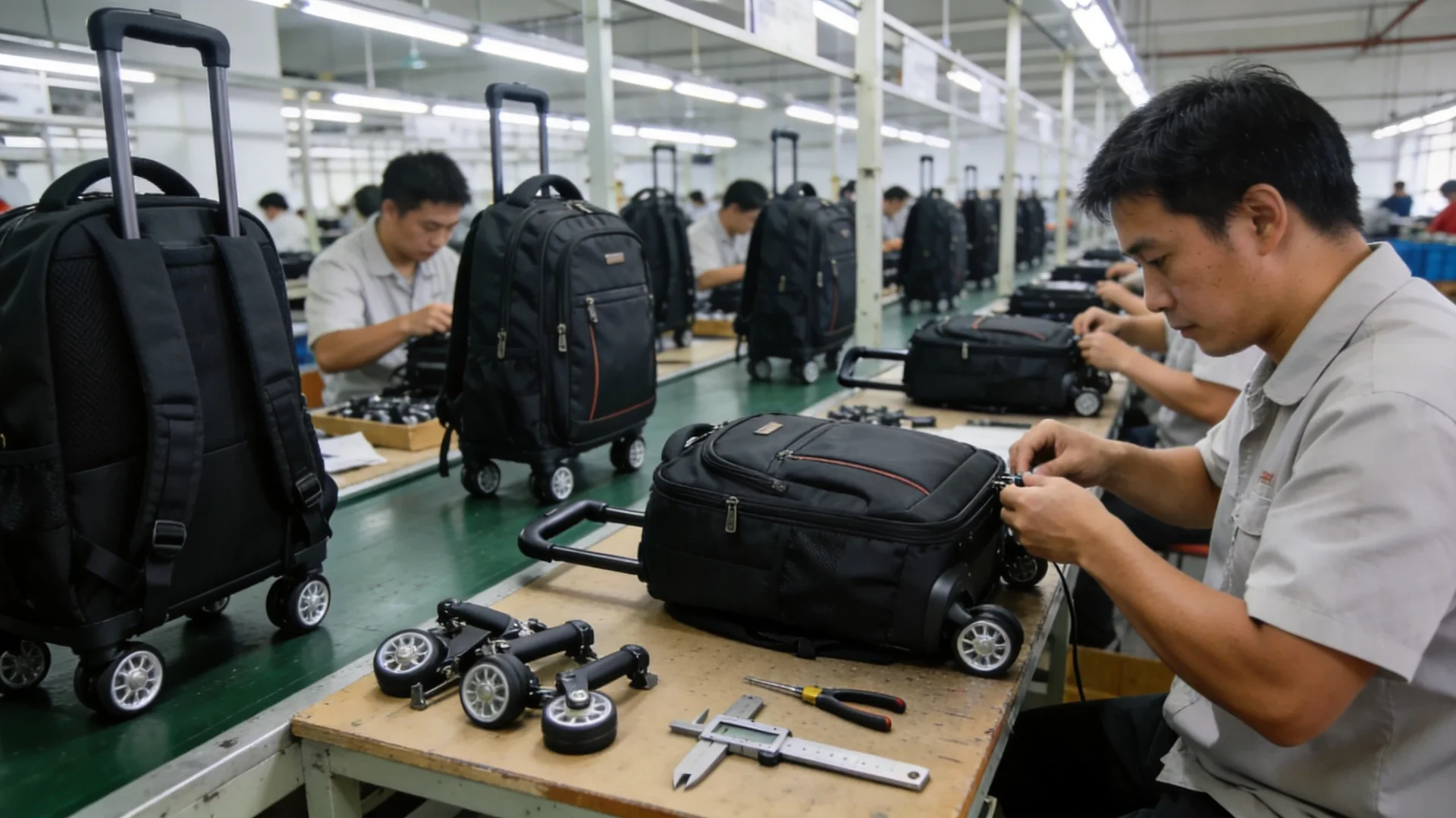
Manufacturing a rolling backpack requires capabilities far beyond standard backpack production. The OEM factory must handle injection molding, metal machining, bearing assembly, and textile sewing — often across different workshop zones within the same facility.
9.1 Mold & Tooling Investment
| Component | Mold Type | Tooling Cost (USD) | Lifetime (cycles) |
|---|---|---|---|
| Wheel housing (spinner) | Injection mold, P20 steel | $3,000–$5,500 | 50,000–80,000 |
| Base plate | Injection mold, P20 steel | $2,500–$4,000 | 50,000–80,000 |
| Handle grip (overmold) | Two-shot injection mold | $4,000–$7,000 | 30,000–50,000 |
| Corner protectors | Injection mold, 718H steel | $800–$1,500 | 80,000–100,000 |
| PC shell (thermoform) | Thermoforming die, aluminum | $1,500–$3,000 | 20,000–30,000 |
Total initial tooling investment for a complete rolling backpack with spinner wheels: $12,000–$21,000. At JUNYUAN, we offer tooling cost amortization over the first 3 production runs for orders exceeding 1,000 units per SKU, effectively reducing the per-unit tooling charge to $0.80–$1.50.
9.2 Key Manufacturing Challenges
- Wheel alignment tolerance: Both wheels must be aligned within ±0.5mm lateral deviation or the bag will pull to one side during rolling. This requires precision jig fixtures during assembly — not achievable with hand assembly alone.
- Handle tube straightness: Telescoping tubes must maintain straightness within 0.3mm/m to prevent binding during extension. Bent tubes cause the handle to jam — the #1 warranty claim for rolling bags.
- Fabric-to-frame bonding: Semi-rigid designs require structural adhesive bonding between fabric panels and the ABS frame. Adhesive selection (hot-melt vs. contact cement) affects both peel strength and flexibility over temperature cycles.
- Zipper stress on curved shell edges: Where zippers meet the curved shell edge, stress concentration can cause premature zipper separation. Reinforcement tape (nylon grosgrain, 25mm) must be bonded along the zipper channel.
9.3 Quality Control Checkpoints
At JUNYUAN’s quality control facility, every rolling backpack order undergoes these mandatory inspections:
- Wheel roll test: 10km continuous rolling on mixed surface at 10kg load
- Handle extension test: 3,000 cycles at rated load without binding
- Drop test: 60cm onto concrete corner, edge, and face (6 orientations)
- Tilt test: Loaded bag tilted to 45° for 24 hours without permanent deformation
- Zipper cycle test: Main compartment zipper, 2,000 cycles at 5kg internal pressure
10. 2026 Rolling Backpack Market Trends
The rolling backpack market is evolving rapidly. Here are the key trends OEM buyers should factor into their 2026 product development:
- Lightweight spinner technology: New micro-bearing designs reduce spinner wheel weight by 30% compared to 2023 generation, closing the weight gap with inline wheels.
- Sustainable materials: RPET recycled fabrics are now used in 25% of new rolling backpack launches. Wheel housings made from recycled nylon (ECONYL) are entering the premium segment.
- Smart luggage integration: GPS tracking modules, USB-C charging ports, and weight sensors are being embedded into rolling backpack designs. The PCB housing and wiring channels must be designed into the frame from day one.
- Modular wheel replacement: Consumers increasingly expect replaceable wheels — a design shift from riveted (permanent) to bolt-on (serviceable) wheel mounts. This adds $0.80–$1.50 in hardware but reduces warranty claims by 60%.
- Anti-microbial interiors: Post-pandemic demand drives anti-microbial lining materials in all bag categories, including rolling backpacks.
11. Working with JUNYUAN: Your Rolling Backpack OEM Partner
As a bag manufacturer in Quanzhou, Fujian led by a founder with over two decades of bag industry experience, JUNYUAN Bags offers a complete rolling backpack development service:
- In-house injection molding: We own our wheel housing and base plate molds — no outsourcing, faster iteration, lower cost.
- Complete testing lab: Wheel roll testers, handle cycle machines, drop test rigs, and durometer equipment on-site.
- MOQ from 500 pieces: Ideal for brands testing new rolling backpack SKUs. Read our guide on MOQ strategies for small brands working with Chinese manufacturers.
- FOB Xiamen shipping: Competitive ocean freight from one of China’s major container ports.
- Full compliance support: REACH, CPSIA, Prop 65, and TSA lock certification assistance.
Frequently Asked Questions
What is the minimum order quantity (MOQ) for custom rolling backpacks?
At JUNYUAN Bags, the MOQ for custom rolling backpacks starts at 500 pieces per color per size. If you use our existing mold designs for wheels and base plates, you can reduce per-unit tooling costs significantly at this volume.
How long does it take to develop a new rolling backpack from concept to production?
The typical timeline is 90–120 days: 30 days for design and 3D prototyping, 15 days for first sample approval, 30 days for mold fabrication (if new molds are needed), and 30–45 days for bulk production. See our 6-month production planning guide for detailed timelines.
Can rolling backpack wheels be replaced by the end user?
Yes, if designed with bolt-on wheel mounts rather than riveted mounts. We recommend M6 stainless steel bolts with nylock nuts for serviceable wheel designs. This adds approximately $0.80–$1.50 per unit in hardware cost but significantly reduces warranty claims and improves customer satisfaction.
What is the ideal weight for a rolling backpack?
For business travel models (35–45L): 3.0–3.8 kg empty. For student models (25–35L): 2.5–3.2 kg empty. For elderly/mobility models: under 2.8 kg empty. The weight target is achieved through material selection — aluminum handles, polycarbonate or ABS frames, and optimized fabric weight.
What certifications are needed for rolling backpacks with TSA locks?
TSA-approved locks must be certified by Travel Sentry® or meet TSA-recognized standards. The lock itself carries the certification — your bag does not need separate TSA certification. However, if exporting to the EU, you will need REACH compliance for all materials, and for California market, Prop 65 testing. JUNYUAN assists with all export compliance documentation.
What is the tooling cost for a custom rolling backpack?
Total tooling ranges from $12,000 to $21,000 for a complete set including wheel housings, base plate, handle grip mold, and thermoforming dies. JUNYUAN offers tooling cost amortization over the first 3 orders for volumes exceeding 1,000 units per SKU, reducing the effective per-unit tooling cost to under $1.50.
Ready to Develop Your Rolling Backpack Line?
JUNYUAN Bags — over two decades of OEM/ODM expertise from Quanzhou, Fujian, China. In-house injection molding, complete testing lab, MOQ from 500 pieces, FOB Xiamen shipping.
Production & Compliance Facts – Rolling Backpacks
| Parameter | Value |
|---|---|
| Minimum order quantity (MOQ) | 500 pieces per design |
| Sampling lead time | 6-10 days |
| Bulk production lead time | 35-50 days |
| Quality control | AQL 2.5 inspection |
| Certifications | ISO 9001 / BSCI / SEDEX / OEKO-TEX / GRS |
| Factory location | Quanzhou, Fujian, China (founded 2014) |