
Backpack attachment systems are the external mounting architectures that allow users to secure additional gear to the outside of a pack. The four primary systems used in modern backpack manufacturing are: MOLLE/PALS webbing (25 mm nylon straps in a standardized grid, derived from NATO STANAG 2339), daisy chains (vertical loops of webbing spaced at regular intervals), lash tabs (flat fabric tabs with a slot for threading webbing or cord), and bottom compression straps (horizontal webbing with buckles at the pack base). As an OEM/ODM manufacturer, Junyuan Bags produces backpacks with all major attachment system types, with MOQs starting from 200 pieces per style.
This guide provides the manufacturing specifications for each attachment type including webbing dimensions, spacing tolerances, stitch patterns, load ratings, and sewing standards. For brand owners developing outdoor, tactical, hunting, or EDC backpacks, this pillar page offers the technical depth needed to specify the right attachment system.
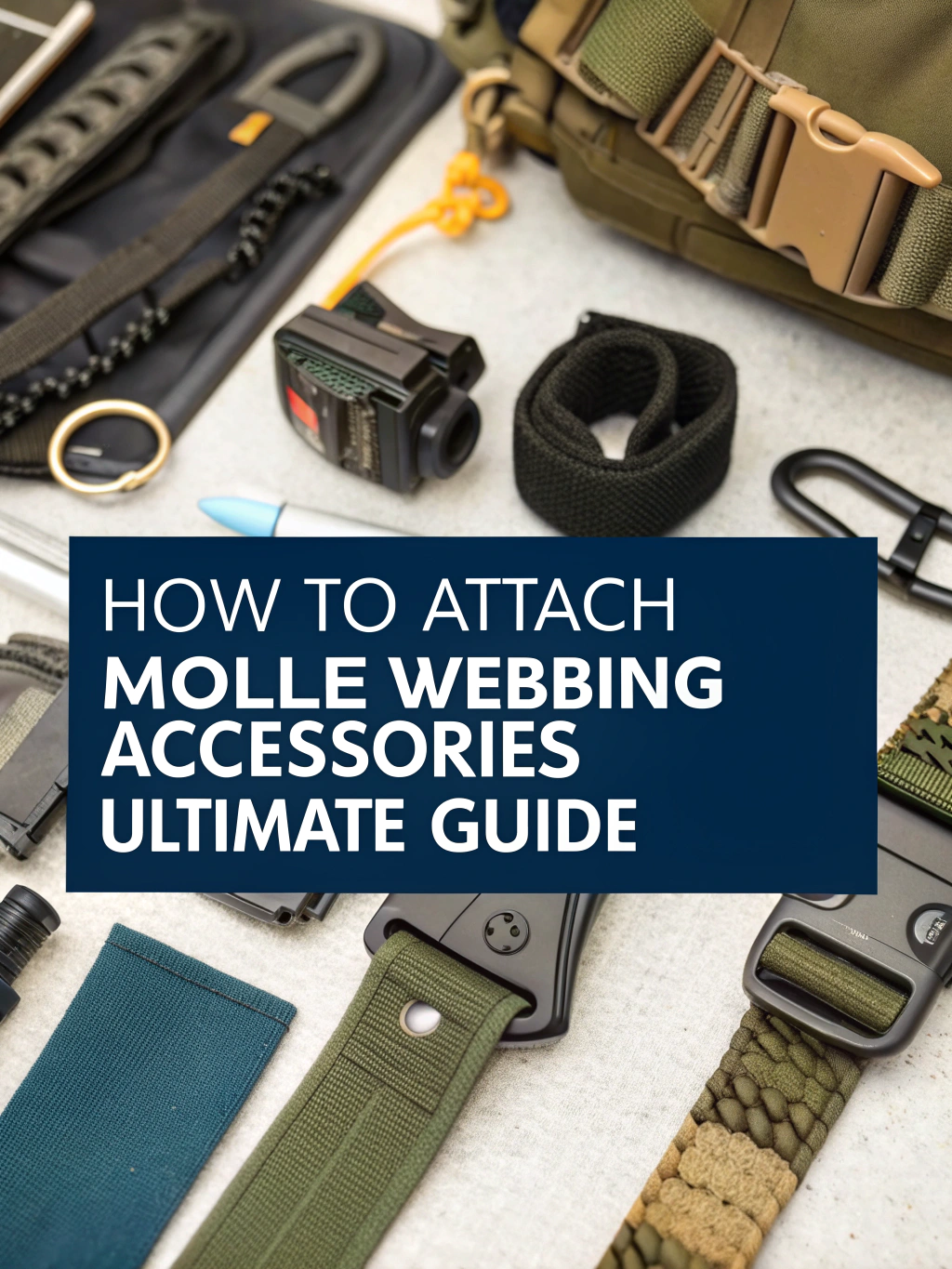
MOLLE/PALS Webbing: The Modular Standard
Origin and Standard
MOLLE (Modular Lightweight Load-carrying Equipment) and its underlying grid system, PALS (Pouch Attachment Ladder System), were developed by the U.S. Army Natick Soldier Research Center in the late 1990s. The system was standardized under NATO STANAG 2339, ensuring cross-national compatibility. Today, MOLLE appears on civilian hiking packs, hunting backpacks, EDC bags, and fashion backpacks. Understanding its specifications is essential for any outdoor backpack manufacturer.
Technical Specifications
| Specification | Standard (MIL-SPEC) | Civilian/Commercial |
|---|---|---|
| Webbing width | 25 mm (1 inch) | 25 mm (1 inch) |
| Row spacing (center to center) | 38 mm (1.5 inches) | 25-38 mm |
| Column spacing (between stitch lines) | 25 mm (1 inch) | 25 mm (1 inch) |
| Webbing material | Type XIII nylon webbing, 1000D | Nylon or polyester, 500-1000D |
| Breaking strength per strip | 500+ kg (MIL-W-17337) | 250+ kg (commercial) |
| Stitch pattern | Triple-stitch at edges; bartack at termination | Double-stitch; bartack recommended |
| Slot length (open portion) | 35 mm | 35-40 mm |
Manufacturing Process for MOLLE Panels
- Webbing cutting: Cut nylon webbing to required panel length plus 25 mm for fold-under.
- Layout marking: Mark stitch lines on the pack panel using a template. Rows spaced 38 mm apart, 25 mm slots.
- Webbing placement: Lay webbing strips horizontally, aligned with marked rows.
- Stitching: Using heavy-duty needle (#20-22) and bonded nylon thread (T-70 or T-90), stitch along each edge. Maintain consistent spacing with plus/minus 1 mm tolerance.
- Bartack reinforcement: At each end of every webbing strip, apply bartack (tight zigzag stitch cluster, 6-8 mm long).
Load Capacity per MOLLE Attachment Point
- Light-duty panels (3-4 rows, 500D webbing): Total capacity 20-30 kg. Suitable for hiking and EDC packs.
- Medium-duty panels (5-7 rows, 1000D webbing): Total capacity 40-50 kg. Suitable for tactical and hunting packs.
- Heavy-duty panels (8+ rows, reinforced backing): Total capacity 60+ kg. Military specification.
Manufacturing critical point: The weakest link is the stitching attaching webbing to the pack panel. Bartack reinforcement at every termination point is non-negotiable for quality manufacturing.

Daisy Chains: Lightweight Vertical Attachment
What Is a Daisy Chain?
A daisy chain is a series of webbing loops sewn vertically along the front or side of a backpack, typically spaced 50-100 mm apart. These loops allow users to clip carabiners, cord, or webbing to attach gear externally. Common on climbing packs, approach packs, and lightweight hiking packs.
Specifications
| Specification | Standard | Ultralight |
|---|---|---|
| Webbing width | 20-25 mm | 15-20 mm |
| Loop length | 30-50 mm | 20-35 mm |
| Loop spacing | 50-100 mm | 40-60 mm |
| Number of loops | 4-8 per strip | 3-6 per strip |
| Material | Nylon webbing 500-1000D | Dyneema or UHMWPE |
| Load per loop | 10-20 kg | 5-10 kg |
Manufacturing Process
- Cut webbing to panel height plus enough length for all loops.
- At each loop position, fold webbing into a loop (30-50 mm), creating a ladder pattern.
- Stitch through all layers at each loop base using a box-X stitch pattern.
- Attach the completed daisy chain strip to the pack panel by stitching along both edges.
On hiking backpacks, daisy chains typically run vertically down the front panel for attaching trekking poles or sleeping pads.
Lash Tabs: The Simple, Strong Solution
Lash tabs (also called pig-snout tabs) are flat fabric or webbing tabs with a horizontal slot, sewn onto the backpack. Users thread webbing or cord through the slot to secure external gear. They are one of the simplest and strongest attachment solutions.
Types and Specifications
| Tab Type | Material | Slot Width | Load Rating | Typical Location |
|---|---|---|---|---|
| Standard lash tab | Nylon webbing, folded | 20-25 mm | 15-25 kg | Front panel, bottom |
| Reinforced lash tab | Double-layer + bartack | 25-30 mm | 25-40 kg | Bottom panel (sleeping pad) |
| Webbing lash tab | Single strip sewn at both ends | 20 mm | 10-15 kg | Sides, top lid |
| Hypalon/rubber lash tab | Hypalon sheet with slot | 15-20 mm | 5-10 kg | Ultralight packs |
Lash tabs are one of the lowest-cost attachment points ($0.05-0.15 per tab) while providing excellent load capacity. They are standard on hiking backpacks, tool bags, and travel packs.

Ice Axe Loops, Bottom Straps, and Specialty Attachments
Ice Axe Loops
- Material: 25 mm nylon webbing, double-layer
- Loop diameter: 30-40 mm (must accommodate ice axe shaft, 16-20 mm diameter)
- Attachment: Sewn through the bottom panel seam for maximum strength
- Load rating: 15-25 kg per loop
Bottom Compression Straps
| Specification | Standard | Heavy-duty |
|---|---|---|
| Webbing width | 20-25 mm | 25-38 mm |
| Buckle type | Side-release buckle 20 mm | Side-release buckle 25 mm or ladder lock |
| Load capacity | 15-20 kg | 25-35 kg |
Trekking Pole Attachment Points
- Top: Bungee cord loop or bungee cord system attachment
- Bottom: Ice axe loop or dedicated pole keeper
Hydration Tube Ports
Tube ports share the same manufacturing principles as other attachments: reinforced openings with grommets or fabric sleeves. See our hydration pack manufacturing guide for details.

Sewing and Reinforcement Standards
| Application | Stitch Pattern | Thread | Needle Size | Min. Pull-Out Strength |
|---|---|---|---|---|
| MOLLE webbing to panel | Double lockstitch + bartack (ends) | Bonded nylon T-70 | #20 (125) | 200+ kg per strip |
| Daisy chain loops | Box-X stitch | Bonded nylon T-70 | #20 (125) | 150+ kg per loop |
| Lash tabs | Box-X stitch + bartack corners | Bonded nylon T-90 | #22 (140) | 250+ kg per tab |
| Shoulder strap anchor | Triple-stitch + bartack | Bonded nylon T-90 | #22 (140) | 500+ kg |
| Bottom compression strap | Box-X stitch + bartack | Bonded nylon T-70 | #20 (125) | 300+ kg |
Quality Control Testing for Attachment Points
- Pull test: Apply specified load, hold 30 seconds. No stitching failure allowed.
- Cycle test: Attach/detach weighted pouch to MOLLE loops 500 times.
- Abrasion test: 5,000 cycles at 2 kg pressure. Less than 10% thickness loss.
- UV resistance: 200 hours UV exposure. 85%+ tensile strength retention.
Design Recommendations by Backpack Category
| Backpack Category | Primary Attachment | Secondary Attachments | Total Cost Add |
|---|---|---|---|
| Tactical/Military | Full MOLLE panels (front + sides) | Bottom straps, D-rings, velcro patch | $2.50-4.00 |
| Hiking/Trekking | Daisy chains (sides), bungee system (front) | Lash tabs (bottom), ice axe loops | $1.00-2.00 |
| Hunting | MOLLE panels (sides), lash tabs | Bow attachment, camo velcro | $1.50-3.00 |
| EDC/Urban | Minimal MOLLE (1-2 rows) | Lash tabs, hidden pocket | $0.50-1.00 |
| Fishing | Rod holder, D-rings | Net holster, tackle attachment | $1.50-3.00 |
| Trail Running | Pole attachments (bungee) | Minimalist design | $0.30-0.60 |
| Travel | Trolley sleeve, compression straps | Lash tabs for jacket/mat | $0.50-1.20 |
Laser-Cut MOLLE: The Emerging Alternative
An emerging alternative to traditional stitched MOLLE is laser-cut MOLLE, where slots are cut directly into the pack panel fabric. Benefits include 40-60% weight reduction, cleaner aesthetic, and no loose webbing ends. Drawbacks include lower load capacity, higher equipment cost, and fabric compatibility limitations (works best with 500D+ nylon).

About Junyuan Bags
Junyuan Bags is a professional backpack OEM/ODM manufacturer based in Quanzhou, Fujian, China. Our 4,950 sqm facility with 137 workers produces backpacks with all major attachment system types.

- MOQ: 200 pieces per style per color
- Sampling: 7-10 days for first sample
- Production: 35-45 days after sample approval
- Attachment capabilities: MOLLE, daisy chains, lash tabs, compression straps, ice axe loops, custom designs
Related products: outdoor backpacks, hiking backpacks, fishing backpacks, tool bags, anti-theft backpacks, waterproof backpacks.
Frequently Asked Questions
What is the standard MOLLE webbing spacing?
NATO STANAG 2339 specifies 25 mm webbing width, 38 mm center-to-center row spacing, and 25 mm column spacing. For civilian packs, some manufacturers use 25 mm row spacing for a tighter grid.
How much weight can a MOLLE attachment point hold?
Each individual MOLLE slot (25 mm x 38 mm) supports approximately 10-15 kg of static load. A full panel with 30 attachment points has a system capacity of 40-50 kg.
What is the difference between MOLLE and PALS?
PALS refers to the grid of webbing strips on the pack surface. MOLLE refers to the entire system including the PALS grid, compatible pouches, and the overall concept.
Can you do laser-cut MOLLE instead of stitched?
Yes. Laser-cut MOLLE is available for weight savings and clean aesthetics. Traditional stitched MOLLE remains stronger for heavy loads.
What stitching standards do you use for attachment points?
All attachment points use bonded nylon thread (T-70 for standard, T-90 for heavy) with box-X stitch patterns and bartack reinforcement. Every point undergoes pull testing.
What is the cost impact of adding MOLLE panels?
A full MOLLE panel adds approximately $1.50-3.00 to FOB cost. A partial panel adds $0.60-1.20. See our bag manufacturing cost guide.
What daisy chain spacing do you recommend for hiking backpacks?
We recommend loops spaced 75 mm apart with 40 mm loop length, using 25 mm nylon webbing. For climbing packs, tighter spacing (50 mm) with shorter loops (30 mm).
Can you design custom attachment systems?
Yes. We regularly develop proprietary attachment systems including magnetic panels, hybrid webbing-mesh systems, and quick-release rail systems. Contact [email protected].
Start Your Custom Backpack Project
Contact us today:
- Email: [email protected]
- WhatsApp: +86 17750020688
- Factory: Quanzhou, Fujian, China
- MOQ: 200 pcs/style
Explore: Custom Backpack OEM/ODM | Outdoor Backpacks | Hiking Backpacks | Private Label Backpacks | Cost Guide
Historical Evolution of Backpack Attachment Systems
Understanding how attachment systems evolved helps OEM brands appreciate why certain designs persist and where innovation is heading:
| Era | System | Key Innovation | Legacy |
|---|---|---|---|
| Pre-1960s | External frame packs | Wooden/metal frames with lashing points | Established the concept of external gear attachment |
| 1960s-1970s | ALICE system | Standardized webbing loops and clips for military packs | First standardized attachment system; predecessor to MOLLE |
| 1980s-1990s | PALS/MOLLE development | Grid-based modular system with 1-inch webbing | NATO standard; still the dominant tactical attachment system |
| 1990s-2000s | Daisy chains in climbing | Lightweight vertical webbing loops for gear attachment | Became standard on climbing and approach packs |
| 2000s-2010s | Bungee cord systems | Elastic shock cord for quick-attach of jackets and gear | Popularized on hiking and trail running packs |
| 2010s-Present | Laser-cut MOLLE | Weight-reduced modular panels cut directly from fabric | Growing in ultralight and urban EDC segments |
| Emerging | Magnetic/quick-release systems | Tool-free attachment with magnetic or mechanical quick-release | Early adoption in premium outdoor and tactical brands |
Attachment System Durability Testing Standards
For brands selling into military, law enforcement, or premium outdoor markets, formal testing protocols are essential. Here are the industry-standard tests for attachment system durability:
| Test | Method | Pass/Fail Criteria | Frequency |
|---|---|---|---|
| Static pull test | Apply rated load to attachment point, hold 60 seconds | No stitch failure, no webbing tear, no fabric damage | Every batch (AQL 2.5) |
| Dynamic drop test | Attach 10 kg weight, drop from 1 meter height, repeat 50 times | No detachment, no deformation beyond 5% | Sample testing |
| Cycle abrasion test | Web against standard fabric at 2 kg, 5000 cycles | Less than 10% thickness loss | Material qualification |
| UV degradation test | Expose to UV-A light (340 nm) for 200 hours | 85%+ tensile strength retention | Material qualification |
| Salt spray test (for military) | 5% NaCl spray, 35C, 48 hours per ASTM B117 | No corrosion on metal hardware; 90%+ webbing strength | Every batch |
| Temperature cycling | -20C to +60C, 100 cycles, 1 hour each | No cracking, delamination, or strength loss | Sample testing |
At Junyuan Bags, all attachment points undergo static pull testing as part of our standard QC protocol. Dynamic and environmental tests are performed on a sample basis for each production batch. Full test reports are available upon request for OEM clients.
Choosing the Right Attachment System for Your Brand
The choice of attachment system should align with your brand positioning and target customer:
- Budget/Value brands: Use lash tabs and simple compression straps. Low cost, adequate functionality, minimal training required for end users. Cost add: $0.30-0.80/unit.
- Mid-range outdoor brands: Use daisy chains + bungee cord systems. Versatile, lightweight, appeals to hiking and trail communities. Cost add: $0.80-1.50/unit.
- Premium tactical/military brands: Use full MOLLE panels with bartack reinforcement. Maximum modularity, NATO-standard compatibility. Cost add: $2.00-4.00/unit.
- Ultralight brands: Use laser-cut MOLLE or minimal lash tabs in Hypalon. Weight savings as the primary selling point. Cost add: $0.50-1.50/unit but requires laser cutting equipment.
Many successful brands combine systems. For example, a hiking pack might use daisy chains on the sides (for trekking poles), a bungee system on the front (for jacket storage), and lash tabs on the bottom (for sleeping pad attachment). This multi-system approach provides maximum versatility while keeping cost moderate.