A molded EVA tote is a single-purchase product. A charm is not. That is the entire commercial argument for building a charm line, and it is why the accessory layer around hole-punched totes has become a more interesting margin story than the tote itself. The mechanic is simple. A customer buys one tote and returns to the same brand repeatedly to personalize it. Each charm is a low-consideration add-on with a high gross margin, and the collection expands the reason to visit the store. For a private-label brand, charms convert a one-time $40 sale into an ongoing relationship — and for a B2B buyer sourcing totes, a charm program is what makes a retail presentation look complete rather than like a single SKU. JUNYUAN BAGS has manufactured bag accessories alongside bags since 2014. This page covers the materials and processes we run for charm programs, the fitting standards that decide whether a charm stays on the bag, the compliance points that actually matter, and how to brief a charm collection that pairs with your tote line.
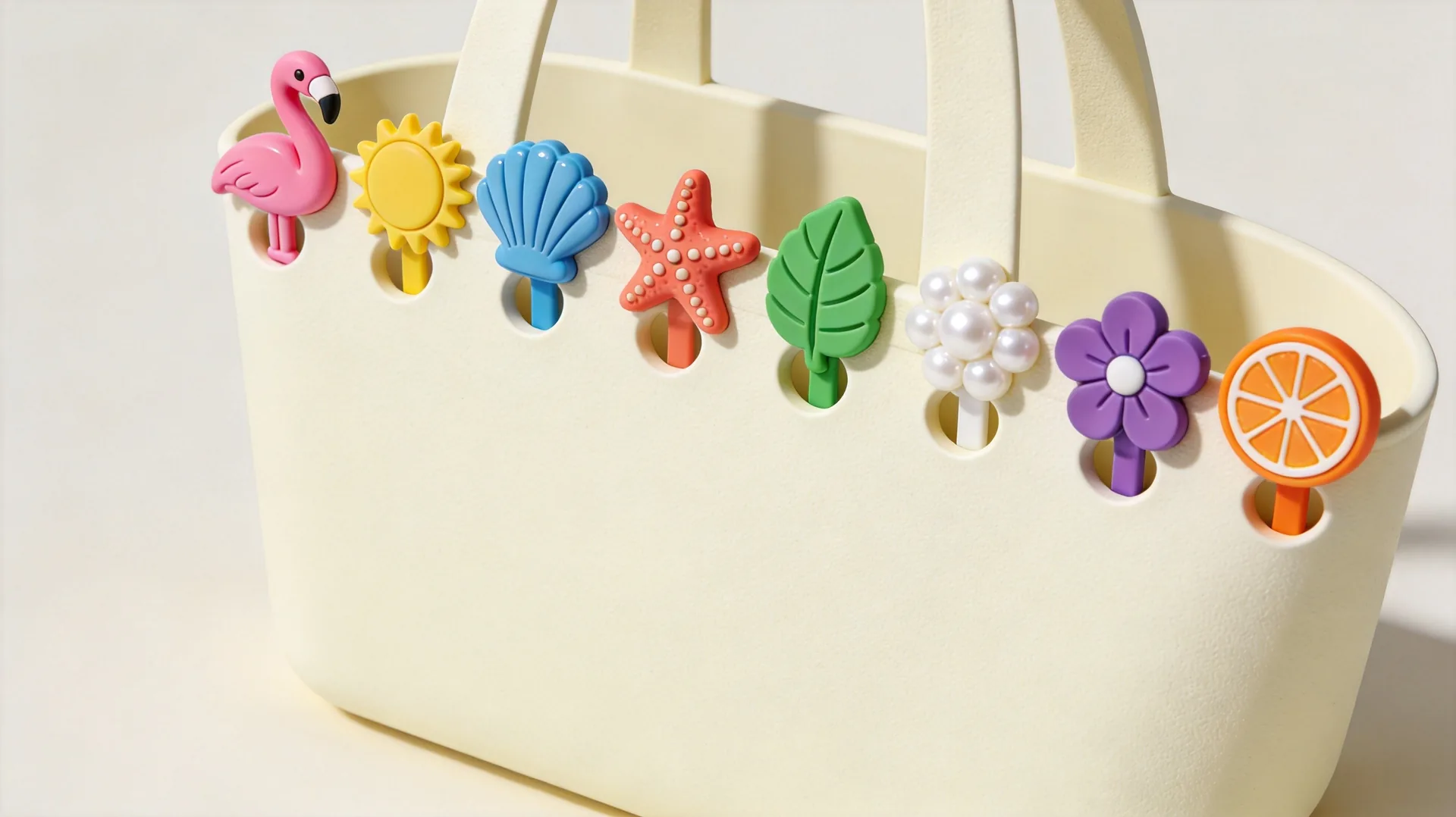
Assorted custom bag charms for EVA totes — PVC, silicone, acrylic and metal charms arranged around a molded EVA beach tote with holes
1. Why Charms Are the Highest-Margin Layer in the EVA Category
The economics of an accessory line are structurally better than the bag it attaches to, and it is worth being explicit about why.
Low material cost, high perceived value. A charm consumes a few grams of PVC or silicone. The retail price is set by design and scarcity rather than material. Gross margin percentages in this layer are routinely several times the margin on the tote itself.
Repeat purchase is designed in. Personalization is never finished. A customer who buys one charm has a bag with empty holes and a reason to buy a second. Collection-based merchandising — seasonal drops, character series, alphabet sets — turns that into a recurring revenue line.
Tooling amortizes fast. Charm molds are small and comparatively inexpensive. Against a 500-piece minimum per design, tooling cost per unit is negligible compared with a shell mold, which means a brand can test many designs cheaply and keep only the ones that sell.
It solves the tote’s differentiation problem. Molded tote shells are increasingly similar across suppliers. Charms are where a brand can actually be distinctive, because a charm design is proprietary in a way that a standard shell geometry is not.
It supports combined ordering. A charm program placed with the tote program consolidates freight, inspection, and documentation into a single cycle. Buyers running both lines usually find the total landed cost is lower than sourcing charms separately.
2. Charm Materials and What Each One Is Good For
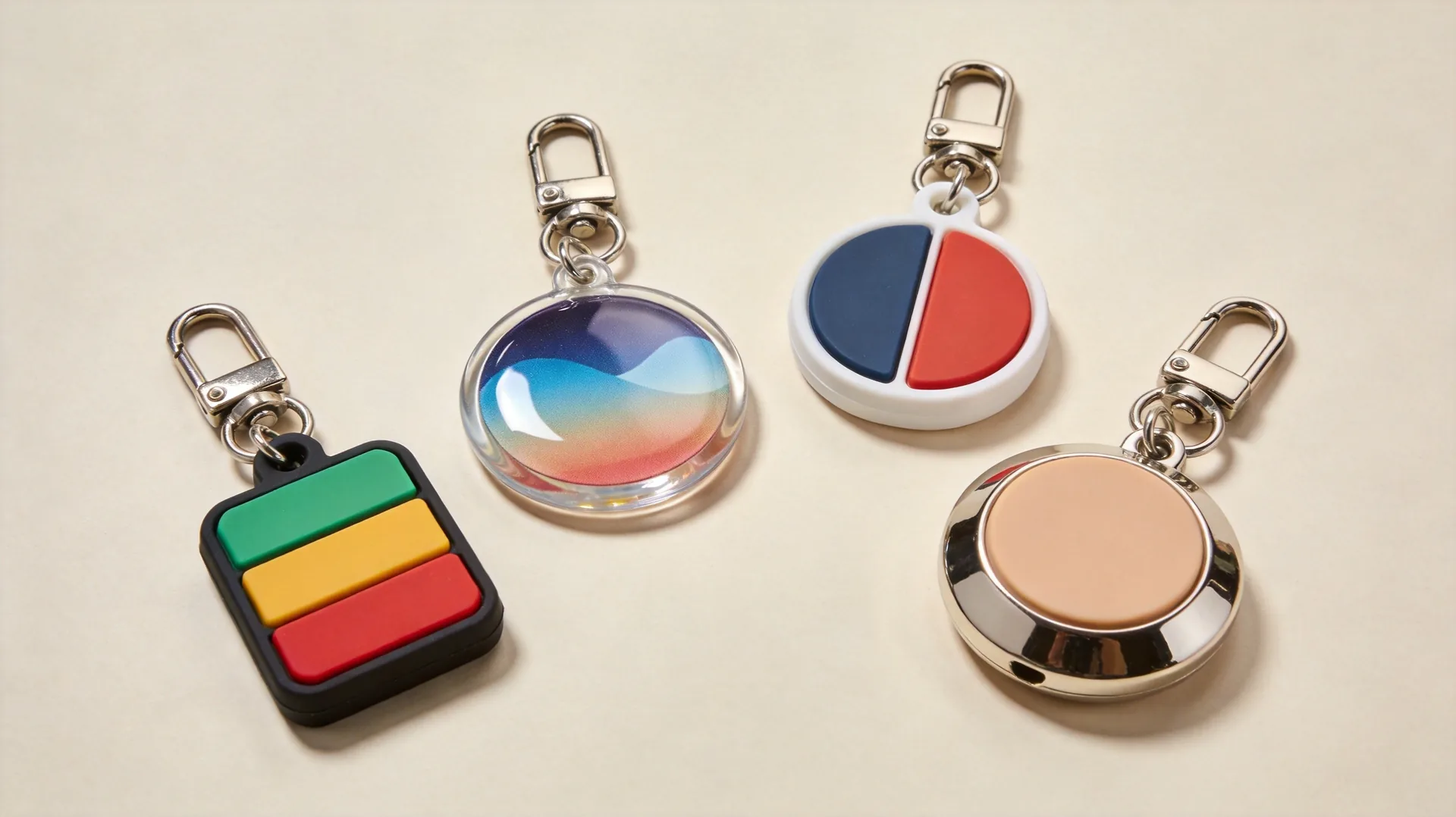
Material choice drives hand feel, durability, unit cost, and which compliance tests apply. The five materials below cover the range we produce.
| Material | Process | Feel and durability | Best for | Cost tier |
|---|---|---|---|---|
| PVC (soft) | Injection molded, single or multi-color | Flexible, slightly rubbery, holds fine detail | Character charms, multi-color designs, button-style charm collections | Low |
| Silicone | Compression or injection molded | Softer, more premium hand feel, matte surface | Brands positioning on material quality, kids’ ranges | Mid |
| Acrylic | Cut and polished, or cast | Rigid, glossy, transparent or translucent | Letter charms, logo charms, translucent color stories | Low–mid |
| EVA | Compression molded | Matches the tote shell exactly, lightweight | Programs that want the charm to feel like part of the bag | Mid |
| Metal (zinc alloy) | Die cast, plated | Heavy, premium, sharp edges possible | Luxury positioning, keyring and clasp formats, logo charms | High |
Three practical notes that come up in almost every charm project review.
PVC is not interchangeable with silicone on compliance. Soft PVC requires plasticizer control — phthalate content is the single most scrutinized parameter, and it is a hard limit under CPSIA and REACH. Silicone avoids plasticizer entirely. If your compliance team is risk-averse or your market is the EU, silicone is the lower-friction choice even at higher unit cost.
EVA charms are the underused option. Because the tote is molded EVA, an EVA charm can be produced in the identical sheet color and finish, so the accessory reads as original equipment rather than an add-on. This matters for brands selling matched sets.
Metal charms change the fitting specification. A die-cast charm is heavier, so a single-post friction fitting is not adequate — metal charms need a clasp, split ring, or lobster claw. This is a design decision, not a detail, and it should be made before tooling.
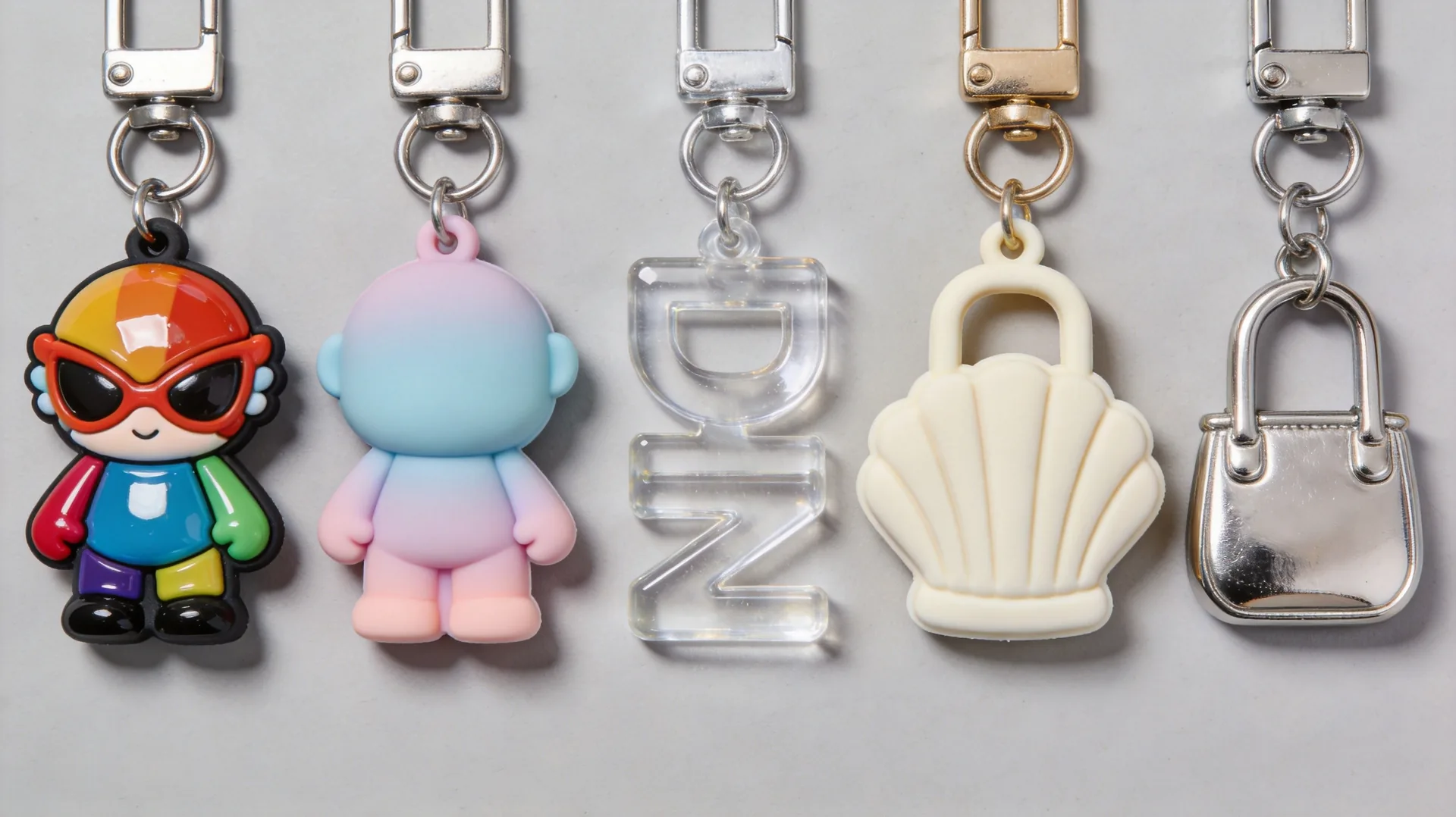
Charm material comparison — PVC, silicone, acrylic, EVA and zinc alloy charm samples side by side with close-up texture detail
3. Fitting Standards: How the Charm Attaches and Stays Attached
A charm that falls off generates a complaint, a replacement, and a review that mentions the word “cheap.” The fitting is where that is decided, and there are four options.
| Fitting type | How it works | Retention | Best for |
|---|---|---|---|
| Single-post friction | One stem pressed through the hole, held by a wider cap | Adequate for light PVC charms; degrades with repeated removal | Standard PVC collections on hole-punched totes |
| Dual-post | Two stems through two adjacent holes | Higher retention, resists rotation, harder to remove | Premium charms, larger designs, kids’ products |
| Clasp or split ring | Metal ring threaded through a loop on the charm | Very high retention, fully removable | Metal charms, keyring formats, handbag charms |
| Magnetic | Embedded magnet pair | Clean look, no visible post | Novelty and gift formats; not suitable for children’s products |
Two engineering points worth stating plainly.
Post diameter and cap geometry matter more than charm design. The post has to match the hole diameter on the tote within a tolerance, and the cap has to be wide enough that the charm does not pull through under load. We test insertion and removal force on pre-production samples rather than relying on nominal dimensions, because mold shrinkage moves these numbers.
Removal force is a compliance parameter, not just a usability one. If the product could be used by children, a charm that detaches too easily is a small-parts choking hazard, and one that is too difficult to remove fails usability. We test to the applicable standard for the target market and report the measured force.
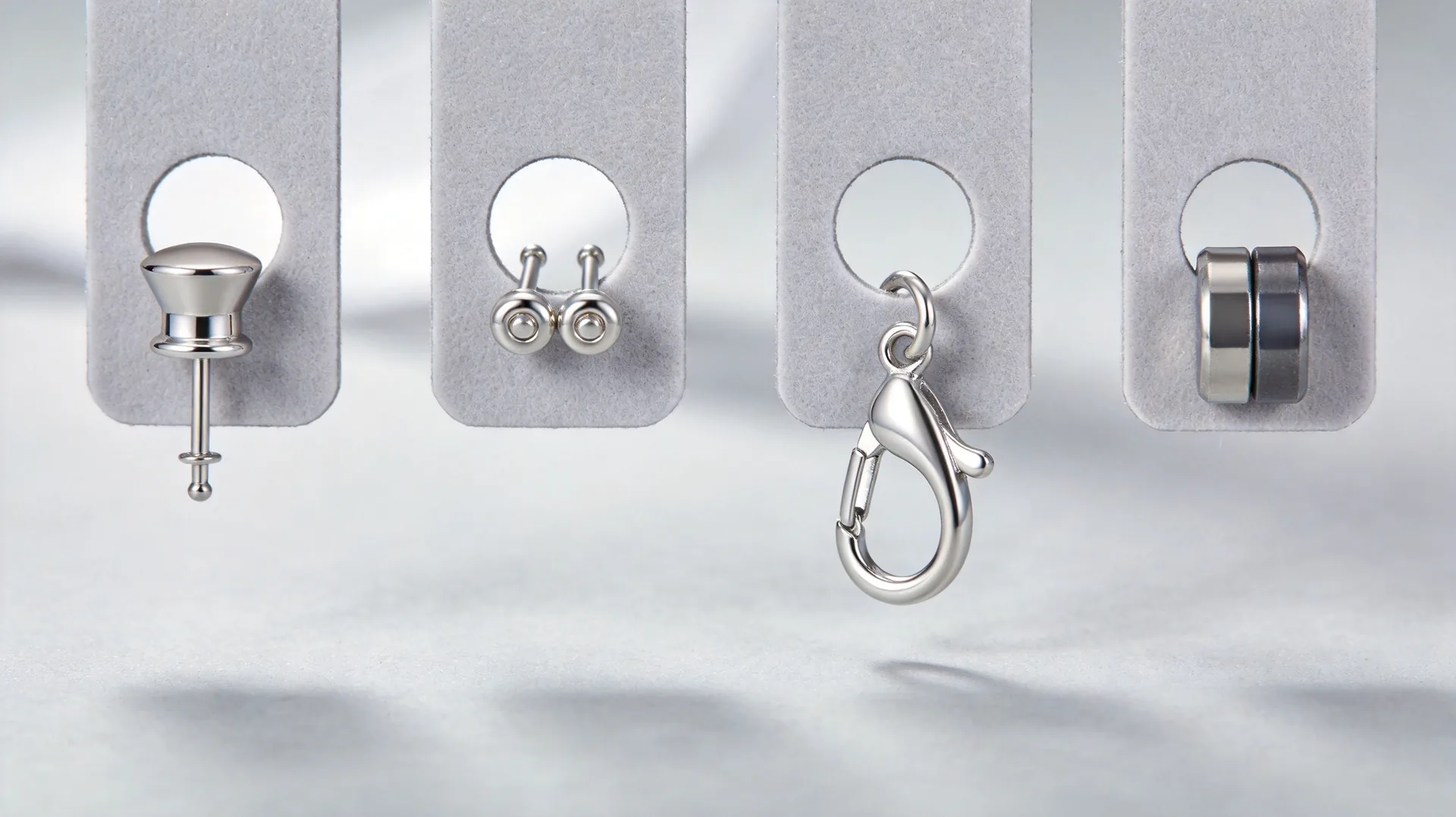
Charm fitting mechanisms — single-post friction, dual-post, metal split ring with clasp and magnetic pair shown on a molded EVA panel
4. Decoration and Color: How Detail Gets Onto a Charm
Charm value is largely visual, so decoration capability determines what designs are possible.
Multi-color injection. The cleanest result for character and logo charms. Each color is a separate shot into the same mold, so colors are integral to the material rather than applied. Tooling is more complex and cost scales with color count, but the result does not wear off.
UV printing. Full-color digital printing onto a flat or slightly curved surface, with a clear coat. Excellent for photographic or gradient artwork and for short runs where injection tooling for each color is not justified. Abrasion resistance depends entirely on the clear coat, so specify it.
Pad printing and silkscreen. Cost-effective for one to three solid colors and simple shapes. On a textured or curved charm, artwork needs a flat land area designed into the mold.
Water transfer printing. Suitable for wrapping artwork around complex three-dimensional shapes. Less durable than integral color but effective for organic forms.
Two-tone and overmold. A hard acrylic or metal base with a soft PVC or silicone overmold produces a premium tactile result and is the standard technique for high-end logo charms.
Color matching. Pantone matching is available on volume orders across all materials. Note that the same Pantone reference renders differently on matte silicone, glossy acrylic, and plated metal, so approval should be against a physical sample in the final material, not against a screen proof.
Charm decoration techniques — multi-color injection, UV print, pad print and two-tone overmold samples with detail close-ups
5. Charm Program Formats: What a Collection Actually Looks Like
A charm program is a merchandising decision before it is a manufacturing one. Four formats cover most of what we produce.
Character and animal series. Six to twelve designs released as a set, often with one or two “rare” designs to drive collection behavior. Highest engagement format for consumer brands.
Alphabet and initial charms. A full A–Z set, usually acrylic or silicone. Strong for gift and personalization positioning, and the breadth of the set means a customer can always find a reason to add one more.
Seasonal and holiday drops. Limited runs tied to summer, back-to-school, or year-end gifting. Short tooling life is acceptable here because the value is in the timing, and pad print or UV print keeps per-design tooling low.
Logo and corporate charms. Single-design programs for promotional use, retail partners, or brand-identity accessories. Often produced in metal for a premium feel, or in EVA to match the tote exactly.
Floral, shell, and coastal motifs. The natural fit for beach tote programs, and the format most buyers start with because the design language is already established by the tote.
6. Quality Control and Test Protocol
Finished goods are inspected to AQL 2.5 major / 4.0 minor, consistent with the standard most US and EU retail buyers specify. Charms need additional functional and safety testing that a general bag inspection does not cover.
Incoming material: Plasticizer and phthalate screening on soft PVC lots; durometer check on silicone; plating thickness verification on metal; color match against the approved physical standard.
In-process: Post diameter and cap dimension check against tolerance; fitting retention check on a sample basis during assembly; decoration adhesion test on printed and coated surfaces.
Pre-production and pilot: Insertion and removal force measurement; small-parts test where the target market requires it; pull test on clasps and rings for metal formats; abrasion test on printed surfaces; aging and UV exposure check on colored material.
Final inspection: AQL 2.5/4.0 sampling on appearance, color consistency, decoration registration, fitting function, and packing accuracy, plus a dimensional check on the post and cap.
Test results are reported on the pre-production sample. If a fitting measures outside tolerance or a printed surface fails abrasion, that goes into the sample report and drives a tooling or process change before bulk.
7. MOQ, Sampling and Lead Times
| Stage | Standard | Notes |
|---|---|---|
| MOQ | 500 pcs per design | Mixed designs within a collection are accepted; each design carries its own minimum |
| Sampling | 6–10 days | Includes mold sourcing or existing-mold selection, material, and decoration |
| Sample fee | Charged, refunded against first bulk order | Covers mold time, material, and courier |
| Bulk production | 35–50 days after sample approval | New mold lead time is additional |
| Tooling | Quoted per design | Small molds amortize quickly against 500-piece runs |
| Repeat order | Shorter than first run | No new sampling if the design and material are unchanged |
A note on how charm MOQ works in practice: because each design needs its own mold, the 500-piece minimum applies per design, not per collection. A ten-design collection at 500 pieces each is a 5,000-piece program. Buyers testing a market often start with three or four designs and expand once sell-through data is in — which is the correct sequence, since charm performance is more design-dependent than almost any other bag category.
8. Compliance: What Actually Gets Checked on a Charm
A charm is a small part, and small parts attract regulatory attention. The applicable requirements depend on who the product is for and where it sells.
Phthalates and plasticizers (soft PVC). The most scrutinized parameter in this category. CPSIA limits apply for the US children’s market, and REACH restricts specific phthalates for the EU. Silicone avoids the issue entirely, which is why it is the lower-risk material choice for children’s ranges.
Heavy metals. Lead and cadmium limits apply to substrate and to surface coatings, so plated and painted charms need substrate and coating tested separately.
Small parts and choking hazard. If the product is intended for or could reasonably be used by children under three, small-parts requirements apply and a charm that detaches under a defined force is non-compliant. This is the single most common compliance problem in charm programs, and it is decided by fitting design, not by testing.
Nickel release. Applies to metal fittings that contact skin — clasps, rings, and posts. Nickel-free plating or a barrier coating resolves it.
Age labeling. The cheapest compliance decision is made at the positioning stage. A charm collection marketed to adults avoids the children’s product framework entirely; a collection with cartoon animals and bright colors may reasonably be seen as appealing to children regardless of stated age grading.
We prepare the documentation package and coordinate third-party laboratory testing through accredited facilities at the buyer’s direction. Certificates are issued by the testing laboratory, not by us.
9. Cost Drivers: What Moves Charm Unit Price
Charm pricing is driven by tooling and decoration more than by material volume. Five variables account for most of the spread.
Number of designs. Each design needs its own mold. A ten-design collection carries ten tooling costs, which is why program structure matters more than per-unit material cost at this scale.
Color count on injection. Multi-color injection requires a more complex mold and more shots. Moving from one color to four can multiply mold cost, so UV printing is often the better economic answer for full-color artwork on lower volumes.
Material choice. Silicone costs more than soft PVC. Zinc alloy costs substantially more than both, and adds plating and weight.
Fitting complexity. A single-post friction fitting is the cheapest. Dual-post requires a second post and matching cap. Clasp and split-ring formats add a purchased hardware component and an assembly step.
Compliance testing scope. Testing per material, per color, and per component adds up. Consolidating to fewer materials across a collection reduces testing cost meaningfully — a practical reason to standardize a collection on one or two materials rather than five.
10. Pairing Charms With Your Tote Program
The commercial case for charms is strongest when they are sourced alongside the tote rather than separately, and there are four concrete advantages.
Single freight cycle. Charms ship in the same container as the totes, which eliminates a separate freight and customs entry for a low-value shipment.
Consolidated inspection. One AQL inspection covers both, rather than two separate inspections with two sets of travel and reporting costs.
Matched color and finish. When the charm and the tote are produced against the same physical color standard, the set reads as designed rather than assembled. This is difficult to achieve when sourcing from two suppliers.
Coordinated launch. Production schedules align, so the charm collection lands with the tote rather than after it — which matters when the tote is the traffic driver and the charm is the conversion.
We produce both, which means a combined program is a single project brief, a single sample round, and a single production schedule.
11. How to Brief a Charm Collection
Eight items get you an accurate quotation. Missing any of them usually produces a range too wide to plan against.
- Number of designs and whether artwork exists or needs development
- Material — PVC, silicone, acrylic, EVA, or metal, per design
- Fitting type — single-post, dual-post, clasp, or magnetic
- Size range and any maximum dimension
- Color — Pantone references and color count per design
- Decoration method — multi-color injection, UV print, pad print, or overmold
- Target market and age positioning — this determines the compliance path
- Program — quantity per design, whether it ships with a tote order, and required certification
- Molded EVA beach totes — the category the charms are designed to accessorize, with the same shell engineering
- EVA LED mirror makeup bags — the second high-growth EVA category, using the same molding capability
- Custom cosmetic and makeup bags — soft-shell, quilted, PVC, and brush-roll formats
- Custom beach bags — mesh, canvas, and laminated totes for resort and promotional programs
Send those with artwork or reference images and we return a specification-matched quotation with material options, tooling cost per design, decoration cost, and lead time, typically within one to two business days.
12. Frequently Asked Questions
Explore Our Other Custom Bag Lines
Our charm and tote programs share materials, tooling capacity, and inspection teams, which is why combined ordering is practical rather than theoretical. Related lines:
Start Your Charm Collection
Send the eight-item brief above with artwork or reference images and we will return a specification-matched quotation with material options, tooling cost per design, and lead time. If you are still choosing between materials, tell us your target market and retail price and we will recommend the configuration that holds margin after compliance testing.
Contact: [email protected] | WhatsApp / Phone: +86 17750020688
JUNYUAN BAGS — Custom bag manufacturing since 2014, Quanzhou, Fujian, China.