
Why Tool Backpacks Demand a Completely Different Manufacturing Approach
An industrial tool backpack must withstand conditions that would destroy a standard backpack in weeks: dropped onto concrete job sites, loaded with 15–25kg of steel tools, exposed to water, chemicals, and UV daily, and expected to perform for 2–5 years. According to the 2024 Work Equipment Durability Survey by ProTool Reviews, 78% of professional tradespeople have experienced a tool bag failure within the first year—most commonly bottom panel blowout, zipper failure under load, and strap detachment.
For brands and distributors sourcing tool backpacks, this means your manufacturing specifications must be engineered to a fundamentally higher standard than consumer backpacks. At Junyuan Bags, we manufacture tool bags and tool backpacks for professional-grade brands across North America and Europe. This guide covers the complete manufacturing landscape—from fabric selection and tool pocket system design to load-bearing construction, drop testing, and OEM customization.
If you are developing a custom tool bag line, expanding an existing brand into the industrial category, or evaluating factory capabilities for heavy-duty bag manufacturing, this pillar page provides the technical detail you need to make informed sourcing decisions.
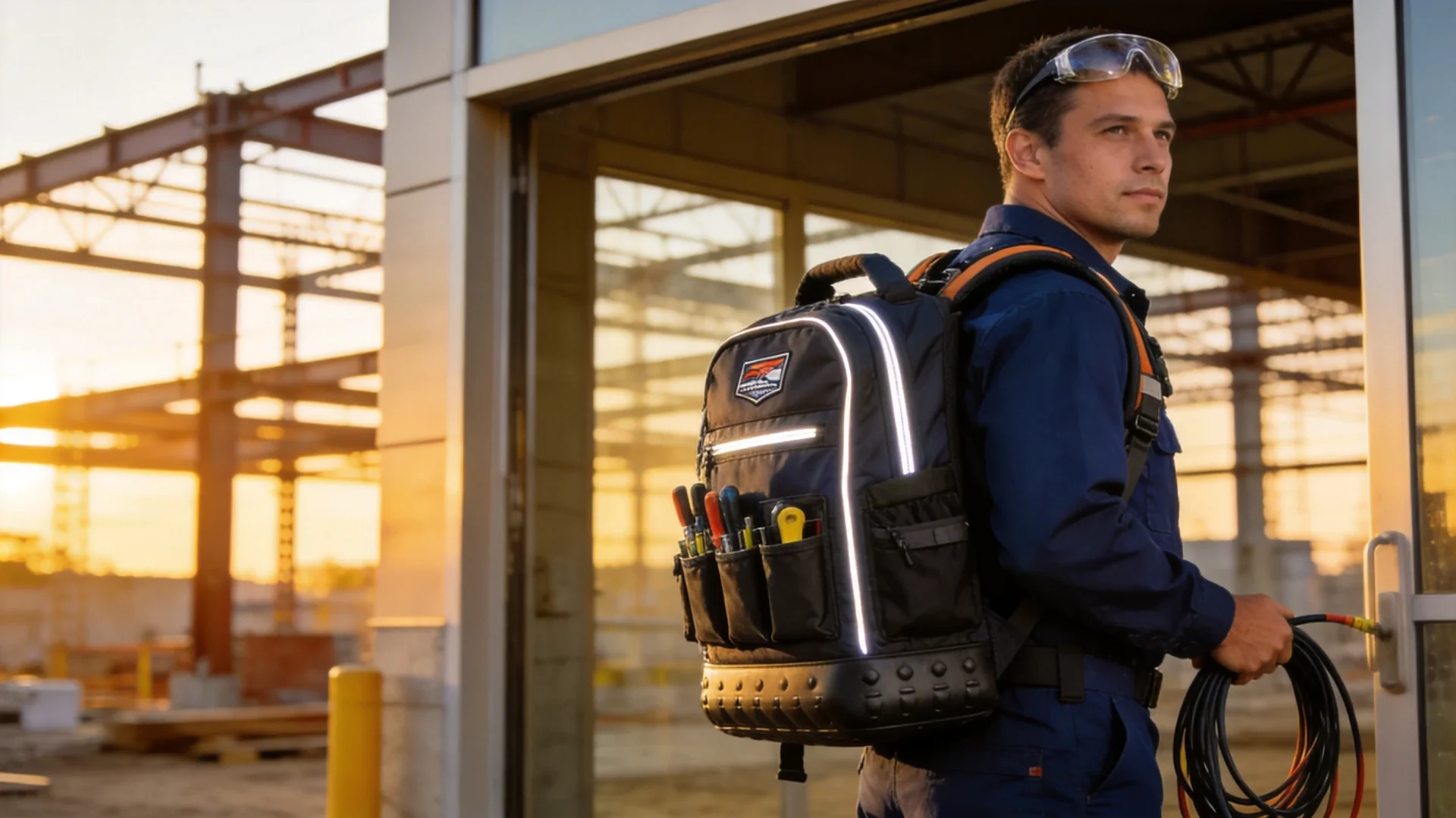
Tool Backpack vs. Standard Backpack: Key Manufacturing Differences
Manufacturers who produce only consumer backpacks often underestimate the engineering gap between a commuter pack and a professional tool backpack. Here are the fundamental differences:
| Attribute | Standard Backpack | Industrial Tool Backpack |
|---|---|---|
| Shell Fabric | 300D–600D polyester | 1680D ballistic nylon or 1000D Cordura |
| Base Material | Same fabric or light padding | Molded EVA/TPU base plate or rubber-coated panel |
| Max Load | 5–8 kg | 15–25 kg |
| Zipper Grade | #5 nylon coil | #8–#10 YKK heavy-duty or #10 coil with metal sliders |
| Strap Attachment | Bar tack to fabric panel | Webbing through-load to base plate, riveted stress points |
| Internal Organization | 2–6 pockets, mesh | 15–40 pockets, reinforced dividers, tool-specific slots |
| Seam Construction | Single-needle lockstitch | Double-needle with bartack at all stress points |
| Expected Lifespan | 1–2 years | 3–5+ years |
| Testing Standard | Light load, gentle use | Drop tests, static load, abrasion cycle, water exposure |
These differences translate directly into higher material costs, more labor-intensive assembly, and more rigorous testing—but they are non-negotiable for any bag that will carry professional tools on a job site.
Heavy-Duty Fabric Options for Tool Backpacks
The shell fabric is the single most important material decision for a tool backpack. Here is what we stock and recommend at our Quanzhou manufacturing facility:
1680D Ballistic Nylon — The Industry Standard
Originally developed for WWII flak jackets, 1680D ballistic nylon is the dominant fabric for professional tool bags. Its characteristics:
- Tensile strength: 350–450 lbs (warp) / 250–350 lbs (fill)
- Abrasion resistance: 15,000+ cycles (Taber test)
- Weight: 340–400 gsm
- Typical coating: PU or PVC backing for water resistance
- Cost: ¥18–30/meter ($2.50–$4.20/m)
1680D ballistic nylon is our default recommendation for any tool bag program. It provides the best balance of durability, sewability, and cost in the heavy-duty category.
1000D Cordura Nylon — Premium Option
Invista’s Cordura 1000D is the gold standard for military and tactical applications. Compared to generic 1680D:
- Better abrasion resistance (2x–3x generic nylon)
- More consistent yarn quality and color fastness
- Recognizable brand name for marketing
- Cost: ¥25–45/meter ($3.50–$6.20/m) — roughly 50–70% more than 1680D
600D Polyester — Budget Option for Light-Duty
For tool bags marketed to DIY homeowners rather than professional tradespeople, 600D polyester is a viable lower-cost option. It handles 8–12kg loads adequately but will show wear faster than nylon options. Cost: ¥8–14/meter.
Hybrid Constructions
Many of the best-selling tool backpacks use hybrid fabric constructions:
- 1680D nylon on the bottom panel and lower sides (highest abrasion zone)
- 1000D or 1680D nylon on the exterior front and sides
- 420D or 600D polyester on the interior (pocket dividers, lining)
This approach optimizes cost by placing the most expensive fabric only where it is needed most.
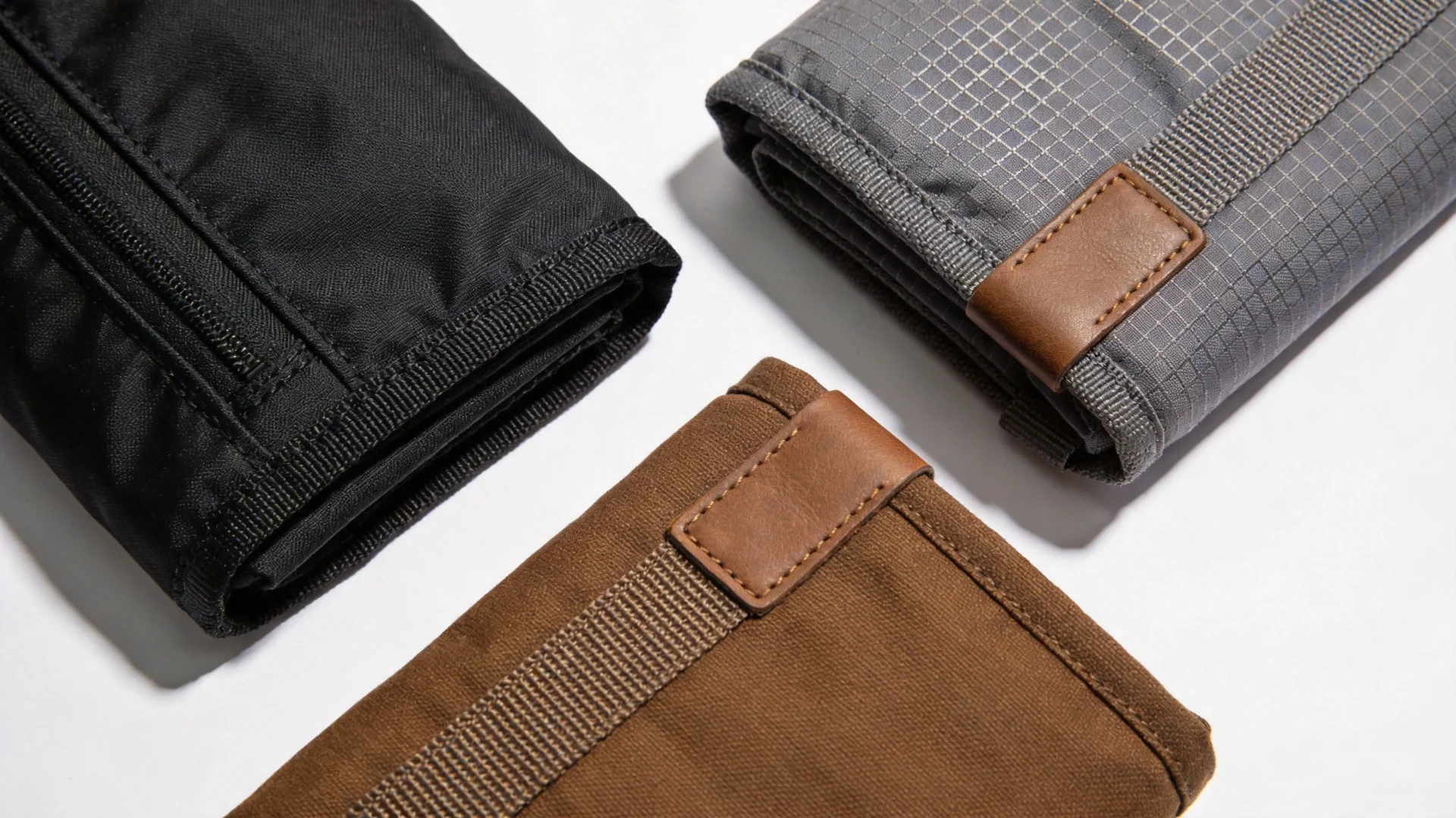
Base Panel and Bottom Construction: Where Most Tool Bags Fail
The bottom panel of a tool backpack absorbs the majority of impact and abrasion forces. It is the single most common failure point in inferior tool bags. At Junyuan Bags, we offer three base construction options:
Option 1: Molded EVA Base Plate
A pre-molded EVA foam sheet (3–5mm thick) encased in 1680D nylon. Provides:
- Impact absorption when set down on hard surfaces
- Structural rigidity — the bag stands upright when loaded
- Water resistance (EVA is closed-cell)
- Cost addition: $1.50–$3.00 per unit (includes mold amortization)
- Mold cost: $300–$600 (one-time, per size)
Option 2: Rubber-Coated Panel (Hypalon/TPE)
A rubber or TPE coating applied to the exterior bottom fabric. Creates a waterproof, abrasion-proof surface that grips surfaces without sliding. Common in fishing bags and marine applications as well.
- Superior abrasion resistance vs. fabric alone
- Non-slip surface
- Cost addition: $0.80–$1.50 per unit
Option 3: Reinforced Double-Layer Base
Two layers of 1680D nylon with a rigid PP (polypropylene) sheet sandwiched between. The most cost-effective option for moderate-duty use.
- Good structural rigidity
- Lower cost than molded base
- Cost addition: $0.50–$1.00 per unit
Critical Construction Detail: Base-to-Body Attachment
The seam where the base panel meets the body is the most stressed joint in a tool backpack. We use the following construction:
- Double-needle lockstitch (type 401) for the primary seam
- Bartack reinforcement at all four corners
- Internal webbing reinforcement strip sewn along the seam
- Optional: riveted corners for maximum durability (adds $0.15–$0.30/unit in hardware and labor)
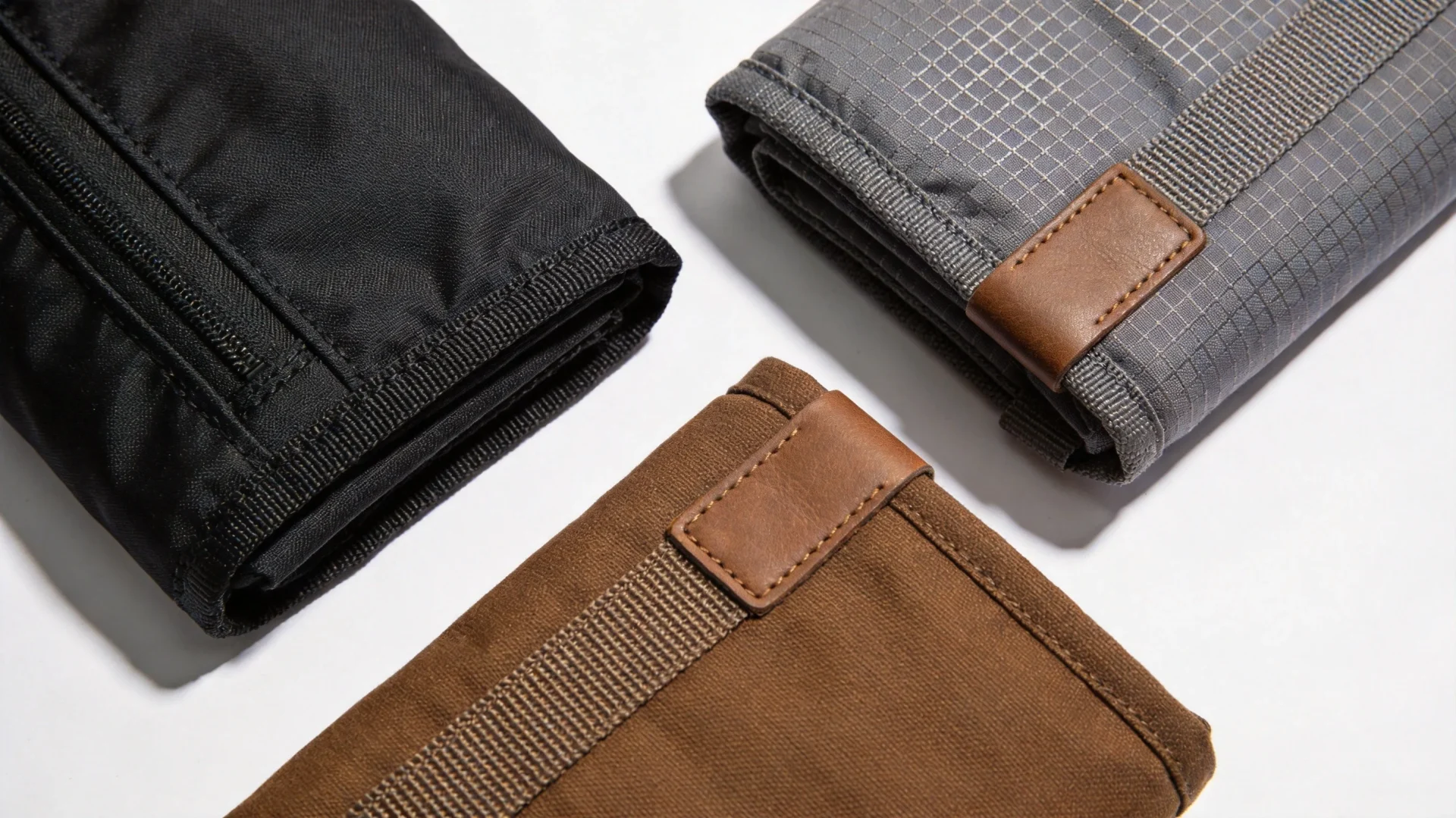
Tool Pocket Systems: Design for Function and Organization
The tool pocket system is what transforms a generic heavy-duty bag into a professional tool backpack. It must accommodate specific tool types, allow quick visual identification, and withstand repeated tool insertion/removal over thousands of cycles.
Common Tool Pocket Configurations
| Pocket Type | Tool It Holds | Construction Requirements |
|---|---|---|
| Elastic loop strip | Screwdrivers, pliers, pencils | Elastic webbing sewn to rigid backing; 10–20 loops per strip |
| Reinforced slip pocket | Tape measures, levels, markers | Double-layer fabric, open top, reinforced mouth |
| Zippered mesh pocket | Small parts, fasteners, bits | Heavy-duty mesh (not standard—use PVC-coated polyester mesh) |
| Tool-specific sleeve | Drills, impact drivers | Padded sleeve with elastic retention strap |
| Exterior molle/webbing grid | Custom attachment via clips | Laser-cut molle or sewn webbing ladder on exterior |
| Heavy-duty hook loop | Cables, extension cords | Internal D-ring with elastic retention |
Electrician-Specific Pocket Layout
Electrician tool backpacks require specialized pocket configurations for wire strippers, crimpers, multimeters, and wire connectors. Key features:
- Dedicated multimeter sleeve with foam padding (protects $200+ instrument)
- Elastic loop strips sized for 8–12 screwdrivers/nut drivers
- Separate compartment for live/dead wire storage (safety-critical)
- Exterior clip point for wire pulling lubricant or fish tape
Machine Mechanic / HVAC-Specific Layout
Mechanic and HVAC tool backpacks prioritize different tools:
- Wrench roll or wrench-specific dividers (8–15 wrenches)
- Socket organization system (ratchet, extensions, socket sizes)
- Heavy-duty bottom pocket for impact wrench (4+ kg tool)
- Reinforced exterior attachment points for ladder hooks or carabiners
For brands developing trade-specific tool bag lines, we recommend creating separate pocket templates per trade. The same backpack body can accommodate different internal pocket modules—this is our standard approach for custom tool bag OEM programs serving multiple trade segments.
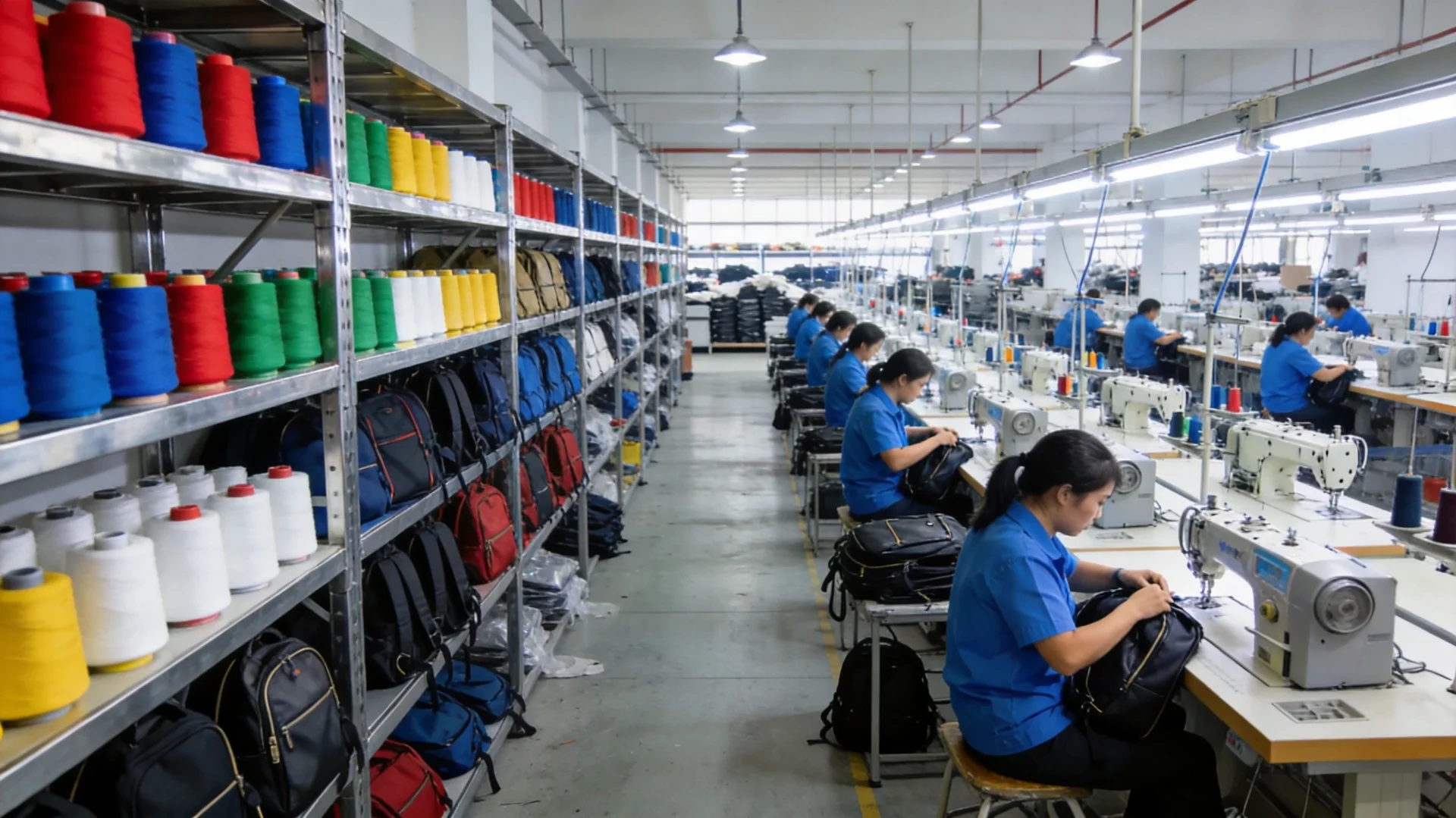
Load-Bearing Construction: Straps, Harness, and Weight Distribution
A loaded tool backpack can weigh 15–25 kg. Standard backpack straps and harness systems are not engineered for this weight range. Tool backpacks require:
Strap Attachment Method
The most critical structural element. We use a “through-load” attachment system:
- Webbing passes through the base plate (not sewn to fabric alone)
- Load is transferred directly to the rigid base, not to the fabric seams
- Reinforced with metal rivets at the webbing-base junction
- This system withstands 50+ kg static load without failure
In contrast, budget tool bags sew straps directly to the back panel fabric. This creates a tear-out risk at 20+ kg loads and is responsible for the most dangerous tool bag failures (strap separation while carrying heavy tools overhead).
Sternum Strap and Waist Belt
For tool backpacks expected to carry 15kg+, we recommend:
- Adjustable sternum strap (reduces shoulder strain by 25–30%)
- Optional removable waist belt (transfers 40–50% of load to hips)
- These features are common in hiking backpack designs and should be adapted for heavy tool loads
Back Panel Ventilation
Tool backpacks are often worn for extended periods in hot environments. A channeled air-flow back panel (similar to outdoor backpack designs) significantly improves comfort and is increasingly expected in premium tool bag lines.
Testing Standards for Industrial Tool Backpacks
Professional tool backpacks must pass testing protocols that are far more rigorous than consumer backpacks. At Junyuan Bags, we enforce the following test protocols:
| Test | Method | Pass Criteria | Standard Reference |
|---|---|---|---|
| Static Load Test | 25 kg loaded, suspended for 72 hours | No seam failure, no strap elongation beyond 5% | Internal standard (exceeds EN 1705) |
| Drop Test | Loaded (15 kg) dropped from 1.2m onto concrete, 6 faces | No structural failure, no zipper burst | ISTA 3A (modified) |
| Zipper Cycle Test | 5,000 open/close under load (10 kg inside) | No tooth separation, no slider failure | ASTM D2061 |
| Abrasion Test (Base) | Base panel on sandpaper, 10 kg load, 500 cycles | No fabric breakthrough | ASTM D3886 |
| Strap Pull Test | Strap pulled to 150% of rated load | No detachment, no webbing tear | Internal standard |
| Water Resistance | Simulated rain exposure for 30 minutes | Interior remains dry (or acceptable moisture level) | ISO 4920 |
| UV Resistance | 200 hours UV exposure (xenon arc) | Less than 20% tensile strength loss | ASTM G155 |
These tests are performed on every new tool backpack design during the sampling phase, and on AQL-sampled units during production. Our QC system maintains full documentation for client audit purposes.
OEM/ODM Customization: Developing Your Tool Backpack Line
When brands partner with us to develop custom tool bags, we follow a structured OEM/ODM development process:
Phase 1: Market and Trade Analysis
We start by understanding which trade(s) your tool bag targets:
- Electrician: Wire tools, multimeter protection, compact organization
- HVAC Technician: Refrigeration tools, gauge sets, larger compartments
- General Mechanic: Wrenches, sockets, ratchets, impact-rated pockets
- Carpenter: Measuring tools, pencils, nail sets, blade storage
- IT/AV Technician: Padded laptop/tablet sleeve, cable management, clean aesthetic
- Multi-Trade: Modular pocket system, flexible dividers
Phase 2: Design and Prototyping
Our sample room develops a functional prototype within 10–15 working days. The prototype includes:
- Exact fabric specifications (1680D or as specified)
- Full tool pocket system with trade-specific configuration
- Molded base plate (if specified)
- Strap and harness system
- Logo placement (embroidery, woven label, or heat transfer)
Phase 3: Testing and Refinement
The prototype undergoes full load and drop testing. Based on results, we may recommend:
- Additional bartack reinforcement at identified stress points
- Pocket dimension adjustments for specific tool models
- Strap padding upgrades if comfort feedback is insufficient
Phase 4: Production
Our MOQ for tool backpacks is 500 pieces per style per color, consistent with all our OEM programs. Production lead time is 35–50 days depending on complexity and quantity.
MOQ and Pricing for Tool Backpacks
Tool backpacks cost more to manufacture than standard backpacks due to heavier materials, more complex construction, and additional hardware. Here is typical pricing at our Quanzhou factory:
| Order Quantity | Standard Tool Backpack (1680D) | Premium Tool Backpack (Cordura + molded base) |
|---|---|---|
| 500–999 pcs | $15.00–$22.00 | $24.00–$34.00 |
| 1,000–2,999 pcs | $12.00–$18.00 | $20.00–$28.00 |
| 3,000+ pcs | $10.00–$15.00 | $16.00–$24.00 |
Pricing depends on pocket count, base plate type, zipper specification, and branding requirements. For a precise quotation, contact us with your specifications.
For detailed cost structure information, see our comprehensive guide on backpack manufacturing cost structure.
Emerging Trends in the Tool Backpack Market
Hard-Shell/Soft Hybrid Designs
Combining a rigid ABS or polycarbonate top panel (protecting tools from crushing) with flexible 1680D nylon sides (allowing the bag to fit in tight spaces). This hybrid approach is gaining traction in the premium segment.
Integrated Power Solutions
Tool bags with built-in USB charging ports connected to an internal battery pocket—allowing technicians to charge phones, testers, and power tools on site. Similar to the USB backpack trend in consumer markets.
RFID-Protected Tool Storage
For trades using smart tools with Bluetooth tracking (Milwaukee ONE-KEY, DeWALT Tool Connect), dedicated RFID-shielded pockets prevent signal interference during transport.
Sustainable Materials
Recycled nylon (GRS-certified) is increasingly requested for tool bags targeting environmentally conscious brands and government procurement specifications.
About Junyuan Bags — Industrial Tool Backpack OEM Partner
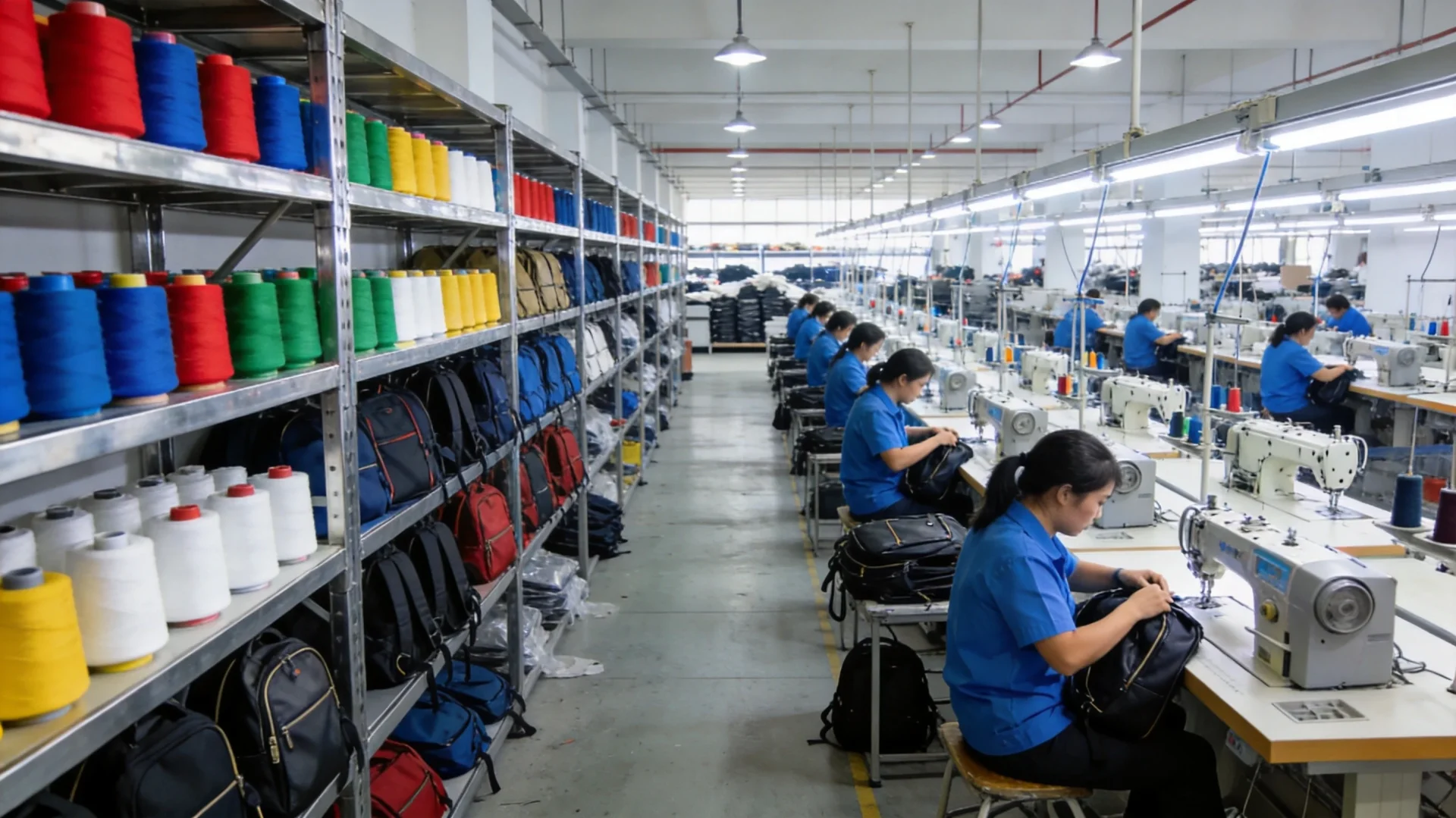
Junyuan Bags is a professional backpack OEM/ODM manufacturer located in Quanzhou, Fujian, China. Our 30,000-square-meter production facility houses 300+ skilled workers across 8 production lines, with dedicated capability for heavy-duty and industrial bag manufacturing.
Why brands choose us for tool backpack programs:
- Proven expertise in 1680D ballistic nylon and Cordura construction
- In-house mold making for EVA base plates
- Trade-specific pocket engineering (electrician, HVAC, mechanic, carpenter)
- Full testing capability (drop test, static load, zipper cycle, abrasion)
- MOQ 500 pcs/style—accessible for growing tool brands
- OEM/ODM support from concept to production
We also manufacture outdoor backpacks, hiking backpacks, anti-theft backpacks, fishing bags, hydration packs, and waterproof backpacks.
Designing Tool Backpacks for Specific End-User Scenarios
One of the most important decisions in custom tool bag development is matching the bag’s design to the actual working conditions of the end user. A tool backpack designed for an electrician working in finished homes has very different requirements from one designed for a carpenter on a rough construction site. At Junyuan Bags, we work with brands to segment their target user and design accordingly.
Scenario 1: Electrician — Precision Tool Protection
Electricians carry expensive, precision instruments (multimeters, wire trackers, laser levels) alongside hand tools. Their backpacks need:
- Padded, shock-absorbing compartments for electronics (minimum 15mm foam padding)
- Elastic loop strips for organized screwdriver and nut driver storage (typically 12–20 loops)
- A dedicated wire connector pouch with clear PVC window for quick visual identification
- Water-resistant exterior to protect tools when working in damp crawl spaces or outdoors
- Bright interior lining (yellow or orange) for visibility in dark work areas
For water-resistant construction, we recommend seam-sealed 1680D nylon with YKK AquaGuard zippers on the main compartment. This adds $2.50–$4.00 to unit cost but provides critical protection for $300+ worth of tools.
Scenario 2: HVAC Technician — Climate and Chemical Exposure
HVAC technicians work in extreme temperatures (attics in summer, crawl spaces in winter) and handle chemical refrigerants. Their backpacks require:
- Chemical-resistant bottom panel (refrigerant oil and flux corrode standard fabrics)
- Insulated side pocket for water bottles (working in heat demands hydration access)
- Reinforced exterior attachment points for manifold gauge sets
- Ventilated back panel mesh to reduce sweat accumulation in hot environments
Scenario 3: General Mechanic — Heavy Tool Load
Mechanics carry the heaviest tool loads—wrenches, sockets, ratchets, and impact drivers can total 20+ kg. Key requirements:
- Heavy-duty load-bearing harness (minimum 50mm wide straps with padding)
- Reinforced bottom with molded EVA base plate
- Wrench roll or individual wrench dividers that prevent tools from clanging together
- Side compression straps to stabilize load during movement
For these heavy-load applications, we recommend the same construction approach used in our hiking backpack programs—internal load distribution frames and padded hip belts. This adds $3.00–$5.00 per unit but dramatically reduces user fatigue and extends bag life.
Customization Flexibility
At our Quanzhou factory, we maintain pocket template sets for each trade scenario. Brands can select a base backpack body and customize the internal pocket module per trade, reducing development time from 4 weeks to 1 week for pocket configuration changes. This modular approach is particularly effective for brands launching multi-trade product lines simultaneously.
Frequently Asked Questions
What fabric is best for a professional tool backpack?
1680D ballistic nylon is the industry standard for professional tool backpacks, offering the best balance of durability, abrasion resistance, and cost. For premium lines, 1000D Cordura nylon provides superior performance. For budget lines targeting DIY users, 600D polyester is acceptable. The base panel should always use reinforced construction with a molded EVA or rubber-coated surface.
How much does a custom tool backpack cost to manufacture?
A standard 1680D tool backpack costs $15–$26 per unit (FOB China) at 500–1,000 piece quantities. Premium versions with Cordura fabric, molded base plate, and 25+ pockets range from $24–$40. At volume (3,000+ pieces), costs drop to $10–$24 depending on specifications. For a full cost breakdown, see our backpack manufacturing cost guide.
Can you design tool pockets for specific tools?
Yes. We engineer pocket systems based on the specific tools your target users carry. Send us a tool list (with dimensions), and our pattern team will design a pocket layout that accommodates each tool securely. This is standard in our custom tool bag OEM programs.
What is the minimum order quantity for tool backpacks?
Our MOQ for tool backpacks is 500 pieces per style per color. This is the same MOQ we apply across all our OEM backpack programs, making it accessible for brands launching new product lines.
How do you ensure tool backpacks can handle heavy loads?
We use a through-load strap attachment system where webbing passes through the rigid base plate, transferring load directly to the base rather than to fabric seams. All stress points are bartack-reinforced. Every new design undergoes 25kg static load testing (72-hour suspension) and 1.2m drop testing before approval for production.
What testing standards do tool backpacks need to pass?
Professional tool backpacks should pass static load testing (25kg for 72 hours), drop testing (1.2m onto concrete), zipper cycle testing (5,000 cycles under load), base abrasion testing, and strap pull testing. At Junyuan Bags, we perform all these tests in-house and provide full documentation.
Can the same tool backpack body be used for different trade-specific versions?
Yes. We frequently produce the same backpack body with different internal pocket modules for different trades—for example, the same exterior shell with an electrician pocket configuration (elastic loop strips, multimeter sleeve) and a mechanic configuration (wrench dividers, socket organizers). This approach reduces tooling costs and simplifies inventory management.
What quality control and warranty do you offer on custom tool backpacks?
All production runs are inspected to an ANSI/ASQ Z1.4 sampling plan at AQL 2.5 across critical and major defect classes. Every custom tool backpack we manufacture is backed by a 12-month warranty covering workmanship and material defects. Sampling and pilot-run feedback are shared with you before bulk production begins, so quality parameters are locked in early.
Start Your Custom Tool Backpack Project
Ready to develop a professional-grade tool backpack that your customers will depend on every day? Our engineering team has the expertise to design pocket systems, select the right materials, and build bags that pass the most demanding field conditions.
Contact Junyuan Bags:
- Email: [email protected]
- WhatsApp: +86 17750020688
- Factory: Quanzhou, Fujian, China
- MOQ: 500 pcs/style
Related manufacturing guides: