
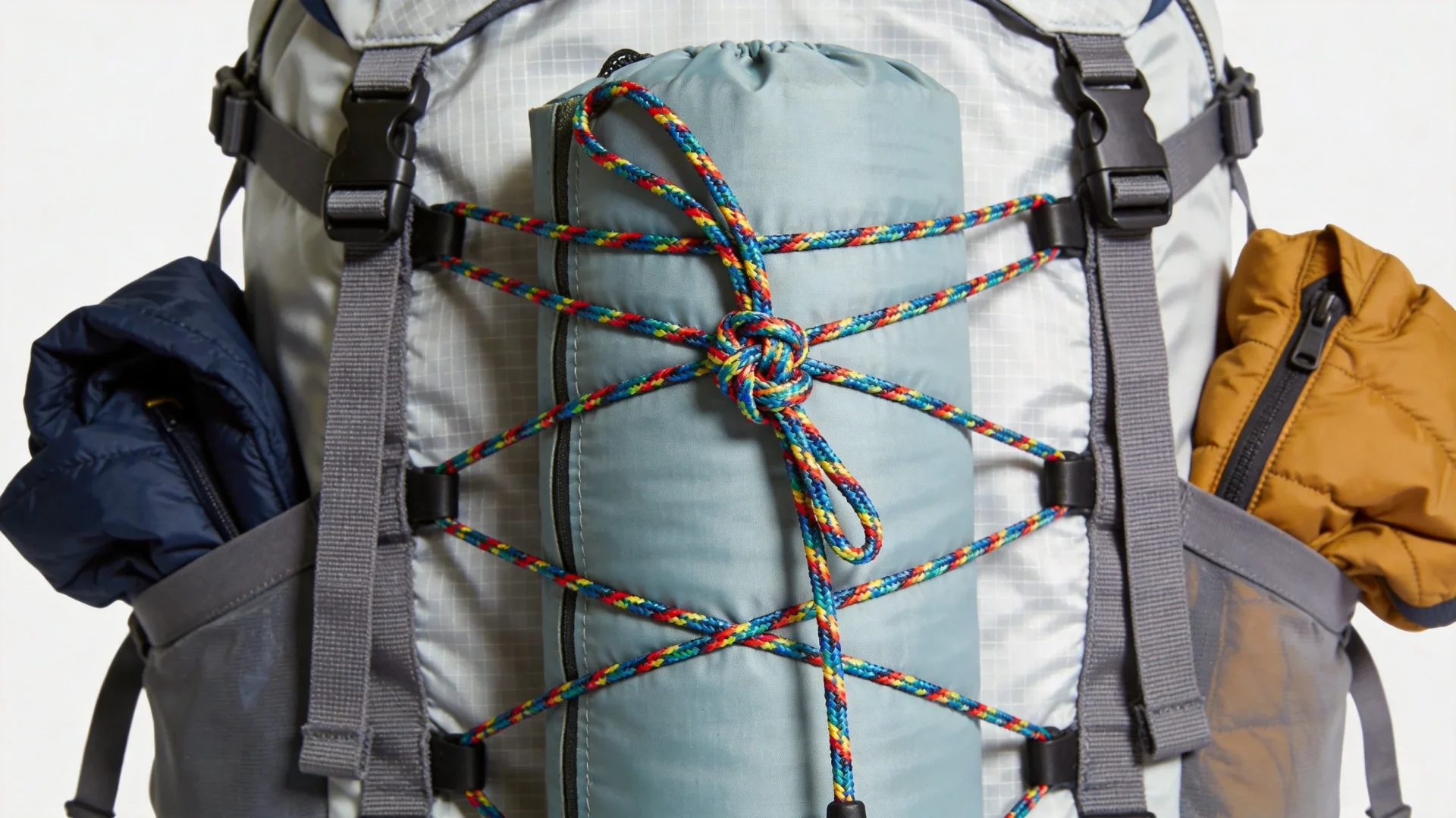
Bungee Cord System on Backpacks: Design Engineering, Attachment Methods & OEM Manufacturing Guide (2026)
The elastic bungee cord system on a backpack appears deceptively simple — a stretchy rope threaded through attachment points. Yet behind this minimalist component lies a complex engineering ecosystem involving rubber science, textile weaving, metal hardware, and precision assembly. For B2B buyers and brand owners developing outdoor, tactical, or commuter backpack lines, understanding the bungee cord system’s design parameters, material specifications, and manufacturing requirements is essential for differentiating products and avoiding costly warranty claims.
At JUNYUAN Bags, we have manufactured bungee cord systems on over 2 million backpacks across hiking, cycling, tactical, and commuter categories. Based in Quanzhou, Fujian with expertise dating from 2004 in OEM/ODM manufacturing experience, we have refined every aspect of this system — from the rubber core compound to the heat-shrink tube sealing process. This comprehensive guide covers everything procurement managers and product designers need to know.
1. Functional Purpose: Why Every Backpack Needs a Bungee Cord System
Before diving into specifications, it is worth understanding the three core functions a bungee cord system serves on a backpack — each with distinct engineering requirements.
1.1 External Gear Attachment
The most common use: securing items too large, wet, or bulky for the main compartment. A sleeping pad, yoga mat, tent poles, foam roller, or wet jacket can be strapped to the exterior in seconds. The bungee cord must provide sufficient clamping force (typically 15–40N depending on cord diameter) without stretching permanently over repeated use cycles.
1.2 Quick-Access Storage
Items needed during activity — a rain jacket, map, snack, water bottle — can be tucked under the bungee cord for immediate retrieval without opening zippers or unbuckling lids. This function prioritizes ease of insertion and removal over maximum clamping force.
1.3 Compression & Load Stabilization
When the main compartment is partially full, contents shift and create uncomfortable movement against the spine. Bungee cords routed through side compression points cinch the load tighter, reducing volume by 15–25% and stabilizing the center of gravity. This function demands consistent elastic recovery — the cord must return to its original length after every compression cycle.
These three functions inform the cord diameter, length, attachment point placement, and material selection. The same bungee cord system cannot optimally serve all three functions simultaneously — design choices must be made based on the target user’s priority. This aligns with our approach to custom bag design for businesses, where function dictates form.
2. Bungee Cord Specifications: Diameter, Length & Elastic Properties
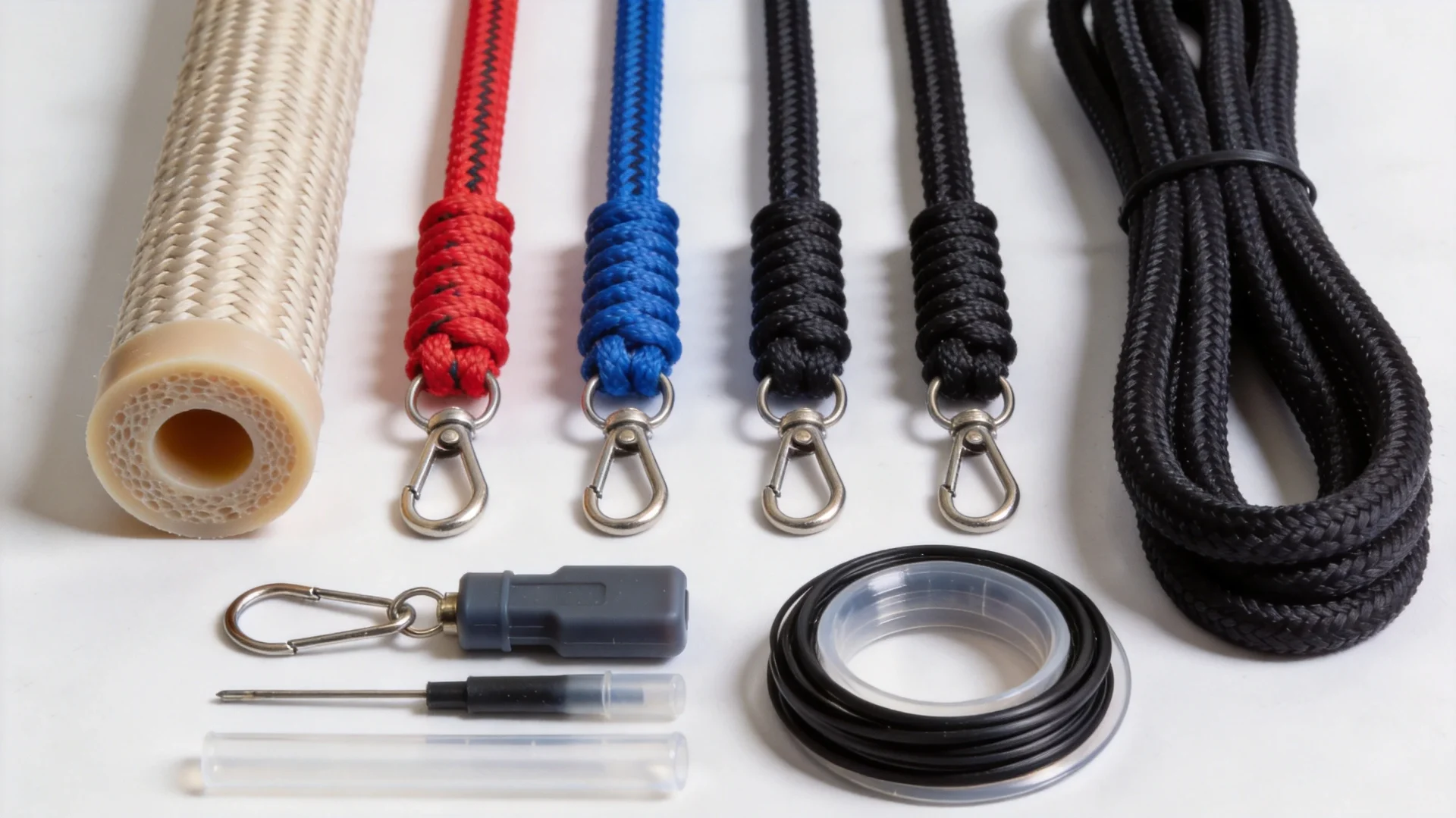
2.1 Diameter Specifications
| Cord Diameter | Clamping Force | Max Stretch | Elastic Recovery | Best Application | Cost (per meter) |
|---|---|---|---|---|---|
| 3mm | 8–15N | 150–180% | 95%+ (500 cycles) | Lightweight commuter bags, daypacks | $0.08–$0.15 |
| 4mm | 15–25N | 130–160% | 93%+ (500 cycles) | Hiking daypacks, cycling backpacks | $0.12–$0.22 |
| 5mm | 25–40N | 120–150% | 90%+ (500 cycles) | Full-size hiking packs, tactical bags | $0.18–$0.35 |
| 6mm | 40–65N | 100–130% | 88%+ (500 cycles) | Expedition packs, heavy-duty military | $0.25–$0.50 |
The most popular diameter for outdoor backpacks is 4mm — it offers the best balance of grip force, stretch range, and visual proportionality to typical bag hardware. For tactical backpacks, 5mm is preferred for its aggressive clamping force on MOLLE-compatible pouches.
2.2 Length Calculation
Bungee cord length must be calculated based on the distance between attachment points, the desired working stretch (typically 30–50% of free length), and the items to be secured. The formula:
At JUNYUAN, we provide cord length calculators to our OEM clients during the sample development phase to optimize cord length before committing to production cuts.
2.3 Elastic Coefficient (Spring Rate)
The elastic coefficient, measured in N/cm of elongation, determines how much force the cord exerts at a given stretch. This is controlled by the rubber core’s cross-section and compound formula:
- High-elastic cord (0.8–1.5 N/cm): Softer grip, easier to hook items under. Preferred for commuter and casual use.
- Medium-elastic cord (1.5–2.5 N/cm): Balanced performance. Standard for most hiking backpacks.
- High-tension cord (2.5–4.0 N/cm): Firm grip, harder to stretch. Used for tactical and load compression applications.
3. Material Science: Natural Rubber Core & Braided Outer Sheath
3.1 Core Material — Natural Rubber (NR) vs. Synthetic Rubber
The core of every bungee cord is the elastic element. We use three core materials depending on performance requirements:
| Core Material | Elastic Recovery | UV Resistance | Temperature Range | Cost |
|---|---|---|---|---|
| Natural Rubber (NR) | Excellent (95%+) | Poor (degrades in 6 months UV) | -20°C to +60°C | $ |
| Styrene-Butadiene Rubber (SBR) | Good (90%+) | Moderate | -30°C to +70°C | $$ |
| Silicone Rubber | Fair (85%+) | Excellent | -50°C to +200°C | $$$$ |
| NR + EPDM Blend | Very Good (93%+) | Good | -35°C to +80°C | $$$ |
For most outdoor backpack applications, the NR + EPDM blend offers the best balance of elasticity, UV resistance, and cost. Natural rubber provides the primary elastic recovery, while EPDM (ethylene propylene diene monomer) adds ozone and UV resistance — critical for bags exposed to sunlight during hiking and cycling use.
3.2 Outer Sheath — Braided Polyester vs. Nylon
The outer sheath protects the rubber core from abrasion, UV radiation, and mechanical damage. Two primary materials:
- Polyester braided sheath (most common): 48-end braiding on 3–4mm cords. Superior UV resistance (retains 80% strength after 500 hours QUV testing). Low stretch in the sheath direction ensures the cord’s elastic behavior comes from the rubber core, not the sheath. Cost: $0.03–$0.08/meter of sheath material.
- Nylon braided sheath (premium): Softer hand feel, higher abrasion resistance, but absorbs moisture (up to 4% weight gain in humid conditions). Moisture absorption causes slight dimensional change that affects cord tension. Used in marine and tactical applications where softness is valued. Cost: $0.05–$0.12/meter.
3.3 Colored & Custom Sheath Options
For branded products, the outer sheath can be dyed to match brand colors or incorporate custom patterns:
- Solid color dye: Minimum 500 meters per color. Available in Pantone-matched colors. Most popular: black, olive green, coyote brown, navy blue, and red.
- Multicolor braiding: Two or three sheath colors interwoven in a pattern. Requires reprogramming the braiding machine. Setup cost: $150–$300 per color combination. MOQ: 1,000 meters.
- Reflective thread integration: Reflective yarn woven into the braid for nighttime visibility. Adds $0.05–$0.10/meter. Mandatory for cycling backpack sold in EU markets (EN 1150 standard).
For more options on custom bag branding and hardware personalization, see our custom hardware and branding guide.
4. Attachment Point Design: D-Rings, Webbing Loops & Anchor Systems
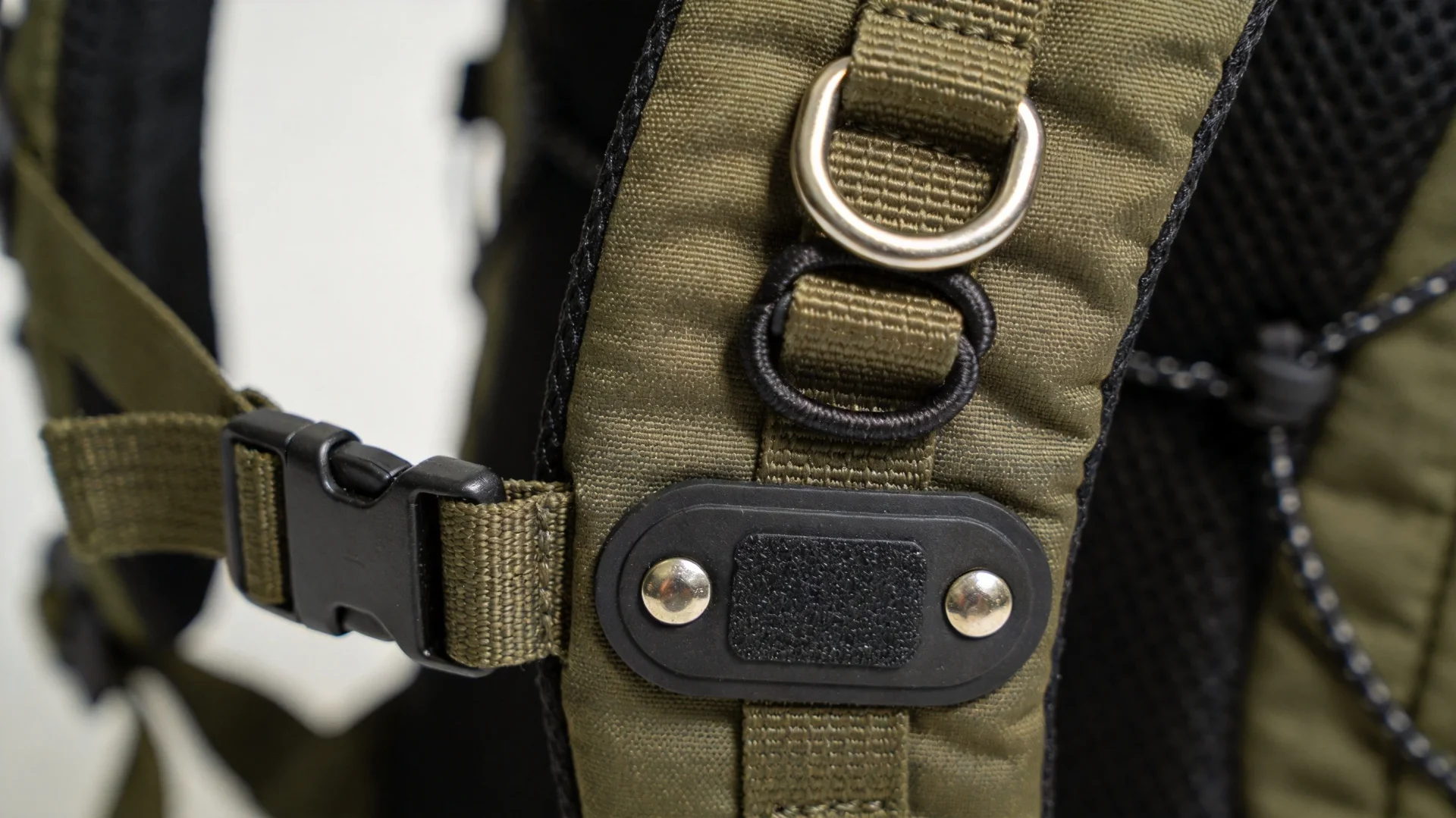
The attachment point is where the bungee cord connects to the backpack body. Its design determines load distribution, durability, and the overall user experience. A poorly designed attachment point will tear through fabric, deform, or create uncomfortable pressure points — regardless of how good the cord itself is.
4.1 D-Ring Attachment
The most versatile attachment method. A welded or sewn D-ring (typically 20mm or 25mm inner width) is anchored to the bag body, and the bungee cord hooks onto it via a plastic or metal hook. Advantages: cord is removable and replaceable. The D-ring can be:
- Welded onto TPU panels: High-frequency welded. Strongest bond, waterproof. Requires TPU-coated fabric at anchor point.
- Sewn through webbing loop: A 25mm nylon webbing loop is bartacked to the bag body, with the D-ring threaded through. Cost: $0.15–$0.30 per attachment point including labor.
- Riveted: Aluminum or steel rivet through fabric and a reinforcement plate. Very strong but creates a hard spot. Used in tactical and military bags.
4.2 Webbing Loop (Direct Thread-Through)
A simple fabric loop (typically 10mm nylon webbing or self-fabric) sewn or bartacked to the bag body. The bungee cord passes directly through the loop. This is the most economical attachment method — $0.05–$0.10 per point — but the cord cannot be removed without cutting or unthreading.
4.3 Heat-Bonded Anchor Pads
A newer technology: TPU or Hypalon pads (30mm × 20mm × 1.5mm) are heat-bonded directly to the fabric surface, with a molded cord channel on top. The bungee cord is seated in the channel and secured with a cord lock or knot. This creates a clean, low-profile look with no sewing required. Cost: $0.20–$0.40 per pad including bonding labor. Popular in minimalist commuter backpack designs.
4.4 Attachment Point Reinforcement
Every attachment point concentrates load on a small area of the bag fabric. Without reinforcement, repeated cord stretching creates a “pull-through” failure where the cord tears through the fabric. JUNYUAN’s reinforcement protocol:
- Internal reinforcement patch: 50mm × 50mm scrap of the same fabric or heavier weight material, placed between the outer fabric and the lining. Bonded with hot-melt adhesive before sewing.
- Bartack pattern: Minimum 42-stitch bartack (Z-pattern or box-X pattern) at each attachment point. This distributes force over a wider area than straight stitching.
- Pull-test requirement: Each attachment point must withstand 50N pull (for 4mm cord systems) or 80N pull (for 5–6mm systems) for 30 seconds without detachment.
Our approach to reinforcement aligns with our quality control AQL standards for all bulk bag orders.
5. Mounting Position Design: Front, Side & Top Configurations
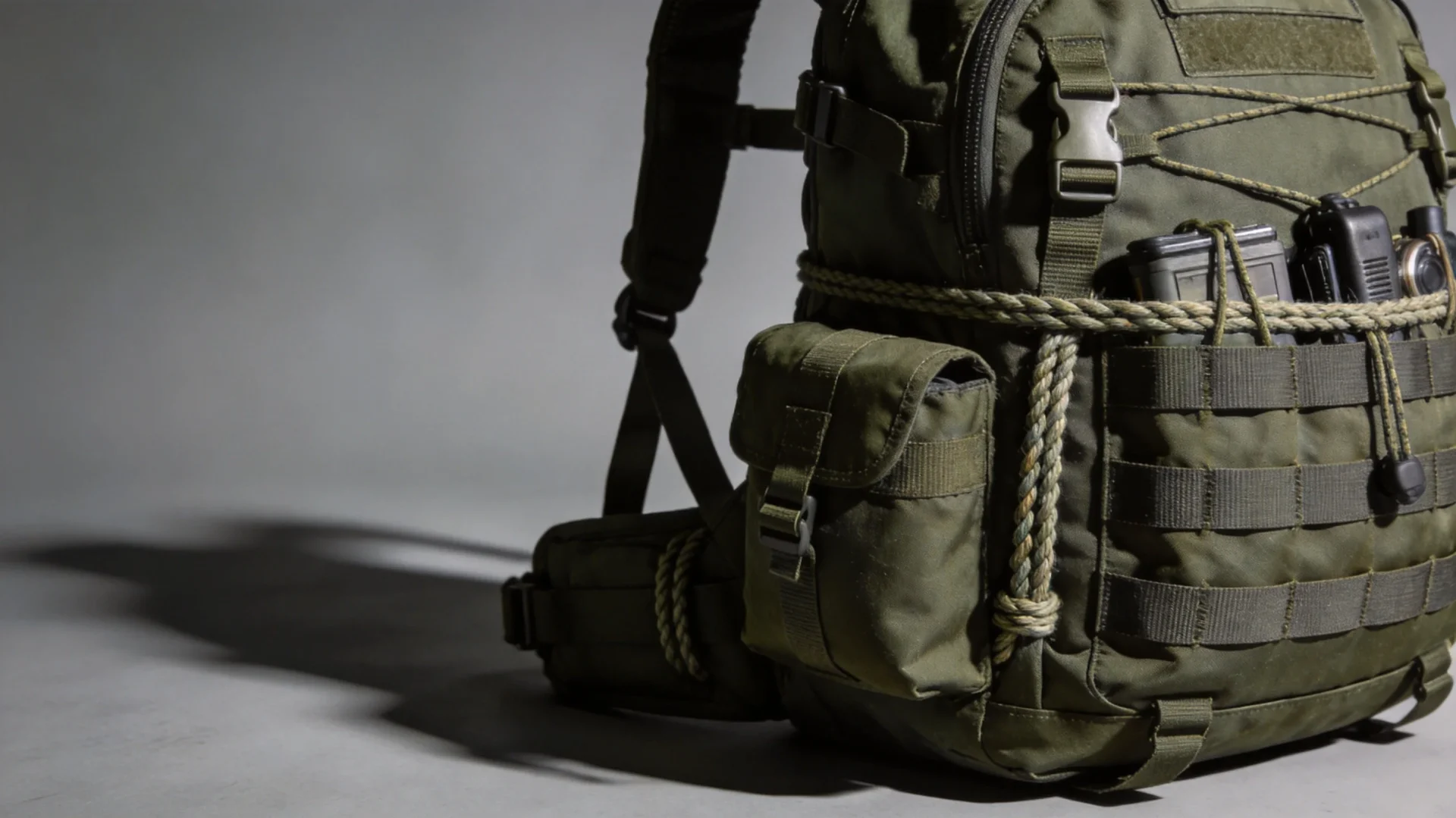
5.1 Front Panel Mount (Most Common)
The bungee cord system is routed across the front panel in a zigzag, X-pattern, or ladder pattern between 4–6 attachment points. This is the most visible design element and often doubles as the bag’s visual signature. Design considerations:
- Attachment point spacing: 80–120mm vertically, 60–100mm horizontally. Too close together = insufficient gap for items. Too far apart = cord sag under load.
- Pattern options: Zigzag (3–5 rows), X-cross, V-shape, horizontal ladder. The pattern affects visual identity and functional capacity.
- Clearance from fabric: The cord should sit 20–40mm off the panel surface at rest to allow items to be inserted underneath.
5.2 Side Compression Mount
One or two bungee cords run vertically along each side panel, connecting top and bottom attachment points. This compresses the bag laterally, reducing volume when the main compartment is partially full. Side mounts are often combined with waterproof fabric construction for all-weather hiking packs.
5.3 Top Lid Mount
A single bungee cord spans across the top lid or between the top lid and the main body. Ideal for securing a foam sleeping pad, rolled jacket, or helmet. Less common than front or side mounts but popular in mountaineering and expedition packs.
5.4 Hybrid Multi-Position Design
Premium hiking backpacks increasingly feature bungee systems on both the front and sides simultaneously. This provides maximum gear-carrying flexibility but increases component cost by $1.50–$3.00 per bag (additional cord + attachment hardware + labor). The design must be coordinated during the digital pattern creation phase to ensure structural integrity across all mounting zones.
6. Replaceable vs. Fixed-Design: Trade-offs for OEM Buyers
| Feature | Fixed (Permanent) | Replaceable (Removable) |
|---|---|---|
| Cord attachment | Knotted & heat-sealed inside lining | Hook/loop through D-rings |
| User replacement | No — requires factory service | Yes — user swaps in seconds |
| Cost per system | $0.80–$1.50 | $2.00–$4.50 |
| Additional hardware | None | 2–4 D-rings + hooks ($0.50–$1.20) |
| Aesthetic | Clean, minimal | More hardware visible |
| Warranty risk | Higher (cord degradation = bag return) | Lower (user replaces cord) |
| Target segment | Budget, minimalist, fashion | Premium outdoor, tactical, enthusiast |
The industry is trending toward replaceable designs as sustainability-conscious consumers prefer products that can be repaired rather than replaced. Offering spare cord kits as aftermarket accessories also creates an additional revenue stream for brands.
7. Application by Segment: Hiking, Cycling, Tactical & Commuter
7.1 Hiking Backpacks
Cord spec: 4mm diameter, NR+EPDM blend, 40cm free length. Front zigzag mount with 4 attachment points. Polyester sheath in outdoor colors (olive, forest green, burnt orange). Load capacity: secure items up to 2kg. Integration with back panel ventilation systems must be considered — bungee cords should not block airflow channels.
7.2 Cycling Backpacks
Cord spec: 3mm diameter, high-elastic NR, 35cm free length. Front X-pattern mount. Reflective thread integrated into sheath for EN 1150 compliance. Must not interfere with helmet attachment clips or hydration bladder hose routing. Cord color matches high-visibility colorways common in cycling gear.
7.3 Tactical Backpacks
Cord spec: 5mm diameter, high-tension SBR core, 50cm free length. Front panel with 6 attachment points using riveted D-rings. Coyote brown or multicam sheath. Must withstand temperatures from -20°C to +50°C without losing more than 15% elastic force. Designed to secure MOLLE-compatible pouches, rolled maps, and 1L hydration bladders.
7.4 Commuter/Everyday Carry
Cord spec: 3mm diameter, standard NR, 30cm free length. Heat-bonded TPU anchor pads for minimalist look. Black or grey sheath. Priority: clean aesthetic and easy one-hand operation. Often used with magnetic cord locks for quick-release. For brands entering the commuter segment, our analysis of bag styles that perform on crowdfunding platforms shows bungee-equipped daypacks consistently outperform minimal designs in backer engagement.
8. Aging Testing & Weather Resistance
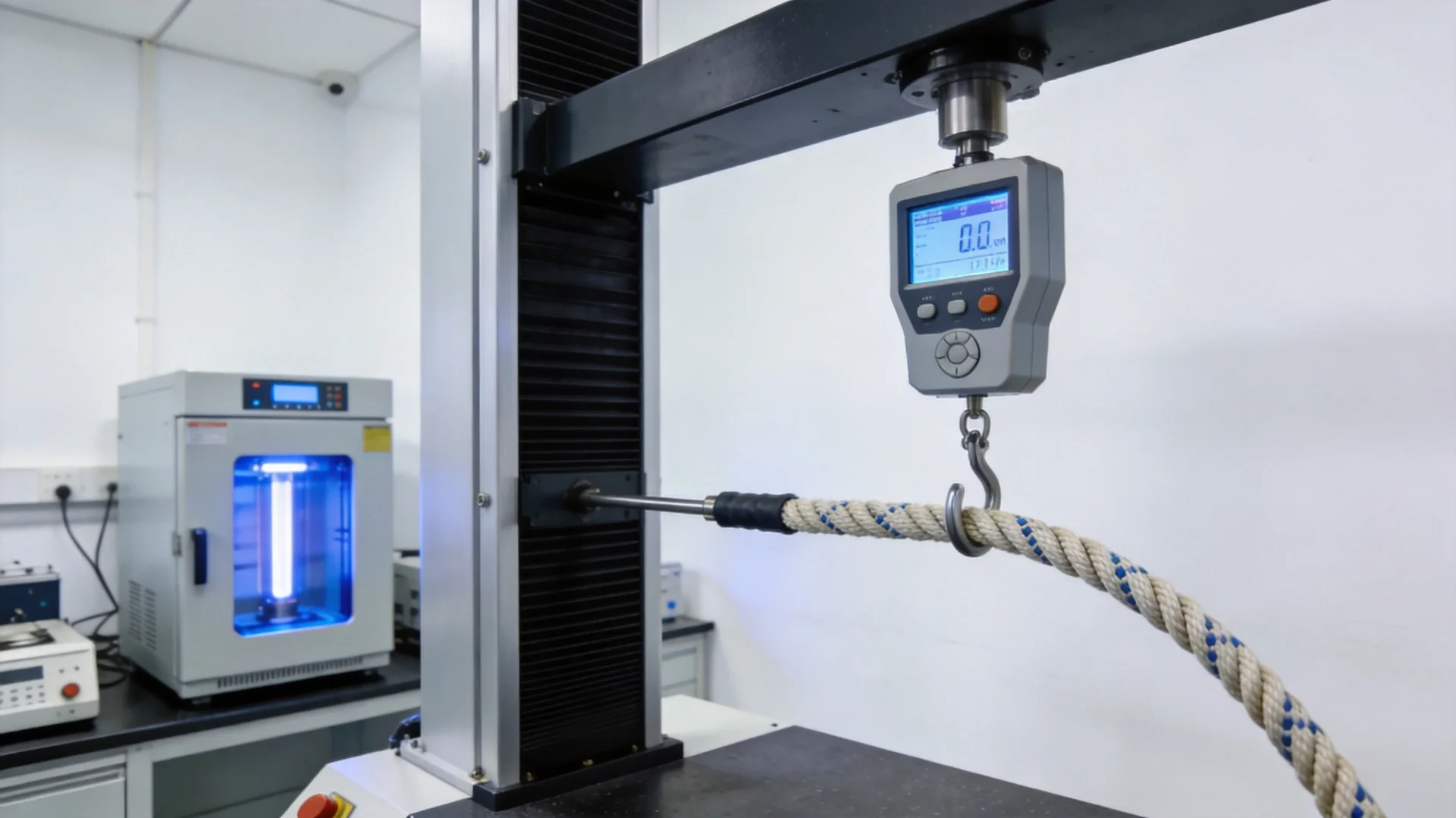
Bungee cords degrade over time through UV exposure, ozone attack, temperature cycling, and mechanical fatigue. OEM manufacturers must validate cord longevity through standardized testing protocols.
8.1 UV Aging Test
QUV accelerated weathering test per ASTM G154: Cord samples exposed to UV-A 340nm lamps at 60°C black panel temperature for 500 hours. Pass criteria: elastic recovery retains ≥80% of initial value, no visible surface cracking. Natural rubber cords typically fail this test within 200–300 hours; NR+EPDM blends pass at 500+ hours.
8.2 Tensile Fatigue Test
Cord mounted on a cyclic stretching machine, stretched to 120% of rated length at 20 cycles/minute for 10,000 cycles. Pass criteria: permanent elongation (set) ≤10% of free length, no core wire breakage. This simulates approximately 2 years of daily use.
8.3 Temperature Cycling Test
Cord subjected to alternating -20°C (4 hours) and +60°C (4 hours) for 50 complete cycles. Pass criteria: elastic force variation ≤20% across temperature range, no sheath delamination from core.
8.4 Ozone Resistance Test
Per ASTM D1149: Cord exposed to 50 ppm ozone concentration at 40°C for 100 hours. Natural rubber without EPDM blending will develop surface cracks within 24 hours under these conditions. NR+EPDM blends pass the full 100-hour test without visible degradation.
9. Production Installation Process: From Cord to Finished Backpack
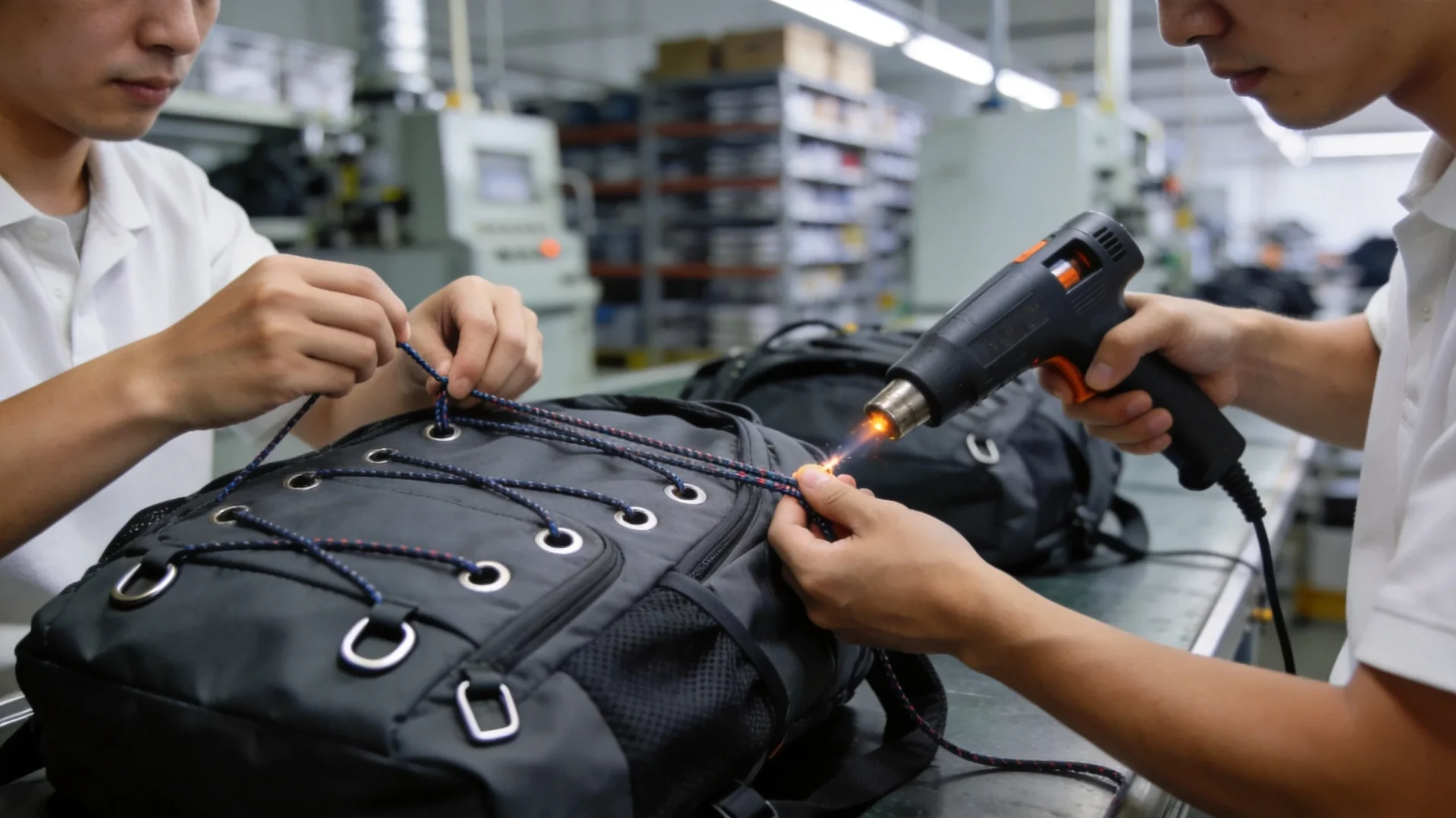
The bungee cord installation on a backpack involves multiple precise steps. At JUNYUAN’s Quanzhou factory, we follow a standardized 7-step process:
- Cord cutting: Semi-automatic cord cutter sets length within ±3mm tolerance. Blades are replaced every 5,000 cuts to ensure clean ends without core exposure.
- Pre-punched attachment holes: Holes are laser-cut or die-cut at attachment points before assembly. Hole diameter is cord diameter + 1mm for thread-through designs, or matches the D-ring shank diameter for hook designs.
- Cord threading: For fixed designs, the cord is threaded through attachment loops using a flexible wire guide. For zigzag patterns, the threading sequence follows a pre-determined path diagram.
- Knotting & securing: Fixed designs use a double fisherman’s knot or surgeon’s knot at termination points. The knot is pulled tight to 30N preload and held for 5 seconds.
- Heat-shrink tube sealing: A 15mm length of polyolefin heat-shrink tube (2:1 shrink ratio) is slid over the knot and heated with a hot air gun at 130°C for 3–5 seconds. This encapsulates the knot, prevents unraveling, and provides a clean finish.
- Elastic force verification: Every 50th unit is tested: cord stretched to 100% of rated extension, force measured with a digital push-pull gauge. Must be within ±15% of target specification.
- Visual inspection: Final QC checks for even tension, proper seating in cord channels, no exposed core at cut ends, and consistent pattern alignment.
9.1 Common Production Defects & Prevention
| Defect | Cause | Prevention |
|---|---|---|
| Uneven cord tension | Inconsistent cutting length or threading path | Use pre-measured cord guides; calibrate cutting machine weekly |
| Core exposure at cut end | Dull cutting blade or insufficient heat-shrink coverage | Replace blades at 5,000-cut intervals; extend heat-shrink tube 3mm beyond knot |
| Knot slippage | Wrong knot type or insufficient preload | Use double fisherman’s knot; apply 30N preload during tying |
| Sheath bunching | Sheath-to-core ratio too tight | Adjust braiding tension; verify ratio at incoming inspection |
| Attachment point tear | Insufficient reinforcement or poor bartack | Mandatory reinforcement patch; 42-stitch bartack minimum |
10. Custom Bungee Cord Systems: OEM Branding & Personalization
The bungee cord system is a highly visible customization point that reinforces brand identity. OEM buyers can personalize:
- Cord color: Match brand Pantone colors. Minimum 500 meters per color for custom dye lots.
- Logo cord locks: Injection-molded cord locks with embossed or debossed brand logo. Mold cost: $500–$1,200. Unit cost: $0.15–$0.40 each.
- Branded D-rings: Laser-engraved logo on metal D-rings or embossed logo on plastic D-rings. Minimum order: 1,000 pieces per design.
- Custom sheath pattern: Camouflage, brand stripe, or tricolor braid patterns. Setup cost: $150–$300 per additional color.
- Heat-bonded logo pads: TPU anchor pads with embossed brand logo. Creates a premium, integrated look. Cost: $0.30–$0.60 per pad.
These customization options are part of our broader private label backpack brand development service. Combined with custom fabric printing, branded zipper pulls, and personalized label systems, the bungee cord becomes one element of a cohesive branded product. For brands preparing artwork for production, our guide on preparing artwork and specs for custom backpack production covers everything from logo files to Pantone color matching.
11. 2026 Bungee Cord Design Trends in Outdoor Backpacks
The bungee cord system continues to evolve. Here are the key trends shaping 2026 product development:
- Magnetic cord lock systems: Neodymium magnets embedded in cord lock ends provide one-hand snap-to-attach operation. Adds $0.50–$1.00 per system but dramatically improves user experience.
- Dyneema cord for ultralight segment: UHMWPE (ultra-high-molecular-weight polyethylene) elastic cords reduce weight by 40% vs. standard rubber core cords. Currently 3× the cost, used only in premium ultralight packs under 500g total weight.
- Smart cord with integrated sensors: Prototype stage — conductive threads woven into the sheath that detect stretch force and transmit to a Bluetooth module. Enables “smart load monitoring” for hiking packs. Expected commercial availability: 2027.
- Sustainable cord materials: Recycled rubber from tire processing and recycled polyester (from RPET sources) for the outer sheath. Growing demand from European brands subject to EPR regulations. Learn about sustainable bag materials beyond RPET for innovative options.
- Quick-adjust cam cleat systems: Borrowed from sailing and kayaking, miniature cam cleats allow instant cord tension adjustment without rethreading. Adds $0.80–$1.50 per system. Popular in cycling and trail running packs.
12. Partnering with JUNYUAN for Bungee Cord Backpack OEM
Whether you need a single front-panel bungee system on a commuter daypack or a multi-position tactical cord network on an expedition pack, JUNYUAN Bags delivers precision-engineered solutions at scale:
- In-house cord specification testing: Tensile testers, UV aging chambers, and durometer equipment on-site at our Quanzhou facility.
- Complete supply chain: We source rubber cores from certified suppliers, braid outer sheaths to spec, and install the complete system — one factory, one quality standard.
- Verified manufacturing capabilities: expertise dating from 2004, BSCI certified, social compliance audits available.
- MOQ from 500 pieces: Ideal for new brands testing market response before scaling.
- Transparent pricing: Detailed cost breakdowns for every component, including custom cord systems.
- FOB Xiamen port: Efficient global shipping from one of China’s top 10 container ports.
- Full OEM/ODM capability: From cord specification to final backpack assembly, we manage the entire production chain under one roof.
For brands looking to understand the full backpack manufacturing process, our guides on backpack material selection and industrial threads in bag manufacturing provide additional technical context for product development decisions.
Frequently Asked Questions
What is the best bungee cord diameter for a hiking backpack?
For most hiking backpacks (30–65L), 4mm diameter provides the optimal balance of clamping force (15–25N), stretch range (130–160%), and visual proportionality. For tactical or heavy-duty packs carrying gear over 3kg, upgrade to 5mm diameter for increased clamping force (25–40N).
How long does a bungee cord system last on a backpack?
With NR+EPDM blend core and polyester braided sheath, expect 3–5 years of regular outdoor use before elastic recovery drops below 80%. Natural rubber-only cores degrade faster (1–2 years with UV exposure). Silicone cores last longest (7+ years) but cost 5–8× more. JUNYUAN validates cord longevity through 500-hour UV aging tests and 10,000-cycle tensile fatigue tests.
Can bungee cords be customized with brand colors and logos?
Yes. The outer polyester sheath can be dyed to any Pantone color (MOQ: 500 meters per color). Cord locks can be injection-molded with embossed logos (mold cost: $500–$1,200). D-rings can be laser-engraved. Custom braid patterns with 2–3 colors are also available with a $150–$300 setup fee per additional color.
What is the difference between fixed and replaceable bungee cord systems?
Fixed systems have the cord permanently knotted and heat-sealed inside the bag lining — cheaper ($0.80–$1.50) but the cord cannot be replaced by the user. Replaceable systems use D-rings and hook attachments ($2.00–$4.50) allowing users to swap cords in seconds. Replaceable designs reduce warranty claims and appeal to sustainability-conscious consumers.
How do you test bungee cord durability for backpack manufacturing?
JUNYUAN performs four standard tests: UV aging (ASTM G154, 500 hours), tensile fatigue (10,000 cycles at 120% extension), temperature cycling (-20°C to +60°C, 50 cycles), and ozone resistance (ASTM D1149, 100 hours at 50 ppm). All test results are documented in the PPAP package delivered with production orders.
What is the minimum order quantity for custom bungee cord backpacks?
JUNYUAN Bags offers MOQ from 500 pieces per color per size. For custom cord specifications (non-standard diameter, color, or elasticity), the MOQ for the cord component alone is 500 meters — which typically covers 500–1,000 backpacks depending on cord length per unit. Contact us at [email protected] for a detailed quotation.
Develop Your Backpack with a Precision Bungee Cord System
JUNYUAN Bags — expertise dating from 2004 in OEM/ODM excellence from Quanzhou, Fujian, China. In-house cord testing, custom branding options, MOQ from 500 pieces, FOB Xiamen shipping.