
There is a specific sentence that kills most plush bag projects before they reach a sample room: “suitable for carrying books and everyday items.” A plush toy factory reads that as a styling note. It is not. It is a load-bearing requirement, and the moment a plush bag has to hold weight every day, the project stops being a toy problem and becomes a bag engineering problem.
That is the gap this page is built to close. We are a custom plush bag manufacturer, and the distinction we work inside every day is simple: plush is a surface process, and a bag is a structure. Shoulder straps, hardware load paths, zipper positioning through a pile fabric, seam integrity under load, lining and interlining that stop a soft shell from collapsing — none of that comes from a plush factory, and none of it comes free.
This page is long on purpose. It covers what a plush bag actually is on a purchase order, which materials you are really choosing between, the five structural points that decide whether the bag survives daily use, how a character artwork becomes a sample, what MOQ 500 pcs means and why it is not negotiable for this category, where the cost sits across price tiers, what the sample fee covers, how long each stage takes, and how landed cost works when the bag is bulky enough that freight changes the arithmetic. If you are sourcing character plush bags for a brand, a distributor or a licensed IP, everything you need to evaluate a supplier — including us — is on this page.
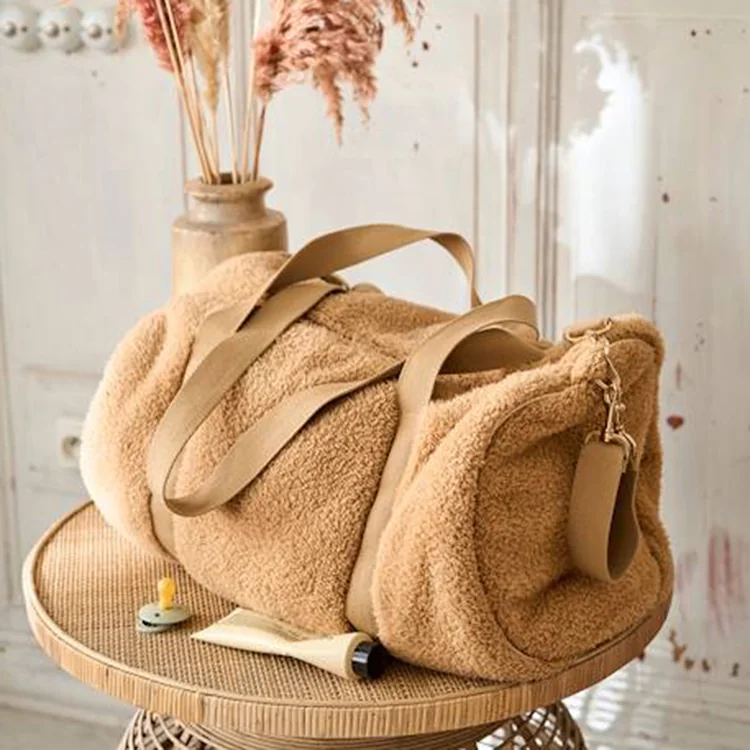
The Two-Factory Problem Behind Every Plush Bag Quote
Plush bags sit in a manufacturing gap. The clusters that make plush toys — Yangzhou, Lianyungang, Dongguan — are excellent at three-dimensional shaping and surface hand feel. What they are not set up to do is make a bag. A soft toy is stuffed and closed; a bag is cut, interlined, sewn, bound, fitted with hardware and tested for load. Those are different machines, different operators and different quality standards.
The reverse is also true. A conventional bag factory can build a load-bearing structure in its sleep, but put a plush fabric in front of it and the process breaks down: pile fabric has nap direction, it stretches on the bias, it will not hold a crease, it hides stitch defects, and it needs different cutting, different needles, different feed settings. Most bag factories simply decline the category.
That is why quotes for the same plush bag can differ by a factor of two and both can be honest. One supplier is pricing a bag and quietly outsourcing the shell. The other is pricing a plush shell and hoping the structure holds.
| Capability | Plush toy factory | Conventional bag factory | Where we sit |
|---|---|---|---|
| Three-dimensional shaping and pile hand feel | Strong | Weak | Fabric segment, through stable specialist suppliers |
| Bag body structure and load bearing | Weak — largely not attempted | Strong | In-house, core capability |
| Strap and hardware load-path design | Weak | Strong | In-house, core capability |
| Zipper positioning through pile fabric | Weak | Strong | In-house, core capability |
| Computerised and three-dimensional embroidery | Moderate | Strong | In-house, core capability |
| Durability validation under daily use | Rarely performed | Strong (AQL 2.5) | In-house, AQL 2.5 at general inspection level II |
| Pile fabric sourcing and pile-side finishing | Strong | Weak | Stable supplier network — stated openly |
We are explicit about that last row because it is the row most suppliers blur. We do not claim a dedicated plush fabric production line. The pile fabric is purchased and the three-dimensional cut-and-sew preparation for the plush face is done with long-standing specialist partners. What is ours is everything that makes the object a bag: pattern engineering, body construction, interlining and lining, strap anchoring, hardware mounting, zipper setting, embroidery, edge finishing and AQL 2.5 inspection. A buyer who visits can see that split for themselves, which is exactly why we write it down.
The practical consequence for you: when you evaluate a custom plush bag manufacturer, the question is not “can you make plush.” Plenty can. The question is which half of this table is in-house and which half is subcontracted, and who carries the quality liability when the two halves meet. If a supplier cannot answer that in one sentence, the answer is usually that nobody does.
One more thing worth stating plainly, because it shapes the rest of this page. We build plush bags — totes, purses, book bags, backpacks, duffles, crossbody bags, belt bags. We do not build plush toys, plush cushions or stuffed characters. If your project is a stuffed figure with a strap glued on, a plush toy factory is the cheaper and more appropriate supplier, and we will say so.
Feasibility review
Send your character artwork for a feasibility review.
No tech pack needed at this stage. Send the character three-view or even a single rendering, plus the bag type and target quantity. What comes back is a written read on whether the shape can carry a bag structure, which materials would hold it, and what would need to change — before anyone quotes a price.
Send artwork on WhatsAppRequest a feasibility review
Prefer email? [email protected]
What “Plush” Means on a Spec Sheet
“Plush” is a retail word, not a specification. On a purchase order it resolves into four parameters that change both the hand feel and the price: the pile family, the fabric weight, the pile height, and — the one buyers most often skip — the backing.
The five pile families you will actually be offered
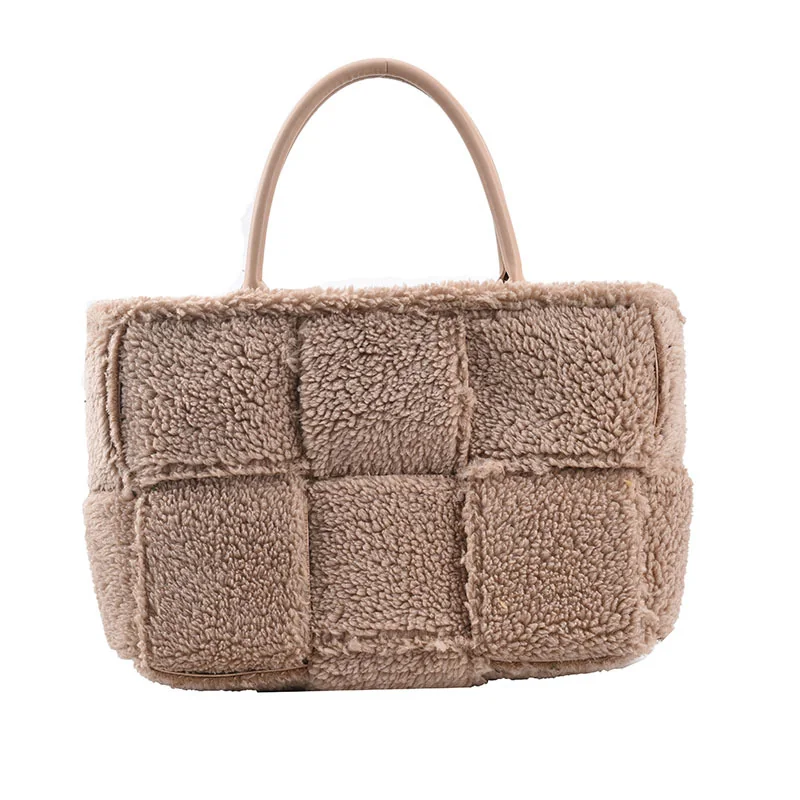
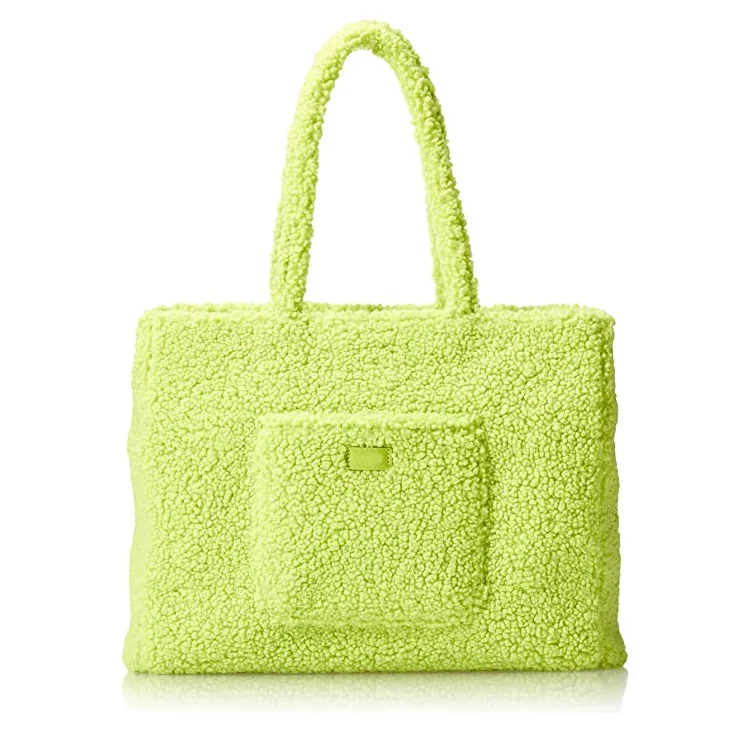
Sherpa fleece is the workhorse. A dense, short, curly pile with a soft wool-like surface. It holds colour well, resists matting, and — critically — is available with backings that give it enough dimensional stability to be sewn into a structured bag. If you are specifying one material for a first plush bag program, this is the one.
Faux fur is long pile, usually acrylic or modacrylic, with a visible fibre length. It photographs beautifully and it is the material most likely to be requested by a brand chasing a specific look. It is also the hardest to build with: long fibres migrate into seams, they foul the needle plate, they hide the stitch line so defects reach the customer, and they flatten permanently wherever a strap rubs. Faux fur bags need more seam allowance, more finishing time and a higher unit price. Anyone quoting faux fur at sherpa prices has not made one.
Teddy fleece is the curly, nubby pile most people picture when they say “plush.” It is forgiving to sew, hides stitch irregularity, and takes embroidery well because the loop structure grips the thread. It is slightly heavier per square metre than sherpa at equivalent warmth.
Short-pile minky or velvet plush is the flat, silky, directional pile. It has the lowest profile and the most refined look, and it is the most difficult to keep clean on a bag that gets handled, because a short pile shows every mark. It is also the pile most sensitive to nap direction — cut two panels in opposite directions and they will read as two different colours under retail lighting.
Boa is the longest and loosest pile. On bags it is a decorative accent at best; as a body material it sheds and it will not hold a load-bearing seam. We will quote it as a trim and talk you out of it as a shell.
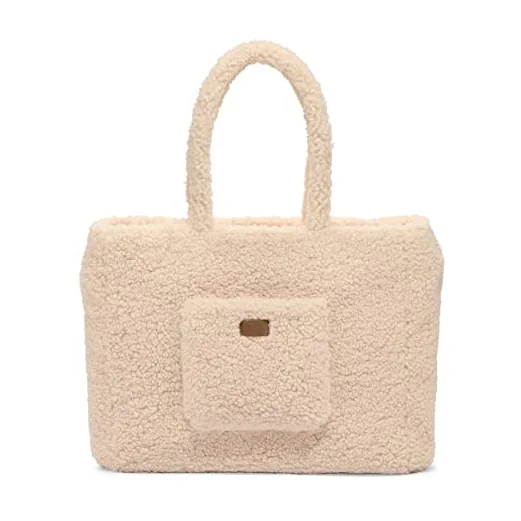
Weight, pile height, and the parameter that decides everything
Fabric weight is quoted in grams per square metre. In the plush bag range, shells typically land between roughly 280 and 450 gsm depending on pile family and target hand feel. Pile height is quoted in millimetres and is what the customer’s hand perceives; it ranges from around 2 mm on a minky up to 15 mm or more on a boa. Neither number tells you whether the bag will hold its shape.
The backing does. A pile fabric is a surface laminated or knitted onto a ground. If that ground is a stretch knit, the finished bag will stretch, sag and lose its silhouette within weeks — no amount of interlining fully rescues it. If the ground is a stable woven or a non-woven laminate, the fabric behaves predictably under a needle and a load. When you compare two plush bag quotes, ask for the backing construction of the shell fabric. It is the single question that most reliably separates a supplier who has built plush bags from one who is extrapolating from plush toys.
| Pile family | Typical shell weight | Pile height | Bag suitability | What it costs you |
|---|---|---|---|---|
| Sherpa fleece | ~300–400 gsm | 3–6 mm | Best all-round shell | Baseline |
| Teddy fleece | ~350–450 gsm | 5–10 mm | Excellent shell, embroidery-friendly | Baseline to +5% |
| Faux fur (long pile) | ~400–600 gsm | 10–25 mm | Workable shell, high finishing cost | +15–30% and slower |
| Short-pile minky / velvet | ~280–350 gsm | 2–3 mm | Good shell, shows marks, nap-sensitive | Baseline |
| Boa | ~500 gsm and up | 15 mm+ | Trim only — not a structural shell | Quoted as trim |
Colour is the other variable that surprises first-time buyers. Plush is dyed in lots, and a pile surface reflects light differently from a flat fabric, so a Pantone reference that reads correctly on a nylon swatch will read lighter and warmer on sherpa. We match to Pantone on the actual pile, and we tell you when a requested shade is only achievable within a stated tolerance. Two production runs of the same reference will show a slight lot difference; that is a property of pile dyeing, not a defect, and any supplier who promises otherwise is either guessing or planning to re-dye at your cost.
The Five Structural Points That Decide Whether a Plush Bag Survives Daily Use
This is the section worth reading twice. Everything else on this page is commercial. This is the part that determines whether the bag is still usable in month six — and it is the part a plush toy factory cannot deliver, because none of these five points exists on a stuffed toy.
1. Strap attachment: never sew the strap to the pile
The most common failure in cheap plush bags is a strap sewn directly onto the plush face. It looks fine in a sample photo and it tears out within weeks, because the pile fibres are not a load-bearing element — they are a surface. The stitch sits in the pile and the ground fabric beneath it, and the ground fabric on a stretch-backed plush will elongate under load until the stitch holes open.
The correct construction is a load path. The strap is sewn to a woven webbing or a reinforced tape, that webbing runs down the inside face of the bag body and is anchored to the bag’s structural panel — usually the base or the side seam — and the anchor is a box-X stitch or a bar-tack, not a single row. The plush face is then closed over the webbing. The strap never touches the pile; the pile is a cosmetic cover over a load-bearing element.
The tell, when you inspect a sample: turn the bag inside out. If you can see a webbing or tape continuing from the strap anchor into the bag body, the construction is real. If the strap terminates at the seam with a row of stitching and nothing continues, the strap is decoration.
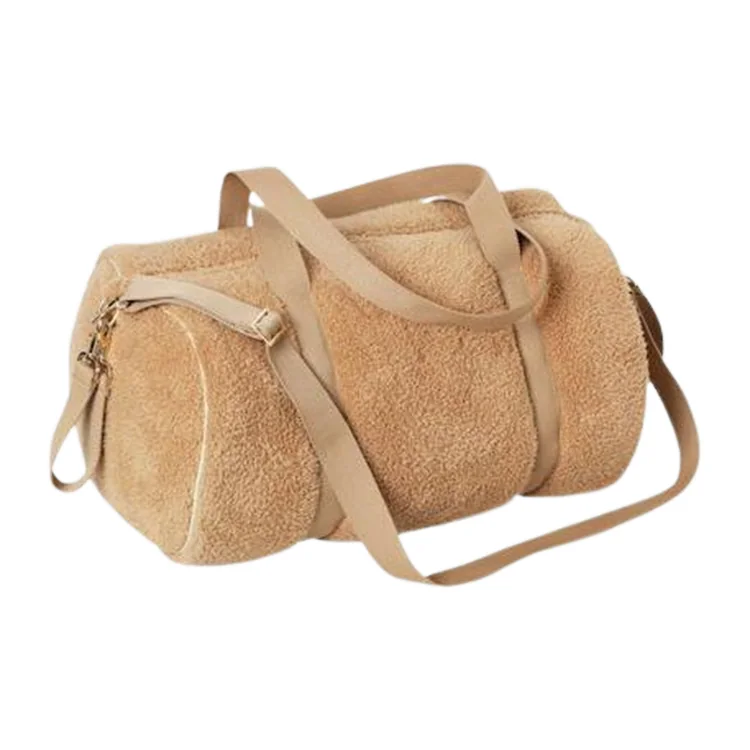
2. Hardware load path: a D-ring is only as strong as what it is mounted to
Hardware is where a bag’s specification and its reality diverge most. A 25 mm D-ring rated to whatever the supplier claims is meaningless if it is mounted to the plush face. Under load, the ring does not fail — the fabric around it does. The mounting point needs a reinforcement patch behind it: a piece of webbing, a leather or PU tab, or an interlining-backed panel, sized so the load spreads across an area rather than a point.
Two more details that separate a competent plush bag from an optimistic one. First, hardware finish matters more on plush than on any other bag category, because pile is abrasive: light plating wears through where a ring or slider rubs, and a bag that leaves the factory with champagne-gold hardware can show a dull grey patch at the rub point inside a season. We specify plating thickness, not just colour. Second, on a plush bag the hardware should be a deliberate visual element, not a hidden one — a plush surface has no structure lines to read, so the hardware and the straps are what tell a buyer the object is a bag. Design them as if they carry the read.
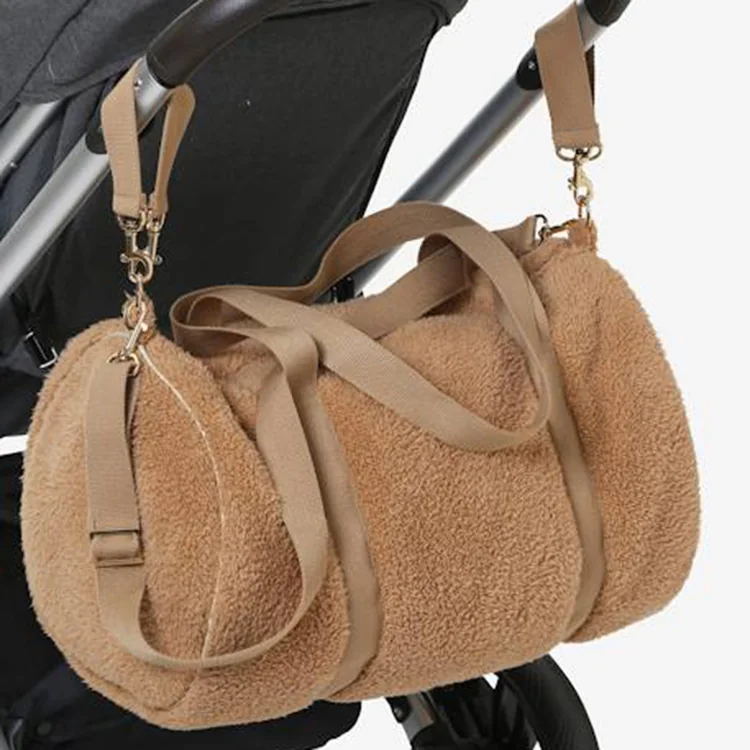
3. Zipper positioning: the pile has to be cut back, not sewn over
Setting a zipper into pile fabric is a specific skill. If the zipper tape is sewn straight onto the plush surface, the pile migrates into the teeth. The slider binds, the customer forces it, and the bag arrives back as a return. If the pile is trimmed back too aggressively, the zipper tape shows and the bag looks unfinished.
The working construction is a trimmed channel: the pile is cut back along the zipper line, the tape is sewn to the ground fabric on both sides of the channel, and the pile is then dressed back over the tape edges so the teeth sit in a clean furrow. Where the zipper is a design feature — a side pocket on a duffle, an exterior pocket on a tote — we set it into a separate panel so the load of opening and closing is carried by the panel, not by the pile.
Test it on any sample: close the zipper, then run a thumb along the teeth from the inside. You should feel teeth, not fibre. Then open and close it twenty times in a row. A correctly set zipper does not catch once.
4. Seams and edge finishing: pile hides defects, so inspection has to change
This is the structural point buyers underestimate, because it works against them. Pile fabric conceals stitch irregularity. On a flat nylon bag, a skipped stitch or a wandering seam allowance is visible at arm’s length. On a plush bag, the same defect is invisible in a photograph and often invisible in hand — until the seam is loaded.
Two consequences. First, seam allowance on plush has to be wider than on flat fabric, because pile fraying consumes the edge and because a narrow allowance under a loaded seam is a tear waiting to happen. Second, quality control cannot rely on visual inspection alone; plush seams need a pull test at the load points and a documented check on stitch density and back-stitching at seam ends.
Edge finishing splits into two approaches. Bound edges — a tape or a PU strip folded over the raw edge — give a crisp, deliberate look and a durable edge, and they are the right answer on totes and duffles where the edge is visible. Turned-and-topstitched edges give a softer, more organic silhouette, which suits character shapes, but they depend entirely on the seam allowance being correct. There is no universally better option; there is only the option that matches the shape. What is not acceptable is an unbound raw edge on a bag that will be handled.
5. Lining and interlining: pile has no body, so you have to add one
A plush bag that collapses into a soft heap is not a design choice — it is a missing interlining. Pile fabric has almost no bending stiffness. Left alone, a plush tote will fold in on itself, the base will sag under the weight of contents, and the bag will look tired within a month of retail.
Two things fix it. A fusible or sew-in interlining laminated to the shell’s ground fabric gives the panel enough body to hold a silhouette while staying soft enough to feel like plush. And a separate lining — usually a woven polyester taffeta or a soft twill — carries the internal structure: it holds the base panel flat, it provides the pocket walls, and it conceals the strap webbing and reinforcement patches from point 1 and point 2. A bag with a properly structured lining can be turned inside out and still look like a bag.
The base deserves its own mention. A plush tote or book bag should have a reinforced base panel — a separate base piece, interlined, sewn in as a distinct panel rather than formed by folding the body. A folded base on plush will round out and the bag will not stand. If a quote does not distinguish a base panel from the body, the supplier is building a sack.
| Failure mode | What causes it | Design fix |
|---|---|---|
| Strap tears out within weeks | Strap sewn directly to plush face | Webbing load path anchored to structural panel with box-X stitch |
| Fabric tears around D-ring | Hardware mounted to pile with no reinforcement | Reinforcement patch or tab spreading load over an area |
| Zipper binds, slider jams | Pile sewn over zipper tape | Trimmed channel, tape sewn to ground fabric, pile dressed back |
| Hardware plating wears at rub points | Pile abrasion on light plating | Specify plating thickness; test at the rub point |
| Seam opens under load | Narrow allowance, pile fray, no pull test | Wider allowance, defined stitch density, pull test at load points |
| Bag collapses, base sags | No interlining, folded base instead of a base panel | Interlined shell, separate reinforced base panel, structured lining |
| Faux fur sheds into seams | Long pile migrating during sewing | Increased seam allowance, pile clearing at seams, post-finishing |
If you take one thing from this section: ask for the inside of the bag. A photograph of a plush bag shows the pile and the silhouette. Turning it inside out shows you whether the supplier builds bags or assembles soft objects. It takes thirty seconds and it answers the question the entire page is about.
From Character Artwork to a Sample: The Four-Step IP Custom Process
Most plush bag enquiries arrive as an image and a question: can you make this into a bag? The answer depends almost entirely on how much information sits behind the image. This is the process we run, and what we need from you at each step.
Step 1 — What you provide
The minimum viable input is a character three-view: front, side and back, at consistent scale. A single hero rendering is workable but it leaves the back and the gusset to interpretation, and interpretation is where revisions come from. Alongside it:
- Pantone references for each colour area, not screenshots. A screen colour is not a specification; a pile dyed to a screenshot will not match the next run.
- Target dimensions for the finished bag — width, height, depth, strap drop. If you only have “about the size of a tote,” we will propose a size set and you choose.
- Embroidery intent — which details are embroidered, which are appliqué, which are printed. Stitch count follows from the artwork, but knowing which features must be embroidered changes the pattern.
- Hardware direction — finish and, if you have a preference, form. If you do not, we propose a hardware set with the quote.
- Bag type — tote, purse, book bag, backpack, duffle, crossbody, belt bag. This is the single most important input, because the bag type determines the structural approach before any artwork is considered.
Step 2 — What we do
Pattern engineering. This is the step that does not exist in a plush toy project. A character shape has to be decomposed into bag panels — front, back, gusset, base, flap, pocket — in a way that preserves the character’s read from the front while giving the bag a structure that holds. Sometimes the honest answer is that a character’s proportions cannot carry a bag at the requested size without a compromise: a wider base, a shallower head, a strap that emerges from behind a shoulder rather than through an arm. We say that at pattern stage, not at sample stage.
Material selection. Pile family, weight, pile height and backing chosen against the character’s look and the bag’s load. Long pile for a shaggy character; sherpa where the character reads soft but the bag needs to hold shape; a two-material split where the character’s body is one pile and the bag’s structural elements — base, handles, trim — are a stable PU or a woven.
Tooling and plate making. Embroidery plates for each embroidered element, cutting dies where the volume justifies them, and hardware tooling if a custom form is specified. These are one-time costs and they are part of what the sample fee covers.
Sampling. One set, built to the approved pattern and materials.
Step 3 — What you confirm
The sample arrives with a written spec sheet: materials with weights and backings, hardware with finishes, dimensions as built, stitch and embroidery details, and the construction notes for the five structural points above. You confirm four things — the shape read, the hand feel, the hardware, and the size. Everything after that is production, and changes after sample approval are charged and scheduled, not absorbed.
Step 4 — What happens when you only have a rendering
This is the most common situation and it is not a problem, but it costs time. If you have a rendering and no tech pack, we have to build the missing specification with you: the three-view, the pile and weight selection, the embroidery stitch counts, the hardware specification, and the construction call on interlining and base. That adds 3–5 days before sampling can start. It is not a delay we invent; it is the difference between sampling a specification and sampling a guess.
If you already have a tech pack, send it. Even an incomplete one saves days, because it tells us what you have already decided and what you are still open on.
The IP question, handled up front
We can produce character-based plush bags. What we cannot do is produce a bag based on a character you do not have the right to use. If the character is your own original design, or you hold a licence, we proceed. If the rights position is unconfirmed, we will ask you to confirm it before tooling, because embroidery plates and cutting dies are not free and an IP dispute after tooling is expensive for both sides.
For a fuller treatment of how licensing works on bag programs — what a licence needs to cover, what the factory should and should not be shown, and where the liability sits — see our guide to IP licensing for custom bags. It was written for exactly this conversation.
MOQ 500: A Filter, Not a Wall
Our minimum order quantity for plush bags is 500 pcs per style per colourway, and it is the same 500 pcs we apply across our general bag range. We did not open a lower MOQ for this category, and the reason is not policy preference — it is process.
Sampling is not subject to it
Before the MOQ applies at all, you can order one set of samples. Sampling is not limited by the production MOQ. The sample fee is charged per style, it covers pattern making, cutting, the embroidery plate and hardware tooling, and it is refunded in full against the first bulk order once the order reaches the refund threshold. In practice this means the decision in front of you is not “commit to 500 pieces” — it is “commit to one sample.”
The three process reasons behind 500
Pile fabric is ordered by the roll. Plush is not bought by the metre in arbitrary quantities. It comes in rolls, in a limited set of colours and weights, and a roll is the smallest unit that makes commercial sense. A 100-piece run still consumes the setup of a roll order, so the fabric cost per unit at 100 pieces is not a fifth of the cost at 500 — it is often closer to half, and sometimes worse if the colour has to be dyed to match.
Three-dimensional cut-and-sew has high cut loss on pile. Pile fabric has nap direction. Every panel has to be cut in a consistent direction or the finished bag reads as two colours. That means you cannot nest pattern pieces tightly the way you can with a flat woven. Add the shaping cuts that a character silhouette requires and the material utilisation drops well below what a conventional bag achieves. Small runs make that loss uneconomic for both sides.
Hardware and embroidery have minimum runs. A custom hardware form has a tooling cost and a minimum plating batch. An embroidery plate is a fixed cost. At 100 pieces those costs are spread over a fifth of the units, and the per-unit price stops resembling a bag price at all.
| Item | Specification | Notes |
|---|---|---|
| Bulk MOQ | 500 pcs per style per colourway | Aligned with our general bag range; not opened lower for this category |
| Sampling quantity | 1 set | Not subject to the bulk MOQ |
| Sample lead time | 6–10 days | Assumes a complete tech pack |
| Tech pack build | +3–5 days | When you have a rendering only |
| Bulk lead time | 35–50 days | Consistent with our general lead time |
| Sample fee | Charged per style; covers pattern, cutting, embroidery plate, hardware tooling | Refunded in full against the first bulk order at the refund threshold |
How to read the number
500 pcs is a statement about who this line is built for: brands, distributors, retailers and IP holders who are ready to scale a style, not test it. It is a filter, and it is a deliberate one. If your plan is 100 pieces to see whether the style sells, the sample is the right step and the MOQ conversation comes later, once you have a purchase order behind you.
What we ask in return is that you do not read 500 as a wall. Read it as the point at which the unit economics of a plush bag start to work. Below it, the honest answer is that the per-unit price you would be quoted is not a price you would want, because it is carrying a roll of fabric you did not use and a tooling cost spread across too few units.
Price Tiers: 500 / 1,000 / 2,000+ and Where the Cost Actually Sits
We quote in three tiers: 500, 1,000 and 2,000+ pcs per style. We do not publish unit prices on this page, because a plush bag price is a function of six variables and any number printed here would be wrong for your project. What we can do is show you where the money goes, so you can read a quote and see whether it is built the way yours should be.
The six cost lines in a plush bag
Shell fabric is the largest single line, and it is the one that varies most. A 300 gsm sherpa and a 550 gsm long-pile faux fur are not in the same cost band, and a colour that has to be dyed to a Pantone match costs more than one pulled from stock. This line is also where the least honest quotes hide — a low quote usually means a thinner fabric, a stock colour, or a stretch backing that will not hold the bag’s shape.
Cutting and sewing labour is the second largest and the one buyers underestimate. A plush bag takes materially longer to cut and sew than a flat nylon bag of the same size: nap-direction layout, pile clearing at seams, slower feed settings, more handling per panel, and finishing that has to dress pile back over the construction. On a character-shaped bag the difference is larger still.
Interlining and lining is a modest line that a cheap quote simply omits. If it is missing from the breakdown, the bag will collapse and the price comparison is meaningless.
Hardware scales with the number of pieces and the plating specification. A bag with two D-rings, a slider, a puller and four feet is a different line from a bag with a single magnetic closure.
Embroidery and appliqué is quoted on stitch count and the number of colour changes, plus plate cost on the first order. This is often the line that surprises a buyer who designed a detailed character face.
Packing is small per unit and disproportionately important in practice, because a plush bag crushes. Polybag plus a shaped insert versus a plain polybag is a real difference in how the goods arrive.
Why a set costs less per unit than two single styles
If you are building a coordinated plush bag range — a tote and a matching purse, or a book bag and a matching pouch — quoting them as a set reduces the per-unit cost, and the reason is entirely mechanical. Same fabric lot means one roll order and one dye lot, so no colour variance between the two items and no minimum charge on a second colour. Same cut layout means the small item’s panels can be nested into the offcuts of the large item’s layout, which matters a great deal on nap-directional pile. Same thread, same hardware family and same embroidery plate setup means one setup instead of two. Same packing carton means fewer cartons and lower handling.
What does not reduce is sewing time. Two items are two items. If a supplier quotes a set at a per-unit price close to a single item, ask how — the answer is usually that one of the two is being built to a lower standard.
What changes between 500, 1,000 and 2,000+
Across the tiers, three things move. Fabric cost per unit falls as the roll order approaches a full-lot buy and as cutting utilisation improves with a larger marker. Setup costs — plates, dies, tooling, line changeover — spread across more units. And labour efficiency improves as operators repeat the same operation, which on a plush bag with pile handling is a real effect rather than a theoretical one.
What does not move is the specification. The 500-piece bag and the 2,000-piece bag are the same bag. If a quote at 2,000 pieces implies a different construction from the quote at 500, the tiers are not tiers.
Why two quotes are often not comparable
Before you compare numbers, confirm what is inside them. FOB means the price ends when the goods are loaded at the port; freight, insurance, duty, clearance and inland delivery are all yours and all unknown at quote stage. DDP means the price includes delivery to your door with duty paid. The gap between the two on a plush bag is wider than on most categories, and the next section explains why. A $4.20 FOB quote and a $6.10 DDP quote may describe the same margin — or they may not, which is exactly why we quote DDP when asked and itemise what it includes.
Pricing
Request a 500 / 1,000 / 2,000 pcs quote.
Send the bag type, the target quantity tier, the pile family if you have a preference, and whether you already hold a tech pack. The quote comes back tiered across all three volumes with the cost lines visible, so you can see what changes and what does not.
Ask on WhatsAppRequest a tiered quote
Prefer email? [email protected]
Sampling Terms: What the Sample Fee Covers
The sample fee is charged per style and it is not a profit line — it recovers work that has already happened before a single bag is made.
What it covers. Pattern making and grading to your dimensions. Cutting, including the material consumed by the sample itself and the pile wasted in setting up. The embroidery plate for each embroidered element. Hardware tooling if a custom form is specified. Assembly and finishing labour. And the specification sheet that comes back with the sample.
What it does not cover. Courier freight on the sample, which is charged at cost and is usually the buyer’s account or a pass-through line. Custom fabric development, if the pile you want does not exist and has to be developed — that is quoted separately and it is a genuine project. Third-party lab testing, if you need a specific test report beyond our standard inspection.
The refund rule. The sample fee is refunded in full against the first bulk order once that order reaches the refund threshold. The threshold and the exact fee for your style are confirmed in writing with the quote, before sampling starts. There is no version of this where the sample fee is a hidden charge that reappears later.
What a revision costs. One round of revision on the sample is normal and expected — the shape read or the hand feel almost always needs a correction. Revisions after sample approval, or revisions that change the pattern rather than a detail, are charged and rescheduled. This is why the specification sheet matters: it is the document that defines what you approved.
Timeline: 6–10 Days to Sample, 35–50 Days to Bulk
Two tracks, and which one you are on is decided by your documentation, not by our schedule.
| Stage | Duration | Depends on |
|---|---|---|
| Tech pack review | 1–2 days | Receipt of artwork, dimensions, Pantone references |
| Tech pack build (if needed) | +3–5 days | You have a rendering but no three-view, weights or stitch counts |
| Sampling | 6–10 days | Complete tech pack, materials in stock or on order |
| Sample in transit | 3–7 days | Courier, destination |
| Sample revision (one round) | 5–8 days | Scope of the correction |
| Bulk production | 35–50 days | Quantity, pile fabric availability in your colour, hardware lead time |
| Bulk inspection | AQL 2.5, general inspection level II | Included in the production window |
The realistic end-to-end picture from first contact to goods in hand: roughly two weeks if your tech pack is complete and no revision is needed, four to five weeks with one revision, and seven to nine weeks from scratch including bulk production and freight. Add time if your pile colour has to be dyed to a Pantone match rather than pulled from stock — that is the single most common cause of a schedule slip on a plush bag, and it is worth asking about before you commit to a launch date.
What delays a plush bag program, in the order we see it: a colour that has to be dyed; a character shape that needs pattern rework after the first sample; hardware in a non-stock finish; and a specification change after sample approval. What does not delay it, in our experience, is the MOQ — 500 pieces and 2,000 pieces run on the same line and the difference is scheduling, not engineering.
Landed Cost and DDP: The Number Most Suppliers Won’t Quote
Ask a supplier for a DDP delivered price on a plush bag and you will often get an FOB number back with a note that freight is “to be advised.” There is a reason for that, and it is not only laziness. Plush bags break the freight arithmetic that most bag suppliers are used to.
Why plush is a freight problem before it is a duty problem
Freight on a container or an air shipment is charged on whichever is greater: actual weight or volumetric weight. Volumetric weight is a function of carton dimensions divided by a dimensional factor, and a plush bag is bulky relative to its mass. A carton of flat nylon totes might cube out at a density that makes the actual weight the chargeable figure. A carton of plush totes will almost always be charged on volume, because the goods are light and the carton is large.
Two consequences follow, and both affect your landed cost more than most buyers expect. First, the freight cost per unit on a plush bag is higher than on a comparable flat bag, sometimes substantially, and it does not fall as fast when you increase volume, because the volume scales with the pieces. Second, packing compression matters financially: a supplier who can pack plush bags at a higher compression per carton, without crushing the pile, is saving you real money on every shipment. That is worth asking about specifically, and it is a question almost nobody asks.
What DDP actually includes
When we quote DDP — delivered duty paid — to your door, the price includes the goods, export clearance, international freight, insurance, import clearance, the duty and fees assessed at destination, and inland delivery to the address you specify. What it does not include, unless agreed in writing: value-added tax or sales tax recovery mechanisms in your jurisdiction, storage or demurrage if delivery is delayed at your end, and any destination inspection fee that is not part of standard clearance.
We quote DDP by air and DDP by sea. Air is faster and materially more expensive per unit on a bulky product. Sea is the default for volume. On a 500-piece program the difference in transit time is measured in weeks, and the difference in landed cost per unit is large enough that it changes which price tier makes sense — which is precisely why the landed cost should be in front of you before you choose a tier, not after.
What drives the duty line
Duty on a bag is not a single rate. It depends on the ten-digit HTSUS classification of the specific bag — construction, outer surface material and type all matter, and a plush-faced tote and a plush-faced backpack can classify differently — and on the country of origin, which is not always the country of manufacture. Rates also move: the 2026 tariff environment has been unusually active, and a landed-cost model built on last year’s assumptions can be wrong by a wide margin.
We state the HTSUS classification and the country of origin used in the DDP price, in writing, with the quote. If your program is large enough that origin strategy is on the table, the arithmetic of running a second production country — and what it genuinely costs beyond the duty line — is set out in our analysis of what a dual-country bag program really costs. For the customs side of the same question, the origin rules that decide where a bag is legally made are covered in Section 301 and origin rules for bag programs.
One practical note. If you are comparing a DDP quote from us against an FOB quote from another supplier, add their freight, insurance, duty, clearance and delivery before you compare. The most common sourcing error in this category is not choosing the wrong supplier — it is choosing the supplier with the lower FOB number and discovering the landed gap two shipments later.
Payment Terms, and the Three Things We Don’t Do
Standard terms are deposit with order, balance before shipment. The deposit secures the material — on a plush program that means the fabric roll order, which is the largest single commitment in the job — and the balance is due when the goods are inspected and ready.
For long-standing accounts we operate a VIP term: 20% deposit, 50% before telex release, 30% fifteen days after arrival. This is available to customers with more than two years of continuous trading history with us and a clean payment record. It is not a general offer and it is not something we extend to open a new account, because it is a credit position and we treat it like one.
The three things we do not do
We do not take revenue share in place of payment. We are a manufacturer, not an investor in your brand. A proposal where the factory is paid out of future sales is a proposal where the factory carries your commercial risk, and the price that risk implies is not a price you want.
We do not finance production against pre-orders. If your model depends on collecting customer money before paying for goods, that model needs a different funding source. We have seen this pattern repeatedly in the character plush category, where a compelling concept arrives with no capital behind it and the request is for the factory to bridge the gap. It is a hard no, and it is stated here so that neither of us spends time on it.
We do not run instalment plans on production orders. Deposit and balance, or the VIP term for qualifying accounts. There is no third structure.
These three lines cost us enquiries. They also mean that the enquiries we do work on are backed by a real purchase order, which is why the sample-to-bulk conversion on this line is high. If you are pre-revenue and the concept is strong, the sample is still available to you — one set, at the sample fee — and that is the correct first step rather than a financing conversation.
How to Vet Any Plush Bag Supplier, Including Us
Eight questions. The first five separate a bag builder from a plush assembler. The last three are about honesty, and they are the ones most suppliers fail.
1. What is the backing construction of the shell fabric? A supplier who has built plush bags will answer immediately and specifically. A supplier who has not will describe the pile instead, because the pile is what they know.
2. How is the strap anchored? The correct answer describes a webbing load path and an anchor to a structural panel. The wrong answer is “double-stitched” — double-stitching to pile is still stitching to pile.
3. Where does the zipper tape attach, and how is the pile cleared? You are listening for the words trimmed channel, ground fabric, dressed back. If the answer is “we sew the zipper on top,” the bag will jam.
4. Is there a separate base panel, and is it interlined? A folded base on plush means a bag that sags. This is a yes-or-no question and there is only one acceptable answer.
5. Can I see the inside of a finished plush bag? Ask for a photograph of the lining and the strap anchor. Any supplier with real plush bag output has one. Any supplier who deflects does not.
6. Which parts are in-house and which are subcontracted? We answer this on this page: structure, sewing, hardware, straps, embroidery and AQL 2.5 inspection are ours; pile fabric sourcing and the three-dimensional plush face preparation come through long-standing specialist suppliers. A supplier who claims 100% in-house on every element of a plush bag is either very unusual or not being accurate.
7. What are your certifications, and can I see the certificates? Ours are BSCI, ISO 9001, SEDEX and OEKO-TEX, and the documents are available on request. OEKO-TEX matters specifically for plush, because it addresses the material safety of the textile rather than only the management system.
8. What happens if the goods fail inspection? The answer should describe the AQL standard, who inspects, and what the remedy is. We work to AQL 2.5 at general inspection level II, and we carry a 12-month warranty against manufacturing defects. A supplier with no answer to this question has no inspection process.
A ninth question worth asking, though it is not about capability: how many brands have you shipped this category for? We have worked with more than 200 brands across more than 100 countries since 2014, and our founder has been in the bag trade since 2004. That history is checkable and it is the reason we can tell you in advance which plush bag designs will fail and why — which is cheaper for you than finding out at sample stage.
FAQ: Custom Plush Bag Manufacturing
Can you make a plush bag with straps and hardware in my character’s shape? Which materials and hardware do you recommend?
Yes, and it is the core of what we do. A character shape is decomposed into bag panels — front, back, gusset, base, flap or pocket — so the character reads correctly from the front while the bag holds a structure. For a first program we recommend sherpa fleece at roughly 300–400 gsm on a stable backing, because it holds colour, resists matting and gives the panel enough body to keep its shape. Straps are built as a webbing load path anchored to a structural panel rather than sewn to the pile, and hardware is mounted on reinforcement patches. For hardware we recommend a light-metal finish with a specified plating thickness, because pile is abrasive and thin plating wears at the rub points. Faux fur is available and it photographs beautifully, but it costs 15–30% more and takes longer, because long pile has to be cleared from every seam.
Can you quote 500, 1,000 and 2,000 pcs, price a purse and a book bag separately, and is a set cheaper?
Yes to all three. We quote across the 500, 1,000 and 2,000+ tiers, and we price each style separately when you have more than one. A coordinated set is cheaper per unit than two single styles, because one fabric lot means one roll order and one dye lot, and the smaller item’s panels can be nested into the offcuts of the larger item’s layout — which matters a lot on nap-directional pile. Thread, hardware family, embroidery setup and packing are also shared. What does not reduce is sewing time: two items are still two items. We do not publish unit prices on this page because a plush bag price depends on six variables, and any figure printed here would be wrong for your project.
What does the sample fee cover?
The sample fee is charged per style and covers pattern making, cutting including the material consumed by the sample, the embroidery plate for each embroidered element, hardware tooling if a custom form is specified, assembly and finishing, and the written specification sheet that comes back with the sample. It does not cover sample courier freight, custom fabric development if the pile has to be created, or third-party lab testing beyond our standard inspection. The fee is refunded in full against the first bulk order once the order reaches the refund threshold, and both the fee and the threshold are confirmed in writing before sampling begins.
How long from tech pack review to a sample in hand?
Six to ten days to produce the sample, assuming a complete tech pack, plus three to seven days in transit. If you only have a rendering and no tech pack, add three to five days before sampling can start, because the three-view, pile and weight selection, embroidery stitch counts and hardware specification have to be built with you first. One round of revision after the first sample is normal and takes a further five to eight days. Bulk production runs 35–50 days after sample approval.
Can you quote DDP air to door? I need landed cost, not just ex-works.
Yes, by air and by sea. A DDP price from us includes the goods, export clearance, international freight, insurance, import clearance, the duty and fees assessed at destination, and inland delivery to your address. We state the ten-digit HTSUS classification and the country of origin used in the price, in writing, with the quote. It matters more on plush than on flat bags, because plush is bulky relative to its mass, so freight is charged on volumetric weight and the cost per unit is higher than a comparable flat bag. Air is faster and materially more expensive; sea is the default for volume. Ask for both before you choose a tier.
What is the MOQ, and can I order a lower quantity at the sampling stage?
The bulk MOQ is 500 pcs per style per colourway, and it is the same 500 pcs we apply across our general bag range. Sampling is not subject to it: you can order one set of samples with no MOQ commitment. The 500 exists for three process reasons — pile fabric is ordered by the roll, three-dimensional cut-and-sew on nap-directional pile has high cut loss so small runs are uneconomic for both sides, and hardware and embroidery have minimum runs that cannot be spread across a small quantity. Below 500 the per-unit price stops resembling a bag price, so the honest first step is a sample rather than a small production order.
Do you do revenue share, pre-order financing or instalments?
No to all three. Standard terms are deposit with order and balance before shipment. For accounts with more than two years of continuous trading and a clean payment record, we operate a VIP term of 20% deposit, 50% before telex release and 30% fifteen days after arrival. We do not take revenue share in place of payment, we do not finance production against pre-orders, and we do not run instalment plans on production orders. If you are pre-revenue, the sample — one set, at the sample fee — is available and is the correct first step.
Is plush a toy material or a bag material? How do I know the bag won’t collapse?
Plush is a surface process; whether the object is a bag depends entirely on what is built underneath it. Five things decide that: a webbing load path for the straps anchored to a structural panel rather than to the pile; reinforcement patches behind every hardware mounting point; a trimmed channel so the zipper tape attaches to the ground fabric and the pile is dressed back over it; wider seam allowances with pull tests at the load points, because pile hides stitch defects from visual inspection; and interlining plus a separate structured lining, with a distinct reinforced base panel rather than a folded base. Ask any supplier for a photograph of the inside of a finished plush bag. The lining and the strap anchor will tell you in thirty seconds whether you are looking at a bag or at a soft object with a handle.
Do I need a tech pack to start?
No, but it saves days. The minimum viable input is a character three-view plus Pantone references, target dimensions, the bag type and the intended quantity tier. If you have only a single rendering, we will build the missing specification with you — three-view, pile and weight selection, embroidery stitch counts, hardware specification and the construction calls on interlining and base — which adds three to five days before sampling. If you already have a tech pack, send it even if incomplete: it tells us what you have decided and what is still open.
Can you produce a bag based on a licensed character?
We can produce character-based plush bags, and we do. What we cannot do is produce a bag based on a character you do not have the right to use. If the design is your own original work, or you hold a licence that covers bags as a product category, we proceed. If the rights position is unconfirmed, we will ask you to confirm it before tooling, because embroidery plates and cutting dies are not free and an IP dispute after tooling is expensive for both sides. We will never use a third party’s character imagery in our own marketing, and we do not imply any manufacturing relationship with a brand we do not work with.
If you are sourcing plush bags for a brand, a distributor or a licensed IP, the fastest way to a real answer is a real input. Send the character artwork, the bag type and the quantity tier — a rendering is enough to start. For background on how character bags get built and how licensing works on a bag program, read how we built a character backpack for a superfan, our guide to IP licensing for custom bags, and the read on why character bags command the prices they do. For storage and carry formats built around collectibles, see custom storage backpacks for vinyl toy collectors and the bag charm styling guide. For the material and category side, browse our sherpa tote bag range, the custom logo soft plush handbag, the plush travel duffle, and our shearling bag manufacturing capability.
Next step
Send your character artwork, and get a written read before a price.
Tell us the bag type, the quantity tier and whether you hold a tech pack. What comes back is a feasibility note on the shape and structure, the recommended pile family and backing, and a tiered quote at 500 / 1,000 / 2,000 pcs with the HTSUS classification and origin stated on the DDP line.
Ask on WhatsAppRequest a quote with the landed cost
Prefer email? [email protected]