
What is a USB charging backpack manufacturer? A USB charging backpack manufacturer is a factory or OEM/ODM supplier that designs and produces backpacks with a built-in USB port wired by an internal cable to a user-supplied power bank in a dedicated compartment — enabling phone charging without unzipping the bag. JUNYUAN Bags manufactures custom USB backpacks from a minimum order quantity (MOQ) of 500 pcs, with sample lead time of 6–10 days, bulk production of 35–50 days, AQL 2.5 quality control, and a 12-month warranty on workmanship. This guide covers port options (USB-A / USB-C), cable routing methods, certification requirements, OEM customization cost, and how to launch your USB backpack line — written from a factory-floor perspective so you can brief a supplier confidently.
What Buyers Look for in a USB Backpack Manufacturer
Before comparing quotes, a sourcing team should screen suppliers on five measurable criteria: fabric and accessory quality, port integration craftsmanship, certification coverage, QC protocol, and the ability to handle OEM/ODM customization without inflating lead time. The single most common sourcing mistake is choosing a supplier based on price alone, then discovering the USB port is an off-the-shelf add-on with poor cable strain relief and no water-resistance testing.
- Craftsmanship track record — ask how many USB backpack lines the factory has shipped and what failure rate they hold.
- Compliance stack — confirm the supplier can produce documentation for the target market (see certifications below).
- Layout freedom — a real manufacturer lets you adjust port placement, cable channel, and power bank compartment sizing.
- Verifiable factory — request facility credentials and, for large orders, a factory audit or third-party inspection.
As a custom backpack manufacturer with an in-house R&D and pattern team, JUNYUAN treats the USB port not as an accessory but as a structural engineering element — which is why our lines pass ingress and cable-flex testing before shipment.
USB Port Module: Options and Integration
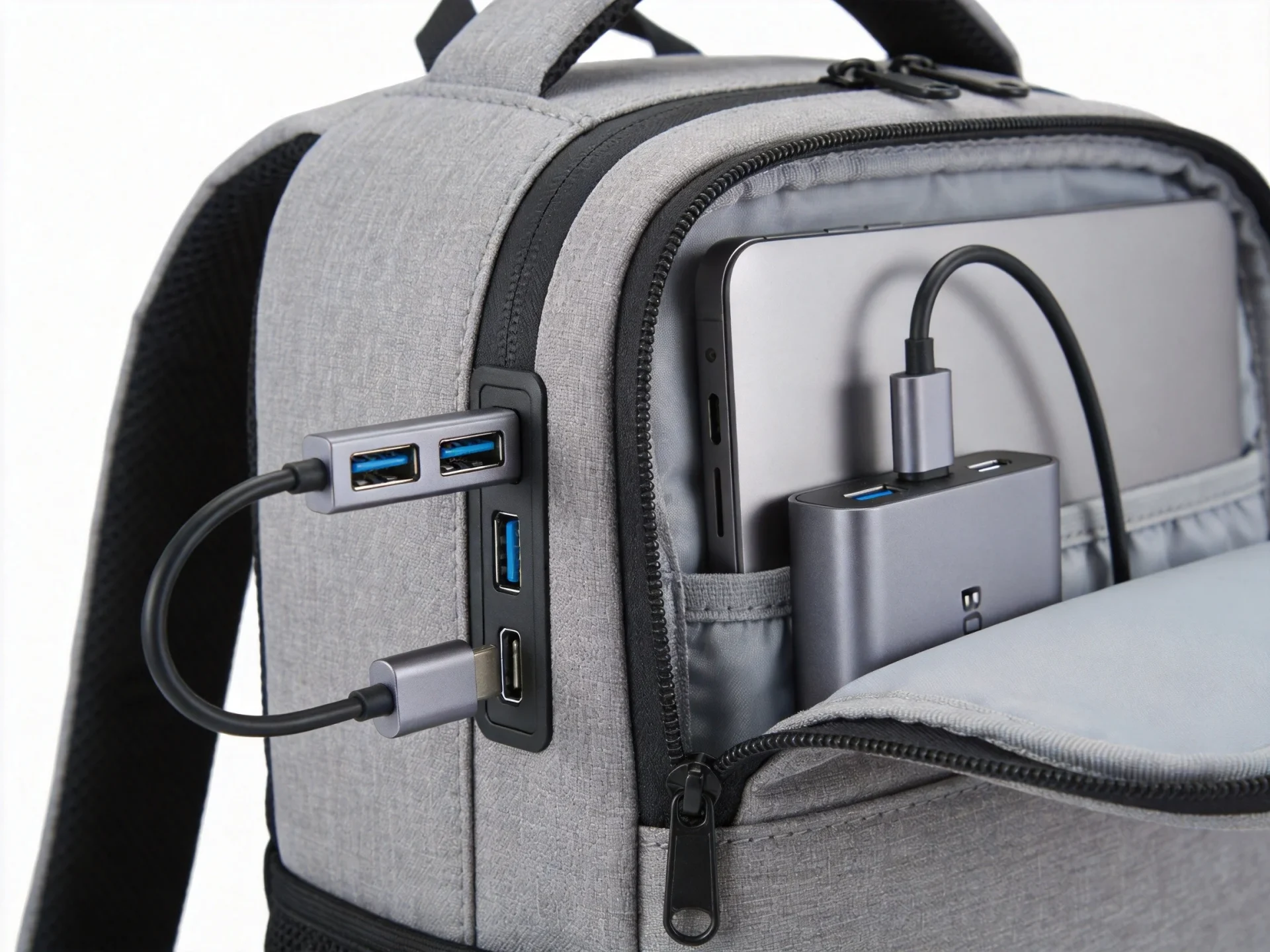
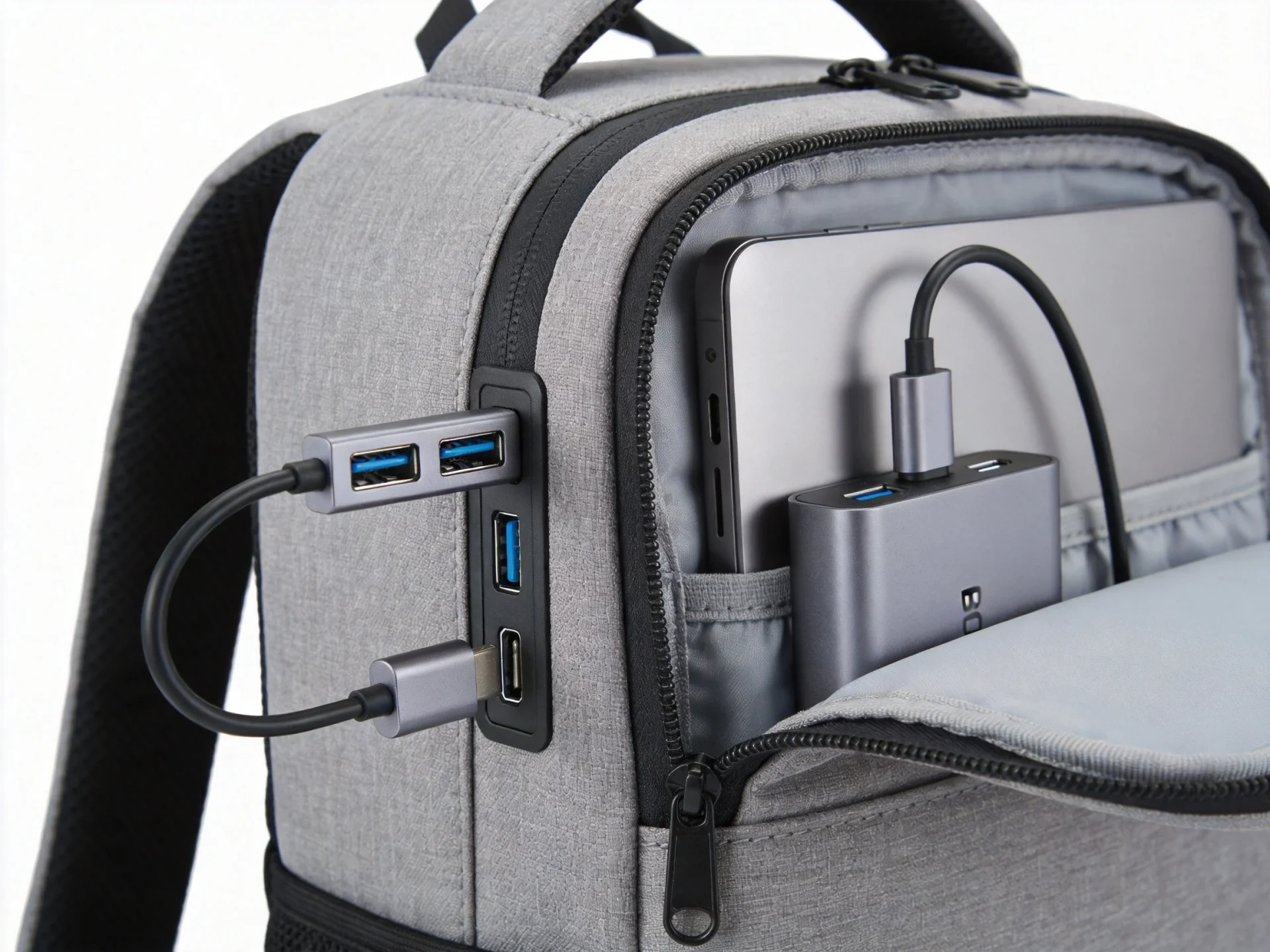
The USB feature consists of three parts: the external port (visible on the panel), the internal USB cable (terminates in the power bank compartment), and the user’s own power bank (not included). There is no battery inside the bag — the manufacturer wires the port to a male USB plug that the user connects to their own bank.
Port Type Options
| Port Type | Output | Best For | Notes |
|---|---|---|---|
| USB-A (standard) | 5V / 2A | Phones, earbuds, basic charging | Lowest cost, most compatible |
| USB-C (PD-ready) | Up to 20V PD | Laptops and fast-charging phones | Requires a PD-compatible user bank |
| Dual (A + C) | Mixed | Multi-device users | Two internal leads, cost +$ |
For a custom USB charging backpack, most buyers choose either USB-A for cost efficiency or USB-C for future-proofing with laptops. Port placement options include: top of the bag near the carry handle, exterior side pocket, shoulder-strap base, or a dedicated anti-theft hidden port tucked in a rear passport pocket.
Port Module Construction
The port housing must be sealed against moisture. Industry-standard approaches include a waterproof grommet seat, a flush-mount metal or PU port plate, and a flip-cover flap that protects the connector when not in use. At JUNYUAN we also offer an anti-theft zipper-hidden port variant so the charging outlet is not visible to opportunistic thieves.
Cable Routing and Power Bank Compartment Design
Cable routing is the most overlooked detail in USB backpack manufacturing — it accounts for most field failures (broken connection, internal wear, or a port that pulls out under strain).
Three Routing Methods
| Method | Description | Ideal For |
|---|---|---|
| Open channel | Cable laid along a fabric channel against the liner | Budget lines |
| Sewn-in channel | Fabric casing sewn around the cable | Mid-range, best protection-to-cost |
| Grommet-guided | Cable passes through reinforced grommets between compartments | Premium/multi-compartment bags |

The power bank compartment should be sized to common bank dimensions (roughly 20×10×2.5 cm for a 20,000 mAh unit) with an elastic or Velcro retention strap, cut a cable exit opening, and vented to avoid heat build-up.


Safety Standards, Certifications and Compliance
What certifications do you need to sell USB backpacks? The answer depends on your target market. A USB cable and port are electronic accessory components, so most mainstream markets apply their electronics rules on top of ordinary bag standards.
- United States — UL/CE-style considerations, FCC for the electronics, plus CPSIA and general product-safety rules if marketed for kids.
- European Union — CE marking and RoHS for the electronics, REACH for fabrics and dyes, and battery rules if a bank is bundled.
- Canada / Australia — analogous electrical certification and import compliance.
A reliable manufacturer should not claim your product is certified — certification is often brand-specific — but they must be able to supply components that are RoHS/CE/FCC compliant and provide the relevant test reports. Always confirm the compliance scope in writing before mass production.
OEM / ODM Customization: MOQ, Sample, Lead Time and Quality
How do you launch a custom USB backpack line? The standard OEM flow is: request a quote → agree on specs → pre-production sample (6–10 days) → approval → deposit → bulk production (35–50 days) → AQL 2.5 inspection → shipment. JUNYUAN’s practical parameters for USB backpack OEM projects are shown below.
| Parameter | JUNYUAN Bags Default |
|---|---|
| MOQ | 500 pcs (mixed colors/styles negotiable) |
| Sample time | 6–10 days |
| Bulk production | 35–50 days |
| Quality acceptance | AQL 2.5 (critical/major/minor inspection standard) |
| Warranty | 12 months on workmanship |
| Sample fee | Charged; fully refunded on first bulk order |
| Customization | Logo, colors, fabrics, port type/placement, compartments |
Manufacturing Process and Cost Structure
Understanding where the cost sits helps you brief a supplier without overpaying. For a USB backpack, the cost stack is: fabric and lining (~45%), hardware and zippers (~15%), the USB port module and cable (~8–12%), workmanship and QC (~20%), and finishing/packaging (~8%). The HEX technical backpack demonstrates a smart-bag approach where charging is paired with technical fabric.
Most cost disputes come from cable stress and port failure, not fabric. Invest budget in the port module, the sewn-in cable channel, and a tested anti-pull design — these directly cut warranty claims.
About Junyuan Bags as a USB Backpack Manufacturer

JUNYUAN Bags is a Quanzhou-based export manufacturer specializing in OEM/ODM backpack and soft-goods production. Our in-house capabilities span pattern-making, fabric sourcing, and a dedicated electronics-assembly workbench for USB/charging integration, backed by AQL 2.5 final inspection and per-order QC reports. We are a flexible custom logo backpack supplier — from custom logo backpacks to tactical and sport backpacks — and can route your project through our custom backpack manufacturing channel for end-to-end management.
Frequently Asked Questions
What is a USB charging backpack and does it include a power bank?
A USB charging backpack has an external USB port wired to a power bank compartment; the bank itself is user-supplied and not included, which keeps it below battery-shipping restrictions and lowers cost.
What is the difference between an integrated charger and a USB port backpack?
An integrated charger packs the USB controller into a panel (often with secure, tamper-resistant design), while a USB port backpack simply pipes an external port to the internal bank compartment — the latter is cheaper, lighter, and the common OEM default.
How do I choose a reliable USB backpack manufacturer?
Screen on five criteria: proven USB line experience, compliance documentation, port/cable craftsmanship, AQL-based QC, and willingness to share failure-rate data and run a third-party inspection.
What MOQ is required for custom USB charging backpacks?
JUNYUAN Bags works from a 500 pcs MOQ for USB backpack OEM projects, with mixed color and style flexibility on reasonable volumes.
Can I customize the USB port type and placement?
Yes — choose USB-A, USB-C, or dual, and place the port on the top panel, side pocket, strap base, or in a hidden anti-theft compartment to match your brand and audience.
What certifications are needed to sell USB backpacks in the US and EU?
The US commonly requires FCC and CPSIA considerations; the EU requires CE marking and RoHS for electronics plus REACH for fabrics. A compliant supplier provides RoHS/CE/FCC component test reports so your brand team can complete market-specific certification.
How long does a custom USB backpack sample and bulk order take?
Sample takes 6–10 days and bulk production 35–50 days after deposit and pre-production sample approval.
What quality control applies to USB backpack production?
Production is accepted to AQL 2.5, covering critical, major, and minor defects, with per-order inspection reports and a 12-month workmanship warranty.
How do I prevent water damage to the built-in USB port?
Use a waterproof grommet seat, a sealed flush-mount plate, and a flip-cover flap; for weather-exposed lines, specify an ingress-tested port module — which JUNYUAN can supply and validate before bulk.
Can USB backpacks support fast charging (PD / QC)?
Yes, when paired with a PD-compatible user power bank and a USB-C port module; our engineering team will match the cable gauge and connector to the target power profile.
Are wireless charging backpacks or power-bank integrated options available?
Wireless charging pockets and power-bank-integrated designs are available on request for the diaper and lifestyle lines; note that integrated batteries add shipping and compliance requirements best reviewed before commit.
How much does the USB feature add to manufacturing cost?
A standard USB-A port module and cable typically add roughly 8–12% to factory cost; USB-C and dual-port modules add more. Site budgets accordingly.
Do you provide power bank sourcing, warranty, or anti-theft port covers?
Yes — JUNYUAN can source qualified power banks, apply a 12-month workmanship warranty, and fit anti-theft hidden ports or flip covers to raise street security and perceived value.
How do I start an OEM/ODM USB backpack project?
Send your spec or reference product to our sourcing team; we respond with a quote, CAD/pattern review, and a pre-production sample within days. Start through our custom backpack manufacturing page to get a dedicated project owner.
Ready to launch a USB charging backpack line? Contact JUNYUAN Bags — OEM/ODM manufacturer — for a quote on your custom USB backpack project. Start your project →