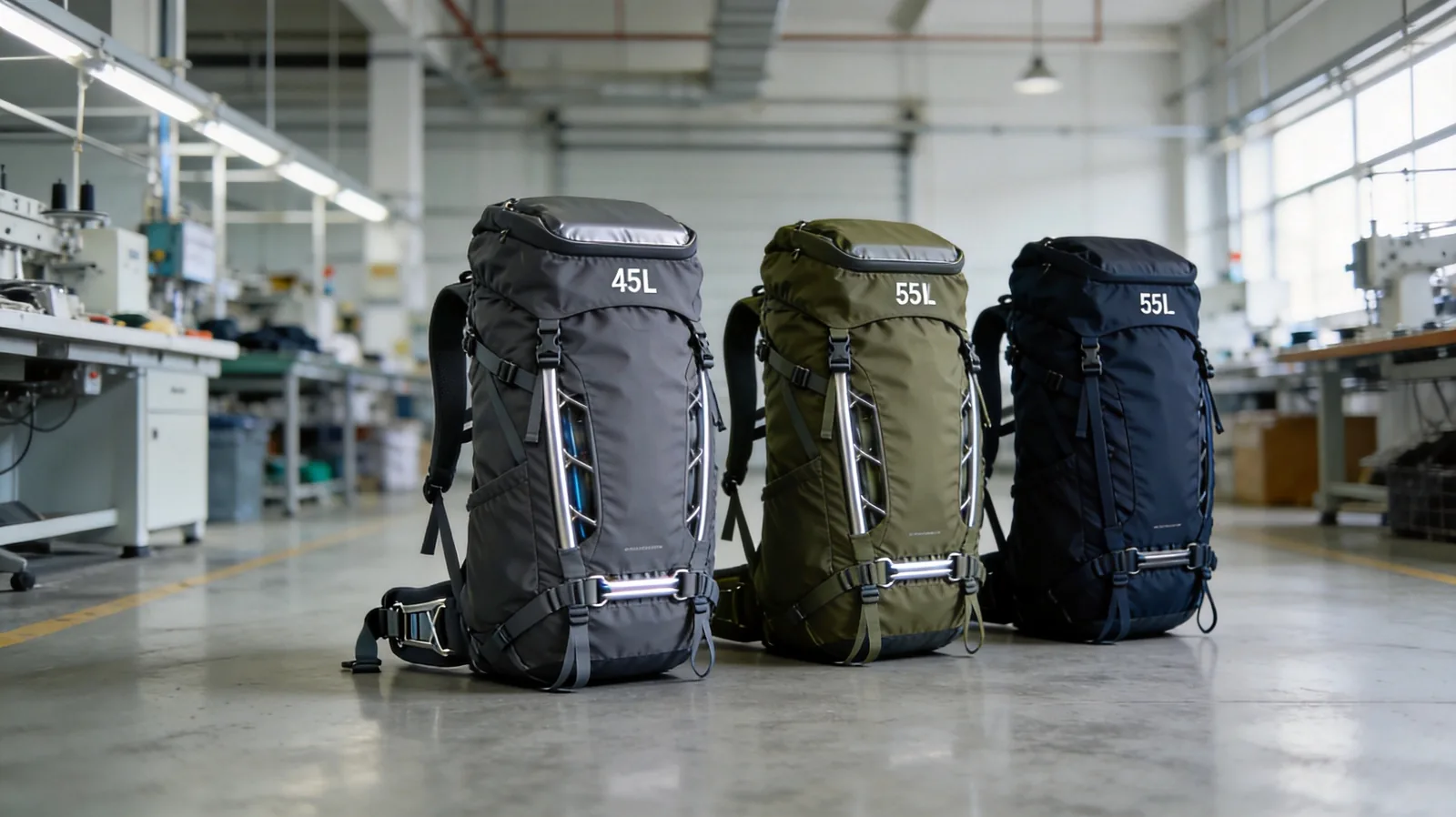
If you are sourcing trekking packs for a European brand, the specifications you receive will not look like the ones a North American buyer sends. The volume range is higher, the load figure is stated in kilograms rather than litres, the rain question comes before the feature question, and somewhere in the brief there will be a reference to a standard that, nine times out of ten, has nothing to do with backpacks at all.
This guide is written for the buyer on that side of the market. It covers what actually changes when a pack has to carry 15 kg for six consecutive days instead of 8 kg for one, how ultralight construction trades away comfort margin, and what European law genuinely requires of a backpack before it can be placed on the market in the EU, the UK, France and Germany. It is the trekking companion to our hiking backpack OEM/ODM blueprint, which covers frame systems and fabric engineering from the daypack side.
Why “Trekking” and “Hiking” Are Two Different Briefs
The terminology split is geographical, and it maps onto a real product split. In the United States and Canada, “hiking backpack” is the dominant commercial phrase and it covers almost everything from a 20 L daypack to a 65 L weekend pack. In the United Kingdom, Germany, the Netherlands, Scandinavia and France, the dominant phrase is “trekking backpack” or “trekking rucksack”, and it implies multi-day self-supported travel — hut-to-hut routes, long-distance trails, alpine approaches.
That difference is not cosmetic. It shows up in the search terms a buyer uses, in the specification questions they ask, and in the load case they design around.
| Dimension | US “hiking backpack” brief | EU/UK “trekking backpack” brief |
|---|---|---|
| Typical capacity | 20–45 L | 45–75 L |
| Design load | 5–12 kg | 12–20 kg |
| Trip length | Day hike to one overnight | 3–7 days self-supported |
| First question asked | Hydration compatibility | Rain protection and hip belt comfort |
| Frame expectation | Internal frame, often a single stay or HDPE sheet | Internal frame with aluminium stays and a load-bearing hip belt |
| Compliance question | CPSIA if youth-oriented | GPSR, REACH, PFAS, national EPR registration |
| Colour/SKU discipline | Broad colour range, fewer sizes | Narrow colour range, 2–3 torso sizes mandatory |
A single page cannot serve both briefs without becoming vague. That is why we maintain two separate engineering references: the hiking pack blueprint for the daypack and weekend segment, and this page for multi-day load. Both sit under the outdoor backpack manufacturer matrix, which explains how the four outdoor pack families share one production platform without sharing one specification.
For the third brief in this family, the custom mountaineering backpack manufacturing guide covers technical attachment systems, cold-weather hardware behaviour below −20 °C, the absence of any UIAA pack certification, and the one case where a backpack becomes regulated personal protective equipment.
Where the market sits
Third-party market sizing for this segment varies widely by definition, so treat any single figure as indicative. PW Consulting puts the global trekking rucksack market at USD 4,650 million in 2025, rising to USD 7,100.55 million by 2032 at a 6.23% CAGR, with North America at 31.71% share, Asia-Pacific at 29.95% and Europe at 28.28%. Stats N Data estimates Germany alone at roughly USD 265 million in 2026 growing to USD 405 million by 2033, and Spain at about USD 126 million in 2026. Definitions differ on whether “trekking rucksack” includes daypacks above 30 L, which explains most of the gap between published totals.
What the numbers agree on is direction: Europe is a mature, high-expectation market where repairability, fit and material transparency support premium pricing, and where specialty retail still shapes product education. That is a different buying environment from a market driven by online comparison.
Who the European Trekking Buyer Actually Is
Three buyer types account for almost all trekking pack sourcing, and they do not want the same thing from a factory.
Type 1: Established outdoor brands
These are the Deuter, Vaude, Haglöfs and Fjällräven tier. They already have a design language, an in-house or long-standing development partner, and a tested suspension platform. When they source, they source specific SKUs or capacity extensions, and they arrive with a full technical pack: material callouts with supplier names, component part numbers, tolerance drawings, and a test protocol they expect you to execute and document.
What they buy from a new supplier is execution fidelity and capacity, not design. The qualification process is long, the first order is small, and the audit is thorough. If you cannot produce a documented AQL inspection report and a material traceability file, the conversation ends early.
Type 2: Retail private label
Retail chains and buying groups want a complete, sellable range at a defined price ladder — typically a 45 L, a 55 L and a 65 L at three price points, in two colourways, with the retailer’s brand on the lid and hangtag. They are less interested in proprietary suspension than in consistency: the third reorder must match the first, in colour, in hand-feel, in fit.
This is the segment where ODM capability matters most. The retailer does not want to design a suspension system; they want a proven one that can be re-skinned and re-specified to a target FOB. Colour consistency across reorders and a locked bill of materials are the two things that decide whether the relationship survives year two.
Type 3: Direct-to-consumer outdoor startups
Typically 2–6 SKUs, launched on a strong point of view — ultralight, repairable, regionally made, or a specific use case such as fastpacking. They need low minimums, fast sampling, and a factory willing to work through three or four prototype rounds. They also need help they often do not know to ask for: which compliance obligations attach to selling into France versus Germany versus the UK, and what documentation their retailer or marketplace will demand.
Multi-Day Load Engineering: 12–20 kg Across Five to Seven Days
The design load for a trekking pack is not an abstract number. It comes from a packing list, and the packing list has an arithmetic that constrains the design.
Take a five-day self-supported alpine summer trek with hut nights but no resupply. A representative load:
| Item | Typical weight | Volume as packed |
|---|---|---|
| Shelter (2-person, split between two) | 0.9–1.3 kg | 5–7 L |
| Sleeping bag (comfort +2 °C, down) | 0.7–1.0 kg | 6–9 L |
| Sleeping mat | 0.4–0.6 kg | 4–6 L |
| Clothing (insulation, shell, spare layers) | 1.8–2.6 kg | 10–14 L |
| Food, 5 days at 700–900 g/day | 3.5–4.5 kg | 7–10 L |
| Water carried (1.5–2.5 L typical between sources) | 1.5–2.5 kg | 2–3 L |
| Stove, fuel, cookset | 0.6–0.9 kg | 3–4 L |
| Navigation, first aid, hygiene, repair kit | 0.7–1.1 kg | 3–5 L |
| Empty pack weight | 1.2–2.2 kg | — |
That lands between 12.3 kg and 16.7 kg on the back, in 40–58 L of packed volume before compression. Add a rope, rack or camera kit and the upper bound moves toward 20 kg. This is why the 45–65 L band dominates the European trekking market and why a 35 L pack, however well built, cannot be the answer.
The three-variable constraint
Every trekking pack design is a solution to a three-way problem: volume, weight and distance. You can optimise any two.
- Volume without weight discipline produces a pack that swallows the load but sags — the classic failure of a large-capacity pack with an underspecified frame.
- Weight without volume discipline produces an ultralight pack that cannot hold a five-day load and gets used as a daypack.
- Distance without suspension discipline produces a pack that is fine for the first two hours and punishing by hour six, because load transfer degrades as the hip belt creeps and the frame fatigues.
The engineering answer is not to make everything stronger. It is to put structure where the load path runs and remove it everywhere else. That principle is developed in more detail on the hiking pack page for the daypack case; here the constraint is harder because the load is sustained.
Volume Architecture: Where 55 Litres Actually Goes
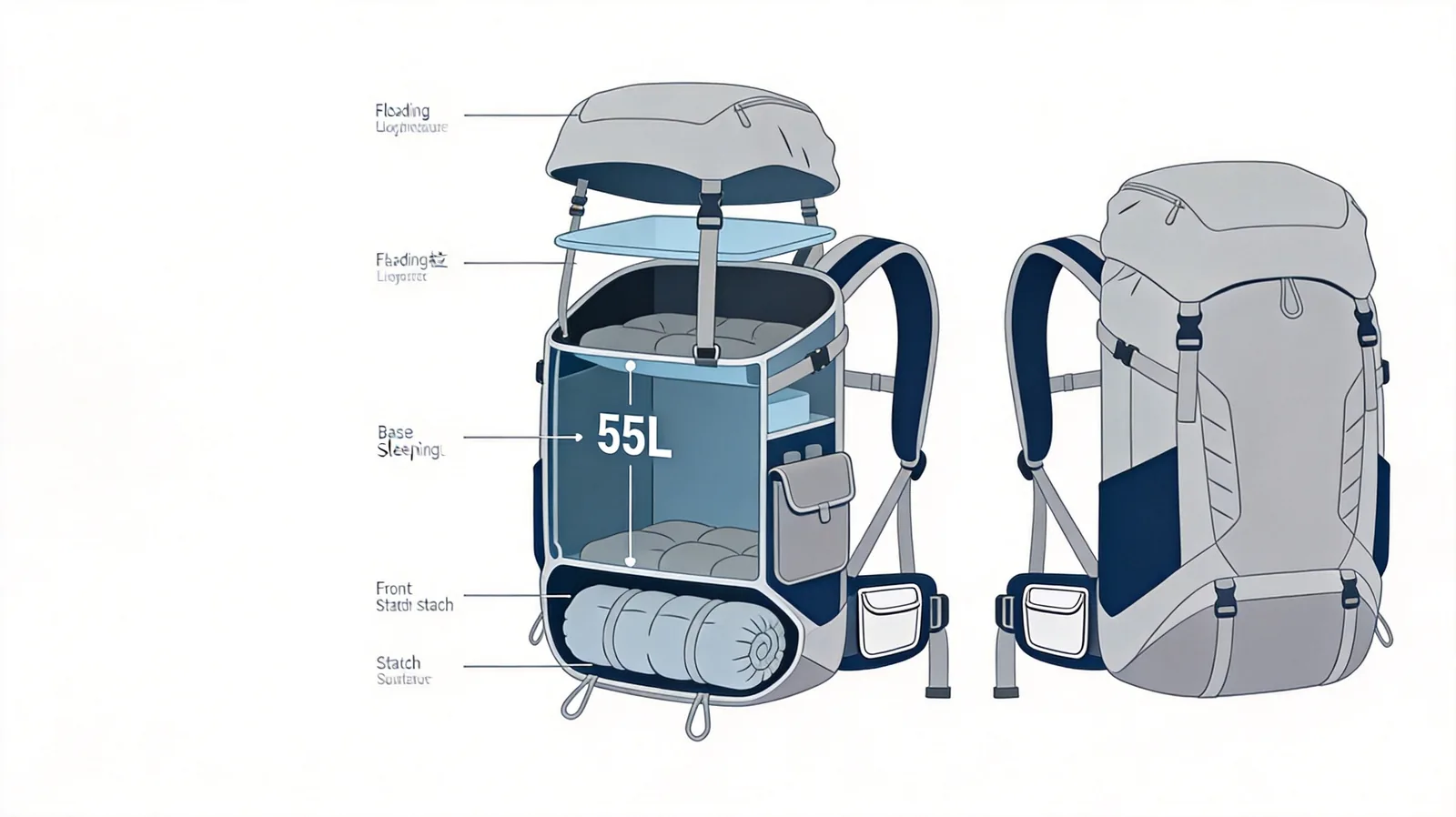
A stated 55 L capacity tells a buyer very little. What matters is how the litres are distributed, because distribution determines whether the pack carries well at 15 kg or merely holds 15 kg.
| Compartment | Typical volume in a 55 L trekking pack | Function | Design note |
|---|---|---|---|
| Main body | 30–34 L | Bulk clothing, food, shelter | Must sit against the frame; keep the load path unobstructed |
| Base compartment | 7–9 L | Sleeping bag, wet kit | Divided by a shelf; a zip-out divider adds versatility at a weight cost |
| Floating lid | 6–9 L | Layers, snacks, map, valuables | Floating rather than fixed so it can rise over an overloaded main body |
| Front stash | 3–5 L | Wet shell, approach shoes | Stretch or laminated; must drain |
| Hip belt pockets | 1–2 L total | Phone, snacks, compass | Placed forward of the iliac crest so they do not interfere with load transfer |
| Side pockets | 2–3 L total | Bottles, poles | Must be reachable while walking, angled rather than vertical |
| Hydration sleeve | 2–3 L | Bladder | Hangs from the frame, not the fabric panel |
Why the floating lid matters more than it looks
A fixed lid is lighter and simpler. A floating lid adjusts vertically on two straps so the pack can compress when the food bag empties and expand when it is full at the start of a resupply leg. On a five-day route with one resupply, the main body volume changes by 8–12 L across the trip. A fixed lid either leaves the pack unstable at the start or leaves a gap at the end. This is a design decision European buyers ask about specifically, and it is one of the clearest markers separating a trekking pack from a scaled-up daypack.
Compression is a load-transfer system, not an accessory
Two side compression straps and a base strap are standard. Their function is not tidiness — it is to keep the centre of mass close to the spine. On a 15 kg load, every centimetre the mass sits behind the frame adds leverage at the lumbar, and that leverage is paid for by the wearer over six hours. Compression that runs over the front stash rather than under it also stabilises the outer layer of the load, which is where a pack typically feels least controlled.
Suspension Under Sustained Load: What Changes Above 15 kg
Below about 12 kg, most of the load sits on the shoulders and a simple internal frame is adequate. Above 15 kg, the hip belt becomes the primary load path and the frame’s job changes from “hold the shape” to “transmit a bending moment from the shoulders to the pelvis without buckling.”
The mechanism of load transfer — hip belt geometry, shoulder strap ergonomics, back panel ventilation — is covered in the hiking backpack engineering guide. What follows is what specifically changes when the load is sustained.
Stay configuration
| Configuration | Load range | Behaviour | Where it belongs |
|---|---|---|---|
| Single U-shaped stay | up to 10 kg | Light, simple, transfers little | Daypacks, 25–35 L |
| Single HDPE framesheet | 8–14 kg | Spreads pressure, no vertical transmission | Hiking packs, 30–45 L |
| Framesheet + 2 parallel aluminium stays | 14–20 kg | Direct vertical load path, predictable flex | Trekking packs, 45–65 L |
| Framesheet + 2 stays + peripheral hoop | 18–25 kg | Resists torsional flex under uneven terrain | Expedition and mountaineering, 55–75 L |
6061-T6 aluminium is the workhorse for stays: it bends predictably, can be field-straightened by the wearer, and is cheap to replace. 7075 offers higher yield strength at the same weight but work-hardens and cracks if repeatedly bent, which is why it appears mostly in fixed-geometry designs. Stay diameter in trekking packs typically runs 8–10 mm; the difference between a pack that feels controlled and one that feels vague at 18 kg is often 1 mm of stay diameter and 15 mm of stay spacing, not the fabric.
Hip belt anchoring
On a daypack, the hip belt is often a padded strap sewn to the back panel. On a trekking pack it must be a structural element anchored to the frame, because it is carrying 60–75% of the load. Three construction details decide whether it holds:
- Anchor point: the hip belt wings must attach to the framesheet or stay pocket, not to the side panel fabric. A fabric-anchored belt creeps under sustained load and the pack settles down onto the shoulders over the course of a day.
- Wrap geometry: the wings need to follow the iliac crest with a compound curve. A flat wing concentrates pressure on two points; a properly moulded wing distributes it across roughly 180° of the pelvis.
- Stabiliser straps: the small upper and lower straps that tension the belt against the hip. Omitting them saves 30 g and costs most of the belt’s effectiveness on technical ground.
Load lifters and the shoulder interface
Load lifter straps run from the top of the shoulder strap back to the frame at roughly 45°. Their job is to pull the top of the pack forward and up, transferring weight from the shoulders to the hips and stabilising the head clearance. On a 15 kg load the correct angle and length of these straps changes the felt weight at the shoulders by several kilograms. Buyers who have been burned by a pack that “carried heavy” are usually describing load lifters that were too short or anchored too low.
Ultralight Trekking: Engineering Below 1,000 g
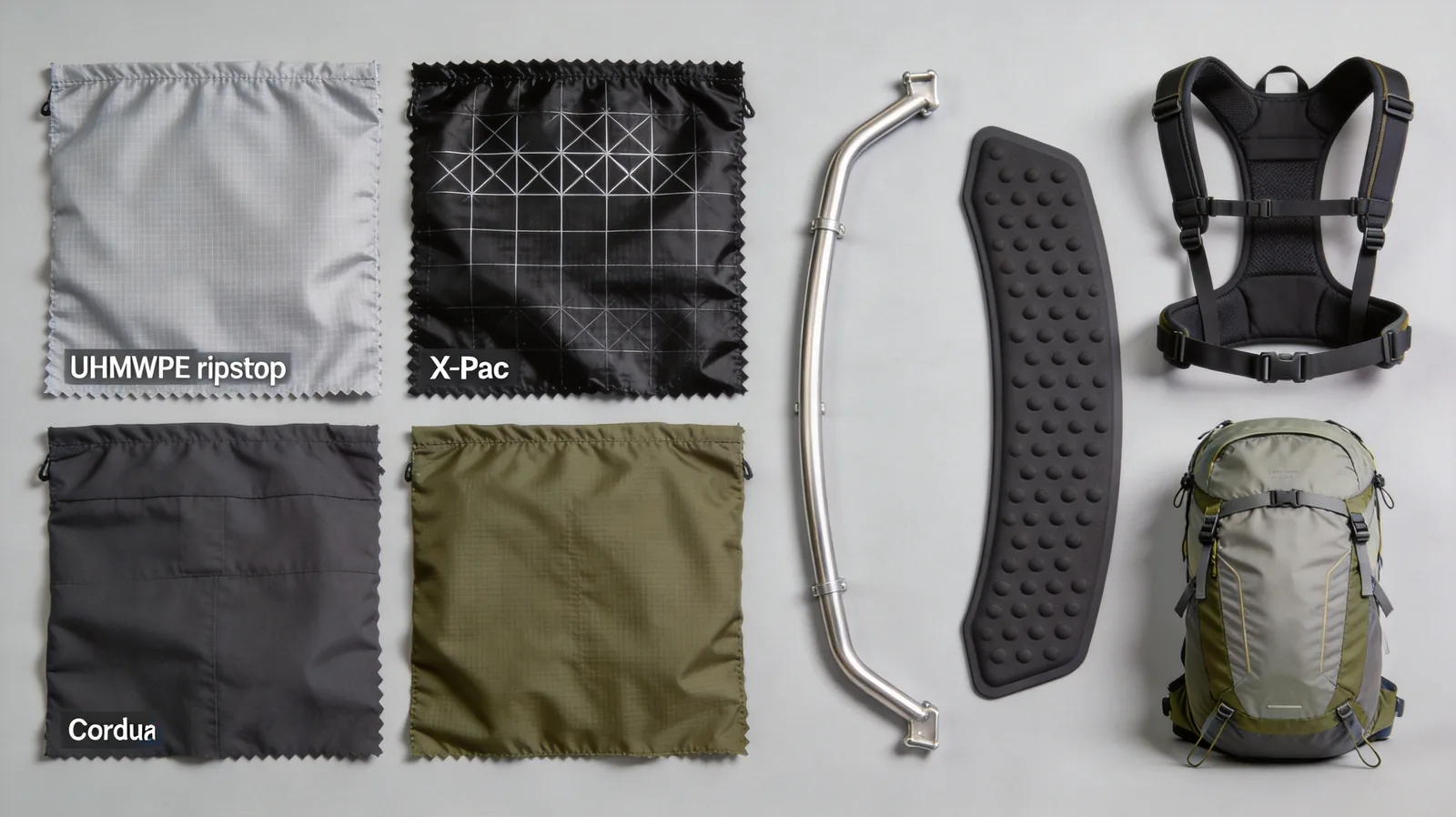
Sub-1,000 g trekking packs exist, and they are genuinely useful, but the weight is not free. It is bought by reducing structure, and reducing structure reduces the load at which the pack remains comfortable.
Three levers
Remove structure. No framesheet, no stays, or a removable closed-cell foam pad doubling as the “frame”. Saves 300–500 g and caps comfortable load at roughly 9–11 kg.
Change material. Move from 420D ripstop or Cordura 500D to a laminated UHMWPE fabric such as Challenge Sailcloth Ultra 200 or Dyneema Composite Fabric. Saves 150–350 g across the pack at equivalent tear strength, at three to five times the material cost and with much lower abrasion resistance in the high-wear zones.
Delete features. Fixed lid instead of floating, single side compression strap per side, no hip belt pockets, no hydration sleeve, no bottom compartment divider. Saves 200–400 g and removes exactly the features multi-day trekkers ask for.
Weight targets and what they actually buy
| Pack weight | Structure | Comfortable load | Realistic use |
|---|---|---|---|
| 1,800–2,200 g | Framesheet + 2 stays + floating lid | 18–22 kg | Multi-day, winter, expedition approach |
| 1,300–1,600 g | Framesheet + 2 stays, fixed lid | 14–18 kg | Standard summer trekking, hut routes |
| 900–1,200 g | Framesheet or 1 stay, minimal features | 10–14 kg | Fastpacking, ultralight multi-day |
| 500–800 g | No frame, foam pad only | 7–10 kg | Ultralight purists, fast-and-light overnight |
Where ultralight packs fail first
Not at the fabric. Field returns on ultralight trekking packs cluster at four points: the hip belt anchor stitching, the stay pocket exit at the top of the frame, the base seam where the pack is set down, and the lid attachment when the pack is overstuffed. All four are construction problems rather than material problems, and all four are addressable with targeted reinforcement that costs 40–70 g rather than 200 g.
Fabrics for Wet, Cold, European Conditions
European trekking briefs weight water resistance differently from North American ones. Scottish, Norwegian, Alpine and Pyrenean routes deliver sustained rain at 5–12 °C rather than short heavy downpours at 25 °C. That changes both the fabric specification and the seam strategy.
| Fabric | Construction | Weight (g/m²) | Water resistance | Best use in a trekking pack |
|---|---|---|---|---|
| 210D HT ripstop nylon, PU coated | Woven, ripstop grid | 110–140 | 1,000–1,500 mm | Budget main body; needs a rain cover |
| 420D ripstop nylon, PU coated | Woven, ripstop grid | 180–230 | 1,500–2,000 mm | Main body, base |
| Cordura 500D | Woven, air-textured nylon | 250–290 | Coated, not waterproof | High-abrasion base and side panels |
| X-Pac VX21 | Laminated: 210D face, PET film, X-ply | 210 | Waterproof laminate | Main body on lightweight builds |
| X-Pac VX42 | Laminated: 420D face, PET film, X-ply | 310 | Waterproof laminate | Main body and base on load-bearing builds |
| Challenge Ultra 200 | Laminated UHMWPE, 200 denier | 125 | Waterproof laminate | Ultralight main body |
| Challenge Ultra 400 | Laminated UHMWPE, 400 denier | 190 | Waterproof laminate | Ultralight body with abrasion margin |
| Dyneema Composite Fabric (DCF) | Non-woven Dyneema laid between Mylar films | 50–150 | Waterproof, low abrasion resistance | Ultralight body only; never the base |
The PU coating problem at low temperature
Polyurethane coatings are the standard waterproofing on coated nylon, and they have two failure modes that matter in European conditions. Hydrolysis: PU absorbs moisture and degrades, especially in humid storage, so a pack stored damp in a garage for two seasons can delaminate without ever being used hard. Cold flex cracking: below roughly −15 °C, standard PU becomes stiff and flexes poorly, so the coating cracks along fold lines — precisely where a pack is creased when packed.
Laminated fabrics (X-Pac, Ultra, DCF) do not have this failure mode because there is no coating to delaminate; the film is bonded. That is a large part of why they dominate the premium European trekking segment despite the cost, and why a buyer who has had a coated-nylon pack delaminate will pay for laminate on the next order.
PFAS: the coating decision has moved
Durable water repellency (DWR) has historically been delivered by C8 fluorochemicals, then C6, and both are now under regulatory pressure in Europe. France has prohibited the manufacture, import and sale of clothing, footwear and waterproofing treatments containing PFAS on its market from 1 January 2026 under Loi 2025-188 and Décret 2025-1376. A backpack is not clothing or footwear, and the French text does not name packs explicitly — but most brands we work with have already moved their entire outdoor range to PFAS-free DWR rather than maintain a separate compliance position for accessories.
The practical answer at quotation stage: specify PFAS-free DWR as the default, and if the buyer wants fluorochemical performance, ask them to confirm in writing which market the goods are destined for. That single question prevents most of the compliance problems we see downstream. More on material chemistry selection is in our TPU vs PVC vs nylon material guide.
The EN 13538 Myth: What European Law Actually Requires of a Backpack
This section exists because the same incorrect standard appears in European trekking briefs over and over, and because answering it correctly is one of the more useful things a factory can do for a buyer.
What EN 13538 actually is
EN 13538 is the European standard for measuring the dimensional characteristics of sleeping bags. Part 3 of the standard covers volume under load and easiness of packing: the bag is placed in a cylinder, loaded with 50 ± 1 kg for 300 ± 15 seconds, and measured at three points, with the results averaged. It has nothing to do with backpacks. The 2003 edition was withdrawn and the 2016 edition is current, and it is referenced by ISO 23537-2:2023 for sleeping bag requirements.
A trekking backpack brief that cites “EN 13538 compliance” is citing a sleeping bag measurement method. If a supplier tells you they will “certify EN 13538” on a backpack, they are either confusing the standard or hoping you are.
Other standards that get misapplied
| Standard cited | What it actually covers | Applies to a trekking pack? |
|---|---|---|
| EN 13538-3 | Sleeping bag dimensions, volume under load | No |
| EN 13210-2 | Child care articles — child carriers with backpacks | No, unless the product is a child carrier |
| ISO 11228-1 | Manual handling: lifting and carrying | No — the standard explicitly excludes backpack use |
| EN ISO 20471 | High-visibility clothing | Only for hi-vis components, not the pack |
What actually applies
There is no harmonised European standard for backpack construction, load capacity or ergonomics. A backpack is a general consumer product, and it falls under the horizontal framework rather than a product-specific directive. That means:
- CE marking does not apply. A trekking backpack is not covered by any CE-marking directive unless it incorporates a regulated function. Do not put a CE mark on a pack, and do not accept a supplier who claims one.
- GPSR does apply. Regulation (EU) 2023/988 on general product safety has applied since 13 December 2024, replacing the 2001 General Product Safety Directive. It requires that each product has a responsible economic operator established in the EU — manufacturer, importer, authorised representative or fulfilment service provider — whose name, trade name and contact details, including postal and email address, appear on the product, its packaging or an accompanying document. It also requires manufacturers to design for safety, carry out an internal risk analysis, maintain technical documentation, keep a complaints register, and be able to supply traceability information to authorities for six years and product risk information for ten.
- REACH applies. Chemical restrictions on the materials themselves: SVHC, azo dyes, APEO, certain phthalates, and the evolving PFAS restriction.
- National EPR registration applies to whoever places the goods on that national market — this is the buyer’s obligation, not the factory’s, but it determines what documentation they need from you.
EU Market Access: REACH, PFAS, EPR and Labelling
Compliance in Europe is not one gate. It is four separate regimes, administered by different bodies, with different triggers. Here is the working map we use when quoting a European trekking programme.
| Regime | Jurisdiction | What it requires | Who is responsible | Status |
|---|---|---|---|---|
| REACH | EU / UK REACH separately | Chemical restrictions on materials; SVHC declaration above 0.1% | Whoever places goods on the market; material data flows from factory | In force |
| GPSR (EU) 2023/988 | EU | EU responsible economic operator named on product or packaging; risk analysis; technical file; complaints register; traceability | Producer / importer / authorised representative | Applies since 13 Dec 2024 |
| France PFAS ban | France | Prohibits manufacture, import and sale of clothing, footwear and waterproofing treatments containing PFAS | Anyone placing on the French market | In force since 1 Jan 2026 (Loi 2025-188, Décret 2025-1376) |
| France EPR (Refashion) | France | Registration with Refashion, eco-contribution, Triman logo plus sorting instructions on product | Producer, importer or distributor placing on French market | Operational since 2007 |
| Germany packaging EPR (LUCID) | Germany | LUCID registration with ZSVR, dual-system contract, volume reporting; non-German producers must appoint an authorised representative in Germany | First party placing packaged goods on the German market | VerpackDG implementing PPWR since 12 Aug 2026; representative mandatory, existing registrations must add one by 12 Nov 2026 |
| ESPR | EU | Ecodesign and digital product passport framework | Economic operators | Applies to large operators from 19 Jul 2026, phasing in |
| UK REACH + UKCA scope | UK | Separate UK chemical regime; UKCA marking applies only where a product-specific regulation requires it, which a backpack does not | UK importer / brand | In force |
What this means for a sourcing conversation
Three practical consequences follow, and they are worth stating plainly because they are where European programmes stall:
One: the factory cannot register on the buyer’s behalf. Refashion registration and LUCID registration belong to the party placing goods on that market. What the factory provides is the input data — material composition by weight, packaging weights by material type, recycled content, country of origin — and the ability to reproduce it consistently across reorders. If a factory cannot produce a material weight breakdown per SKU, the buyer cannot complete their own registration.
Two: packaging is a separate obligation from product. German LUCID is about packaging placed on the German market, including the polybag and the carton. Its thresholds have no minimum: a single packaged product triggers registration. Fines under the German rules reach EUR 200,000 for not joining a dual system and EUR 100,000 for failing to register or selling while unregistered. This is why German buyers ask for packaging weights early, and why a factory that can supply them saves the buyer weeks.
Three: PFAS is a material decision, made at sampling. Once a DWR is locked into a sample and approved, changing it later means re-testing and re-approval. Specify PFAS-free at the first sampling round and the issue never arises.
For the shipping and cost side of European programmes, our guides on FOB vs EXW vs DDP and the de minimis and importer compliance changes cover the landed-cost mechanics.
Component Sourcing: Buckles, Zips, Foams and Stays
Components are where trekking packs diverge from daypacks under load, and where brand-specified parts create the longest lead times in a programme.
Load-bearing hardware
- Hip belt buckle: 38–50 mm side-release, rated for the full belt tension. Duraflex and YKK are the default specifications; Woojin and Nifco appear where a buyer wants cost reduction with acceptable performance. A 25 mm buckle on a 50 mm belt is a failure point, not a saving.
- Shoulder strap adjusters: ladder locks and strap keepers in acetal rather than nylon where cold-weather stiffness matters.
- Compression strap hardware: 20–25 mm with cam or side-release. The base strap takes the highest dynamic load when the pack is set down, so specify a metal-free but reinforced buckle there.
Zips
YKK 8# and 10# coil zips are standard for main compartment access on trekking packs; 5# for lid and pockets. Water-resistant coated zips are worth specifying on the lid and front stash, and rarely worth it on the main body where a storm flap plus compression does the same job at lower cost and higher durability. Reverse-coil zips reduce abrasion wear on the teeth where the pack is dragged.
Foams
- Shoulder straps: 8–12 mm closed-cell PE or EVA, with a 3D spacer mesh against the body. PE holds shape better under sustained load; EVA is softer and degrades faster.
- Hip belt wings: 12–20 mm laminated EVA/PE composite with a moulded compound curve. This is the single highest-value foam specification in the pack and the one most often downgraded to hit a price target.
- Back panel: 3D spacer mesh over a contoured foam layer, with ventilation channels aligned to the spine rather than across it.
Stays
6061-T6 aluminium, 8–10 mm diameter, in a removable sleeve so the wearer can field-replace or reshape. Removability also matters for air freight and for recycling claims. Specify the stay length tolerance tightly: a stay 10 mm too long will perforate the sleeve top within a season.
Manufacturing a Load-Bearing Pack: Stitch, Seam, Seal
Most trekking pack failures are stitch failures, not material failures, and they cluster at four locations. Our construction standard addresses each explicitly.
The four critical zones
| Zone | Load | Construction standard | Failure mode if underbuilt |
|---|---|---|---|
| Hip belt root (belt to frame) | Highest sustained, 60–75% of total load | Box-X stitch through webbing into the framesheet pocket, plus bar-tack at each corner; minimum 6 lines of stitch | Belt separates from body; catastrophic and unrepairable in the field |
| Shoulder strap root (top of pack) | High, cyclic with stride | Box-X plus bar-tack, anchored to the frame sleeve not the panel fabric | Strap tears out at the top; pack unusable |
| Stay pocket exit (top and bottom) | Concentrated point load | Double-fold binding plus bar-tack; reinforced with 500D at the exit | Stay perforates the sleeve |
| Base seam | Impact, repeated set-down | Double-stitched, bound, 500D or VX42 base panel; corner reinforcements | Base blows out on abrasive rock |
Stitch specification
We work to 8–10 stitches per inch with bonded polyester thread, tex 70 for general seams and tex 105 for load-bearing seams. Lock stitch throughout, no chain stitch on any load path — chain stitch unravels from a single break. Bartacks at every strap termination, and box-X at every anchor point where two webbing runs meet fabric.
Seam sealing
On laminated fabrics, seam sealing is what converts a waterproof material into a waterproof pack. Two approaches:
- Seam tape: 20–25 mm PU or TPU tape, heat or pressure applied. Fast, consistent, adds 40–90 g. Requires clean seam allowance control and does not work well over compound curves.
- Seam grip (liquid PU): applied to the interior seam. Slower, labour-intensive, works on curves, adds 15–30 g. The practical choice for small radius seams at the base and around the stay pocket.
Most production packs use both: tape on long straight seams, grip on the difficult geometry. A laminated pack with neither is a marketing claim rather than a waterproof product.
QC Protocol: What We Test and How
Because there is no harmonised backpack standard in Europe, the test protocol is the specification. Ours covers six areas, and the results are documented per production lot.
| Test | Method | Acceptance |
|---|---|---|
| Static load | 1.5× rated load suspended 24 hours from shoulder and hip anchor points | No seam failure, no permanent deformation above 5 mm |
| Dynamic load | Rated load, 2,000 cycles of 0–15 cm vertical oscillation | No stitch failure at the four critical zones |
| Drop test | Loaded pack dropped 1 m onto concrete, base first, 10 cycles | No base seam separation, no hardware fracture |
| Zip cycle | Main access zip opened and closed 2,000 cycles under load | No slider binding, no tooth displacement |
| Fabric abrasion | Martindale, 500 g head, base and high-wear panels | No face fabric breakthrough before the agreed cycle count |
| Cold flex | −20 °C for 4 hours, then 100 flex cycles at the pack crease lines | No coating crack, no laminate delamination |
| Seam strength | Grab tensile on load-bearing seams (ASTM D5034 method) | Seam strength ≥ 80% of fabric strength |
In-line inspection runs to AQL 2.5 for major defects and AQL 4.0 for minor, with a documented report per lot. For buyers who need third-party inspection, we accommodate nominated agencies and schedule production so inspection does not delay shipment.
OEM/ODM Programme: MOQ, Sampling and Lead Time
The programme structure below is what we quote for trekking packs. It does not vary by market, but the documentation package does — European buyers typically require more of it earlier.
| Parameter | Standard |
|---|---|
| MOQ | 500 pcs per colour per design |
| Sampling time | 6–10 days from confirmed tech pack |
| Bulk production | 35–50 days from sample approval and deposit |
| Sample fee | Charged, refunded against the first bulk order |
| Torso sizes | 2–3 sizes available without additional MOQ penalty on the first order |
| Branding | Embroidery, heat transfer, woven label, moulded rubber patch, printed webbing |
| Documentation | Material composition by weight, packaging weights by material, test reports, AQL inspection report, REACH SVHC declaration |
Programme stages
- Brief and specification review (3–5 days). We review the tech pack, flag specification conflicts — weight versus load, capacity versus frame — and confirm the compliance position for the destination market.
- Quotation and BOM (3–5 days). Itemised bill of materials with named fabric and component suppliers, so the buyer can see exactly what drives the FOB.
- Sampling (6–10 days). First proto, then one or two revision rounds as needed. Fit and load testing happens at this stage, not after approval.
- Approval and pre-production (5–7 days). Golden sample signed off, material booked, production slot confirmed.
- Bulk production (35–50 days). In-line inspection at 30% and 70%, final AQL inspection before packing.
- Packing and shipping. Export cartons specified to the buyer’s requirement, with packaging weight data supplied for their EPR reporting.
For the commercial mechanics of the sourcing relationship — how an OEM programme differs from ODM and private label, and how to structure the first order — see our guides on OEM vs ODM vs private label and the sample-to-bulk production journey.
Frequently Asked Questions
Is EN 13538 required for trekking backpacks in Europe?
No. EN 13538 is the European standard for measuring the dimensional characteristics of sleeping bags — Part 3 covers volume under load and easiness of packing. It does not apply to backpacks. There is no harmonised European standard for backpack construction, and CE marking does not apply to a backpack either. What does apply is the General Product Safety Regulation (EU) 2023/988, REACH for material chemistry, and national EPR registration for the party placing the goods on that market.
What capacity should a European trekking pack range cover?
Most European multi-day ranges run 45 L, 55 L and 65 L, with a 75 L for expedition and winter use. A five-day self-supported summer load typically lands between 12 and 17 kg in 40–58 L of packed volume, which is why the 45–65 L band dominates. A 35 L pack cannot serve this use case however well it is built.
Can you build a trekking pack under 1,000 g that carries 18 kg?
Not honestly. Below 1,000 g the structure required to transmit 18 kg to the hips has been removed, so comfortable load drops to roughly 10–14 kg. A pack quoted at sub-1,000 g and 18 kg capacity will either exceed 1,000 g when built to survive, or fail at the hip belt anchor within a season. We flag this conflict at quotation stage rather than at claim stage. Our realistic bands are 1,300–1,600 g for 14–18 kg and 900–1,200 g for 10–14 kg.
Do I need CE marking on a trekking backpack?
No. A trekking backpack is not covered by any CE-marking directive. CE marking applies to product categories governed by specific directives — PPE, toys, electrical equipment and similar. A backpack has no such directive, so a CE mark on it is either meaningless or misleading. What you do need for the EU is an EU-based responsible economic operator named on the product or packaging under GPSR.
How do I make a trekking pack PFAS-free?
The DWR finish is the component that carries PFAS risk. Specify a PFAS-free DWR at the first sampling round and the material is locked in before approval; changing it later means re-testing. France has prohibited PFAS in clothing, footwear and waterproofing treatments on its market since 1 January 2026, and although a backpack is not named in that text, most brands we work with have moved their whole outdoor range to PFAS-free DWR rather than maintain a separate position for accessories.
What documentation do European buyers need from the factory?
At minimum: material composition by weight per SKU, packaging weights by material type (needed for German LUCID and French Refashion reporting), a REACH SVHC declaration, test reports for load and abrasion, and an AQL inspection report per lot. Buyers who sell into Germany also need the packaging data early because LUCID registration has no minimum volume threshold — a single packaged product triggers it.
What is the difference between a trekking pack and a hiking pack?
Load and duration. A hiking pack is designed around 5–12 kg for a day to one overnight, typically 20–45 L, with the load carried mostly on the shoulders. A trekking pack is designed around 12–20 kg for three to seven days, typically 45–75 L, with 60–75% of the load transferred to the hips through a frame-anchored hip belt. The structural difference is stay configuration and hip belt anchoring, not fabric.
Can you produce a 55 L pack in two torso sizes without doubling the MOQ?
Yes. Torso sizing is a pattern and cutting variation rather than a separate design, so two or three torso sizes are available on the first order without an additional MOQ penalty. Colourways are what carry the MOQ: 500 pcs per colour per design.
Which fabrics do you recommend for wet European conditions?
Laminated fabrics outperform coated ones in sustained wet and cold. X-Pac VX21 and VX42 for load-bearing builds, Challenge Ultra 200 and 400 for ultralight, Cordura 500D or VX42 for the base. Coated PU nylon is viable at a lower price point but has two failure modes that matter in Europe: hydrolysis in humid storage and cold flex cracking below about −15 °C. Laminates have neither because there is no coating to delaminate.
How long does a trekking pack programme take from brief to shipment?
Roughly 55–75 days in total. Sampling runs 6–10 days from a confirmed tech pack, revision rounds add 6–10 days each if needed, pre-production takes 5–7 days, and bulk production runs 35–50 days from sample approval and deposit. First programmes with a new buyer usually take longer because the test protocol and documentation package are being agreed in parallel.
Start Your Trekking Pack Programme
Build a Multi-Day Trekking Range With JUNYUAN
We manufacture custom trekking backpacks from 45 L to 75 L, in coated nylon and laminated UHMWPE constructions, with frame-anchored hip belts, removable aluminium stays and documented load testing. MOQ 500 pcs per colour per design, sampling in 6–10 days, bulk in 35–50 days.
Send us your tech pack or your packing list — we will tell you what the load actually requires, and where your specification conflicts.
Request a Trekking Pack Quote
See the Full Outdoor Pack Matrix
Related engineering and sourcing references: hiking backpack OEM/ODM blueprint, outdoor backpack manufacturer matrix, why Gregory packs cost more, premium hiking packs: name or fabrics, and top custom backpack manufacturers in China 2026.