
The Anti-Theft Backpack Market: A $3.2 Billion Manufacturing Opportunity
The global anti-theft bag market is projected to reach $3.2 billion by 2028 (Grand View Research, 2024), growing at a CAGR of 7.4% driven by urbanization, international tourism recovery, and rising pickpocket crime rates in major cities. Anti-theft backpacks represent the fastest-growing product segment within this market—outpacing anti-theft shoulder bags and crossbody bags in unit growth.
For brands and retailers, anti-theft backpacks offer premium pricing potential (typically 30–50% above equivalent non-anti-theft models) and strong repeat purchase rates. But manufacturing a genuinely effective anti-theft backpack requires far more than marketing claims—it demands specific fabric engineering, hardware selection, and construction techniques that most generic backpack factories cannot deliver.
At Junyuan Bags, we manufacture anti-theft backpacks for brands across North America, Europe, and Asia. This guide covers the complete manufacturing process: slash-proof fabric technology, locking zipper systems, RFID-blocking construction, hidden pocket integration, and how to develop an anti-theft backpack line with an OEM/ODM factory.
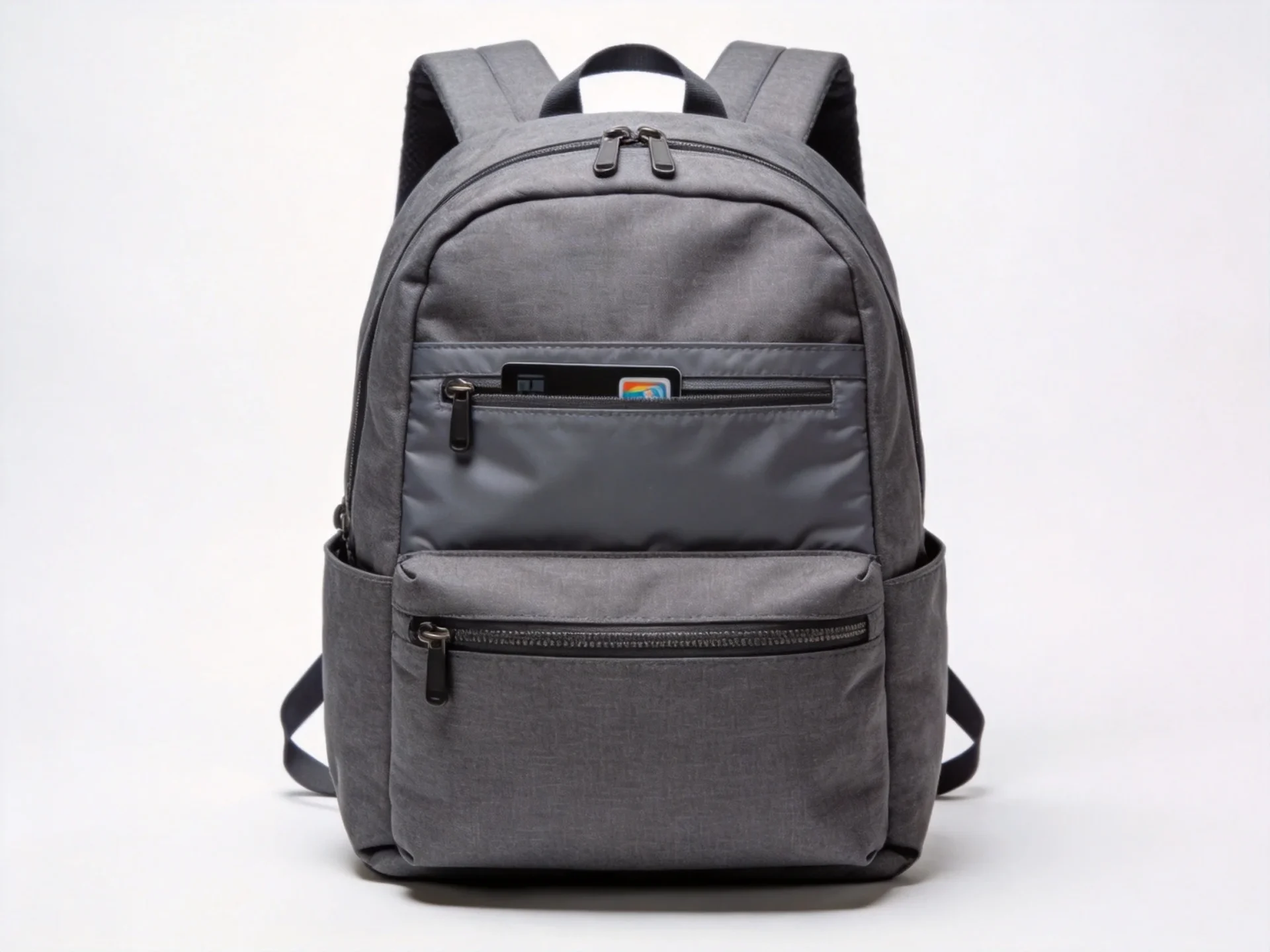
Five Core Anti-Theft Technologies in Backpack Manufacturing
Professional anti-theft backpacks integrate multiple security technologies. Each addresses a specific theft vector, and effective products layer several of these systems together. Here is the technology breakdown from a manufacturing perspective:
1. Slash-Proof Body Panels
The most visible anti-theft feature: a fabric that cannot be cut open with a blade. This prevents the most common bag theft technique—a quick slash with a razor to open the back or side panel and extract contents.
How Slash-Proof Fabrics Work
Slash resistance in backpack fabrics is achieved through three methods:
- UHMWPE (Ultra-High Molecular Weight Polyethylene) fiber integration: The most effective approach. UHMWPE fibers (brand names: Dyneema, Spectra) have a tensile strength 15x greater than steel at the same weight. When woven into a fabric panel, they resist blade cutting because the fibers flex away from the blade edge rather than being severed.
- Stainless steel mesh layer: A flexible stainless steel mesh (similar to cut-resistant kitchen gloves) sandwiched between fabric layers. Provides Cut Level 5 protection (EN 388 standard) but adds significant weight.
- Ballistic fiber + glass fiber hybrid weave: A more cost-effective approach using tightly woven ballistic nylon combined with glass fiber filaments. Provides Cut Level 3–4 protection at lower cost than UHMWPE.
Slash-Proof Fabric Options and Pricing
| Fabric Technology | Cut Level (EN 388) | Weight (gsm) | Cost per Meter | Cost Addition per Bag |
|---|---|---|---|---|
| Dyneema composite (DCF) | Level 5 (30+) | 150–200 | ¥80–150 | +$8.00–$16.00 |
| UHMWPE + polyester blend | Level 5 (25+) | 250–350 | ¥35–60 | +$4.50–$8.00 |
| Stainless steel mesh panel | Level 5 (25+) | 400–500 | ¥25–45 | +$3.50–$6.00 |
| Ballistic nylon + glass fiber | Level 3–4 (15–20) | 300–400 | ¥20–35 | +$2.50–$4.50 |
| Standard 1680D nylon (baseline) | Level 1 (2–5) | 340–400 | ¥18–30 | Baseline |
Key insight for buyers: The most cost-effective slash-proof construction for the mass-market anti-theft backpack segment is the stainless steel mesh sandwich panel. It provides genuine Cut Level 5 protection at $3.50–$6.00 addition per unit, compared to $8–$16 for Dyneema composites. For premium lines where weight is a selling point, UHMWPE blends offer Cut Level 5 at half the weight of steel mesh.
2. Locking Zipper Systems
The zipper is the most vulnerable point on any backpack. Anti-theft backpacks address this with three zipper security technologies:
a) Double-Lock / Interlocking Zipper Pulls
Two zipper pulls that lock together when closed, requiring both to be depressed simultaneously to open. This prevents casual opening and slows down thieves significantly.
- Cost addition: $0.30–$0.60 per zipper (vs. standard single pull)
- Best for: Main compartment, exterior pockets
b) Zipper Pull with Lock Hole (TSA-Compatible)
Zipper pulls with reinforced holes that accept a small padlock or TSA-approved combination lock. This is the most visually recognizable anti-theft feature and a strong selling point for travel and hiking backpacks.
- Cost addition: $0.15–$0.30 per zipper (for the lock-hole pull)
- Optional add-on: Include a small TSA lock ($1.50–$3.00 sourced, retail value $10–$15)
c) Hidden-Track Zipper (Concealed Coil)
The zipper coil is positioned on the interior face of the zipper tape, making it impossible to access from the exterior with a cutting tool. Even if a thief cuts the fabric beside the zipper, the concealed coil prevents access. This is a standard feature in our hidden pocket backpack designs.
- Cost addition: $0.50–$1.00 per zipper (reverse-coil construction)
- Best for: Back panel access, high-security compartments

3. RFID-Blocking Construction
RFID (Radio Frequency Identification) theft—scanning contactless credit cards and e-passports without physical contact—is a documented threat. A 2023 study in the Journal of Cybersecurity Privacy found that 23% of urban travelers had experienced attempted RFID skimming.
RFID-Blocking Materials We Use
| Material | Frequency Range Blocked | Cost per Panel | Weight Addition |
|---|---|---|---|
| Silver-fiber woven mesh | 13.56 MHz (cards, passports) | $0.40–$0.70 | 15–25 g |
| Copper-nickel ripstop fabric | 125 kHz – 13.56 MHz | $0.80–$1.20 | 30–50 g |
| Aluminum-coated taffeta | 13.56 MHz | $0.25–$0.45 | 10–15 g |
| Full Faraday cage construction | All frequencies | $1.50–$2.50 | 60–100 g |
For a standard anti-theft backpack, we recommend silver-fiber mesh lining in the front panel pocket and any hidden pocket zones. This blocks credit card and passport RFID at minimal cost and weight. For premium executive lines, full Faraday cage construction in a dedicated tech pocket provides complete signal isolation.
4. Hidden Pocket / Secret Compartment Systems
Hidden pockets are the most consumer-visible anti-theft feature. A well-designed concealment pocket keeps valuables completely out of sight—and out of mind for would-be thieves. We cover five hidden pocket types in our detailed guide: Hidden Pocket Backpack OEM Manufacturing.
For anti-theft backpacks specifically, we recommend combining:
- Back panel stash pocket: Flat, zippered pocket between the back padding and the main body—virtually invisible from outside
- Interior disguised pocket: Same-lining-fabric pocket that visually disappears within the main compartment
- Optional false bottom: Concealed compartment beneath the main compartment floor
Each hidden pocket adds $0.30–$1.50 to unit cost, depending on type and whether RFID lining is integrated.
5. Slash-Proof Strap and Anchor System
A commonly overlooked vulnerability: the shoulder straps and attachment points can be cut, allowing a thief to grab the entire bag. Anti-theft solutions include:
- Steel cable core in straps: A flexible steel cable runs through each shoulder strap, making them impossible to cut through quickly. Adds $1.00–$2.00 per unit.
- Slash-proof back panel: The back panel (which faces the wearer’s body) incorporates a steel mesh or UHMWPE layer, preventing slash-and-grab attacks.
- Lock-down anchor loop: A reinforced stainless steel loop at the top of the bag, allowing it to be locked to a fixed object (chair, bike rack). Adds $0.30–$0.50.

Anti-Theft Backpack Manufacturing: Construction Process
Manufacturing an anti-theft backpack at Junyuan Bags follows a specialized process that differs from standard backpack production in several key stages:
Stage 1: Material Preparation
Slash-proof fabric panels are prepared as sub-assemblies. For stainless steel mesh constructions, this involves:
- Cutting the outer shell fabric (typically 1680D nylon)
- Cutting the stainless steel mesh layer (same dimensions, ±2mm tolerance)
- Cutting the inner lining fabric
- Laminating the three layers using a spray adhesive bonding process
- Edge-binding the laminated panel to prevent layer separation
This lamination process adds $0.80–$1.50 per panel in labor and materials, and must be completed before any sewing operations begin.
Stage 2: Zipper Security Integration
Anti-theft zippers require precise installation:
- Double-lock zippers must be aligned so both pulls engage simultaneously
- Hidden-track zippers require the coil to face inward—this must be verified during sewing, not after
- TSA-lock holes must be reinforced with metal grommets to prevent tearing under lock torque
Our sewing operators assigned to anti-theft backpack lines receive specific training on these zipper types. At Junyuan Bags, we maintain separate production protocols for anti-theft lines to ensure consistency.
Stage 3: RFID Lining Installation
RFID-blocking panels are sewn as pocket linings in designated security zones. Critical quality checks include:
- Full coverage verification: the RFID panel must extend 2cm beyond all pocket edges to prevent signal leakage at seams
- Seam overlap: where two RFID panels meet, a minimum 1cm overlap is required
- Testing: every RFID-lined pocket is tested with an NFC reader to confirm zero signal penetration
Stage 4: Strap and Anchor Integration
For backpacks with steel cable core straps:
- The cable (typically 2mm diameter, 7-strand stainless steel) is inserted into the strap webbing during the strap assembly process
- Cable ends are secured with metal ferrules at the top and bottom attachment points
- The strap is then attached to the bag body using the through-load system described in our tool backpack guide
Stage 5: Final Assembly and Testing
The completed anti-theft backpack undergoes additional testing beyond standard QC:
| Test | Method | Pass Criteria |
|---|---|---|
| Slash resistance | Box cutter blade, 5N force, 3 strokes per panel | No blade penetration through all layers |
| Zipper security | Forced opening attempt with flat tool | Cannot be opened without operating both pulls |
| RFID blocking | NFC reader at pocket surface | Zero signal penetration |
| Strap cut resistance | Blade applied to loaded strap (15kg) | Steel core prevents complete separation |
| Hidden pocket concealment | Visual inspection at 1m distance | Pocket not detectable from exterior |

Anti-Theft Backpack OEM: Customization Guide for Brands
When developing an anti-theft backpack line with Junyuan Bags as your OEM partner, we recommend a tiered product architecture:
Product Tier Strategy
| Tier | Target Price (Retail) | Anti-Theft Features | FOB Cost (500 pcs) |
|---|---|---|---|
| Essential | $49–$69 | Hidden pocket + RFID front pocket + double-lock zippers | $12.00–$16.00 |
| Advanced | $79–$119 | Essential features + slash-proof panels + TSA lock holes | $18.00–$26.00 |
| Professional | $129–$189 | Advanced features + steel cable straps + full RFID lining + false bottom | $28.00–$40.00 |
| Executive | $199–$299 | All features + Dyneema panels + premium hardware + full brand customization | $42.00–$60.00 |
This tiered approach allows brands to capture multiple price segments with shared development costs—the pocket patterns, zipper specifications, and RFID materials can be incrementally added across tiers.
Target Market Considerations
Anti-theft backpack requirements vary significantly by market:
- European Urban Commuter: Prioritizes slim profile, RFID blocking, and pickpocket defense. Smaller capacity (15–20L). Clean, minimalist design.
- Southeast Asian Traveler: Prioritizes slash resistance and locking zippers. Medium capacity (20–28L). Water-resistant construction for monsoon climates. Similar needs to waterproof backpack buyers.
- Latin American Daily Use: Prioritizes maximum concealment and slash protection. Anti-theft features must be invisible (not advertised externally, which signals valuables). Medium capacity.
- Global Tourist: Prioritizes passport security, hidden pockets, and RFID blocking. Must accommodate travel documents and electronics. 20–30L capacity. Often overlaps with travel hiking backpack needs.
Cost Structure of Anti-Theft Backpacks
Anti-theft backpacks cost 40–80% more to manufacture than equivalent non-anti-theft models. Here is where the additional cost goes:
| Anti-Theft Feature | Cost Addition (per unit) | % of Total Anti-Theft Premium |
|---|---|---|
| Slash-proof fabric panels | $2.50–$8.00 | 30–40% |
| Locking zipper systems | $0.80–$2.00 | 10–15% |
| RFID-blocking lining | $0.40–$2.50 | 5–15% |
| Hidden pocket construction | $0.50–$1.50 | 8–12% |
| Steel cable straps | $1.00–$2.00 | 12–18% |
| Additional testing/QC | $0.30–$0.60 | 5–8% |
Despite the higher manufacturing cost, the retail premium typically justifies the investment. Anti-theft backpacks achieve 30–50% higher retail margins than standard backpacks at the same quality tier.
For a complete breakdown of how materials, labor, and features determine total cost, see our guide on backpack manufacturing cost structure.
MOQ and Pricing at Junyuan Bags
At Junyuan Bags, our MOQ for anti-theft backpacks is 500 pieces per style per color—the same as our standard backpack programs. This reflects our commitment to supporting brands at all stages, from startup lines to established collections.
Pricing ranges based on anti-theft feature level:
| Feature Level | 500–999 pcs | 1,000–2,999 pcs | 3,000+ pcs | |
|---|---|---|---|---|
| Essential (hidden pocket + RFID + lock zips) | $14.00–$18.00 | $12.00–$15.00 | $9.50–$12.00 | $7.50–$10.00 |
| Advanced (+ slash-proof + TSA) | $22.00–$28.00 | $18.00–$24.00 | $15.00–$20.00 | $12.00–$16.00 |
| Professional (+ cable straps + full RFID) | $32.00–$42.00 | $26.00–$35.00 | $22.00–$28.00 | $18.00–$24.00 |
Quality Control: Anti-Theft Specific Standards
At our 4,950 sqm facility in Quanzhou with 137 workers, anti-theft backpacks undergo the following additional QC procedures beyond standard backpack inspection:
- 100% slash test: every panel with slash-proof construction is tested with a blade during in-process inspection
- 100% RFID test: every RFID-lined pocket is tested with an NFC reader
- AQL 2.5 sampling for zipper security function
- Hidden pocket concealment check: 100% visual inspection
- Cable strap continuity test: metal detector verification that the cable is intact and properly anchored
All testing is documented in inspection reports available to clients. Our QC system meets the requirements of major retail compliance programs including BSCI, Sedex, and Disney FAMA.
About Junyuan Bags — Anti-Theft Backpack OEM Manufacturing Expert
Junyuan Bags is a professional backpack OEM/ODM manufacturer in Quanzhou, Fujian, China. Our 4,950-square-meter facility with 137 skilled workers produces anti-theft backpacks alongside outdoor backpacks, hiking backpacks, fishing bags, USB backpacks, hydration packs, and tool bags.
Why brands trust us for anti-theft backpack manufacturing:
- Proven expertise in slash-proof fabric laminating and construction
- YKK authorized partner for all anti-theft zipper systems
- In-house RFID material sourcing and testing capability
- Hidden pocket engineering with dedicated concealment QC
- MOQ 500 pcs/style—ideal for launching anti-theft product lines
- Full OEM/ODM capability from concept to finished goods
- Private-label ready with full brand customization
Certification and Compliance for Anti-Theft Backpacks
As anti-theft backpacks gain mainstream adoption, certifications and test standards are becoming increasingly important for brands making security claims. At Junyuan Bags, we help our clients navigate the certification landscape to ensure their marketing claims are defensible and their products meet retailer requirements.
Key Certifications for Anti-Theft Features
| Certification / Standard | What It Covers | Cost to Brand | Timeline |
|---|---|---|---|
| EN 388 (Cut Resistance) | Slash-proof fabric cut level rating | $200–$400 per fabric sample | 2–3 weeks |
| TSA Lock Approval (TSA-007/008/009) | Lock mechanism compatible with TSA inspection | $1,500–$3,000 per lock model | 4–8 weeks |
| RFID Test Report (ISO 14443) | RFID blocking effectiveness verification | $150–$300 per test | 1 week |
| BSCI / Sedex | Factory social compliance audit | $500–$2,000 (factory pays) | Already completed at Junyuan |
| Prop 65 (California) | Chemical safety compliance | $300–$800 per material | 2–4 weeks |
| REACH (EU) | Chemical compliance for EU market | $500–$1,500 per product | 3–6 weeks |
For brands targeting major retailers (Amazon, REI, Decathlon), EN 388 certification for slash-proof claims is increasingly required. We maintain pre-certified fabric options in our anti-theft backpack material library, allowing clients to launch with certified products without waiting for individual testing.
Comparing Anti-Theft Technologies: Cost vs. Effectiveness Matrix
Not all anti-theft features deliver equal value. Here is our assessment based on real-world effectiveness and manufacturing cost:
| Technology | Theft Prevention Value | Consumer Perceived Value | Cost to Implement | ROI Rating |
|---|---|---|---|---|
| Hidden back panel pocket | High (removes valuables from sight) | High (customers love “secret” features) | Low ($0.30–$0.60) | ★★★★★ |
| RFID-blocking pocket | Medium (specific threat vector) | High (strong marketing claim) | Low ($0.40–$0.70) | ★★★★★ |
| Double-lock zippers | Medium (deters casual theft) | Medium (visible but not dramatic) | Low ($0.30–$0.60) | ★★★★☆ |
| Slash-proof fabric (steel mesh) | Very High (prevents slash-and-grab) | Very High (dramatic demo potential) | Medium ($3.50–$6.00) | ★★★★☆ |
| Steel cable straps | Medium (prevents strap cutting) | Low (invisible, hard to demonstrate) | Medium ($1.00–$2.00) | ★★★☆☆ |
| TSA lock compatibility | Low (only useful at airports) | Medium (travel-specific appeal) | Low ($0.15–$0.30) | ★★★☆☆ |
Our recommendation for brands entering the anti-theft category: start with the high-ROI features (hidden pocket, RFID blocking, double-lock zippers) to create an entry-level product under $70 retail. Then add slash-proof panels for the mid-tier, and steel cable straps plus premium hardware for the flagship tier. This approach—demonstrated successfully by brands like Pacsafe, Travelon, and Bobby—maximizes margin at each price point while building a clear value ladder.
For brands developing related product lines, the same anti-theft technologies can be applied to our fishing bags, hydration packs, and outdoor backpack categories, where theft prevention is also a growing consumer concern.
Frequently Asked Questions
What makes a backpack truly “anti-theft”?
A genuinely anti-theft backpack integrates multiple security technologies: slash-proof fabric panels that resist blade cutting, locking or concealed zipper systems that prevent unauthorized access, RFID-blocking pockets that protect contactless cards and passports, and hidden compartments that keep valuables out of sight. No single feature makes a bag anti-theft—it is the combination of layers that provides real protection. At Junyuan Bags, we engineer all these systems in-house.
How much does slash-proof fabric add to backpack cost?
Depending on the technology, slash-proof fabric adds $2.50–$8.00 per unit. Stainless steel mesh panels (Cut Level 5) are the most cost-effective at $3.50–$6.00. UHMWPE blends (like Dyneema) cost $4.50–$8.00 but are lighter. Dyneema composite fabric (DCF) costs $8.00–$16.00 but offers the highest cut resistance at minimal weight. The retail price premium of anti-theft bags typically justifies this cost addition.
Is RFID blocking effective in backpacks?
Yes, when properly implemented. Silver-fiber mesh or copper-nickel fabric linings block 13.56 MHz signals completely—preventing contactless credit card and e-passport skimming. The critical factor is complete coverage: the RFID panel must extend beyond pocket edges and overlap at seams. At Junyuan Bags, we test every RFID-lined pocket with an NFC reader to confirm zero signal penetration before shipment.
What is the MOQ for anti-theft backpacks?
Our MOQ for anti-theft backpacks is 500 pieces per style per color—identical to our standard backpack programs. This supports brands launching new anti-theft product lines without requiring a large initial investment. For detailed pricing by quantity, see the pricing tables above.
Can you make anti-theft backpacks that do not look like anti-theft bags?
Yes, and this is an increasingly important design direction. The most effective anti-theft bags look like normal urban backpacks—with all security features integrated invisibly. Hidden zippers, concealed slash-proof panels, and internal RFID pockets mean the bag provides full protection without advertising that it contains valuables. This “stealth” approach is popular in European and Japanese markets.
What is the difference between anti-theft backpacks and hidden pocket backpacks?
Hidden pocket backpacks focus on concealment—one or more secret compartments for valuables. Anti-theft backpacks provide comprehensive security: slash-proof construction, locking zippers, RFID blocking, AND hidden pockets. All anti-theft backpacks include hidden pockets, but not all hidden pocket backpacks are full anti-theft bags. The two categories overlap significantly in manufacturing techniques.
How do you test the slash resistance of anti-theft backpacks?
We test slash resistance using a standardized box cutter blade test: the blade is applied to the fabric panel with 5N force for 3 strokes. Cut Level 5 materials (stainless steel mesh, UHMWPE) will show surface marks but no penetration. We also conduct real-world simulation tests where a loaded backpack is slashed while suspended, verifying that contents remain protected.
Do anti-theft backpacks need TSA-approved locks?
TSA-approved locks are recommended for travel-oriented anti-theft backpacks but not required. Lock-compatible zipper pulls (with reinforced holes) allow users to add their own lock. Including a small TSA lock as a packaged accessory adds $1.50–$3.00 to cost but $10–$15 to perceived retail value—a strong ROI for brands targeting the travel segment.
Start Your Anti-Theft Backpack Project
Ready to manufacture anti-theft backpacks that provide genuine security and command premium pricing? Whether you need a single-feature product (RFID + hidden pocket) or a full-spectrum anti-theft system (slash-proof + locking zippers + steel cable straps), our engineering team can design and produce to your exact specifications.
Contact Junyuan Bags:
- Email: [email protected]
- WhatsApp: +86 17750020688
- Factory: Quanzhou, Fujian, China
- MOQ: 500 pcs/style
Related manufacturing guides: