
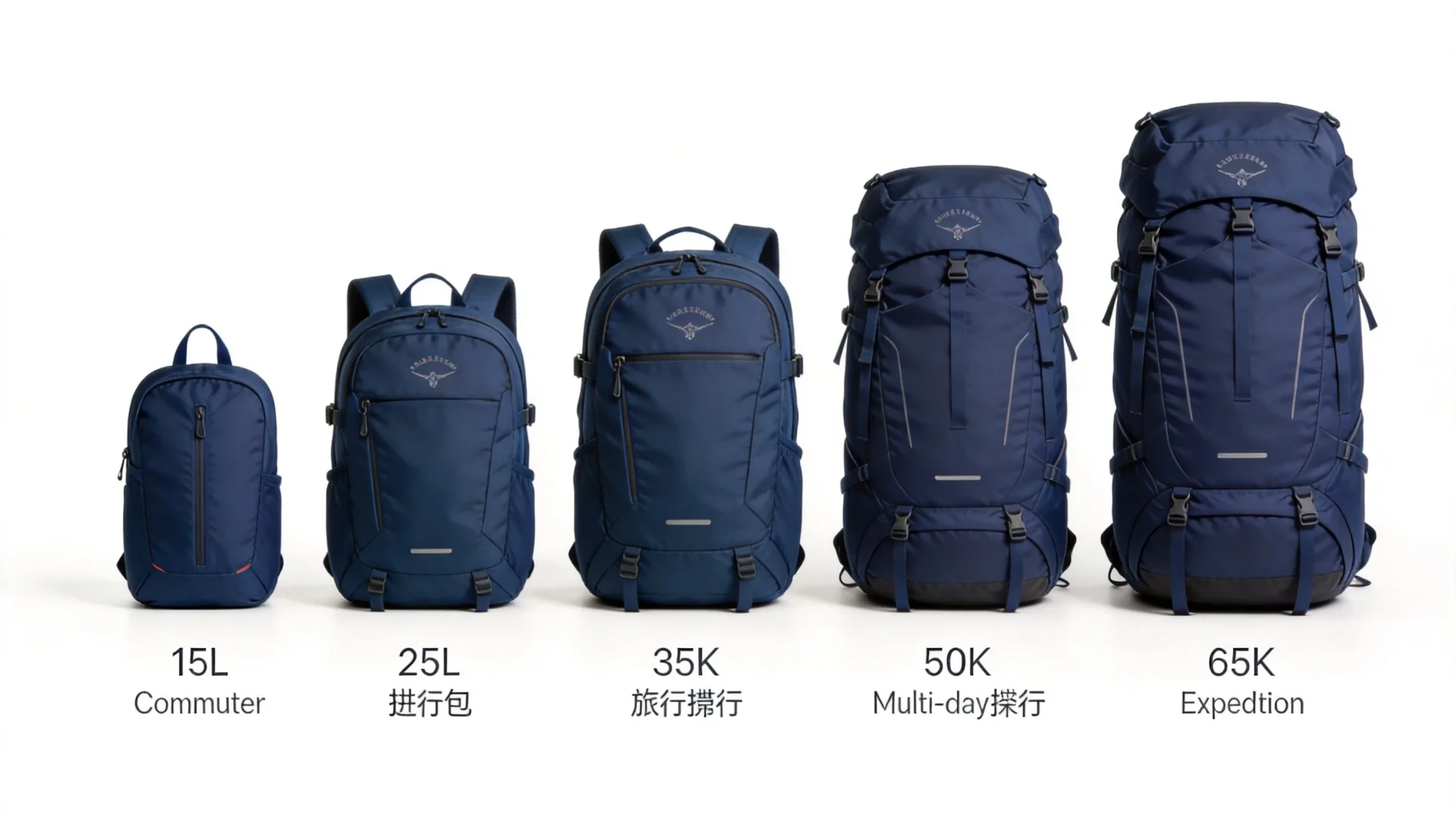
Backpack Capacity Design Guide: 15L–60L Volume Optimization for OEM Manufacturing (2026)
Backpack capacity is the single most important specification that consumers use to evaluate whether a bag meets their needs. Yet for OEM manufacturers and brand owners, designing the right capacity involves far more than simply scaling a pattern up or down. Volume optimization requires balancing usable space against structural weight, compartment efficiency against material waste, and ergonomic constraints against marketing claims. At JUNYUAN Bags, our founding owner’s bag-industry experience dates from 2004, and since the company was founded in 2014 our affiliated factory has engineered backpacks across every capacity class — from compact 15L daypacks to 65L expedition packs — and this guide shares the technical knowledge we have accumulated.
Whether you are designing a commuter carry for Amazon FBA, a performance sports backpack, or a multi-day trekking pack for your outdoor brand, understanding how capacity is calculated, how design decisions affect usable volume, and how different markets prefer different capacity ranges is essential. This guide also connects to our broader resources on material selection, custom bag design, and OEM/ODM manufacturing models.
How Backpack Capacity Is Calculated
Before you can optimize capacity, you need to understand how it is measured. There are two primary methods used in the industry, and they produce different results.
Method 1: Fill Media Measurement (Industry Standard)
The standard method — used by organizations like the Outdoor Industry Association (OIA) and European Outdoor Group (EOG) — involves filling the backpack with calibrated ping-pong balls or plastic pellets, then measuring the volume of fill material. This method captures the total internal volume including all compartments, pockets, and irregular spaces. The measurement includes:
- All main compartments
- Lid/brain pockets
- Stretch mesh side pockets (filled to their natural rest position)
- Front shove-it pockets
- Hip belt pockets
- Hydration sleeves (empty)
It does NOT include external attachment points (daisy chains, gear loops, compression straps) or the volume of items that extend above the collar when the pack is fully loaded.
Method 2: Geometric Calculation
Some manufacturers use internal dimensions (length × width × depth) to calculate volume. This method is simpler but tends to overstate usable capacity because it assumes rectangular geometry that does not account for curved panels, tapered shapes, or seam allowances. Geometric calculation is useful for initial design estimation but should not be used for marketing claims.
Converting Between Units
| Liters | Cubic Inches | Common Category |
|---|---|---|
| 15L | 915 cu in | Daypack / Commuter |
| 20L | 1,220 cu in | Daypack / School |
| 25L | 1,526 cu in | Hiking Daypack |
| 35L | 2,136 cu in | Travel / Carry-on |
| 45L | 2,746 cu in | Multi-day Hiking |
| 55L | 3,356 cu in | Backpacking |
| 65L | 3,967 cu in | Expedition |
For more detailed conversions and category standards, see our bag capacity converter guide.
Capacity Segments: Design Philosophy and Market Positioning
Each capacity range serves distinct use cases and consumer segments. Understanding these segments helps you position your product correctly and design features that match user expectations.
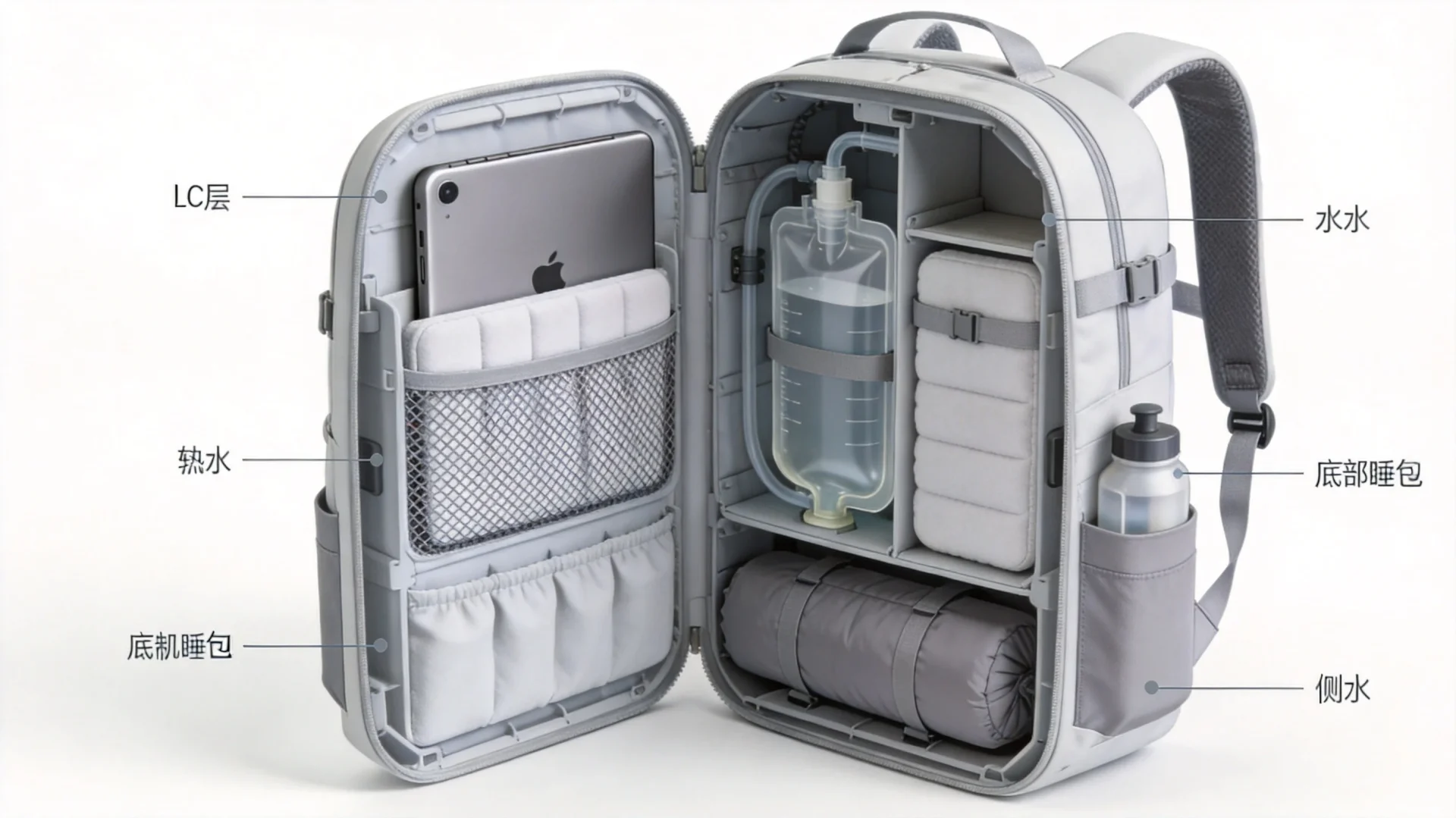
15L–20L: Commuter and Daypack
This is the fastest-growing capacity segment, driven by urban commuting, hybrid work, and everyday carry (EDC) culture. Design priorities include:
- Laptop Protection: Suspended laptop sleeve (13-16 inch) with minimum 10mm padding. The tech-focused bag market demands reliable device protection.
- Organization: Admin panel with pen slots, key leash, phone pocket, and tablet slot. In a compact volume, every compartment must earn its place.
- Low Profile: Slim silhouette that does not look bulky in office or transit environments. Target depth of 10-14 cm when not fully loaded.
- Quick Access: Top-loading or panel-loading main compartment with pass-through to luggage handle for travel integration.
For OEM manufacturing, 15-20L packs use less material and are faster to produce, resulting in lower unit costs. A quality 18L commuter backpack with 600D polyester, YKK zippers, and custom branding typically costs $5-$9 FOB at 500-piece MOQ. Understanding manufacturing cost structures helps you price these products competitively.
25L–35L: Hiking Daypack and Travel Carry-On
This is the “sweet spot” for the outdoor market and increasingly popular as airline carry-on optimization. Design considerations include:
- Hydration Compatibility: Internal sleeve for 2-3L bladder with hose routing ports. Insulation technology considerations apply when combining hydration storage with cooler features.
- Trekking Pole Attachments: External loops or shock cord systems for pole carry.
- Rain Cover Integration: Dedicated bottom pocket for integrated rain cover — essential for outdoor credibility.
- Ventilated Back Panel: Mesh trampoline suspension system to reduce sweat buildup during active use.
- Carry-On Compliance: At 35L, the pack should fit under-seat dimensions for most airlines (55 × 40 × 20 cm).
This segment overlaps significantly with the cooler backpack market, as many 25-35L packs are designed with insulated pockets for food and beverages. Understanding these cross-segment opportunities helps maximize your product’s addressable market.
40L–50L: Multi-Day Hiking and Travel
For multi-day trips, the design challenge shifts from compact organization to load management and access efficiency:
- Frame Sheet or Internal Frame: Semi-rigid support structure to distribute weight to hip belt. This is where bespoke design approaches truly outperform mass-produced models.
- Top Lid + Bottom Access: Dual access points allow reaching gear at the bottom without unpacking everything.
- Sleeping Bag Compartment: Separate zippered bottom compartment (removable divider) for sleeping bag storage.
- Load Lifter Straps: Adjustable straps connecting shoulder harness to frame for fine-tuning weight distribution.
- Multiple Compression Points: Side and bottom compression straps to stabilize loads and reduce pack volume when not full.
55L–65L+: Expedition and Extended Backpacking
At the upper end of capacity, engineering challenges multiply. These packs must carry 15-25kg loads comfortably for multiple days:
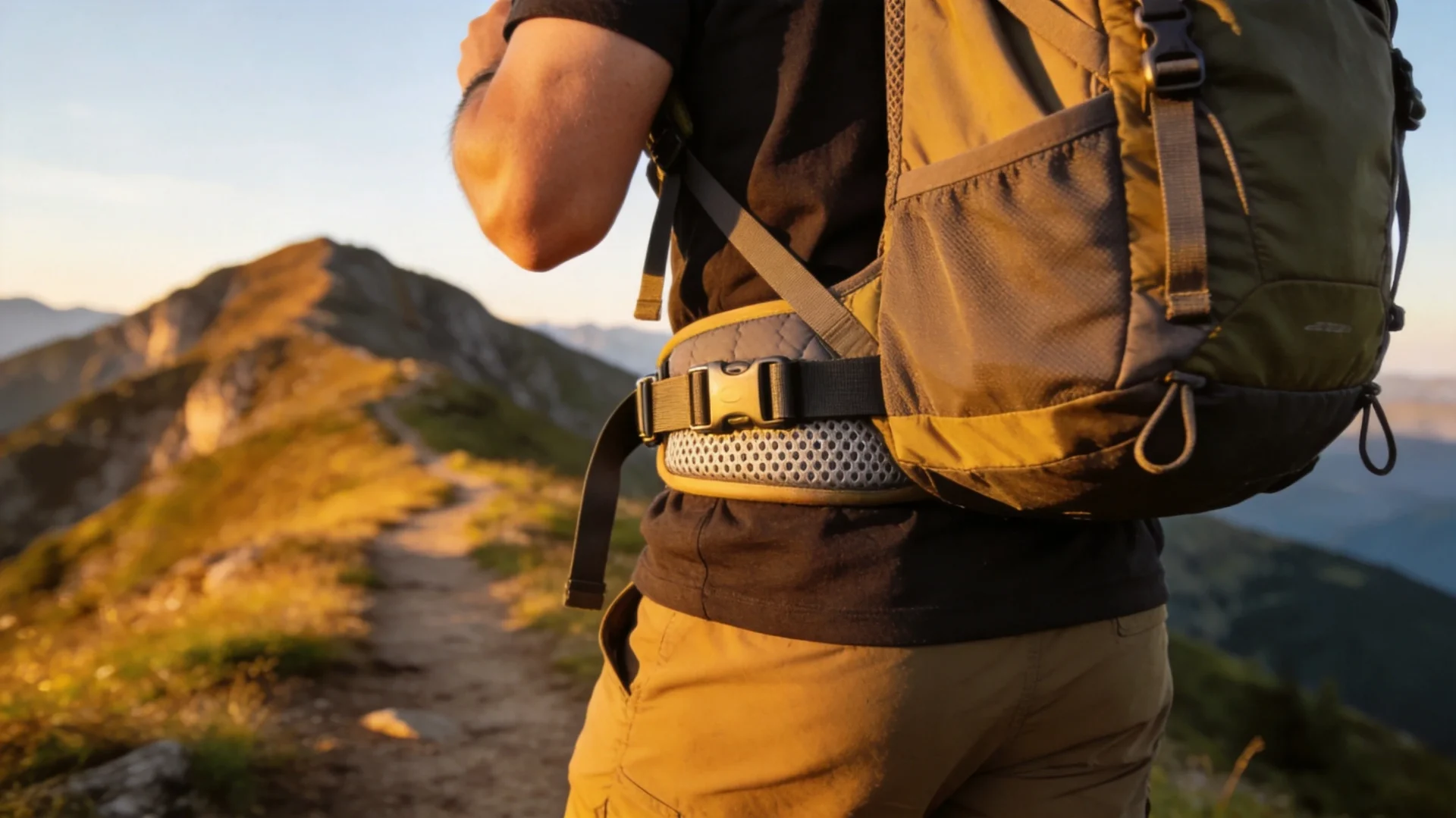
- Robust Suspension System: Multi-density foam hip belt (minimum 60mm width), padded shoulder straps (minimum 80mm), and ventilated back panel with internal frame.
- Extended Collar: Fabric collar above main compartment allows 5-10L of additional capacity for extra gear.
- Heavy-Duty Materials: 420D-1000D nylon base panels, reinforced stress points, and bartacked seam construction. Material durability becomes critical at these volumes. See our guide on abrasion-resistant fabrics for technical details.
- External Attachment Systems: Ice axe loops, gear loops, daisy chains, and sleeping pad straps for lashing bulky items.
The Engineering Balance: Capacity vs. Weight
The most critical engineering challenge in backpack design is maximizing usable capacity while minimizing empty weight. Every gram of material adds to the pack’s base weight, which directly affects user comfort and market competitiveness.
Weight Budget Targets by Segment
| Capacity | Target Empty Weight | Weight-to-Volume Ratio | Material Strategy |
|---|---|---|---|
| 15-20L | 400-700g | 28-38 g/L | 210D-420D nylon, minimal framing |
| 25-35L | 600-1,100g | 22-35 g/L | 210D-420D ripstop, mesh back panel |
| 40-50L | 900-1,600g | 20-35 g/L | 210D-420D ripstop + 600D base, internal frame |
| 55-65L | 1,200-2,200g | 20-35 g/L | 420D-1000D nylon, full frame, padded harness |
The weight-to-volume ratio should remain relatively consistent across capacity ranges (20-35 g/L). If your ratio is significantly higher, you are using too much material or over-engineering the structure. If it is lower, you may be compromising durability.
Where Weight Comes From
- Fabric selection: Switching from 600D polyester to 210D ripstop nylon can reduce fabric weight by 30-40%, but at 2-3x the material cost
- Frame components: Aluminum frames add 200-400g but are essential for loads above 12kg
- Padding: Hip belt and shoulder strap foam accounts for 15-25% of total pack weight
- Hardware: Buckles, zippers, and adjusters add 100-300g depending on pack complexity
- Organization features: Each additional pocket adds 30-80g of fabric, zipper, and binding
How Compartment Design Affects Usable Capacity
Not all liters are created equal. A 35L backpack with minimal compartments may feel more spacious than a 40L pack divided into 12 pockets, because internal dividers, mesh panels, and zipper tracks consume usable volume.
The Compartment Efficiency Formula
Internal dividers (mesh or fabric) consume approximately 2-5% of total volume each. Zipper tracks around compartment openings consume an additional 1-2%. A backpack with 8+ internal compartments may lose 15-25% of its rated capacity to structural elements.
Padded Sleeves: The Hidden Volume Tax
A padded laptop sleeve consumes 3-8% of total pack volume depending on padding thickness and sleeve size. For a 15L commuter pack, a heavily padded 15.6-inch laptop sleeve can reduce usable main compartment volume by nearly 10%. Design strategies include:
- Using the laptop sleeve as the back panel (zero additional volume loss)
- Reducing padding from 10mm to 6mm for non-critical zones
- Using closed-cell foam that maintains structure without bulk
Understanding how protective padding works helps you make informed decisions about where to place padding for maximum protection with minimum volume impact.
Expandable Capacity Design: Roll-Top and Zipper Expansion
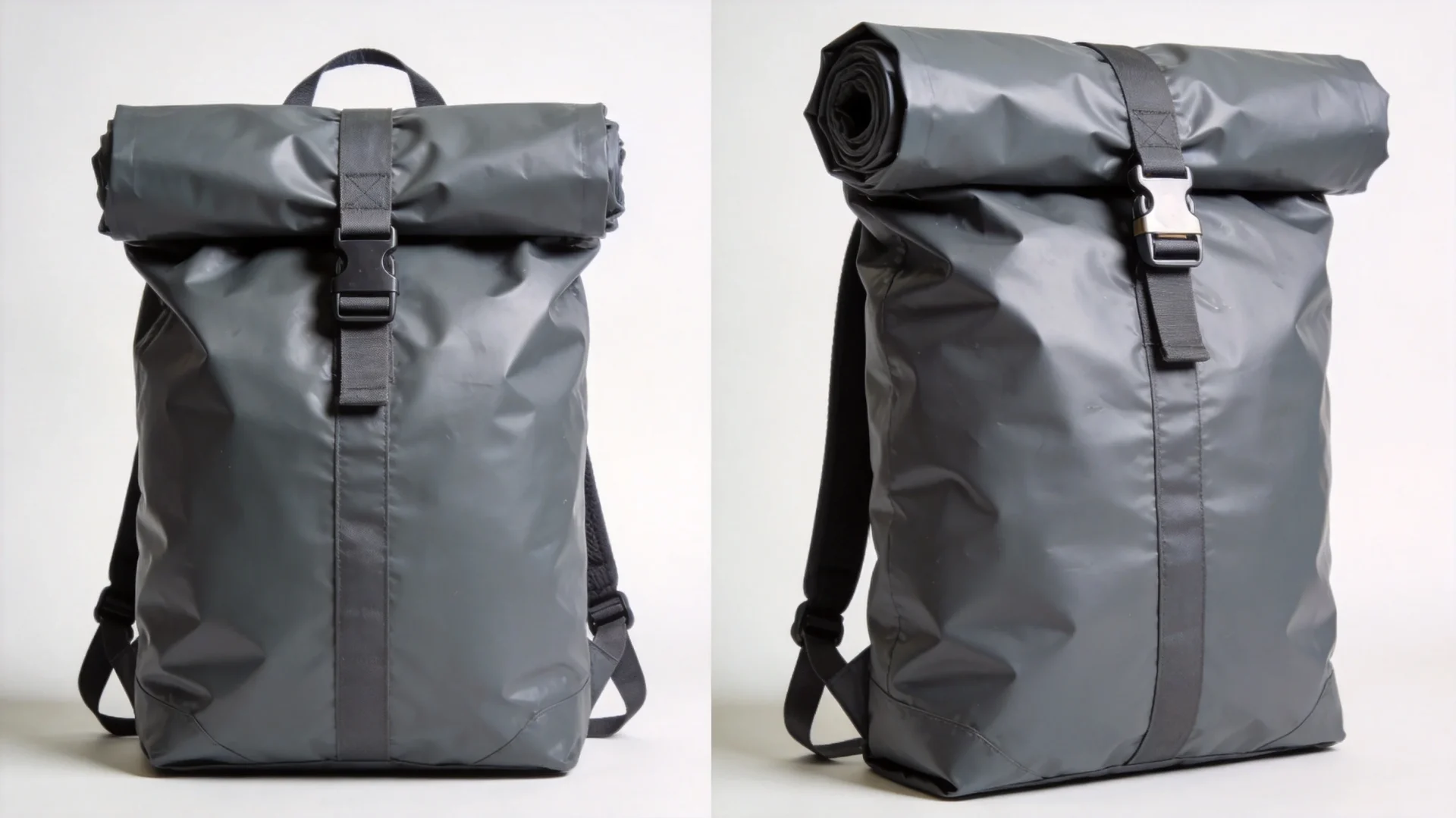
One of the most innovative trends in backpack design is expandable capacity — allowing a single pack to function at multiple volume settings based on user needs.
Roll-Top Closure
Roll-top backpacks offer 5-10L of adjustable capacity through a waterproof roll-and-buckle closure. Advantages include:
- Inherent waterproofing (no zipper penetration at the top)
- Continuous volume adjustment from fully rolled (compact) to fully extended (maximum)
- Clean aesthetic that appeals to minimalist design sensibilities
- Popular in waterproof fabric applications using TPU-coated nylon or tarpaulin materials
Zipper Expansion Panels
A circumferential expansion zipper (typically 2-4 cm deep) adds 3-8L of capacity when unzipped. This approach maintains the traditional top-loading or panel-loading aesthetic while providing “just a bit more room” for travel days or gear-heavy excursions.
Gusset Expansion
Side or bottom gussets with zippered expansion allow the pack to transition between a slim commuter profile and a larger travel or hiking configuration. This design is particularly effective in 25-35L packs that straddle the commuter/travel boundary.
Human Body Dimensions and Capacity Matching
Backpack capacity must be designed in proportion to the target user’s torso length and hip circumference. A 65L pack designed for a 190cm tall male mountaineer has vastly different proportions than the same capacity designed for a 160cm female hiker.
Torso Length and Pack Height
| Torso Length | Pack Body Height | Recommended Capacity | Target Demographic |
|---|---|---|---|
| 38-43 cm (XS/S) | 45-55 cm | 15-35L | Petite adults, youth |
| 43-48 cm (M) | 50-60 cm | 25-50L | Average adults |
| 48-53 cm (L/XL) | 55-70 cm | 40-65L+ | Tall adults, expedition |
For brands selling in both Asian and Western markets, this proportionality matters significantly. Average torso lengths differ by population, meaning the same 40L pack may need different panel heights and hip belt adjustments for different markets.
Fabric Thickness Impact on Internal Volume
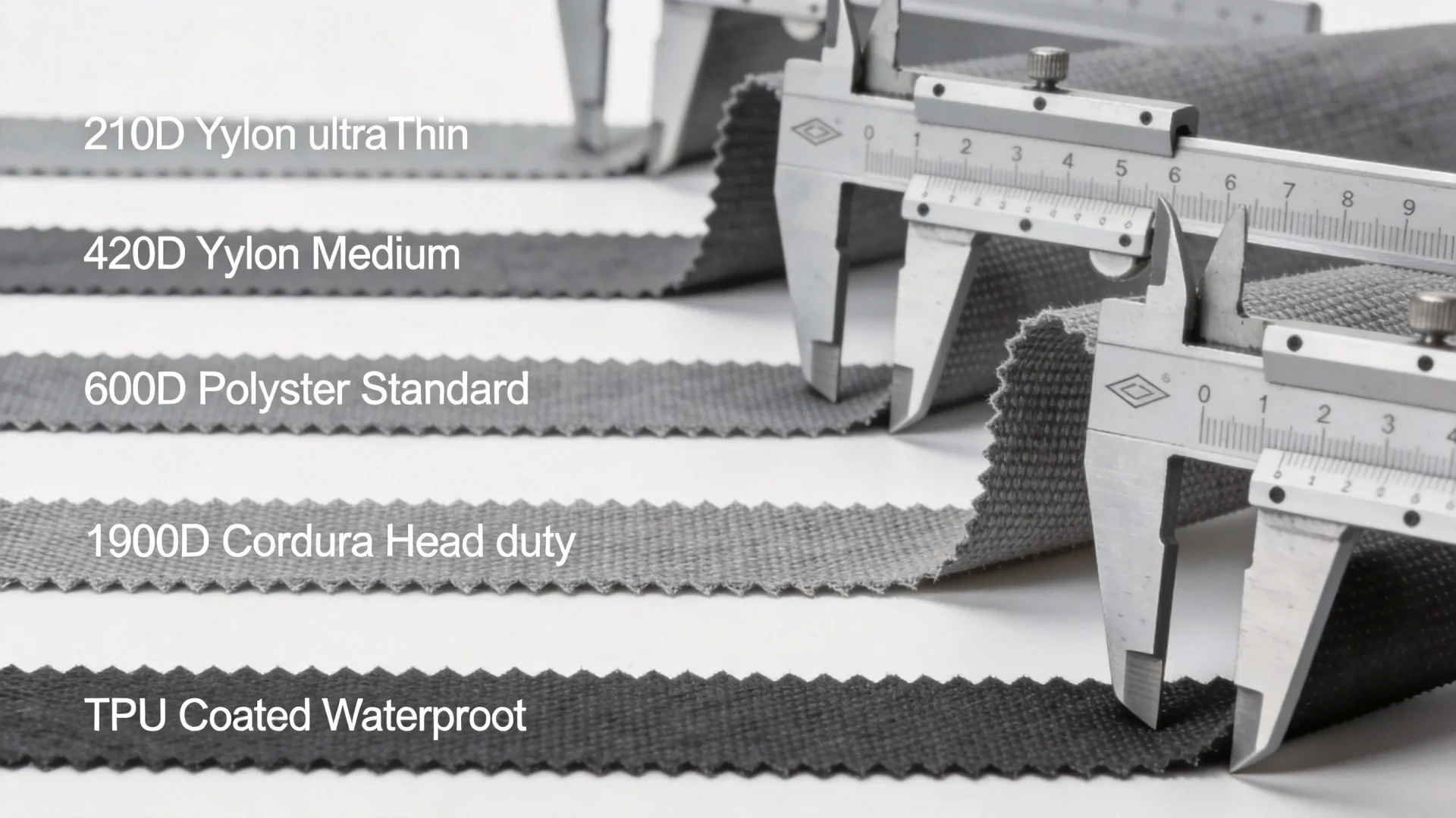
An often-overlooked factor in capacity optimization is how fabric thickness reduces internal volume. Every millimeter of padding and fabric lining consumes space that could otherwise hold gear.
| Fabric + Padding Combination | Total Thickness | Volume Impact (35L pack) |
|---|---|---|
| Single-layer 210D nylon liner | 0.3mm | ~2% loss |
| 600D polyester + 3mm foam back panel | 5mm | ~8% loss |
| 420D nylon + 10mm EVA back panel + mesh | 15mm | ~15% loss |
| Hard-shell frame sheet + thick hip belt | 20mm+ | ~20% loss |
This is why ultralight backpacks (under 600g) with thin single-layer fabric often have larger usable capacity than heavier packs with the same rated volume. When verifying material quality, also consider how material thickness affects the end-user experience.
Regional Market Preferences: Asia vs. Europe vs. Americas
Capacity preferences vary significantly by market, and OEM manufacturers must adapt their designs accordingly.
Asian Markets (China, Japan, Korea, Southeast Asia)
- Preference for 15-25L compact daypacks
- Urban commuting is the dominant use case
- Compact physical stature favors shorter torso lengths
- Minimalist aesthetic with clean lines preferred
- Strong demand for laptop compartments and tech organization
- Price sensitivity is higher; 600D polyester dominates over nylon
European Markets
- Strong outdoor culture drives 30-50L hiking segment
- Sustainability is a top priority — sustainable materials are often a purchase requirement
- Travel carry-on optimization (40-45L) is a growing segment
- REACH compliance is mandatory for chemical substances
- Preference for structured, organized designs with multiple access points
North American Markets
- Larger capacity preference: 30-65L for outdoor, 20-30L for daily
- Willingness to pay premium for technical features
- Brand loyalty is strong; alternatives to established brands must match feature sets
- CPSIA compliance critical for products targeting youth market
- Prop 65 awareness in California affects material selection
Understanding these regional differences is crucial when comparing bag manufacturers worldwide and selecting a production partner who understands your target market.
OEM Manufacturing: How JUNYUAN Optimizes Capacity for Your Brand
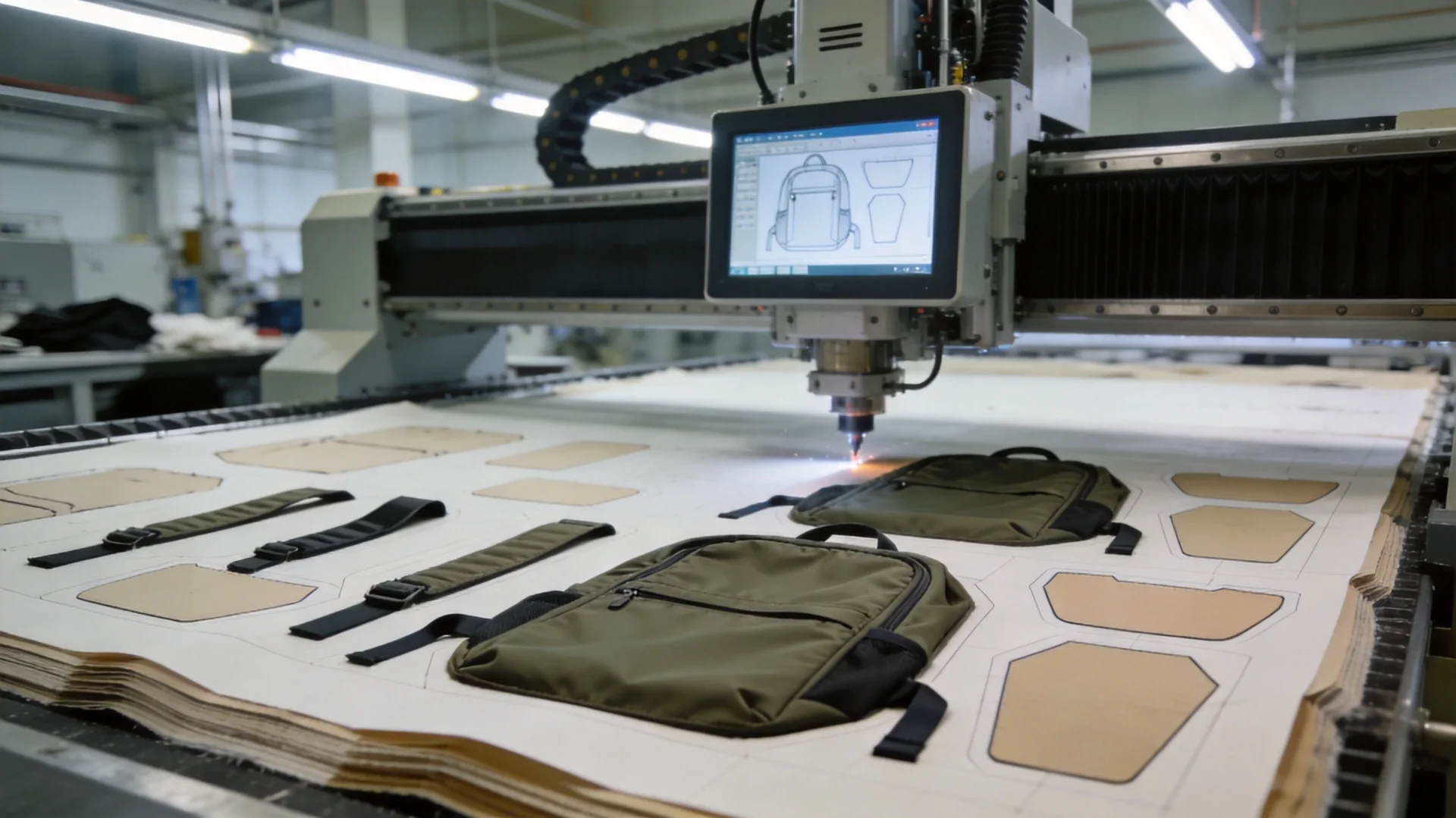
At JUNYUAN Bags, capacity optimization is a core part of our design engineering process. Here is how we work with brand owners to get the most from every liter:
Design for Volume Efficiency
Our pattern engineers use 3D CAD software to model internal volume before cutting any fabric. This allows us to:
- Simulate fill media measurement digitally
- Test different compartment configurations for optimal volume utilization
- Calculate material yield to minimize waste while maximizing usable space
- Adjust panel geometry to match target capacity within ±3% tolerance
Material Engineering
We help clients select the optimal fabric for their capacity target. A brand wanting a lightweight 40L daypack might use 210D ripstop nylon with minimal padding (targeting under 800g), while a brand building a premium 40L travel pack might use 420D nylon with organizational features and a luggage pass-through (targeting 1,200-1,500g). Each decision affects both volume efficiency and material performance characteristics.
Compartment Optimization
Based on your target market research, we recommend the optimal number and configuration of compartments. For a minimalist outdoor brand, we would suggest fewer, larger compartments to maximize usable volume. For a commuter brand targeting tech professionals, we would design a highly organized interior with dedicated device protection. Our experience with custom bag design across hundreds of projects means we can recommend compartment layouts proven to work in your segment.
Prototyping and Testing
Every capacity design goes through rigorous prototyping. Our sample development process includes:
- Digital volume simulation from CAD model
- First physical prototype with fill media measurement
- Load testing at 1.5x and 2x rated capacity
- User testing for comfort, access, and organization feedback
- Final PP sample with production-identical materials and construction
Scaling Across Your Product Line
Once we establish the design language for one capacity, we can efficiently scale it across your entire product range. A successful 25L daypack design can be proportionally adapted to 18L and 35L versions, maintaining brand consistency while planning seasonal production around shared tooling and patterns. This approach significantly reduces development costs for multi-SKU product lines.
Frequently Asked Questions
How is backpack capacity measured accurately?
The industry standard method is fill media measurement — filling the pack with calibrated spheres or pellets and measuring total volume. This captures all compartments and irregular spaces. Geometric calculation (L×W×H) is used for initial estimates but tends to overstate capacity by 10-20%. JUNYUAN Bags uses fill media measurement for all specifications.
What capacity backpack is best for daily commuting?
For daily commuting with a laptop, 18-25L is the optimal range. This provides enough space for a laptop, documents, lunch, water bottle, and personal items without looking oversized in professional or transit environments. Slim profiles (10-14cm depth) are preferred for commuter bags.
How does compartment design affect usable capacity?
Each internal divider consumes 2-5% of total volume. A heavily compartmentalized pack (8+ pockets) can lose 15-25% of rated capacity to structural elements. Premium outdoor brands minimize internal compartments in larger packs to maximize usable volume, using external organization instead.
What is an expandable backpack and how much extra capacity does it add?
Expandable backpacks use roll-top closures, expansion zippers, or gusset designs to provide adjustable volume. Roll-tops add 5-10L, expansion zippers add 3-8L, and gusset systems add 5-15L depending on design. This allows one pack to function at multiple capacity settings.
Do Asian and Western markets prefer different backpack capacities?
Yes. Asian markets prefer 15-25L compact daypacks optimized for urban commuting and smaller physical proportions. European markets favor 30-50L for outdoor use with strong sustainability requirements. North American markets tend toward larger 30-65L capacities for outdoor and travel applications, with willingness to pay for technical features.
How does fabric thickness affect backpack capacity?
Thicker fabric and padding reduce internal usable volume. A heavily padded back panel (15mm) can reduce capacity by 15%. Single-layer thin fabric (0.3mm) loses only 2%. This is why ultralight packs often feel more spacious than heavier packs with the same rated capacity.
What is the lightest weight per liter ratio achievable?
Ultralight backpacks achieve 15-20g/L using 210D ripstop nylon, minimal padding, and frameless designs. Standard hiking packs run 22-35g/L. Fully loaded expedition packs with frames and heavy padding run 25-40g/L. JUNYUAN Bags can engineer to your specific weight target.
Can JUNYUAN Bags customize capacity for my brand?
Absolutely. Our design engineering team uses 3D CAD to model and optimize capacity before production. We can develop packs at any capacity from 10L to 80L+, with precise volume control within ±3% tolerance. Contact us at [email protected] to discuss your capacity requirements.
Need a Backpack Engineered to the Perfect Capacity?
JUNYUAN Bags combines led by a founder with bag industry experience dating from 2004 with advanced 3D design engineering to create backpacks optimized for your target market and use case. From 15L commuter daypacks to 65L expedition packs, every liter is engineered with purpose.