
Antimicrobial materials prevent bacteria, mold, and mildew growth in sports bags. Silver ion technology kills 99.9% of bacteria (ISO 22196 certified) and lasts 300+ washes; Microban® delivers 250× less bacterial growth across the product lifetime; BACshield offers eco-friendly, wash-resistant protection. For custom OEM/ODM orders, JUNYUAN BAGS integrates these treatments into nylon, polyester, and vegan leather with MOQ 500 pieces, 6-10 day sampling, and SGS-audited Quanzhou factory quality control.
Why Antimicrobial Materials Matter in Sports Bags
The global athletic gym bag market was valued at $892.4 million in 2024, with antimicrobial treatments now specified in over 35% of premium sports bags. Among gym bag buyers, 73% rank odor control as a top-3 purchase feature—and for good reason. On untreated fabric surfaces, bacteria can double every 20 minutes in warm, moist conditions, turning a gym bag into a breeding ground for odor-causing microbes, mold, and mildew within hours.
Antimicrobial materials go beyond masking smells. They actively inhibit microbial growth at the molecular level, keeping bag interiors hygienic, extending product lifespan, and reducing warranty claims for brands. Whether you source nylon, polyester, canvas, or vegan leather, integrating antimicrobial technology during manufacturing is now an industry-standard practice for sports bags.
Leading Antimicrobial Technologies for Sports Bags
1. Silver Ion (Ag⁺) Technology
Silver has been used for its antimicrobial properties for over 2,400 years. Modern silver ion technology harnesses Ag⁺ ions to deliver proven, long-lasting protection. It is the most widely specified antimicrobial in the sports bag industry, used by brands including Jack Wolfskin, Eagle Creek, and numerous OEM programs.
How Silver Ion Works — The 5-Step Mechanism:
- Detection: Ag⁺ ions are attracted to the negatively charged cell membranes of bacteria and fungi.
- Attachment: Ions bind to the microbial cell wall through electrostatic interaction.
- Penetration: Silver ions breach the cell membrane and enter the cytoplasm.
- Disruption: Inside the cell, Ag⁺ ions denature proteins, disable DNA replication, and block respiratory enzymes.
- Inhibition: The microbe cannot reproduce or survive; silver ions remain active on the surface, continuing to protect.
Key performance data:
- Kills 99.9% of tested bacteria (Staphylococcus aureus, Escherichia coli) per ISO 22196
- Effective for 300+ wash cycles without significant degradation
- Compatible with nylon, polyester, cotton, and blended fabrics
- Safety: EPA-registered; compliant with OEKO-TEX Standard 100, REACH, and CPSIA
2. Microban® Antimicrobial Technology
Microban® is a globally recognized antimicrobial additive built into materials at the manufacturing stage. Unlike surface sprays, Microban is integrated into the molecular structure of fibers, coatings, and foams, providing continuous protection for the product’s entire lifetime.
Performance highlights:
- Delivers 250× less bacterial growth compared to untreated surfaces across the product lifetime
- Tested against a broad spectrum of bacteria, mold, and mildew species
- Available for plastics, foams, textiles, and coatings used in bag manufacturing
- Registered with EPA and compliant with REACH and CPSIA safety standards
3. BACshield / HeiQ BACshield
BACshield (by HeiQ) is a next-generation antimicrobial coating designed for textile applications. It provides both antibacterial and odor-control performance with a strong eco-friendly profile.
Key specifications:
- Based on advanced polymer science for wash-resistant durability—maintains efficacy after 50+ home launderings
- PFOA-free and PFOS-free formulation
- Compatible with most textile finishing processes (pad-dry-cure)
- Targets both Gram-positive and Gram-negative bacteria
- Ideal for antimicrobial backpack linings and sports bag interiors
Steeletex Vinyl-Coated Nylon for Antimicrobial Sports Bags
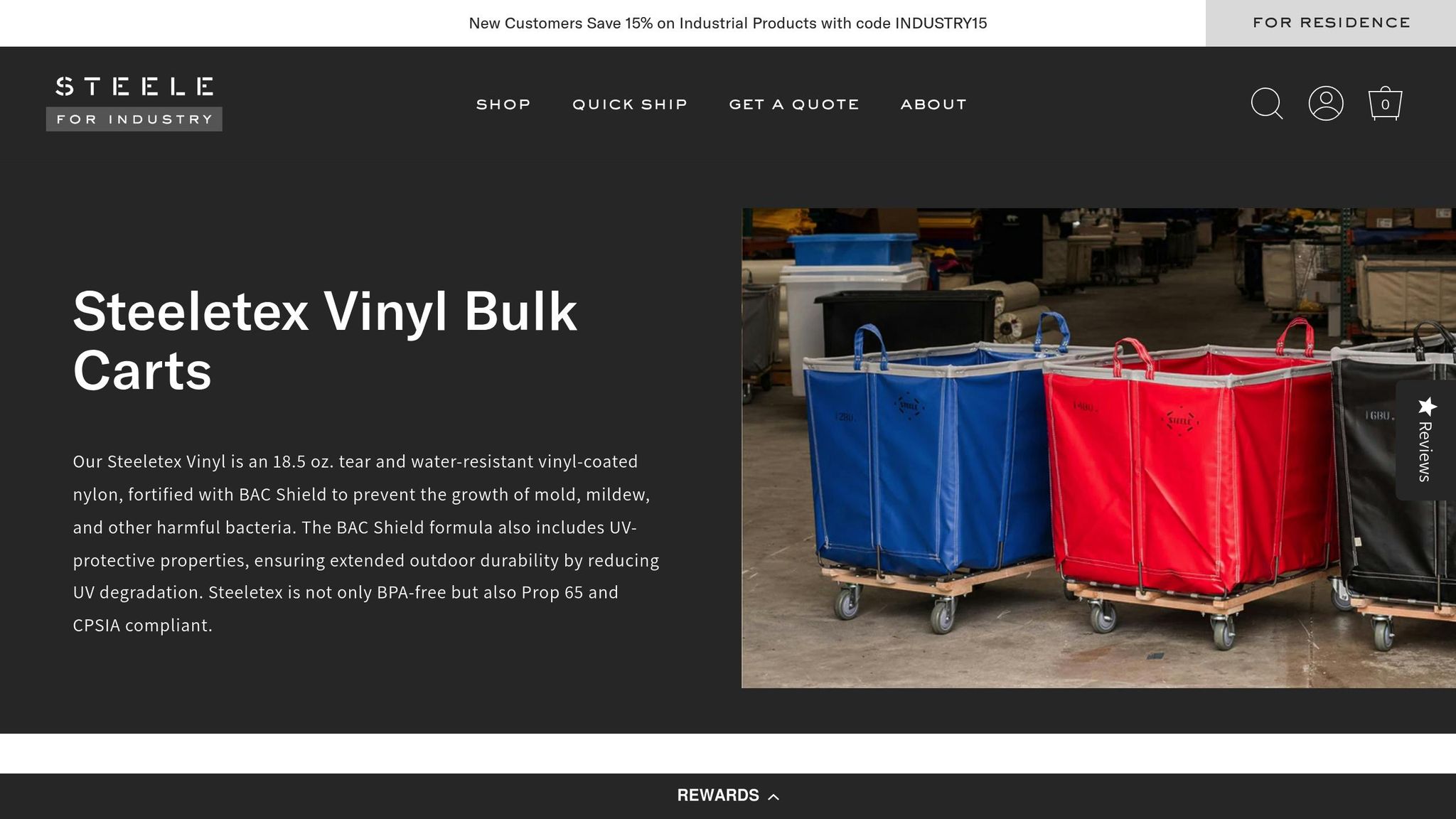
Steeletex by Steele Canvas is a heavy-duty vinyl-coated nylon fabric engineered for commercial-grade durability. When combined with antimicrobial treatments, it creates an ideal exterior shell for gym bags, duffel bags, and sports equipment carriers that face daily exposure to moisture and bacteria.
Key features:
- 100% vinyl-coated nylon; water, mold, and mildew resistant
- Antimicrobial treatment compatibility (silver ion and Microban integration verified)
- Tear strength exceeding 60 lbs (ASTM D751)
- Available in 18 standard colors with UV-resistant pigments
- Wipe-clean surface reduces microbial harboring compared to woven fabrics
For brands sourcing waterproof sports bag materials, Steeletex provides the durability foundation while antimicrobial liners handle interior hygiene.
Apera Sport Fabric — Engineered Antimicrobial Textiles
Apera Sport Fabrics specializes in performance textiles with built-in antimicrobial protection for the sports and fitness bag market. Their fabric systems combine moisture management, breathability, and antimicrobial action in a single textile platform.
Specifications:
- Proprietary antimicrobial finish tested per AATCC 100 (antibacterial finishes on textile materials)
- Moisture-wicking capability: absorbs less than 5% water weight while maintaining dry-touch feel
- Breathability rating exceeding 500 g/m²/24h (ASTM E96)
- Applications: bag linings, shoe compartments, wet/dry separation pockets
- Compatible with custom golf bags, gym bags, and travel duffels

Silver Ion vs. Copper vs. Zinc vs. Activated Charcoal: Antimicrobial Technology Comparison
Not all antimicrobial technologies perform equally. The table below compares the four most common antimicrobial approaches used in sports bag manufacturing, helping brands and buyers select the right solution for their product requirements.
| Property | Silver Ion (Ag⁺) | Copper-Based | Zinc Oxide (ZnO) | Activated Charcoal |
|---|---|---|---|---|
| Mechanism | Disrupts cell membrane and DNA | Oxidative damage to cell wall | ROS generation, membrane disruption | Physical adsorption of odor molecules |
| Bacteria Kill Rate | 99.9% (ISO 22196) | 95–99% | 90–95% | N/A (adsorbs, does not kill) |
| Wash Durability | 300+ washes | 100–150 washes | 50–100 washes | 20–30 washes (recharge needed) |
| Odor Control | Excellent (kills source) | Good | Moderate | Good initially, diminishes fast |
| Mold/Mildew Inhibition | Yes | Yes | Partial | No |
| Color Stability | No discoloration | Can tint fabrics green/blue | White, minimal impact | Gray/black color only |
| Cost (Relative) | $$$ | $$ | $ | $ |
| Best For | Premium sports bags, long-life products | Mid-range bags, industrial applications | Budget-friendly antimicrobial bags | Short-term odor masking inserts |
Key takeaway: Silver ion technology offers the highest kill rate and longest durability, making it the preferred choice for premium sports bags. Activated charcoal is cost-effective but only adsorbs odor molecules—it does not inhibit microbial growth. For custom OEM/ODM antimicrobial backpack programs, silver ion integration into nylon or polyester delivers the best ROI over the product lifecycle.
Antimicrobial Certifications for Sports Bag Materials
When sourcing antimicrobial fabrics for sports bags, certifications validate that claims are independently tested and meet international safety standards. The following certifications are essential for any bag manufacturer producing antimicrobial products for global markets.
ISO 22196 — Antibacterial Activity on Plastics and Non-Porous Surfaces
ISO 22196 measures the antibacterial activity of treated surfaces using a standardized agar diffusion test. A result of 99.9% reduction (log reduction of 3.0 or higher) against S. aureus and E. coli qualifies as “antibacterial.” This is the most widely referenced test standard for antimicrobial bag materials.
AATCC 100 — Antibacterial Finishes on Textile Materials
AATCC 100 specifically tests antibacterial finishes on fabrics. It measures the reduction in bacterial count after 18–24 hours of contact. This test is critical for bag linings, mesh panels, and woven textile components that require antimicrobial certification.
OEKO-TEX Standard 100
OEKO-TEX Standard 100 certifies that textiles have been tested for harmful substances and are safe for human use. Antimicrobial-treated fabrics must pass OEKO-TEX limits for heavy metals (including silver ion release levels), formaldehyde, pesticides, and allergenic dyes. Products carrying this label are verified safe for direct skin contact.
REACH Compliance (EU Regulation EC 1907/2006)
REACH regulates the registration, evaluation, authorization, and restriction of chemicals in the EU market. Antimicrobial bag materials sold into Europe must comply with REACH Substance of Very High Concern (SVHC) thresholds. Silver nanoparticles, copper compounds, and zinc oxide used in antimicrobial treatments must all be registered.
CPSIA — Consumer Product Safety Improvement Act (US)
CPSIA sets strict limits on lead and phthalates in consumer products, including bags. Antimicrobial coatings and fabric treatments used in children’s sports bags or school backpacks sold in the US must comply with CPSIA testing requirements (total lead at 100 ppm or below in substrate, 90 ppm or below in coatings).
| Certification | Scope | Market | Key Test Parameter |
|---|---|---|---|
| ISO 22196 | Antibacterial efficacy | Global | 99.9% reduction (log 3.0+) |
| AATCC 100 | Textile antibacterial finish | Global (US origin) | Bacterial reduction after 18-24h contact |
| OEKO-TEX Standard 100 | Harmful substance safety | Global | Heavy metals, formaldehyde, allergens |
| REACH | Chemical safety | EU | SVHC threshold compliance |
| CPSIA | Consumer product safety | US | Lead at 100 ppm or below; phthalates limits |
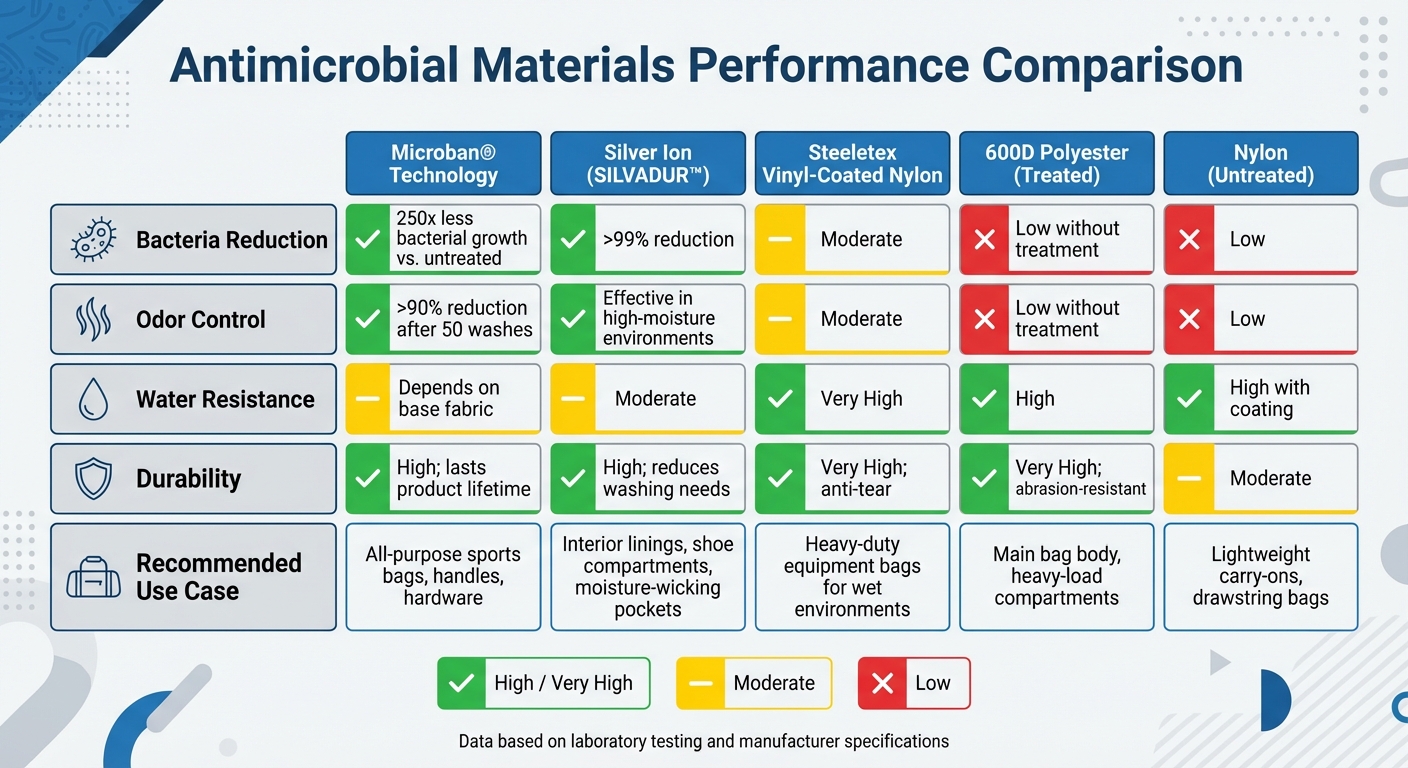
Antimicrobial Sports Bag Materials: Comparison Table
The table below compares the five most common base materials used for antimicrobial sports bags, including treatment compatibility and performance characteristics relevant to OEM/ODM manufacturing.
| Material | Antimicrobial Compatibility | Certifications | Wash Durability | Best Application | Cost |
|---|---|---|---|---|---|
| Nylon (Silver Ion) | Excellent — pad-dry-cure or masterbatch | ISO 22196, OEKO-TEX, REACH | 300+ washes | Gym bags, duffels, backpack linings | $$$ |
| Polyester (Microban) | Excellent — molecular integration | EPA, REACH, CPSIA | Product lifetime | Sports shoe bags, wet pockets | $$$ |
| Canvas (BACshield) | Good — surface coating | PFOA-free, OEKO-TEX | 50+ washes | Casual gym bags, tote-style carriers | $$ |
| Vinyl-Coated Nylon | Good — wipe-clean surface plus treatment | ISO 22196 (surface test) | 200+ wipe cycles | Commercial duffels, equipment bags | $$ |
| Vegan Leather (PU/TPU) | Moderate — surface treatment or additive | OEKO-TEX, REACH | 100+ wipes | Premium lifestyle sports bags | $$$$ |
Eco-Friendly Antimicrobial Options for Sports Bags
Sustainability is increasingly important in sports bag sourcing. Brands and buyers now request eco-friendly antimicrobial options that maintain performance while reducing environmental impact. The following approaches are available for OEM/ODM manufacturing:
PFOA-Free and PFOS-Free Formulations
All major antimicrobial treatment providers (Microban, HeiQ BACshield, SILVADUR by LANXESS) now offer PFOA-free and PFOS-free formulations. These per- and polyfluoroalkyl substance-free treatments eliminate the environmental and health concerns associated with legacy fluorinated compounds while maintaining equivalent antimicrobial performance.
Bio-Based Antimicrobial Treatments
Emerging bio-based antimicrobial agents—derived from chitosan (crustacean shell waste), neem oil extracts, and zinc ricinoleate (castor oil derivative)—offer renewable-source alternatives to synthetic biocides. While currently less durable than silver ion technology (typically 30–80 wash cycles), bio-based treatments are gaining traction in eco-conscious product lines.
Recyclable Antimicrobial Materials
Silver ion-treated nylon and polyester remain fully recyclable through standard textile recycling streams. Microban-integrated fibers can be reprocessed without losing antimicrobial efficacy. Brands pursuing circular economy goals can specify antimicrobial treatments that do not compromise material recyclability—a critical factor for European markets under the EU Strategy for Sustainable and Circular Textiles.
Custom Antimicrobial Bag Manufacturing with JUNYUAN BAGS
JUNYUAN BAGS (QUANZHOU JUNYUAN COMMERCIAL AND TRADING CO., LTD.) is a Quanzhou-based OEM/ODM bag exporter founded in 2014, led by a founder with bag industry experience dating from 2004. We specialize in integrating antimicrobial technologies into custom sports bags, backpacks, duffel bags, and golf bags for brands worldwide.
Manufacturing capabilities at a glance:
- SGS-audited factory: 4,950 sqm SGS-verified plant with 7 production lines, 149 machines (126 sewing), and 137 staff
- Monthly capacity: 200,000 pieces per month (SGS-verified line capacity)
- MOQ — general bags: 500 pieces per design/color
- MOQ — golf bags: 200 pieces (special product line)
- Sampling: 6-10 days for custom designs with antimicrobial treatment
- Production: 35-50 days for bulk orders
- Quality control: AQL 2.5 inspection standard; full QC across 8 quality checkpoints
- Antimicrobial integration: Silver ion, Microban, BACshield, and custom treatment protocols available
- Certifications supported: ISO 22196, AATCC 100, OEKO-TEX Standard 100, REACH, CPSIA
Production runs through an SGS-audited Quanzhou factory and a vetted partner-factory network, with all export handled by our trading company (customs registration: 35059619KU). Whether you need 500-piece antimicrobial gym bags or 200-piece custom golf bags with silver ion lining, JUNYUAN BAGS delivers consistent quality from sampling to container loading.
Conclusion
Antimicrobial technology has become essential in modern sports bag manufacturing. Silver ion technology leads with 99.9% bacteria kill rates and 300+ wash durability (ISO 22196 certified); Microban provides lifetime protection with 250× less bacterial growth; BACshield delivers eco-friendly wash-resistant performance. Combined with proper certifications (ISO 22196, AATCC 100, OEKO-TEX Standard 100, REACH, CPSIA) and sustainable options (PFOA-free formulations, bio-based treatments), brands can produce high-performance, compliant sports bags that meet the demands of the $892.4 million global market.
For OEM/ODM orders, JUNYUAN BAGS offers MOQ 500 pieces (200 for golf bags), 6-10 day sampling, 35-50 day production, and SGS-audited quality control from a 4,950 sqm Quanzhou facility with 200,000-piece monthly capacity. Contact us to integrate antimicrobial protection into your next sports bag program.
Frequently Asked Questions (FAQ)
1. How do antimicrobial materials help sports bags last longer?
Antimicrobial materials prevent bacteria, mold, and mildew from colonizing fabric surfaces. By inhibiting microbial growth, they reduce fabric degradation, stitching corrosion, and permanent odor buildup. Bags made with silver ion-treated nylon can maintain structural integrity and hygiene for 300+ wash cycles, compared to 50–80 washes for untreated fabrics. This extends the usable lifespan of sports bags by an estimated 40–60% under normal gym-use conditions.
2. Why is Silver Ion Technology a great choice for sports bags?
Silver ion technology kills 99.9% of tested bacteria (ISO 22196 certified), remains effective for 300+ washes, and does not discolor fabrics. Unlike surface sprays that wash off, silver ions are integrated into fiber structure during manufacturing. Silver is also EPA-registered, OEKO-TEX compliant, REACH compliant, and CPSIA safe—making it the most versatile and durable antimicrobial solution for sports bags sold globally.
3. Are antimicrobial treatments safe to use in sports bags?
Yes. All major antimicrobial treatments used in sports bags—silver ion, Microban, and BACshield—are registered with regulatory agencies and comply with international safety standards. Silver ion treatments are EPA-registered and meet OEKO-TEX Standard 100 limits for skin contact. Microban is FDA-compliant for indirect food contact surfaces. CPSIA compliance ensures safety for children’s products. All treatments are tested for heavy metal limits, allergenic compounds, and skin irritation potential.
4. What is the difference between antibacterial and antimicrobial bag materials?
Antibacterial materials specifically target bacteria—reducing or killing bacterial colonies on surfaces. Antimicrobial is a broader term that covers protection against all microorganisms, including bacteria, fungi, mold, mildew, and in some cases viruses. For sports bags, antimicrobial treatments are preferred because gym environments expose bags to both bacteria (odor-causing Staphylococcus) and fungi (mold and mildew from sweat moisture). Silver ion, Microban, and BACshield are all antimicrobial (not just antibacterial) solutions.
5. What certifications should antimicrobial bag fabric have (ISO 22196, OEKO-TEX)?
Essential certifications for antimicrobial bag fabrics include: ISO 22196 (antibacterial efficacy testing, 99.9% kill rate), AATCC 100 (antibacterial finishes on textiles), OEKO-TEX Standard 100 (harmful substance safety for skin contact), REACH (EU chemical compliance), and CPSIA (US consumer product safety). For eco-conscious markets, PFOA-free and PFOS-free certifications add further assurance. Any reputable bag manufacturer should provide test reports for these standards upon request.
6. How long does antimicrobial treatment last in gym bags (wash durability)?
Durability depends on the technology used. Silver ion-treated fabrics maintain antimicrobial efficacy for 300+ wash cycles (ISO 22196 verified). Microban-integrated materials provide lifetime protection as the additive is molecularly bonded into fibers. BACshield coatings last 50+ home launderings. Copper-based treatments typically last 100–150 washes, while activated charcoal inserts lose effectiveness after 20–30 uses. For premium gym bags, silver ion and Microban offer the longest-lasting protection and best ROI.
7. Can antimicrobial treatments be customized for OEM/ODM sports bags?
Yes. OEM/ODM sports bag manufacturers can customize antimicrobial treatments by type (silver ion, Microban, BACshield), concentration (adjusted for performance vs. cost), application method (pad-dry-cure for textiles, masterbatch for plastics and foams), and target certifications (ISO 22196, AATCC 100, OEKO-TEX). JUNYUAN BAGS offers full customization: choose your antimicrobial technology, base material (nylon, polyester, canvas, vegan leather), and certification package. MOQ starts at 500 pieces for general bags and 200 pieces for golf bags, with 6-10 day sampling.
8. What is the best antimicrobial material for custom sports bag manufacturing?
The best antimicrobial material depends on the product tier and target market. For premium sports bags: silver ion-treated nylon offers the highest kill rate (99.9%), longest durability (300+ washes), and broadest certification support (ISO 22196, OEKO-TEX, REACH, CPSIA). For mid-range products: Microban-integrated polyester provides lifetime protection at moderate cost. For eco-friendly lines: BACshield-coated canvas delivers PFOA-free, wash-resistant performance. JUNYUAN BAGS—a bag manufacturer with SGS-audited production (4,950 sqm, 200,000 pcs/month)—supports all three options with MOQ 500 pieces and 35-50 day production.