What does a custom backpack manufacturer in China actually do after you approve the quote? A standard OEM/ODM order runs through six stages: RFQ and quotation, sampling in 6–10 days, pre-production confirmation, bulk production in 35–50 days, AQL 2.5 inspection, and export packing. The commercial minimum is 500 pcs per design. The order value is not created at the quotation stage — it is created or destroyed in the four weeks between sample approval and the first carton coming off the line. This guide walks through the full order sequence week by week, shows where lead time and landed cost actually accumulate, and lists the seven failures that account for most late or rejected shipments.
Most buyers searching for a custom backpack manufacturer have already read enough supplier lists. What is missing is the operational detail: what to send in an RFQ, what a sample does and does not prove, which documents must exist before the container leaves, and how the 500 pcs minimum behaves when a programme has four colourways and three sizes. That is the scope here. For supplier selection criteria rather than order execution, the companion guide on choosing a backpack manufacturer covers that ground.
The Order Timeline at a Glance
A clean, un-rushed 500 pcs order of a single style takes roughly eight weeks from PO to container. Compressing below that is possible, but every week removed is removed from a specific stage, and the buyer should know which one.
| Week | Stage | Duration | What the Buyer Owns | What the Factory Owns |
|---|---|---|---|---|
| W0 | RFQ and quotation | 2–4 days | Tech pack, target FOB, volumes | BOM, cost breakdown, MOQ confirmation |
| W1–W2 | Sampling | 6–10 days | Sample comments, fit feedback | Pattern, prototype, material sourcing |
| W2–W3 | Sample revision (if needed) | 5–7 days | Consolidated comment sheet | Pattern correction, re-sample |
| W3 | Golden sample and PO | 2–3 days | Signed golden sample, PO terms | Signed golden sample, production slot |
| W3–W4 | Material inbound | 7–14 days | — | Fabric, hardware, lining procurement |
| W4–W11 | Bulk production | 35–50 days | Checkpoint sign-offs | Cutting, sewing, assembly, packing |
| W10–W11 | Inspection | 1–2 days | Inspection report review | AQL 2.5 inspection, rework if needed |
| W11–W12 | Packing and handover | 2–4 days | Booking, forwarder nomination | Cartoning, palletising, loading |
Two structural facts drive this schedule. First, material inbound (7–14 days) runs in parallel with production slot reservation, not after it — a factory that starts counting lead time only after fabric arrives will always be late. Second, the 35–50 day production window is a range, not a promise: a 500 pcs single-colour order typically lands near the low end, while a 4-colourway programme with custom hardware sits near the upper end.
Step 1 — RFQ: What to Send, What Comes Back
The quality of the quotation is bounded by the quality of the RFQ. A one-line email asking “how much for 500 backpacks” returns a number that will not survive contact with production. A structured RFQ returns a cost breakdown the buyer can negotiate against line by line.
What the buyer should send
- Style reference — technical drawing, or a clear photo of a reference product with the specific features that must change
- Dimensions and capacity — external H×W×D in cm and internal volume in litres
- Material specification — fabric type and denier, lining, coating, hardware finish (the fabric specification guide covers how to write this)
- Colourways and size split — number of colours, number of sizes, and the quantity per combination
- Target FOB — a real number, not “as low as possible”
- Destination market — this determines which compliance documents are mandatory
- Required ship date — and whether it is a hard retail window or a soft target
- Branding method — woven label, printed label, heat transfer, embroidery, rubber patch
What a usable quotation must contain
| Line item | Why it matters |
|---|---|
| Unit FOB price at the stated quantity | Baseline for all comparison |
| Price breaks at 500 / 1,000 / 3,000 pcs | Shows where fixed costs amortise |
| Material cost share | Typically 35–50% of FOB — the main negotiation lever |
| Sampling fee and refund condition | Standard practice is a sampling fee refunded against the first bulk order |
| Tooling or mould cost, if any | One-off, should be itemised separately from unit price |
| Carton dimensions, pcs per carton, CBM | Drives freight, which is often 8–15% of landed cost |
| Gross and net weight per carton | Needed for forwarder booking |
| Quotation validity | Fabric prices move; 30 days is normal |
A quotation missing the carton and CBM lines is not a landed cost quotation. Buyers routinely compare FOB prices and then discover the freight difference between two suppliers wipes out the FOB advantage.
Step 2 — Sampling in 6–10 Days: What a Sample Actually Proves
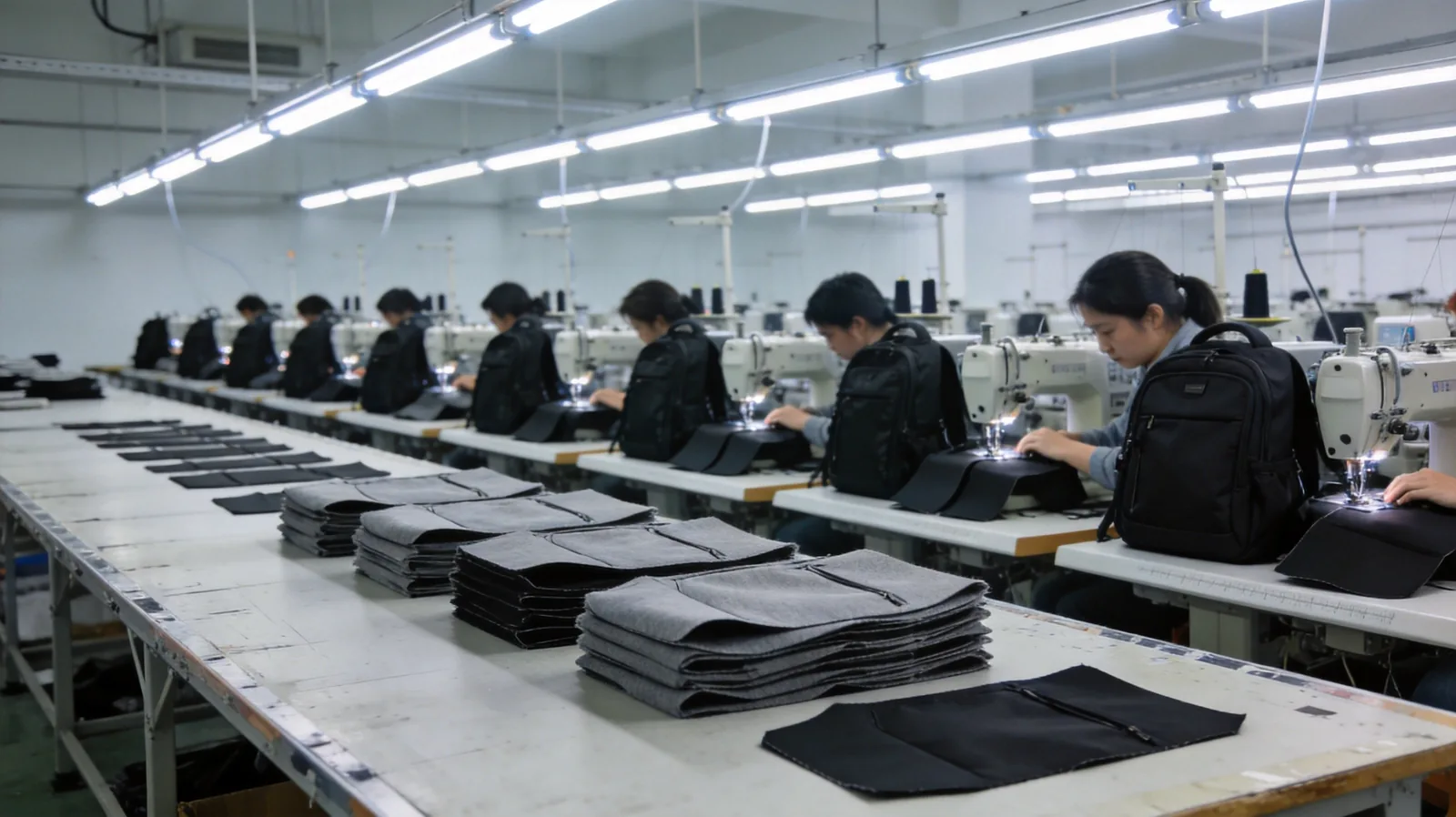
Sampling is 6–10 days for a standard backpack. That window covers pattern making, material sourcing against the specification, and one prototype. It does not cover a second colourway, custom tooling, or a hardware item that has to be developed.
A sample proves four things and no more:
- Pattern and fit — whether the dimensions in the tech pack produce a bag that actually holds the target volume
- Material hand-feel — whether the 600D the factory sourced reads the same as the reference
- Construction method — bar-tacks at stress points, seam type, binding finish
- Branding placement — whether the label sits where the design intends
It does not prove production consistency, because a sample is made by the sample room, not the line. Buyers who treat sample approval as quality assurance are the ones who discover the problem at inspection. The sample is a specification agreement, not a quality guarantee.
The sample comment sheet
Feedback sent as a paragraph of prose produces a re-sample that fixes one issue and breaks another. A comment sheet with one line per issue — location, current state, required state, priority — produces a re-sample that converges. Ask for a second sample only after consolidating every comment, because each revision cycle costs 5–7 days.
Step 3 — Pre-Production: Golden Sample, Tech Pack and PO Terms
The golden sample is the signed, approved reference that production is measured against. It must physically exist at the factory, and it must be the exact revision the buyer approved — not the earlier one with the hardware that was later changed.
The three documents that prevent disputes
| Document | Content | Who signs |
|---|---|---|
| Golden sample | Approved physical unit, labelled with style number, revision, date | Both parties |
| Tech pack | BOM, dimensions with tolerances, construction callouts, colour references | Both parties |
| PO with quality annex | Quantity, price, ship date, AQL level, defect definitions, rework terms | Both parties |
The quality annex is the single most-skipped document and the single most useful one. It should state: AQL 2.5 for major defects, the definition of a major defect for this specific style, who pays for rework, and what happens if inspection fails twice. Writing this before the PO is signed costs an hour. Negotiating it after a failed inspection costs weeks.
Tolerances belong in writing
A ±5% tolerance on fabric GSM is normal mill practice. A ±0.5 cm tolerance on finished dimensions is normal for soft goods. Neither is a defect. Buyers who specify “exact” without stating a tolerance create a rejection criterion that no factory can meet — and factories that accept it will meet it by over-sorting, which shows up as a price increase on the next order.
Step 4 — Bulk Production: 35–50 Days and Three Checkpoints
Bulk production for 500 pcs runs 35–50 days. The range exists because production is not one operation — it is cutting, sewing, assembly, and packing in sequence, each with its own queue.
Three checkpoints are worth attending or commissioning:
Checkpoint 1 — After cutting (day 3–7)
Confirm the cut panels match the approved colour and the approved fabric lot. This is the last moment where a wrong material can be corrected at low cost. After sewing, a wrong fabric is a full re-make.
Checkpoint 2 — At 30% output (day 10–20)
Pull five finished units off the line and check them against the golden sample. At 30% output, a systematic error has produced roughly 150 units — painful but recoverable. At 90% output, the same error has produced 450 units and the order is lost.
Checkpoint 3 — Before packing (day 30–45)
Confirm hardware, labels, and hangtags are the approved revisions, and that packing matches the carton specification. Packing errors are cheap to fix before the carton is sealed and expensive after.
Step 5 — Inspection: AQL 2.5 in Practice
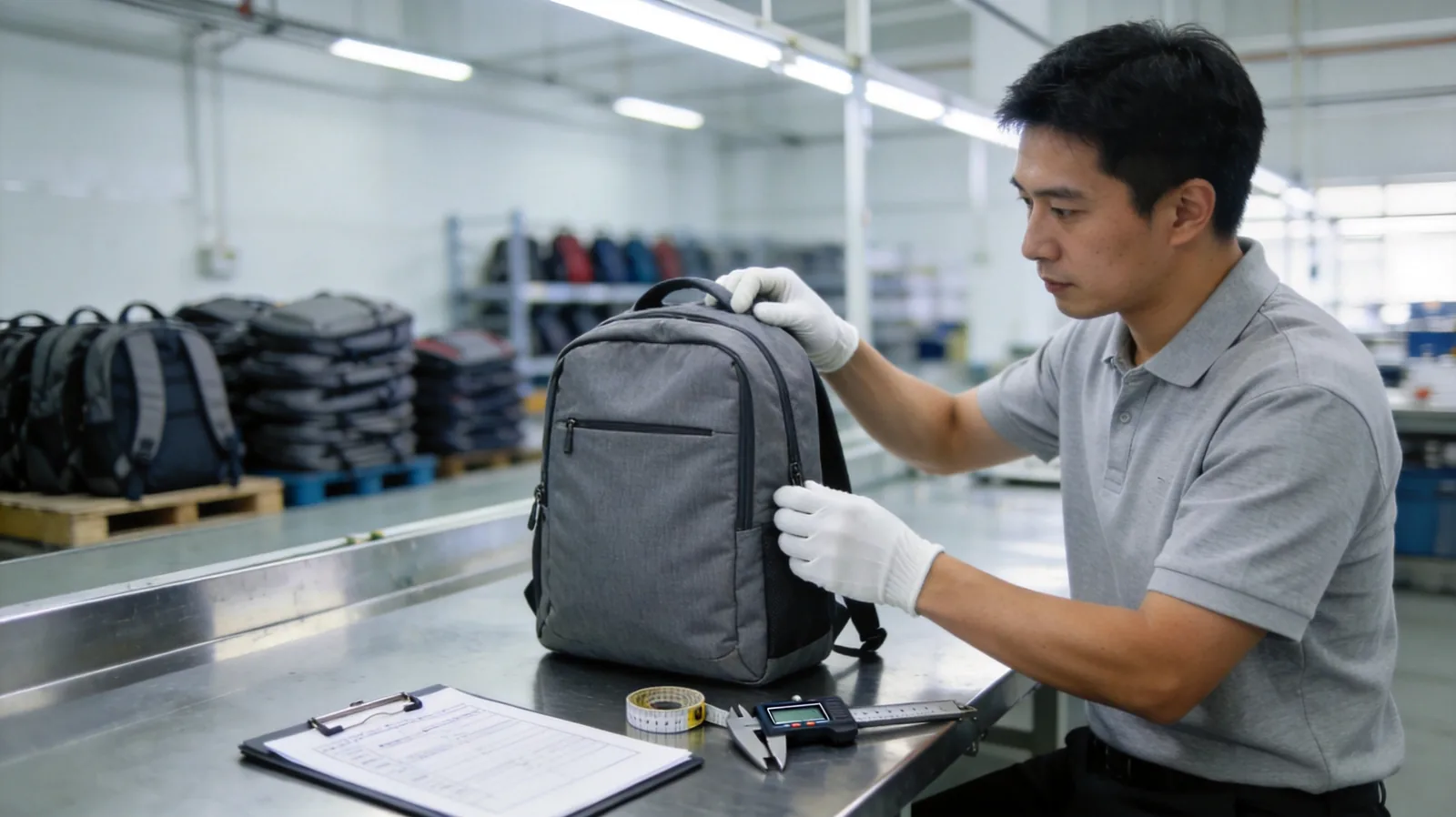
AQL 2.5 is the standard acceptance level for consumer soft goods. It is a sampling system, not a 100% inspection: a defined number of units is pulled at random from the lot, and the lot passes or fails based on the number of defects found in that sample.
| Lot size | Sample size (level II) | Accept | Reject |
|---|---|---|---|
| 281–500 | 50 | 3 major | 4 major |
| 501–1,200 | 80 | 5 major | 6 major |
| 1,201–3,200 | 125 | 7 major | 8 major |
| 3,201–10,000 | 200 | 10 major | 11 major |
Two things decide whether AQL 2.5 is a real control or a formality. The first is the defect definition: a factory that classifies a crooked seam as “minor” will always pass. The second is who inspects. A third-party inspection on a 500 pcs order typically costs a few hundred dollars and is the cheapest insurance in the whole order.
Critical defects — sharp points, broken needles left in the bag, non-functional zips, unsafe dye content — are never accepted at any AQL level. They are zero-tolerance by definition and should be written into the quality annex as such.
Step 6 — Packing, Shipping and Landed Cost
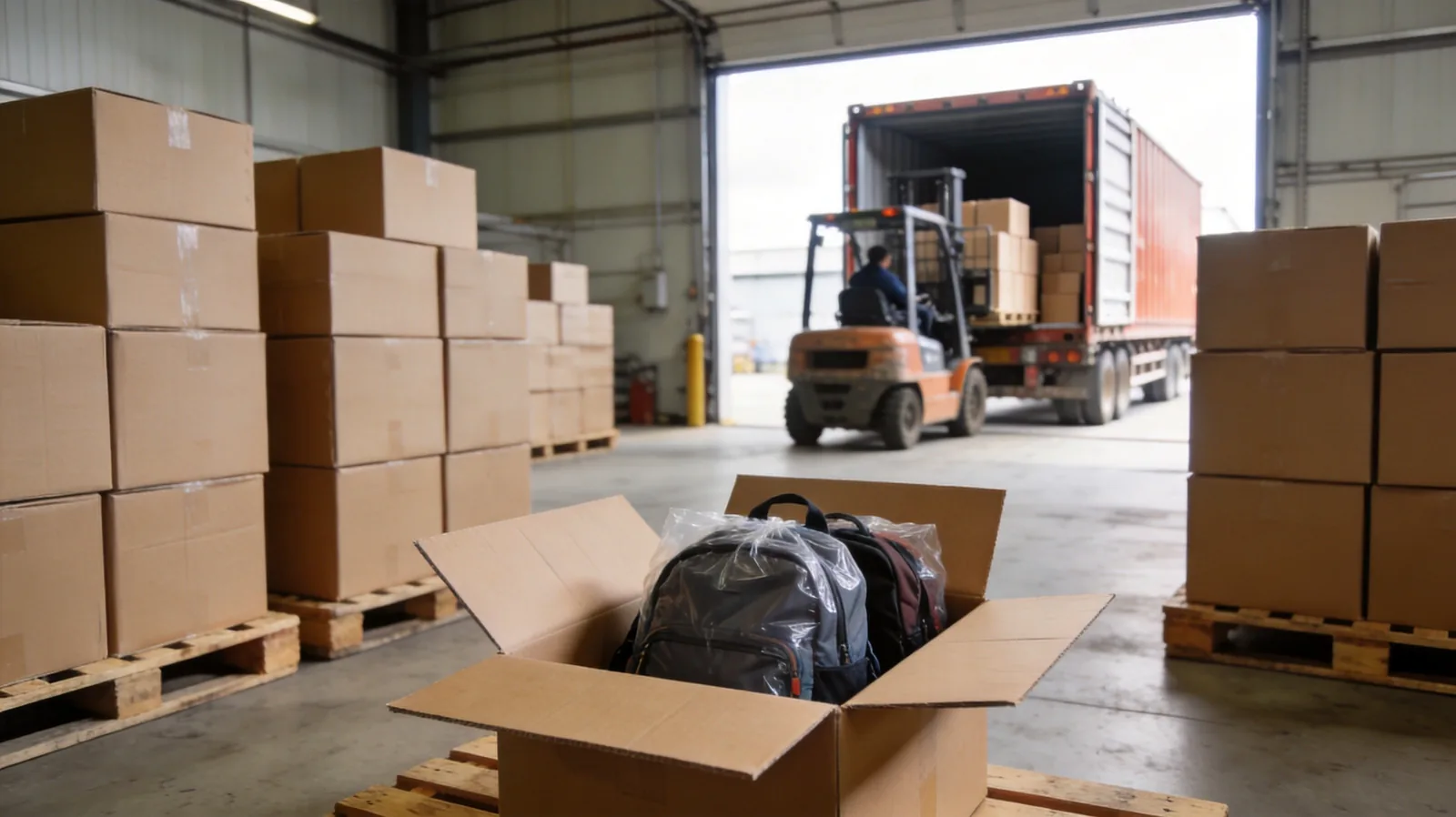
Packing is where the last controllable cost sits. A backpack compressed into a smaller carton reduces CBM, and on sea freight CBM is money.
FOB, CIF and DDP: what actually changes
| Term | Factory delivers to | Buyer controls | Best for |
|---|---|---|---|
| FOB | Named port, loaded on vessel | Freight, insurance, import clearance | Buyers with an established forwarder |
| CIF | Named destination port | Import clearance, inland | First orders, low freight volume |
| DDP | Buyer’s door | Nothing after PO | Small programmes, marketplace sellers |
The six lines of landed cost
- FOB unit price × quantity
- Freight (sea, air, or rail) — commonly 8–15% of FOB for backpacks
- Insurance — typically 0.3–0.5% of CIF value
- Import duty at the destination HS code
- Destination port charges and inland delivery
- Inspection and compliance testing, amortised across the order
A 10% FOB saving that adds 4% in freight and 3% in duty is a 3% saving, not a 10% one. This is why the quotation must contain CBM.
What Each Stage Costs
| Stage | Cost type | Typical share of order value | Recoverable? |
|---|---|---|---|
| Sampling | One-off fee per style | 0.5–2% | Usually refunded against first bulk order |
| Tooling / moulds | One-off, if custom hardware | 1–5% | No |
| Materials | Per unit | 35–50% of FOB | — |
| Labour and assembly | Per unit | 20–30% of FOB | — |
| Inspection | Per lot | 0.5–1.5% | No — and worth it |
| Freight | Per shipment | 8–15% of FOB | No |
| Compliance testing | Per material or per style | 1–3% | No, but reusable across orders |
The pattern is consistent: the line items buyers try to cut (sampling, inspection, testing) are the cheapest, and the line items that actually move (materials, freight) are the ones worth negotiating.
MOQ 500 in Practice: Splitting Across Colours, Sizes and Styles
The 500 pcs minimum applies per design, not per colour. This is the single most misunderstood term in OEM backpack sourcing, and it is worth stating precisely.
A 500 pcs order can be split across colourways, provided the fabric and hardware are common across those colours. Splitting into four colours at 125 pcs each is normal. What breaks the minimum is not colour — it is material differentiation: four colours in the same 600D oxford is one minimum; four colours in four different fabrics is four material setups and effectively four minimums.
Where the minimum becomes flexible
- Repeat styles — a design already in production has patterns and cutting files, so a lower reorder quantity is negotiable
- Stock fabric — a colourway that uses fabric already on the floor avoids a mill minimum
- Consolidated programmes — three styles that share one fabric can be scheduled together
- Sampling-stage commitment — a programme that commits to a 12-month volume plan can often start below 500 on the first drop
What does not move the minimum: asking. A 200 pcs request on a new design with new fabric is not a pricing question, it is a mill minimum question, and the answer is no regardless of which supplier is asked.
Payment Terms: What Protects Both Sides
Standard practice for a first order is 30% deposit on PO and 70% against the bill of lading copy. The deposit funds material purchase; the balance releases the documents.
| Structure | Buyer risk | Factory risk | When appropriate |
|---|---|---|---|
| 30 / 70 against B/L copy | Moderate | Moderate | Standard first order |
| 30 / 70 with inspection release | Low | Moderate | Buyer’s preferred structure |
| Letter of credit at sight | Low | Low | Orders above USD 50,000 |
| Escrow / trade assurance | Low | Low | First order with a new supplier |
| 100% on shipment | High | None | Avoid |
Tying the balance release to a passed inspection is the single highest-value clause a buyer can add. It converts the inspection from a report into a payment condition.
Compliance Documents to Collect Before the Container Leaves
Document requirements follow the destination market, not the supplier’s preference. The list below is what buyers most commonly need; the exact set depends on the product and the channel.
| Market | Document | Applies to |
|---|---|---|
| EU | REACH conformity, GPSR responsible-person details | All textile consumer goods |
| EU | BSCI or equivalent social audit | Buyer or retailer requirement |
| US | Proposition 65 statement | California-bound goods |
| US | CPSIA children’s product testing | School and kids’ backpacks |
| Global | GRS transaction certificate | Recycled polyester claims |
| Global | OEKO-TEX Standard 100 | Skin-contact textiles |
Two practical rules. First, request the documents at PO stage, not at shipment — testing labs have their own lead times and they do not compress. Second, verify the certificate covers the specific material and the specific supplier; a GRS certificate for a different fabric is not evidence for this order. The GPSR compliance guide for custom bags covers the EU responsible-person requirement in detail.
Seven Order Failures and How to Prevent Them
- Sample approved on the wrong revision — the golden sample at the factory is not the one the buyer signed. Prevention: photograph the golden sample, label it with revision and date, and keep a copy of the photo in the PO file.
- Material substitution at cutting — a similar-looking fabric at a lower GSM replaces the specified one. Prevention: checkpoint 1, with a GSM cutter on site.
- Colour drift between colourways — dye lots differ. Prevention: specify that all colourways be cut from a single dye lot, and state it in the PO.
- Hardware revision mismatch — an older buckle is used because stock was already on the floor. Prevention: list hardware by part number in the tech pack, and confirm at checkpoint 3.
- Packing specification ignored — polybag thickness, carton count, or hangtag placement differs from the spec. Prevention: put the packing spec on its own page, not buried in the tech pack.
- Compliance documents unavailable at shipment — testing was never ordered. Prevention: raise the testing request at PO stage.
- Inspection failure discovered at the destination — no pre-shipment inspection was booked. Prevention: book third-party inspection for every first order and every new style.
None of these are exotic. All seven are process failures, which means all seven are preventable with documents rather than with trust.
How to Brief a Chinese Manufacturer: The Eight-Line RFQ
A usable RFQ fits in eight lines. Each line removes one round of clarification, and each round of clarification costs 2–4 days.
- Style: reference image or drawing, plus the three features that must differ from it
- Size: external dimensions in cm and internal volume in litres
- Material: fabric type, denier and coating; lining; hardware finish
- Colours and sizes: number of colourways, number of sizes, quantity per combination
- Quantity: total, plus the split if above 500
- Branding: method and placement for label, logo and any hangtag
- Destination: country, and the compliance documents required
- Dates: sample required by, ship required by, and which of the two is hard
Buyers who send this in the first email routinely get a usable quotation in two days. Buyers who send “please quote 500 backpacks” get a range, then three weeks of clarification, then a price change.
Why Buyers Run OEM Programmes with JUNYUAN BAGS
JUNYUAN BAGS is a backpack OEM/ODM manufacturer based in Quanzhou, Fujian, founded in 2014, with the founder entering the bag industry in 2004. Production runs through an independently inspected in-house base and a vetted network of affiliated partner factories, which is what allows capacity to flex without the quality variance that comes from brokering.
| Parameter | Standard |
|---|---|
| Minimum order quantity | 500 pcs per design |
| Sampling lead time | 6–10 days |
| Bulk production lead time | 35–50 days |
| Inspection standard | AQL 2.5, third-party inspection welcome |
| Sampling fee | Charged, refunded against the first bulk order |
| Programme coverage | Laptop, hiking, school, travel, promotional, tactical, and golf bags |
Category-specific order guides are available for laptop backpack programmes, hiking backpack programmes, recycled RPET programmes, and custom golf bags. For premium-tier builds with leather and metal hardware, see the premium backpack manufacturer page. Buyers comparing suppliers across markets will find the custom backpack manufacturers in China comparison and the Chinese backpack manufacturer guide useful as cross-references.
To start an order, send the eight-line RFQ to [email protected] or WhatsApp +86 17750020688. Quotations include the cost breakdown and carton CBM, so the landed cost comparison is possible from the first reply. The contact page also routes to sampling enquiries.
Frequently Asked Questions About Custom Backpack Orders in China
How long does a custom backpack order take from PO to shipment?
Roughly eight weeks for a clean 500 pcs order of one style: 2–4 days for quotation, 6–10 days for sampling, 2–3 days for golden sample approval and PO, 7–14 days for material inbound running in parallel with the production slot, 35–50 days for bulk production, and 1–2 days for inspection plus 2–4 days for packing. Compressing the schedule is possible but every week removed comes out of a specific stage — usually sampling or inspection, which are the two stages worth keeping.
What is the minimum order quantity for a custom backpack from China?
500 pcs per design is the standard minimum for a new OEM backpack programme. The minimum applies per design rather than per colour, so a 500 pcs order can be split across colourways as long as the fabric and hardware are common to those colours. Four colours in the same 600D oxford is one minimum; four colours in four different fabrics is four material setups and effectively four minimums.
Can I order less than 500 pcs for a first order?
Sometimes, in specific situations: a repeat style that is already in production with existing patterns and cutting files, a colourway that uses fabric already on the factory floor, three styles that share one fabric and can be scheduled together, or a programme that commits to a 12-month volume plan and starts below 500 on the first drop. A 200 pcs request on a new design with new fabric is a mill minimum question, and the answer is no regardless of which supplier is asked.
How much does it cost to develop a custom backpack sample?
Sampling is charged as a one-off fee per style, and the standard practice is to refund it against the first bulk order. The fee covers pattern making, material sourcing against the specification, and one prototype. It does not cover a second colourway, custom tooling, or a hardware item that has to be developed — those are quoted separately. Always confirm the refund condition in writing before paying.
What should I send in an RFQ to get an accurate quotation?
Eight lines: style reference with the three features that must differ from it; external dimensions in cm and internal volume in litres; fabric type, denier and coating plus lining and hardware finish; number of colourways and sizes with quantity per combination; total quantity and the split; branding method and placement; destination country and required compliance documents; and the required sample date and ship date, with which of the two is hard. Buyers who send this get a usable quotation in two days.
What should a Chinese backpack manufacturer’s quotation include?
Unit FOB price at the stated quantity, price breaks at 500 / 1,000 / 3,000 pcs, material cost share, sampling fee and refund condition, tooling cost if any, carton dimensions and pcs per carton, CBM, gross and net weight per carton, and quotation validity. A quotation missing the carton and CBM lines is not a landed cost quotation — buyers who compare FOB prices only often find the freight difference wipes out the FOB advantage.
What does a sample prove and what does it not prove?
A sample proves four things: pattern and fit, material hand-feel, construction method, and branding placement. It does not prove production consistency, because a sample is made by the sample room rather than the production line. Buyers who treat sample approval as quality assurance are the ones who discover the problem at inspection. The sample is a specification agreement, not a quality guarantee.
How many sample revisions should I expect?
One revision is normal for a new style; two is common for a technical pack or a bag with custom hardware. Each revision cycle costs 5–7 days. The way to converge in one revision is a consolidated comment sheet with one line per issue — location, current state, required state, priority — rather than feedback sent as a paragraph of prose, which tends to fix one issue and break another.
What is a golden sample and why does it matter?
The golden sample is the signed, approved physical reference that bulk production is measured against. It must physically exist at the factory, and it must be the exact revision the buyer approved — not an earlier one with hardware that was later changed. Photograph it, label it with style number, revision and date, and keep the photo in the PO file. Hardware revision mismatch and wrong-revision approval are two of the most common order failures.
What is AQL 2.5 and how does it apply to backpack inspection?
AQL 2.5 is a sampling acceptance system, not a 100% inspection. A defined number of units is pulled at random from the lot and the lot passes or fails based on defects found in that sample. For a 281–500 pcs lot the sample size at level II is 50 units, with 3 major defects accepted and 4 rejected. For 501–1,200 pcs it is 80 units with 5 accepted and 6 rejected. Critical defects — sharp points, broken needles, non-functional zips, unsafe dye content — are zero-tolerance at any AQL level.
Should I book a third-party inspection for a 500 pcs order?
Yes, for every first order and every new style. A third-party inspection on a 500 pcs order typically costs a few hundred dollars, which is the cheapest insurance in the whole order. Two things decide whether inspection is a real control: the defect definition must be written into the quality annex, and the inspector must not be the factory’s own QC. Tying the balance payment release to a passed inspection converts the report into a payment condition.
What are the standard payment terms for a Chinese backpack manufacturer?
30% deposit on PO and 70% against the bill of lading copy is standard for a first order. The deposit funds material purchase and the balance releases the documents. Tying the 70% release to a passed inspection is the highest-value clause a buyer can add. Letter of credit at sight suits orders above USD 50,000, and escrow or trade assurance is appropriate for a first order with a new supplier. Avoid 100% payment on shipment.
What compliance documents do I need for backpack imports?
It depends on the destination. For the EU, REACH conformity and GPSR responsible-person details are required for all textile consumer goods, and BSCI or an equivalent social audit is often a buyer or retailer requirement. For the US, Proposition 65 applies to California-bound goods and CPSIA children’s product testing applies to school and kids’ backpacks. Globally, GRS transaction certificates support recycled polyester claims and OEKO-TEX Standard 100 covers skin-contact textiles. Request them at PO stage, because lab lead times do not compress.
How is the 500 pcs minimum split across colours and sizes?
Colour splits freely as long as fabric and hardware are common — four colours at 125 pcs each is normal. Sizes split freely as long as the pattern set covers them. What breaks the minimum is material differentiation: a different fabric per colour means a separate material setup and a separate minimum. State the intended split in the RFQ rather than after quotation, because the split changes the material purchasing plan and therefore the price.
How do I compare two suppliers when the FOB prices differ?
Compare landed cost, not FOB. Six lines: FOB unit price times quantity, freight, insurance, import duty at the destination HS code, destination port charges and inland delivery, and inspection plus compliance testing amortised across the order. A 10% FOB saving that adds 4% in freight and 3% in duty is a 3% saving, not a 10% one. This comparison is only possible if both quotations include carton dimensions and CBM.
Related Reading
- Custom Backpack Manufacturer: OEM/ODM Capability Overview
- How to Find a Custom Backpack Manufacturer in China
- Custom Backpacks: How to Choose a Backpack Manufacturer
- Top 10 Custom Backpack Manufacturers in China 2026
- Chinese Backpack Manufacturer: 2026 Guide
- What Materials Are Suitable for Backpacks: Fabric Specification Guide
- OEM/ODM Service: How a Private Label Programme Runs
- Custom Trekking Backpack Manufacturing
- Custom Mountaineering Backpack Manufacturing
- Outdoor Backpack Manufacturer: OEM/ODM Matrix
- Waterproof Backpack Manufacturer Guide
- Top Backpack Manufacturers in China