
A bag manufacturer established in 2014, with our founder working in the bag trade since 2004. We build private-label organizer cases and utility organizers — zip-around folio cases, moulded EVA tech cases, compartmented tool cases, travel packing organizer cases, clear PVC utility cases and roll-up wraps — for consumer-electronics accessory brands, tool and hardware labels, travel and luggage brands, grooming and beauty brands, promotional distributors and corporate-gifting programs, in 210D–1680D polyester and nylon, RPET, 5 mm EVA laminate, 1.2 mm PP board and 0.3–0.5 mm clear PVC or TPU.
Short answer for buyers: an organizer case is not a bag with pockets — it is a case whose interior is engineered so that a fixed list of contents sits in fixed positions, every time the case is opened. Four specifications decide whether a program reorders or dies: the interior architecture (divider count and layout, elastic loop pitch, mesh window placement), the shell rigidity class (soft, semi-rigid with a 1.0–1.5 mm PE board, or rigid with 5–8 mm moulded EVA or 1.2 mm PP), the closure and hardware grade (#3 versus #5 versus #8 coil, auto-lock versus free slider, puller attachment), and the interior dimensional tolerance against the actual contents (±2 mm on a moulded tray, ±3 mm on a sewn interior). On a like-for-like 500-piece order the cost index runs roughly 1.00 for a soft sewn case, 1.30 for a semi-rigid board-reinforced case and 1.60–1.90 for a moulded EVA case, and about 60% of that difference sits in the interior, not the shell. We build organizer cases at 500 pieces per style, sample them in 6–10 working days, run mass production 35–50 days after sample approval, and inspect to AQL 2.5 major / 4.0 minor.
What an Organizer Case Actually Is — Seven Structures That Share a Name
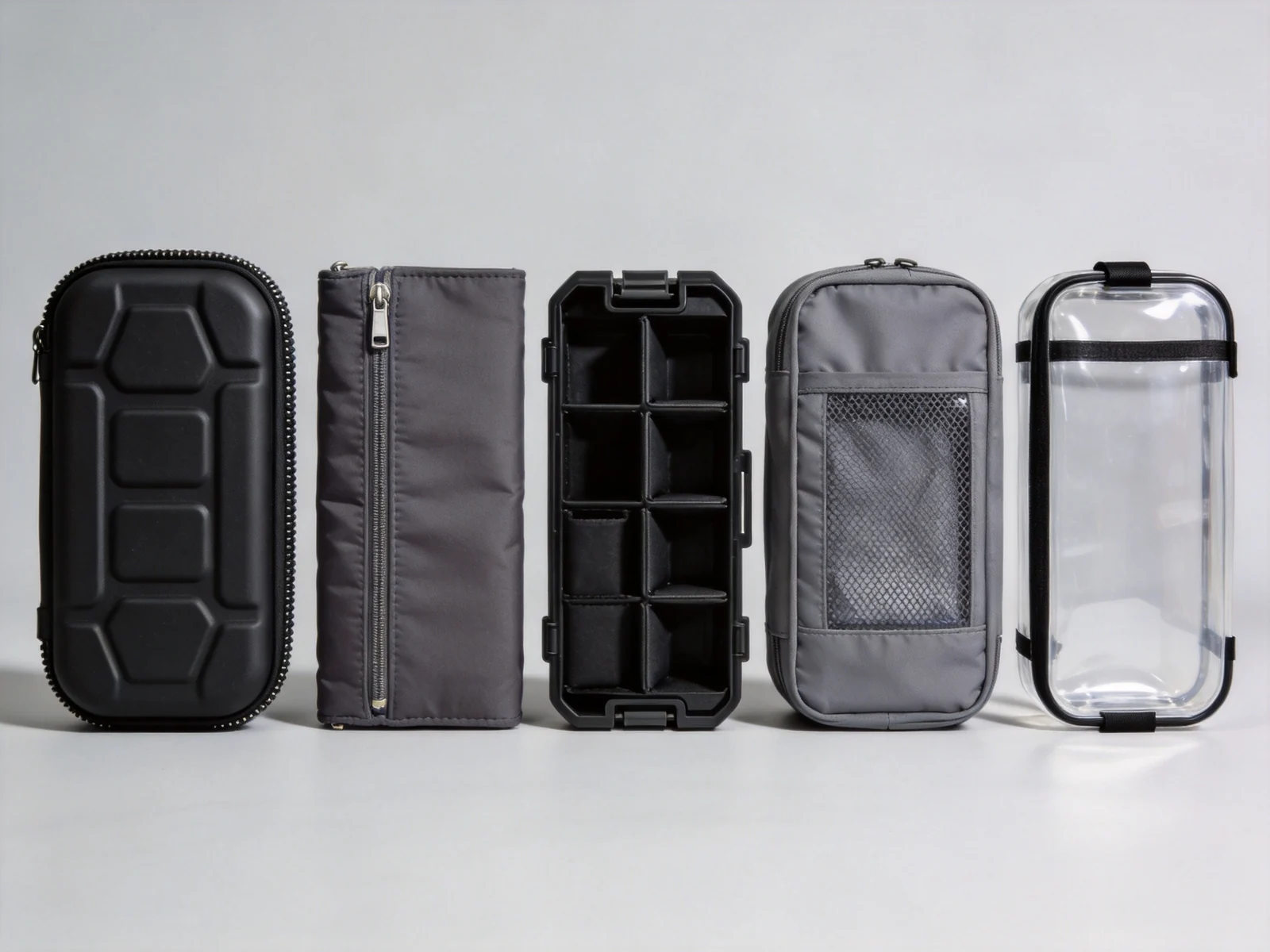
“Organizer case” is a merchandising term, not a construction. It covers at least seven products that are bought by different departments, priced on different cost structures and inspected against different criteria. A cable folio sold by a consumer-electronics accessory brand, a twelve-compartment tool case sold by a hardware label, a compression packing case sold by a travel brand and a clear utility case sold at a stadium gate have almost nothing in common except the word. Fixing which of the seven the range needs is the first decision, because pattern, board consumption, interior labour and inspection criteria change by a factor of two to three between them.
| Code | Structure | Shell / body | Closure | Typical contents | Typical buyer | Cost index |
|---|---|---|---|---|---|---|
| OC-01 | Zip-around folio case | 210D–600D shell, 1.0–1.5 mm PE board front and back | #5 coil, three-sided zip | Cables, adapters, memory cards, pens | Electronics accessory brands, corporate gifting | 1.30 |
| OC-02 | Moulded EVA hard case | 5–8 mm EVA laminate, 210D or jersey lining | #5 or #8 reverse coil, zip-around | Headphones, drone, meter, camera insert | Audio and drone brands, instrument and meter OEMs | 1.75 |
| OC-03 | Compartmented tool case | 600D–1680D shell, rigid PP or PE dividers | Zip-top or open-top with handle | Hand tools, fasteners, drill bits, test gear | Tool and hardware brands, service contractors | 1.45 |
| OC-04 | Travel packing organizer case | 210D–420D ripstop, mesh window, 1.0 mm board base | #5 coil, two-way | Folded garments, shoes, laundry separation | Travel and luggage brands, DTC travel labels | 1.15 |
| OC-05 | Clear PVC / TPU utility case | 0.3–0.5 mm clear film, piped or bound edge | #5 nylon zip, sometimes 2 sliders | Toiletries, cosmetics, event carry-in items | Beauty brands, event and stadium retail, airlines | 1.20 |
| OC-06 | Roll-up / wrap organizer | 600D shell, no board, tie or buckle | Tie cord, strap or zip flap | Cables, brushes, wrenches, cutlery | Grooming brands, chef and trades supply | 1.05 |
| OC-07 | Hanging organizer case | 420D–600D shell, 1.0 mm board panels, swivel hook | Zip-around, hangs open | Toiletries, jewellery, small parts on shelves | Beauty and grooming brands, hospitality supply | 1.40 |
Organizer Case vs Storage Organizer Bag vs EVA Case — Routing Buyers to the Right Page
Three product names on this site overlap enough that buyers regularly request the wrong one, which wastes a sampling round. The distinction is simple and worth stating plainly. An organizer case is a protective, closeable case whose interior is divided so that specific contents cannot move — it is judged on interior fit and on protection in transit. A storage organizer bag is a soft, usually open or lightly closed container for volume storage at home or in a warehouse — it is judged on capacity, stackability and breathability, not on impact protection. An EVA case is defined by its shell process rather than its interior: vacuum-formed EVA laminate, moulded to shape, with the interior usually filled by die-cut foam or a moulded tray.
The overlap is real: a moulded EVA case with a die-cut foam interior is simultaneously all three. What changes the quotation is which discipline leads the design. If the contents list is fixed and the buyer cares about drop protection, we lead with the shell and the foam. If the contents list is fluid and the buyer cares about compartments and labelling, we lead with the interior and keep the shell semi-rigid. If the buyer is buying volume for storage, we drop the board and the moulding entirely and the price falls by roughly 35–45%.
| Buyer question | Organizer case (this page) | Storage organizer bag | Moulded EVA case |
|---|---|---|---|
| Primary job | Keep fixed contents in fixed positions, protected | Hold volume, store and stack | Protect a specific shaped product |
| Shell | Soft to rigid, board-reinforced | Soft, no board | 5–8 mm EVA laminate, moulded |
| Interior | Dividers, loops, mesh, foam | One open cavity, sometimes a lid pocket | Die-cut foam or moulded tray |
| Key spec | Compartment dimensions vs contents | Litres, load rating, stack height | Drop height, foam density |
| Tooling | Pattern + cutting dies for dividers | Pattern only | Mould + cutting dies |
| Relative unit cost | 1.00–1.90 | 0.70–0.90 | 1.60–2.10 |
The Buying Landscape: Seven Channels and What Each One Actually Needs
Every channel that buys organizer cases asks for the same object and evaluates it against a different scorecard. A promotional distributor cares about landed cost per impression and whether the case survives a courier; a consumer-electronics brand cares about interior fit for a specific accessory set and about how the case photographs; a tool brand cares about load, divider rigidity and whether the case can be stood open on a bench without collapsing. Selling the same construction to all seven is how manufacturers end up with a catalogue nobody reorders.
| Channel | Order profile | What wins the order | What kills the order | Spec we default to |
|---|---|---|---|---|
| Consumer-electronics accessory brands | 500–3,000 pcs, 2–4 SKUs, annual refresh | Interior fit for a named device set, retail-ready photography | Loops that stretch out, foam that crumbles in 12 months | OC-01 folio, 420D, 1.2 mm PE board, 20 mm loop pitch |
| Audio, drone and instrument OEMs | 500–2,000 pcs, one SKU, tooling amortised | Drop performance and a moulded tray that holds shape | Shell deformation in a hot container | OC-02 EVA, 6 mm shell, 210D lining, die-cut PE foam |
| Tool and hardware brands | 1,000–5,000 pcs, multi-SKU families | Divider rigidity and load rating | Divider stitching that tears at 5 kg | OC-03, 600D, PP dividers, bar-tacked seams |
| Travel and luggage brands | 500–3,000 pcs, sets of 2–3 | Compression, mesh visibility, weight | Zipper that catches on the mesh | OC-04, 210D ripstop, 1.0 mm base board |
| Beauty and grooming brands | 500–2,000 pcs, seasonal colourways | Clean piping, print quality on film, colour accuracy | Ink that flakes on PVC folds | OC-05, 0.4 mm TPU or 0.3 mm PVC, bound edge |
| Promotional distributors | 500–5,000 pcs, tight deadlines | Price, lead time, decoration durability | Decoration that peels after one trip | OC-01 or OC-06, 210D–420D, one-colour print |
| Corporate gifting and hospitality | 500–1,500 pcs, gift-boxed | Presentation, custom lining, name personalisation | Case arriving creased in a gift box | OC-07 hanging case, 600D, custom lining print |
Interior Architecture: The Part That Decides the Reorder Rate
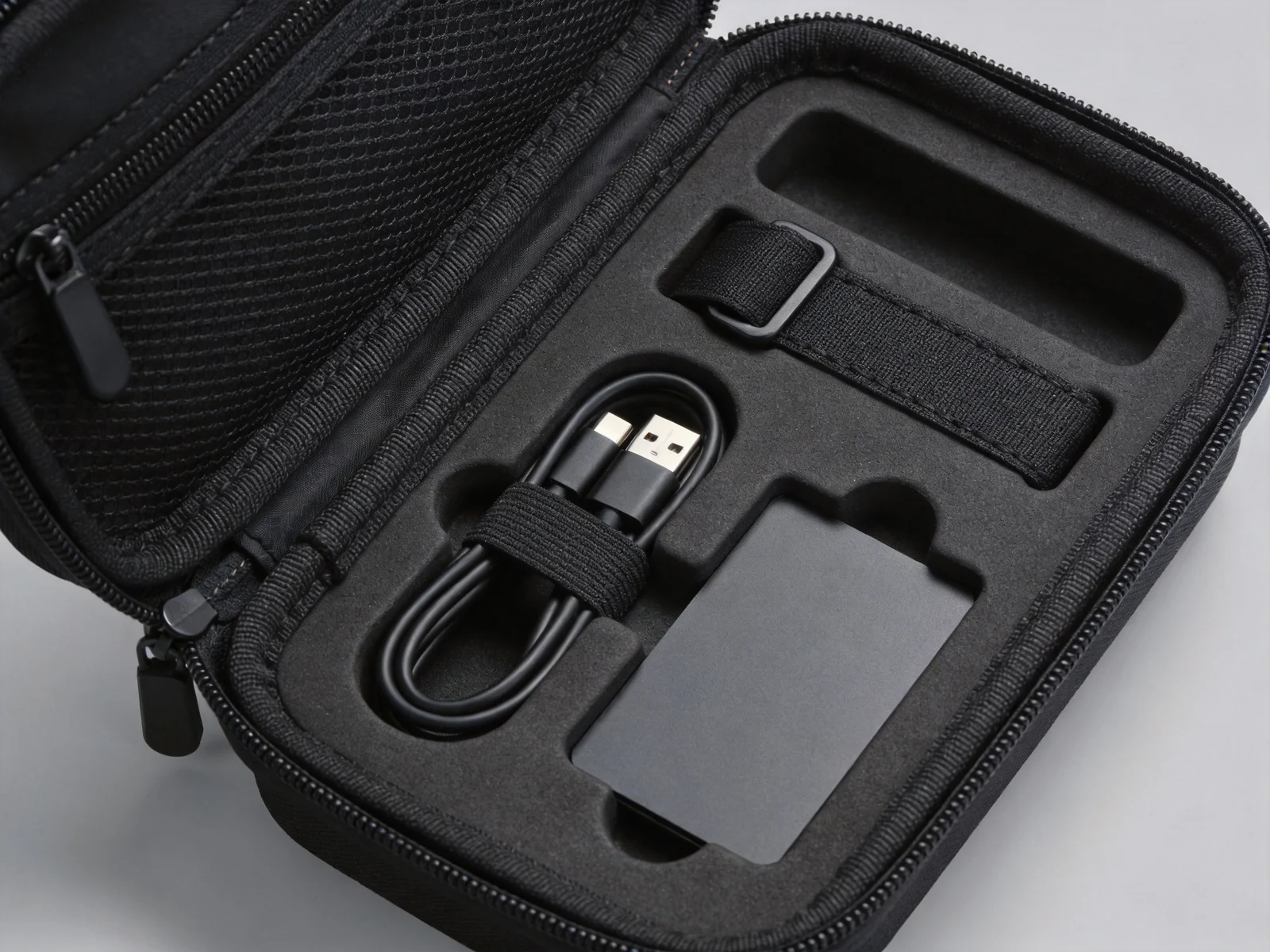
Buyers spend their attention on the shell and their money on the interior. Nine out of ten complaints we see on competitor cases are interior failures: an elastic loop that has lost tension, a divider that has torn away at its ends, a mesh pocket whose zip has separated from the lining, a foam insert that has crumbled into dust. None of these are shell problems, and none of them are fixed by upgrading the fabric. They are fixed at the pattern stage, by how the interior is attached and how much material is left at the stress points.
| Interior element | Construction | Where it belongs | Numbers that matter | Failure mode if done cheaply |
|---|---|---|---|---|
| Sewn fabric divider | Two-ply 210D–420D panel, bound edge, stitched to base seam | Soft folios, travel cases | 8–10 SPI, 200 N bar-tack at each end | Tears out at the base seam within a season |
| Rigid divider | 1.0–1.5 mm PP or PE board, fabric-wrapped, sewn into base | Tool cases, multi-compartment cases | Board stiffness 1.2 GPa flexural modulus; 3 mm stitch margin | Board edge cuts through the wrap, visible white line |
| Removable divider | Hook-and-loop panel, 20 mm tape, both faces | Configurable tool and camera cases | Peel strength ≥ 3 N/cm; 500 open-close cycles | Loop pile flattens, divider slides under load |
| Die-cut foam insert | 25–35 kg/m³ PE foam, die-cut to contents, glued or drop-in | Moulded EVA cases, electronics | Cut tolerance ±1.5 mm; foam density ≥ 25 kg/m³ | PU foam crumbles in 12–18 months; too-soft foam lets contents move |
| Elastic loop panel | 20–25 mm woven elastic, stitched at both ends, 2–3 mm slack | Cable, pen and tool retention | Loop pitch 15/20/25 mm for cables, 25/30/40 mm for tools; ±1 mm | Loops sewn flat, no slack, so nothing can be inserted |
| Mesh zip pocket | 0.5 mm polyester mesh, #3 coil, bound opening | Small-parts visibility in travel and tech cases | Mesh ≥ 0.5 mm; zip tape sewn 4 mm from edge | Zip catches mesh, pocket tears at the corner radius |
| Clear window pocket | 0.3 mm PVC or 0.2 mm TPU, stitched or high-frequency welded | ID, business card, contents label | Weld width 3 mm; stitch 6 SPI with 0.4 mm needle | PVC cracks along stitch holes at low temperature |
| Moulded EVA tray | Thermoformed tray inserted into shell, or tray forming the shell | Electronics, meters, medical-style kits | Wall 2.0–3.0 mm; radius ≥ 3 mm | Sharp internal corners tear the lining on assembly |
The one-piece lining rule
The single most effective interior decision is to cut the lining as one piece per side rather than as a patchwork of panels. A one-piece lining spreads the load of every divider and every pocket across the whole panel; a patchwork lining concentrates it at the seams, and the first thing to go is the seam next to the heaviest compartment. On a 500-piece order the difference in material cost is small — typically 3–5% of the interior cost — and the difference in returns is large. We cut one-piece linings as standard on OC-01, OC-03 and OC-07, and we will cut patchwork only when the buyer’s design requires a contrasting panel.
Shell Platforms: Nine Constructions and What Each One Is For
The shell is chosen against three questions, in this order: does the case need to hold a shape on its own, does it need to survive abrasion against hard objects, and does it need to be seen through. Everything else — colour, texture, hand-feel — is secondary and can be solved inside any of the nine platforms below.
| # | Shell platform | Weight / thickness | Best for | Abrasion | Cost index |
|---|---|---|---|---|---|
| 1 | 210D polyester, PU-backed | 60–75 gsm | Promotional folios, light travel cases | Low | 1.00 |
| 2 | 420D polyester, PU-backed | ~110 gsm | Retail folios, mid-grade tech cases | Medium | 1.15 |
| 3 | 600D polyester, PU-backed | ~200 gsm | Tool cases, heavy-duty organizers | High | 1.30 |
| 4 | 600D RPET, PU-backed | ~200 gsm | Recycled-content programs | High | 1.35 |
| 5 | 1680D ballistic nylon | ~380 gsm | Professional tool and range cases | Very high | 1.75 |
| 6 | 5 mm EVA laminate + 210D face | 5 mm / 6 mm / 8 mm | Moulded tech and instrument cases | Medium | 1.85 |
| 7 | 1.2 mm PP board + fabric wrap | 1.0–1.5 mm board | Semi-rigid folios that must stay flat | Depends on wrap | 1.55 |
| 8 | 0.3 mm clear PVC | 0.25–0.5 mm film | Visibility cases, event and beauty | Low–medium | 1.20 |
| 9 | 0.4 mm TPU film | 0.3–0.5 mm film | Cold-climate and phthalate-free visibility | Medium | 1.45 |
Two notes that save buyers a sampling round. First, RPET is not a performance upgrade — it is the same 600D construction with recycled yarn, and it should be specified for the content claim, not for durability. Second, TPU costs 20–25% more than PVC film but does not embrittle at low temperature and contains no plasticiser, which matters if the case will ship to a market with phthalate restrictions or will be stored in an unheated warehouse.
Zippers, Sliders and Pulls: The Load Path on a Case That Opens Twenty Times a Day
A case is opened far more often per unit than a bag is. That makes the zipper the highest-cycle component in the product, and the place where a 3-cent saving becomes a 30% return rate. The three decisions that matter are the chain size, the slider type and the puller attachment.
| Component | Option | Typical use | Numbers | Watch out for |
|---|---|---|---|---|
| Chain | #3 nylon coil | Small folios, mesh pockets, inner pockets | Breaking strength ~250–300 N | Too light for a 400 mm zip-around perimeter |
| Chain | #5 nylon coil | Standard for OC-01, OC-04, OC-05 | ~350–450 N | Chain tape width must match the seam allowance |
| Chain | #8 nylon coil | Moulded EVA cases, tool cases | ~600 N | Needs a 12 mm+ seam allowance; narrow channels pucker |
| Chain | #5 reverse coil | Cases where the teeth should not touch contents | Same as standard #5 | Harder to sew around tight radii; radius ≥ 40 mm |
| Chain | #5 PU-coated waterproof coil | Outdoor and wet-use cases | Hydrostatic resistance on the tape only | Not a substitute for seam sealing at the case corners |
| Slider | Auto-lock | Any case carried vertically | Holds at 50 N pull | Can feel stiff; test with the actual puller |
| Slider | Free / non-lock | Cases opened constantly at a bench | — | Opens under vibration in transit |
| Puller | Cord loop, 3 mm | Low-cost programs | Pull test 80 N | Cord frays; specify a heat-sealed end |
| Puller | Metal or moulded puller | Retail and gift programs | Pull test 120 N | Branded pullers usually carry a 1,000-pc minimum |
Cycle testing is where the specification is proven. We run 3,000 open-close cycles on the main zip of every new organizer case pattern, and 500 cycles on inner pocket zips, with the case loaded to its rated contents. A #5 coil on a correctly supported curve will pass 3,000 cycles without a skipped tooth; a #3 coil on a 420 mm zip-around perimeter will typically fail between 800 and 1,500 cycles, and that is the number that shows up as a one-star review eighteen months after launch. On a moulded EVA case the zipper is also the assembly fixture — it is sewn before the shell is formed — so the zip length must be set from the finished perimeter, not from the flat pattern, or the case will smile at the corners.
Sizing: A Matrix Based on Contents, Not on Guesswork
Organizer cases are specified from the inside out. The buyer’s contents list — with real dimensions, not product names — sets the interior; the interior sets the board; the board sets the shell; the shell sets the carton. Working the other way round, from a case size that looks right in a catalogue, is the most common reason a first sample is rejected.
| Case type | Interior dimensions (mm) | Interior volume | Contents it is sized for | Exterior (approx.) |
|---|---|---|---|---|
| Pen / small tech pouch | 210 × 130 × 50 | 1.4 L | Pens, earbuds, two cables, a card holder | 225 × 145 × 60 |
| Cable organizer folio | 240 × 170 × 45 | 1.8 L | Four cables, two adapters, a power bank | 255 × 185 × 55 |
| Tech accessory case (medium) | 280 × 200 × 75 | 4.2 L | Chargers, hub, mouse, spare batteries | 300 × 220 × 90 |
| Tool case, 12 inch | 320 × 230 × 70 | 5.2 L | Twelve hand tools up to 300 mm | 340 × 250 × 85 |
| Tool case, 16 inch | 420 × 300 × 90 | 11.3 L | Twenty tools, a meter, fasteners | 440 × 320 × 105 |
| Travel packing organizer, M | 400 × 300 × 100 (70 compressed) | 12.0 L | Five to seven folded garments | 415 × 315 × 110 |
| Travel packing organizer, L | 480 × 350 × 120 (85 compressed) | 20.2 L | Eight to ten garments or two pairs of shoes | 495 × 365 × 130 |
| Camera / device insert | 300 × 200 × 120 | 7.2 L | Body plus two lenses, or a handheld device | 315 × 215 × 135 |
| Clear utility case, cabin | 340 × 200 × 90 | 6.1 L | Toiletries within liquid limits, event carry-in | 350 × 210 × 95 |
Tolerance follows the process. A sewn interior holds ±3 mm on compartment dimensions and ±5 mm on overall case dimensions; a moulded EVA tray holds ±2 mm on the tray and ±3 mm on the assembled case; a die-cut foam insert holds ±1.5 mm. Those numbers are not marketing — they are what a buyer needs in order to know whether a 152 mm device will fit a 155 mm cut-out after a 3% shrink in the lining. We ask for the contents list in millimetres, with the largest and smallest item identified, before quoting.
Rigidity and Protection: Drop, Compression and Crush Targets
Protection claims on organizer cases are usually written by marketing and then quietly dropped when a buyer asks for a test report. We prefer to state the target, the method and the load at the quotation stage, so that the specification is testable in the inspection report rather than in an advertisement.
| Test | Method | Target for OC-01 (soft / semi-rigid) | Target for OC-02 (moulded EVA) |
|---|---|---|---|
| Free-fall drop | 1.0 m, six faces, concrete, loaded to rated contents | No seam failure, contents retained | No shell crack, no hinge separation |
| Compression | 200 N held 60 s on the closed case | ≤ 8 mm deflection, full recovery in 10 min | ≤ 3 mm deflection, no permanent set |
| Vibration | ISTA 3A-style random vibration, 30 min per axis | No hardware loosening, no zip creep | Same, plus no foam displacement |
| Cold crack | −10 °C for 4 h, then flex the film or shell | PVC: no cracking at the stitch line | No lining delamination |
| Hinge cycle | Open 90° and close, 5,000 cycles | n/a | No hinge crack, ≤ 2 mm set |
| Zip cycle | 3,000 open-close on the main zip | No skipped tooth, no slider lock failure | Same |
| Handle / pull | Static pull 300 N for 60 s | No stitch failure | No anchor tear-out |
| Seam strength | Grab test on the main body seam | ≥ 200 N | ≥ 200 N |
Branding: Eight Methods and Where Each One Belongs
Decoration on an organizer case is harder than on a bag because the panels are small, curved, or made of a material that does not accept ink well. Choosing the method after the material is chosen is the normal order; choosing it before is how buyers end up with a logo that flakes on a fold.
| Method | Best substrate | Practical minimum | Durability | Notes |
|---|---|---|---|---|
| Woven label | Any fabric shell | 500 pcs | Excellent | Cheapest reliable brand mark; 35 × 15 mm typical |
| Silicone patch | 600D and above | 500 pcs | Excellent | Mould cost applies; raised edge reads well in photos |
| Embossed leather or PU patch | Semi-rigid folios | 500 pcs | Very good | Deboss die cost; suits premium price points |
| Heat transfer | Polyester, RPET | 500 pcs | Good | Full-colour; avoid on high-abrasion corners |
| Screen print | 210D–600D, flat panels | 500 pcs | Good | One to three colours; plastisol on nylon needs a catalyst |
| Embroidery | 600D, canvas | 500 pcs | Very good | Small text under 4 mm fills in; keep logos simple |
| Metal badge / rivet plate | Tool and premium cases | 1,000 pcs | Excellent | Adds 6–12 g; check it cannot scratch contents |
| Moulded-in logo on EVA | EVA shell | 1,000 pcs | Permanent | Part of the mould; no colour unless post-printed |
| Printed zipper pull | Any | 1,000 pcs | Good | High perceived value per cent spent |
| Custom lining print | Any lined case | 1,000 pcs | Good | Strong unboxing effect; adds 3–5 days to material lead time |
Colour, Pantone Matching and the Tolerances That Matter
Colour is the most frequent source of first-sample rejection on organizer cases, and almost always because the buyer compared two different materials under office lighting. Dyed polyester, coated film, moulded EVA and silicone cannot be matched to the same number by the same process — each has its own colour path — so a program that specifies one Pantone across shell, trim and patch is specifying an impossible target.
What is achievable, and what we quote against: ΔE ≤ 1.5 against the approved master swatch for the same material and process, ΔE ≤ 2.0 for a first production run against the lab dip, and ΔE ≤ 1.0 for moulded EVA where colour is in the masterbatch. Evaluation is under D65 at 45/0 geometry; a visual check under warm office light will read a full point different and should not be used to approve or reject. Where a buyer needs shell, binding and patch to look identical, we recommend matching the binding to the shell and making the patch deliberately contrastive rather than pretending to match it.
Water Resistance: What “Water-Resistant” Can and Cannot Mean
A sewn organizer case cannot be waterproof, and any supplier who says otherwise is describing a different product. Stitch holes are holes. What a sewn case can honestly claim is water resistance: a PU-backing or DWR finish on the shell, a coated zip tape, and bound or taped seams at the base. That keeps out rain, spray and a wet bench. It does not survive immersion, and it will not protect electronics left in a puddle.
| Level | Construction | Honest claim | Test reference |
|---|---|---|---|
| 1 | PU-backed 210D–600D, unsealed seams | Water-repellent surface, light rain | AATCC 22 spray rating 70–80 |
| 2 | PU-backed shell + coated zip + bound base seam | Water-resistant, rain and spray | Spray 80–90; 300–500 mm hydrostatic head on the fabric |
| 3 | Level 2 + taped critical seams | Water-resistant under sustained rain | Spray 90+; 800 mm hydrostatic head |
| 4 | Welded TPU shell, welded zip | Waterproof to a stated depth | Requires a welded construction, not a sewn one |
Quality Control: The Inspection Plan and the Tests Behind It
Inspection on an organizer case is not a visual pass over a finished unit. The failures that matter are dimensional — a compartment 4 mm narrow, a loop pitch 3 mm out, a zip 10 mm short — and they are only found by measuring against the approved sample, not by looking. Our standard plan is ten checks, run at AQL 2.5 major / 4.0 minor on a general inspection level II sample.
| # | Check | Method | Target |
|---|---|---|---|
| 1 | Overall dimensions | Tape measure, three units per carton | ±5 mm sewn, ±3 mm moulded |
| 2 | Compartment dimensions | Steel rule inside each compartment | ±3 mm against approved sample |
| 3 | Elastic loop pitch and tension | Measure pitch; insert a dummy contents set | ±1 mm pitch; contents retained when inverted |
| 4 | Zip function | Full open-close, both directions, 20 cycles | No catch, no skipped tooth, slider locks |
| 5 | Stitch density and seams | Count SPI on four seams; inspect for run-offs | 8–10 SPI, no raw edge, bar-tacks present |
| 6 | Hardware attachment | Pull test on handle, D-ring and puller | 300 N handle, 120 N puller |
| 7 | Colour | Spectrophotometer against master swatch | ΔE ≤ 1.5 same material, ≤ 2.0 cross-material |
| 8 | Decoration | Position gauge, adhesion tape test | ±2 mm position; no lift on tape test |
| 9 | Interior cleanliness | Visual, all compartments | No thread waste, no adhesive residue, no oil marks |
| 10 | Packing | Carton count, polybag, hangtag, carton mark | Per approved packing list; carton drop 1.0 m |
MOQ, Sampling and the Production Calendar
Our MOQ is 500 pieces per style, and colourways can be mixed inside that 500 as long as each colourway is a viable dye lot for the mill. Sampling runs 6–10 working days from a confirmed specification — confirmed meaning a contents list in millimetres, a shell platform chosen from the nine above, an interior layout sketch or reference, and a decoration method. Mass production runs 35–50 days after sample approval, with the longer end applying to moulded EVA and to any program with a custom lining print or a custom puller.
| Stage | Duration | What the buyer must supply |
|---|---|---|
| Specification lock | 1–3 days | Contents list with dimensions, interior layout, decoration artwork, target price |
| Quotation | 1–2 days | Quantity per colourway, destination, Incoterm |
| Sampling | 6–10 working days | Artwork files, Pantone references, any licensed artwork approval |
| Sample revision | 4–7 working days per round | Consolidated comments, one round of changes |
| Material procurement | 5–10 days | Deposit, PO with final spec |
| Mass production | 35–50 days | Approved sample as the reference standard |
| Inspection | 1–2 days | Inspection standard agreed up front |
| Packing and handover | 2–3 days | Carton marking, shipping documents |
Sampling: What the Sample Proves and What It Does Not
Most sampling disputes come from expecting a pre-production sample to answer a question it cannot answer. A sample proves the pattern, the interior fit and the decoration position. It cannot prove cycle life, foam longevity or transit survival, because those are time-and-load tests that a single unit sent by courier will not reveal. Knowing which is which saves a revision round and stops a buyer approving a case on the wrong evidence.
| What to check on arrival | How to check it | Pass criteria | Can a sample prove it? |
|---|---|---|---|
| Interior fit | Load the actual contents, not substitutes | Contents enter and leave without force; nothing rattles when shaken | Yes |
| Loop tension | Load loops, invert the case, shake for 10 s | Nothing falls out; loops recover their shape | Yes |
| Zip run | Open and close 20 times around every corner | No catch, no skipped tooth, slider stays where left | Partly — 20 cycles, not 3,000 |
| Stand-open behaviour | Place the case open on a bench and load the front panel | It stays open and upright | Yes |
| Colour | Spectrophotometer under D65 against the master swatch | ΔE ≤ 1.5 same material | Yes, for the sample lot only |
| Decoration position | Measure from the seam, both panels | ±2 mm against the artwork | Yes |
| Drop performance | 1.0 m, six faces, loaded | No seam failure, contents retained | Destructive — needs extra units |
| Foam longevity | Compress 500 cycles or age 72 h at 60 °C | No crumbling, ≤ 5% thickness loss | No — test report or material certificate only |
Two practical rules follow. First, always order two or three sample units on a program where drop or load performance matters, so one can be destroyed. Second, ask for the material certificate for the foam and the shell at sampling stage rather than at shipment, because a certificate produced after production is a certificate for a lot that has already been cut. We include the shell and foam specification with the sample, and we will run the destructive tests on extra units on request.
Cost Drivers: Where the Money Actually Goes
Buyers who understand the cost structure negotiate better and sample faster. On a 500-piece semi-rigid organizer case at a mid-market price point, the split below is typical. The number that surprises most buyers is interior labour — it is larger than the shell, and it is the line that a supplier quietly removes when a target price is pushed without changing the design.
| Cost line | Share of unit cost | What moves it |
|---|---|---|
| Shell fabric and board | 22–28% | Platform choice, board thickness, panel yield |
| Interior materials | 10–14% | Foam density, elastic width, mesh grade, lining print |
| Interior labour | 18–24% | Number of dividers, loop panels, pockets; one-piece versus patchwork lining |
| Zippers and hardware | 12–16% | Chain size, slider type, puller, D-rings, hooks |
| Decoration | 4–8% | Method, number of colours, number of positions |
| Packing | 3–5% | Polybag, hangtag, gift box, carton grade |
| Overhead and margin | 12–18% | Order size, payment terms, season |
The three levers that reduce unit cost without reducing quality are: consolidate the interior to fewer divider types, drop from #8 to #5 chain where the zip perimeter allows it, and standardise one shell colour across two SKUs. The lever that reduces cost and quality at the same time is removing the bar-tacks at divider ends — it saves about 2% and it is the first thing to fail.
Compliance and Claims: What Can Be Documented
Organizer cases sit close to regulated categories — electronics accessories, tooling, cosmetic and toiletry containment — so the paperwork matters more than the marketing. What we can document per order: material composition by component, REACH Annex XVII compliance statements for azo dyes, phthalates and heavy metals on the shell and film, California Proposition 65 statements where the destination requires them, and a transit test report against an ISTA 3A-style protocol.
What we will not do is write a claim the file cannot support. “Biodegradable”, “eco-friendly”, “non-toxic” and “fully waterproof” are not claims we put on a sewn organizer case, because none of them can be evidenced for this construction. Where a recycled content claim is needed we build on 600D RPET and state the percentage of recycled yarn in the shell only, not in the whole product. Where an OEKO-TEX certificate is requested, the certificate belongs to the mill that wove or dyed the fabric — we supply the mill’s certificate number and the lot reference, and we do not present it as our own. Where a buyer needs a factory audit, we arrange the audit rather than asserting a standard we have not been audited against.
Six Failure Points We Design Out
Every one of these has come back to us from a competitor’s product at some point, which is why each is now a checked item on our pattern sheet rather than a lesson learned per order.
- Divider tear-out at the base seam. Fixed by a 3 mm stitch margin, a bound divider edge and a 200 N bar-tack at both ends. A divider stitched flush to the seam with no bar-tack fails at the first heavy load.
- Zip end-stop split at the case corner. Fixed by setting the zip length from the finished perimeter and adding a 10 mm top-stop reinforcement. This is the most common failure on moulded cases assembled from a flat pattern.
- EVA delamination. Fixed by specifying a laminate with a minimum 5 mm EVA core and a face fabric bonded at the moulding stage, not glued afterwards. Glue lines fail in a hot container.
- Foam crumbling. Fixed by specifying PE foam at 25 kg/m³ or above. PU foam feels better on day one and turns to dust in 12–18 months, which is exactly when the reorder would have come.
- Puller detachment. Fixed by a 120 N pull test on every slider type and a heat-sealed cord end. A knotted cord pulls through the eye within weeks.
- Shell-to-trim colour mismatch. Fixed by matching trim to shell and making the patch contrastive by design, instead of promising a cross-material match that no dye house can deliver.
Customization: What We Actually Change on a 500-Piece Order
The useful question is not “can you customize” but “what changes at 500 pieces, what needs 1,000, and what needs tooling money”. The table below is the honest version of that answer for organizer cases.
| Customization | Available at 500 pcs | Tooling / extra cost | Lead-time impact |
|---|---|---|---|
| Shell colour and lining colour | Yes | None above minimum dye lot | None |
| Interior divider layout | Yes | Cutting dies if the layout is new | +3–5 days |
| Elastic loop pitch and panel size | Yes | None | None |
| Woven label, screen print, heat transfer | Yes | Screen or plate charge | +2–3 days |
| Silicone or leather patch | Yes | Mould or deboss die | +5–7 days |
| Custom zipper pull | 1,000 pcs | Mould charge | +7–10 days |
| Custom lining print | 1,000 pcs | Print cylinder | +5–8 days |
| New moulded EVA tray | 1,000 pcs | Mould charge | +10–15 days |
| Gift box with print | 500 pcs | Die-cut plate | +5–7 days |
| Personalisation (name or number) | 500 pcs | Per-unit decoration | +3–5 days |
Packaging, Cartons and the Freight Number Buyers Forget
Organizer cases are volumetric, not heavy, so freight is decided by carton cube and by whether the case can be packed flat or must ship assembled. A moulded case ships assembled and costs two to three times the cube of an equivalent soft case — a difference that frequently exceeds the unit-cost gap between the two constructions.
| Case type | Packed state | Pcs per carton | Carton dimensions (cm) | CBM per 500 pcs |
|---|---|---|---|---|
| Tech folio (240 × 170 × 45) | Flat, one per polybag | 40 | 52 × 38 × 42 | 1.04 |
| Tool case 12 inch | Assembled | 20 | 58 × 44 × 40 | 2.55 |
| Tool case 16 inch | Assembled | 12 | 62 × 48 × 44 | 6.55 |
| Travel packing organizer M | Flat, compressed | 50 | 52 × 38 × 40 | 0.79 |
| Moulded EVA tech case | Assembled, nested | 24 | 56 × 42 × 42 | 2.47 |
| Clear utility case | Flat, nested | 60 | 48 × 36 × 38 | 0.55 |
Why Brands Build Organizer Case Programs With Us
We are a bag manufacturer, not a case assembler: pattern, cutting, interior construction, zipper setting and final inspection sit in one production flow, which is why a divider layout change can be sampled in 6–10 working days rather than quoted as a new project. Our founder has been in the bag trade since 2004 and the company was established in 2014, so the trade knowledge is old and the factory is not. Programs run at 500 pieces per style with mixed colourways, mass production in 35–50 days, and inspection to AQL 2.5 major / 4.0 minor with a report that lists the ten checks above by measurement rather than by comment.
What we do not do is take a target price and quietly delete the interior to reach it. If a target is below what the specified interior costs, we say so at quotation and offer the three levers above, in writing, so the buyer chooses which one gives.
Frequently Asked Questions
Start an Organizer Case Program
Send the contents list in millimetres, the structure code from the seven above, the shell platform you want and your target quantity per colourway. You will get a quotation with the interior cost broken out, a sampling date and the inspection plan in writing — not a price for a picture. If the target price does not fit the specified interior, we will say so at quotation and give you the three levers that close the gap without deleting the parts that make the case work.
Request an Organizer Case Quote
500 pcs MOQ · 6–10 day sampling · 35–50 day production · AQL 2.5 major / 4.0 minor · OEM/ODM since 2014 · 12-month warranty
Related Manufacturing Pages
- Custom Bag Manufacturer — OEM/ODM Hub
- Custom EVA Case Manufacturer
- Custom Tool Bag Manufacturer
- Custom EDC Pouch Manufacturer
- Custom Clear Bag Manufacturer
- Custom Packing Cubes Manufacturer
- Custom Camera Bag Manufacturer
- Custom Makeup Bag Manufacturer
- Custom Laptop Bag Manufacturer
- Custom Travel Bag Manufacturer
- Custom Tactical Bag Manufacturer
- Custom First Aid Bag Manufacturer
- Custom Laundry Bag Manufacturer
- Custom Backpack Manufacturer
- Custom Tote Bag Manufacturing Guide