
Short answer: a custom golf staff bag programme at Junyuan Bags runs at MOQ 500 pieces per style, samples in 6–10 working days, bulk in 35–50 days, inspected to AQL 2.5 major / 4.0 minor. We are a bag manufacturer established in 2014, with our founder in the golf and bag trade since 2004. A staff bag — the large caddie-carried tour bag — is the one product in a golf line where the specification is decided by two numbers that never appear in a brochure: a finished weight between 3,500 g and 5,500 g and a top assembly of 6 to 15 full-length dividers. Those two numbers decide 34% of the cost and roughly 65% of field complaints, which cluster on the top collar and the strap anchor. This page is a procurement document for the brand owner, product developer or sourcing manager placing that order. For the product range itself, start on our custom golf staff bags range page or the staff bag private label programme, and come back here when you need the grams, the dollars and the tolerances.
Why a staff bag is priced nothing like a cart bag. A cart bag buyer negotiates features; a staff bag buyer negotiates the top assembly and the labour behind it. Take a mid-market tour bag in 600D polyester with a 14-way full-length divider set and PU leatherette panels at USD 62.00 FOB. Fabric is only 14% of that price. The top collar and divider assembly is 12%, the frame, base board and moulded feet 8%, pockets and rain hood 9%, zippers and hardware 10%, strap and webbing 7%, decoration 6%, overheads and packing 8%, factory margin 4% — and labour is 22%, the single largest line, because a staff bag carries roughly 2.6 times the seam metres of a Sunday bag in the same production slot. Add the top assembly to the labour and 34% of the price sits in the two components the end customer never looks at and the caddie touches every round. That is the honest answer to “can you take 10% out”: it is done by simplifying the top, not by changing the fabric, and it changes how the bag behaves on the ninth fairway.
What a Staff Bag Is — and the Four Things It Is Not
A staff bag is the largest bag in a golf brand’s line: a wide-mouth top of 230–270 mm with six to fifteen full-length dividers, six to nine external pockets, a dual padded strap rated for caddie carry, and a finished weight between 3,500 g and 5,500 g. It exists for two customers at once. The first is the professional or elite amateur whose caddie carries it for eighteen holes and needs clubs to come out and go back without snagging. The second is the brand itself, because the staff bag is the flagship object in the range — the one in the tour photography, the one on the shop wall, the one that carries the largest logo area and therefore the highest perceived value per square centimetre.
The vocabulary is worth settling before a purchase order, because the three names are used loosely and they price differently. Staff bag is the trade term for the large bag built around a 14-way top with full-length dividers. Tour bag describes the same family at a lighter build: the caddie version, typically 300–500 g lighter, with fewer pockets and a flat double strap rather than a padded harness. Mini staff is the 8-inch top version at roughly 2,600–3,200 g, sold to members who want the look without the carry weight. If your range plan says “tour bag” and your specification sheet says 14-way with a cooler pocket and a padded harness, you are describing two products. We quote whichever one you actually name.
Four things a staff bag is not, because each confusion changes the pattern, the tooling and the price:
- Not a cart bag with a strap. A cart bag is built to sit still on a trolley: a flat, low centre of gravity, a cart strap channel across the back, pockets arranged for access from the side, and often a 14-way top with short dividers. A staff bag is built to hang from a shoulder: the frame runs vertically, the base is smaller than the top, the pockets are arranged for access from the top, and the strap anchors take the full 5 kg of load. Sewing a strap onto a cart bag pattern produces a bag that lists to one side and tears at the anchor within a season.
- Not a stand bag. No legs, no hinge, no actuator. The staff bag stands because the base is wide and the frame is stiff, and it is set down on the ground by the caddie rather than kicked open. Buyers who want the bag to stand at the tee want the stand bag line; see custom golf stand bag manufacturing for the leg mechanism, hinge tolerances and cycle testing.
- Not a trophy. There is a persistent belief that staff bags are a low-volume marketing object. In practice the largest single order type we run is the resort and rental fleet: 300 to 800 identical bags with a small logo, no decoration, and a specification written around abrasion and cleaning rather than beauty. That order has completely different priorities from a 500-piece flagship run, and it is quoted differently.
- Not a fixed size. Two staff bags can share a 14-way top and differ by 900 g and USD 18. The difference is the frame material, whether the dividers are full-length tubes or stitched fabric walls, whether the panels are 600D polyester or 1.2 mm PU leatherette, and how much structure sits in the base. That difference is what the caddie feels on the back nine and what your customer feels in the shop, and it has to be a decision rather than an accident.
If your programme is a carry-only light bag rather than a full staff bag, the custom golf Sunday bag programme is the right entry point and prices at roughly a third of a staff bag. If the bag will live on a trolley with a 14-way top and a cooler pocket, the cart bag programme covers it. This page stays with the caddie-carried category.
The Weight Budget: Where 4,850 Grams Actually Goes
Every staff bag project we run opens with a weight budget, not a drawing. The buyer states a target finished weight, we allocate it across eleven component groups, and that allocation becomes the specification the sample is measured against. A bag that arrives 240 g over target is not a quality failure; it is a design failure that was avoidable at the allocation stage, because weight is decided by the bill of materials months before the first stitch.
The table below is a real allocation for a 14-way tour bag in 600D polyester with PU leatherette panels and a padded dual strap, measured on a finished, packed-out sample. It totals 4,850 g, which sits in the middle of our 3,500–5,500 g production band.
| Component group | Weight | Share | What moves this number |
|---|---|---|---|
| Body shell + lining (600D shell, 210D taffeta lining) | 1,090 g | 22.5% | Denier and panelling. Moving the side panels from 600D to 1.2 mm PU leatherette adds 180–240 g; a 70D lining saves 35 g against 210D |
| Top collar + 14-way divider tube set | 660 g | 13.6% | Full-length tubes versus stitched fabric walls (adds 150–210 g); moulded versus bound collar; 6-way versus 14-way |
| Base panel + moulded feet | 350 g | 7.2% | PE board 3 mm versus 5 mm; five moulded feet versus three; wrapped versus stitched base |
| Internal frame: spine, hoop, throat ring | 300 g | 6.2% | 1.5 mm HDPE spine versus 2.5 mm; steel throat ring versus nylon; whether the frame is removable |
| Pockets (7) + pocket linings | 590 g | 12.2% | Pocket count and depth; lined versus unlined; bar-tacked stress points; whether the cooler pocket is insulated |
| Zippers: No.10 main + six No.5 | 310 g | 6.4% | No.8 versus No.10 coil; reverse-coil; metal sliders add 25 g |
| Hardware: D-rings, sliders, towel ring, umbrella tube | 265 g | 5.4% | Metal versus acetal; number of attachment points; aluminium versus steel umbrella tube |
| Padded dual strap + pad | 445 g | 9.2% | Pad length and thickness; spacer mesh versus flat foam; swivel versus fixed anchors |
| Rain hood + attachment | 315 g | 6.5% | Single-layer versus laminated hood; zip versus elastic hem; whether the hood is stowed in its own pocket |
| Piping, binding tape, webbing, thread | 395 g | 8.1% | Piped versus bound seams; double-needle coverage; webbing width at the anchors |
| Embroidery, badge, metal plate | 130 g | 2.7% | Woven label versus rubber badge versus cast metal plate; embroidery stitch count |
| Total | 4,850 g | 100.0% | Measured on a finished, packed-out sample |
Three practical rules come out of that allocation. First, the shell and the top assembly together are 36.1% of the weight, and there is no route to a sub-4,000 g bag that does not touch both. Second, the frame is only 6.2% but it decides whether the other 93.8% behaves; buying 200 g back by dropping the spine to 1.5 mm is usually a false economy because the bag then folds at the throat under load. Third, we hold a tolerance of ±5% on finished weight per unit — 242 g on this bag — and we weigh five units per pallet at final inspection. A supplier who cannot state a weight tolerance has not measured the bag.
Weight and price move in the same direction above 4,200 g and in opposite directions below it. Going from 4,850 g to 4,200 g typically adds 8–14% to FOB, because the savings in fabric are smaller than the cost of lighter, stronger material and the extra operations needed to keep a thin shell from collapsing at the top. Going from 4,850 g to 5,400 g is usually free and sometimes cheaper, because heavier stock fabric and simpler seam construction cost less. That trade-off belongs in front of whoever set the target, not in a later argument about the sample.
Top Geometry: 6-Way to 15-Way, and What a Caddie Actually Needs
The top is where a staff bag is won or lost. It has to hold fourteen clubs upright while the bag hangs from a shoulder, let each club slide out and back without snagging on a neighbour, keep iron heads from grinding the graphite shafts beside them, and do all of that while staying light enough to carry. We build five standard geometries; anything outside them is a pattern change and is quoted as tooling.
| Top configuration | Throat diameter | Divider depth | Practical club capacity | Typical use | Weight effect |
|---|---|---|---|---|---|
| 6-way, fabric walls | 230 mm | Partial, 300 mm | 12–14 clubs | Entry price points, rental fleets, promotional programmes | Baseline −190 g |
| 8-way, moulded collar | 240 mm | Full length | 14 clubs | Mini staff bags, club-brand mid tier | Baseline −110 g |
| 14-way, moulded collar, tube set | 254 mm | Full length | 14 clubs + putter well | The volume SKU for club brands and green-grass pro shops | Baseline |
| 14-way + external putter well | 260 mm | Full length | 14 clubs, putter outside | Tour builds where the putter grip is oversize | +45 g |
| 15-way, split iron and wood sections | 270 mm | Full length | 14 clubs + umbrella shaft channel | Flagship and limited editions | +120 g |
Two specifications inside that table are worth arguing about with your supplier. The first is full-length versus partial dividers. Full-length tubes are what stop grips tangling at the bottom of the bag; they add 150–210 g and about USD 1.60 at 500 pieces, and they are the single most noticeable upgrade a caddie will thank you for. Partial walls save the weight and the money, and are appropriate only on the 6-way entry configuration where the bag is expected to be shaken rather than loaded. The second is throat ring rigidity. A 4 mm nylon ring at the rim keeps the top circular under load; a 2 mm ring or a bound fabric rim will ovalise within a season and the divider tubes will then pinch the grips. We specify 4 mm as standard and quote 2 mm only on request.
Diameter has a hard floor. Below 230 mm a 14-way layout cannot be built with usable tube walls, because the wall thickness eats the club bore; what you get is fourteen narrow slots that grip the shafts. Above 270 mm the bag starts to look like a cart bag and the carry balance goes. If your design calls for a 280 mm top, the honest answer is that the product is now a cart bag and should be engineered as one. We hold ±2 mm on throat diameter and ≥140 mm clear tube depth on every staff bag we ship, and both are measured at first-off and at pre-shipment.
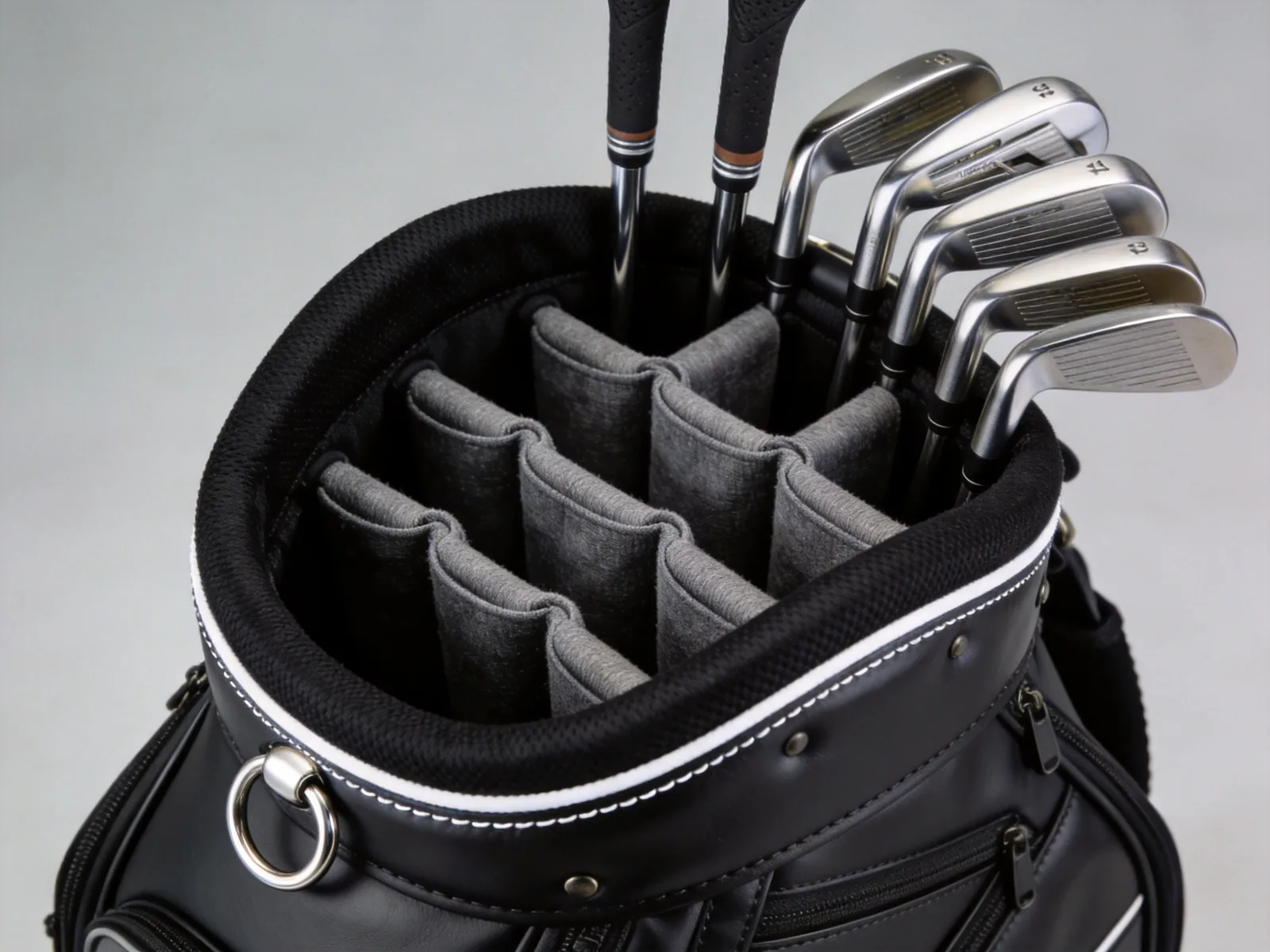
A 14-way top at 254 mm: moulded collar, full-length tube set, white stitch line on the rim. This assembly is 13.6% of the bag’s weight and 12% of its cost.
Staff, Tour, Cart and Stand: The Comparison Buyers Actually Need
Range planning arguments usually start with a photograph and end with a container. The table below puts the four golf bag families side by side on the thirteen metrics that decide cost, freight and channel fit. It is the table we use internally when a buyer asks which product to develop first.
| Decision metric | Staff bag | Tour bag (caddie build) | Cart bag | Stand bag |
|---|---|---|---|---|
| Finished weight | 4,200–5,500 g | 3,500–4,300 g | 3,200–4,200 g | 2,200–3,200 g |
| Top ways | 14–15 | 14 | 14 | 4–14 |
| Full-length dividers | Standard | Standard | Usually short | Usually short |
| External pockets | 7–9 | 5–7 | 6–9 | 5–7 |
| Strap | Padded dual harness | Flat dual strap | Single, removable | Dual, harness |
| Stand legs | No | No | No | Yes, with hinge |
| Cart strap channel | Optional | No | Standard | Optional |
| Cooler pocket | Optional | No | Standard | Optional |
| Umbrella tube | Standard | Standard | Standard | Optional |
| Labour share of FOB | 22% | 20% | 19% | 23% |
| Carton cube per piece | 0.088–0.147 CBM | 0.082–0.132 CBM | 0.075–0.125 CBM | 0.058–0.098 CBM |
| Indicative FOB at 500 pcs | USD 62–86 | USD 52–72 | USD 42–64 | USD 34–56 |
| Primary channel | Club brands, tour fleets, flagship retail | Tour players, elite amateur, club professionals | Trolley users, resorts, rental | Walking members, corporate gifting |
The column that surprises buyers is labour. A staff bag is 22% labour at FOB while a stand bag is 23% — almost the same share — but the stand bag sells at roughly 60% of the staff bag price. That is why stand bags are the harder product to make money on and why factories push back on small stand bag orders while accepting small staff bag orders. If you are building a range from scratch and the budget only stretches to one pattern, the staff bag is the better commercial first move; if the budget stretches to two, add the stand bag because that is the category the market expects a new brand to enter with.
If your buyer is a cart user rather than a caddie, the custom golf cart bag range covers the same 14-way top with a trolley-oriented pocket layout. If your buyer is a walking member, the stand and Sunday bag range is the right product page. This page stays with the caddie-carried category, which is the one the “staff bag” and “tour bag” keywords actually describe.
Materials: Leatherette, 600D and the Quilted Panel
A staff bag is usually a two-material product: a durable woven shell for the body and a decorative face material for the panels that carry the brand. Getting that pairing wrong is the most common reason a sample looks expensive and a bulk order looks cheap, because the two materials age at different rates and under different light.
| Material | Weight (g/m²) | Abrasion | Cost index | Where it belongs |
|---|---|---|---|---|
| 600D polyester, 1,000 mm PU backer | 230 | Good | 100 | Body shell for volume programmes and rental fleets |
| 1,680D ballistic nylon | 420 | Excellent | 165 | Base, pocket bottoms, high-wear panels |
| 1.2 mm PU leatherette | 560 | Good, scuffs visibly | 180 | Flagship side panels, embroidery carrier |
| PVC-free TPU leatherette | 520 | Good, cold-cracks below −10 °C | 225 | EU programmes with material restrictions |
| Quilted microfibre, 3 mm foam | 390 | Fair, pilling risk | 195 | Heritage and limited editions, front panel only |
| 210D taffeta lining | 62 | n/a | 40 | Pocket and body lining, colour-matched |
Three rules follow from that table. Do not put leatherette where the bag touches the ground. A 1.2 mm PU panel looks superb on the shop wall and scuffs white at the base within a month of caddie use; the base and the lower 120 mm of the body should be 1,680D ballistic nylon or 600D with a heavy backer. Do not embroider onto quilting. A 3 mm foam quilt compresses under a dense stitch and the logo puckers within a season; if the design needs a quilted front panel, put the logo on a separate leatherette plate. Do not specify PVC-free and then approve a PVC trim. TPU leatherette costs about 25% more than PU; if the buyer’s market restricts PVC, the trim, the piping and the badge all have to move with the panel, and that is a line in the specification rather than a conversation at inspection.
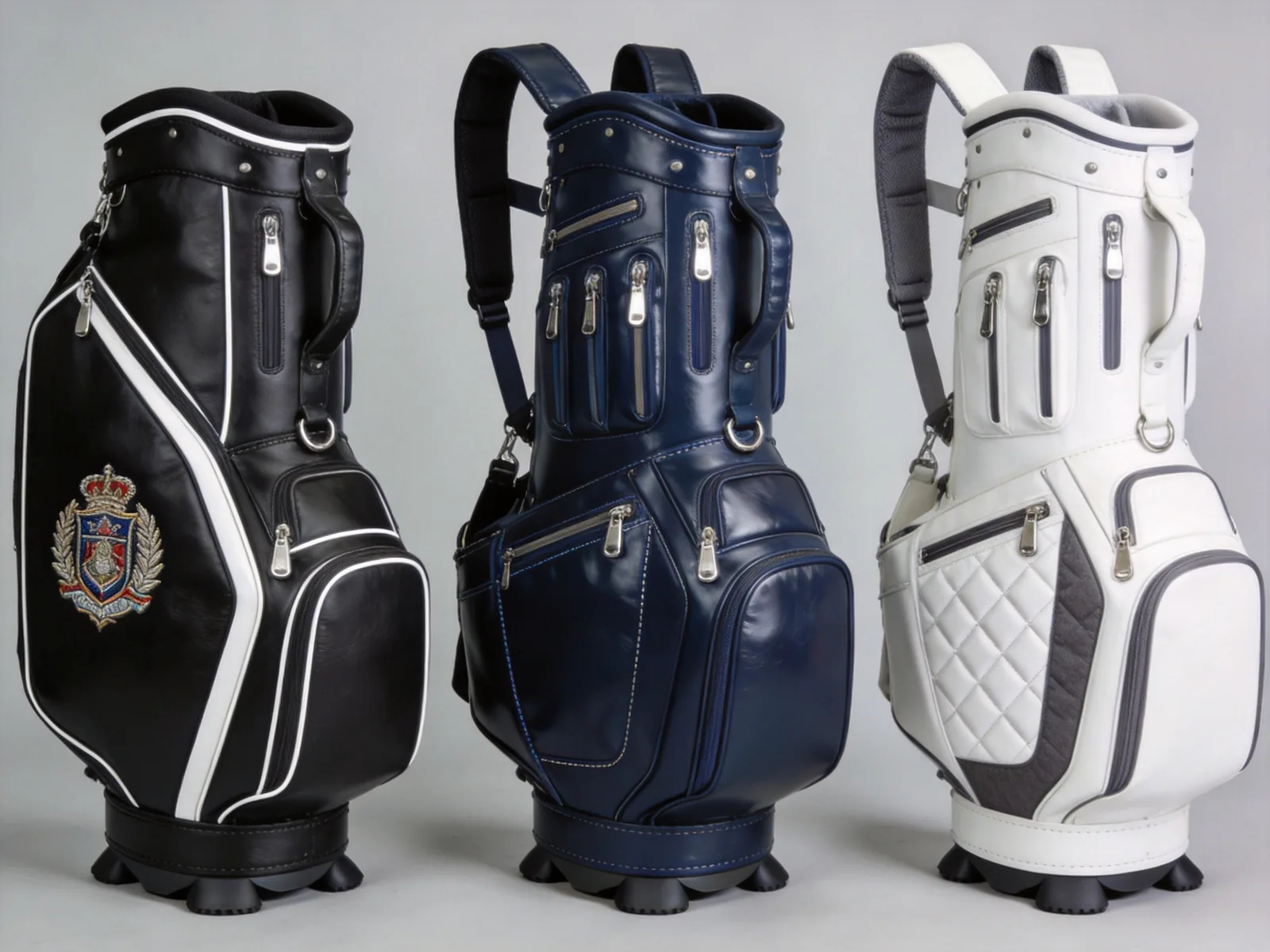
Three staff bag builds from the same 254 mm 14-way platform: black leatherette with white piping, navy PU with tonal stitching, and a white and charcoal quilted flagship. Same pattern, three material budgets.
The Strap and the Load Path: 300 Newtons, 500 Cycles
The strap is the component that decides whether a staff bag is used or abandoned, and it is the one buyers specify last. A loaded staff bag weighs 8–12 kg with clubs, balls and a full water bottle, and every gram of that hangs from four anchor points. When a staff bag fails in the field, it almost never fails at the seam of the body; it fails at the anchor, and it fails because the anchor was bar-tacked into a single layer of shell fabric rather than into a bonded patch.
Our standard build is a dual strap with a 55 mm pad, 8 mm closed-cell foam under spacer mesh, anchored at four points: two at the top collar, two at the mid-body. Each anchor is a bonded 600D patch with a box-X bar-tack in 20/3 bonded nylon thread, 8 stitches per leg, and the webbing passes through a swivel so the strap can rotate without loading the stitch line. The acceptance test is 300 N static for 60 seconds on each anchor — about 30 kg, or roughly three times a fully loaded bag — followed by 500 cycles of 5–50 N on the swivel to prove the hardware does not walk. A bag that passes the static test and fails the cycle test has a hardware problem, not a sewing problem, and that distinction is worth knowing before you approve the sample.
Pad geometry matters more than pad thickness. A 55 mm pad that follows the shoulder line distributes better than a 70 mm flat pad, because the load path on a caddie-carried bag runs diagonally across the trapezius rather than straight down. We build the pad with a 12° taper and a spacer-mesh face; the mesh is what stops the strap sliding on a waterproof jacket, which is the complaint that reads as “the bag keeps slipping” in every review section. If your programme is a tour build, ask for the flat double strap instead — it is 120 g lighter and it is what a professional caddie will re-tie anyway.
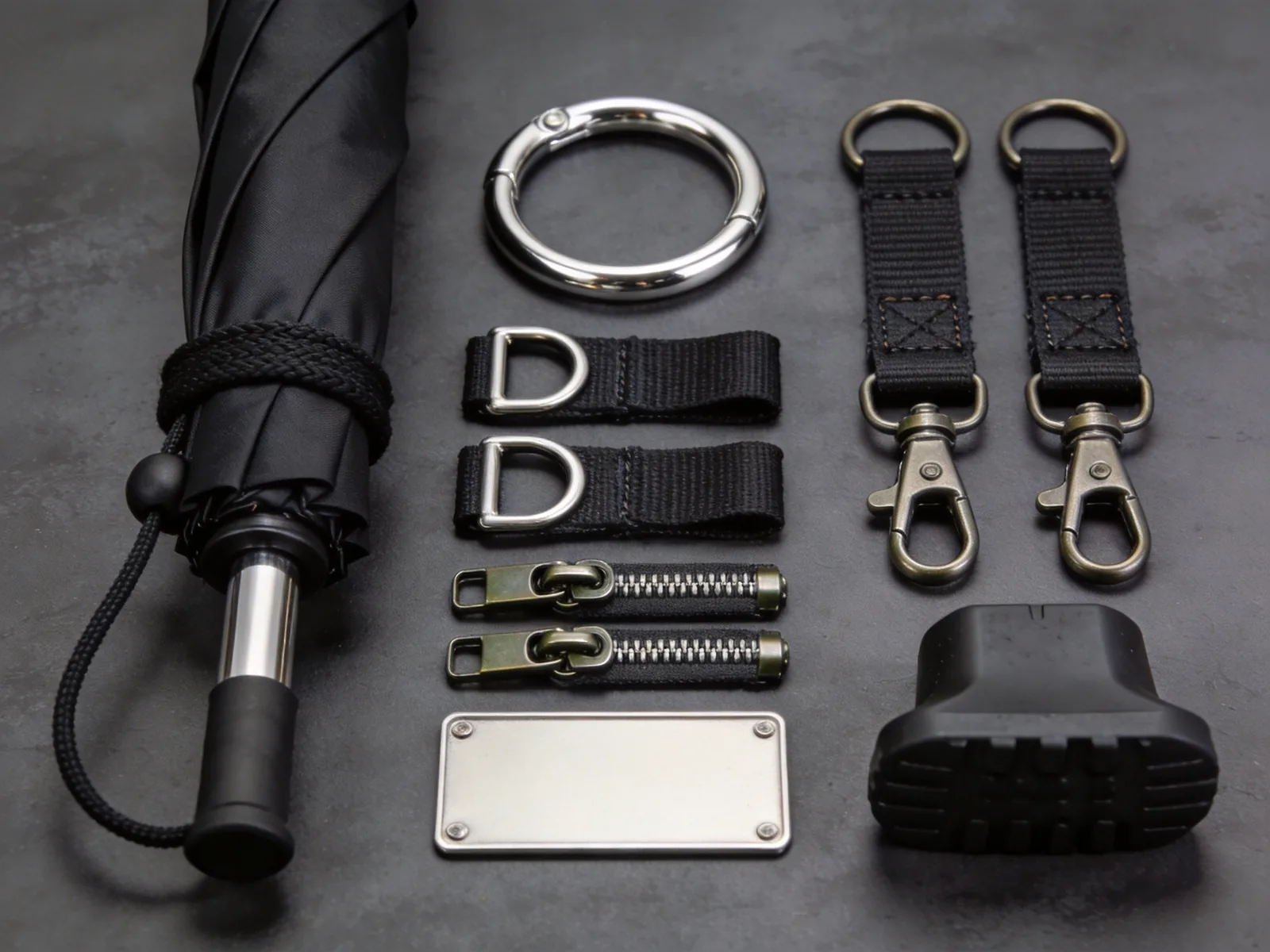
The hardware set on a staff bag, laid out: umbrella tube, towel ring, D-rings on webbing tabs, No.10 zipper pulls, base foot and the metal plate that carries the brand.
Frame, Base and Pocket Discipline
A staff bag has no legs, so the frame is doing all of the structural work. We build it from three parts: a 1.5 mm HDPE spine down the back panel, a 4 mm nylon throat ring at the top, and a 3 mm PE base board stitched into a wrapped base with five moulded feet. That combination holds the bag upright when it is set down, keeps the top circular when it is carried, and stops the base from sagging into a rounded bag after two seasons. The spine is removable on request, which matters for markets where the bag has to be shipped compressed, but a removable spine adds a zip and a pocket and 45 g.
Pocket discipline is the other half of the structure. A staff bag with nine pockets and no rule about depth becomes a bag that bulges at the hips and will not sit flat on a cart. Our working limit is seven external pockets on a 14-way build: a large garment pocket on the front, a valuables pocket with a fleece lining at the top, a rangefinder or phone pocket, a ball pocket, a cooler pocket if the channel needs one, an umbrella tube and a towel ring. Anything beyond seven has to displace one of those rather than being added alongside it. Pocket depth follows the same logic: no pocket deeper than 320 mm, because a deep pocket on a soft body pulls the shell out of shape when it is loaded.
What a Staff Bag Costs: BOM at USD 62.00 FOB
Buyers ask for a cost breakdown because they want to know which line to attack. The table below is a real BOM for the 4,850 g, 14-way build described above at 500 pieces, priced at USD 62.00 FOB. Percentages and amounts are reconciled: the ten lines total 100.0% and USD 62.00.
| Cost line | Share | USD at 500 pcs | What moves it |
|---|---|---|---|
| Shell + lining fabric (600D / 210D) | 14.0% | 8.68 | Panel count and denier; leatherette substitution adds USD 2.40–3.80 |
| Top collar + divider assembly | 12.0% | 7.44 | Full-length tubes versus fabric walls; moulded versus bound collar |
| Frame, base board and moulded feet | 8.0% | 4.96 | Spine thickness; five feet versus three; steel versus nylon ring |
| Pockets and rain hood | 9.0% | 5.58 | Pocket count; insulated cooler pocket adds USD 1.10; hood lamination |
| Zippers and hardware | 10.0% | 6.20 | No.10 versus No.8 main zip; metal versus acetal sliders; swivels |
| Strap, pad and webbing | 7.0% | 4.34 | Pad length; spacer mesh; number of anchors |
| Decoration: embroidery, print, metal plate | 6.0% | 3.72 | Stitch count; number of positions; cast plate versus etched |
| Labour | 22.0% | 13.64 | Seam metres; number of pockets; whether the base is wrapped |
| Overheads and packing | 8.0% | 4.96 | Carton grade; polybag versus polybag plus dust cover |
| Factory margin | 4.0% | 2.48 | Volume and payment terms, not negotiation skill |
| Total | 100.0% | 62.00 | FOB, 500 pcs, one style, three colourways |
Read the labour line before you ask for a discount. At 22% of FOB, labour is the only line with real room in it, and the only way to move it is to remove operations: fewer pockets, a bound collar instead of a moulded one, a wrapped base instead of a stitched one, one embroidery position instead of three. Each of those is a visible change to the product. A supplier who cuts 8% off the price without changing any of them has either mispriced the original quote or intends to substitute material at bulk, and both outcomes arrive at the loading dock rather than the sample room.
Volume does move the number, but not as much as buyers expect. At 2,000 pieces the same build lands at USD 56–58, because material buying tiers and line efficiency recover about 6–9%, not 20%. The step change is not volume but specification: a 4,200 g build with fabric walls instead of tubes and six pockets instead of seven lands at USD 51–54 at the same 500 pieces. That is where a price target should be met.
Tooling: Patterns, Moulded Collars and Plates
A staff bag is a sewn product, so most of the tooling is patterns rather than moulds — which is why it is cheaper to start than a hard-case programme and more expensive than buyers assume once decoration is included.
| Tooling item | One-time cost | When it is needed | Amortised at 500 pcs | Amortised at 2,000 pcs |
|---|---|---|---|---|
| Pattern set + grading | USD 350–600 | Every new body shape | USD 0.70–1.20 | USD 0.17–0.30 |
| Moulded top collar mould | USD 1,800–3,200 | Only for a new throat geometry | USD 3.60–6.40 | USD 0.90–1.60 |
| Metal plate die | USD 320–600 | Cast or embossed brand plate | USD 0.64–1.20 | USD 0.16–0.30 |
| Embroidery frame + digitising | USD 60–120 | Every new logo position | USD 0.12–0.24 | USD 0.03–0.06 |
| Screen print frame | USD 45–90 per colour | Print instead of embroidery | USD 0.09–0.18 | USD 0.02–0.04 |
Two decisions follow. First, reuse the top collar. If your design can live inside a standard 240 mm or 254 mm throat, you avoid the single largest tooling line and 3–4 days of sampling. Second, treat the plate die as the buyer’s asset. A die paid for by the buyer can be assigned to that buyer in writing and we will not run it for another customer without a written release; that clause is worth having before the first order, not after the third.
Sampling in 6–10 Days: The Four Stages
Six to ten working days is measured from a locked specification, not from the first email. The four stages below are what actually happens inside that window.
| Stage | Days | What is produced | What you approve |
|---|---|---|---|
| 1. Specification lock | 0–2 | Tech pack with dimensions, tolerances, material list, weight budget, decoration positions | The document itself — this is the only stage where changes are free |
| 2. Pattern and cutting | 2–4 | Pattern set, marker, cut shell and lining, frame parts cut | Panel shapes and seam allowances against the drawing |
| 3. First-off sewing | 4–7 | Assembled body, top collar set, pockets, strap, base | Construction, weight on the scale, throat diameter on the gauge |
| 4. Decoration and dispatch | 7–10 | Embroidery or print, plate, hood, packing | The finished sample, plus a sealed copy kept as the production reference |
A sample costs USD 120–220 depending on material and decoration, and the fee is credited against the first order at 500 pieces. Every sample ships with a tolerance sheet and a weight record, because a sample without a weight record cannot be approved as a production reference — there is nothing to measure the bulk order against. If a new moulded collar is needed, we quote the mould first and build the sample from the new tool; a sample built from a different mould cannot be approved, and approving one is how bulk disputes start.
Two things slow the window down and neither is sewing. Custom-dyed fabric adds 10–15 days because the lab dip has to be approved before the fabric is woven. A new moulded collar adds 12–18 days because the mould has to be cut and trialled. Both are worth starting before the sample rather than after it.
Production Calendar: 35–50 Days, Day by Day
Bulk runs 35–50 days from sample approval. The 35-day end assumes stock fabric and stock colourways; the 50-day end assumes custom dyeing, peak season, or a decoration method that needs a second pass.
| Phase | Days | What happens | What can go wrong |
|---|---|---|---|
| Material release | 1–4 | Fabric, lining, zippers, hardware, webbing released to the line against the approved sample | Backer weight differs from the sample lot; hardware colour batch drift |
| Cutting | 5–9 | Marker, spreading, cutting, numbering, bundling by size | Panel shrinkage on 600D if the lot is not relaxed before cutting |
| Top assembly | 8–15 | Collar set, divider tubes inserted, throat ring fitted | Tube set out of tolerance — the failure that closes the whole bag |
| Body sewing | 12–26 | Shell, pockets, piping, frame insertion, base | Pocket misalignment; base board not centred |
| Strap and hardware | 22–30 | Anchors bar-tacked, swivels, D-rings, umbrella tube, towel ring | Anchor stitched to single-layer shell |
| Decoration | 26–36 | Embroidery, print, plate, badge | Logo position drift on a curved panel |
| Final inspection and packing | 34–44 | AQL inspection, weight check, hood fit, cartoning | Carton cube overrun on a bulked bag |
| Documentation and handover | 42–50 | Packing list, inspection report, photographs, shipping marks | Marks that do not match the buyer’s warehouse format |
Two calendar rules are worth writing into the purchase order. First, March to May is peak season, when the same floor runs stand and cart bags for the northern-spring launch; a staff bag placed in that window should assume the 50-day end rather than the 35-day end. Second, a repeat order with no changes and fabric in stock runs 25–35 days, because cutting and top assembly can be scheduled against known material. If a supplier quotes 20 days on a first staff bag order with custom dyeing, the calendar is a sales document rather than a production one.
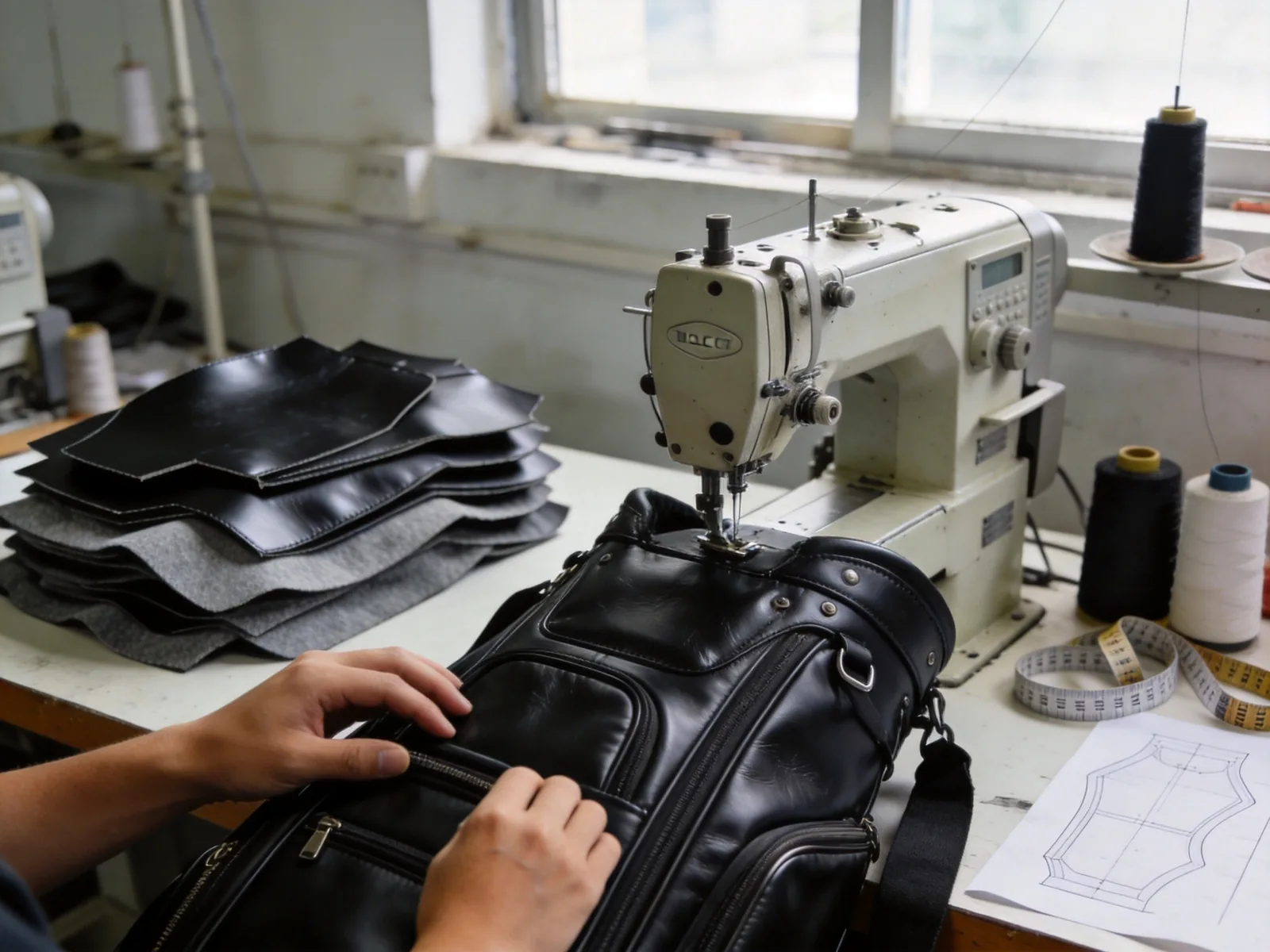
Body assembly on a staff bag: the largest single operation in the build, and the reason labour is 22% of FOB.
Test Protocol: Twelve Checks and Five Inspection Gates
A staff bag carries 8–12 kg of load through a shoulder strap and takes more abrasion in a season than a cart bag takes in three. The protocol below is what we run; each line has a method and an acceptance criterion rather than a promise.
| # | Test | Method | Acceptance |
|---|---|---|---|
| 1 | Finished weight | Scale, five units per pallet | Within ±5% of the approved sample |
| 2 | Throat diameter | Caliper at four points | 254 mm ±2 mm on the 14-way build |
| 3 | Divider tube depth | Steel rule into each tube | ≥140 mm clear depth on all fourteen |
| 4 | Strap anchor static load | 300 N for 60 s on each of four anchors | No stitch failure, no webbing pull-through |
| 5 | Swivel cycle | 500 cycles at 5–50 N | No hardware walk, no swivel seizure |
| 6 | Main zipper cycle | 500 open/close cycles under load | No skipped teeth, no slider separation |
| 7 | Seam strength | Grab test on body, pocket and base seams | ≥250 N on shell seams, ≥180 N on pocket seams |
| 8 | Base drop | Loaded bag dropped 500 mm onto concrete, base first, 5 times | No board fracture, no foot detachment |
| 9 | Top collar drop | Loaded bag dropped 500 mm onto the collar, 3 times | No collar delamination, ring stays circular |
| 10 | Rain hood fit | Hood fitted and removed 20 times | Full coverage of the top, elastic retains, no tear at the seam |
| 11 | Colour fastness | Rub test wet and dry, 50 cycles | Grade 4 minimum on leatherette, grade 4 on 600D |
| 12 | Logo adhesion | Cross-hatch on plate and print, plus 30-minute soak | No lifting, no colour bleed |
Inspection runs at five gates: incoming material, first-off from cutting, in-line at 30% of the run, end-of-line, and pre-shipment. Each gate produces a report the buyer can see. Final inspection is AQL 2.5 major / 4.0 minor, with zero tolerance on four critical defects: a strap anchor not bar-tacked, a divider tube set out of tolerance, a base board missing, and wrong logo placement or wrong logo colour. Those four are the defects that cannot be fixed in the field and cannot be sold at full price, which is why they are separated from the sampling plan.
Compliance: What We Sign and What We Do Not
Compliance conversations go wrong when a factory implies it holds certifications it does not. What we provide is the documentation we actually have, re-confirmed per order:
- Material declarations from our fabric, zipper and hardware suppliers, listing fibre content, coating chemistry and any restricted substances the supplier declares against REACH Annex XVII and California Proposition 65.
- Batch marking and traceability — a production lot number on the carton and a specification file that maps the lot to fabric rolls, hardware batches and the inspection reports for that run.
- A testing package the buyer can hand to a third-party laboratory: construction drawings, material list with weights, and a sample of each material in the quantity a lab needs.
What we do not do is equally explicit. We are not a certification body and we do not issue REACH, GRS, BSCI or ISO certificates; if your customer needs one, it has to come from the body that audits and the certificate has to be in the name of the party that holds it. We are not an EU authorised representative and not a GPSR responsible person — those obligations sit with the importer placing the product on the EU market, and we will supply the technical file content that person needs. And we will not print a certification mark, a recycling mark or a country-of-origin claim on a bag unless the underlying claim is true for that shipment and documented. A bag with a GRS logo and no transaction certificate is a liability that follows the brand, not the factory.
For programmes that involve junior bags or bags sold with children’s products, the testing route changes: CPSIA tracking labels and testing apply in the United States and EN 71 applies in the EU, and a junior bag built to adult documentation is a compliance problem rather than a design problem. Say so at the brief stage and the protocol is built correctly the first time.
Packing, Cube and Freight Maths
Staff bags are the most freight-expensive product in a golf bag range because they are long, bulky and cannot be compressed far without creasing the leatherette. The packing decision therefore moves more money than most specification arguments.
| Packing method | Carton | CBM per piece | 20GP (28 CBM usable) | 40HQ (68 CBM usable) | Ocean cost per piece at USD 2,600 / 40HQ |
|---|---|---|---|---|---|
| Retail-ready, one bag per carton | 92 × 40 × 40 cm | 0.1472 | 190 pcs | 461 pcs | USD 5.64 |
| Paired carton, two bags nested | 95 × 42 × 44 cm | 0.0878 | 318 pcs | 774 pcs | USD 3.36 |
Paired cartons cut freight per piece by 40% and raise the container load from 461 to 774 pieces, which is the difference between a 40HQ and a 20GP plus an LCL shipment for a 500-piece order. The cost is handling: two bags share one carton, so the retailer cannot ship a single unit to a customer without re-packing, and the nested bag has to be protected with a polybag plus a card stiffener to avoid creasing at the collar. For a club brand selling through green-grass pro shops, retail-ready packing is usually the right answer because the carton is the shop unit. For a distributor or a rental fleet, paired cartons are obviously correct.
Two packing details are worth specifying rather than leaving to the factory. First, a card stiffener inside the collar on every bag in a paired carton; without it the top ovalises under the weight of the bag above and the bag arrives with a throat that no longer takes fourteen clubs smoothly. Second, a dust cover rather than a sealed polybag on leatherette programmes, because a sealed bag traps solvent from the PU and produces a smell that reads as “chemical” when the retailer opens the carton.
Six Channels That Buy Staff Bags — and What Each One Demands
The same product is specified completely differently depending on who sells it. The table below is the pattern we see across orders.
| Channel | Typical order | What it prioritises | What it will not pay for |
|---|---|---|---|
| Club brand flagship | 500–1,200 pcs, 3–5 colourways | Leatherette panels, moulded collar, cast plate, quilted front, retail carton | Nothing visible — this channel buys the top of the spec |
| Tour and elite amateur | 50–200 pcs, one colour | Weight under 4,300 g, flat double strap, full-length tubes, no cooler pocket | Decoration and packaging |
| Resort and rental fleet | 300–800 pcs, one colour | 1,680D base, washable shell, six pockets, no leatherette | Quilting, plates, retail cartons |
| Green-grass pro shop | 100–300 pcs | Club-crest embroidery, staff bag look at mini staff weight | Tour-grade frame, custom dyeing |
| Corporate and tournament gifting | 100–500 pcs, one date | Large logo area, fixed delivery date, presentation carton | Weight optimisation, hardware quality |
| Online DTC brand | 500–2,000 pcs | Photogenic panel, paired carton for freight, consistent colour across lots | Tour durability testing |
The rental fleet line is the one buyers underestimate. A fleet bag is cleaned with a pressure washer between rounds, dragged across tarmac and stored wet; leatherette delaminates in that environment within a season and the quilted panel mildews. A fleet specification should be 600D shell, 1,680D base, no leatherette anywhere, stainless or acetal hardware and a hood that can be replaced. It costs about USD 12 less than the flagship build and lasts three times as long in that channel.
Fleet and Programme Management: ECN, Spares and Reorders
A staff bag programme usually runs for several seasons, and the second order is where the money is made or lost. Three mechanisms keep it stable.
Engineering change control. Any change to the approved sample — a pocket moved, a zipper changed, a logo resized — gets an ECN with a number, a date, the affected components and the effect on weight, cost and lead time. The production reference sample is re-sealed when the ECN is approved, so there is never a bulk run measured against a superseded bag. Buyers who skip this step end up with two versions in the market and no way to tell which is which.
Spare parts. The three parts that fail first are the rain hood, the strap assembly and the umbrella tube. We keep hoods and straps available as spares at USD 3–6 each and will ship them inside a bulk carton at no extra freight. A brand that can replace a hood has a customer service story; a brand that cannot has a return.
Reorder discipline. A repeat order with no changes and fabric in stock runs 25–35 days. The trap is colour: a stock colourway ordered twelve months later can drift by a visible delta, so we keep a retained sample of every approved lot and match to it rather than to a Pantone number. If the buyer needs a guaranteed match across seasons, the fabric has to be dyed in one lot and held, which means committing to the quantity up front.
Eight Failure Modes and the Line in the Spec That Prevents Each
These are the eight ways staff bags come back from the field. Each one has a specification line that prevents it, and each line costs less than the return.
| Failure mode | What it looks like | Root cause | Line in the specification |
|---|---|---|---|
| Strap anchor tear-out | Webbing pulls out of the shell at the top anchor | Bar-tack into single-layer shell, no bonded patch | Bonded 600D patch, box-X 8 stitches per leg, 300 N static test |
| Collar delamination | Leatherette lifts from the collar edge | Heat-set adhesive too thin for the panel weight | Laminated collar with 0.6 mm adhesive film, 500 mm drop test |
| Top ovalisation | Throat loses shape, clubs drag | 2 mm or fabric rim instead of a rigid ring | 4 mm nylon throat ring, ±2 mm diameter check |
| Grip tangling | Grips jam at the bottom of the bag | Partial dividers sold as full-length | ≥140 mm clear tube depth on every divider |
| Base sag | Bag will not stand, base rounds out | 2 mm board, three feet | 3 mm PE base board, five moulded feet, 500 mm base drop |
| Zipper skip at the pocket | Pocket zip opens behind the slider | No.5 coil on a pocket that takes load | No.8 minimum on any pocket over 250 mm, 500-cycle test |
| Leatherette scuff | White marks at the base after a month | PU panel in a ground-contact zone | 1,680D ballistic nylon on base and lower 120 mm |
| Colour mismatch on reorder | Second lot visibly different from the first | Matching to Pantone instead of a retained sample | Retained approved sample per lot, match to sample not to number |
Twelve Questions to Ask Any Staff Bag Supplier
These are the questions that separate a factory from a trader, and the answers should be numbers rather than adjectives.
- What is the finished weight of the sample, and what tolerance do you hold on it in bulk?
- Are the dividers full-length tubes or stitched walls, and what is the clear depth in millimetres?
- What is the throat diameter, and what is your tolerance on it?
- How is the strap anchor constructed, and what static load does it pass?
- Which parts of the bag are 1,680D or heavier, and which are leatherette?
- Is the collar laminated, and with what adhesive film weight?
- What is the base board thickness and how many feet does it carry?
- What is the AQL, and which defects are treated as critical with zero tolerance?
- How many inspection gates are there, and will you send the report from each?
- What is the carton dimension and cube per piece, and can it be paired?
- Which certifications do you actually hold in your own name, and which do you only supply documents for?
- What happens to the pattern and the plate die if we move to a second order or stop ordering?
If the answers arrive as adjectives rather than numbers, the specification does not exist yet. That is the most reliable signal in this category, and it is much cheaper to discover before the deposit than after the container.
Frequently Asked Questions
Send the Weight Target and the Top Geometry, Not the Slogan
Send us your target finished weight, your top configuration and club capacity, your channel and your delivery date. Within two working days you will get a weight budget with component allocations, a specification sheet with tolerances, a BOM with the labour line visible, tooling listed separately, a carton cube calculation and a realistic production calendar — or an honest statement of which of your targets cannot be met at the price you have in mind.
Related Capabilities and Programmes
- Custom Golf Staff Bags — product range
- Golf Staff Bag Private Label Programme
- Custom Golf Cart Bag Manufacturer — BOM and tooling
- Custom Golf Sunday Bag Manufacturer — weight budgets
- Custom Golf Stand Bag Manufacturer
- Custom Stand & Sunday Golf Bags — product range
- Custom Golf Cart Bags — product range
- Custom Golf Bag Manufacturer
- Custom Leather Golf Bags
- Custom Logo Golf Bags — Embroidery
- Custom Golf Bag Accessories
- Custom Golf Headcovers
- Custom Golf Club Covers
- Custom Golf Shoe Bag
- Custom Golf Den Caddy
- Golf Boston Bag Manufacturer
- OEM / ODM Service
- Factory Audit
- Bag Manufacturer vs Trading Supplier
- Frequently Asked Questions