Finding a Chinese backpack manufacturer is not the hard part. Alibaba alone lists tens of thousands of suppliers, and a single trade show will put you in front of hundreds. The hard part is telling the 5% who can actually hold a tolerance, hit a delivery date and survive a second order apart from the 95% who can only quote a price. This guide covers the whole path: where the factories physically are, how to read a quotation, what MOQ and lead times are realistic in 2026, and which red flags should end a conversation before you wire a deposit.
A custom backpack order from China typically runs on these terms: MOQ 500 pieces for general backpacks, 6–10 days for a sample, and 35–50 days for bulk after sample approval. Pricing is quoted FOB Xiamen or another named port, inspected to AQL 2.5 major / 4.0 minor, and backed by a 12-month warranty on workmanship. Anything materially cheaper or faster than that is usually a different product specification, not a better deal.
The single most useful filter is not price. It is whether the supplier can show you a written inspection record from a previous order that matches the specification they are quoting you.
Why Chinese Backpack Factories Still Win on Landed Cost
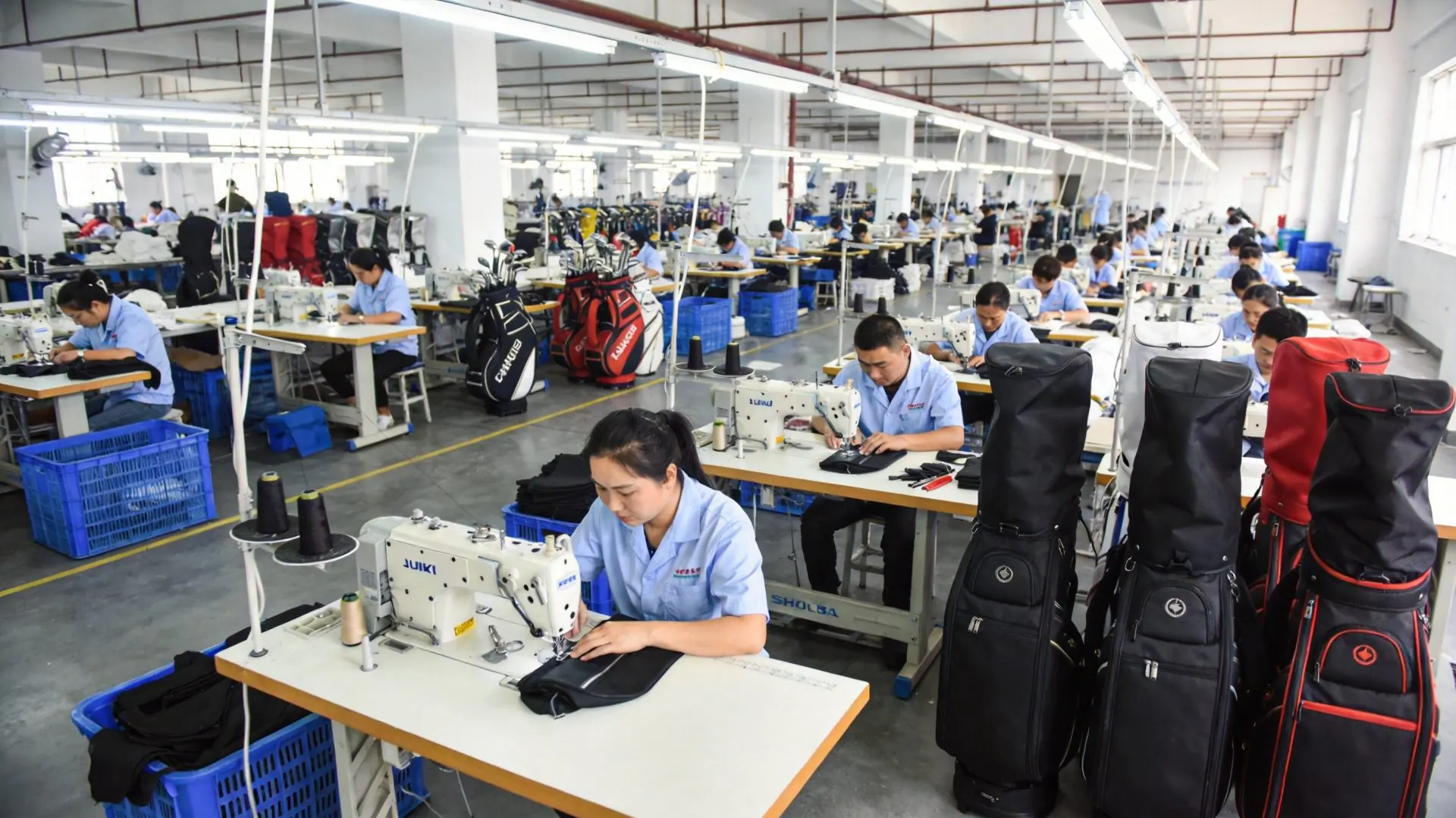
The cost advantage is not primarily labour any more. Chinese sewing wages have risen for two decades, and Vietnam, Cambodia and Bangladesh now beat coastal China on direct labour. What China still has is something harder to replicate: a complete materials and components ecosystem inside a two-hour drive.
A single backpack contains 40 to 90 components — webbing, buckles, sliders, zipper chain, pulls, foam, mesh, lining, binding tape, piping, logo plates. In the Pearl River Delta or around Quanzhou, all of those exist as separate specialist suppliers within a short radius. A factory can order a non-standard buckle on Monday and have it in hand Wednesday. In a market without that density, the same buckle is a four-week import with a minimum quantity of 5,000.
That density is what makes small, customised runs economic. It also explains a pattern buyers notice: Chinese quotes stay competitive up to fairly complex, multi-material designs, and lose their edge only on the simplest, most labour-heavy items where pure wage cost dominates.
What this means for your sourcing decision. If your product is a straightforward single-material pack in high volume, labour cost matters more than ecosystem, and other countries may quote lower. If your product involves mixed materials, custom hardware, printed lining, embroidered branding or several colourways, the Chinese ecosystem usually wins on total landed cost even at a higher unit price, because it removes the hidden costs of component sourcing, rework and delay.
Where Chinese Backpack Factories Are Actually Concentrated
“Made in China” hides a lot of geography. Backpack production clusters into a handful of regions, and each has a different specialism and a different cost base. Knowing which cluster you are being quoted from tells you what to expect on quality, minimums and lead time.
| Region | Typical strength | What buyers should expect |
|---|---|---|
| Guangdong — Guangzhou, Dongguan, Shenzhen | Fashion, laptop and commuter packs; fast sampling; strong hardware and trim supply | Highest component choice and fastest iteration, higher unit cost. Good for trend-driven ranges and complex trims. |
| Fujian — Quanzhou, Xiamen | Outdoor, travel, sports and technical bags; mature export logistics through Xiamen port | Balanced cost and capability. Strong on multi-material construction and mid-to-high volume OEM/ODM. |
| Zhejiang — Pinghu, Yiwu, Ningbo | Volume luggage, school bags, promotional packs | Very competitive on simple high-volume items; less suited to complex technical construction. |
| Jiangsu — Suzhou, Nantong | Precision sewing, corporate and premium lines | Higher labour cost, tighter workmanship. Suits premium and corporate-gift programmes. |
| Hebei — Baigou | Low-cost bags and promotional volume | Lowest price band. Specification discipline is weaker; inspection matters more here than anywhere else. |
A practical implication: when two suppliers quote very different prices for what looks like the same backpack, they are often in different clusters working to different material grades. Ask each one to state the fabric denier, the zipper brand and the foam density. The gap in the answers usually explains the gap in the price.
For a worked example of how one cluster compares on cost and capability, see our profile of bag manufacturing in Quanzhou, where the outdoor, travel and technical categories are concentrated.
Manufacturer, Trading Company or Sourcing Agent?
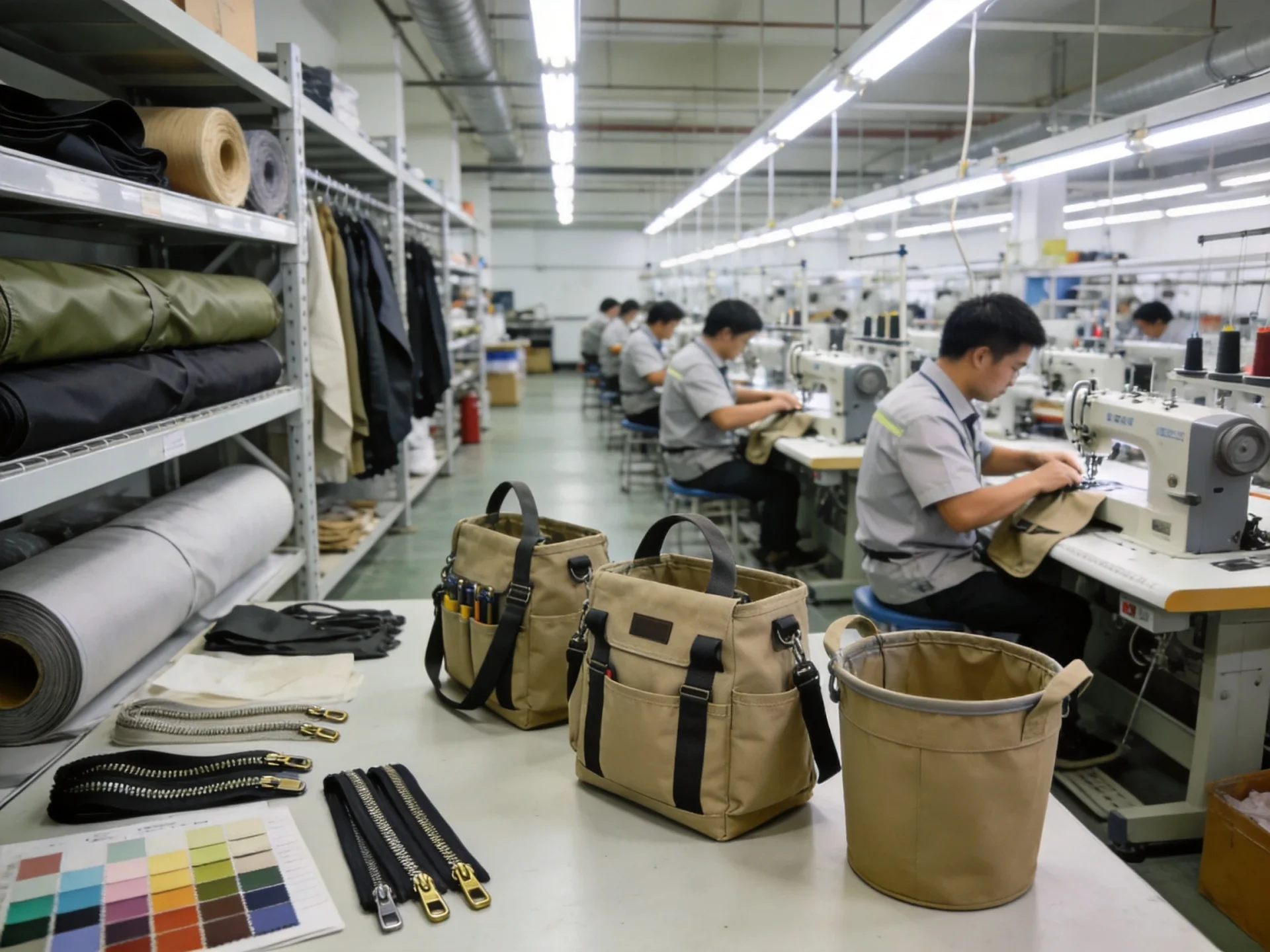
All three will answer your inquiry. They are not interchangeable, and the wrong choice costs you either margin or control.
| Type | What they control | Main advantage | Main risk |
|---|---|---|---|
| Direct manufacturer | Cutting, sewing, finishing, in-line QC | Best price at volume; direct control over specification changes and rework | Narrower material range; you may need to approve substitutions |
| Trading company | Sourcing across several factories; documentation and export | Wide product range, one contact for many SKUs, strong export paperwork | Less visibility into the line; specification drift between quote and production |
| Sourcing agent | Supplier selection, negotiation, inspection coordination | Useful for a first order in an unfamiliar market | Adds a margin layer; accountability splits between agent and factory |
The distinction has a real cost consequence, which we break down separately in bag manufacturer vs supplier. There is no universal right answer, but there is a decisive question: who signs the inspection report? If the answer is vague, you have found the weak point in the chain. A trading company that runs its own documented QC, with named inspectors and a report you receive before shipment, is a safer partner than a factory that cannot show you what it checks.
How to Find and Shortlist Suppliers
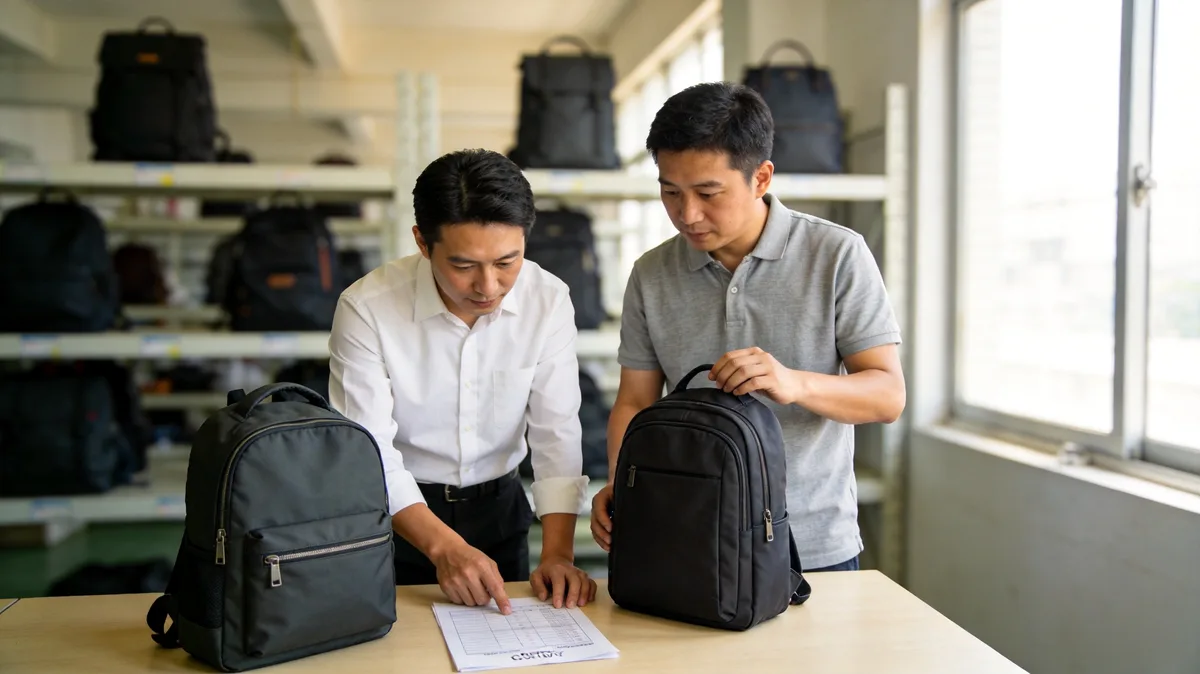
There are four practical channels. Use at least two of them, because each one filters for something different.
1. Trade fairs
Canton Fair, the China Bags Exhibition and regional sourcing shows put samples in your hands, which no listing photo can replace. The value is not the catalogue — it is that you can feel the stitching, open the zips and judge whether the person at the booth knows their own production floor. Treat fair contacts as introductions, not as vetting.
2. B2B marketplaces
Alibaba, Made-in-China and Global Sources remain the fastest way to build a long list. The weakness is that listings are marketing, not evidence. Two filters do most of the work: whether the supplier has been verified for multiple consecutive years, and whether their listed product range is coherent. A supplier offering backpacks, water bottles and phone cases is a trader, which may be fine — but you should know that before you negotiate.
3. Sourcing agents and inspection firms
Worth the fee on a first order in an unfamiliar market, and worth it again when you are entering a new product category. The value is not the introduction, it is the independent inspection before you pay the balance.
4. Direct search and reverse image lookup
If you are buying for resale rather than for your own brand, the commercial terms differ from a straight OEM programme — our wholesale and OEM/ODM production page covers that split. Searching the exact product type plus “manufacturer” surfaces specialist factories that do not invest in marketplace ranking. Reverse image lookup on a competitor’s product photo will often identify the original factory. Both routes favour factories with real capability over factories with good listings.
Shortlist to five, not twenty. Requesting samples from twenty suppliers produces twenty samples and no decision. Five is enough to see a real spread in capability, and few enough that you can compare them against the same specification sheet.
The Vetting Checklist That Predicts Problems
Most supplier failures are predictable months before the first shipment. These are the checks that actually correlate with a clean order, in the order they are worth doing.
| Check | What to request | Weak answer looks like |
|---|---|---|
| Business identity | Business licence, registered name, whether it matches the bank account name | Account name differs from the company name with no explanation |
| Production scope | Which operations happen in-house: cutting, sewing, hardware, printing, packing | “We do everything” with no detail on subcontracted steps |
| Category experience | Three previous orders in your product type, with construction details | Photos only, no construction detail; can’t explain why a design choice was made |
| Specification literacy | Written response to your spec sheet, with denier, zipper brand, foam density filled in | Repeats your spec back without adding the material data |
| QC documentation | A redacted inspection report from a past order, showing sample size and defect counts | “100% inspection, no defects” — not a measurable claim |
| Sampling behaviour | Sample lead time, cost, and whether it is credited against the bulk order | Quotes a sample in 3 days for a complex custom build |
| Communication | Response time and technical quality of answers before you pay anything | Fast replies that don’t answer the question asked |
One check carries more weight than the rest: can they push back? A supplier who tells you that your requested 2 mm embroidery detail will not reproduce, or that your target price requires a lighter denier than your use case supports, is demonstrating that they understand the product. A supplier who agrees with everything is quoting a hope.
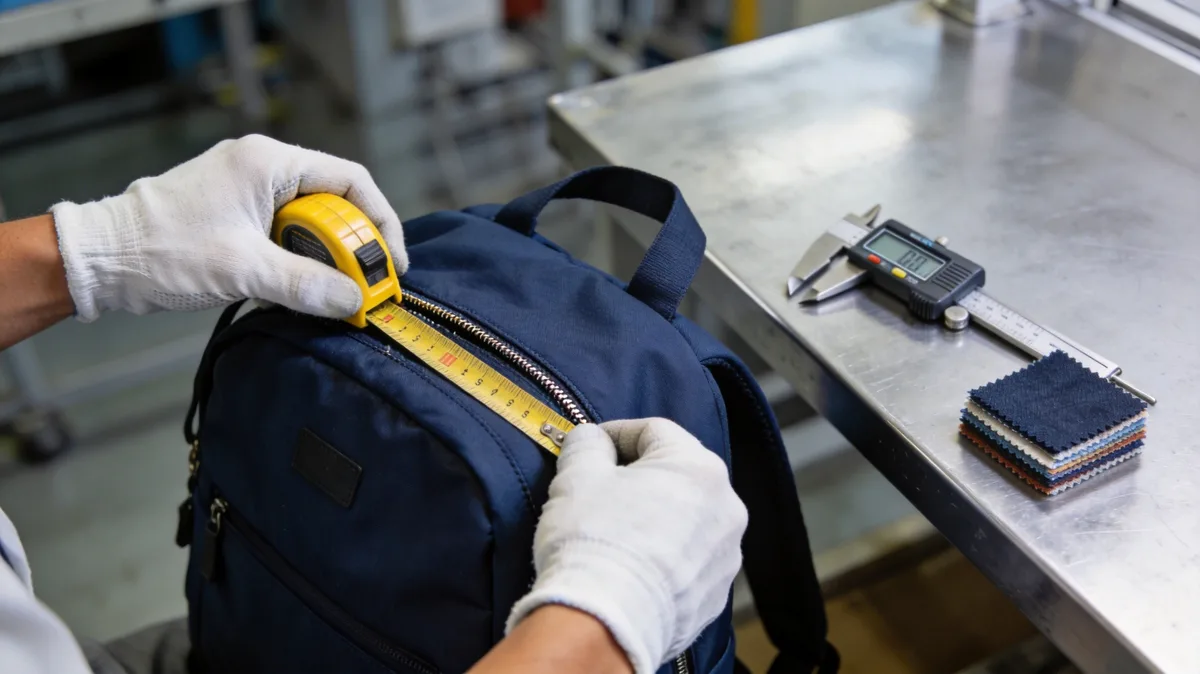
MOQ, Sampling and Lead Times in 2026
These are the numbers that decide whether a project is viable, and they are more negotiable than most buyers assume — but only in one direction.
| Item | Standard position | What moves it |
|---|---|---|
| MOQ — general backpacks | 500 pieces per colourway | Stock fabric and stock trim can lower it; custom-dyed fabric or a new mould raises it |
| MOQ — specialist categories | 200 pieces for technical and golf bag lines | Category-specific tooling already exists; complexity per unit is higher |
| Sample lead time | 6–10 days from approved brief | Custom hardware, new moulds or printed lining add days; a repeat sample is faster |
| Sample cost | Charged, then credited against the bulk order | Fully custom builds may be charged at cost with no credit |
| Bulk lead time | 35–50 days after sample approval and deposit | Peak season, custom fabric dyeing and multi-colourway orders push toward the upper end |
| Payment terms | 30% deposit, 70% before shipment | Established relationships can move toward balance against documents |
| Incoterm | FOB Xiamen or another named Chinese port | EXW, CIF and DDP are all available; each shifts risk and cost differently |
Two of these numbers deserve emphasis because they are the ones buyers most often get wrong.
Sampling is not the bottleneck; approval is. A sample in 6–10 days is standard. The 35–50 day bulk clock does not start until you approve the sample in writing. Every week of internal review on your side is a week added to the calendar, and a factory that promises to “start production now and adjust later” is offering you a rework bill.
A lower MOQ is usually a different product. If one supplier quotes 100 pieces where everyone else quotes 500, check what changed: stock fabric instead of custom-dyed, a stock size instead of your pattern, or a lower-grade trim set. Sometimes that is exactly what you want for a test order. It is only a problem when it happens silently.
What Actually Drives Your Unit Cost
Buyers negotiate hard on the headline number and rarely ask what is inside it. That is backwards: the components of a backpack quote are stable and comparable, so a broken-down quotation tells you far more than a discount.
| Cost element | Typical share of FOB | What pushes it up |
|---|---|---|
| Fabric and lining | 25–35% | Higher denier, custom dye lots, coated or recycled substrates, multiple colourways |
| Hardware and trims | 8–15% | Branded zips, metal sliders, custom moulded buckles, logo plates |
| Labour and sewing | 20–30% | Piece count, small parts, tight tolerances, multi-panel construction |
| Branding | 3–8% | Embroidery stitch count, silicone patches, metal badges, multi-colour print |
| Packaging and cartons | 3–5% | Retail-ready polybags, printed inserts, individual cartons, low carton fill |
| Overhead and margin | 15–25% | Order size, tooling amortisation, payment terms, inspection level |
Read that table as a negotiation map. A supplier who cannot tell you which line item moved when they cut their price has either changed the specification or is absorbing the difference in margin to win the order — and the second option tends to reappear later as a substitution during production.

Two levers reduce cost without degrading the product. First, consolidate colourways: a single dye lot across three SKUs is cheaper than three separate lots, and it removes the risk of shade mismatch between production runs. Second, standardise hardware across your range. Using the same zip and buckle family on five packs turns five small orders into one larger hardware purchase, and the saving shows up in the FOB price.
The levers that look like savings but are not: reducing fabric denier below what the use case needs, replacing a branded zip with an unbranded equivalent without re-testing, and cutting inspection to shorten the timeline. Each one shifts cost from the invoice to the returns line.
Trade Terms, Payment and Incoterms
Most first-order disputes are not about quality. They are about who owns the goods, and at what point, when something goes wrong in transit.
FOB (free on board) is the default for a reason: the supplier’s responsibility ends when the goods are loaded at the named Chinese port, and yours begins there. It keeps the freight decision and the freight cost with you, which is where the control should be. For most importers, FOB Xiamen or FOB Ningbo is the cleanest arrangement.
EXW (ex works) puts export clearance on you. It looks cheaper and is usually not, because you end up paying a forwarder to do what the factory does routinely.
CIF bundles cost, insurance and freight into one number. Convenient for a first shipment, but it hides the freight margin and makes it hard to compare quotes from suppliers who use different forwarders.
DDP (delivered duty paid) puts everything, including import duty, on the supplier. It is genuinely useful when you are testing a market and want a single landed number, and it is a poor default once you are importing regularly, because you lose visibility of the duty and freight components.
On payment terms. 30% deposit and 70% before shipment is the market standard, and asking to move to balance-against-documents on a first order will usually be refused — reasonably, because the supplier is carrying the production risk. The better move is to keep the standard terms and add a pre-shipment inspection before the balance is released. That converts a payment dispute into a quality gate, which is where it belongs.
Never pay a deposit to an account whose name does not match the contracting company. This one check prevents most of the fraud in this category.
Quality Control and AQL, Explained Honestly
Every supplier will tell you they have strict quality control. Almost none will tell you what that means numerically, which is the only part that can be verified.
Acceptable quality limit (AQL) sampling is the standard method. A lot is sampled at random, the sample is inspected against a defect classification, and the lot is accepted or rejected based on the number of defects found. The classification is the part buyers skip, and it is the part that decides the outcome.
| Class | Definition | Typical limit | Examples |
|---|---|---|---|
| Critical | Unsafe, illegal, or unusable | Zero tolerance | Broken needle left in a seam, mould, banned substance, sharp edge |
| Major | Would cause a return or a refund | AQL 2.5 | Broken zip, failed seam, missing component, wrong logo placement |
| Minor | Noticeable but not functionally defective | AQL 4.0 | Loose thread, slight stitch irregularity, minor shade variation |
AQL 2.5 does not mean zero defects, and any supplier who presents it that way does not understand the standard. On a 1,200-piece lot sampled at 80 pieces, AQL 2.5 permits a defined number of major defects before the lot is rejected. What you are buying with an AQL clause is a predictable defect rate with a documented decision rule — not a guarantee of perfection.
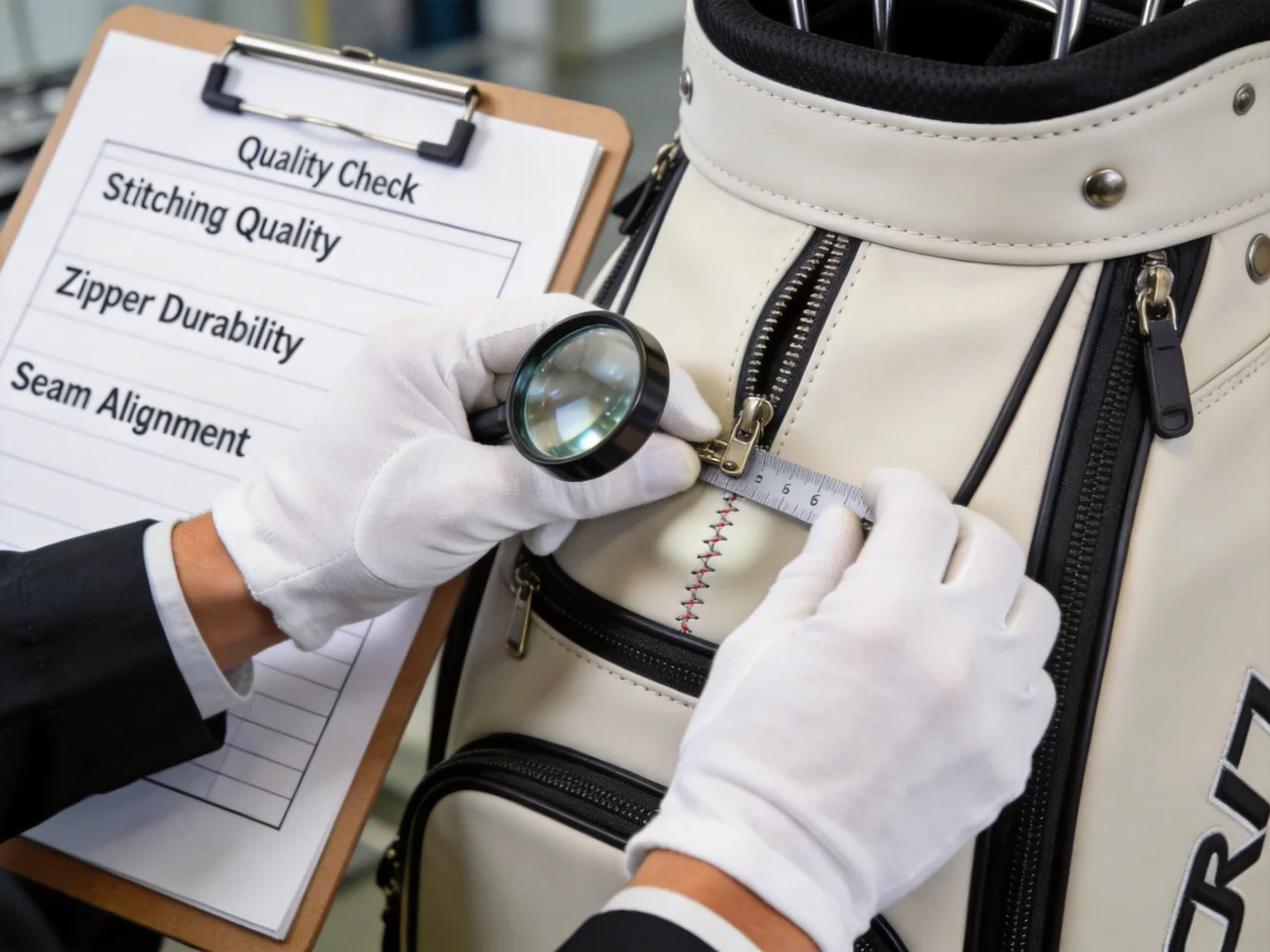
Three practical additions make an AQL clause actually useful:
- Define the inspection point. Pre-shipment inspection at the factory, before cartoning, is the standard. Inspection after loading tells you what you already bought.
- Name the classification. Attach your own defect list to the purchase order, with three or four examples per class. Otherwise the inspector uses their own judgement, and yours will differ.
- Require the raw data. Not a certificate — the actual counts. A report that says “passed” without sample size and defect counts cannot be audited or compared across orders.
Red Flags That Should End the Conversation
These are not theoretical. Each one shows up regularly, and each one has a specific reason for being disqualifying.
| Signal | Why it matters |
|---|---|
| Bank account name differs from the company name | The single strongest fraud indicator in this category. No explanation makes this acceptable. |
| Price 30% or more below the cluster average | At that gap something in the specification has changed. The question is only what, and whether you will find out before production. |
| Refuses a live video walkthrough of the line | Not a privacy issue. A working factory can show you a sewing floor in ninety seconds. |
| Cannot state fabric denier or zipper brand | They are quoting a product they did not specify, which means they cannot control it either. |
| “100% inspection, zero defects” | Not a measurable claim, and it signals the QC conversation will stay rhetorical. |
| Sample is excellent, bulk photos look different | The classic substitution pattern. Insist on the bulk inspection being against the approved sample, side by side. |
| Pushes payment outside the platform or to a personal account | Removes the only leverage you have if the order goes wrong. |
| Quotes a complex custom build in three days | Either they misunderstood the brief or they are quoting a stock product. |
Your First Order: A Six-Step Playbook
- Write a specification, not a request. Include dimensions, capacity in litres, fabric denier, zipper brand, foam density, hardware list, colour references, branding method and packaging. A spec sheet is what makes quotes comparable, and it is what an inspection is measured against later.
- Shortlist five and request quotes on the same document. Ask each supplier to respond in writing to the spec, line by line. The quality of that written response predicts the quality of the production.
- Order two or three samples. Compare them against each other, not only against your expectation. Note stitch density, seam alignment, hardware feel and whether the zip runs cleanly at the corners.
- Approve in writing, with a golden sample retained. Sign off the sample, photograph it, and keep one at the factory as the reference for bulk. This is the document that settles 90% of quality arguments.
- Book pre-shipment inspection before the balance. Third-party or self-arranged, but with your defect classification and the raw counts in the report.
- Plan the second order before the first ships. Record what you would change: a heavier denier here, a different pull there, one fewer colourway. The second order is where the margin actually appears.
Frequently Asked Questions
What is the MOQ for a custom backpack from China?
500 pieces per colourway is the standard minimum for general backpacks. Specialist technical and golf bag lines commonly run at 200 pieces. Minimums fall when the fabric and trims are stock items, and rise when you need custom dyeing, a new mould or printed lining.
How long does a custom backpack sample take?
6–10 days from an approved brief. Custom moulded hardware, printed lining or a new pattern push toward the upper end. A revision of an existing sample is faster, typically three to five days.
What is a realistic FOB price for a custom backpack?
It depends almost entirely on specification, so any single number is misleading. What is useful is the cost structure: fabric and lining take 25–35% of FOB, hardware 8–15%, labour 20–30%. When a quote looks unusually low, ask which of those three lines moved.
How do I verify a Chinese backpack manufacturer is legitimate?
Four checks in this order: the business licence name must match the bank account name; ask for a live video walkthrough of the production floor; request a redacted inspection report from a previous order; and confirm they can respond in writing to a technical specification. A supplier who passes all four is worth a sample order.
What is AQL 2.5 and why does it matter?
AQL 2.5 is the acceptance limit for major defects under random sampling. It is not a zero-defect guarantee — it is a documented decision rule that makes defect rates predictable across lots. It matters because it converts “good quality” into a number that can be verified before you release payment.
Can I get a custom backpack made to my own design?
Yes, and it is the normal way this category works. You provide a design, a technical drawing or a reference sample, and the factory builds a pattern from it. Expect to approve a sample before bulk, and expect the sample stage to surface two or three construction details that need a decision.
What payment terms are normal for a first order?
30% deposit, 70% before shipment is the market standard. Instead of trying to renegotiate the split on a first order, add a pre-shipment inspection as the condition for releasing the balance. That addresses the actual risk.
What are the most common quality problems in Chinese backpack orders?
In practice: stitch density below specification, seam alignment drift at stress points, zip function at corners, hardware that was substituted for a visually similar part, and shade variation between dye lots. All five are detectable at pre-shipment inspection, and four of the five trace back to a specification that was never written down.
Should I use a trading company or a direct factory?
Use a direct factory when your design is complex and you need control over specification changes. Use a trading company when you need a wide range of SKUs, strong export documentation, or a single contact across several product types. The deciding question either way is who signs the inspection report.
What should be in a backpack pre-shipment inspection checklist?
Dimensions against spec, capacity, weight, fabric denier verification, stitch density at three points, seam pull test at strap attachments, zip cycle test, hardware function, logo placement and size, colour against the approved standard, labelling and packaging, and carton drop and quantity verification. Defects are then classified as critical, major or minor before the accept/reject decision.
Next Step
Sourcing a backpack range from China? Junyuan Bags has been trading since 2014, with the founder in bag manufacturing since 2004. We run custom backpack programmes on MOQ 500 pieces, with samples in 6–10 days and bulk in 35–50 days after approval, inspected to AQL 2.5 major / 4.0 minor and backed by a 12-month workmanship warranty.
Send us a specification or a reference sample and we will respond in writing, line by line, including the parts of your design we think will not work. That answer is more useful than a price.
Explore custom backpack manufacturing, laptop backpack production, hiking backpack programmes and premium backpack lines. For a broader view of how we work, see OEM/ODM bag manufacturing and our OEM/ODM service.