In 2022 this article was about why sustainable fashion would last. That was a consumer-side question. Four years later the question has changed — it is no longer “will shoppers buy it” but “will your order clear the gate.”
For bag brands in 2026, sustainable sourcing is no longer a marketing option. It is an entry requirement: regulation is hardening, retail channels are auditing, and capital plus insurance are asking for data. Most brands are stuck in the same place — not unwilling, but unsure which step comes first and what to actually ask a factory.
This article does not repeat the material lists. We already publish a material guide and a certification guide. What follows is what a decision maker actually has to handle: what is already in force, how your quotation sheet has to change, how to model the cost, how to sequence 18 months, and the 12 questions to put on the table at your next factory meeting.

Why 2026 Is the Year Sustainable Sourcing Stopped Being Optional
Three things changed at once.
First, regulation moved from framework to dated obligation. On 19 July 2026, the ban on destroying unsold textiles under Article 25 of the EU Ecodesign for Sustainable Products Regulation began applying to large companies. That is not a pledge or a guideline. It is a prohibition.
Second, retail channels wired ESG scoring into sourcing decisions. Walmart’s buying and sourcing teams have direct visibility into each supplier’s Project Gigaton participation status. A supplier that does not participate can be disadvantaged during category reviews. That is a sourcing mechanism, not a communications one.
Third, the CSRD scope was narrowed by the Omnibus package — but value-chain data requests did not disappear. Directly in-scope companies got fewer. The pressure they put on suppliers did not.
For a bag brand, all three pressures converge on one concrete question: can your factory hand you a set of material and compliance documents that survives a follow-up question?
The Three Pressures Closing In on Brands
Regulation: What Is Already in Force, and What Is Still Planned
Separating “in force” from “planned” matters, because a lot of published commentary mixes the two.
Already in force:
- ESPR (EU) 2024/1781 entered into force on 18 July 2024.
- From 19 July 2026, large companies are prohibited from destroying unsold apparel, accessories and footwear (Article 25).
- From 19 July 2026, the European Commission was required to have the central DPP registry operational (Article 13).
- From 2 March 2027, large companies must disclose discarded volumes using the standardised EU template.
Planned but not yet binding:
- The textile-specific delegated act is planned for adoption in Q1 2027.
- After that act enters into force, a transition period of at least 18 months applies, placing effective application of the textile Digital Product Passport in 2028–2029.
- When it applies, it applies to every economic operator placing a textile product on the EU market, regardless of company size.
That last point is worth underlining. The unsold-goods destruction ban exempts micro and small companies indefinitely. The DPP does not.
In the United States, the picture is messier and more fluid:
- California SB 253 (greenhouse gas disclosure): CARB’s initial regulation was approved by the Office of Administrative Law on 12 October 2026 and took effect the same day. The first reporting deadline is 10 November 2026, covering Scope 1 and Scope 2 only, for entities above the $500 million revenue threshold.
- California SB 261 (climate-related financial risk): enforcement was enjoined by the Ninth Circuit on 18 November 2025 pending appeal. CARB has confirmed it will not enforce the original 1 January 2026 deadline. The injunction pauses the law; it does not invalidate it.
- New York Fashion Act: as of September 2026 the bill remained in committee after the 2026 session ended without a floor vote in either chamber. It is not law.
Why be this precise? Because when a European or American customer asks you for data, they are quoting these clauses. If you cannot say which regulation a requirement comes from and when it bites, you have already lost ground in the negotiation.
Retail Channel Gatekeeping
Regulation is the floor. Channels are the reality. For most bag brands, orders are lost not because of a legal violation but because a retailer’s supplier audit was failed.
The publicly documented programmes share a shape:
- Walmart runs Project Gigaton through its Sustainability Hub, with six pillars — energy, nature, waste, packaging, transportation, and product use and design. Scope 1 and Scope 2 data at roughly 95% completeness per scope is required for Giga Guru recognition.
- Target runs a Responsible Sourcing programme covering environmental, social and governance expectations, asking strategic suppliers for Scope 1 and 2 emissions, science-based targets, and packaging and waste progress. Own-brand suppliers face stricter requirements including chemical safety and packaging specifications.
- Amazon maintains supply chain standards; textile categories are expected to hold Higg FEM, and private-label products require a product carbon footprint.
- Costco enforces requirements through its Supplier Code of Conduct and CDP participation.
- Home Depot expects top-tier suppliers to have stated sustainability goals.
The common denominator: Scope 1 and Scope 2 emissions data, calculated under GHG Protocol. And a second common denominator that saves real money — one recognised third-party rating, EcoVadis or a verified Higg score, is accepted across most programmes. Getting one rating done properly beats improvising a separate response for each retailer.
For a bag factory, this translates into a requirement to supply product-level or facility-level emissions and material data — not a sentence claiming to be a green factory.
Capital, Insurance, and Board-Level Scrutiny
The third pressure is quieter but often lands on the purchasing desk first.
- Supply chain ESG is now a standard item in financing due diligence.
- Some markets now ask about supply chain compliance status when quoting product liability and cargo insurance.
- For listed and pre-IPO brands, supply chain risk has entered the board agenda as a recurring item.
The transmission path is short: the board asks the CEO, the CEO asks the supply chain director, the director asks purchasing, and purchasing asks the factory.
What Actually Changes in Your Purchase Order
Background aside, four things change in daily work.
Quotations Now Need Material Traceability
“600D polyester” is no longer a sufficient line on a quotation.
What buyers now need is: where the roll came from, how much recycled content it carries, and whether a transaction certificate exists.
The core mechanism of GRS is the Transaction Certificate. Every batch of certified material is chained from spinning to finished goods by TCs. It is not a case of “the factory says so.” If the chain breaks, the batch cannot be claimed as recycled.
Practical advice for buyers: put a requirement in the RFQ for a sample TC from a comparable previous order. A factory that cannot produce one has not actually run the certified process.
Sustainability Questionnaires Arrive With the RFP
More RFPs now carry a 20 to 60 question sustainability section. Typical content:
- Facility-level Scope 1 and Scope 2 emissions
- Recycled content and origin for main materials
- Chemical management, ZDHC MRSL compliance
- Wastewater treatment and test reports
- Labour and factory audit reports (SMETA, BSCI, WRAP)
- Current certification list with expiry dates
These answers should not be improvised. Build a sustainability data pack once, maintain it, and reuse it.
Certifications Moved From Nice to Have to Required
Buyers used to treat GRS as a bonus. Several channels now treat it as a gate.
The certifications that matter for bags:
- GRS — recycled content plus chain of custody, environmental and social criteria
- RCS — recycled content only, lighter than GRS
- GOTS — organic cotton, farm to finished product
- OEKO-TEX Standard 100 — harmful substance testing on the finished article
- bluesign — input-side chemical and process control
- ISO 14001 — environmental management system at facility level
A simple mapping: to claim recycled, you need GRS or RCS. To claim skin-safe, you need OEKO-TEX 100. To prove facility management, ISO 14001. To enter premium outdoor channels, bluesign.
For how each is applied for, audited and maintained, our certification guide covers the process in detail.
Lead Times, MOQs and Sampling Shift
This is the most underestimated part.
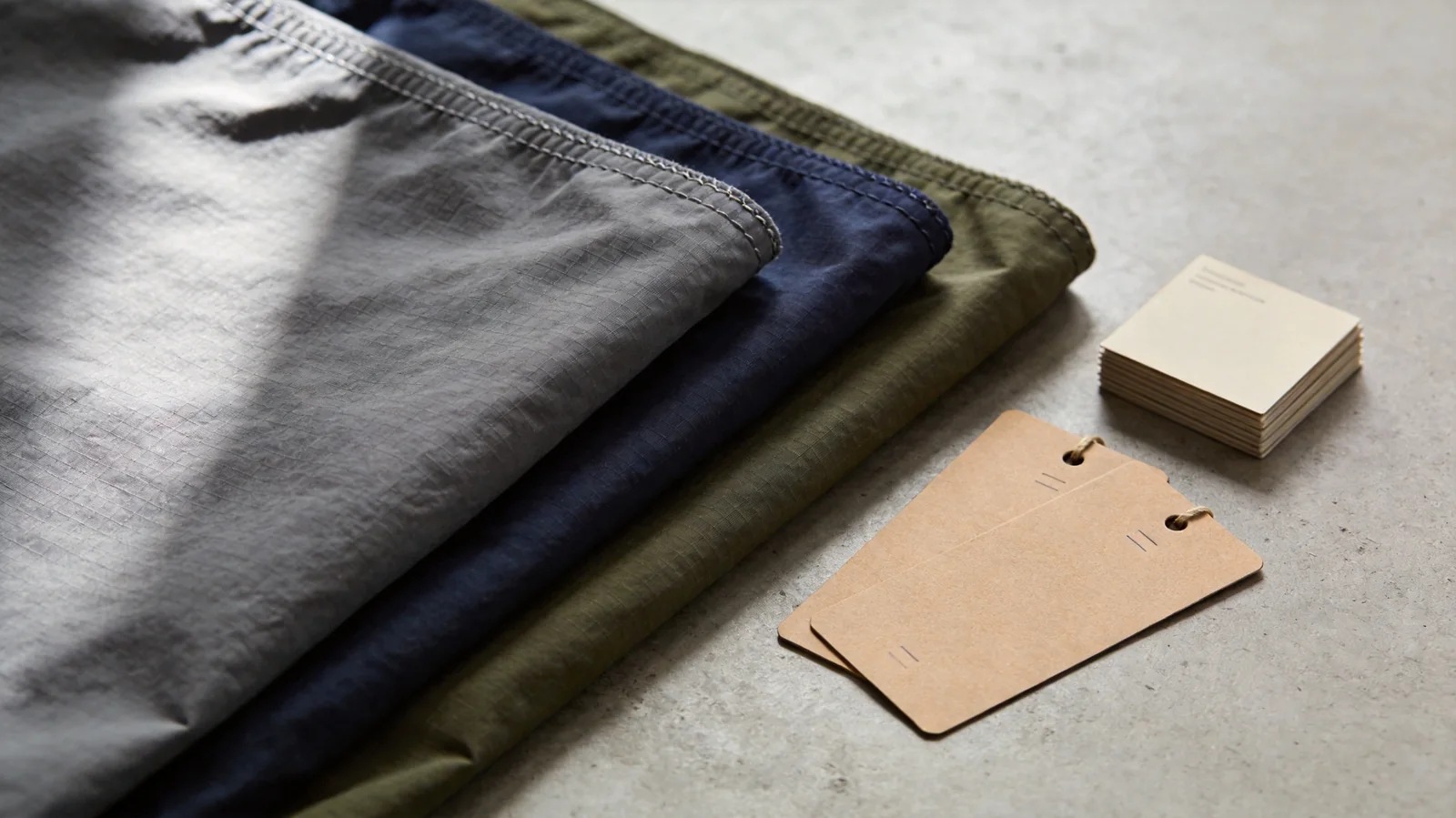
- Certified material takes longer to prepare. Recycled yarn supply is less stable than conventional yarn; shade and weight often have to wait. Conventional fabric can land in 7 to 10 days; certified recycled fabric frequently needs 2 to 4 weeks.
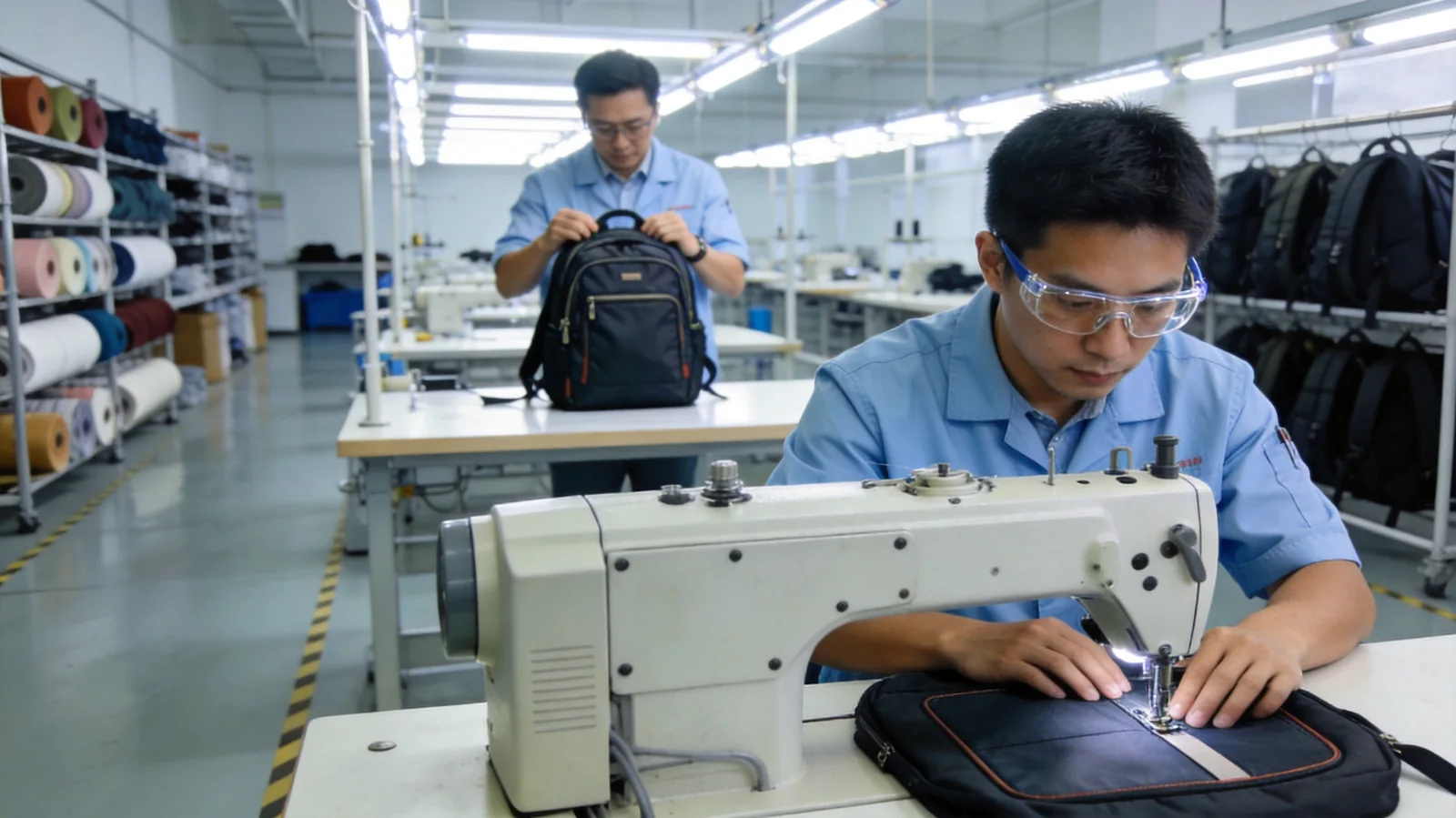
- MOQ structure changes. Recycled fabric mills set their own minimums, and the factory’s MOQ is pushed up by the upstream minimum. At JUNYUAN, general bag MOQ starts at 500 pieces and golf bags at 200 pieces — but a specific certified fabric can require more, and that has to be clarified at quotation stage, not after the PO.
- Sampling needs more room. Our standard sampling cycle is 6 to 10 days on conventional materials. The first time a new certified material is used, add time for material arrival and testing.
The conclusion is scheduling, not philosophy: if you want to be on shelf in Q3, materials have to be locked in Q1. The old rhythm does not hold.
The Real Cost Question: Premium Versus Lost Order
What the Material Premium Actually Looks Like
The premium on recycled material is not a fixed percentage. It depends on material type, certification status and order volume.
The general pattern:
- Conventional polyester to GRS-certified recycled polyester: a visible premium that amortises as volume grows
- Organic cotton versus conventional cotton: typically a larger premium
- Recycled nylon: tighter supply, higher premium, longer lead time
We deliberately do not publish a price band here, because the spread is wide and dates quickly. The right method is a side-by-side quotation on your own SKU. We have published a cost comparison method that can be applied directly.
Certification Is a Fixed Cost, Not a Per-Unit Cost
This is where many cost models go wrong.
Audit fees, testing fees and TC administration are fixed costs. They do not scale linearly with order quantity. Which means:
- At low volume, the per-unit cost of certification looks alarming.
- As volume rises, the per-unit cost falls quickly.
Practical advice: do not convert the whole line at once. Pick one or two main SKUs, run certification through, and spread the fixed cost across a large order before extending.
The Cost of Not Doing It
This is the decision that actually matters. Three accounts to run:
- Lost order cost. A SKU that cannot enter a channel loses the entire order cycle, not a per-unit price difference.
- Retrofit cost. Sourcing certified material only after a customer demands it means the weakest negotiating position and the tightest lead time.
- Redo cost. Claiming recycled content without a TC and being forced to relabel or withdraw costs double.
Against those three, the material premium is usually the smallest line item.
A Three-Phase Rollout Plan
Phase 1 (Months 0–3): Audit and Pilot
Goal: understand the current state and pick a pilot.
- Inventory existing SKUs and rank by material share times customer sensitivity; pick one or two pilots.
- Ask your current factory for a sustainability data pack and identify the gaps.
- Confirm the factory’s existing certification list and expiry dates — certifications lapse quietly and often go unnoticed.
- Run one complete sampling and quotation cycle on the pilot SKU using certified material.
Output: a gap list and a pilot quotation.
Phase 2 (Months 3–9): Certify and Document
Goal: close the paperwork gap.
- Select the certification path (GRS, RCS, OEKO-TEX, ISO 14001) and start the application.
- Build a material ledger: file the TC for every certified batch.
- Establish chemical management documentation, including a ZDHC MRSL compliance statement.
- Prepare a standard answer template for sustainability questionnaires.
- Complete a first-pass Scope 1 and Scope 2 calculation.
Output: a deliverable data pack and a questionnaire template.
Phase 3 (Months 9–18): Convert the Line and Use the Data
Goal: extend from pilot to mainline, and put the information to work.
- Replicate the pilot across other SKUs.
- Implement traceability information on product and packaging, which also lays groundwork for the 2028–2029 DPP window.
- Feed sustainability data into tenders, RFPs and marketing.
- Establish an annual refresh cycle covering certification validity, emissions data and supplier changes.
Output: a product line with defensible claims.
Why 18 months? Because the textile DPP is expected to apply in 2028–2029, with the delegated act planned for Q1 2027. Starting now puts you just ahead of that window.
12 Questions to Ask Your Bag Factory
This is the most usable part of the article. Take it to the meeting.
Materials
- Do you currently hold GRS or RCS certification? What is the certificate number and expiry date?
- Can you show me a sample Transaction Certificate from a previous recycled material order?
- What is your standard lead time on certified recycled fabric, and how many days longer than non-certified?
- If I specify a particular weight and shade of recycled fabric, what is the minimum order quantity?
Compliance
- Have you calculated Scope 1 and Scope 2 emissions? Under what methodology?
- Do you hold OEKO-TEX Standard 100 or an equivalent finished-goods test report? Which product categories does it cover?
- Is chemical management run to ZDHC MRSL? Can you provide a compliance statement?
- When was your most recent third-party factory audit, to what standard, and with what result?
Production
- How are certified and non-certified materials segregated on the production line? What prevents mixing?
- Do you have wastewater treatment and test reports? How often is testing done?
- If I need a product-level carbon footprint, can you provide it, and what do you need from me?
- Who inside the factory owns certification maintenance, and what happens if that person leaves?
Question 12 is the one most often skipped and the most damaging. A lapse in certification maintenance breaks the TC chain, and every claim built on it fails with it.
Five Mistakes Brands Keep Making
- Treating “we use recycled material” as equivalent to “we are sustainable.” Material is one link. Chain of custody, chemicals, labour and emissions all count. Customers ask about the system, not the single point.
- Waiting until a customer demands it. That is when negotiating power is weakest, lead time tightest, and the risk of buying material that claims certification without a TC is highest.
- Converting the entire line at once. Fixed costs cannot be amortised, and supply instability turns into broad delays. Start with one or two SKUs.
- Collecting documents without verifying them. A certificate received but not checked for number, validity and matching TC is not evidence. GRS certificates can be verified with the issuing body.
- Underestimating supply chain data collection. The real bottleneck in DPP is not the QR code — it is collecting verifiable multi-tier supplier data. Doing it now takes months. Doing it in 2028 takes months plus penalty risk.
How JUNYUAN BAGS Fits Into This
Stating our limits is more useful than claiming we do everything.
What we do:
- General bag MOQ from 500 pieces; golf bag MOQ from 200 pieces
- Sampling in 6 to 10 days; bulk production in 35 to 50 days
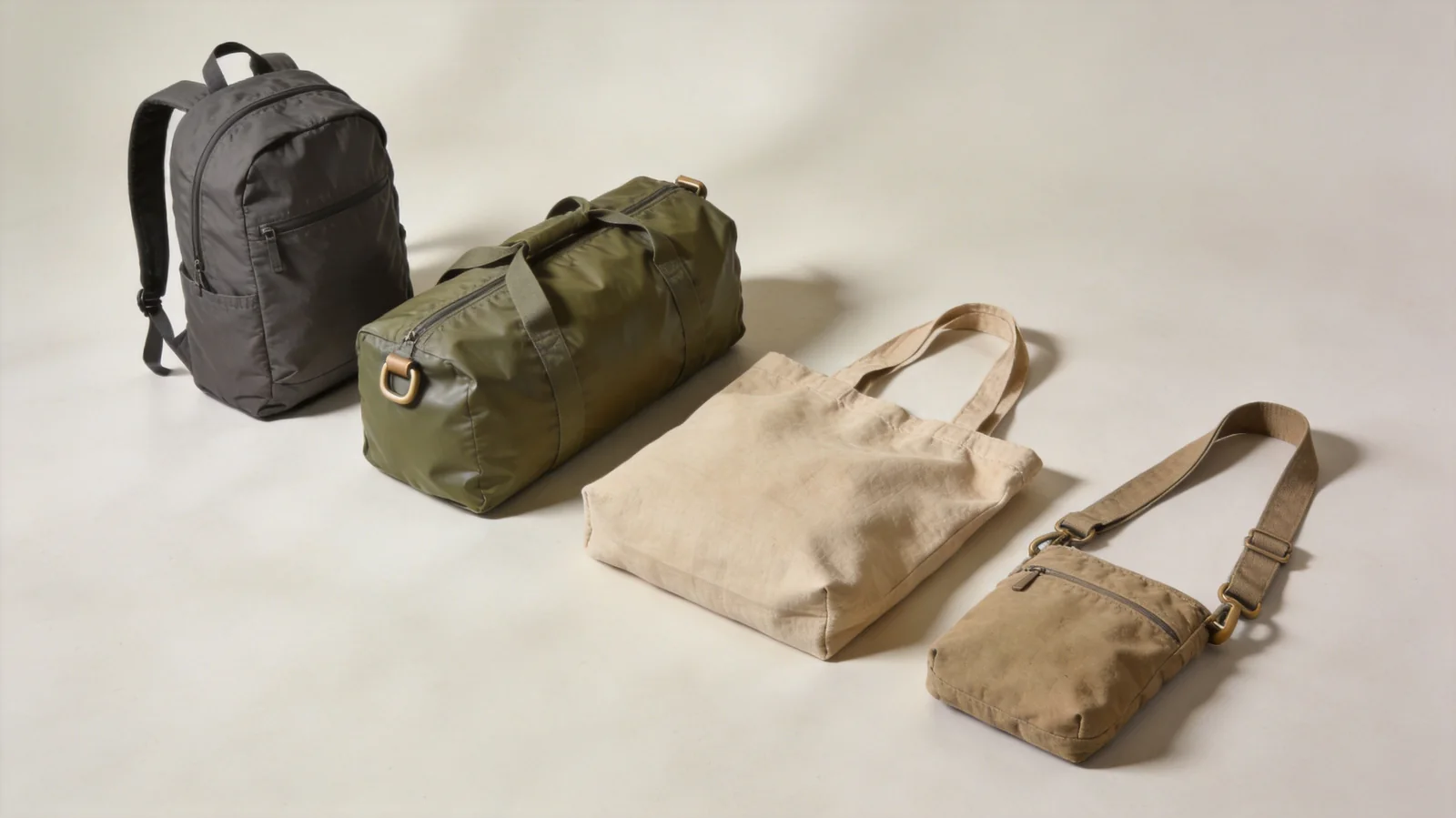
- Sourcing and processing of certified materials including rPET, recycled cotton and organic cotton
- Material traceability documentation to support customer GRS and OEKO-TEX applications
- Full custom development: design, pattern making, sampling and mass production
For our rPET-specific capability, see the rPET backpack manufacturing page. For golf-specific sustainability work, see the golf bag sustainability guide.
How we suggest you use us:
- Start with one or two SKUs to validate material and process.
- Ask for the TC and test reports at sampling stage, not at bulk production.
- Send the sustainability questionnaire in advance so we can prepare to the template rather than against a deadline.
What we do not promise:
- We do not promise that any material can be certified immediately. Certification has a cycle and supply chains have real constraints.
- We do not promise a zero-cost switch. The material premium is real, and we will quote it honestly.
If you are preparing a retailer supplier audit, or selecting sustainable materials for a new SKU, send us the requirement and we will respond against your actual conditions.
Contact: [email protected] / +86 17750020688
FAQ
Our customers have not asked for sustainability yet. Is it too early? It depends who your customers are. If they are European or American retailers or brands, their requirements will reach you eventually. If they are regional wholesalers, you can move more slowly — but material lead times and certification cycles do not shorten because you are not in a hurry. The 18-month preparation window is not an exaggeration.
What is the difference between GRS and RCS, and which should we choose? RCS verifies recycled content only and is lighter. GRS also covers environmental, chemical and social criteria — heavier, but more widely recognised. Use RCS to start quickly; use GRS to enter mainstream channels.
Is certification a one-time exercise? No. GRS certificates are typically valid for one year and require annual audit renewal. TCs are issued per shipment. Maintenance is ongoing work, not a one-off investment.
Does recycled material affect product performance? Mainstream certified recycled polyester meets normal bag requirements for strength, abrasion and colour fastness. Recycled nylon shows more performance variance and needs sampling validation. Do not believe “identical,” and do not believe “impossible” — test it.
The DPP is a 2028 issue. Is preparing now too early? The bottleneck in DPP is data, not technology. Collecting multi-tier supplier data takes months today and will take months in 2028 — except by then it will be stacked on top of compliance pressure. What you build now is the data ledger.
The Takeaway
Sustainable sourcing in 2026 is no longer a question of whether to do it. It is a question of which step comes first.
Three things you can do this week:
- Ask your current factory for a sustainability data pack and look at the gaps.
- Pick one or two SKUs and request a certified-material comparison quotation.
- Send the 12 questions above to your factory.
Eighteen months sounds long. Measured against material preparation, certification audit and production ramp-up, it is just enough.