
Short answer: a custom golf Sunday bag programme from Junyuan Bags starts at MOQ 500 pieces per style, samples in 6–10 working days, runs 35–50 days in bulk and is inspected to AQL 2.5 major / 4.0 minor before shipment. We are a bag manufacturer established in 2014, with our founder working in the golf and bag trade since 2004. A Sunday bag is the one product in the golf range where the specification is decided by a number in grams rather than a feature list: finished weight lands between 950 g and 1,350 g, the whole commercial case rests on a 3–6 way top and a single strap, and roughly 70% of field complaints come back to two components — the strap anchor and the top collar. This page is written as a procurement document for the brand owner, product developer or sourcing manager who has to place that order. For the product range itself, including stand bags, start on our Sunday and stand bag range page and return here when you need the numbers behind it.
Why this category is priced differently from every other golf bag. A cart bag buyer negotiates features; a Sunday bag buyer negotiates grams. Take a mid-market Sunday bag in 300D polyester with a padded single strap at a USD 21.50 FOB. The shell and lining are 22% of that price, the strap and its hardware 15%, the top collar and base board 12%, zippers 9%, logo decoration 5%, overheads and packing 7%, factory margin 4% — and labour is 26%, the single largest line, because a light bag is sewn with more operations per gram than a heavy one. That ratio explains the two questions we are asked most often. “Can you take 10% out?” usually means deleting a pocket, dropping the spacer mesh, or moving from a laminated top collar to a bound one. “Can you make it lighter?” usually means paying more, not less: below about 1,000 g the cost per gram rises sharply as fabric denier falls and seam engineering takes over. We quote both trade-offs explicitly instead of promising a lower price and a lower weight in the same sentence.
What a Sunday Bag Is — and the Four Things It Is Not
A Sunday bag is a carry-only golf bag for a partial set: typically 6 to 9 clubs, no cart strap channel, no full-length divider system, and a body narrow enough to hang from one shoulder for nine holes without the bag swinging. The name comes from the informal round — the Sunday walk, the after-work nine, the par-3 loop — but the product has drifted well past that origin. It is now the lightest SKU in a club brand’s bag line, the default rental bag at short courses and resorts, and the second bag that cart users buy so they can walk in the winter without hauling 3 kg of nylon and plastic around.
Four things a Sunday bag is not, because each confusion changes the specification and the price:
- Not a stand bag without legs. A stand bag carries a frame, a hinge assembly and a base actuator; strip those out and what remains is a floppy tube. A Sunday bag is a different pattern: a spine or a light PE insert replaces the frame, the base is a flat reinforced panel rather than an actuating plate, and the top is smaller in diameter. If a supplier offers to “remove the legs” from a stand bag pattern, the bag will sag at the throat within a season.
- Not a pencil bag. Pencil bags are the cheapest possible construction — single-wall fabric, no lining, one zip, a webbing loop for a strap. A Sunday bag in a branded programme carries a padded strap, a lined valuables pocket, a laminated top collar and a printed or embroidered logo, and it is inspected to the same AQL as a full cart bag.
- Not a travel bag. It has no padding for air travel and no club-head protection. It is the bag you put inside a travel cover, which is why the flat-packed carton dimensions in the freight section of this page matter more than they look.
- Not a size, but a weight class. Two Sunday bags can share a 4-way top and differ by 400 g. The difference is the fabric denier, the lining, whether the top collar is laminated or bound, and how much reinforcement sits in the base. That 400 g is what the end customer feels on the ninth hole, and it is the number a product developer has to defend in a range review.
If your programme needs a bag that stands on its own beside the ball, you want the stand bag line instead — see custom golf stand bag manufacturing, which covers the leg mechanism, hinge tolerances and cycle testing in detail. If it needs to sit on a trolley or a buggy with a 14-way top and cooler pocket, the cart bag programme is the right entry point. This page covers only the carry-only category.
The Weight Budget: Where 1,070 Grams Actually Goes
Every Sunday bag project we run starts with a weight budget, not a drawing. The buyer states a target finished weight, we allocate it across nine component groups, and the allocation becomes the specification that the sample is measured against. A bag that arrives 180 g over budget is not a quality failure — it is a design failure that was avoidable at the allocation stage, because weight is decided by the bill of materials long before the first stitch.
The table below is a real allocation for a 4-way Sunday bag in 300D polyester with a padded single strap, measured on a finished sample. It totals 1,070 g, which sits in the middle of our 950–1,350 g production band.
| Component group | Weight | Share | What moves this number |
|---|---|---|---|
| Body shell + lining | 300 g | 28.0% | Denier and backing. 210D ripstop saves 35–45 g against 300D; a 70D taffeta lining saves 20 g against 150D |
| Top collar / divider | 105 g | 9.8% | Laminated EVA collar versus bound fabric collar; 3-way versus 6-way tube set |
| Base panel + feet | 130 g | 12.1% | PE board thickness (2 mm vs 3 mm), number of moulded feet, whether the base is wrapped or stitched |
| Padded single strap | 180 g | 16.8% | Pad length and thickness, spacer mesh versus flat foam, swivel hardware |
| Webbing handle, D-rings, sliders | 55 g | 5.1% | Metal versus acetal hardware; number of attachment points |
| Main zipper | 60 g | 5.6% | No. 5 versus No. 8 coil; full-length opening adds 15–25 g |
| Pockets + linings | 145 g | 13.6% | Pocket count and whether pockets are lined, zipped and bar-tacked |
| Piping, binding tape, thread | 70 g | 6.5% | Piped versus bound seams; double-needle coverage |
| Badge / decoration | 25 g | 2.3% | Woven label versus rubber badge versus embroidery only |
| Total | 1,070 g | 100% | Measured on a finished, packed-out sample |
Two practical rules come out of that table. First, the shell and the strap together are 44.8% of the weight; there is no route to a sub-1,000 g bag that does not touch both. Second, we hold a tolerance of ±5% on finished weight per unit against the approved sample, and we weigh ten units per carton at final inspection. A supplier who cannot state a tolerance on weight has not measured the bag.
Weight and price move in opposite directions below a certain point. Dropping from 1,070 g to 950 g typically adds 6–11% to FOB, because the savings in fabric are smaller than the added cost of lighter, more expensive material and the extra operations needed to keep a thin shell from distorting. That is the trade-off to put in front of whoever set the target.
Top Geometry and Club Capacity: 3-Way to 6-Way
The top is where a Sunday bag is won or lost. It has to hold a partial set upright while the bag hangs from a shoulder, it has to let clubs slide in and out without snagging, and it has to do that at a throat diameter small enough to keep the body narrow. We build four standard geometries; anything outside them needs a pattern change and is quoted as tooling.
| Top configuration | Throat diameter | Practical club capacity | Typical use | Weight effect |
|---|---|---|---|---|
| 3-way, moulded collar | 76 mm | 5–6 clubs | Par-3 loops, pitch and putt, junior programmes | Baseline −25 g |
| 4-way, moulded collar | 89 mm | 6–8 clubs | The volume SKU for club brands and pro shops | Baseline |
| 5-way, moulded collar | 102 mm | 7–9 clubs | Half-set players, walking members, resort rental | Baseline +20 g |
| 6-way, moulded collar | 114 mm | 8–10 clubs | Private-label premium, leather-trim programmes | Baseline +45 g |
| 3-way, bound fabric (no mould) | 74 mm | 5–6 clubs | Entry price points, canvas and waxed-cotton ranges | Baseline −60 g, tooling free |
The relationship between ways and clubs is not one-to-one, and buyers regularly over-specify here. A 4-way top with a 89 mm throat holds eight clubs comfortably because the tubes are oval rather than round; a 6-way top at 114 mm does not hold twelve, because the body has to stay narrow enough to carry. We recommend sizing the top to the set the end customer will actually use, then checking the largest grip diameter in that set: midsize or jumbo grips need one way fewer than the club count suggests, or the clubs bind on entry.
Three tolerances matter at the top and we specify them in writing on every programme: throat diameter ±2 mm, divider tube depth measured from the collar edge (minimum 140 mm, or clubs tilt and rub), and collar-to-body seam strength, which is where a light bag first fails. The collar is also where the bag takes its shape, so a laminated EVA collar and a bound fabric collar are not interchangeable: the laminated version holds a 3 mm wall and weighs about 105 g, the bound version weighs about 45 g and will ovalise under a full set within a season.
Sunday Bag, Stand Bag or Cart Bag: The Comparison Buyers Actually Need
Most sourcing teams arrive with a range plan that has already decided how many SKUs sit in each category, and the question is which one to develop first. This table compares the three on the metrics that drive a development decision rather than on features.
| Decision metric | Sunday bag | Stand bag | Cart bag |
|---|---|---|---|
| Finished weight band | 950–1,350 g | 1,400–2,800 g | 2,500–4,000 g |
| Club capacity | 5–10, partial set | 13–14, full set | 14, full set |
| Legs / stand mechanism | None, or optional micro-stand | Required, hinge and spring assembly | None, trolley or buggy use |
| Divider system | 3–6 way, short tubes | 4–14 way, full depth | 14 way, full depth, putter well |
| Structural element | Spine or light PE insert | Frame plus base actuator | Rigid moulded frame |
| Tooling profile | Pattern only; collar mould optional | Pattern plus leg and hinge tooling | Pattern plus divider and base moulds |
| Typical FOB band | USD 15–29 | USD 32–58 | USD 38–72 |
| Labour share of FOB | About 26% | About 24% | About 25% |
| Sampling time | 6–10 days | 6–10 days | 6–10 days |
| Bulk lead time | 35–50 days | 35–50 days | 35–50 days |
| Carton cube per piece | 0.0197 CBM flat-packed | 0.062 CBM | 0.085 CBM |
| Best channel fit | Club brand accessory line, resort rental, corporate gifting, DTC second bag | Green-grass pro shop, club brand core SKU, online golf retail | Trolley users, premium retail, club brand flagship |
| Seasonality | Spring gifting peak, year-round corporate | Spring, single peak | Spring, single peak |
The strategic point in that table is the last three rows. A Sunday bag is one third of the freight cube of a cart bag and it sells into channels that do not buy cart bags at all — corporate gifting, resort rental fleets, tournament prize programmes, and the second-bag market. That is why brands that already have a cart bag and a stand bag add a Sunday bag as a third SKU rather than as a cheaper version of the first two. It is also why the same factory can quote all three: the pattern room, the sewing floor and the inspection protocol are shared, and only the specification changes.
Fabrics That Survive a Walking Season
Sunday bag fabric is chosen on three axes that pull against each other: weight per square metre, abrasion resistance where the bag contacts the ground and the hip, and how the material takes a print or an embroidery. The table below covers the five fabrics we run most often, with the specification points a buyer should put in the purchase order.
| Fabric | Weight | Body weight effect | Cost index | Where it belongs |
|---|---|---|---|---|
| 210D ripstop nylon, PU 800 mm | About 95 g/m² | −40 g vs 300D | 1.00 | Ultralight programmes, packable second bags, print-heavy designs |
| 300D polyester, PU 1,000 mm | About 150 g/m² | Baseline | 0.92 | The volume SKU; best balance of cost and durability |
| 420D polyester, PU 1,500 mm | About 210 g/m² | +85 g | 0.96 | Rental fleets and junior programmes where abuse is expected |
| Waxed cotton canvas, 16 oz | About 480 g/m² | +290 g | 1.35 | Heritage and premium ranges; needs a dry-wax finish, not a wet one |
| 600D polyester, PVC-free TPU backing | About 260 g/m² | +150 g | 1.05 | Base panels, high-wear corners, reinforcement patches on any of the above |
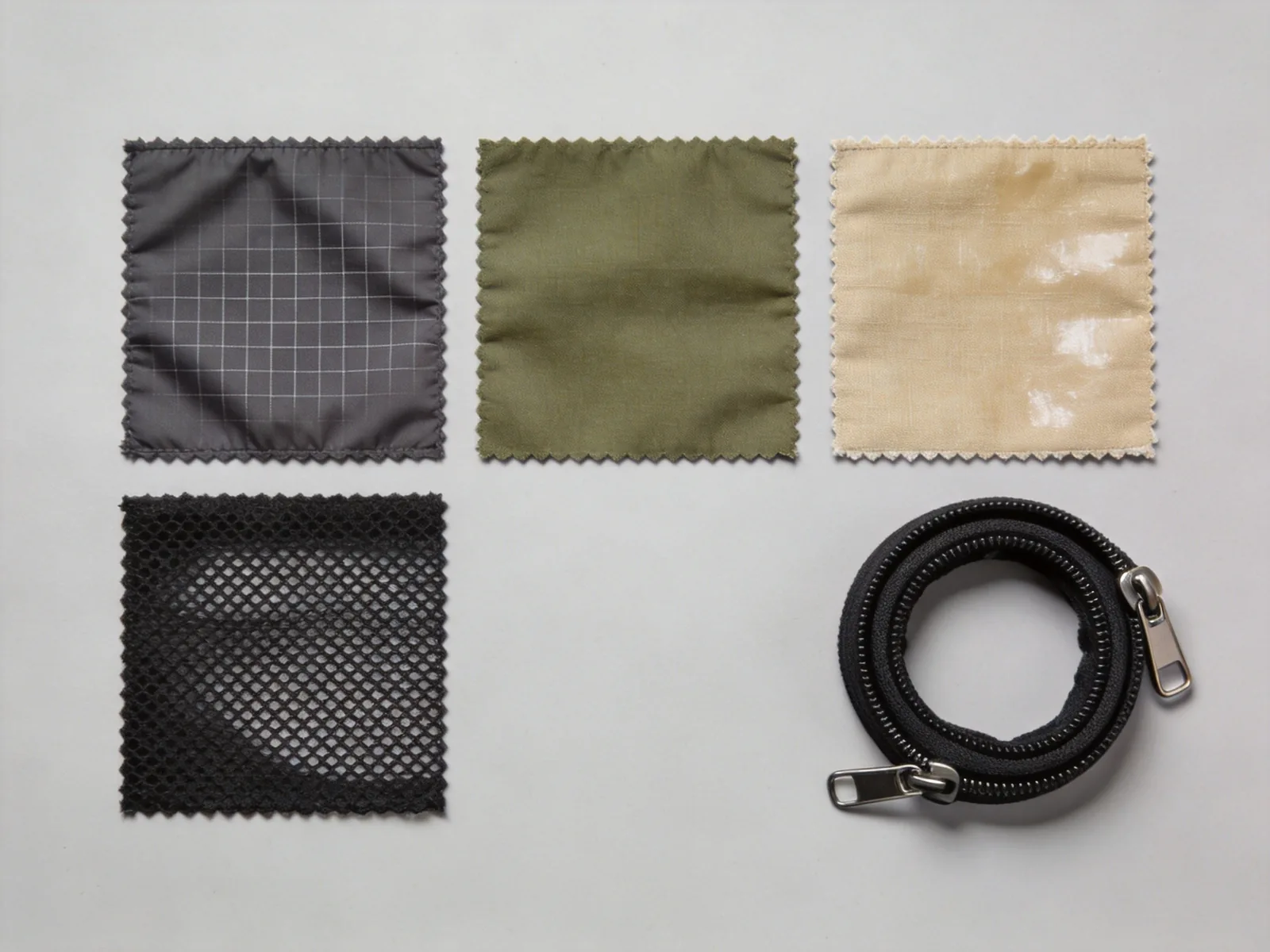
The five inputs that decide a Sunday bag: 210D ripstop, 300D polyester, waxed canvas, spacer mesh for the strap pad and a water-resistant zipper.
Three specification notes that separate a good bag from a durable one. Backing matters more than denier: a 210D with a proper 800 mm PU backer outlasts a 420D with a thin acrylic coat, because the failure mode is water ingress into the weave followed by abrasion of the fibre, not a tear. Lining is a wear part: a 70D taffeta lining saves 20 g and is fine for a club-brand bag that gets used nine holes a week, but it will grin at the seams in a rental fleet, where we specify 150D. Waxed canvas is not waterproof and should not be sold as such — we finish it dry so it can be re-waxed by the owner, and we say so on the hangtag copy.
The Strap Is the Product: Ergonomics, Anchors and Load Paths
On a 1,070 g bag, the strap is 180 g — 16.8% of the weight and, in practice, most of the customer’s opinion of the product. A Sunday bag is carried on one shoulder for nine holes, which means the strap pad sits on the trapezius, the load path runs from the pad through two webbing anchors into the shell, and the shell has to spread that load without a frame to help it. Every tear-out we have ever investigated on this category started at an anchor, not in the middle of the fabric.
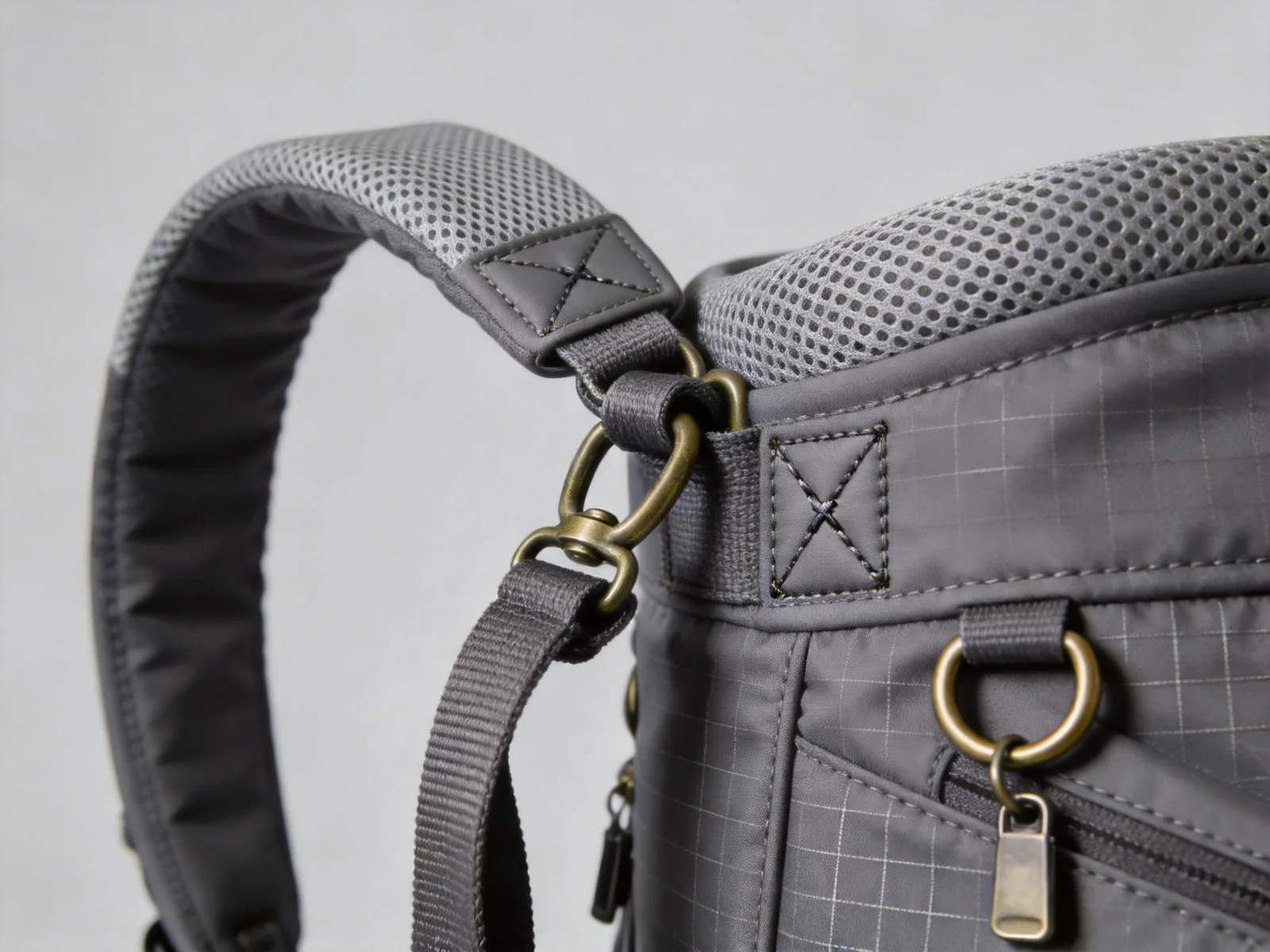
Box-X bar-tacks at both anchors, a spacer-mesh pad and a swivel D-ring — the three details that decide whether a 1 kg bag survives a season of one-shoulder carry.
| Strap specification point | Our standard | Why it is specified |
|---|---|---|
| Pad length × width | 420 × 75 mm, 8 mm foam plus 3 mm spacer mesh | Shorter pads concentrate load; narrower pads roll off the shoulder |
| Anchor type | Box-X bar-tack, 8 stitches per leg, through a webbing patch bonded to the shell | Load is transferred to the patch, not to the shell seam |
| Anchor pull test | 600 N static for 30 seconds, no stitch failure | 61 kgf is roughly four times the loaded bag weight |
| Hardware | Acetal swivel or brass D-ring, 25 mm webbing | Swivel stops the strap twisting when the bag is set down |
| Adjustment | Ladder-lock or cam buckle, 60 mm of travel | Ladder-lock holds under load; cam buckles slip on thin webbing |
| Strap configuration | Single shoulder, or single with a detachable second strap | Double straps on a 1 kg bag add 90–120 g and are rarely used |
Two things we will argue with a buyer about. The first is pad thickness: 8 mm of foam with 3 mm of spacer mesh costs about 25 g more than a flat 5 mm pad and is the difference between a bag that is comfortable on the back nine and one that is not, so it is the last place to save weight. The second is the anchor: a strap sewn directly into the shell seam passes a visual inspection and fails in month four, because the seam is the weakest plane in a light fabric. We specify a bonded webbing patch under every anchor on this category regardless of price point, and we will decline a programme that asks us to delete it.
Structure Without a Frame: Spine, Base and Pocket Discipline
A Sunday bag has no frame, so the shape has to come from three cheap elements used well: a spine, a base board and the top collar. Get them right and the bag stands up when set down, keeps its throat open while a club goes in, and does not fold at the hip after a season. Get them wrong and the bag looks acceptable on a sample table and collapses in the third month.
- Spine. A 1.5 mm high-density PE strip, 45 mm wide, running the full body height and riveted at both ends. Weight 38–45 g. This is the single element that replaces the stand bag’s frame; omit it and the bag folds at the throat under a full set.
- Base. A 3 mm PE board wrapped in 600D, stitched on three sides and bound on the fourth, with two moulded feet at the wear points. Weight 130 g including the board. A 2 mm board saves 22 g and will dish after a season of being set down on gravel.
- Top collar. Laminated EVA, 3 mm wall, with the divider tubes set 140 mm deep. This is the part that keeps the mouth open and holds the club set upright while the bag hangs.
- Pocket discipline. Three pockets maximum on a Sunday bag: a full-length side pocket for balls and a bottle, a valuables pocket with a water-resistant zip, and one small accessory pocket. Every extra pocket costs 30–45 g and, in our experience of re-engineering competitor samples, is used once.
The base and the spine are also where the bag touches the ground, so they set the abrasion specification. We use 600D with a PVC-free TPU backing on the base and the lower 80 mm of the body, and we specify a 25,000-rub Martindale requirement on that zone against 12,000 on the upper body. A bag that wears through at the base corner after one season has been built to the wrong specification for its price point, not badly sewn.
What a Sunday Bag Costs: BOM at USD 21.50 FOB
Buyers ask for a cost breakdown for one reason: to find the line to argue with. The table below is the bill of materials and conversion cost for the 1,070 g, 4-way, 300D polyester Sunday bag described above, at a FOB of USD 21.50 and 500 pieces. The percentages are computed from the values, so the column sums to exactly 100%.
| Cost line | USD per piece | Share of FOB | What a reduction actually means |
|---|---|---|---|
| Shell fabric + lining | 4.73 | 22.0% | Drop to 210D: −0.38, and the bag gets lighter but less abrasion-resistant |
| Strap, mesh + hardware | 3.23 | 15.0% | Flat pad instead of spacer mesh: −0.34, and the product gets worse |
| Top collar, divider + base board | 2.58 | 12.0% | Bound collar instead of laminated: −0.55, and the top ovalises |
| Zippers + pulls | 1.94 | 9.0% | No. 3 coil instead of No. 5: −0.31, and sliders creep on a full pocket |
| Cut, sew, finish labour | 5.59 | 26.0% | Reduce operations, not wages: fewer pockets, simpler binding |
| Logo decoration | 1.08 | 5.0% | Embroidery only instead of embroidery plus print: −0.42 |
| Overheads, QC + packaging | 1.50 | 7.0% | Poly bag instead of retail carton: −0.28, and retail-ready claims fail |
| Factory margin | 0.85 | 4.0% | The line to leave alone; a 4% margin is what keeps a factory honest on QC |
| Total FOB | 21.50 | 100% | Ex-works, before freight, duty or tooling amortisation |
The useful reading of that table is the ratio between the two biggest lines: labour is larger than fabric. That is the opposite of a cart bag, where material dominates. It means the fastest way to hit a price target on a Sunday bag is to reduce the number of operations — one pocket instead of three, a bound top instead of a laminated one, a single-needle binding instead of double — and the slowest way is to shop for cheaper fabric. It also means a 20% cheaper quotation for a bag that looks the same on a spec sheet is almost always four or five deleted operations, and the way to find out which is to ask for the operation list, not the price.
Tooling When There Is No Mould
One of the genuine advantages of this category is that most Sunday bags need pattern work rather than moulds. A brand can enter the category for a few hundred dollars of tooling instead of a few thousand — provided the top is bound rather than moulded, and provided there is no micro-stand. The table below is what we actually charge, and how it amortises.
| Tooling item | One-time cost (USD) | Per piece at 500 | Per piece at 2,000 |
|---|---|---|---|
| Pattern grading, three sizes | 350–600 | 0.70–1.20 | 0.17–0.30 |
| Logo embroidery digitising | 0–60 | 0.00–0.12 | 0.00–0.03 |
| Screen print frame, per colour | 45–90 | 0.09–0.18 | 0.02–0.04 |
| Heat-transfer plate | 80–150 | 0.16–0.30 | 0.04–0.07 |
| Woven label or rubber badge mould | 120–260 | 0.24–0.52 | 0.06–0.13 |
| Micro-stand bracket tool | 900–1,600 | 1.80–3.20 | 0.45–0.80 |
Two notes on how we handle this commercially. Tooling is invoiced separately from the goods and credited against the first order at 500 pieces, so the amortised numbers above are the ones that apply to your real landed cost. And tooling paid for by a buyer can be assigned to that buyer in writing: we will not run a buyer-funded mould or a buyer-funded pattern for another customer without written release. What we will not promise is exclusivity on a construction that uses only our standard pattern block and a stock fabric — that is a shared platform by definition, and any factory telling you otherwise is describing a mould, not a design.
Sampling in 6–10 Days: The Four Stages
Sampling is the cheapest part of the programme and the most expensive to get wrong, because a sample that was built from a different specification than the bulk order proves nothing. We run four stages and we say which stage a sample is at every time we send one.
- Stage 1 — specification lock (day 0–1). Target weight, top geometry, fabric and backing, strap configuration, pocket count, logo method, packing. One page, signed off by both sides. Nothing is cut before this exists.
- Stage 2 — pattern and proto (day 2–5). Pattern from our block or yours, first-off sample in the specified fabric. This sample exists to prove the pattern, not the finish; expect it to be 30–60 g over the weight target, because the reinforcement and the collar are usually provisional.
- Stage 3 — pre-production sample (day 6–9). Built with production materials and production operations, weighed, photographed, and measured against the tolerance sheet. This is the sample that becomes the approved reference; we keep a sealed copy.
- Stage 4 — shipment and approval (day 9–10). Courier with the tolerance sheet and the weight record. If the sample is approved by photograph we ask for written approval; verbal approval by phone is the single most common cause of a bulk dispute.
The sample fee is USD 90–180 depending on fabric and decoration, and it is credited against the first order at 500 pieces. If the design needs a new moulded collar, we quote the mould first and build the sample from the new tool, because a sample from a different mould cannot be approved as a production reference.
Production Calendar: 35–50 Days, Day by Day
Bulk production runs 35–50 days from sample approval, and the spread is almost entirely about material availability rather than sewing capacity. The calendar below is the one we put in the quotation, so a buyer can see where a delay would come from instead of hearing about it in week five.
| Stage | Days from approval | What is happening | What can delay it |
|---|---|---|---|
| Material booking and in-house | 1–8 | Fabric, lining, zippers, webbing, hardware ordered and inspected on arrival | Non-stock colourways; branded zipper lead time |
| Pre-production sample and sign-off | 9–13 | PP sample built from bulk material, approved before cutting | Late artwork or late approval |
| Cutting | 14–20 | Panels cut, collars laminated, base boards punched | Print or heat-transfer panels arriving late |
| Sewing | 21–38 | Body, pockets, collar, base, strap assembly in line sequence | Operator availability in peak season (March–May) |
| Hardware, logo, finishing | 39–43 | Rivets, D-rings, embroidery or print, thread trimming | Embroidery file errors caught late |
| Inspection and packing | 44–47 | AQL 2.5 / 4.0 final inspection, weight check, cartoning | Failed inspection requiring rework |
| Documents and handover | 48–50 | Packing list, inspection report, photographs, booking | Buyer-side forwarder nomination |
Two honest caveats. First, the 35-day end of that range assumes stock fabric and stock colourways; a custom-dyed 210D ripstop adds 10–15 days before cutting even starts. Second, March to May is our peak, when the same floor is running stand bags and cart bags for the northern-spring season. A Sunday bag order placed in February for April delivery is a request to jump a queue; we will say so rather than book it and apologise later.
Test Protocol and Inspection Gates
A light bag fails differently from a heavy one: not by tearing, but by loosening. Stitches creep, anchors pull, zips walk, collars ovalise. The protocol below is what we run on every Sunday bag programme, and the values are the pass criteria written into the inspection sheet.
| Test | Method | Pass criteria |
|---|---|---|
| Strap anchor pull | Static tensile on both anchors | 600 N for 30 s, no stitch failure, no shell distortion |
| Handle pull | Static tensile on the top handle | 400 N for 30 s, no tear-out |
| Seam strength | Grab test on body and collar seams | 350 N per 50 mm minimum |
| Zipper cycles | Reciprocating machine, main and pocket zips | 3,000 cycles, no slider creep, no missing teeth |
| Abrasion, base zone | Martindale, 600D base and lower body | 25,000 rubs, no breakthrough to backing |
| Abrasion, upper body | Martindale, shell fabric | 12,000 rubs, no breakthrough |
| Colourfastness to rubbing | Wet and dry crocking | Grade 4 minimum, wet and dry |
| Water resistance | Spray rating on shell and base | Grade 3 minimum, no wet-out within 5 minutes |
| Hardware corrosion | Neutral salt spray, 24 h | No red rust on functional surfaces |
| Finished weight | Ten units per carton, calibrated scale | ±5% against the approved sample |
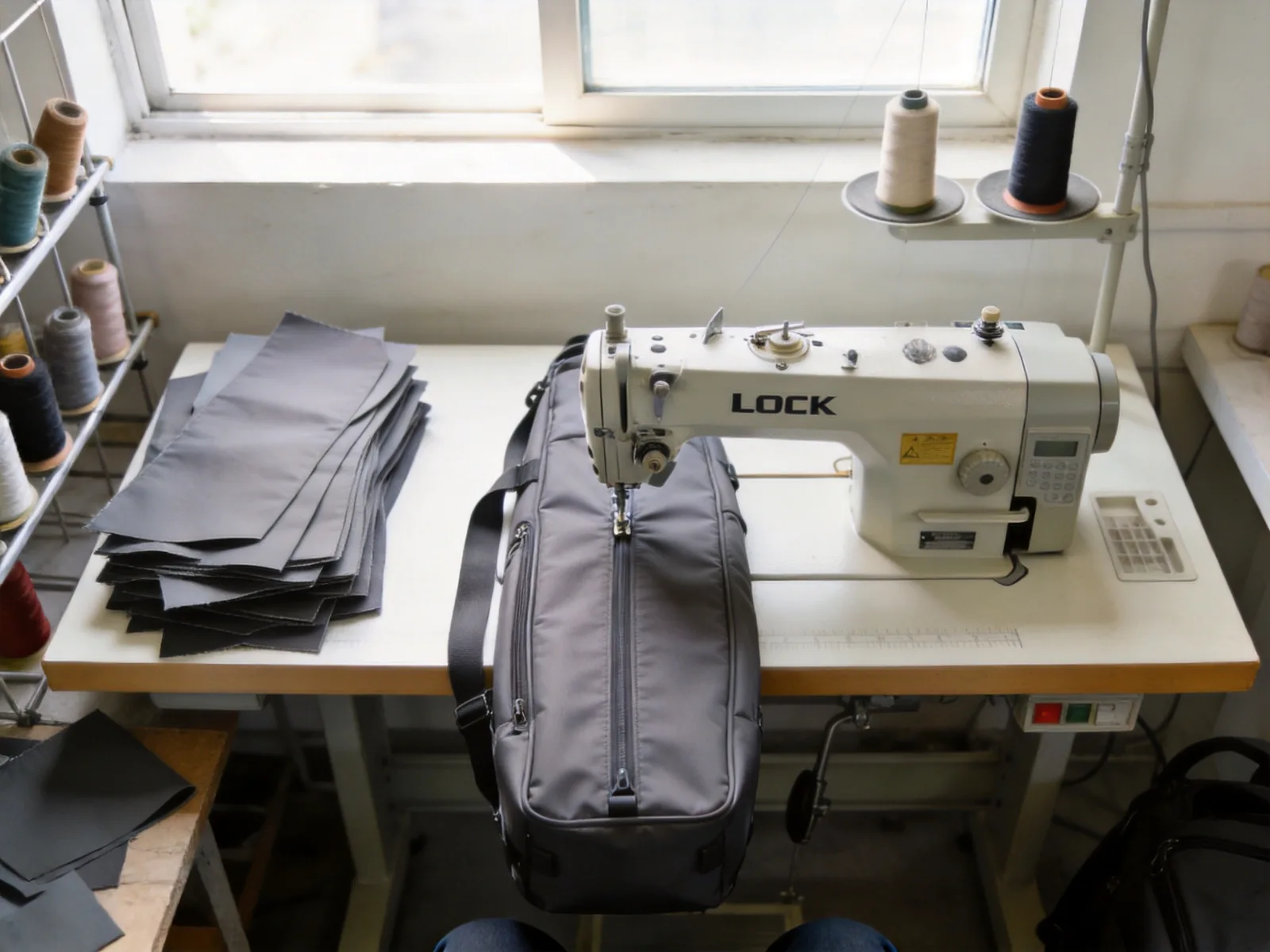
Cut panels staged beside the line: on a Sunday bag the operation count per gram is higher than on any other bag in the golf range, which is why labour is 26% of FOB.
Inspection runs at five gates, not one: incoming material, first-off from cutting, in-line at 30% of the run, end-of-line, and pre-shipment at AQL 2.5 major / 4.0 minor with a zero tolerance on the four critical defects — strap anchor not bar-tacked, collar not laminated to specification, base board missing, and wrong logo placement. Ask for the report at each gate. A single pre-shipment report tells you what was caught at the end, not what was prevented in the middle.
Compliance: What We Sign, What We Do Not
This is the section where buyers most often get told what they want to hear. We are a bag manufacturer, not a certification body, not a testing laboratory and not an EU authorised representative. What we can do is build to a specification, keep the records that a test house needs, and tell you honestly which obligations sit with you.
- REACH (EU) and UK REACH. We hold material declarations from our fabric, zipper and hardware suppliers and we re-confirm them per order. We will provide the declaration pack and a sample for testing. We do not issue REACH certificates; the importer’s testing house does, and the importer is the responsible party.
- GPSR (EU General Product Safety Regulation). Since December 2024 this requires a named EU responsible person, traceability information on the product or its packaging, and a technical file. We support it with batch marking, a specification file and photographs. The responsible person must be your EU entity or a contracted service — we will not act as it.
- California Proposition 65. We can supply the component list and material data needed for a test programme. Warning-label decisions are yours, based on your test results.
- CPSIA and EN 71. A Sunday bag sized for juniors is a children’s product and falls under different rules, including testing and tracking labels in the United States. Tell us at the brief stage: a junior bag built to adult documentation is a compliance problem, not a design problem.
- EPR and packaging. Extended producer responsibility registration for packaging is the importer’s obligation in most EU member states. We report carton and poly-bag weights per shipment so your filing is accurate.
We also will not print a claim we cannot support. GRS, RWS, BSCI, ISO 9001 and “carbon neutral” logos go on a bag only if the certificate is held by the party named and is valid for the shipment date; otherwise the bag carries no such mark. If a competitor’s quotation includes certification marks at a price that leaves no room for the audit, the marks are decoration.
Packing, Cube and Freight Maths
Sunday bags flat-pack, and that single property is why the category works commercially for small brands. A cart bag occupies roughly four times the container space of a Sunday bag, so the freight per piece is not a rounding error — it is a line in the landed cost that can exceed the factory margin.
| Packing mode | Carton | Pieces per carton | CBM per piece | 20GP (28 CBM usable) | 40HQ (68 CBM usable) |
|---|---|---|---|---|---|
| Flat-packed, bulk export | 58 × 40 × 34 cm | 4 | 0.0197 | 354 cartons / 1,416 pcs | 862 cartons / 3,448 pcs |
| Retail-ready, one per carton | 92 × 26 × 22 cm | 1 | 0.0526 | 532 cartons / 532 pcs | 1,292 cartons / 1,292 pcs |
At a 40HQ rate of USD 2,600, the flat-packed mode costs about USD 0.75 per piece and the retail-ready mode about USD 2.01 per piece. That USD 1.26 difference is roughly a third of the factory margin on the same bag, which is why we ask early whether the bag ships to a warehouse or to a shelf. A flat-packed bag also arrives compressed, so the retailer needs either a steaming step or a stuffer — if your channel cannot do that, retail-ready packing is not optional.
Three packing details we specify: poly bag with a suffocation warning and a recycled-content note where required; a hangtag with material and origin fields filled in, not blank; and a carton mark carrying SKU, colour, size, quantity and the batch number that ties back to the inspection report. The batch number is what makes a warranty claim traceable to a production run rather than to a conversation.
Six Channels That Buy Sunday Bags — and What Each One Demands
The same bag is a different product depending on who buys it. We build one platform and vary the specification by channel; the table below is how we brief a new programme once the buyer tells us where the bag will be sold.
| Channel | Typical order | What it demands | Specification consequence |
|---|---|---|---|
| Club brand accessory line | 500–1,500 per colourway | Consistency with the existing bag range, colour matching, logo discipline | Pantone-matched fabric, embroidery to brand manual, sealed reference sample per colour |
| Green-grass pro shops | 100–300 (via distributor) | Club crest, fast replenishment, retail-ready packing | Small-batch embroidery, retail carton, hangtag |
| Resorts, par-3 and rental fleets | 200–800 | Abuse tolerance, identification, easy cleaning | 420D body, 600D base, stitched-on number patch, dark colourways |
| Corporate gifting and tournaments | 200–1,000 | Fixed event date, gift presentation, low unit value | Print or heat transfer rather than embroidery, gift box option, 25–30 day fast track |
| Travel and second-bag retail | 500–2,000 | Packability, low weight headline, fit inside a travel cover | 210D ripstop, 950–1,000 g, stuff sack, flat-pack |
| Private label and online sellers | 500–1,000 per SKU | Photography-ready finish, unboxing, review-proof durability | Retail-ready packing, colour-matched trims, reinforced anchors |
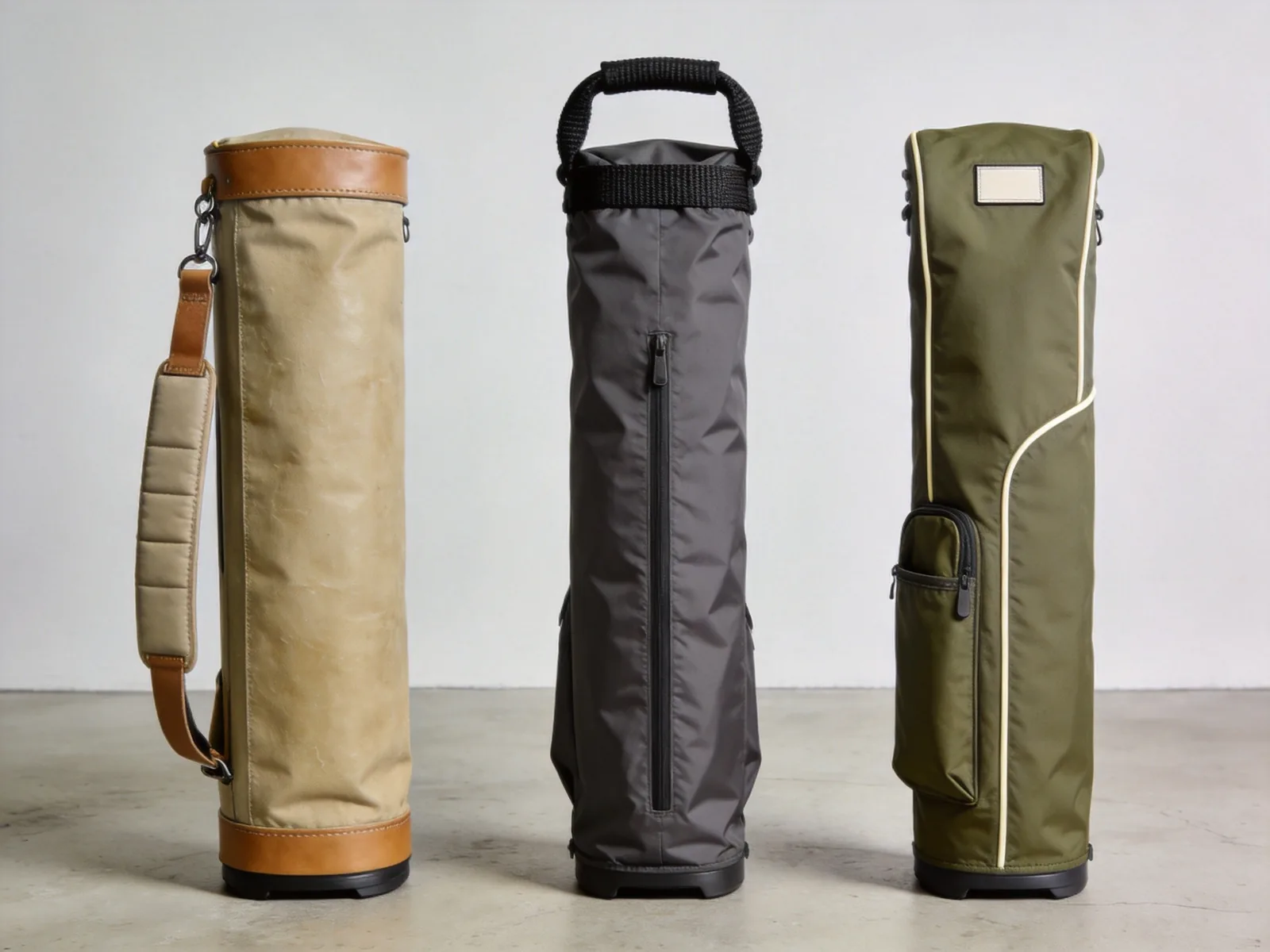
One platform, three channel briefs: waxed canvas for heritage retail, 210D ripstop for travel and second-bag programmes, 300D polyester for club-brand volume.
The channel also decides the size run. A club brand wants one size that fits an adult set; a junior programme needs a graded pattern with a shorter body and a smaller throat; a resort fleet wants one size, one colour and a number patch. Grading three sizes costs USD 350–600 in pattern work, and it is wasted if the channel only buys one — so we ask which sizes the first order will actually contain before we quote the grading.
Programme Management: Reorders, ECN and Spare Parts
A first order is a transaction; the second order is the business. Four things decide whether the second order is easy.
- Specification record. Every programme keeps a sealed reference sample, a tolerance sheet, the fabric and trim references, the logo artwork and the digital embroidery file. A reorder placed two seasons later is built from the record, not from memory.
- ECN discipline. Any change after approval — fabric, trim, pocket, logo position — goes through an engineering change note with a stated effect on weight, cost and lead time, signed before cutting. Undocumented changes are how a reorder arrives 60 g heavier than the original.
- Spare parts. Straps, swivel hardware and zip sliders can be supplied as service parts from 100 pieces, packed with the bulk shipment or sent separately. For a rental fleet this is the difference between repairing a bag and writing it off.
- Reorder lead time. With fabric in stock and no changes, a repeat order runs 25–35 days rather than 35–50, because pattern, approval and material qualification are already done.
Payment terms for a first order are 30% deposit with the order and 70% against the bill of lading copy by T/T, or a letter of credit at sight. Terms are agreed in writing before the purchase order, not after it.
Eight Failure Modes and the Line in the Spec That Prevents Each
This table is drawn from warranty returns and sample teardowns across the category. Each failure has a single specification line that prevents it, and that line belongs in the purchase order rather than in a conversation.
| Failure mode | How it shows up | Specification that prevents it |
|---|---|---|
| Strap anchor tear-out | Strap detaches at the top anchor after 3–6 months | Bonded webbing patch plus box-X bar-tack, 600 N pull test on every lot |
| Top collar ovalising | Mouth closes, clubs bind on entry | Laminated EVA collar, 3 mm wall, throat tolerance ±2 mm |
| Base corner wear-through | Hole at the ground-contact corner | 600D TPU-backed base and lower 80 mm, 25,000-rub Martindale |
| Zip slider creep | Main zip opens behind the slider when the bag is full | No. 5 coil with a locking slider, 3,000-cycle test |
| Lining seam grin | Lining pulls apart at the body seam | 150D lining on rental and fleet programmes, 8 mm seam allowance |
| Colour transfer | Dark trim marks light trousers or a white shirt | Grade 4 minimum crocking, wet and dry, on every trim |
| Hardware corrosion | White bloom or red rust on D-rings after a wet round | Acetal or plated brass, 24 h neutral salt spray |
| Pocket zip snag | Pocket zip catches lining on first use | Zip guard tape on the pocket mouth, bound edge rather than raw |
Twelve Questions to Ask Any Sunday Bag Supplier
These are the questions we would ask if we were buying, and we answer all twelve in a quotation rather than waiting to be asked.
- What is the finished weight of the approved sample, and what tolerance do you hold on it per unit?
- Is the top collar laminated or bound, and what is the throat diameter and its tolerance?
- How is the strap anchor attached, and what pull force does it pass?
- What is the base board thickness, and what fabric covers it?
- Which fabric and backing are you quoting — denier, coating and water resistance in mm?
- How many sewing operations does the bag take, and which ones did you delete to reach this price?
- What is the MOQ per style, and can colourways be mixed inside it?
- What is the sampling time from a locked specification, and what does the sample cost?
- What is the bulk lead time, and does it assume stock or custom-dyed fabric?
- What AQL do you inspect to, and can I see the report from each gate?
- Which tests do you run in-house and which go to a third-party laboratory?
- What happens to my pattern, artwork and tooling if I move the programme?
If the answers arrive as adjectives rather than numbers, the specification does not exist yet. That is the single most reliable signal in this category, and it is cheaper to discover it before the deposit than after the container.
Frequently Asked Questions
Send the Weight Target, Not the Slogan
Send us your target finished weight, your club capacity, your channel and your delivery date. Within two working days you will get a weight budget, a specification sheet with tolerances, a BOM with component weights, tooling listed separately, a carton cube calculation and a realistic production calendar — or an honest statement of which of your targets cannot be met at the price you have in mind.
Related Capabilities and Programmes
- Custom Sunday & Stand Golf Bags — product range
- Custom Golf Stand Bag Manufacturer
- Custom Golf Cart Bag Manufacturer — BOM and tooling
- Custom Golf Bag Manufacturer
- Custom Golf Cart Bags — product range
- Golf Staff Bag Private Label
- Custom Golf Bag Accessories
- Custom Golf Headcovers
- Custom Golf Shoe Bag
- Custom Golf Den Caddy
- Custom Cooler Caddy Manufacturer
- Custom EVA Case Manufacturer
- Custom Tactical Bag Manufacturer
- OEM / ODM Service
- Factory Audit
- Wholesale Bag Factory
- Bag Manufacturer vs Trading Supplier
- Frequently Asked Questions