Creating a prototype bag for crowdfunding is a step-by-step process that ensures your idea is ready to attract backers and meet production standards. Here’s a quick breakdown:
- Define Your Concept:
- Identify the purpose of your bag (e.g., travel, sports, outdoor).
- List 5–10 standout features, like waterproof materials or modular compartments.
- Research your target audience using online communities and polls.
- Sketch and Design:
- Start with hand-drawn sketches, including dimensions and material details.
- Use digital tools to refine designs and create a Bag Spec Sheet for manufacturers.
- Choose Materials:
- Select fabrics and hardware that match your bag’s purpose (e.g., recycled polyester for eco-conscious designs, YKK zippers for durability).
- Finalize material specifications to avoid production errors.
- Build a Prototype:
- Partner with a manufacturer to create an initial sample (takes 7–12 days).
- Test and refine the design through 2–3 iterations to fix flaws and improve functionality.
- Prepare for Crowdfunding:
- Use the final prototype for professional photos and videos.
- Ensure your manufacturer can handle production and shipping for your campaign.
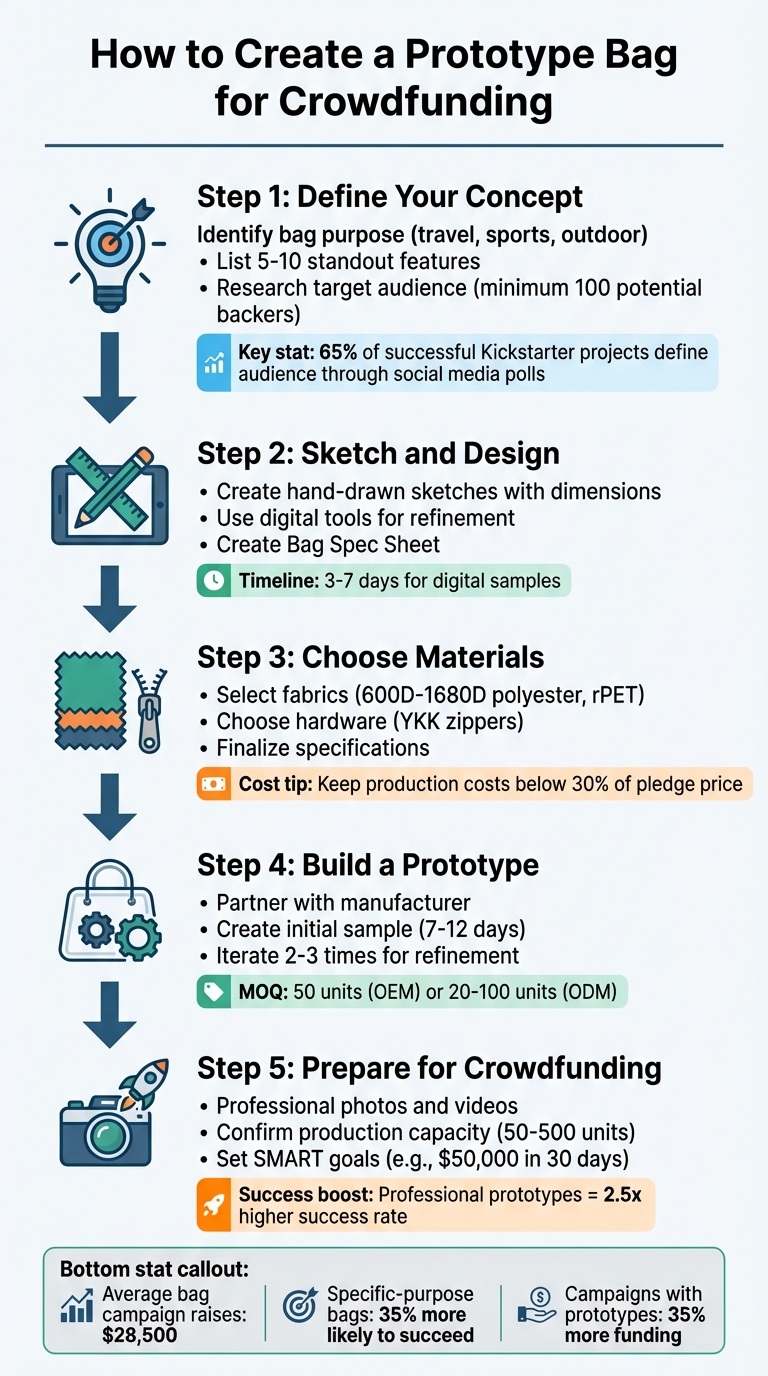
5-Step Process to Create a Prototype Bag for Crowdfunding
Step 1: Define Your Bag Concept and Target Audience
Determine the Bag’s Purpose and Features
Start by identifying the specific problem your bag is designed to solve. For example, a sports bag might need ventilated compartments to handle sweaty gear and adjustable straps for comfort. A travel bag could benefit from lockable zippers and expandable sections that increase capacity by 20–30%. Outdoor bags often require waterproof materials like 500D nylon and MOLLE webbing for attaching extra gear.
Next, outline 5–10 key features that make your bag stand out. For sports bags, think about sweat-resistant interiors, quick-access pockets, and padded laptop sleeves that fit up to 15-inch devices. Travel bags may need roller wheels, TSA-approved locks, and RFID-blocking pockets. Outdoor bags might shine with hydration compatibility, D-rings for carabiners, and UV-resistant fabrics. Take a look at other Kickstarter campaigns to see which features resonate most with backers.
Once you’ve nailed down the features, focus your research on the audience that would value them the most.
Understand Your Target Audience
Use platforms like Reddit and Facebook groups to gather input from at least 100 potential backers. Ask about their daily routines, priorities, and frustrations with their current bags. Build detailed buyer personas based on this data, including demographics (e.g., urban commuters aged 25–40), habits (like frequent gym visits), and concerns (such as durability under heavy loads up to 50 lbs).
Interestingly, 65% of successful Kickstarter projects define their audience through social media polls before launch, often doubling their funding goals. Dive into the comment sections of similar campaigns to learn what features people love and what they criticize. Common complaints include uncomfortable straps that cause shoulder strain (solve this with ergonomic, padded neoprene straps), poor organization (add modular compartments), and water damage (use IPX6-rated waterproof materials).
Set Your Crowdfunding Goals
Use your feature list and audience insights to create realistic crowdfunding goals. Set SMART targets, such as raising $50,000 in 30 days from 1,000 backers at an early-bird price of $79 per unit, with a production cost of $25. Offer tiered rewards – perhaps a basic version for $59 and a premium option with custom embroidery for $99.
Keep production costs below 30% of your pledge price to stay profitable. Use US measurements (e.g., 18 x 12 x 6 inches) and pricing in USD ($49–$149). Include weight limits in pounds (e.g., 40 lbs). On average, bag crowdfunding campaigns raise $28,500, and those with specific purposes – like a "waterproof hiking bag" – are 35% more likely to succeed than vague concepts.
sbb-itb-1e6451b
Step 2: Create Initial Sketches and Digital Designs
Sketch the Bag Design
Begin by sketching your bag’s structure and layout by hand. Include dimensions (like 16 x 11 x 5 inches) and mark where compartments will go. Make sure to label the materials and hardware directly on your sketches. For example, note whether you’re using 600D polyester or mesh, specify zipper sizes (like YKK #5 or #8), and highlight the types of buckles. Don’t forget to indicate where the logo will go and how it will be applied – options might include screen printing, embroidered patches, or custom metal hardware.
As you sketch, keep your reward tiers in mind. A basic tote for entry-level buyers might have a simple two-compartment design with minimal branding. In contrast, a higher-tier backpack could feature extras like padded laptop sleeves, multiple specialized pockets, and premium embroidery. Once your sketches are polished, compile them into a detailed Bag Spec Sheet. This document will guide production and help differentiate your reward tiers. With your hand-drawn ideas complete, it’s time to refine them using digital tools.
Use Digital Tools for Detailed Designs
Digital tools allow you to take your initial sketches to the next level. Convert your hand-drawn concepts into precise digital specifications, which can then be included in your Bag Spec Sheet. These detailed designs not only streamline communication with manufacturers but also help you get accurate quotes.
Digital tools also let you experiment with branding options. For instance, you can see how your logo would look as a heat-transfer print, an embroidered patch, or a laser-etched metal plate. This process helps you refine your bag’s overall appearance while keeping costs in check. Once your digital designs are ready, manufacturers can typically create physical samples within 3–7 days, and many offer low minimum order quantities, sometimes starting at just 10 units.
Add Branding and Customization
A strong branding strategy should guide every design decision. Emily Blumenthal, Founder of Handbag Designer 101, emphasizes the importance of research in shaping your brand:
"Research doesn’t just inform your designs; it fuels your brand’s growth and sets you apart in a crowded market."
Use your brand’s mission statement as a filter for your ideas. If an element doesn’t align with your brand’s identity, consider leaving it out. Blumenthal also encourages experimenting with unique features to make your bag stand out:
"Experiment with unique materials, unexpected shapes, or bold embellishments to make your bag unforgettable."
Try incorporating bold colors, asymmetrical pocket designs, or distinctive hardware finishes. Be sure to include exact specifications for these features in your designs. By focusing on these details, you’ll create a prototype that not only resonates with your target audience but also meets production requirements.
Step 3: Choose Materials and Build an Initial Prototype
Select Durable and Cost-Effective Materials
The materials you choose for your bag can make or break its functionality and appeal, not to mention its production costs. Start by aligning fabric choices with your bag’s intended use. For example, 600D polyester is a solid option for everyday backpacks, while 1680D polyester offers extra durability, making it ideal for laptop bags or athletic gear. If you’re designing for eco-conscious consumers, consider using rPET (recycled polyester) or OEKO-TEX certified organic cotton to highlight environmentally friendly practices.
Hardware is just as important. YKK zippers are a trusted standard for their reliability. If your design requires waterproofing, make sure to include custom waterproof zippers in your specifications. Create a detailed Bag Spec Sheet that outlines every material choice – fabric weight, zipper type, buckle style, and strap width. This step reduces the chance of errors and speeds up the quoting process. Once your materials are finalized, you can move on to creating a physical prototype.
Assemble a Basic Prototype
With your materials in hand, it’s time to turn your design into a physical model. Manufacturers typically need about 7 to 12 days to produce a prototype based on your 3D drawings. This first sample should include all the key features – zippers, straps, pockets, and any specialized compartments – so you can test how it functions in real life.
Don’t expect perfection on the first try. It often takes 2 to 3 iterations to refine the prototype and address any design flaws. For instance, the Urban Flex Backpack team used this process to perfect their modular professional backpack, eventually earning Kickstarter’s "Project We Love" badge. Each iteration allowed them to fix weak points, adjust pocket placement, and improve weight distribution. Testing your prototype is also crucial for verifying claims like waterproofing or ergonomic support. Plus, these prototypes can serve as production-ready visuals for your crowdfunding campaign.
If you’re offering multiple reward tiers, create prototypes for each level. This could range from a simple tote bag to a premium, feature-packed backpack. Testing these samples will help you evaluate the cost-effectiveness of each option while ensuring they meet your backers’ expectations.
Step 4: Partner with a Manufacturer for a Refined Prototype
Find the Right Manufacturing Partner
Once your initial prototype has been validated, the next step is to refine its design by teaming up with a skilled manufacturer. A reliable manufacturing partner, especially one with OEM (Original Equipment Manufacturer) or ODM (Original Design Manufacturer) capabilities, can turn your basic prototype into a polished, production-ready model that aligns with industry standards. It’s essential to assess potential manufacturers based on their experience with custom bag prototypes, production capacity, and whether they offer low minimum order quantities – ideal for securing early-bird rewards.
Look for certifications like ISO 9001 for quality assurance and BSCI for ethical practices. These credentials can help reassure your backers about your product’s safety and ethical production standards. Platforms such as Alibaba, ThomasNet, and Maker’s Row are great resources for finding manufacturers. Prioritize suppliers who communicate clearly in English and have experience shipping to the United States. To make an informed decision, request quotes from at least three manufacturers and compare their costs, lead times, and customization options. This process will help you find the right partner to refine your design and prepare it for production.
Work with JUNYUAN BAGS for Custom Prototypes
If you’re looking to refine your prototype further, JUNYUAN BAGS is a great option. Led by a founder with bag industry experience dating from 2004, they’ve specialized in creating custom bag designs that meet both backer expectations and production requirements. They cater to creators with limited budgets, offering flexible minimum order quantities (MOQs) – starting at just 50 units for OEM projects and between 20 to 100 units for ODM projects.
JUNYUAN BAGS has played a key role in over 20 successful crowdfunding campaigns. For instance, the Nomad Sling Pack raised $380,000 from more than 1,200 backers, surpassing its funding goal by 450%. This success was made possible through rapid prototyping, a 50-unit MOQ, and custom waterproof zippers. Similarly, the Urban Flex Backpack achieved 428% of its funding goal and was recognized with Kickstarter’s "Project We Love" badge. This was thanks to their ODM services, which included features like custom laptop sleeves and recycled materials designed for professional users.
Their team can take your sketches and transform them into manufacturable 3D drawings. They also provide access to specialized materials, including waterproof zippers, rPET (recycled polyester), and OEKO-TEX certified fabrics. Every detail of your design can be customized – whether it’s internal compartments, pocket layouts, strap designs, or branding elements. Additionally, they offer DDP (Delivered Duty Paid) shipping and direct-to-backer fulfillment services, simplifying the process of delivering your product to campaign supporters.
To get started, reach out to their team at [email protected] or via WhatsApp/WeChat at +86 17750020688. Share your design files and project goals, and plan for 2 to 3 sample iterations to fine-tune both the functionality and aesthetics of your product before finalizing it for launch.
Step 5: Test, Iterate, and Prepare for Crowdfunding
Conduct User Testing and Gather Feedback
Once you have your refined prototype in hand, it’s time to put it to the test – literally. Start by conducting real-world testing with target customers and industry experts. This step is all about seeing how the bag performs in everyday use. Pay close attention to critical factors like durability, weight distribution, zipper performance, and overall user experience. Does it meet the expectations you’ve set for your campaign?
Plan for 2-3 testing rounds, each running for 7 to 12 days, and make sure to include this in your campaign timeline. Feedback during this phase is gold. Be open to suggestions and critiques, as they can highlight areas needing improvement – whether it’s rethinking the compartment design, adjusting the straps, or choosing better materials. Work closely with your manufacturer’s design team to implement these changes efficiently without going over budget. Once these refinements are made, you’ll be ready to finalize the prototype.
Finalize the Prototype for Launch
With testing complete, it’s time to lock in your production-ready prototype. This version will not only meet your quality standards but also serve as the centerpiece for your crowdfunding campaign. Use this finalized prototype to create professional photos and videos that highlight the bag’s features. High-quality visuals are essential for building trust and generating interest on crowdfunding platforms.
Before you move forward, confirm that your manufacturer can handle your fulfillment needs. Look for flexible minimum order quantities – such as 50 to 500 units for OEM projects or 20 to 100 units for ODM projects. Additionally, make sure they offer DDP shipping and direct-to-backer fulfillment services. These steps will streamline delivery once your campaign is a success, ensuring a smooth experience for your backers.
How to Design a Backpack in 24 Hours – With a Mystery Box Twist! [Ep 3]
Conclusion
Bringing a prototype bag to life for crowdfunding isn’t just about having a great idea – it’s about executing each step with care and precision. From defining your concept and understanding your audience to designing, choosing materials, and teaming up with the right manufacturer, every decision helps shape a prototype that appeals to backers and performs effectively.
Every element of your prototype matters. Whether it’s the design, the materials, or the craftsmanship, these details can make or break your campaign. The difference between a campaign that struggles and one that excels often comes down to careful planning and working with the right partners. For example, manufacturers like JUNYUAN BAGS offer key advantages: rapid prototyping within 7-12 days, low minimum order quantities (starting at 50 units for OEM projects), and material expertise that can reduce production costs by 15-25% through smarter choices. These benefits can significantly improve your campaign’s chances – campaigns with professional prototypes see 2.5 times higher success rates and 35% more funding.
Refinement is key. The most successful crowdfunding campaigns don’t rely on getting everything right the first time. Instead, they embrace multiple rounds of testing and feedback. Rapid prototyping and iterative improvements have consistently shown to boost funding outcomes.
As discussed earlier, your prototype does more than prove manufacturability; it’s the heart of your campaign’s visuals. High-quality images and videos of a polished prototype build trust and help turn casual interest into committed backing. By combining strategic planning, a strong manufacturing partnership, and a willingness to adapt based on feedback, you’re setting yourself up for crowdfunding success.
FAQs
How much should a bag prototype cost?
Creating a bag prototype usually falls within the range of $500 to $1,000. This estimate accounts for the cost of materials, hardware, and producing a functional sample. However, the final expense can shift depending on factors like the intricacy of the design, the type of materials you select, and the factory’s production capabilities. It’s important to consider these elements when planning your budget.
What files do manufacturers need to quote my bag?
When requesting a quote from manufacturers, you’ll need to provide a thorough tech pack or specification sheet. This document should cover all the essential details, including:
- Dimensions: Exact measurements for your product.
- Materials: Specify the type and quality of materials to be used.
- Hardware: Include any components like zippers, buttons, or fasteners.
- Construction details: Outline how the product should be assembled or built.
- Branding: Add logos, labels, or any other brand elements.
- Custom features: Highlight any unique design aspects or modifications.
To make the process smoother, organize your files with clear, descriptive names and group related assets into folders. Adding notes or instructions can help clarify your requirements, ensuring manufacturers can provide accurate and detailed quotes.
How do I choose the right bag manufacturer?
To find the right bag manufacturer for your crowdfunding project, focus on a few key factors. First, ensure they can scale production while maintaining consistent quality. A proven track record with at least 95% reliability is another must. You’ll also want a partner who offers extensive customization options, such as a variety of materials and branding possibilities.
Certifications like ISO 9001 can demonstrate their commitment to quality. Check for low minimum order quantities (MOQs) in the range of 50–500 units, which is ideal for smaller projects. Additionally, quick prototype delivery – typically within 7–14 days – can help you stay on schedule.
Starting with a detailed tech pack is essential. This document outlines your requirements clearly, ensuring the manufacturer understands your specifications and expectations from the start.