
:root{–ink:#1c2333;–brand:#1f5c3d;–gold:#b88a2c;–bg:#f7f5f0;–card:#ffffff;–line:#e4dfd2;–muted:#667085;}
*{box-sizing:border-box;}
body{margin:0;font-family:-apple-system,BlinkMacSystemFont,”Segoe UI”,Roboto,Helvetica,Arial,sans-serif;color:var(–ink);line-height:1.72;background:var(–bg);}
header.top{background:linear-gradient(135deg,#173f2b,#287a4f);color:#fff;padding:40px 22px;text-align:center;}
header.top h1{font-size:clamp(1.55rem,4vw,2.4rem);margin:0 0 12px;line-height:1.25;}
header.top p{max-width:820px;margin:0 auto;color:#e6f2ec;}
.wrap{max-width:960px;margin:0 auto;padding:26px 18px 56px;}
.answer{background:var(–card);border-left:6px solid var(–brand);border-radius:10px;padding:20px 24px;box-shadow:0 2px 10px rgba(0,0,0,.05);font-size:1.06rem;}
.answer strong{color:var(–brand);}
.tldr{background:#122a1d;color:#eaf6f1;border-radius:10px;padding:20px 24px;margin:24px 0;}
.tldr h2{color:#fff;margin-top:0;}
.kicker{display:inline-block;background:var(–gold);color:#fff;font-size:.72rem;letter-spacing:1px;text-transform:uppercase;padding:4px 10px;border-radius:20px;font-weight:700;margin-bottom:10px;}
h2{font-size:clamp(1.3rem,3vw,1.75rem);margin:38px 0 14px;color:#173f2b;border-bottom:2px solid var(–line);padding-bottom:8px;}
h3{font-size:1.15rem;margin:22px 0 9px;color:var(–ink);}
p{font-size:1.01rem;}
ul,ol{padding-left:22px;}
li{margin:8px 0;}
strong{color:var(–ink);}
table{width:100%;border-collapse:collapse;margin:16px 0;background:var(–card);box-shadow:0 2px 8px rgba(0,0,0,.05);}
th,td{border:1px solid var(–line);padding:10px 12px;text-align:left;font-size:.94rem;vertical-align:top;}
th{background:var(–brand);color:#fff;font-weight:600;}
tr:nth-child(even){background:#faf8f2;}
.img{background:var(–card);border:1px solid var(–line);border-radius:10px;padding:10px;margin:20px 0;box-shadow:0 2px 8px rgba(0,0,0,.05);overflow:hidden;}
.img img{width:100%;height:auto;border-radius:6px;display:block;}
.img figcaption{font-size:.82rem;color:var(–muted);padding:8px 4px 2px;text-align:center;}
.note{background:#f4efe2;border:1px solid #e7d9ae;border-radius:8px;padding:13px 16px;margin:16px 0;font-size:.94rem;}
.verdict{background:var(–card);border:2px solid var(–gold);border-radius:10px;padding:18px 22px;margin:20px 0;}
.cta{background:linear-gradient(135deg,#173f2b,#287a4f);color:#fff;border-radius:12px;padding:26px 24px;margin:38px 0 10px;text-align:center;}
.cta h2{color:#fff;border:none;margin:0 0 10px;}
.cta p{color:#dff0e8;max-width:740px;margin:0 auto 14px;}
.cta a{display:inline-block;background:#fff;color:#173f2b;font-weight:700;text-decoration:none;padding:11px 24px;border-radius:30px;margin:6px;}
.cta a.alt{background:transparent;color:#fff;border:1px solid #fff;}
.cta a:hover{opacity:.9;}
a{color:#287a4f;}
.authors{font-size:.85rem;color:var(–muted);margin-top:28px;border-top:1px solid var(–line);padding-top:14px;}
@media(max-width:720px){header.top{padding:28px 14px;}.wrap{padding:18px 12px 42px;}table{font-size:.86rem;}}
Why Peak Design Camera Bags Are So Expensive
A factory-backed answer to the exact question every photographer asks before they buy – why Peak Design camera bags and backpacks command a premium, and how much of that price is real protection, modularity and build versus the brand. With an honest cost ledger and the alternatives that match the spec.
Peak Design camera bags are expensive because they sell a genuinely engineered protection system, plus a premium brand – and the engineering is real, but the badge still absorbs a meaningful share of the ticket. A Peak Design Everyday Backpack or camera sling typically retails around $180–$340 (approx.) for the premium formed-shell models, while capable camera-carry builds from value brands run about $40–$120 (approx.) – roughly a 2–3× retail premium. Yet on the factory bench the honest build gap is far smaller: a structured, padded-and-walled camera build with good dividers costs about $35–$60 (typical) to manufacture, while a solid value camera bag comes in around $15–$28 (typical) – only about 1.5–2.2× in build cost. In other words, Peak Design does spend genuinely more on formed protective shells, dense shock foam, premium zips, magnetic/clasp hardware and a lockable laptop sleeve – but the part of the gap that is built is smaller than the part that is the label, the lifetime-warranty promise and the distribution.
TL;DR / Quick Answer
Peak Design is not just a logo – the protection and modular build is genuinely above a value bag – but the brand still carries a large share of the premium. A $180–$340 (approx.) Peak Design Everyday Backpack builds for roughly $35–$60 (typical), and a $40–$120 (approx.) value camera backpack builds for about $15–$28 (typical). The factory-grade upgrade – dense shock foam, formed protective walls, premium coated zips, magnetic/clasp closures, a lockable laptop sleeve and clean modular dividers – is worth roughly $12–$25 per bag. The rest is design, brand, lifetime warranty, distribution and retail margin. Buy the protection and access you need, not the badge – if a padded, walled, organizer camera bag meets your kit, a good value build or a clean OEM delivery matches most of the benefit for a fraction of the ticket. For the sourcing side of the protection spec, see our Peak Design camera bag alternatives guide.
1. Where the Price Gap Actually Comes From
The fastest way to answer “why do Peak Design bags cost so much?” is to split the retail dollar of a camera backpack. From the factory bench, Peak Design and the value tier are often made through the same global camera-bag supply chains – the difference is the grade they buy and the premium they attach. Here is an honest picture of where each retail ticket goes:
| Part of the Ticket | Peak Design (approx.) | Value Camera Bag (approx.) | Why It Differs |
|---|---|---|---|
| Factory build cost | ~$35–$60 | ~$15–$28 | Formed protective shell, dense shock foam, premium zips & magnetic/clasp hardware vs a simpler padded build. |
| Design, R&D & modular system | High | Low–Moderate | Peak Design’s signature formed-shell design and modular camera-access system carry a heavier design/R&D spend. |
| Brand, distribution & retail | Higher | Lower | Premium shelf placement, wider retail/direct-to-consumer reach and marketing load on the premium brand. |
| Lifetime warranty & service | Longer/structured | Standard | A strong warranty and support model is a real, priced cost of doing business. |
So the retail gap is roughly 2–3×, but the built gap is only about 1.5–2.2×. That arithmetic is the whole story: Peak Design genuinely puts more into protection, structure and finish, but a third or more of the premium is absorbed by brand, warranty and distribution – not by making a safer bag. For the honest side of choosing protection grade and access, our custom shoulder & sling bag sourcing guide prices padded and structured builds line by line.
2. A Factory-Level Cost Ledger for Each Spec
Strip away the badge and each camera bag is a set of discrete, priced choices. Here is how a premium engineering-led camera backpack and a value camera bag actually split their build cost in an affiliated factory:
| Cost Line | Peak-Design-Spec (structured) | Value Camera-Spec (padded) | Real Difference |
|---|---|---|---|
| Shell & lining fabrics | ~24–30% | ~34–40% | Value build leans more on raw fabric share; premium adds a formed/coated shell and premium lining on a costlier base. |
| Protection / structure (foam, formed walls, dividers) | ~16–22% | ~6–10% | Dense shock foam, formed protective walls and modular dividers – a genuinely larger built share for camera gear. |
| Hardware, zips & closures | ~12–16% | ~8–11% | Coated/TE-sealed premium zips and magnetic/clasp or lockable closures vs standard YKK-grade zips. |
| Labor & assembly | ~20–26% | ~18–22% | Higher operation count from formed walls, padding, dividers and clean finish grading. |
| Tooling & amortization | ~9–13% | ~4–6% | Formed-shell/mold and dense-foam tooling are a bigger line on a structured camera build. |
| QC, packaging & margin | ~8–12% | ~8–12% | Drop/load testing on camera compartments and premium boxing. |
The decisive insight: the biggest real difference is the protection/structure line – the dense shock foam, formed protective walls and modular dividers that keep camera bodies and lenses safe. Everything else moves the gap less than the retail price would suggest.
3. What Peak Design Puts Into a Bag That Value Bags Skip
Buyers often assume the whole gap is the brand. It is not – the protection hardware is real. But it is also not as large as the retail gap. Here is the pouch-level comparison:
| Component | Peak-Design-style premium build | Value camera build | Real Cost Effect at Build |
|---|---|---|---|
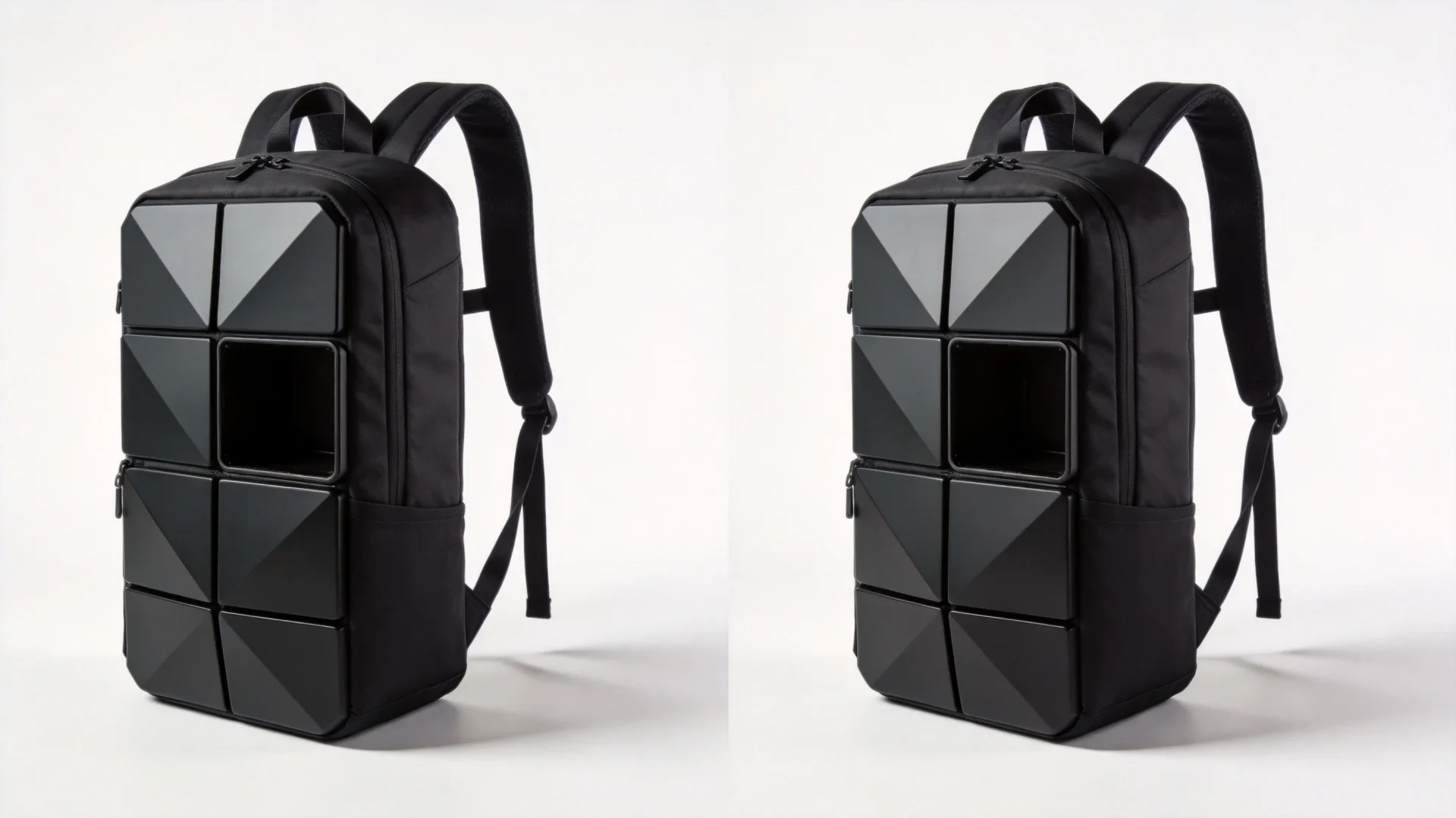
| Main shell & structure | Formed protective shell with a clean weather-resistant finish, semi-rigid profile | Soft, padded coated nylon shell | The formed shell adds a few US-dollars per bag and needs its own molds – real but bounded. |
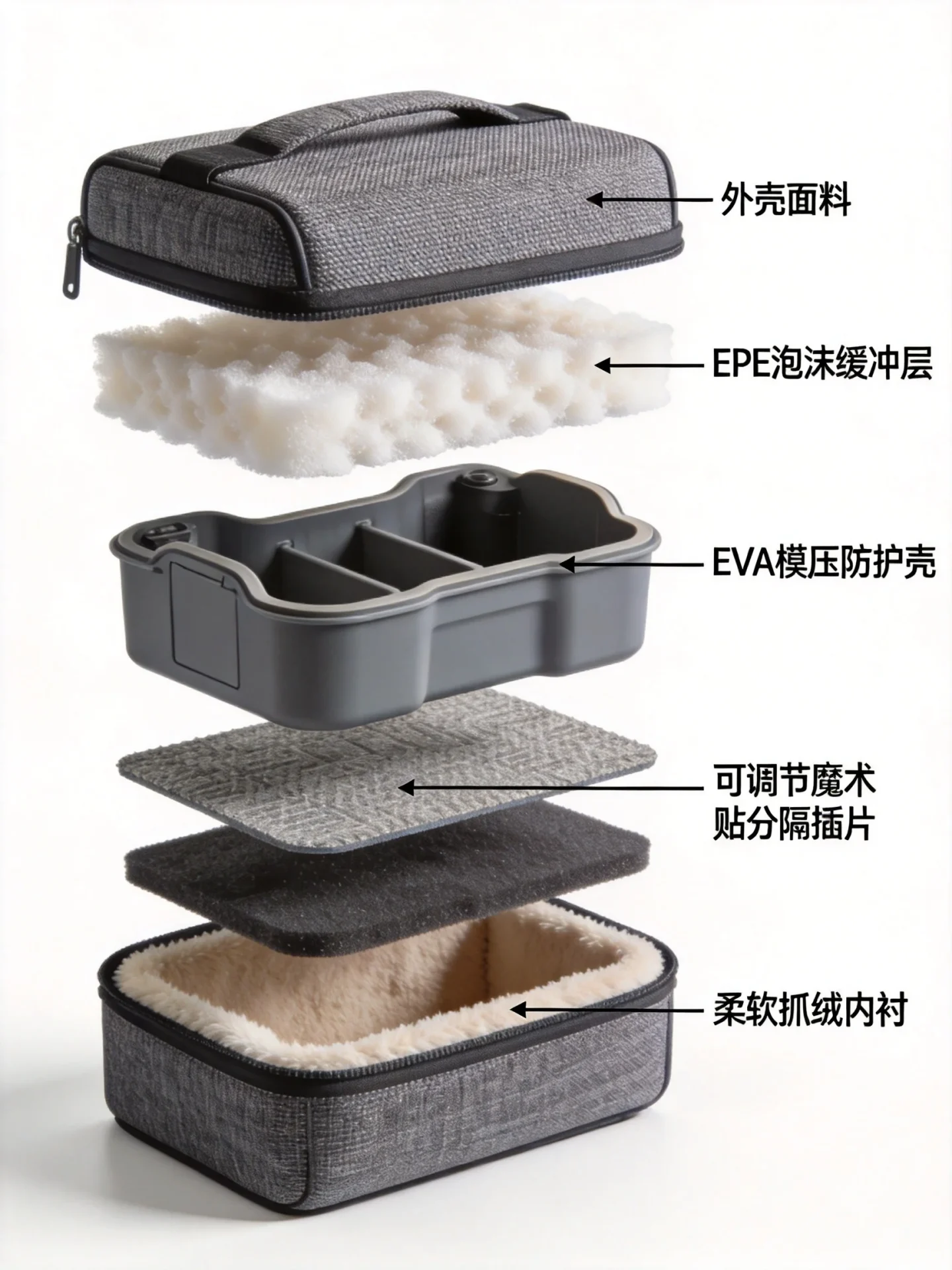
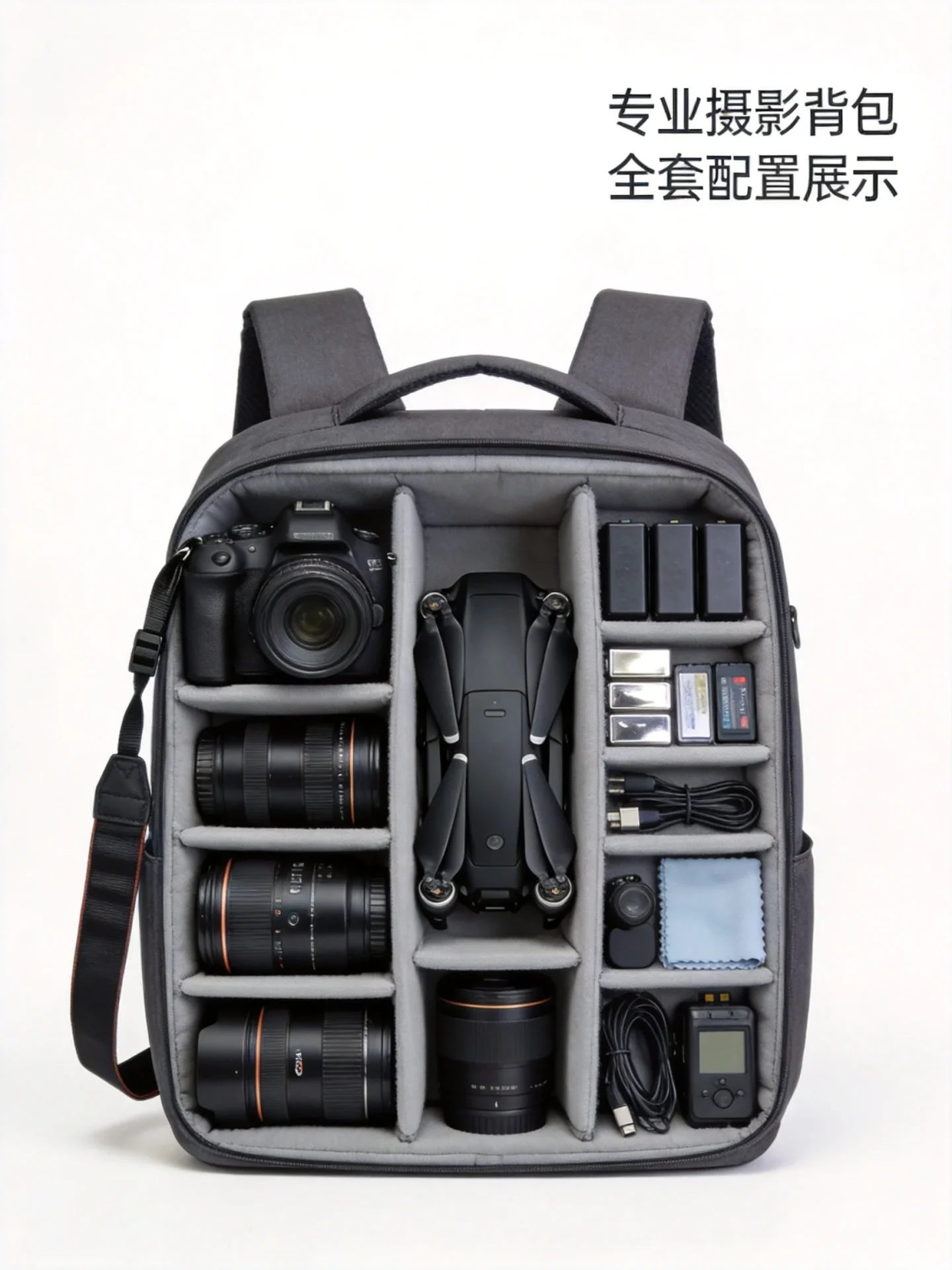
| Camera protection | Dense shock foam, formed padded walls, modular dividers sized to bodies/lenses | Standard padded insert with basic dividers | Denser foam and a walled, tooled compartment are a big genuine line. |
| Access system | Top/side/front multi-access with quick-open closures, magnetic/clasp hardware | Top- or single-open access | Multi-access engineering and quick hardware are a genuine premium – build, not cloth. |
| Laptop sleeve | Separate lockable padded sleeve (often on back panel) | Often shared or minimal sleeve | A dedicated, lockable padded sleeve is a real added cost. |
| Zippers & closures | Coated/TE-sealed premium zips, magnetic or clasp quick release | Standard YKK-grade zips | Repeated-failure point; the difference is durability and weather fit. |
| Lining & organizers | Premium soft-touch lining with organizer/wall layout | Clean standard lining | Modest line – a polished interior is a finish choice, not a protection upgrade. |
The takeaway: the fabric gap is real but bounded. The dense shock foam, formed walls, modular dividers, premium zips and the access system are what move the built price more – and all of them are the same spec a private-label buyer can source through an OEM.
4. The Tooling That Drives the Price
The cleanest way to see that you pay for engineering rather than just textiles is to measure what it takes to tool a formed-shell, foam-walled camera compartment. These molds are the same ones Peak Design amortizes across a big run – and the same ones a private-label buyer amortizes for a single order:
| Tooling / Mold Item | Typical Investment (USD) | Amortized Over | Approx. Cost Per Bag |
|---|---|---|---|
| Formed-shell / protective-body mold | $9,000–$18,000 | 5,000–10,000 pcs | $1.2–$2.8 |
| Dense camera-protection foam molds | $6,000–$12,000 | 5,000–10,000 pcs | $1–$2.2 |
| Modular divider / organizer-wall tooling | $4,000–$8,000 | 5,000–10,000 pcs | $0.8–$1.6 |
| Coated-fabric & laminated-layer setup | $2,000–$4,000 | Full run | $0.5–$1.5 |
| Brand plate / magnetic-clasp hardware tools | $1,000–$3,000 | Full run | $0.4–$1 |
Notice what the list contains: protection and access structure. The tools that turn a flat commuter bag into a “camera bag worth $250+” are tools for formed shells, dense-foam compartments, modular dividers and quick-access hardware – not a roll of special cloth. This is also the strongest argument for OEM/ODM: the same molds a premium brand amortizes across a big run are the same molds a private-label buyer gets to amortize. Our custom crossbody & sling bag sourcing guide walks through which protection and organizer features cost most to source.
5. How Each Bag Is Actually Built
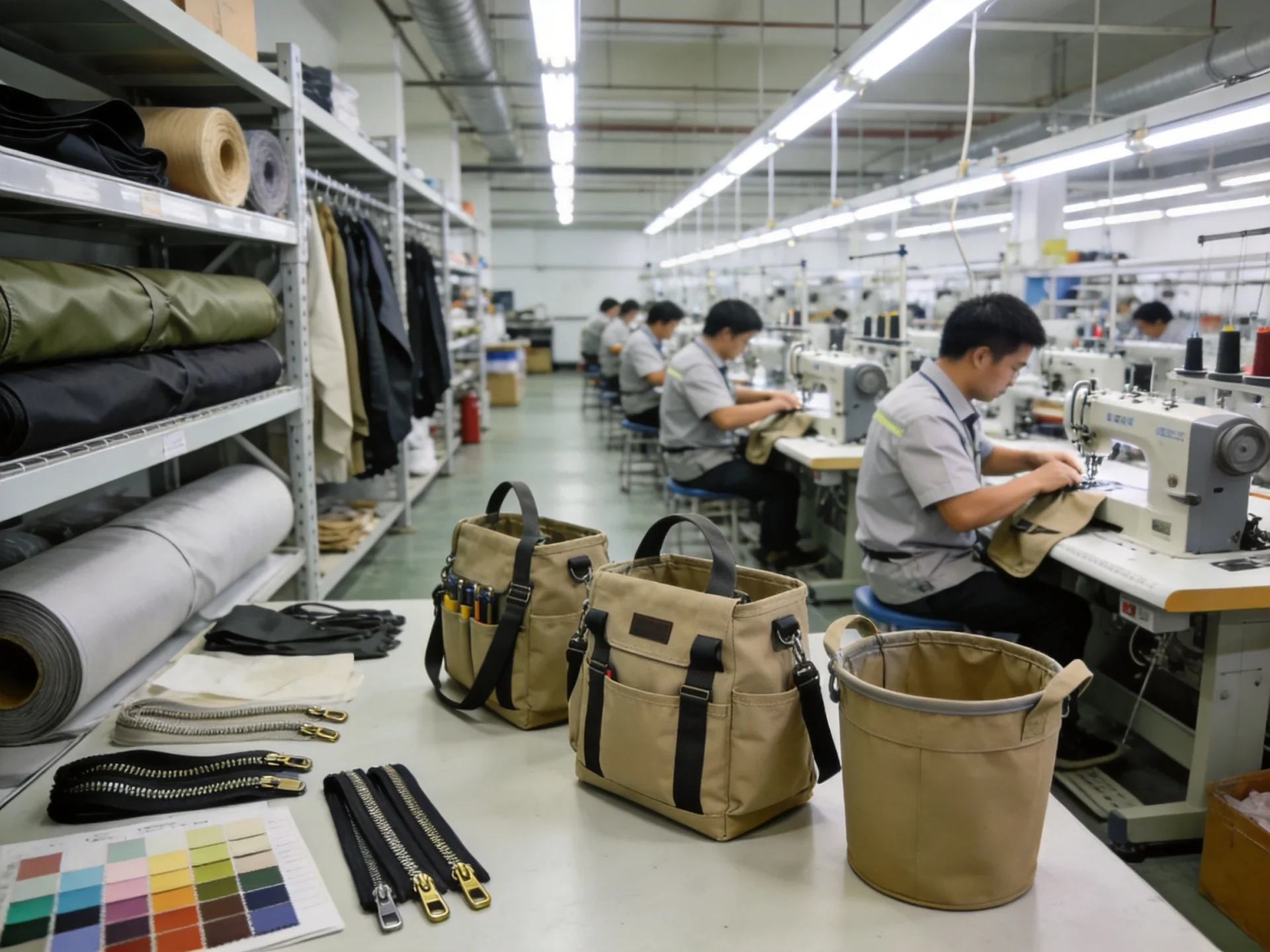
A camera bag, at either grade, travels through roughly 45–75 separate operations depending on dividers, padding, structure and access design. In our affiliated factory that runs across 7 production lines with 149 machines (126 sewing) and 137 staff, with a monthly line capacity of 200,000 pieces, the difference between an $18 build and a $50 build shows up in the steps themselves:
- Cutting & laminating — panels are cut from roll stock; the formed/coated shell and the value coated nylon are laid up and fused to lining.
- Padding & structure build — the value build inserts a standard padded camera sleeve; the premium build heat-presses dense shock foam into formed protective walls and a modular divider layout.
- Sewing & assembly — body, camera compartment, organizer walls, back panel and straps are joined in sequence, with stress points bar-tacked; premium tiers add a higher stitch-consistency standard.
- Hardware & access — zippers, magnetic/clasp quick-open hardware, lockable laptop closures and webbing are fitted; coated TE-sealed zips are a premium-tier line.
- Protection QC & packing — drop and load check of the camera compartment, zipper and stitch review, and premium boxing.
The measurable difference is operations per bag. A formed-shell, foam-walled, modular camera compartment absorbs more assembly and tooling time, pushing the structured class toward a build cost of roughly $35–$60 (typical) versus $15–$28 (typical) for a clean padded value build.
6. So Why the Premium? The Verdict
Here is the straight, factory-backed call:
- Peak Design genuinely builds a more protective, more engineered bag. Dense shock foam, formed protective walls, modular dividers, a lockable laptop sleeve and a quick-access closure system add roughly $12–$25 per bag (approx.) in true build content – real value for photographers carrying multiple bodies and lenses.
- Value camera bags are not junk – they are a real, cheaper grade. A clean padded camera build with basic dividers delivers solid everyday kit protection for roughly $40–$120 (approx.). For a single body and lens, it covers most real needs.
- The rest of the gap is the name. Beyond the true $12–$25 (approx.) of extra build content, the premium is absorbed by design, brand, lifetime warranty, distribution and retail margin. That is a real cost of doing business – but it is not a cost of making the bag.
- Match the protection to your kit, not your ego. If you carry one body and a lens on a desk-to-site shoot, a good value build is sufficient. If you carry multiple cameras, need quick top/side access or want a lifetime warranty, a structured build is worth the upgrade – and the best way to get it at a fair price is a clean-spec OEM delivery under your own label (see our top sling & crossbody camera bags and custom travel bag manufacturing guide).
The honest bottom line: Peak Design is fairly priced for what it engineers, but the premium is real yet over-stated by the name – and the same protection spec is buyable without the premium badge.
Bottom line: Peak Design bags are expensive because they mix genuine engineering with a premium brand. The true protection upgrade (dense shock foam, formed walls, modular dividers, lockable laptop sleeve, premium quick-access hardware) is worth roughly $12–$25 (approx.) per bag; the rest is the name, lifetime warranty, distribution and retail margin. Buy the protection and access you actually need, and source the engineering you want at a fair price – both are separate decisions, and both grades are buildable under your own label.
Build a Camera Bag at Either Grade Under Your Brand
JUNYUAN BAGS is a bag trading company backed by an affiliated factory in Quanzhou, Fujian – SGS-verified at 4,950 sqm, 7 production lines, 149 machines (126 sewing) and 137 staff, with a monthly line capacity of 200,000 pieces and a vetted partner-factory network. We have supplied 200+ brands across 100+ countries as of 2026. Whether you want a clean padded camera carry or a structured, foam-walled, modular camera backpack with a lockable laptop sleeve, we can spec it, sample it and ship it for your brand, shop or wholesale account.
Request a custom camera & sling bag OEM/ODM quote
See how custom backpacks are sourced end-to-end
FAQ: Why Peak Design Camera Bags Are Expensive
Why are Peak Design camera bags so much more expensive than value camera bags?
Because Peak Design sells a genuinely engineered protection system plus a premium brand. A structured build spends extra on dense shock foam, formed protective walls, modular dividers, a lockable laptop sleeve and premium quick-access hardware – worth roughly $12–$25 (approx.) in real build content. The rest of the roughly 2–3× retail gap is absorbed by design, brand, lifetime warranty, distribution and retail margin.
Is Peak Design actually better built than cheaper camera bags?
Genuinely, yes, in protection and access. Peak-Design-style builds add dense shock foam, formed padded walls, modular dividers sized to bodies and lenses, and coated/TE-sealed premium closures – a real $12–$25 (approx.) upgrade in build content. But both use durable coated materials, and for a single body and lens a value padded build covers most real protection needs at a fraction of the price.
What is the real price gap between Peak Design and value camera bags?
At retail roughly 2–3× – a Peak Design Everyday Backpack or camera sling typically runs $180–$340 (approx.) versus $40–$120 (approx.) for a capable value camera bag. But the built gap is far smaller: a structured camera build costs about $35–$60 (typical) to make versus $15–$28 (typical) for a padded value build – only about 1.5–2.2× in build cost.
Is the Peak Design premium worth it for a camera bag?
Yes, but only if you need that grade of protection and access. If you carry multiple camera bodies and lenses, need quick top/side access, or want a lifetime warranty and premium finish, the additional roughly $12–$25 (approx.) of true build content plus the brand service can be worth it. If you carry a single body and lens, a padded value build is sufficient – know you would otherwise be paying the name.
What are good budget alternatives to Peak Design that match?
Several clean-spec camera brands deliver similar padded, organizer-built camera carries at moderate prices, and value camera backpacks with basic dividers cover a single-body kit well. The durable, foam-walled, modular protection spec anyone wants is also buildable as a private-label OEM delivery that trims most of the brand margin. See our Peak Design camera bag alternatives guide for closely matched specs.
What makes Peak Design camera bags protective vs value bags?
Peak-Design-style builds add dense shock foam, formed protective walls, modular dividers sized to bodies and lenses, a dedicated lockable laptop sleeve and coated/TE-sealed premium closures with magnetic/clasp quick access. Value camera bags use a standard padded insert with basic dividers and standard zips – still protective for light kit, but with less structure, density and tooled access.
Can I get a camera bag built under my brand at either price point?
Yes. Both the padded value grade and the structured, foam-walled modular camera backpack grade are manufactured through global partners in the same specialized factories. Our affiliated factory works within a vetted partner-factory network and can spec a clean value camera carry or a structured, formed-shell, modular build to order for your brand.
How much does a camera bag cost to make?
A clean padded camera bag carries a factory build cost of roughly $15–$28 (typical); a structured camera backpack with dense shock foam, formed walls, modular dividers and a lockable laptop sleeve runs about $35–$60 (typical), depending on size, fabric grade, protection depth, access design and volume. Retail then adds a 2–3× or larger design-brand-distribution-warranty load.
Disclaimer: Retail and factory figures in this article are industry-typical approximations used to explain cost structure – not precise quotes or guaranteed prices. Actual pricing depends on your specification, volumes and prevailing conditions. Approx./typical labels apply to every figure above.
OEM perspective note: JUNYUAN BAGS operates as a bag trading and sourcing organization backed by an affiliated factory and partner factories in Quanzhou, Fujian. We do not claim to manufacture for any named brand, nor do we represent any brand’s proprietary design. Figures describe the open, buyable spec that any brand can source.