Launching a bag project on Kickstarter? Here’s the challenge: Manufacturing often consumes 30-50% of your funding, with material costs, prototyping, and shipping inflating budgets by 20-40%. The good news? You can cut production costs by 20-40% without sacrificing quality.
Key Takeaways:
- Material Choices: Polyester ($2–$5/yard) is affordable, while nylon ($3–$6/yard) offers durability. Recycled polyester (rPET) is eco-friendly and costs $3–$5.50/yard.
- OEM/ODM Services: Use pre-designed templates (ODM) or custom designs (OEM) to reduce design costs by up to 50%. Minimum order quantities start as low as 20–50 units.
- Shipping Tips: Opt for DDP (Delivered Duty Paid) to avoid hidden fees, and design packaging to avoid oversized charges.
Examples of Success:
- Nomad Sling Pack: Raised $380,000 by aligning production with backer rewards and using efficient prototyping.
- Urban Flex Backpack: Reached 428% of its funding goal by combining recycled materials with ODM services.
Bottom Line: Smart material selection, efficient production strategies, and streamlined logistics can help you deliver quality bags while staying within budget.
How much does it cost to make a backpack? (EP #1 – Building a Backpack)
sbb-itb-1e6451b
Selecting Affordable Materials for Custom Bags
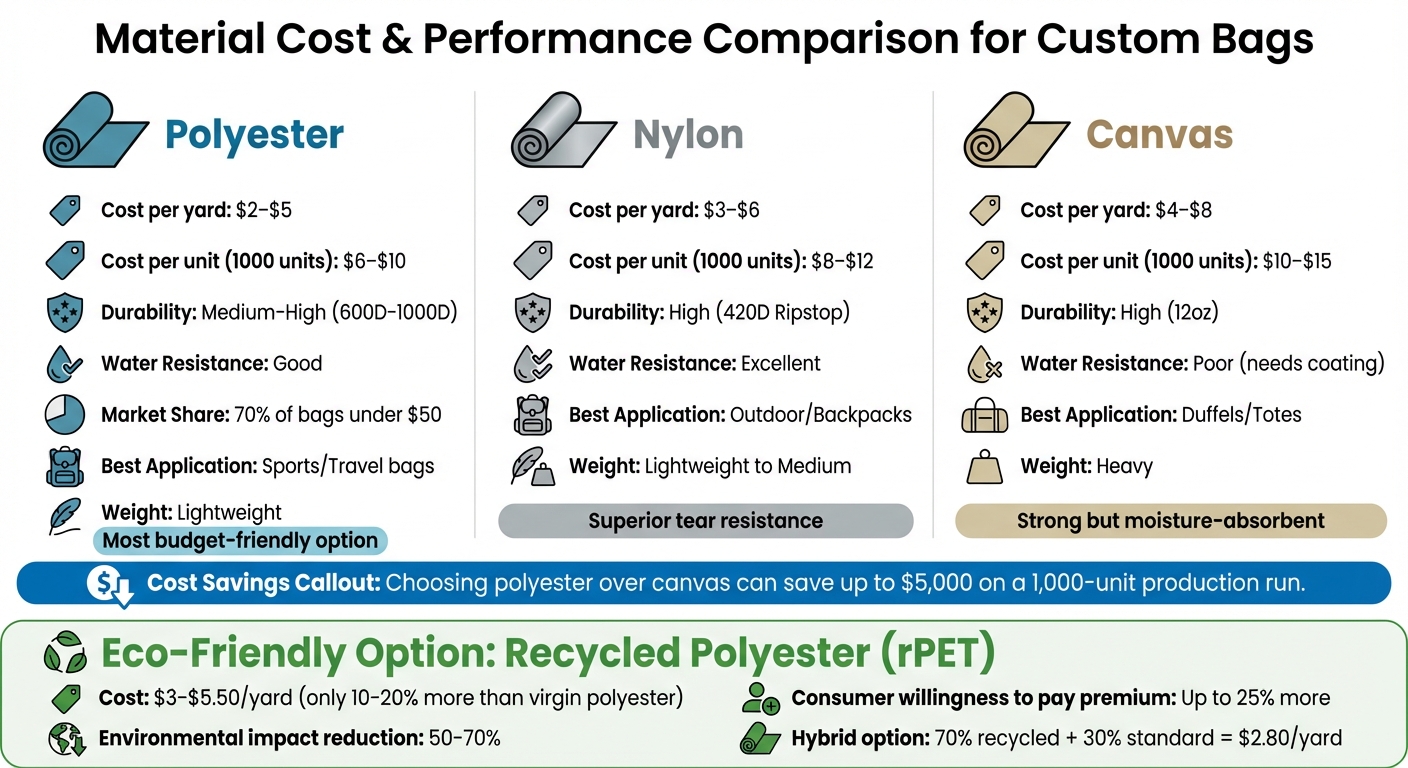
Custom Bag Materials Cost Comparison: Polyester vs Nylon vs Canvas
When it comes to custom bag production, material selection plays a key role in managing costs and earning backer trust. For Kickstarter projects, polyester is often the most budget-friendly option, priced at $2–$5 per yard. Nylon, costing $3–$6 per yard, is ideal for outdoor gear thanks to its water resistance. Canvas, priced at $4–$8 per yard, is a great choice for heavy-duty travel bags due to its strength, though it’s heavier and absorbs moisture unless treated.
For a production run of 1,000 units, these material costs stack up quickly. A standard 20×30-inch bag made from polyester will cost $6–$10 per unit in materials alone. The same bag in nylon costs $8–$12, while canvas pushes the cost to $10–$15. Opting for polyester over canvas could save up to $5,000 across the entire run – a significant difference for any campaign.
Material Options and Cost Comparison
Let’s dig deeper into these materials and their potential. Polyester dominates bag manufacturing, holding over 70% of the market for bags priced under $50. For Kickstarter projects, 600D to 1000D polyester strikes a balance between affordability and performance. At 600D, you get solid tear strength for daily use. If you need extra durability, 1000D polyester costs around $4 per yard and works well for high-impact sports bags.
Nylon, on the other hand, offers exceptional tear resistance and waterproofing, making it the go-to for outdoor backpacks. A popular choice is 420D ripstop nylon, which provides durability without adding too much weight. Canvas, while strong and visually appealing, has drawbacks – it’s heavier and absorbs moisture unless treated with a waterproof coating, which adds to the cost.
| Material | Durability | Water Resistance | Best Application |
|---|---|---|---|
| Polyester (600D) | Medium-High | Good | Sports/Travel |
| Nylon (420D Ripstop) | High | Excellent | Outdoor/Backpacks |
| Canvas (12oz) | High | Poor (needs coating) | Duffels/Totes |
Finding Eco-Friendly Materials Within Budget
For creators looking to stand out, eco-friendly materials are an emerging trend that resonates with backers. With 68% of consumers favoring sustainable bags and willing to pay up to 25% more for recycled options, it’s a strategy worth considering. Recycled polyester (rPET), made from plastic bottles, costs $3–$5.50 per yard – only 10–20% more than virgin polyester – while cutting environmental impact by 50–70%. Platforms like Alibaba offer GRS-certified rPET, and negotiating minimum orders down to 500 yards can help reduce costs by up to 15%.
A hybrid approach can further balance sustainability and cost. Mixing 70% recycled polyester with 30% standard polyester brings the price down to about $2.80 per yard while maintaining eco-friendly credentials. Highlighting this in your campaign – such as stating “70% recycled content, same durability as virgin materials” – can boost backer engagement. Similar campaigns have reported pledge increases of up to 25%. For those targeting premium markets, organic canvas is another option. Priced at $5–$9 per yard through GOTS-certified suppliers, it’s ideal for campaigns where natural fibers align with backer priorities, despite its higher cost.
Using OEM/ODM Services to Reduce Manufacturing Costs
Once you’ve chosen cost-effective materials, the next step is to focus on efficient production strategies, and that’s where OEM/ODM services come into play.
For Kickstarter creators working with limited budgets, OEM (Original Equipment Manufacturer) and ODM (Original Design Manufacturer) services offer a way to produce high-quality bags without breaking the bank. OEM allows you to manufacture bags based on your exact design specifications, while ODM lets you tweak an existing design by adding your branding and selecting materials. This method can slash design costs by 30–50%, as the manufacturer has already handled the initial research and development. This means fewer upfront expenses and a smoother campaign launch. Just as selecting the right materials balances cost and quality, choosing the right OEM/ODM partner ensures efficient production.
The savings don’t stop at design. Partnering with an established manufacturer often means benefiting from economies of scale and shared tooling, which can lower production costs by 20–40%. At the same time, quality remains a priority, with many manufacturers operating ISO-certified facilities equipped with automated sewing lines and strict quality control processes that keep defect rates under 1%. For a Kickstarter project, this balance is essential – you need to deliver high-quality bags that meet backer expectations without overspending. These cost savings also open the door to a more adaptable production process, which is outlined below.
JUNYUAN BAGS‘ OEM/ODM Services for Kickstarter Projects
JUNYUAN BAGS tailors its services specifically for crowdfunding creators who need flexibility. Their OEM services start with minimum order quantities of 50–500 units, while ODM projects can go as low as 20–100 units.
They also offer free design consultations and 3D drawing services, eliminating the need for external design fees, which can range from $5,000 to $15,000. For example, a sports duffel bag campaign that raised $120,000 saved these design costs by using JUNYUAN’s in-house team, allowing the creators to allocate more funds toward marketing.
For fulfillment, JUNYUAN provides DDP (Delivered Duty Paid) shipping, handling customs and duties while delivering products directly to your backers. This streamlined logistics approach cuts out third-party overhead and simplifies international delivery. A great example is the Nomad Sling Pack campaign, which raised $380,000 from 1,200 backers and achieved a 450% funding rate thanks to efficient delivery.
Custom Design Process from Concept to Production
The custom design process is another way to ensure your bags meet backer expectations while keeping costs under control. This step-by-step approach reduces expenses and guarantees high-quality results.
It all starts with an idea and a design consultation. JUNYUAN’s team reviews your concept, target audience, and Kickstarter positioning. After submitting sketches, you’ll receive 2D/3D mockups and a detailed cost breakdown within 3–5 days, giving you a clear view of how design choices impact per-unit pricing.
Next is prototype production, where 1–2 samples are created at $50–$100 each. This stage includes 2–3 design iterations to resolve any issues before moving to bulk production. The Urban Flex Backpack project used this iterative approach with ODM services and recycled materials, achieving 428% of its funding goal, attracting over 1,000 backers, and earning Kickstarter’s "Project We Love" badge.
Bulk production takes about 4–6 weeks and includes rigorous quality checks. For creators planning their campaigns, starting the sampling process 2–3 weeks before launch ensures you’ll have professional product photos for your campaign and can confidently commit to delivery timelines. This end-to-end workflow – from concept to final shipment – is designed to minimize costly revisions, stay within budget, and deliver bags that truly resonate with backers.
Practical Cost-Saving Strategies for Bag Manufacturing
There are smart ways to cut production expenses while staying on track with your Kickstarter timeline. These tactics build on material and production strategies, helping you save money and speed up your campaign without compromising quality. Let’s dive into some specific steps you can take.
Bulk Ordering and Minimum Order Quantity Negotiation
One key way to manage costs is by optimizing your Minimum Order Quantity (MOQ). For example, ODM (Original Design Manufacturer) services usually require orders of 20–100 units, while full OEM (Original Equipment Manufacturer) customization typically starts at 50–500 units. For Kickstarter campaigns, this distinction can be a game-changer. Choosing existing ODM designs with minimal tweaks – like preset pocket layouts or standard laptop sleeves – can significantly cut upfront costs. Customizing only key elements, such as fabric or logo, allows you to create a unique product without overspending.
A great tactic is to match your campaign’s early-bird rewards with the manufacturer’s lowest MOQ. This alignment ensures you’re not overproducing while still meeting backer expectations. Once your MOQ strategy is in place, you can focus on streamlining the development process to save even more time and money.
Streamlining the Sample Approval Process
Time is money, especially during a Kickstarter launch. Before committing to physical samples, request 3D drawings to identify structural flaws early. This step can save you from wasting materials and labor on designs that might not work. Typically, the prototype development cycle lasts about 7–12 days, with limited opportunities for revisions.
To make the most of this cycle, consolidate all feedback into one clear set of revisions. This approach minimizes extra sampling fees and keeps you within the standard iteration window. Plus, a well-made physical sample can double as both a quality check and a marketing tool, eliminating the need for a separate prototype for campaign photography.
With production optimized, it’s time to focus on shipping strategies to protect your margins.
Lowering Shipping and Logistics Expenses
Shipping can quietly eat into your profits if not carefully managed. Opt for DDP (Delivered Duty Paid) shipping to handle customs, duties, and taxes upfront. This approach simplifies logistics and avoids unexpected costs. Also, design your packaging to fit standard dimensions – oversized boxes can add $3–$8 per unit in extra charges.
During prototyping, work closely with your manufacturer to create packaging that avoids these surcharges. Additionally, choosing a manufacturer that offers direct-to-backer fulfillment can cut out warehousing and double-handling fees. To further streamline logistics, plan your first production batch around early-bird rewards. This staggered shipping approach helps smooth out cash flow and simplifies delivery timelines. For the best results, request detailed quotes from your manufacturer that cover all production and shipping phases.
Kickstarter Campaign Examples Using Budget-Friendly Manufacturing
Real campaigns show how smart manufacturing choices can lead to funding success. Two projects from 2025 highlight how collaborating with JUNYUAN BAGS helped creators balance cost, quality, and backer satisfaction.
Sports Bag Campaign Success Through Bulk Ordering
In 2025, the Nomad Sling Pack campaign focused on outdoor enthusiasts by offering a versatile and functional bag design. The creator teamed up with JUNYUAN BAGS, utilizing a 50-unit minimum order quantity (MOQ) that aligned perfectly with early-bird rewards, helping to keep costs under control. Custom waterproof zippers were integrated into a thoughtfully planned production process, ensuring durability in key areas. This approach paid off – raising $380,000 from over 1,200 backers and achieving a 450% funding rate. Rapid prototyping, completed within 7–12 days, provided high-quality visuals while saving time and money.
This campaign demonstrates how bulk ordering and efficient prototyping can drive success.
Balancing Sustainability and Affordability in Material Selection
The Urban Flex Backpack campaign in 2025 took a different route, leveraging JUNYUAN BAGS’ Original Design Manufacturing (ODM) services. By customizing an existing design, the creator introduced recycled materials and added features like specialized laptop sleeves. This method cut development costs while appealing to eco-conscious backers. The campaign reached 428% of its funding goal, supported by over 1,000 backers, and earned Kickstarter’s "Project We Love" badge. By using recycled nylon and rPET fabrics, the creator met sustainability goals without overspending. Additionally, the ODM approach, with its lower MOQ of 20–100 units, made the project accessible to first-time creators working with limited budgets.
These examples highlight how tailored manufacturing strategies can help creators overcome budget challenges while maintaining quality. Strategic partnerships like these prove essential for launching cost-effective and successful Kickstarter campaigns.
Conclusion
Launching a successful Kickstarter campaign for custom bags doesn’t demand a massive budget – it requires smart manufacturing choices. By combining affordable materials, adaptable OEM/ODM partnerships, and effective cost-saving methods, you can manage production expenses while maintaining the quality your backers expect.
The results speak for themselves. Campaigns like the Nomad Sling Pack, which raised $380,000, and the Urban Flex Backpack, funded at 428%, prove that balancing cost and quality is achievable. These projects succeeded by using strategies such as low minimum order quantities, quick prototyping, and carefully selected materials.
JUNYUAN BAGS embraces these principles with MOQs as low as 20–100 units for ODM and 50–500 for OEM, ensuring production scales with your campaign needs. Their 7–12 day prototyping turnaround helps creators stay on schedule, while their access to eco-friendly materials like rPET and recycled nylon aligns with the growing demand for sustainable options.
Whether you’re a newcomer or a seasoned entrepreneur, partnering with the right manufacturer is essential. JUNYUAN BAGS offers design consultations, flexible production options, and integrated logistics to help you turn budget limitations into opportunities. With over 20 successful crowdfunding campaigns under their belt, they understand the unique challenges Kickstarter creators face – and how to overcome them.
FAQs
How do I pick the right fabric weight (like 600D vs 1000D) for my bag?
To pick the right fabric weight, consider the balance between durability, weight, and cost, aligning it with your campaign’s objectives. For rugged, performance-focused, or outdoor bags, heavier fabrics like 1000D nylon offer excellent durability. On the other hand, lighter fabrics such as 600D nylon are more affordable and reduce overall weight, making them a smart choice for casual or budget-conscious designs. Keep in mind, your fabric selection impacts both production costs and how customers perceive the quality of the product.
Should I use OEM or ODM for my first Kickstarter bag launch?
When launching your first Kickstarter bag, choosing between OEM and ODM depends on your goals and resources.
If you want complete control over the design, materials, and branding, go with OEM. However, this option comes with higher upfront costs – ranging from $5,000 to $20,000 or more – and requires larger minimum orders, typically 500 to 1,000 units.
On the other hand, ODM is a quicker and more budget-friendly choice. With production timelines of 4 to 8 weeks and costs between $0 and $2,000, it’s perfect for testing the waters with a smaller budget and a shorter timeline.
How can I avoid surprise shipping and duty fees to U.S. backers?
To avoid unexpected shipping and duty fees for U.S. backers, opt for DDP (Delivered Duty Paid) shipping. This approach covers all customs fees and import duties upfront, so backers won’t face extra charges when their package arrives. Working with a manufacturer familiar with DDP shipping can make the process smoother and more straightforward. Be sure to clearly explain your shipping terms in your campaign to set proper expectations and minimize confusion.
Related Blog Posts
- FAQs on Lightweight Materials for Custom Bags
- The Ultimate Guide to Custom Bags for Kickstarter Creators
- Backpack Design Tips to Boost Kickstarter Funding
- Eco-Friendly Custom Bags for Sustainable Crowdfunding Projects
? Related: Looking for a comprehensive guide to bag sample development? Check out our Complete Guide to Bag Sample Development & Prototyping — covering sample types, design process, testing, timeline, costs, and common mistakes.