Want to launch your crowdfunding campaign on time? The key is fast and efficient bag prototyping.Without a physical sample, you can’t create the visuals or videos that attract backers.Delays in sampling often lead to missed deadlines and frustrated supporters.Here’s how to stay on track:
Straight Answer
MOQ 500 pieces ·Sampling 6-10 days ·Production 35-50 days ·AQL 2.5 inspection ·Sample fee refunded on volume order.JUNYUAN BAGS (QUANZHOU JUNYUAN COMMERCIAL AND TRADING CO., LTD.), an SGS-verified OEM/ODM bag factory (about 200,000 pieces/month, 7 lines, 149 machines, 137 workers) serving 200+ brands in 100+ countries, supports Kickstarter bag projects end to end.
- Define clear specifications upfront: Lock in bag dimensions, materials, and features early to avoid costly revisions.
- Partner with fast prototyping manufacturers: Companies like JUNYUAN BAGS deliver samples in 7–12 days, far faster than the industry average.
- Use project management tools: Streamline communication with suppliers to avoid approval delays and track progress in real time.
- Opt for pre-approved materials: Choose readily available fabrics and hardware to cut down on sourcing time.
- Plan for small MOQ production: Start with smaller batches (50–500 units) to fulfill early backer rewards quickly.
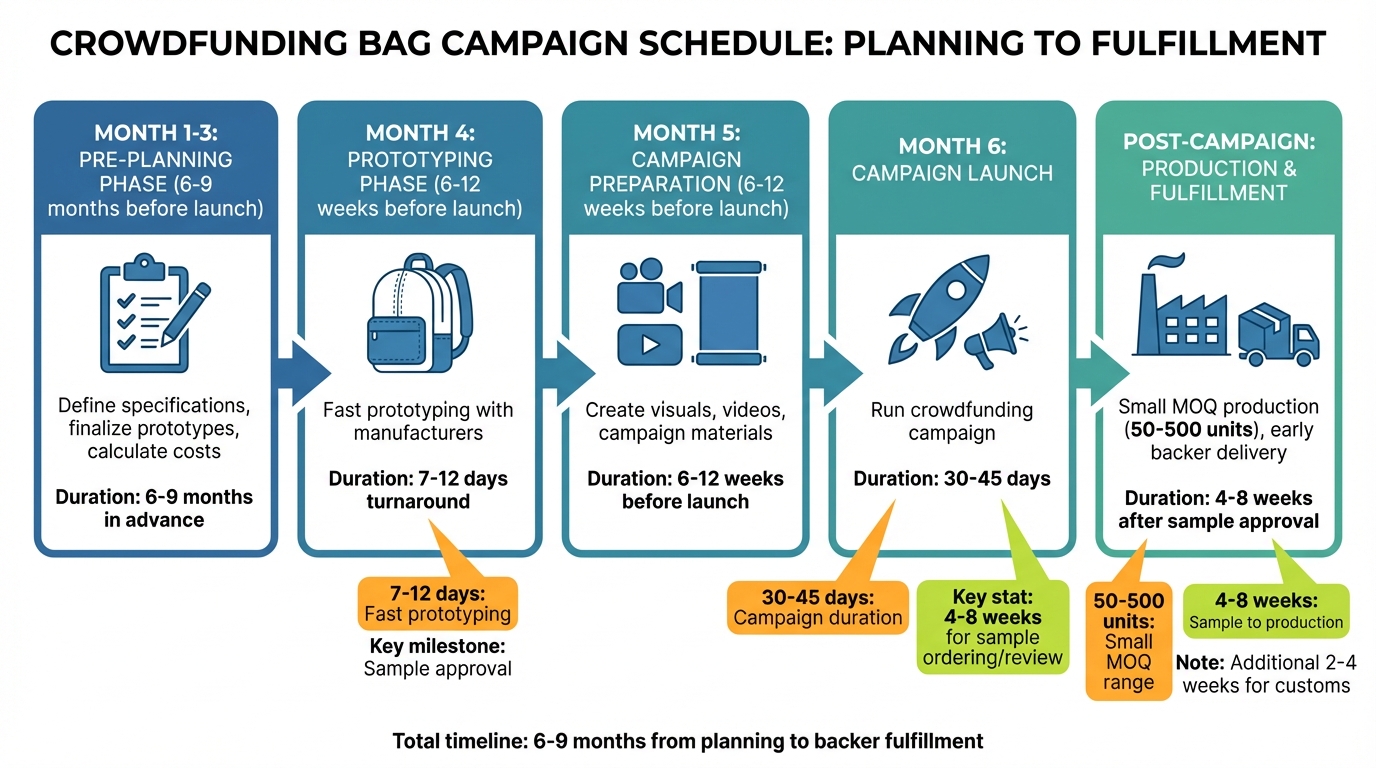
Crowdfunding Bag Campaign Timeline: 6-Month Planning Schedule
Step 1: Define Bag Specifications and Reward Tiers Early
Set Clear Campaign Goals and Reward Tiers
Starting a crowdfunding campaign without clear goals can lead to unnecessary delays.To avoid this, create a detailed product brief before reaching out to manufacturers.Include specifics like dimensions, materials, and structural elements – such as laptop sleeves or waterproof zippers – and explain how these features align with your reward tiers.
Take the Urban Flex Backpack campaign as an example.The creators collaborated with an ODM design service to finalize the specifications for a modular backpack.It included custom laptop sleeves and recycled materials, appealing to professional users.This upfront planning helped them exceed their funding goal by 428% and earned them the Kickstarter "Project We Love"badge.By locking in these details early, they sped up prototype iterations and stayed on schedule.
Your reward tiers should guide the features and production quantities of your bag.Finalizing these designs before sampling ensures that you can calculate your minimum order quantity (MOQ) and production costs accurately, allowing you to price your rewards in a way that covers fulfillment expenses without straining your budget.
Once you’ve set clear specifications and reward tiers, finalize your design to avoid unnecessary delays later.
Standardize Design Requirements
After finalizing your specifications, standardizing your design requirements is critical to staying on track.Design changes mid-process can derail your timeline and inflate costs.For example, filmmaker Dan Mirvish launched his Atomic Fondue Kickstarter in March 2026 with pre-approved tote bag samples from a print-on-demand service.This preparation ensured he was ready with unboxing videos for Sundance and Slamdance and could submit orders just one week after the campaign ended.
"Campaign rewards fulfillment is still an area that can thwart many crowdfunders"
Standardizing your design early also helps avoid overpromising.One filmmaking team learned this lesson the hard way – they raised $126,000 but later realized fulfilling their perks would cost $150,000 and take two years to complete.Defining materials like rPET, recycled nylon, or organic cotton upfront ensures availability for your prototypes and aligns with any sustainability messaging in your campaign.Making these decisions early eliminates delays during the sampling phase, helping you meet your crowdfunding deadlines.
sbb-itb-1e6451b
Step 2: Choose Manufacturers with Fast Prototyping like JUNYUAN BAGS
Why Fast Prototyping Matters
Crowdfunding campaigns often operate on tight schedules, where even minor delays can throw off the entire timeline.According to Kickstarter’s fulfillment guidelines, the first 4-8 weeks after launching a campaign are typically set aside for ordering and reviewing samples before moving into production.For campaigns that last the recommended 30-45 days, every single week counts.This is where fast prototyping becomes a game-changer – it shortens the sampling phase, allowing you to refine designs quickly while maintaining high-quality standards.
Fast prototyping doesn’t just save time;it ensures your product is ready to meet backer expectations.It also allows you to create accurate campaign visuals and promotional materials ahead of launch.Without this speed, you risk unveiling incomplete designs or missing critical deadlines, which can harm your credibility with potential backers.JUNYUAN BAGS stands out by offering a proven fast-track approach to prototyping, making them a reliable choice for time-sensitive campaigns.
Benefits of Choosing JUNYUAN BAGS
JUNYUAN BAGS offers a range of advantages that make it easier to meet the tight deadlines of crowdfunding campaigns.For starters, they deliver custom samples within 7-12 days of design confirmation, significantly faster than the industry norm of 4-8 weeks.This quick turnaround has already supported over 20 successful crowdfunding campaigns.Take the Nomad Sling Pack project as an example – using JUNYUAN BAGS’ rapid prototyping and low 50-unit MOQ, they launched a waterproof sling pack that raised $380,000 from more than 1,200 backers, achieving a 450% funding rate.
Speed doesn’t come at the cost of quality.JUNYUAN BAGS operates through ISO9001 and BSCI certified facilities and follows a rigorous 5-stage quality control process.This includes material inspections, in-process checks, and AQL Level II pre-shipment audits.They also provide digital or 3D mockups before physical production begins, helping to minimize revision cycles and ensure design precision.Additionally, all materials comply with REACH, RoHS, and California Proposition 65 safety standards, so you can transition smoothly from samples to full-scale production.
The company further enhances efficiency with free 24-hour quotes and real-time support via WhatsApp and WeChat, eliminating delays in communication and approvals.Their flexible MOQs – ranging from 20-100 units for ODM and 50-500 units for OEM – are ideal for crowdfunding budgets, enabling you to offer early bird rewards without overcommitting financially.Plus, sample fees are 100% refundable once you place a bulk order.This streamlined process not only helps you stick to your timeline but also sets the stage for a successful campaign launch.
Step 3: Use Project Management Tools to Improve Supplier Communication
Speed Up Approvals and Updates
Clear and fast communication with suppliers is crucial to sticking to the 7–12 day prototyping window required for your crowdfunding campaign.Did you know that poor communication is responsible for 80% of project failures?To avoid this, use project management tools to centralize design files, feedback, approvals, and timelines, allowing for real-time updates and tracking.
Mobile apps and instant notifications make it easy to approve design changes on the fly.For example, when JUNYUAN BAGS sends updated 3D mockups or material samples, you can review and respond immediately using your chosen platform.Teams using visual task boards have reported a 25% boost in project completion rates.Additionally, automation features can save up to 10 hours per month by managing routine follow-ups and status updates automatically.These tools eliminate approval delays and cut down on lengthy email threads, keeping your project on track.
To further streamline communication, integrate file-sharing services like Google Drive or Dropbox so suppliers always have access to the latest technical drawings.Shared calendars can help you track deadlines for prototype iterations and testing schedules.Quick virtual check-ins can address any roadblocks, improving team coordination and increasing engagement by 30%.All of this helps ensure you maintain the tight prototyping timeline that JUNYUAN BAGS provides.
The key is to choose a tool that fits seamlessly into your team’s workflow.
Comparison of Project Management Tools
Here’s a quick comparison of popular project management tools to help you decide which one suits your needs best:
| Tool Name | Best For | Strength | User Satisfaction |
|---|---|---|---|
| Trello | Simple project management | Intuitive Kanban boards that enhance visual tracking | 4.3/5 |
| Asana | Enterprise companies | Connects daily tasks to high-level campaign goals | 4.5/5 |
| Monday.com | Small businesses | Highly visual interface with automation features that save ~10 hours/month | 4.6/5 |
| ClickUp | Startups and small teams | Combines tasks, documents, and goals in one platform | 91% satisfaction |
| Jira | Development-focused teams | Advanced Agile tracking that can reduce turnaround time by 40% | 4.4/5 |
Most of these tools offer free trials, so you can test their features before making a commitment.Annual subscriptions often provide savings compared to monthly plans.By leveraging these tools, you can improve communication efficiency and keep your operations aligned with the tight deadlines of your crowdfunding campaign.
Step 4: Speed Up Material Selection for Faster Approvals
Use Pre-Approved Material Libraries
Cut down on sampling delays by opting for materials that manufacturers already have in stock.Instead of waiting for custom weaving or dyeing processes, you can prototype using materials that are ready to go.
For example, pre-certified OEKO-TEX fabrics have already passed stringent safety and environmental checks, eliminating the need for additional compliance testing.To streamline your planning, request a material swatch book early on.This lets you match your design with "ready-to-ship"fabrics, which significantly speeds up prototyping.Using pre-existing ODM configurations is much faster than developing custom OEM solutions, helping you stay on track with your crowdfunding timeline.
Additionally, pre-sourced hardware like waterproof zippers, buckles, and straps ensures immediate availability, sparing you the delays that come with custom parts.By relying on pre-approved materials, you also naturally incorporate eco-friendly choices, which can further simplify and accelerate the production process.
Choose Readily Available and Eco-Friendly Materials
Taking it a step further, selecting eco-friendly materials not only supports sustainability but also keeps your project moving quickly.Common options like rPET (recycled polyester), recycled nylon, and organic cotton are widely stocked, enabling prototypes to be developed in just 7–12 days.These materials also resonate with eco-conscious backers, potentially earning your project recognition through platforms like Kickstarter’s "Projects We Love", which can boost credibility and attract more supporters.
When choosing materials, consider how they align with your logistics.Lightweight, durable options make shipping and fulfillment easier to manage during your campaign.Look for certifications like GRS or OEKO-TEX to avoid delays tied to verification.For ODM projects, flexible minimum order quantities – ranging from 20 to 100 units – make these materials ideal for early-bird rewards, keeping costs manageable.
| Material Type | Availability | Common Certifications | Crowdfunding Benefit |
|---|---|---|---|
| rPET / Recycled Nylon | High (Stocked) | OEKO-TEX, GRS | Quick sampling;appeals to eco-conscious backers |
| Organic Cotton | High | OEKO-TEX | Sustainable branding;ideal for soft goods |
| Waterproof Synthetics | Moderate | Manufacturer Tested | Perfect for outdoor/tech-focused products |
Step 5: Set Up Quality Checks and Sample Testing Schedules
Create a Quality Control Checklist
A well-structured quality control checklist is your best ally for speeding up approvals and avoiding costly revisions during the prototyping phase.By standardizing the evaluation process, you ensure every prototype is assessed consistently.Your checklist should include key areas like:
- Stitching consistency and durability
- Material quality and texture
- Hardware functionality (zippers, buckles, D-rings)
- Color accuracy compared to your specifications
- Dimensional accuracy (length, width, depth, and strap lengths)
- Weight verification
- Overall functionality tests, such as load-bearing capacity
Focusing on these details helps you catch potential issues early, keeping the process on track.Pay extra attention to critical features like seam strength, zipper durability, and strap load capacity, as these directly affect how satisfied your backers will be.Less pressing concerns, such as slight color variations, can often wait until after your campaign.This way, you maintain high standards without getting stuck chasing perfection.
Keep detailed records, including dated photos, checklists, and revision logs.Not only does this create an audit trail for your team, but it also builds trust with your backers by showing them the steps you’re taking to ensure quality.
Set Realistic Testing Schedules
Planning your testing schedule in phases can help you stay efficient and organized.A good timeline might look like this:
- 1–2 weeks for visual inspections
- 1–2 weeks for functional testing
- 1 week for final approval
Additionally, allow for a 1–2-week buffer for each revision cycle, as 2–3 iterations are common.The first 4–8 weeks after your campaign are usually spent ordering and reviewing samples, with final approval from the creator required before production starts.
To stay ahead, aim to complete your sampling phase before launching your campaign.Ideally, start planning at least 5–6 months before your campaign begins.This gives you enough time to finish manufacturing and prototype checks without putting unnecessary pressure on your crowdfunding timeline.A thorough testing phase ensures your prototypes are up to par before moving to small MOQ production.
Step 6: Plan Small MOQ Production After Sample Approval
Why Small MOQ Production Makes Sense
Once your sample is approved, it’s time to move into small MOQ (Minimum Order Quantity) production.This step is ideal for meeting campaign deadlines, especially when you need to fulfill early backer orders quickly.Producing in smaller batches – typically between 50 and 500 units – allows you to deliver rewards to your first supporters within 4–8 weeks of sample approval.Early delivery for backers, particularly those in early-bird reward tiers, helps generate positive feedback and builds trust while your larger production run is still in progress.
Another advantage?Flexibility.Small MOQs let you gather real feedback from your initial customers.Instead of committing to a massive production run, you can test the waters, refine designs, or tweak materials before scaling up.This phased approach reduces risks and helps you avoid issues like overstocking or delays caused by customs inspections, which can add an extra 2–4 weeks to your timeline.
JUNYUAN BAGS: A Partner for Small MOQs
JUNYUAN BAGS understands the needs of crowdfunding campaigns and offers tailored small MOQ solutions.For OEM projects, they can produce as few as 50 units, while ODM projects can start with just 20–100 units.Their rapid prototyping process, which takes only 7–12 days, ensures you can move seamlessly from sample approval to production.
Logistics are also simplified with JUNYUAN BAGS’ DDP (Delivered Duty Paid) shipping service.This means they handle customs clearance and deliver directly to your backers, taking a huge burden off your plate.Whether you’re shipping early-bird rewards or preparing for larger core shipments, their flexible MOQ options make it easier to scale production without worrying about excess inventory.
How to make a backpack (Intro – I’m documenting my journey!)
Meeting Your Crowdfunding Deadline with Efficient Sampling
To meet your crowdfunding deadlines, preparation is key.Start planning 6–9 months in advance.During this time, you’ll need to finalize your prototypes, set your manufacturing timeline, and calculate per-unit costs.These steps should be completed at least 6–12 weeks before launching your 30–45-day campaign.This early groundwork ensures you’re ready to deliver on your promises and sets the stage for smooth communication with suppliers.
Maintaining clear and consistent communication with your manufacturer is essential.Aim for rapid prototyping with a 7–12 day turnaround.This approach allows you to approve samples quickly and keep your backers informed with accurate updates.Sharing detailed progress reports builds trust and reassures supporters with a clear delivery plan.
To streamline your sampling process and avoid delays, focus on these key strategies:
- Finalize specifications early.
- Use fast prototyping methods.
- Choose pre-approved materials to minimize back-and-forth.
- Enforce quality checks to ensure consistency.
- Plan for small MOQ (minimum order quantity) production.
FAQs
What should I send a bag manufacturer to start sampling fast?
To get samples made faster, provide a detailed tech pack that includes precise measurements, material specifications, and assembly instructions.Add clear design sketches or digital renderings to eliminate guesswork.Be specific about your preferences for materials, hardware, and any custom features you want to include.Strong communication is key – partner with manufacturers who specialize in fast prototyping (think 7-14 days) to keep the process moving efficiently.
How many prototype rounds should I budget for before launch?
Before launching your product, it’s wise to plan for 2 to 3 rounds of prototyping.On average, creating a sample takes about 2 to 4 weeks.During this time, you’ll likely need a few revision cycles to fine-tune the materials, features, and overall design.This process helps ensure the final product matches your campaign goals and meets the desired quality standards.
When should I choose small MOQ production vs.full production?
Opting for small MOQ (Minimum Order Quantity) production is a smart way to test your design, gauge market interest, and reduce financial risk before committing to large-scale production.This strategy is especially helpful for crowdfunding campaigns with strict timelines, as it lets you fine-tune your product without the pressure of overproducing or overinvesting.
Frequently Asked Questions
How do I write a tech pack fast?
Share a reference bag or sketch, and our engineers build the tech pack for you.You approve materials and hardware against a checklist, not from scratch.
How many sample rounds do I have time for?
Plan 1-2 rounds inside a typical campaign runway.Lock materials and fittings in round 1 to protect the 35-50 day production run.
Should sampling and material ordering run in parallel?
Yes.Order long-lead materials like custom hardware or imported fabric while sampling proceeds, so production is not blocked later.
How do you report sampling progress?
We share photo updates at each sampling milestone and a physical sample for your final approval, so you can track against your launch calendar.
Can you match an existing foreign sample?
Yes.Ship a reference sample and we reverse-engineer dimensions, materials and construction, then sample to match within the 6-10 day window.
What if my Kickstarter deadline is fixed?
Tell us your drop-dead shipping date early.We hold confirmed production slots and can compress the 35-50 day run around it.
What delays sampling most?
Waiting on fabric approval, unresolved hardware specs, and back-and-forth sample changes.Locking decisions in one round is the biggest time saver.
What is the fastest sample we can get?
For standard bags with confirmed materials, our sampling window is 6-10 days from brief approval.Complex hardware or imported fabric can extend it, so prep the pack early.
How can I speed up bag sampling?
Finalize your tech pack and materials before the sample clock starts, use standard hardware for the prototype, and request photo reviews.A complete brief lets us deliver a physical sample in 6-10 days.
Do sample fees slow me down?
No.Sample fees are refunded on a confirmed volume order, so you can move forward without treating sampling as a sunk cost.
Related Blog Posts