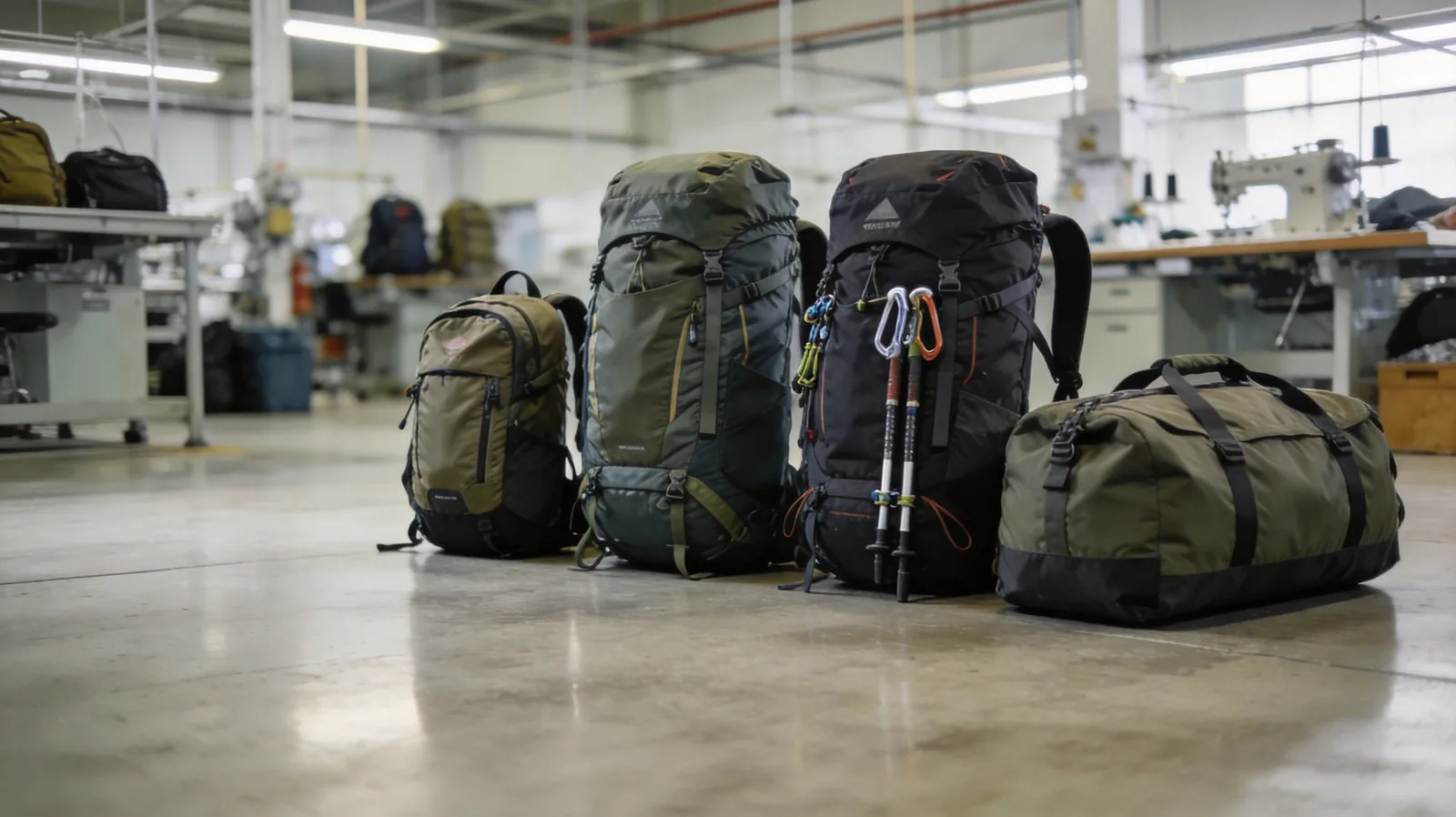
Most outdoor brands do not lose money on the first pack they develop. They lose it on the third and fourth. A supplier who is excellent at 40L hiking daypacks is rarely excellent at 65L expedition frames, and almost never at ultralight Dyneema alpine packs. So the brand ends up managing four factories, four quality systems, four lead-time calendars and four sets of tolerance drift — while trying to build one coherent product line.
This page is written for the sourcing manager and the product director who have already discovered that problem. It maps the four outdoor pack families against what each one actually demands from a factory, and explains how a single manufacturing platform can carry all four without collapsing into lowest-common-denominator production.
Why Outdoor Is the Hardest Category to Source
Outdoor packs sit at an awkward intersection that most bag factories never resolve. The category is small enough that no single sub-segment justifies a dedicated plant, but technical enough that generic bag production fails on the first load test. Three structural problems follow.
Load Is a Structural Problem, Not a Volume Problem
A 25kg multi-day load does not scale linearly from a 8kg commuter load. It multiplies. Stitch density that holds a laptop sleeve will creep under 25kg of cyclic load on a hip belt wing. Bar-tacks that pass on a daypack shoulder strap will tear out of a 1000D Cordura panel when a mountaineering pack is hauled by its grab loop. The failure mode changes with load class, which means the factory’s process control has to change with it — not just the bill of materials.
Fabric Choice Is Locked to Category, Not to Cost
A brand cannot substitute 600D polyester for X-Pac on a technical alpine pack to hit a price target, because the fabric carries functional meaning: abrasion resistance against granite, hydrostatic head under sustained snow contact, or dimensional stability when the pack is compressed by a rope. This makes outdoor packs unusually intolerant of the cost-down substitutions that work fine in fashion and promotional bags.
Compliance Varies by Market and Has No Universal Standard
There is no single harmonised EN standard governing recreational backpack construction. A supplier who tells you otherwise is either confused or selling you something. What actually governs access to European, UK and US retail is a combination of chemical regulation, material certification and buyer-specific test protocol — covered in detail in the compliance section below. Getting this wrong is the most common reason a technically sound pack is refused at retail QA.
The Four Outdoor Pack Families: What Each One Demands
Outdoor packs divide along two axes: load duration and terrain severity. Those two axes produce four families with genuinely different engineering priorities — not four marketing labels on the same product.
| Family | Typical capacity | Load class | Dominant design constraint | Primary market |
|---|---|---|---|---|
| Hiking / daypack | 18–45L | 5–12kg | Ventilation and on-trail access | North America, global |
| Trekking | 45–75L | 12–20kg | Sustained multi-day carry comfort | Europe, UK, Australasia |
| Mountaineering | 30–70L | 10–25kg + rack | Tool attachment, abrasion, cold performance | Global, specialist |
| Camping / car camping | 50–100L | 15–25kg, short distance | Access, volume, cost per litre | North America, EU value tier |
The practical consequence: a brand building a full outdoor line needs four different suspension architectures, four fabric specifications and four test protocols. On a single platform with shared tooling and shared QC, that is a manageable engineering programme. Across four unrelated factories, it becomes four separate development cycles that never converge on a common quality standard.
Hiking Packs: The Volume Segment
Hiking is the largest single outdoor pack segment and the one most brands enter first. The global hiking backpack market was estimated at roughly USD 5.69 billion in 2026, tracking toward USD 8.74 billion by 2033 at a CAGR near 6.3% (Future Data Stats). Volume growth in this segment is real, but so is competitive density — which pushes the engineering conversation toward differentiation rather than base capability.
What Wins in Hiking
Back panel ventilation is the single most contested feature in the segment. Trampoline mesh suspension, tensioned mesh over a cut-out frame, and channel-moulded foam each solve the sweat problem differently, and each carries a distinct manufacturing cost and a distinct failure mode. Beyond ventilation, on-trail access — hip belt pockets, side bottle pockets angled forward for reach while walking, a lid that opens without unclipping the sternum strap — is where mid-price packs win or lose against Osprey and Gregory.
Where the Category Breaks
Hiking packs fail in two predictable places: shoulder strap attachment under cyclic load, and zipper chain fatigue at the main compartment curve. Both are process problems, not design problems. They are solved by stitch density specification, bar-tack placement and a defined cyclic load test — not by switching fabric.
The full engineering blueprint for this segment — internal versus external frame philosophy, load transfer paths, 20L/35L/50L/65L capacity scaling and the OEM customisation process — is covered in our hiking backpack OEM/ODM blueprint. That page covers the North American search and design vocabulary. If you are sourcing for European or UK retail, read the trekking section next, because the design brief is genuinely different.
Trekking Packs: The European Long-Distance Segment
This is the category most Asian suppliers underestimate, and the one where North American-designed packs most often fail in European retail. “Trekking” and “hiking” are not synonyms in the market — they describe two different carry problems and two different buyer vocabularies.
The Carry Problem Is Different
A hiking pack is loaded and unloaded within a day. A trekking pack is loaded once and carried for five to fourteen days, often 15–20kg, across terrain that includes long descents. That changes the engineering priority from ventilation toward sustained load transfer: a hip belt that can carry 70–80% of pack weight without pressure points after eight hours, a frame that resists fatigue across thousands of load cycles, and a back length adjustment that stays where it is set. Multi-day trekking also drives the ultralight sub-segment, where sub-1000g total pack weight is the design constraint that overrides almost everything else.
The Vocabulary Is Different
European and UK buyers search “trekking rucksack” and “trekking backpack.” North American buyers search “hiking backpack” and “backpacking pack.” A brand with only a hiking page is invisible to the European query set regardless of product quality. This is a discoverability problem that no amount of product engineering fixes.
The Compliance Frame Is Different
European retail adds REACH chemical compliance, PFAS restrictions on durable water repellent finishes, and increasingly OEKO-TEX or bluesign material certification to the specification. These are covered in the compliance matrix below, and in more detail — along with multi-day load architecture, EN-adjacent test protocol and the ultralight sub-1000g design envelope — in our trekking backpack OEM/ODM guide.
Mountaineering Packs: The Technical Ceiling
Mountaineering carries the highest unit value and the highest technical bar in the outdoor pack category. The global mountaineering bag market was estimated at approximately USD 3.3 billion in 2026 (PW Consulting), with the adjacent climbing pack segment around USD 874 million. Buyers here are specialist alpine brands and equipment houses, not generalist outdoor retailers — which means the sourcing conversation is conducted between engineers.
What Makes It Hard
Four requirements separate mountaineering from trekking. First, tool attachment: ice axe loops, crampon pouch attachment, ski and snowboard carry straps that hold under load with gloves on, and a rope strap that does not crush the coil. Second, abrasion resistance against rock and ice, which pushes fabric selection toward 500D–1000D Cordura at high-wear zones and UHMWPE-based laminates elsewhere. Third, cold-weather performance: buckles, webbing and foam that do not stiffen or crack at −20°C. Fourth, strippable design — removable lid, removable frame sheet, removable hip belt — because alpine climbers cut pack weight to the gram before a summit push.
Material Ceiling
The segment has moved decisively toward laminated UHMWPE fabrics: Dyneema Composite Fabric, X-Pac VX21 and VX42 from Dimension-Polyant, and Challenge Sailcloth’s Ultra 200 and Ultra 400. Arc’teryx’s Alpha SL, launched in May 2025, pushed further with ALUULA Graflyte to cut weight while improving durability and recyclability. These materials behave differently from woven nylon under needle and heat: they do not self-heal around a stitch hole, they require specific needle geometry and stitch density, and they fail by delamination rather than by tearing. A factory without lamination experience will produce a pack that looks correct and delaminates in the field.
The climbing vocabulary overlaps almost entirely with mountaineering, so we cover it inside the mountaineering blueprint rather than splitting into a thin separate page. Our existing climbing backpack review guide covers the consumer-facing side. The full engineering brief — extreme-environment construction, tool attachment engineering, laminated fabric handling, technical suspension and cold-weather testing — is in our mountaineering and alpine climbing backpack OEM guide.
Camping & Car Camping: The Value Segment
Camping packs are the least technical family and the most price-sensitive. Loads are heavy but carried short distances, access matters more than suspension, and the design brief centres on volume, organisation and cost per litre rather than on fit engineering. This is where a matrix supplier earns its keep differently: through shared componentry and shared fabric platforms that let a camping pack ride on tooling already amortised by hiking production.
Where the Engineering Actually Sits
Two areas still require care. First, base durability: car camping packs get set down on gravel and loaded into vehicle boots, so base panel abrasion resistance and a reinforced bottom are not optional. Second, access architecture: a U-shaped or duffel-style opening that lets a family load a 90L pack without unpacking it. Getting these two right at a competitive price is the whole game in this segment.
One Material Platform, Four Specifications
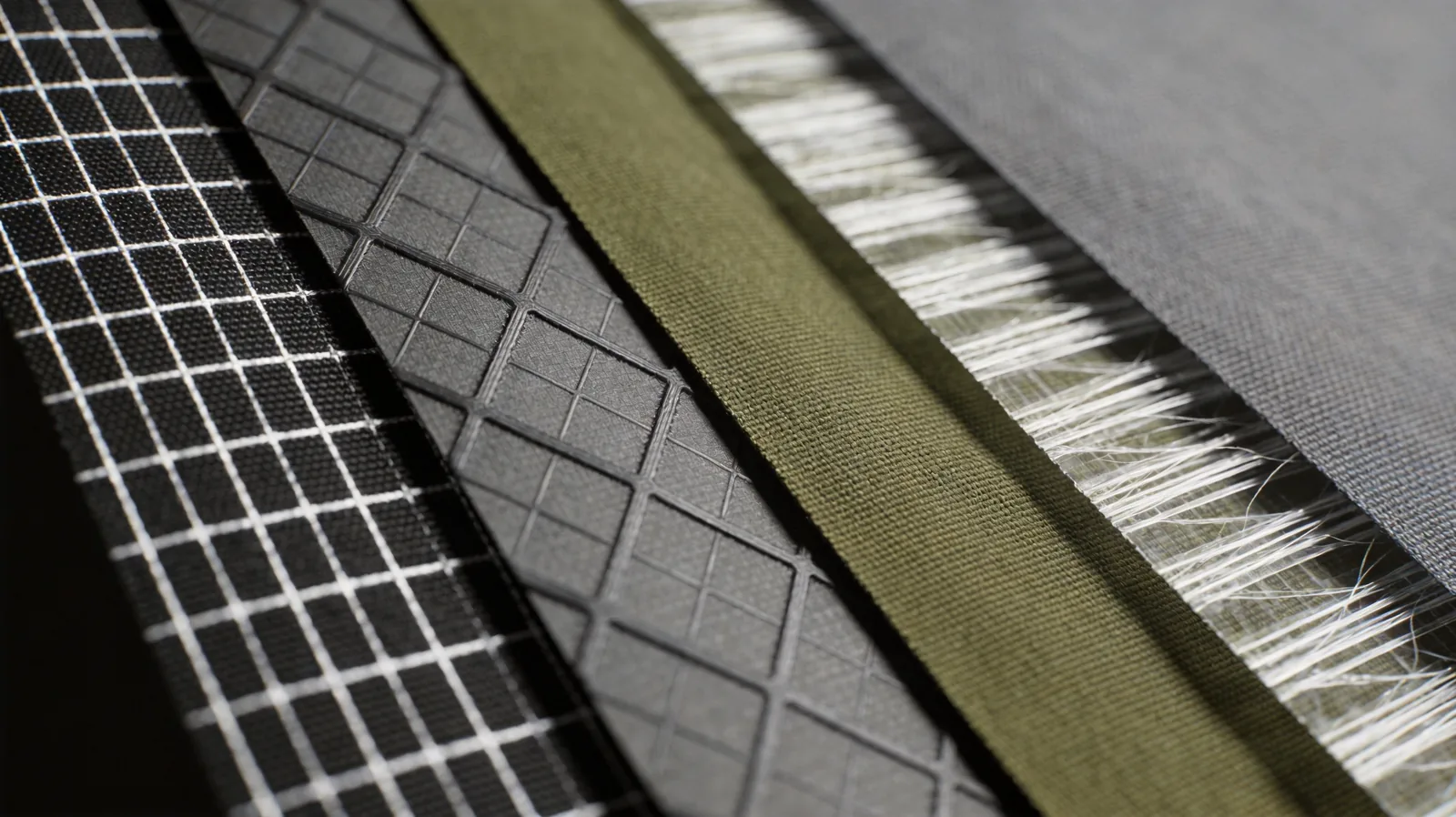
The commercial argument for a matrix supplier is not that one factory makes everything identically. It is that one factory can hold a single material qualification process and apply it across four product specifications — so a fabric approved for hiking is already qualified, tested and traceable when the trekking line moves into production six months later.
| Material | Weight (gsm) | Best fit | What it does well | Where it fails |
|---|---|---|---|---|
| 210D ripstop nylon | ~70–90 | Ultralight hiking, packable | Weight, cost, packability | Abrasion against rock |
| 420D ripstop nylon | ~120–140 | Hiking, trekking body panels | Balance of weight and durability | Sustained abrasion at base |
| Cordura 500D | ~200–230 | Trekking, mountaineering high-wear | Abrasion and tear resistance | Weight, water uptake if uncoated |
| Cordura 1000D | ~350–400 | Mountaineering base, haul zones | Maximum abrasion resistance | Heavy; needs lamination to be waterproof |
| X-Pac VX21 | ~210 | Technical trekking, alpine | Laminated waterproof, dimensional stability | Puncture; stitch holes need sealing |
| X-Pac VX42 | ~330 | Mountaineering, expedition | High abrasion plus waterproof | Stiff hand; limited colour options |
| Dyneema Composite Fabric | ~50–150 | Ultralight expedition | Highest strength-to-weight | Cost; UV degradation; delamination risk |
| Challenge Ultra 200/400 | ~120–230 | Ultralight alpine, bikepacking | UHMWPE strength, low water uptake | Requires specialised needle and stitch spec |
One qualification process, four specifications. In practice this means a fabric lot approved and tested for a hiking line does not need to be re-qualified when it moves onto a trekking pattern — the test data carries over because the platform, the lamination line and the QC protocol are the same. That is the operational difference between a matrix supplier and a broker who sources four factories.
Suspension Architecture: What Changes Between Categories
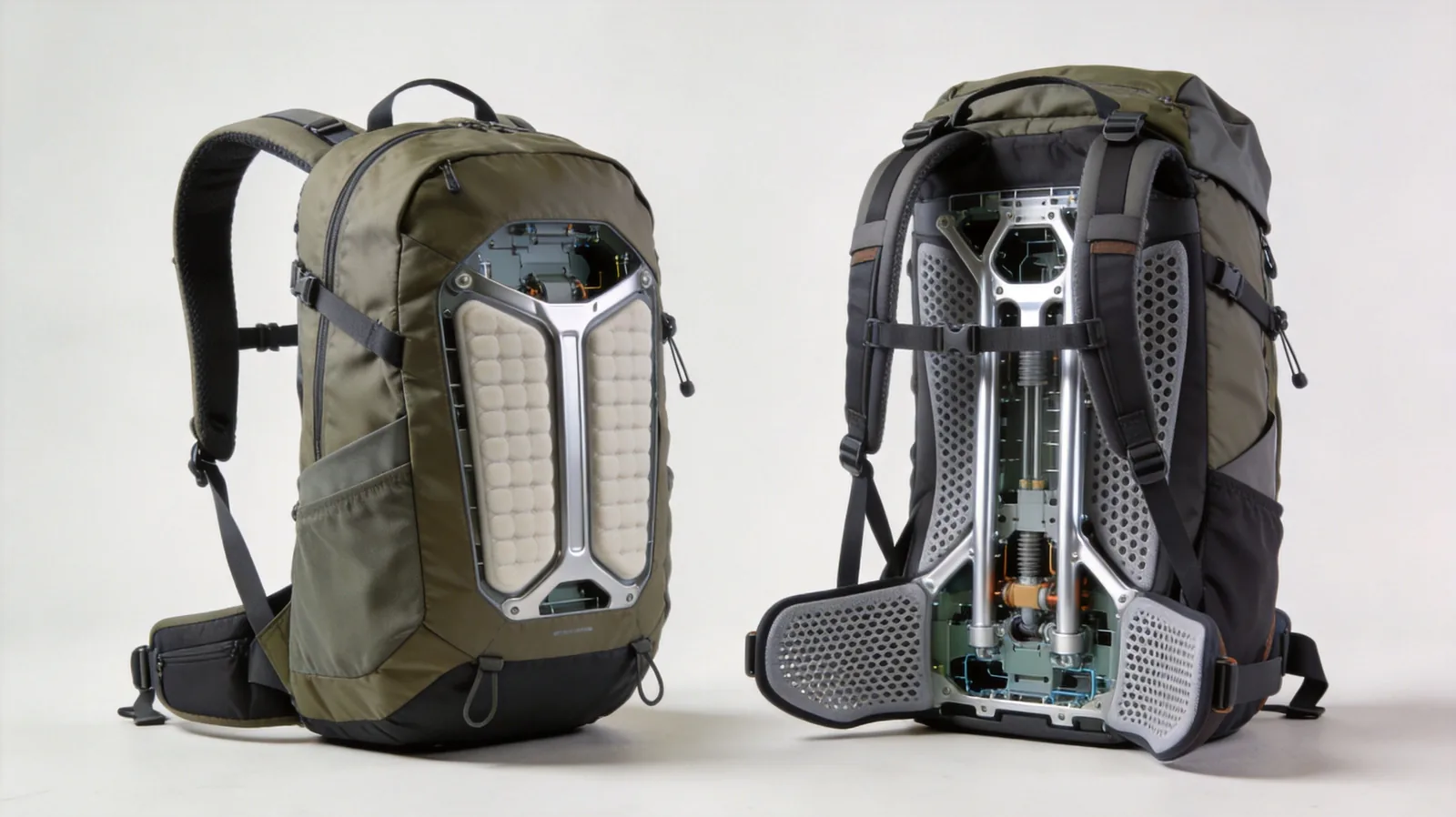
Suspension is where the four families diverge most sharply, and where a factory’s real capability shows. The frame is not a component you scale up; it is an architecture you redesign.
Frame Class by Load
Under roughly 10kg, a frameless or foam-padded back panel with a light internal stiffener is sufficient and saves weight. From 10–18kg, a peripheral or inverted-U aluminium stay transfers load to the hip belt efficiently without adding much mass. Above 18kg, and especially where the load is carried for days, a dual-stay or full-frame architecture with a load-lifter connection becomes necessary to keep the centre of gravity forward and off the shoulders. A single-stay frame pushed into a 20kg multi-day role will flex, and flexing frames generate pressure points that no hip belt padding can fix.
Hip Belt Load Transfer
The hip belt is where the category difference becomes measurable. Daypack hip belts are stabilisers carrying perhaps 30% of load. Trekking and mountaineering hip belts are load-bearing structures expected to carry 70–80%. That changes the wing geometry, the foam density stack, the contact area and the way the belt attaches to the frame. A trekking brief handed to a factory that only builds daypacks will come back with a stabiliser belt and fail field testing.
Torso Adjustment and Fit Range
Adjustable torso length is standard in trekking and mountaineering, optional in hiking, and usually absent in camping. The mechanism matters: hook-and-loop adjustable is cheap but migrates under load; a ladder-lock or cam system holds position but costs more and adds a failure point. For European retail, where fit range must span a taller average torso than Asian domestic patterns, torso adjustment is not a feature — it is a market access requirement.
Compliance by Market: EU, UK and US
This is the section most sourcing pages get wrong, usually by citing a standard that does not exist. There is no harmonised EN standard for recreational backpack construction. What actually determines whether a pack can be sold is a layered framework of chemical regulation, material certification and buyer test protocol.
| Market | Chemical / material requirements | Typical buyer test protocol |
|---|---|---|
| EU | REACH (SVHC, azo dyes, restricted substances); PFAS restriction on DWR finishes; OEKO-TEX Standard 100 or bluesign increasingly required by retail | Load / cyclic load test, drop test, abrasion (Martindale), tear and tensile strength, colourfastness, zipper cycle test |
| UK | UK REACH; same material certification expectations as EU in practice | Same as EU; UKCA marking applies to regulated product categories, not to backpacks as such |
| US | CPSIA where the product reaches children; California Prop 65 labelling; no mandatory backpack construction standard | ASTM D5034 (tensile), ASTM D2261 (tear), brand-specific load and durability protocol |
The PFAS Point Deserves Emphasis
Durable water repellent finishes based on PFAS are under active restriction in the EU, and major European retailers have moved ahead of regulation by requiring PFAS-free DWR in their supplier agreements. If your factory’s default DWR contains PFAS and cannot offer a C0 alternative with documented performance, your pack is not sellable into European outdoor retail regardless of how well it performs in the rain. This is a specification conversation that has to happen before sampling, not after.
What We Provide as Standard
For every outdoor programme we supply: material composition declarations per component, REACH SVHC status for all trims and finishes, OEKO-TEX or bluesign certificates where the nominated fabric carries them, and third-party test reports (SGS, TÜV or BV) against the load, abrasion and tear protocol agreed at sampling. Where a brand’s retail customer requires a specific protocol we build that protocol into the production QC plan rather than treating it as a final inspection afterthought.
One-Stop OEM: What a Matrix Supplier Actually Saves
“One-stop” is overused to the point of meaninglessness, so here is the concrete version — what actually changes when four product families run on one platform instead of four.
Development Time
A new category on an existing platform reuses the fabric qualification, the trim library, the stitch specification and the QC plan. Sampling a trekking pack as a first category takes 6–10 days for a first prototype and 4–6 weeks for design refinement and fit iteration. Sampling the same pack as a fifth category for an existing brand on an existing platform compresses that, because only the frame architecture and pattern are new — the material and trim decisions are already made and already documented.
Tolerance Consistency
Four factories mean four tolerance regimes. A 5mm seam allowance variance between your hiking supplier and your trekking supplier is invisible in isolation and very visible when both packs sit on the same retail fixture. One platform means one tolerance regime across the line, which is what makes a coherent product family possible.
Volume Consolidation
Outdoor brands rarely order 5,000 units per SKU per category. They order 800 hiking, 600 trekking, 400 mountaineering and 500 camping. Split across four factories, none of those orders reaches a volume tier that earns priority scheduling or price breaks. Consolidated on one platform at 2,300 units across four categories, the order does — and the brand gains scheduling priority it could not otherwise access.
JUNYUAN Outdoor Manufacturing Capability
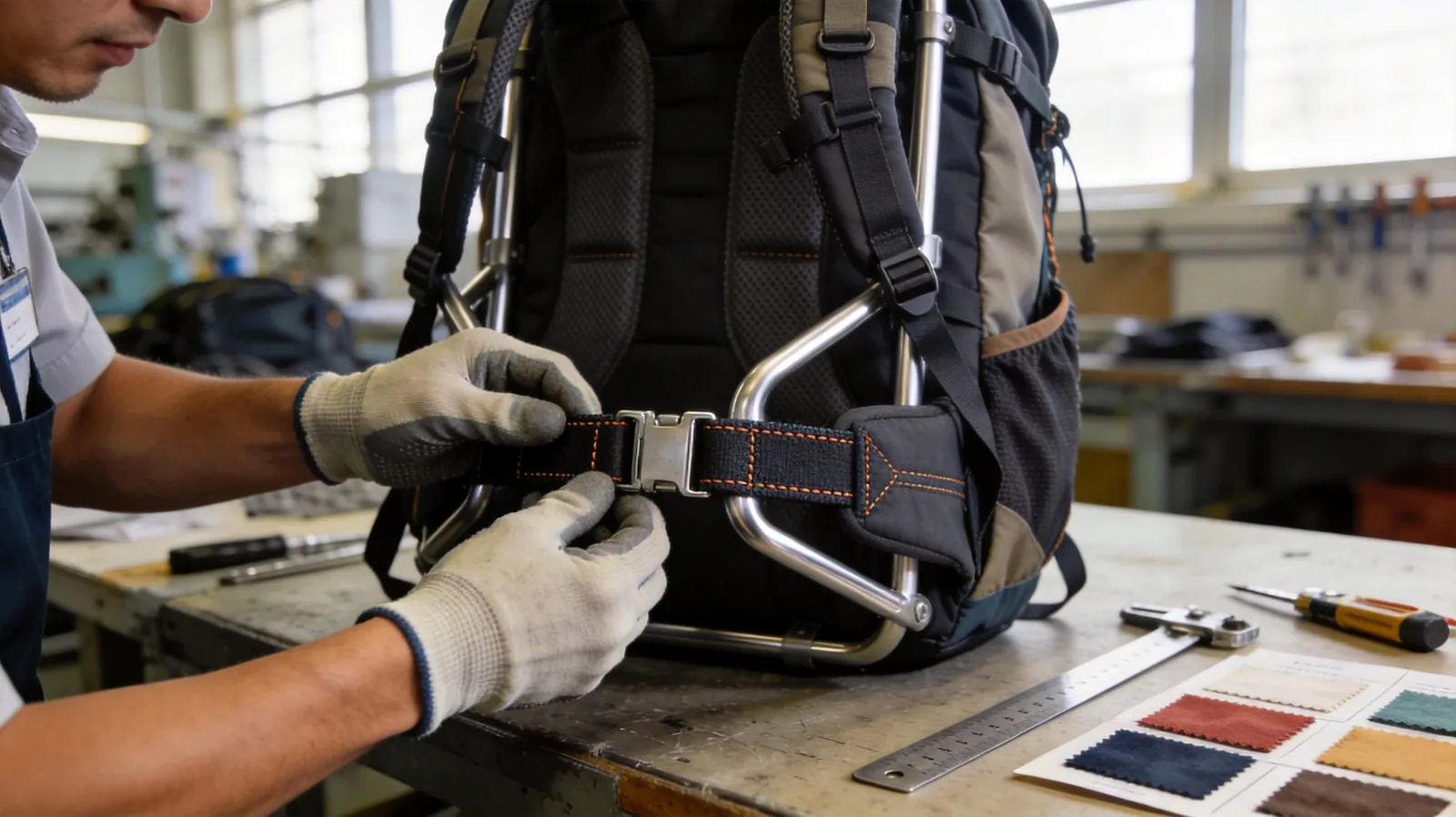
JUNYUAN has manufactured outdoor packs since the founding team entered the bag industry in 2004, with the company established in 2014 and operating from Quanzhou, Fujian — one of the densest bag manufacturing clusters in China. Our outdoor work spans hiking, trekking, mountaineering, camping and technical daypack programmes for brands across Europe, North America and Australasia.
| Parameter | Standard |
|---|---|
| MOQ | 500 pieces per colour per design (OEM and ODM) |
| Sampling lead time | 6–10 days for first prototype |
| Production lead time | 35–50 days after sample approval and deposit |
| Sampling fee | Charged, refunded against the bulk order once volume threshold is met |
| Fabric sourcing | Cordura, Dyneema, X-Pac, Challenge Sailcloth and equivalent laminated UHMWPE platforms |
| Testing | In-house QC plus third-party SGS / TÜV / BV against agreed protocol |
| Customisation | Pattern, frame architecture, branding, trim, packaging and retail-ready labelling |
How We Differ From a Single-Category Outdoor Factory
A hiking specialist will build you an excellent hiking pack and a mediocre trekking pack, because trekking load architecture is not in their process control. A mountaineering specialist will build a technically superb alpine pack at a price that only works at low volume. Running all four families on one platform means the trekking programme inherits the mountaineering team’s frame discipline, and the hiking programme inherits the trekking team’s fabric qualification — which is how a mid-market brand ends up with a product line that feels coherent at retail.
For reference points on what this looks like in finished product, see our comparison of Osprey-grade hiking packs and technical mountaineering alternatives, and our roundup of waterproof backpack manufacturers for outdoor and hiking brands.
Frequently Asked Questions
Can one factory really produce hiking, trekking and mountaineering packs to the same quality standard?
Yes, provided the factory treats them as separate architectures on a shared platform rather than as one pattern at three sizes. The shared parts are material qualification, trim library, stitch specification and QC protocol. The parts that must be redesigned per category are frame architecture, hip belt load transfer geometry and attachment engineering. A factory that only changes the pattern and the logo will produce a trekking pack with daypack suspension — which fails field testing at 15kg.
What is the difference between a trekking pack and a hiking pack from a manufacturing standpoint?
Load duration and load class. Hiking packs are designed for 5–12kg carried within a day; trekking packs for 12–20kg carried for five to fourteen days. That changes the frame class (single stay versus dual stay or full frame), the hip belt from stabiliser to load-bearing structure carrying 70–80% of weight, and the test protocol from cyclic load to sustained multi-day simulation. It also changes the fabric brief, because European trekking retail expects REACH and often PFAS-free DWR compliance as a baseline.
Is there an EN standard for backpack construction we should specify?
No. There is no harmonised EN standard governing recreational backpack construction, and a supplier who cites one is likely confusing backpack standards with adjacent categories — EN 13538, for example, is the sleeping bag dimensional standard, not a backpack standard. What governs market access is REACH chemical compliance (including PFAS restrictions on DWR), OEKO-TEX or bluesign material certification where the retail customer requires it, and the buyer’s own load, abrasion and durability test protocol. We build that protocol into production QC rather than treating it as a final inspection step.
Which fabric should we specify for a mountaineering pack?
It depends on the wear zone rather than the pack as a whole. A typical specification uses 500D–1000D Cordura at base and haul zones for abrasion resistance, and a laminated UHMWPE fabric — Dyneema Composite Fabric, X-Pac VX21/VX42 or Challenge Ultra 200/400 — for the main body to reduce weight while keeping waterproofness. Note that laminated UHMWPE does not self-heal around stitch holes and fails by delamination rather than tearing, so it requires specific needle geometry, stitch density and seam sealing. A factory without lamination experience will produce a pack that looks correct and delaminates in the field.
What is the MOQ and lead time for an outdoor pack programme?
MOQ is 500 pieces per colour per design for both OEM and ODM programmes. First prototype sampling takes 6–10 days; bulk production takes 35–50 days after sample approval and deposit. Sampling fees are charged and refunded against the bulk order once the volume threshold is met. Where a brand runs multiple categories on the same platform, orders can be consolidated to reach volume tiers that individual category orders would not reach on their own.
Can you handle the compliance documentation for European retail?
Yes. We supply material composition declarations per component, REACH SVHC status for all trims and finishes, OEKO-TEX or bluesign certificates where the nominated fabric carries them, and third-party test reports from SGS, TÜV or BV against the protocol agreed at sampling. For brands whose retail customers require PFAS-free DWR, we specify a C0 alternative with documented performance at the sampling stage rather than substituting later in production.
Should we build one outdoor page or separate pages per category?
Both, and they should link to each other. Category pages capture the specific query vocabulary — “custom trekking backpack” and “custom mountaineering backpack” are searched by different buyers with different briefs, and European buyers search “trekking” where North American buyers search “hiking.” A matrix page like this one captures the consolidated commercial query and acts as the internal linking hub that passes authority to each category page. Building only category pages leaves the consolidated commercial query unaddressed; building only a matrix page leaves four category query sets unaddressed.
Start With the Category You Actually Need
Send us your target category, load class and destination market. We will come back with a frame architecture recommendation, a fabric specification and a compliance document list within two business days.
Hiking Pack Blueprint
Trekking Pack Blueprint
Mountaineering Pack Blueprint
Sources: Hiking backpack market size — Future Data Stats; mountaineering bag and climbing pack market size — PW Consulting; Arc’teryx Alpha SL and ALUULA Graflyte launch, May 2025. Market figures are third-party estimates and vary by research house definition; treat them as order-of-magnitude context rather than precise measurement.