
Every time US duty on Chinese bags goes up, a certain kind of supplier appears with the same offer: move the last step of production to Vietnam, ship from a Vietnamese port, declare Vietnamese origin, and the China Section 301 duty disappears. In 2019 that pitch was aggressive but it often survived contact with customs. In late 2026 it does not survive contact with reality — because three separate things changed, and only one of them is a tariff rate.
The rate change is the part everyone talks about. On 24 July 2026 Vietnam picked up its own 12.5% Section 301 duty with no sunset date. The two changes nobody priced in are more consequential: US Customs officers now conduct on-site inspections inside Vietnamese factories, and Vietnam itself has closed the transit corridor that transshipment depended on. The paperwork shortcut that used to be a grey area is now a documented enforcement target.
This guide sets out what the July 2026 action actually did, what the Vietnam saving really looks like after the new duty, why the transshipment route closed, what “substantial transformation” means for a bag, and the legitimate lever that most importers ignore entirely. It is written from the position of a Chinese manufacturer, which is exactly why it sticks to published rules and dated sources rather than opinion.
Quick Answer / TL;DR
- Vietnam is no longer duty-free. The 24 July 2026 Section 301 action put a 12.5% duty on Vietnamese goods, on top of the 17.6% MFN rate most man-made-fibre bags carry. The Vietnam advantage narrowed from roughly 25 percentage points to roughly 25 percentage points of a much larger total — and it now carries an enforcement tail.
- CBP moved the inspection inside Vietnam. Since mid-2026, CBP officers have conducted on-site checks at Vietnam-based factories with Chinese ties, examining purchase contracts, production lines, utility bills, worker attendance, inventory and financial records to test whether capacity matches export volume.
- Vietnam shut its own transit corridor. Vietnam’s consolidated document 43/VBHN-BCT restricts China-origin transit to four border gate pairs, caps in-country dwell time at 30 days, and prohibits unpacking, processing or relabelling in transit.
- Vietnam wrote its own origin test down. Decree 384/2026/NĐ-CP, issued 9 October 2026 and effective 1 January 2027, allows a “Made in Vietnam” claim only where the goods meet a change-in-tariff-classification test or a minimum 30% Vietnamese value content — and places the burden of proof on the declarant.
- A Vietnamese certificate of origin does not bind US Customs. US non-preferential origin is determined by CBP under its own substantial-transformation analysis. This is the single most expensive misunderstanding in the current market.
- The legitimate lever is design-stage tariff engineering — outer-material and HS classification decisions made while the style is still open, not origin claims made at the port.
What the July 2026 Section 301 Action Actually Did
The action was not a China measure. On 12 March 2026 USTR initiated 60 separate Section 301 investigations into economies that had failed to impose and effectively enforce a prohibition on importing goods made with forced labour. On 2 June 2026 it determined the practices actionable in each. Final action was published on 23 July 2026 and applies to goods entered for consumption on or after 24 July 2026.
| Origin | Section 301 forced-labour rate | Notes |
|---|---|---|
| China (incl. Hong Kong) | 12.5% | Stacks on top of the existing China Section 301 duties of 7.5–25% |
| Vietnam | 12.5% | No China 301 layer — but no longer duty-advantaged by a wide margin |
| Malaysia | 10.0% | Lower tier |
| Cambodia, Indonesia, India, Bangladesh, Sri Lanka | 10.0% | Lower tier; tariff-rate quotas were established where feasible for Bangladesh, Cambodia, Indonesia and Malaysia |
Two features of this action matter more than the numbers.
There is no sunset date. The previous flat 10% placeholder was imposed under Section 122, which carried a hard 150-day statutory limit and expired on 24 July 2026. The Section 301 forced-labour duty replaced it the same day and has no expiry. A sourcing plan that assumes the 12.5% is temporary is not a plan.
It is a forced-labour action, not a trade-deficit action. That changes what CBP is looking for. The question at the border is not “is this cheap?” — it is “can you show where this came from, who made it, and under what conditions?” That is an evidence question, and evidence is exactly what a transshipment arrangement cannot produce.
The Vietnam Math — What You Think You Are Saving
Take the same man-made-fibre backpack used in our landed-cost walkthrough: HTS 4202.92.31, 17.6% MFN, $12.00 FOB.
| Duty layer | China origin | Vietnam origin |
|---|---|---|
| MFN (Column 1 General) | 17.6% | 17.6% |
| China Section 301 (most bag lines) | 25.0% | — |
| Section 301 forced-labour (from 24 Jul 2026) | 12.5% | 12.5% |
| Total ad valorem duty | 55.1% | 30.1% |
The gap is real: 25 percentage points, about $3.00 per unit on this example. Nobody should pretend otherwise. But three things erode it, and they are the three things that never appear in the pitch deck.
- Vietnam is not a low-cost manufacturing base any more. The labour and overhead differential against coastal China has narrowed for years, and a factory that exists mainly to host the last production step has no scale advantage to offset it.
- The MFN rate does not move. The HS code describes the product, not the origin. Moving the sewing does not change 17.6%.
- The exposure is asymmetric. If origin is challenged, the assessment is the duty you should have paid plus penalties and interest — and in a forced-labour enforcement context, the goods can be detained or refused entry while you argue. A 25-point saving on a $12 bag does not cover a single container held for six weeks.
Three Things That Changed in 2026 and Closed the Transshipment Route
1. CBP started inspecting inside Vietnam
The historic enforcement model was a document review and a container exam at the US port. In 2026 CBP officers began conducting on-site checks at factories inside Vietnam that have Chinese ties, specifically to test whether goods are being transshipped from China or given only low-value processing before being exported as Vietnamese. CBP has maintained an attaché office in Vietnam since February 2025, and from 27 to 31 July 2026 it ran a five-day Illegal Transshipment Investigation Workshop in Hanoi with Vietnam Customs and the Ministry of Industry and Trade.
The on-site checks cover four areas, and each one is a document a transshipment arrangement cannot produce honestly:
- Source documents — purchase contracts, packing lists and logistics records, traced backwards to establish whether materials, components and semi-finished goods originated in China.
- The physical process — production lines, process flow and the actual processing steps performed in Vietnam, assessed against the substantial-transformation standard and against the local value added.
- Operating records — utility bills, worker attendance, production logs, inventory and financial vouchers, used to test whether the factory’s real capacity is consistent with the volume it exports.
- Software and intellectual property compliance — an adjacent exposure that most bag suppliers have never considered.
The capacity-versus-volume test is the one that ends most arrangements. A factory with two hundred workers and a warehouse that never fills cannot credibly ship the volume attributed to it, and utility consumption per unit does not lie.
2. Vietnam closed its own transit corridor
Vietnam did not wait to be pushed. Its Ministry of Industry and Trade issued consolidated document 43/VBHN-BCT in June 2026, tightening control over Chinese goods in transit across Vietnamese territory. The measures are specific:
- A border-gate whitelist: transit is currently permitted through only four China–Vietnam border gate pairs — Lao Cai, Huu Nghi, Mong Cai and Dong Dang. Other crossings and third-country routing are not open for transit.
- A dwell-time cap: goods may remain in Vietnam for a maximum of 30 days from completion of entry formalities, extendable in approved cases by 30 days at a time, up to three times.
- Original packaging and original seals must be preserved from entry to exit. Unpacking, processing, swapping, or warehouse consolidation in transit is prohibited, and any damage or anomaly must be reported to customs immediately.
- Prohibited and restricted goods may not transit at all.
Read that list against what a transshipment scheme needs and the contradiction is immediate. Transshipment requires repacking, relabelling, sometimes a light assembly step, and time in a warehouse. Vietnam has now prohibited every one of those acts in the transit channel — precisely because it does not want to be the named origin in a US enforcement action.
3. Vietnam wrote its own origin test down
On 9 October 2026 the Vietnamese government issued Decree 384/2026/NĐ-CP on determining Vietnamese origin for goods produced and traded domestically. It takes effect on 1 January 2027. The mechanics matter:
- The regime is voluntary, self-declared and self-assumed — a business is not forced to claim Vietnamese origin for every product.
- But once “Made in Vietnam” appears on the goods, the product must meet the criteria and the business must be able to prove it on request.
- For goods made from non-Vietnamese inputs, origin can be established either through a change-in-tariff-classification test or through a minimum 30% Vietnamese value content threshold.
- Simple processing and packing performed in Vietnam does not by itself justify a “Made in Vietnam” claim.
For a bag program, the 30% value-content threshold is the operative number. A backpack whose shell fabric, webbing, buckles, zips, logo hardware and lining are all sourced from China and then cut and sewn in Vietnam will generally not reach 30% Vietnamese value content — the imported components carry most of the material cost, and cut-and-sew labour is a minority of the finished value.
What “Substantial Transformation” Actually Means for a Bag
Here is where the two legal systems diverge, and where most importers lose money.
For non-preferential origin — which is what determines whether a Section 301 duty applies — the United States applies a substantial-transformation test. The question is whether processing in the second country produced a new and different article, with a different name, character or use, compared with the inputs. There is no fixed percentage, no published formula, and no self-certification. It is a legal determination.
Vietnam’s Decree 384/2026, by contrast, is Vietnamese domestic law. It tells you when Vietnam will let a producer claim Vietnamese origin. It does not tell you what CBP will conclude. A product can satisfy the Vietnamese change-in-classification test and still fail the US substantial-transformation test, and the reverse is also possible.
The practical consequence: a certificate of origin issued in Vietnam is evidence about Vietnamese law. It is not a US origin determination. If your duty position depends on the origin claim, the only instrument that actually settles the question in advance is a CBP binding ruling requested by the importer under 19 CFR Part 177, describing the specific materials, the specific processing steps and the specific finished article. It costs a filing and a wait. It is cheaper than a detention.
For bags specifically, the analysis turns on facts that a supplier should be able to document without effort if the origin is genuine: where the shell fabric was woven, where the webbing and hardware were made, what operations were performed in the claimed country, and what proportion of the finished value those operations represent. If those four answers cannot be produced, the origin claim is not a position — it is a hope.
The Paper Trail CBP Will Ask For
Assume an origin question arises. This is the file you will be asked to produce. Build it now, not after the request.
| Evidence | What it has to prove |
|---|---|
| Purchase contracts and supplier invoices for fabric, webbing, zips, buckles, lining | Where the material inputs actually came from |
| Bill of materials with origin by component | The material composition behind the cost, not just the finished article |
| Production records, process routing, cut-and-sew logs | Which operations were genuinely performed, and where |
| Utility bills and worker attendance | That real capacity exists in the claimed country |
| Inventory records and warehouse throughput | That the exported volume is physically plausible |
| Financial statements and payment flows | That money and goods moved consistently — not just paperwork |
| Commercial invoice stating origin and 10-digit HTSUS | That the declaration matches the physical shipment |
The common failure mode is not a missing document. It is documents that contradict each other: an invoice volume the factory cannot physically produce, a value that does not reconcile with the declared material cost, a payment flow routed through a different entity than the shipper. Enforcement attention in 2026 is trained on exactly that kind of inconsistency.

The Lever You Do Have: Tariff Engineering at Design Stage
If origin is off the table as a cost lever, the honest question is whether any lever remains. One does, it is entirely legitimate, and it is worth more than most importers realise: the outer material and the resulting HS classification.
The MFN spread across HTS 4202 runs from about 4.5% to 17.6%. A polyester canvas tote and a cotton canvas tote look nearly identical on a shelf and sit more than eleven percentage points apart at the border. A leather travel or sports bag line sits far below a man-made-fibre line. Those are design decisions, made in the sampling room, and they are permanent for the life of the product.
Three constraints keep this legitimate rather than abusive:
- The declared material must be the actual outer surface material. Classification follows the goods, not the spreadsheet.
- Function has to survive the change. A material swap that ruins abrasion resistance or water repellency to save duty points is a false economy on a bag that will be returned.
- The 10-digit classification should be confirmed before tooling, because retroactive reclassification is assessed with penalties and interest.
This is where a manufacturing conversation belongs. Material choice, coating, lining and hardware specification all sit upstream of the duty line, and all of them are settled before the first bulk order. Once the tech pack is locked, the rate is locked with it.
If You Already Run a Vietnam Program — A Five-Step Audit
- Map the material origin, not the factory location. For each style, list where the shell fabric, webbing, zips, buckles, lining and logo hardware were made. If China-sourced inputs dominate the cost, the origin claim is fragile regardless of where the sewing happened.
- Calculate the value content honestly. Vietnamese local value content, computed the way Decree 384/2026 describes it, is the number Vietnam will test. Do the arithmetic before someone else does.
- Test capacity against volume. Compare the factory’s workforce, floor space, utility consumption and machinery count against the volume you are buying. If your allocation exceeds plausible capacity, that is the finding an on-site inspection will make.
- Reconcile the money and the goods. Payment flows, shipping documents and customs declarations should tell one story. Where they diverge, document why in advance.
- Consider a binding ruling. If the duty saving depends on origin, ask CBP to decide it in advance under 19 CFR Part 177 rather than discovering the answer at audit.
If those five steps produce a clean file, a Vietnam program is a legitimate program and we will say so — real Vietnamese manufacturing with genuine local content is not the target of any of this. If they do not, the saving is borrowed money.
How JUNYUAN Structures Origin-Defensible Programs
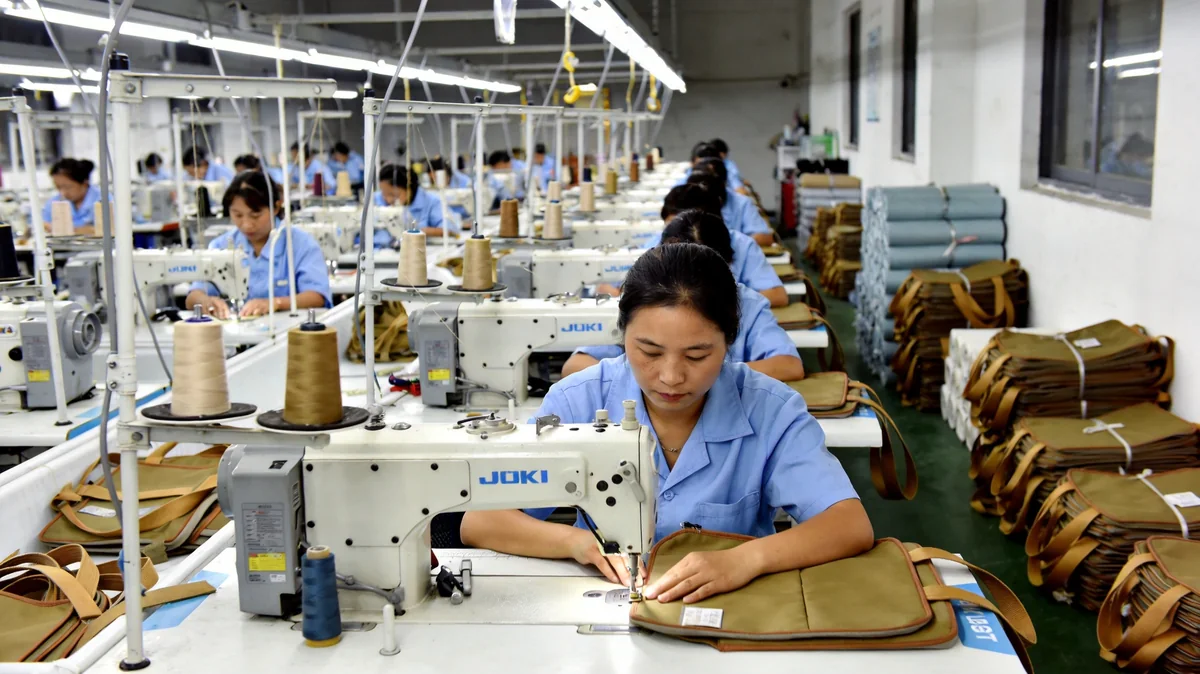
We manufacture in Quanzhou, China, and we do not offer an origin workaround — which is precisely why our documentation has to be right. What we can give a US buyer is a program whose declaration survives scrutiny.
- Material specification and HS classification fixed at sampling. Because the outer material sets the MFN rate, we settle the material, the construction and the 10-digit HTSUS while the style is still open — the only point at which the rate can legitimately be influenced.
- A bill of materials you can hand to a broker. Component-level material and origin detail, so the invoice, the entry and the physical goods describe the same thing.
- Commercial invoices built for formal entry. Full description, outer-material composition, country of origin, 10-digit HTSUS, quantity and value.
- DDP with the arithmetic shown. We quote DDP to US doors and show the duty rate and origin we used, plus who is named as importer of record. If you prefer to hold the entry, we run FOB and give you the complete document set.
- Scale and process behind it: manufacturing in Quanzhou since 2014 with a team in the bag trade since 2004, 350,000+ units a year across 200+ brands, AQL 2.5 inspection with photo reporting, MOQ 500 pieces per style, sampling in 6–10 days, bulk production in 35–50 days.
For the US entry mechanics see importing bags from China to the US; for the document set, the import document checklist; for who carries which obligation under each term, FOB vs EXW vs DDP vs CIF. If your question is the cost of the whole stack rather than origin alone, start with the de minimis repeal and landed-cost recalculation.
FAQ
Q: Is transshipping bags through Vietnam still legal?
A: Genuine Vietnamese manufacturing is legal. What is not legal is declaring Vietnamese origin for goods whose essential character was established elsewhere. US non-preferential origin follows CBP’s substantial-transformation analysis, not the shipping route or a third-country certificate.
Q: Does a Vietnamese certificate of origin protect me from US Section 301 duty?
A: No. A C/O is a statement about Vietnamese law. US non-preferential origin is determined by CBP under its own test. If duty depends on origin, the instrument that settles it in advance is a CBP binding ruling under 19 CFR Part 177.
Q: How much duty does a bag from Vietnam carry now?
A: A man-made-fibre backpack under HTS 4202.92.31 carries 17.6% MFN plus the 12.5% Section 301 forced-labour duty that took effect on 24 July 2026 — about 30% in total. It does not carry the China Section 301 layer, but it is no longer duty-free.
Q: Will the 12.5% Vietnam duty expire?
A: The action carries no sunset date. It replaced a Section 122 tariff that had a hard 150-day limit and expired on 24 July 2026. Plan on the 12.5% continuing.
Q: What is the 30% Vietnamese value content rule?
A: Decree 384/2026/NĐ-CP, issued 9 October 2026 and effective 1 January 2027, lets a producer establish Vietnamese origin either through a change-in-tariff-classification test or a minimum 30% Vietnamese value content. It also places the burden of proof on the declarant once “Made in Vietnam” is used.
Q: Can CBP really inspect a factory inside Vietnam?
A: Yes. CBP has maintained an attaché office in Vietnam since February 2025 and in 2026 began on-site checks at factories with Chinese ties, examining source documents, production processes, operating records and software/IP compliance. It also ran a joint transshipment investigation workshop with Vietnam Customs in Hanoi in July 2026.
Q: What did Vietnam change about China-origin transit?
A: Consolidated document 43/VBHN-BCT restricts China-origin transit to four border gate pairs, caps dwell time at 30 days with limited extensions, and requires original packaging and seals to be preserved — prohibiting unpacking, processing, swapping or warehouse consolidation in transit.
Q: How does CBP decide whether cut-and-sew in Vietnam creates Vietnamese origin?
A: By the substantial-transformation test — whether processing produced a new and different article with a different name, character or use. There is no published percentage. The analysis looks at the material inputs, the nature of the operations performed and the value they add, which is why a bill of materials with origin by component matters.
Q: What records should I be able to produce if origin is questioned?
A: Purchase contracts and supplier invoices for all material inputs, a bill of materials with origin by component, production and process records, utility bills and worker attendance, inventory and warehouse throughput, financial statements and payment flows, and a commercial invoice stating origin and 10-digit HTSUS. The risk is not a missing document but documents that contradict each other.
Q: Can I reduce duty legitimately at all?
A: Yes — through outer-material and HS classification decisions made at design stage. The MFN spread across HTS 4202 runs from about 4.5% to 17.6%, so material choice is a real rate lever. The declared material must be the actual outer surface, and the classification should be confirmed before tooling.
Q: Are all Vietnamese factories suspect?
A: No. Genuine Vietnamese manufacturing with real local value content is a legitimate sourcing base and none of the enforcement described here targets it. The exposure sits with arrangements where the essential character of the goods was established outside the claimed origin country.
Q: What if I want to keep sourcing from China but manage the duty properly?
A: That is a documentation and design problem, not an origin problem. Get the 10-digit classification right, choose the outer material deliberately at sampling, build a commercial invoice that matches the entry, and decide up front whether you or the supplier holds the importer-of-record position.
Next Step: Audit the Origin Claim Before Anyone Else Does
If you are running a Vietnam program on the assumption that a certificate settles the question, the useful action this quarter is a five-step audit — material origin, honest value content, capacity against volume, reconciled money and goods, and a decision on whether to request a binding ruling. If you are sourcing from China and the duty is the problem, the useful action is a recalculation with the right classification and a deliberate material choice.
Send us the style, the target quantity and the destination market, and we will come back with a material specification, the classification we would declare, sampling in 6–10 days and bulk production in 35–50 days — with the duty arithmetic behind any DDP figure we quote. Documented, conservative, and no hard sell.
Start at our quote request page with your design and quantity, or review our OEM/ODM service structure for US import programs. Category-specific detail is on custom backpack manufacturing, custom travel bag manufacturing and custom hiking backpack manufacturing.
— Written by Marvin Zhang, JUNYUAN Bags