
Short answer for buyers: a retail work backpack review tells you how a bag feels to one person for one week. It tells you nothing about whether the bag can be manufactured at your target cost, whether the laptop sleeve actually protects a 16 inch machine in a drop, whether the zipper will survive 15,000 cycles, or whether the materials clear REACH and California Proposition 65. This guide converts the questions retail reviews ask into the specifications a private-label buyer has to lock before a purchase order is raised — fabric, structure, hardware, compliance, MOQ, lead time and inspection.
JUNYUAN BAGS has produced work, commuter and laptop backpacks for brand owners, corporate-gift programmes and distributors since the category moved from leather briefcases to nylon technical carry. The 18 retail reviews archived at the bottom of this page were published between 2021 and 2022 and each still lives on its own URL. They are kept because they are useful reference for what the market rewards. They are not a buying guide. This page is the buying guide.
Why Retail Work Backpack Reviews Do Not Answer Procurement Questions
A retail review is written from the inside of one bag, by one person, for other people who will buy one bag. A procurement decision is made from the outside of a production run, by a buyer, for a channel that will sell 5,000 bags. The two documents share vocabulary and almost nothing else. Three specific gaps show up on every project.
1. Reviews test the experience, not the manufacturability
“The laptop compartment is well padded” is a conclusion. The question a buyer has to answer is: padded with what, at what density, stitched with what seam allowance, and does the padding survive a 76 cm drop with a 2.4 kg load? A review cannot answer that because the reviewer never cut the bag open and never dropped it on a calibrated rig. A specification can answer it, because all four variables are written down before sampling.
2. Reviews have no bill of materials
Two work backpacks that photograph identically can differ by 40 % in landed cost. The difference sits in variables that never appear in a review: yarn denier versus fabric gram weight, PU versus PVC versus TPU coating, YKK versus unbranded slider, EPE versus EVA foam, bound versus overlocked interior seams, and whether the lining is 210D or 70D. None of these change how the bag looks. All of them change the quote.
3. Reviews do not touch market access
A bag can be beautiful, durable and cheap, and still be unsellable in your market because a dye lot failed aromatic amine testing, because the PU coating contains a phthalate above the REACH limit, because the fabric contains a PFAS treatment banned in California, or because the packaging carries no importer address required under the EU General Product Safety Regulation. None of that is visible in a review. All of it is checked at customs or by a market-surveillance authority.
The Specification Sheet That Replaces a Review
Before a first sample is cut, a work backpack programme needs twelve decisions written down. Every one of them is a cost driver and every one of them is a quality variable. This is the sheet to take into a factory conversation.
| # | Specification | What to decide | Why it matters commercially |
|---|---|---|---|
| 1 | Capacity & dimensions | Volume in litres, plus external L×W×H in mm | Drives pattern cost, fabric consumption and freight cube |
| 2 | Shell fabric | Denier, gram weight (gsm), fibre, coating type | Largest single BOM line; sets abrasion life and price band |
| 3 | Lining fabric | 70D / 210D, colour, water resistance | Visible at unboxing; cheap lining is the most common cost-cut complaint |
| 4 | Laptop sleeve | Internal clear dimensions, suspension type, foam density | The single spec most likely to trigger a return or a chargeback |
| 5 | Zippers | Size (#5/#8/#10), brand, coil or vislon, reverse or standard | 15–20 % of hardware cost; the top field-failure point |
| 6 | Hardware | Buckle and adjuster brand, D-rings, magnetic closures | Perceived quality at unboxing; also a salt-spray durability item |
| 7 | Foam & padding | EPE vs EVA, thickness in mm, density | Protection performance and back-panel comfort; measurable cost per mm |
| 8 | Structure | Frameless, HDPE board, or internal frame; base reinforcement | Determines whether the bag stands up loaded — a top review complaint |
| 9 | Stitching | Stitch density (stitches per inch), thread ticket, bar-tack locations | Direct determinant of seam failure rate in the field |
| 10 | Compliance | Destination market, age group, chemical restrictions | Can block import entirely; cannot be retrofitted after production |
| 11 | Branding | Embroidery, silicone transfer, woven label, metal plate | Each method has a different MOQ and a different tooling cost |
| 12 | Packaging | Polybag spec, hangtag, carton drop test, master carton count | Freight damage rate and retail-ready requirements |
If a factory can quote without asking about at least eight of these twelve, the quote is a guess. A real costed offer takes the fabric weight, the zipper brand and the sleeve construction as inputs, because those three alone can move unit cost by 25 % at the same visual design.
Laptop Compartment Tolerances: Where Programmes Break
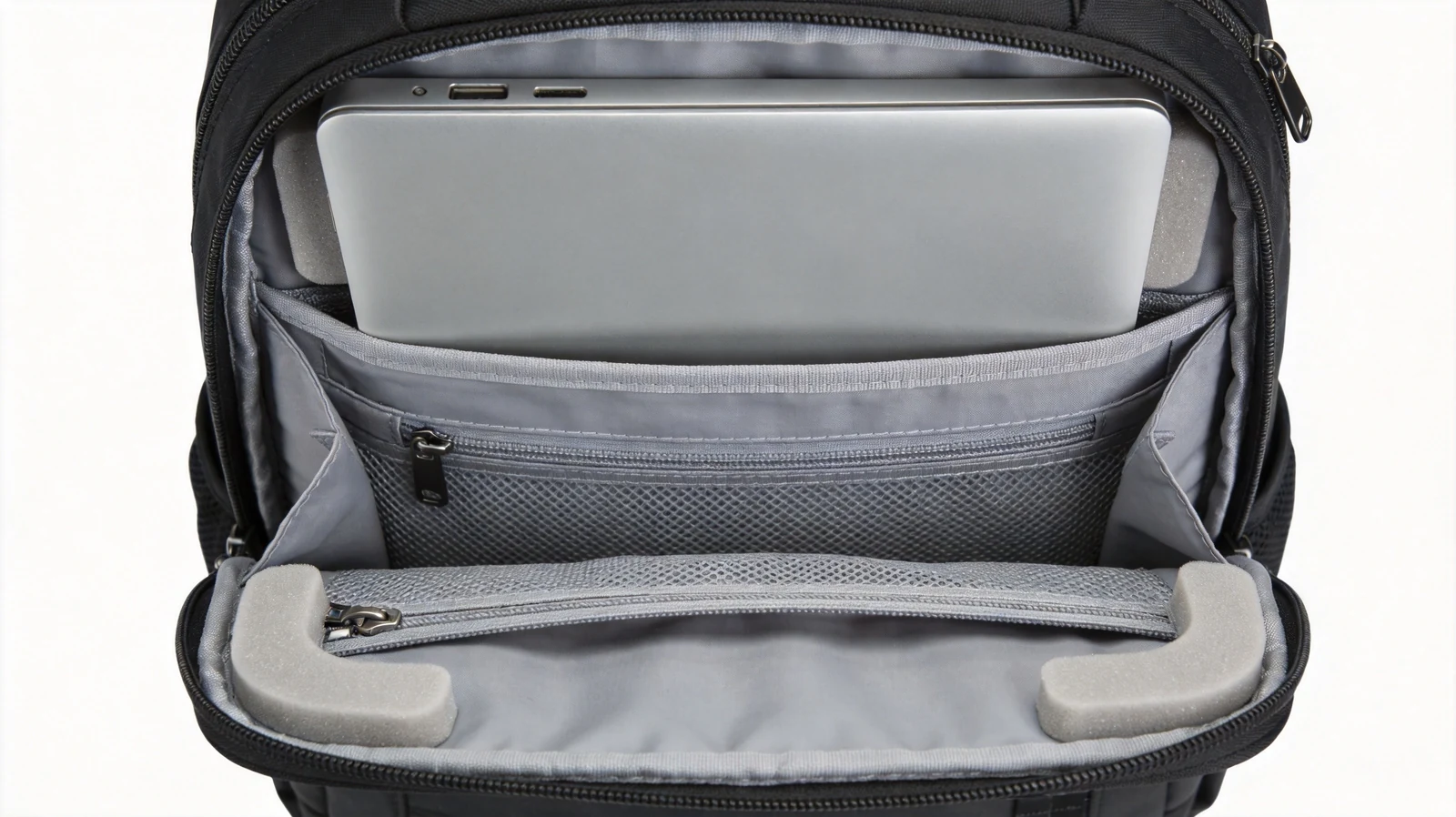
This is the specification that generates the most after-sales cost in the entire work backpack category, and it is the one retail reviews describe most vaguely. A reviewer writes “fits my 15-inch laptop”. A buyer needs a number in millimetres, measured inside the seam, at the widest point, with the sleeve empty.
The nominal-size trap
Laptop sizes are quoted as screen diagonal. That number does not describe the machine’s physical footprint, and the footprint varies by chassis design. A 15.6 inch business notebook typically measures around 360 × 250 mm; a 16 inch machine with a taller 16:10 panel can measure 357 × 248 mm but be 3 mm thicker, which changes the sleeve depth requirement. A 17.3 inch desktop-replacement unit can reach 415 × 285 mm and 28 mm thick.
The working rule on the factory floor is to add clearance to the largest target machine:
- Length and width: add 10–15 mm to the largest device’s footprint, measured internally at the sleeve mouth.
- Depth: add 15–20 mm to the thickest device, because a loaded sleeve compresses and a tight depth is what makes a bag feel like it “does not fit”.
- Sleeve mouth width: at least 25 mm wider than the device, so a corner does not catch on the binding tape.
A sleeve specified at exactly 360 × 250 mm will accept a 360 × 250 mm machine on a bench and reject it in a customer’s hand, because seam allowance, binding tape thickness and fabric stretch all consume tolerance. This is the most common reason a first production run comes back with fit complaints despite passing a factory fit check.
Suspended versus base-resting sleeves
Two constructions dominate. A base-resting sleeve sits on the bag’s bottom panel; drop protection depends entirely on the bag’s own base padding. A suspended sleeve hangs from a seam 20–40 mm above the base, so the device never contacts the ground plane even if the bag is dropped flat.
Suspension costs more — extra stitching, an additional panel, and a longer assembly time — and it is the difference between a bag that survives a 76 cm corner drop and one that does not. If your channel is corporate B2B, education or field sales, specify suspension. If your channel is fashion-led retail at a low price point, a base-resting sleeve with a 10 mm EPE base pad is a defensible compromise, provided you do not claim drop protection you have not tested.
Foam: the number nobody publishes
Padding thickness is quoted in millimetres; padding performance depends on density. A 10 mm EPE (expanded polyethylene) pad at 25 kg/m³ and a 10 mm EVA (ethylene-vinyl acetate) pad at 65 kg/m³ look identical in cross-section and behave completely differently under impact. EPE is cheaper and lighter and is the correct choice for volume programmes. EVA costs more, resists compression set better, and is what to specify when the bag is sold with a protection claim.
Ask for the foam density in kg/m³ on the sample report. If a supplier can only answer “10 mm foam”, the specification is incomplete.
Testing the claim before you make it
If the product page will say “laptop protection”, the bag should be tested rather than asserted. Two protocols are in common use for bag programmes:
- ISTA 1A — non-simulation integrity test for packaged-products up to 68 kg; a screening test for drop and vibration robustness.
- ISTA 3A — general simulation for parcel delivery, including drops, random vibration and compression. Use this when the bag ships direct to consumer in its own carton.
Run the test with a dummy load equal to the heaviest target laptop plus accessories, and inspect the sleeve seam and the device surrogate after each drop. A pass with an empty bag proves nothing.
What “600D” Actually Tells You — and What It Does Not
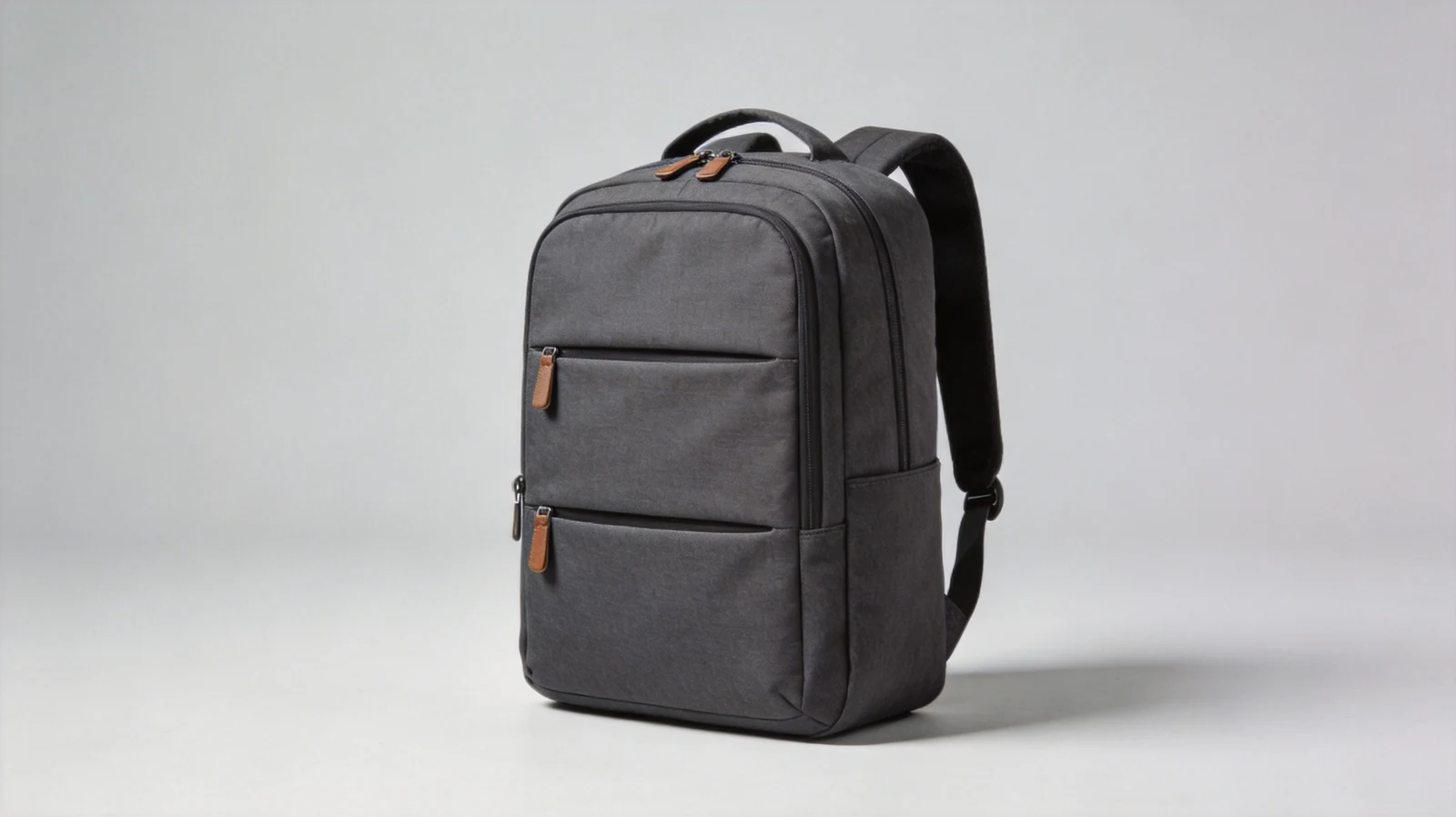
Almost every work backpack listing in the world says “600D” and almost no buyer is told what it means. Denier is a measure of yarn linear mass: 600D means 9,000 metres of that yarn weighs 600 grams. It describes the yarn, not the fabric. Two 600D fabrics can differ by 40 % in weight and by a factor of three in abrasion resistance depending on weave density, coating and finishing.
The number that actually predicts durability is gram weight in gsm, together with the coating and the weave. A practical reference set for work backpack shells:
| Construction | Typical weight | Where it belongs | Trade-off |
|---|---|---|---|
| 300D polyester, PU coated | 180–220 gsm | Lightweight commuter, promotional | Low abrasion life; creases permanently |
| 600D polyester, PU coated | 280–340 gsm | Mainstream work and laptop bags | The default for good reason; balances cost and life |
| 900D–1200D polyester, PU coated | 420–520 gsm | Heavy-duty, tool and field use | Heavier bag, stiffer hand, higher freight cost |
| 420D–840D nylon, PU coated | 260–420 gsm | Premium technical and travel | Better strength-to-weight; higher fabric cost |
| RPET 600D, PU coated | 280–340 gsm | Brands with a recycled-content claim | Requires GRS or equivalent traceability to substantiate |
Coating: the invisible cost and compliance variable
The coating is what makes the fabric water resistant and what determines most of the chemical-compliance exposure.
- PU (polyurethane) — the mainstream choice. Flexible, quieter, better low-temperature behaviour than PVC. Can be solvent-based or water-based; water-based costs more and is the direction most EU-bound programmes are moving.
- PVC (polyvinyl chloride) — cheapest, most water resistant, and the highest compliance risk. Phthalate plasticisers in PVC are restricted under REACH Annex XVII and are a routine failure point. Many EU retailers now refuse PVC outright.
- TPU (thermoplastic polyurethane) — best abrasion and flex performance, weldable, and the highest material cost. Used where a bag carries a genuine waterproof claim.
Two questions to put to a supplier in writing: is the coating solvent-based or water-based, and can you supply the coating’s REACH and phthalate test report for the production lot, not a generic certificate. A certificate without a lot number is a marketing document.
Recycled content and the substantiation problem
RPET is now a standard option and a standard marketing claim, and the two are not the same thing. If the product will say “made from recycled plastic bottles”, the supply chain needs traceability: a GRS (Global Recycled Standard) transaction certificate covering the specific fabric lot, issued by a recognised certification body, with the quantity matching the purchase. Without that document the claim is unsubstantiated in the EU and increasingly challenged in North America. Specify the certificate requirement at the sampling stage, not after the goods are on the water.
Zipper and Hardware Specification
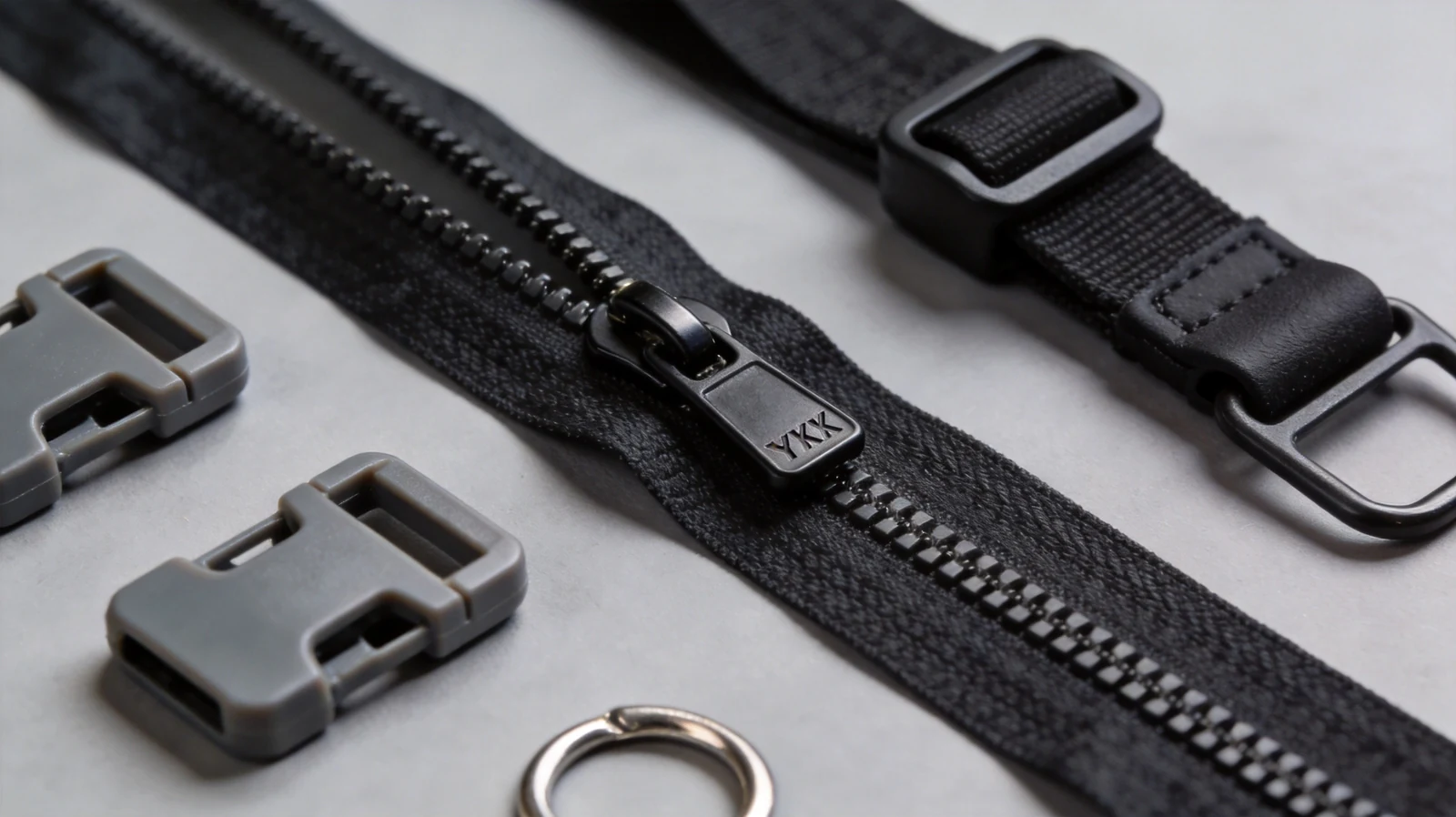
Hardware is 8–14 % of the bill of materials and accounts for a disproportionate share of field failures. It is also the area where a factory quote varies most between suppliers quoting “the same bag”.
Zipper size is a load rating, not a style choice
- #5 — the workhorse for main compartments on commuter and work bags. Adequate for a loaded 15 kg bag in normal use.
- #8 — specify for the main opening when the bag is expected to be over-packed, or when the zipper takes a corner radius. Larger teeth resist lateral pull at curves.
- #10 — luggage and heavy travel. Over-specified for a work backpack and adds visible bulk and cost.
- #3 — interior pockets and small accessory zips only. Using #3 on a main compartment is a cost cut that shows up as a failure within months.
Brand versus unbranded
A branded slider and tape assembly (YKK, SBS and equivalents) costs meaningfully more than an unbranded equivalent and delivers a measurable difference in cycle life and in colour consistency between lots. For a programme where the zipper is a stated feature, specify the brand in the purchase order with the part number. For a promotional or entry-price programme, an unbranded zipper from a controlled supplier is a rational choice — provided the inspection plan includes a zipper reciprocation test rather than trusting the label.
The same logic applies to buckles and adjusters. A branded acetal side-release buckle and a generic moulding look alike in a photograph; they differ in gate strength, in UV stability, and in whether the finish yellows within a season.
The specification line that prevents arguments
Write hardware into the tech pack as: part type, size, brand, colour reference, and the test it must pass. For example: “#8 reverse-coil, branded, matte black, 15,000-cycle reciprocation with 8 kg load, no tooth separation.” That sentence is enforceable. “Good quality zipper” is not.
Compliance for Work Backpacks by Destination Market
This section matters more than any other on this page, because compliance failures cannot be fixed after production. It is also the section where the most incorrect information circulates in the category — including from suppliers.
What does not apply to a work backpack
Three claims appear constantly and are all wrong:
- “CE certified backpack.” CE marking applies to products covered by specific European directives and regulations — toys, personal protective equipment, electrical equipment, medical devices and similar. A backpack is not in any of those scopes. There is no CE certificate for a bag, and a supplier offering one is either misusing the mark or selling you a certificate for a component.
- “TSA approved backpack.” The US Transportation Security Administration does not certify, approve or endorse bags, locks or carriers. TSA-recognised luggage locks exist as a voluntary arrangement for checked baggage access; there is no TSA approval for a backpack. Any “TSA approved” badge on a bag page is a marketing phrase with no regulatory status behind it.
- “Anti-theft certified.” There is no harmonised standard for anti-theft bags. Cut-resistant fabric may carry its own ASTM or ISO test result for the material, but the bag as a product has no anti-theft certification.
Correcting these in your own product copy is a competitive advantage, not a loss. Buyers in your channel are increasingly checking, and a page that states what is actually required reads as more credible than one that stacks logos.
European Union
- General Product Safety Regulation (EU) 2023/988 — applies since 13 December 2024. It requires the economic operator established in the EU, traceability information on the product or packaging (including a producer or importer address), and a documented risk assessment. For a bag programme this means the labelling and the paperwork are part of the product, not an afterthought.
- REACH Regulation (EC) 1907/2006, Annex XVII — restricts aromatic amines from azo dyes, certain phthalates, and polycyclic aromatic hydrocarbons in rubber and plastic components. Textiles, coatings, foams, prints and hardware finishes are all in scope. Ask for a test report naming the specific restricted substances and the production lot.
- PFAS restrictions — the EU-wide restriction proposal is progressing through the ECHA process, and several member states already restrict PFAS in textiles. If your fabric carries a durable water-repellent finish, ask the mill whether the DWR is PFAS-based or PFAS-free, and get it in writing. Switching after a production run is not possible.
- ESPR / Digital Product Passport — the Ecodesign for Sustainable Products Regulation introduces a digital product passport, with textiles among the first priorities. Programmes with a multi-year life should start capturing material composition, recycled content and origin data now, because the passport is a data problem before it is a labelling problem.
- Packaging — the Packaging and Packaging Waste Regulation sets recyclability and minimum-recycled-content requirements for packaging placed on the EU market. Polybag specification is therefore a compliance decision, not a purchasing detail.
United States
- CPSIA — applies to products designed or intended primarily for children 12 years and younger. A work backpack for adults is out of scope. A backpack marketed to schoolchildren is in scope and brings third-party testing, tracking labels and lead and phthalate limits with it. The decision is made by how the product is marketed, not by what the factory intended.
- California Proposition 65 — requires a clear and reasonable warning before exposure to listed chemicals. This is a warning obligation, not a pre-market approval. For bags, the practical exposure is in coatings, foams, printing inks and soft PVC components.
- California AB 1817 — restricts intentionally added PFAS in textile articles sold in California, with the textile articles provision effective from 1 January 2025. This is the single most consequential US requirement for bag programmes with water-repellent finishes.
- State chemical programmes — Washington, Maine, Minnesota and New York each run their own reporting or restriction schemes. For a national US launch, a single PFAS-free material specification avoids most of this complexity.
Practical compliance package to request with every sample
- Material safety data and composition declaration for shell fabric, lining, coating, foam and webbing.
- REACH Annex XVII test report covering azo dyes, phthalates and PAHs, with lot identification.
- PFAS declaration for any water-repellent finish, stating whether PFAS is intentionally added.
- Recycled-content transaction certificate if a recycled claim will be made.
- Nickel-release statement for metal hardware in prolonged skin contact.
- Packaging specification with material, recycled content and importer identification.
MOQ, Sampling and Lead Time: The Numbers Buyers Actually Work With
Published MOQ figures in the category range from 50 pieces to 1,000 pieces, and the spread is not arbitrary — it tracks whether the offer is a stock item with a logo added, or a genuinely custom build with a new pattern, new tooling and a new material buy.
| Stage | Typical duration | What it covers |
|---|---|---|
| Specification and costing | 3–7 days | Tech pack review, BOM, material sourcing, quotation |
| Sampling | 6–10 days | Pattern making, cutting, assembly, first sample |
| Sample revision | 5–7 days per cycle | Fit, hardware and branding corrections |
| Pre-production | 7–12 days | Material in-house, cutting approval, line scheduling |
| Mass production | 35–50 days | Cutting, sewing, hardware, final assembly |
| Inspection and packing | 3–5 days | Inline and final AQL inspection, cartoning |
| Sea freight to EU/US | 25–40 days | Port to port, plus customs clearance |
Standard minimum order quantity for a custom work backpack programme is 500 pieces per colour per design. Below that threshold the material buy, the pattern work and the line setup are being amortised across too few units, and either the unit price rises sharply or the quality of the material buy drops. Sample charges are normally credited against the first bulk order once it reaches the agreed value.
Two planning notes that save programmes from slipping. First, book the sampling slot before the artwork is finalised — the 6–10 day sampling window starts from an approved tech pack, not from an idea, and the most common cause of delay is a specification that is still moving while the sample is being cut. Second, plan the freight mode against the retail launch date rather than against the production completion date; a 35–50 day production run plus 30 days of sea freight is a 10–12 week supply chain before any buffer.
Cost Structure: Where the Money Actually Goes
Buyers who understand the cost stack negotiate better, because they know which line has room and which line is already at the floor. For a mid-market 600D PU work backpack at a 5,000-piece volume, the FOB cost typically decomposes as follows.
| Cost element | Share of FOB | Lever available to the buyer |
|---|---|---|
| Shell and lining fabric | 22–30 % | Fabric weight and coating type; consolidating colours across styles |
| Foam, webbing, mesh | 6–9 % | Foam density; mesh quality on non-visible panels |
| Zippers and hardware | 8–14 % | Brand versus unbranded; reducing slider count |
| Direct labour | 24–34 % | Reducing panel count and seam length; simplifying the interior |
| Branding and decoration | 3–6 % | Method choice: embroidery versus silicone transfer versus woven label |
| Packaging | 3–5 % | Polybag specification, hangtag, carton configuration |
| Overhead and margin | 15–20 % | Volume, payment terms, order frequency |
Two levers matter more than the rest. Panel count drives labour more than any other design variable: a bag with eleven pattern pieces costs materially more to sew than a bag with seven, and the difference is invisible on a product photograph. Colour consolidation drives the material buy: every additional shell colour adds a minimum fabric order and a cutting setup, which is why a three-colour range at 500 pieces each is cheaper per unit than three colours at 170 pieces each.
Incoterms matter for the same reason. An FOB quote excludes freight and insurance to your port; a DDP quote includes duty and final delivery and therefore embeds the importer’s risk in the price. For a first programme, FOB with your own forwarder gives visibility of the real landed cost. The HS classification for backpacks with an outer surface of textile or plastic sheeting falls in heading 4202, with 4202.12 covering trunks, suitcases and similar containers including backpacks — the specific subheading depends on the outer material, so confirm it with your customs broker against the actual shell rather than accepting a supplier’s default code.
Quality Control: What to Inspect, When, and Against What
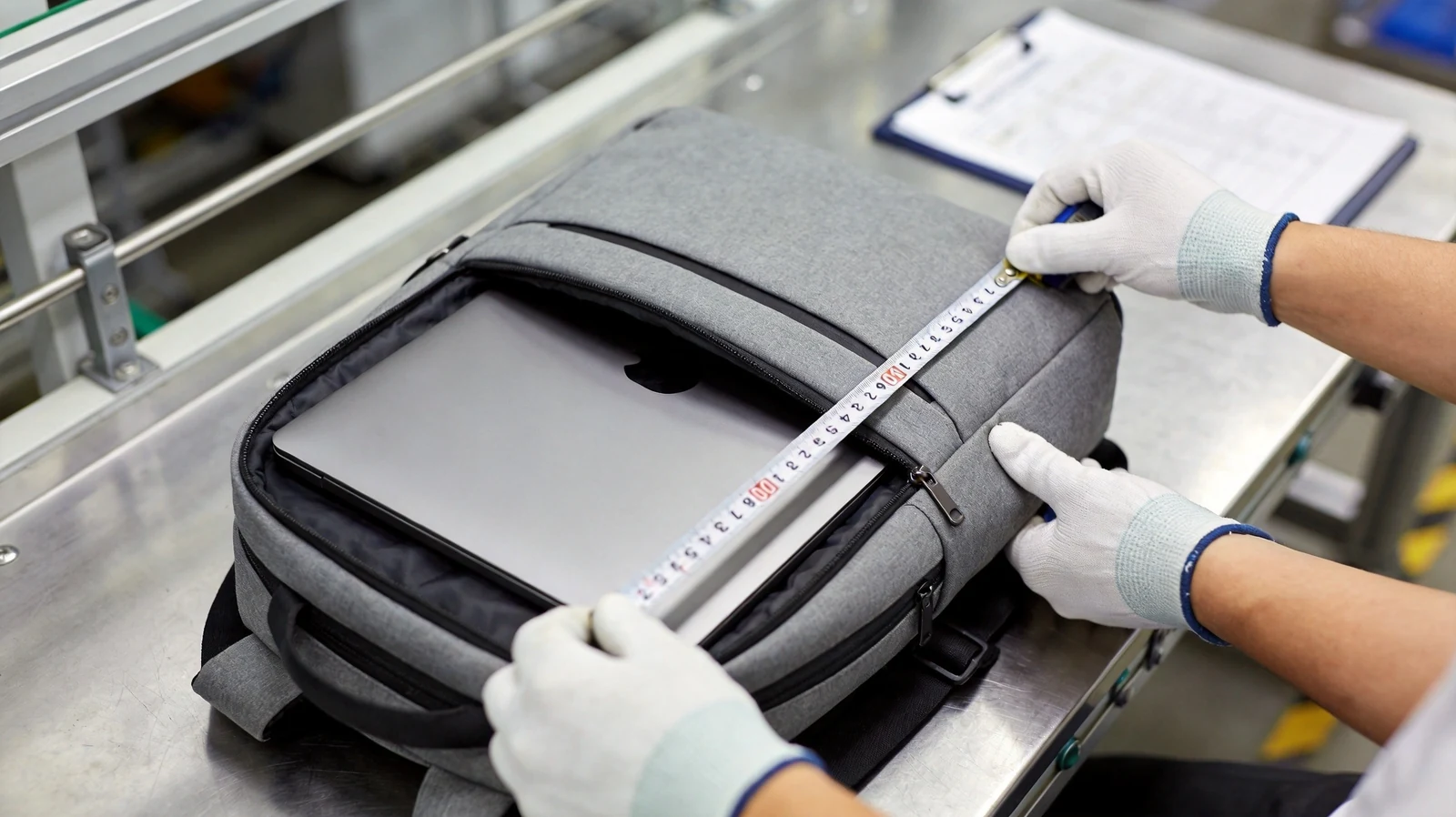
Inspection is not a final gate. A programme that inspects only at the end is inspecting scrap. Three checkpoints carry almost all the value.
Checkpoint 1 — incoming material
Verify fabric gram weight against the specification by cutting a known area and weighing it. Verify colour against the approved lab dip under a light box. Verify the zipper brand on the tape and the slider. Verify foam density by dimension and mass. Material substitution is the most common and least visible cost cut in the category, and it is only detectable at this stage.
Checkpoint 2 — inline, during sewing
Check seam allowance, stitch density and bar-tack placement on the first units of each operation, not on the finished bag. The failure modes to watch are specific: a sleeve sewn 5 mm short, a bar-tack omitted at a strap junction, a lining panel cut on the bias so it stretches, a zipper tape not fully enclosed at the end. All four are cheap to fix inline and expensive to fix after packing.
Checkpoint 3 — final inspection against AQL
Final inspection should be a statistical acceptance decision, not an opinion. AQL 2.5 for major defects and AQL 4.0 for minor defects is the conventional level for bag programmes. Define “major” and “minor” in writing before the inspection, or the inspection becomes a negotiation. A workable definition: a major defect affects function, safety or saleability (broken zipper, failed seam, wrong dimension, non-removable stain); a minor defect affects appearance only and would not stop a sale at full price.
Functional tests to include in the inspection plan, beyond visual checks:
- Zipper reciprocation — 15,000 cycles with a load representative of a packed bag, on main and secondary openings.
- Strap and handle static load — a sustained load at the specified rating, held and released, with inspection of the attachment.
- Seam strength — tensile test on the load-bearing seams, recorded in newtons per centimetre.
- Colour fastness — rubbing and water, particularly on dark shell fabrics against light linings.
- Hardware salt spray — for metal components, to confirm the plating specification rather than discovering it as corrosion in a retail stockroom.
- Carton drop — on the packed master carton, to confirm the packaging rather than the bag.
How to Read Any Work Backpack Review as a Buyer
The archive below is genuinely useful if you read it the right way. Five statements recur in retail reviews, and each one translates into a question worth putting to a factory.
| What the review says | What the buyer should ask |
|---|---|
| “The laptop compartment is really well padded” | Foam type and density in kg/m³, thickness in mm, suspended or base-resting, and which drop test was run with what load |
| “The zippers feel premium” | Size, brand and part number, plus the reciprocation test result at the specified load |
| “It stands up on its own when full” | Base reinforcement: HDPE board thickness, or frame construction, and whether it survives the ISTA sequence |
| “The material feels durable” | Gram weight in gsm, coating chemistry, and the abrasion test method and result |
| “Great for commuting with a 16-inch laptop” | Internal sleeve dimensions in mm at the mouth, measured on a production unit, not a sample |
Every one of those five questions has a numeric answer. A supplier who can produce the numbers is a supplier who has a controlled process. A supplier who answers with adjectives has a sales team.
Frequently Asked Questions
What is the minimum order quantity for a custom work backpack?
The standard minimum is 500 pieces per colour per design for a genuinely custom build with a new pattern and a new material buy. Below that, the pattern work and the fabric minimums are spread across too few units and either the price rises steeply or the material specification is quietly reduced. Stock styles with a logo applied can run lower, but that is a decoration programme, not a custom manufacturing programme.
How long does it take to develop and produce a custom work backpack?
Sampling runs 6–10 days from an approved tech pack, with 5–7 days per revision cycle. Pre-production takes 6-10 days once materials are in house. Mass production is 35–50 days depending on quantity and interior complexity. Add 25–40 days for sea freight to Europe or North America. A first programme should plan on 10–12 weeks from approved sample to goods at your warehouse, before any buffer.
Is a backpack required to carry CE marking?
No. CE marking applies only to products within the scope of specific European directives and regulations such as toys, personal protective equipment, electrical equipment and medical devices. A backpack is outside all of those scopes, so there is no CE certificate for a bag. What does apply is the General Product Safety Regulation (EU) 2023/988, REACH Annex XVII for restricted substances, and national EPR registration for the party placing the goods on that market.
Is there such a thing as a TSA approved backpack?
No. The US Transportation Security Administration does not certify, approve or endorse bags, locks or carriers. TSA-recognised luggage locks are a voluntary arrangement that lets agents open checked baggage without cutting it, and they have no bearing on a backpack. Any “TSA approved” badge on a bag listing is a marketing phrase without regulatory status.
What internal laptop sleeve size should I specify for a 15.6-inch and a 16-inch laptop?
Add 10–15 mm to the largest target device’s physical footprint for length and width, and 15–20 mm for depth, all measured inside the seam with the sleeve empty. A 15.6-inch business notebook is typically around 360 × 250 mm, so the sleeve should be specified at roughly 375 × 265 mm internally. A 16-inch machine with a 16:10 panel can be shorter but thicker, which is why depth must be specified from the thickest target device rather than the largest screen.
Does 600D mean the backpack is durable?
Not on its own. Denier describes yarn linear mass, not fabric performance. Two 600D fabrics can differ by 40 % in gram weight and by a factor of three in abrasion resistance depending on weave density, coating and finishing. Specify gram weight in gsm alongside denier, plus the coating chemistry, and require an abrasion test result against a named method.
Which compliance documents should I request with the sample?
A material composition declaration for shell, lining, coating, foam and webbing; a REACH Annex XVII test report covering azo dyes, phthalates and PAHs with lot identification; a PFAS declaration for any water-repellent finish; a recycled-content transaction certificate if a recycled claim will be made; a nickel-release statement for metal hardware; and a packaging specification that includes importer identification for the EU market. Generic certificates without a lot number are not evidence.
What AQL level should a work backpack inspection use?
AQL 2.5 for major defects and AQL 4.0 for minor defects is the conventional level for bag programmes. The critical step is defining major and minor in writing before the inspection: a major defect affects function, safety or saleability, while a minor defect affects appearance only and would not prevent a sale at full price. Without that definition the inspection result becomes a negotiation rather than a decision.
Can you produce a work backpack from our own design and tech pack?
Yes. Both OEM (built to your specification) and ODM (our development adapted to your brand) are available. Send the tech pack or a dimensioned drawing with the target fabric, hardware and branding method, and the costing and sampling plan follows from that. If the design is still at concept stage, the fastest path is a specification review before pattern making, because most sampling delays come from a specification that is still moving while the sample is being cut.
What is the difference between FOB and DDP pricing for a backpack order?
FOB prices the goods delivered to the named origin port, with freight, insurance and import clearance excluded. DDP prices the goods delivered to your door with duty and import formalities included, which means the importer’s risk is embedded in the unit price. For a first programme, FOB with your own forwarder gives clearer visibility of the real landed cost and of where the duty is being calculated.
Archive: Work Backpack Reviews Published 2021–2022
The reviews below were published on this site between 2021 and 2022 and each remains available on its own URL. They are listed here as reference on what the consumer market rewards — comfort narratives, brand positioning, aesthetic language. Read them as market research, not as procurement documentation.
Brand and product reviews
- Harber London Office Backpack Review — A Handcrafted Laptop Backpack for Work
- Day Owl Backpack Review — Stylish Grown Up Backpack for Work and Weekends
- Topologie Satchel Backpack Dry Review — Minimalist Backpack for Work and Play
- King Kong ZONE25 Review — Meal Prep Backpack for Work & Workouts
Buying guides and comparisons
- The Best Work Backpacks — Professional Bag Manufacturer
- 10 Best Men’s Backpacks for Work — Professional & Stylish
- 10 Best Women’s Backpacks for Work — Tested and Reviewed
- 10 Best Backpacks For Work that are Professional and Stylish
- Best Backpacks for Work and Gym — 9 Gym Bags that Are Office-Friendly
- Best Backpack For Gym and Work
- Best Backpacks with Shoe Compartments — Top Work to Gym Bags
- The Hunt: The Best Work Backpacks
- Tote or Backpack for Work?
- Best Minimalist Urban Backpacks for Work and Play
- 12 Best Convertible Backpacks for Work, Play and Travel
- 4 Best Backpacks For Running To Work
- How To Choose a Backpack for Work that is Sophisticated and Stylish
- How to Organize a Work Backpack
Related Manufacturing Resources
- How to Prepare Artwork and Specs for Custom Backpack Production — the tech pack inputs that make a first sample accurate.
- Outdoor Backpack Manufacturer Matrix — how hiking, trekking, mountaineering and camping packs differ on one factory platform, and where the construction logic overlaps with technical work bags.
- Custom Trekking Backpack Manufacturing Guide — load-transfer engineering and European fabric sourcing, useful reference for any load-bearing bag.
- Custom Mountaineering Backpack Guide — attachment systems and cold-temperature hardware behaviour.
- Custom Tool Bag Manufacturer — heavy-duty construction and abrasion specification for tool and field carry.
- Best Backpack for Construction Workers — duty-cycle requirements in the trades channel.
Start a Custom Work Backpack Programme
If you are specifying a work, commuter or laptop backpack range, the useful first step is a specification review rather than a price request. Send the target market, the laptop sizes to be supported, the fabric and hardware direction, the branding method and the expected first-order quantity, and the response should come back as a costed BOM with a sampling plan — not a single number.
JUNYUAN BAGS manufactures custom backpacks, travel bags and technical carry for brand owners, distributors and corporate programmes. OEM and ODM both run through the same specification-first process: tech pack review, material sourcing, sampling, inline and final inspection against a written AQL plan, and export documentation matched to the destination market.
Contact: [email protected] | WhatsApp / Tel: +86 177 5002 0688