
What is the Topologie Satchel Backpack Dry, and is it still worth buying in 2026? The Satchel Backpack Dry is a 15-litre water-resistant commuter backpack that fuses a classic trekking pack with a business satchel: a splashproof 900D polyester body, a waterproof PU lid, a suspended padded sleeve for laptops up to 15 inches, and a 770 g carry weight. It is no longer listed in Topologie’s current catalogue — the brand’s published product feed now runs the Parachute, Mobility and Archive Mobility backpack families instead — so the model survives through resale and remaining retail stock rather than as a first-line product. For brands sourcing a comparable 15 L commuter satchel, the same construction is buildable at 500 pcs MOQ, 6–10 days sampling and 35–50 days bulk production, inspected to AQL 2.5 major / 4.0 minor.
That paragraph is the short answer. The rest of this page is the long one: what the Satchel actually is, how each of its parts is made, where the design succeeds and where it compromises, and what it takes to put a competing 15 L commuter satchel into your own line.
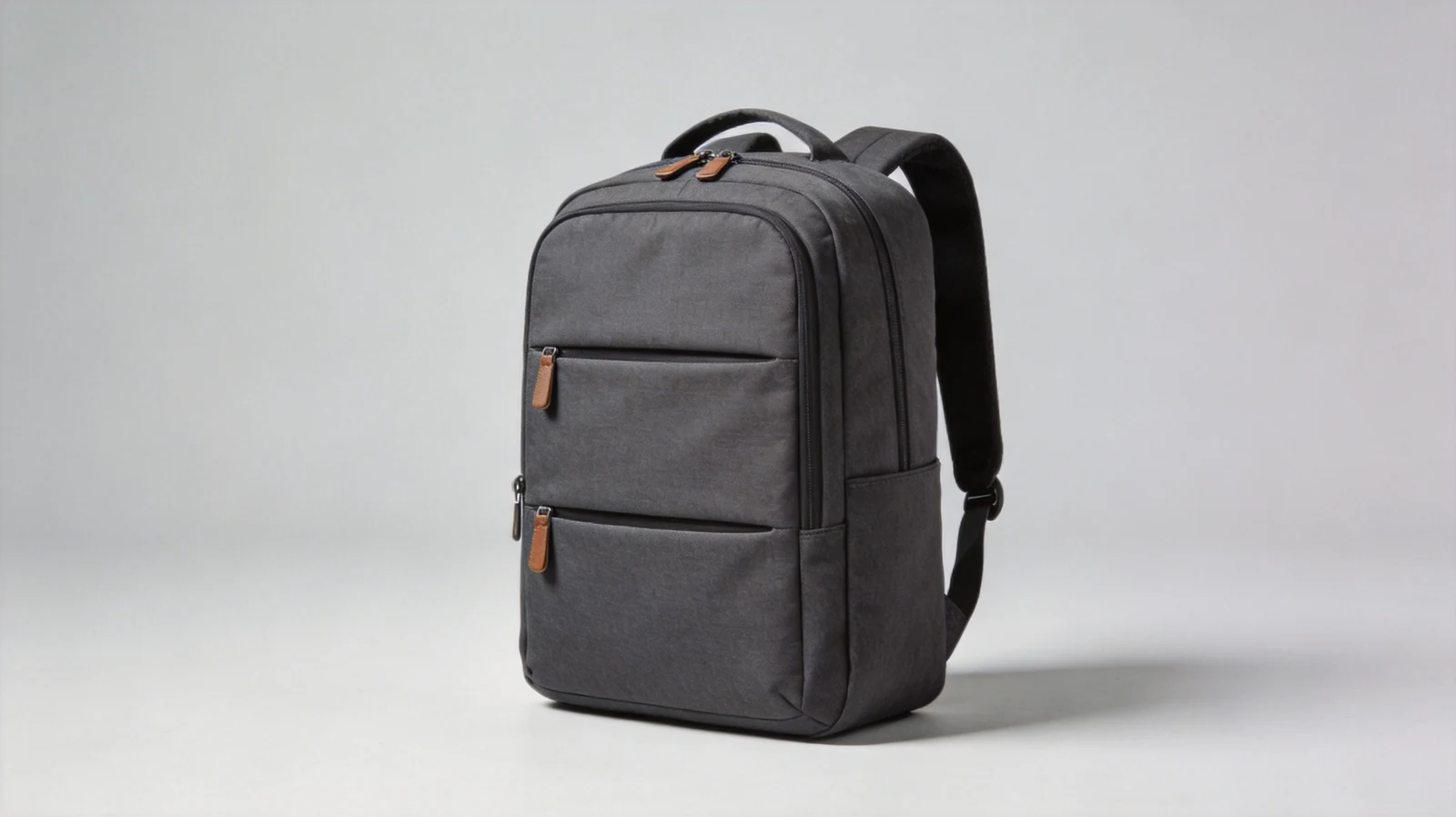
Topologie Satchel Backpack Dry at a glance
| Specification | Topologie Satchel Backpack Dry |
|---|---|
| Capacity | 15 L |
| Dimensions | 42 × 29.5 × 12 cm (16.5 × 11.6 × 4.7 in) |
| Weight (empty) | 770 g |
| Body fabric | Splashproof 900D polyester; earlier production runs used PU-coated 600D polyester and PU-coated poly-canvas |
| Lid | Waterproof PU fabric with polyester backing |
| Laptop fit | Suspended, padded sleeve, up to 15 in |
| Access | Top lid with metal utility hook and twin magnetic closures; side zipper into main compartment |
| Pockets | Hidden rear zip pocket, document sleeve, three slip pockets, zipped mesh pocket, bottle / umbrella compartment |
| Carry | Adjustable padded shoulder straps on punched metal buckles; padded back panel |
| Water resistance | Water-resistant body and lid; water-repellent zipper with PU storm lip. Not submersible. |
| Status in 2026 | Discontinued from Topologie’s primary line; available via resale and remaining retail stock |
Is the Topologie Satchel Backpack Dry still available?
No — not as a current Topologie product. A check of the brand’s published product sitemap returns 311 active product URLs and none of them is a Satchel. The backpack range has moved to the Parachute family (in XS, Medium, Large and standard sizes), the Mobility Backpack and the Archive Mobility Backpack. Anyone searching for the Satchel today is buying from resale marketplaces, regional retailers holding old stock, or secondary listings.
This matters for two reasons. First, if you are a buyer, do not pay a current-season price for a discontinued model — and check the fabric spec on the label, because earlier runs shipped a PU-coated 600D polyester body while later stock moved to 900D. Second, if you are a brand, the discontinuation is the interesting signal: a 15 L minimalist commuter satchel with a PU lid still has an audience, and the format is now under-served in the brand’s own line-up. That is a sourcing opportunity, not a dead end.
Cited source: Topologie product catalogue, topologie.com (product sitemap reviewed November 2026).
Materials and construction
The Satchel’s weather story rests on three materials working together rather than one waterproof shell: a coated polyester body, a PU lid, and a zipper with a PU storm lip. Each does a different job, and each fails in a different way if specified badly.
The body: coated 900D polyester
900D polyester is a coarse, high-density weave. The “D” is denier — the weight in grams of 9,000 metres of the yarn — so 900D yarn is roughly three times heavier per unit length than 300D. In a bag body that translates into abrasion resistance and a stiff hand that holds a structured shape without a plastic frame sheet. The trade-off is weight and drape: 900D reads as firm and technical, not soft.
On its own, woven polyester is not waterproof. The Satchel relies on a polyurethane coating on the reverse face. Coating quality is where cheap bags quietly diverge from good ones: an under-cured or too-thin PU film survives the factory and delaminates within a season of folding. In production this is controlled by coating weight (grams per square metre), adhesion testing after lamination, and a fold-and-flex check on the finished panel. If you are specifying a comparable body, ask for the coating weight in writing, not just the word “waterproof”.
The lid: PU fabric
The lid is the part of a top-loading satchel that takes rain first, and Topologie used a thick PU sheet with a rubbery hand rather than coating a textile. That is the correct call for the top of the bag: a solid film has no weave to wick through, so water beads and runs off. The compromise is that PU is not breathable and can stiffen in cold weather, which is why it is confined to the lid and trim instead of the whole body.
Zippers and hardware
The rear zip pocket uses a water-repellent zipper shielded by two PU lips that meet over the teeth. This is not a waterproof zipper and Topologie did not claim it was — the lips stop water reaching the teeth on contact, which is what a commuter actually encounters. The main closure is mechanical rather than zipped: a metal utility hook inspired by climbing hardware, backed by two magnetic closures under the lid. Magnetic closures are fast and quiet; they also mean the lid is not load-bearing, so the hook carries the tension.
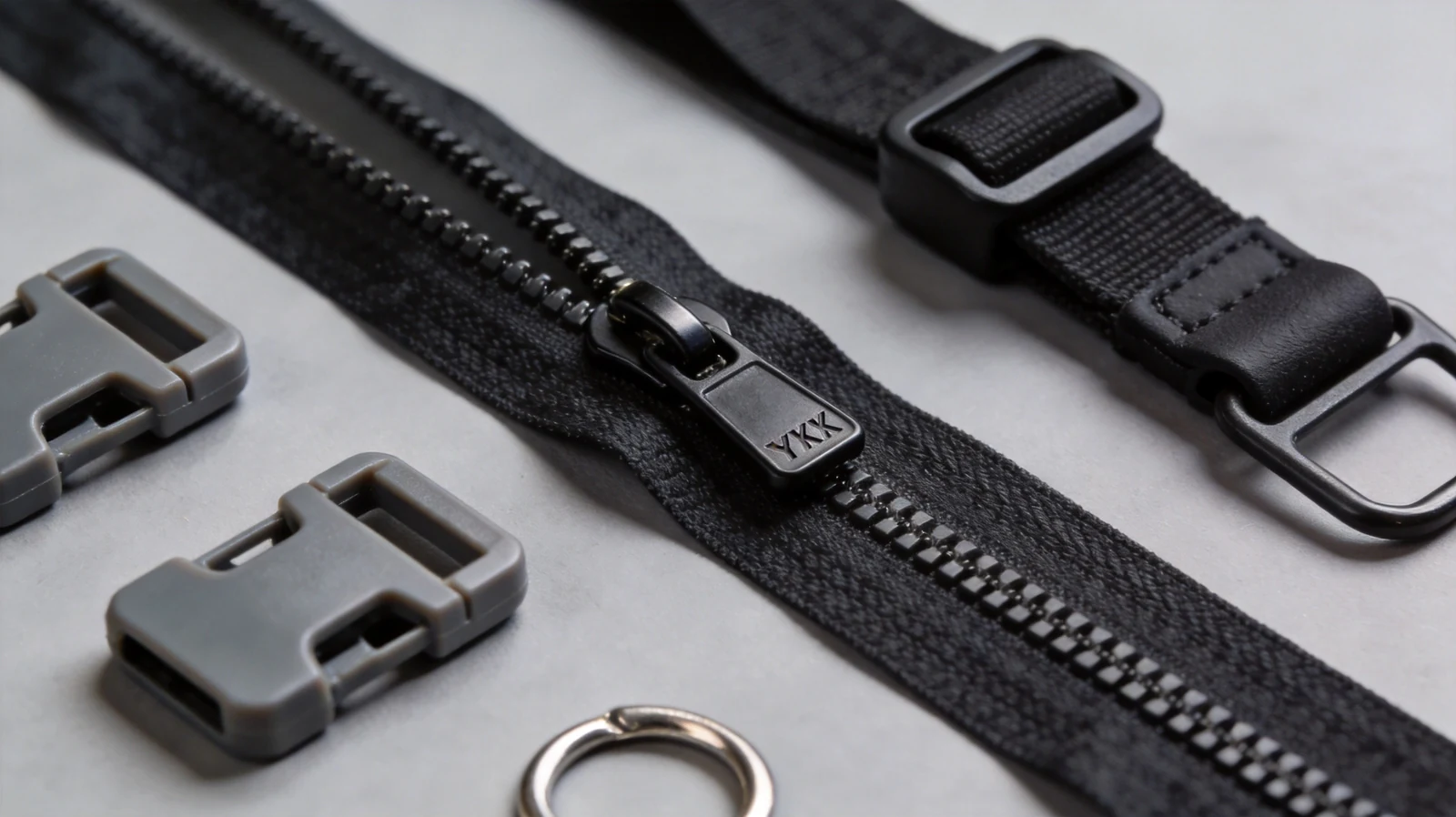
Pockets, compartments and access
Exterior storage is deliberately minimal: one hidden zippered pocket on the back panel, sized for a phone, passport or wallet, and nothing else. Everything else lives inside. That is the design thesis — a clean outside, an organised inside — and it is the single biggest thing to understand before copying the silhouette.
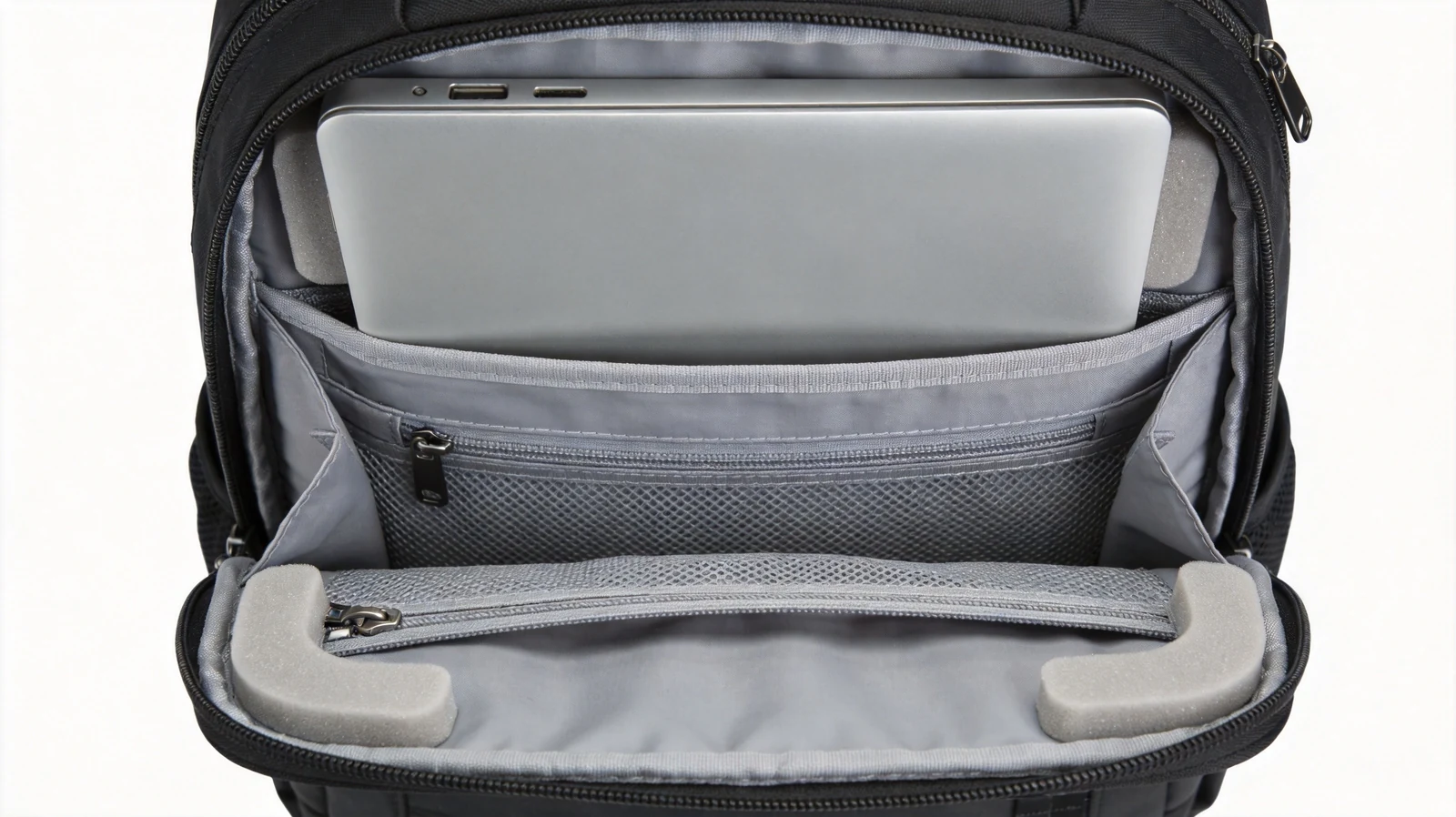
Under the lid sits the laptop sleeve, and it is suspended rather than floor-touching. This is the detail worth paying for. A sleeve sewn flat to the back panel transmits every knock straight into the laptop; a sleeve hung from the top seam with a gap below the base keeps the machine off the ground when the bag is set down. Topologie padded it, though not heavily — if drop protection is your priority, that is the first thing to upgrade.
Beside it runs a separate document sleeve, also against the back panel, which keeps papers flat and uncreased. Then three smaller slip pockets for personal items, and a zipped mesh pocket for loose objects. One side wall carries a dedicated bottle or umbrella compartment so a wet cylinder is not rolling around against your laptop. What is missing is the usual pen loops and business-card slots; the slip pockets absorb those jobs without dedicated tooling.
What actually fits in 15 litres
Fifteen litres is a commuter volume, not a travel volume, and the honest test is whether it swallows a full working day without becoming a brick. In practice the Satchel takes:
- A 15-inch laptop in the suspended sleeve
- A tablet in the document sleeve alongside paperwork
- A one-litre bottle or a compact umbrella in the side compartment
- A folded sweater or light jacket in the main body
- Over-ear headphones, cables and a pouch in the remaining space
- Two 1-inch binders plus a large textbook, with room left for the laptop
What it will not do is carry a week of clothing, a pair of shoes and a laptop at once. If that is the requirement, 15 L is the wrong number and the Haul at 22 L is the right one.
Fit, weight and comfort
At 770 g empty the Satchel sits in the light half of the commuter category, and because the volume ceiling is low the bag rarely gets heavy enough to expose weak padding. The shoulder straps sit a little over 4 inches apart at the top, which is a genuine middle ground — narrow enough not to slide off sloped shoulders, wide enough not to bind across a broad back. That single measurement is why the bag reads as unisex rather than as a men’s or women’s pack.
Strap length adjusts on punched metal buckles, belt-style. This holds a setting permanently, which plastic sliders do not, but it gives you fixed increments instead of stepless tuning. The back panel shares its foam with the laptop sleeve, so your machine and papers sit against your back rather than against a separate pad. That is what produces the flat profile — and it is also why the bag never pokes you in the spine.
How a 15 L commuter satchel is actually built
Strip away the branding and the Satchel is a top-loading satchel with a coated shell, a film lid, a suspended laptop sleeve and a mechanical closure. That bill of materials is buildable at scale, and the sequence is consistent across commuter-bag programmes:
- Pattern and grading. The satchel silhouette depends on panel geometry more than on hardware. Curved side walls, a gusseted base and a lid that overhangs by 10–15 mm are all pattern decisions made before any material is cut.
- Cutting. Coated polyester is cut on a straight-knife or die press. Coated goods must be cut face-down and handled so the film is not scored along fold lines — a scored coating becomes a crack.
- PU lid and trim assembly. Film panels are joined by high-frequency welding or by stitching with a sealed seam, depending on the finish you want. Welded seams are cleaner and more watertight; stitched seams need seam tape or a bound edge.
- Laptop sleeve construction. The suspended sleeve is a separate sub-assembly — foam, lining and a binding — hung from the top seam before the main body is closed. Getting the suspension gap right is a measurement, not a judgement call.
- Main assembly and bar-tack. Strap anchors, the utility hook plate and the bottle compartment all carry load and are bar-tack reinforced. This is the step that decides whether a bag survives two years of daily commuting.
- Hardware setting. Metal hooks, magnetic closures, punched strap buckles and zipper sliders are set last, after the shell is closed, because setting them earlier risks crushing them under the needle.
- Inspection and packing. AQL 2.5 major / 4.0 minor sampling, plus functional checks on every closure and a seam-strength pull on load-bearing joins.
Two of those steps are where cost quietly accumulates and where quotes diverge most: the PU lid (welded versus stitched) and the suspended sleeve (foam grade and whether the suspension is real or cosmetic). A supplier quoting a low number is usually saving on exactly those two.
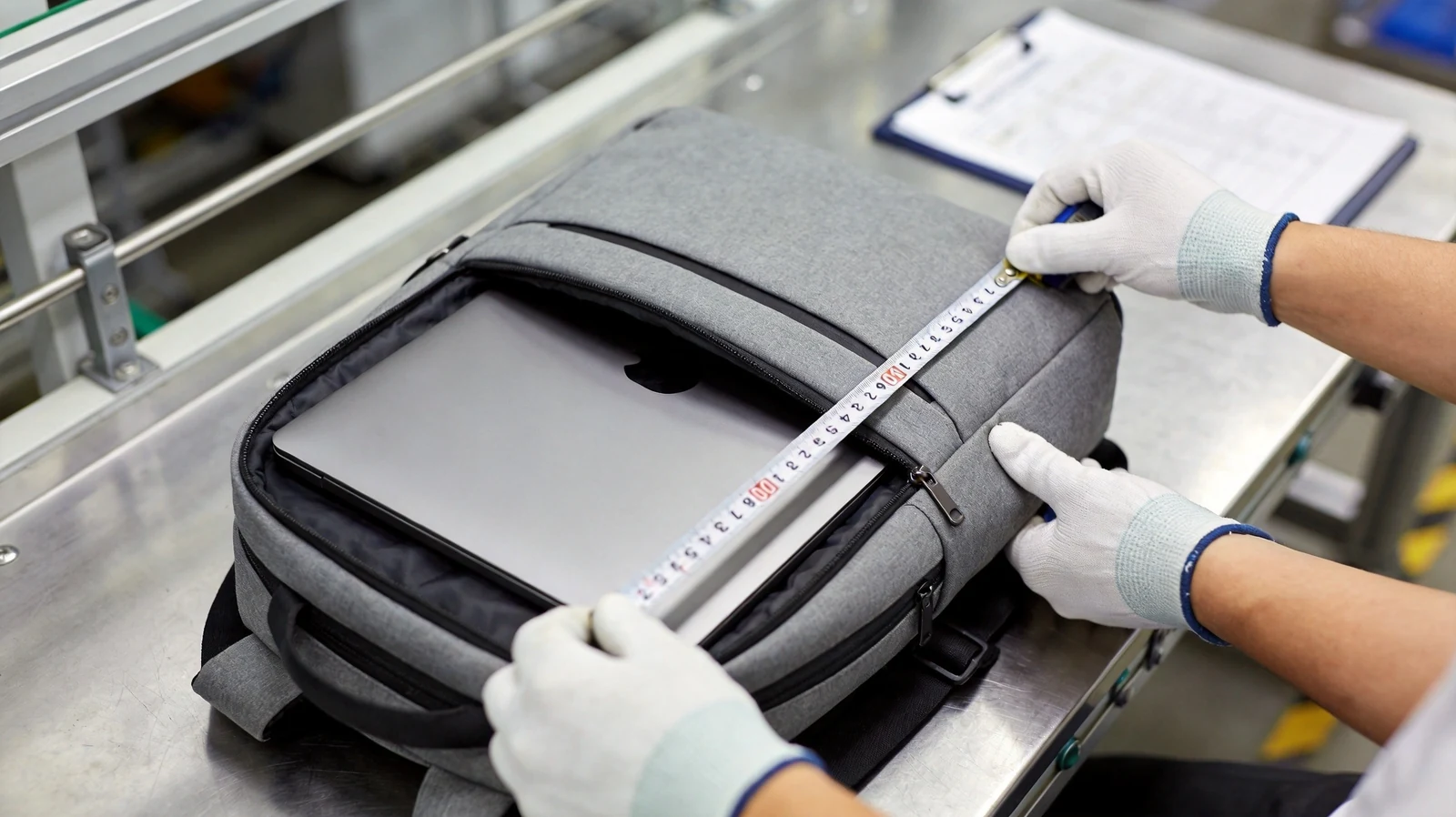
Specifying a comparable satchel for your own brand
If the Satchel’s format is the one your customers want, here is what a programme looks like on our side. Quanzhou Junyuan has coordinated bag manufacturing since 2014, with design and production experience in the category dating to 2004, and ships FOB Xiamen with a 12-month warranty on workmanship.
| Parameter | Standard programme |
|---|---|
| Minimum order quantity | 500 pcs for general bag programmes; 200 pcs for golf bag programmes |
| Sampling lead time | 6–10 days |
| Bulk production lead time | 35–50 days after sample approval |
| Inspection standard | AQL 2.5 major / 4.0 minor |
| Incoterm | FOB Xiamen |
| Warranty | 12 months on workmanship |
| Sample fee | Charged, refunded against the first bulk order |
What we need from you to quote accurately: target retail price band, the laptop size the sleeve must hold, whether the lid should be welded or stitched, the closure type (mechanical hook, magnetic, or zipper), logo method, and your destination market — because labelling and material restrictions differ by market and change the bill of materials. Send a reference sample or a dimensioned sketch and the sampling clock starts from that, not from a conversation.
Material selection is the first decision and the one most likely to be revisited. A 900D coated polyester body gives you the firm, structured look the Satchel has; a 600D body is lighter and softer at the cost of some abrasion resistance; a recycled polyester or RPET body is available if your market asks for recycled content, and we will not overstate what documentation we can provide — ask, and we will tell you exactly what is and is not on file for a given material.
On inspection: buyers commonly nominate their own inspection agency rather than accepting a factory’s own report. Agencies such as Intertek publish their own testing and inspection scopes, so you can match the service to the risk you care about — seam strength, colourfastness, zipper cycling, or coating adhesion. We work with whatever agency you appoint.
Satchel vs Haul: 15 L or 22 L?
The Satchel is not Topologie’s only minimalist carry, and picking between it and the Haul is really a question about your commute, not about taste.
| Satchel Backpack Dry | Haul Backpack | |
|---|---|---|
| Capacity | 15 L | 22 L |
| Opening | Top lid with utility hook and magnets | Bucket-style top opening |
| Carry modes | Backpack | Backpack and hand carry |
| Best for | Office commute, laptop, papers, a layer | Commute plus gym kit, a change of clothes, short trips |
| Weak point | No room for shoes or bulk clothing | Larger footprint on a crowded train |
Our hands-on teardown of the larger sibling is here: Topologie Haul Backpack review — a modern backpack tote.
Frequently asked questions
Q1. Is the Topologie Satchel Backpack Dry still in production?
No. It is absent from Topologie’s current 311-URL product catalogue, which now lists the Parachute, Mobility and Archive Mobility backpack families. Remaining units circulate through resale and retailers holding old stock.
Q2. What are the Satchel Backpack Dry’s core specifications?
15 L capacity, 42 × 29.5 × 12 cm, 770 g empty, splashproof 900D polyester body, waterproof PU lid, and a suspended padded sleeve for laptops up to 15 inches.
Q3. Is it waterproof or only water-resistant?
Water-resistant. The body and lid shed rain and the rear zipper has PU storm lips, but no seam is sealed for submersion. Treat it as a heavy-shower bag, not a dry-bag.
Q4. Does it fit a 15-inch laptop?
Yes, in a dedicated suspended sleeve. The suspension keeps the machine off the bag’s base, though the padding is modest — add a sleeve if you need drop protection.
Q5. How much does the Satchel Backpack weigh?
770 g empty. That is light for a structured commuter satchel and is a direct result of the 15 L volume ceiling rather than of thin materials.
Q6. What is the difference between the Satchel and the Haul?
Volume and opening. The Satchel is 15 L with a hook-and-magnet lid and a laptop-first layout; the Haul is 22 L, bucket-opening, and carries as a backpack or by hand.
Q7. What fits inside a 15-litre commuter satchel?
A 15-inch laptop, a tablet, paperwork, a bottle or umbrella, a folded layer, headphones and cables — and, tested, two 1-inch binders plus a textbook with the laptop still in place.
Q8. Why does the laptop sleeve design matter so much?
Because a suspended sleeve hangs from the top seam with a gap under the base, so the laptop never rests on the ground when the bag is set down. A sleeve sewn flat to the back panel transmits every impact.
Q9. What is the minimum order quantity for a comparable custom satchel?
500 pcs for general bag programmes and 200 pcs for golf bag programmes. MOQ is set by fabric minimums and tooling, so a new shell fabric raises it.
Q10. How long do sampling and bulk production take?
Sampling runs 6–10 days from approved artwork and spec. Bulk production runs 35–50 days after sample sign-off. Both clocks start when the specification is fixed, not when the enquiry arrives.
Q11. What inspection standard is used?
AQL 2.5 major / 4.0 minor, applied to a sample drawn from the finished lot, plus functional checks on closures and seam-strength pulls on load-bearing joins.
Q12. What material should I specify for a splashproof commuter backpack?
A coated polyester body — 900D for a firm, structured hand or 600D for lighter weight — with a PU or film lid. Specify coating weight in grams per square metre, not just the word “waterproof”.
Q13. Can the PU lid, hardware and closure be customised?
Yes. Lid construction (welded or stitched), closure type (mechanical hook, magnetic or zipper), strap hardware and logo method are all specified per programme, and each choice moves cost and lead time.
Q14. Can you document material or compliance claims?
Only what is actually on file for the specific material and lot. We do not assert certifications we cannot evidence, and we will tell you plainly when a claim cannot be supported for a given shell or lining.
Q15. Do you sell single units or samples to individuals?
No. This is a business-to-business manufacturing operation; sampling is part of a bulk programme, and the sample fee is refunded against the first bulk order.
Who the Satchel suits — and who should look elsewhere
A 15 L top-loading satchel is a specific tool, and the fit question is easier to answer by commute than by taste.
It suits you if your working day travels with a 15-inch laptop and paper, your commute is 20–60 minutes on foot, rail or a bike, you dislike bags that look like luggage, and you want rain protection without a separate cover. The hidden rear pocket and the top-loading lid also make it fast in a queue or at a ticket gate, because there is one closure and it is one-handed.
Look elsewhere if you carry shoes or gym kit — that is a 22 L job. Also reconsider if you want a bottle you can reach without opening the bag: the bottle compartment here is internal, which keeps a wet cylinder away from your laptop but means stopping to get it. The same applies if you need a luggage pass-through for business travel, or if your laptop is expensive enough that you want a dedicated padded compartment rather than a shared back-panel foam. None of those are flaws in the design; they are consequences of holding the volume at 15 L and the profile flat.
Where this leaves the Satchel
The Topologie Satchel Backpack Dry got the hard parts right: a genuinely suspended laptop sleeve, a lid that actually sheds rain, a closure with real character, and a 770 g weight that makes 15 L feel effortless. Its compromises are the honest ones for the format — modest laptop padding, fixed-increment strap adjustment, no room for bulk. It is a discontinued design that still reads as a good one, which is exactly why the silhouette is worth building again for a brand that wants it in its own line.
If that is the conversation you want to have, send us your spec — we reply within 12 business hours.
Related capabilities
- Custom laptop backpack manufacturing — suspended sleeve engineering, foam grading and drop protection
- RPET and recycled fabric backpack programmes — recycled shell options with honest documentation
- Custom school and character backpack manufacturing — high-volume programmes with print and embroidery
- Wholesale OEM/ODM bag programme details — MOQ, lead times, inspection and Incoterms
- OEM/ODM bag manufacturing service — from pattern and sampling to bulk delivery