Short answer: a private label freediving bag programme at Junyuan Bags starts at 500 pieces per style (100 per colourway), with samples in 6–10 working days, bulk in 35–50 days and final inspection at AQL 2.5 major / 4.0 minor. We have manufactured bags since 2014; our founder has traded them since 2004. The branding decision is not the pattern decision. On a 110 cm fin bag, a moulded silicone patch and a damask woven label are 5.5× apart in cost — USD 1.42 against USD 0.26 per piece at 500, tooling included — yet both are read as “the brand” by a customer standing in a dive shop. The whole tooling bill for five branding methods is USD 990, which is USD 1.98 a piece at 500 and USD 0.20 at 5,000. This page is the branding document: seven decoration methods priced at three volumes, the geometry of where a logo can physically sit on a fin bag, Pantone control, the label package a European retailer will ask for, the four packaging levels and what they do to freight, the artwork and tech-pack fields we need, sampling and production calendars, the branding line inside a real BOM, and the eight failures that turn a private label order into a returns problem.
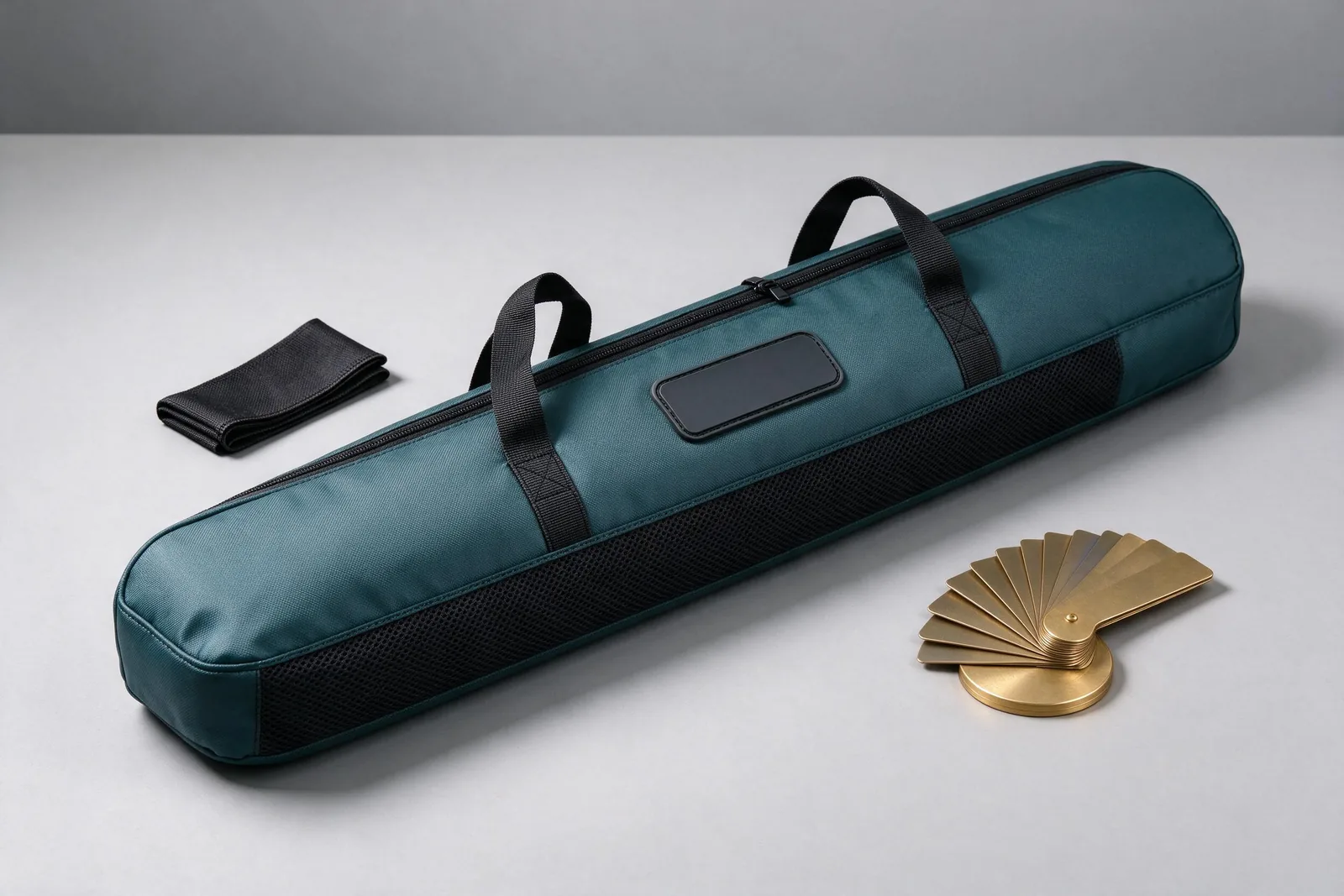
A 110 cm fin bag with a blank moulded patch on the upper panel. The patch sits above the drain line, on the flat between two seams, because that is the only zone on a long narrow bag where a 60 × 40 mm logo can be applied without crossing a seam, a zip or the wet zone.
The one number to take away. At 500 pieces the complete branding stack on the reference build — moulded patch, woven main label and printed care label, tooling amortised — costs USD 1.86 a bag, 10.2% of the USD 18.30 FOB. At 5,000 pieces the same stack costs USD 0.62, a 66.6% fall, because the tooling has been spread over ten times the volume. Nothing about the bag changed. This is why a first private label run should be treated as a marketing spend with a tooling tail, not as a cost-reduction exercise, and why the volume you commit to on the first purchase order decides whether your logo costs more than your zipper.
What “private label” means for a freediving bag
Five terms get used interchangeably in sourcing conversations and they price differently. Before a quotation means anything, both sides need to agree which one is being bought.
| Term | Who owns the pattern | Who owns the tooling | What you get | Typical first order |
|---|---|---|---|---|
| Private label | Adapted from an existing pattern, or new if you pay for it | You, if you paid; otherwise us, licensed to you | Your labels, your colours, your packaging on a build you control | 500 pcs per style |
| White label | Ours, unchanged | Ours | A stock build with your woven label and hangtag sewn in | 500 pcs per style |
| OEM | Yours, from your tech pack | Whichever party pays; stated in the contract | Made exactly to your drawing and specification | 500 pcs per style, plus pattern cost |
| ODM | Ours, licensed to you | Ours | Our design, your brand; the same structure may be sold to others unless exclusivity is bought | 500 pcs per style |
| “Custom logo” | Ours, unchanged | Ours | Decoration only — a patch, a print, an embroidered mark | 500 pcs per style |
The difference that matters commercially is not the label on the term, it is the answer to four questions. First, does the pattern change? If the panels, gusset, drain geometry or strap anchors move, you are buying development, not decoration, and a pattern maker plus two rounds of samples sit between you and a price. Second, who owns the tooling? A silicone patch mould, a deboss die, an embroidery punch file and a woven loom set are physical and digital assets; if you paid for them, ask for them in writing, including what happens to them if you leave. Third, do you need exclusivity? ODM without exclusivity means the same structure can appear under another brand in the same market. Fourth, who is liable for the label claims? Fibre content, country of origin, care instructions and the EU responsible-person block are legal statements about goods you will place on the market, and the responsibility sits with the importer or the brand, not with the factory that printed the label.
Freediving is a small category, and that shapes the answer. A dive centre ordering 500 fin bags is not going to fund a new pattern; it should buy white label and spend the budget on decoration and packaging, because that is what its customers actually see. A brand that intends to build a range — long fin bag, monofin sleeve, low-volume gear bag, changing mat — should pay for one pattern family that shares a construction language, then vary length and decoration across the range. Paying for four independent patterns to sell 500 pieces each is how a small brand spends USD 2,000 on development and has nothing left for the first marketing push.
The six builds we private-label most
The freediving family is not one bag. It is a set of long, narrow, salt-exposed containers whose dimensions are dictated by what goes inside them, and the decoration plan has to survive the same salt, UV and abrasion as the bag. The table below gives the working geometry, the empty weight, the export carton and the freight consequence of each build; all carton and load figures on this page use a 40’ HQ at 68 CBM usable and USD 1,850 ocean freight, which is USD 27.21 per CBM.
| Build | Inner dimensions | Empty weight | Export carton | Pcs / ctn | CBM / pc | Pcs per 40’ HQ | Freight / pc |
|---|---|---|---|---|---|---|---|
| Long fin bag, 110 cm | 114 × 22 × 14 cm | 1,180 g | 62 × 34 × 30 cm | 4 | 0.01581 | 4,301 | USD 0.43 |
| Long fin bag, 95 cm | 99 × 21 × 13 cm | 1,020 g | 58 × 32 × 28 cm | 5 | 0.01039 | 6,544 | USD 0.28 |
| Monofin bag | 68 × 30 × 12 cm | 860 g | 66 × 32 × 20 cm | 5 | 0.00845 | 8,047 | USD 0.23 |
| Low-volume gear bag, 30 L | 55 × 30 × 26 cm | 640 g | 52 × 38 × 30 cm | 10 | 0.00593 | 11,467 | USD 0.16 |
| Camo spearfishing bag, 95 L | 90 × 38 × 34 cm | 1,760 g | 68 × 40 × 36 cm | 3 | 0.03264 | 2,083 | USD 0.89 |
| Neoprene mat bag, 45 L | 62 × 40 × 30 cm | 980 g | 62 × 40 × 32 cm | 4 | 0.01984 | 3,427 | USD 0.54 |
Two consequences follow. The freight spread across the family is 5.6× — USD 0.16 for a 30 L gear bag against USD 0.89 for a 95 L camo bag — which is larger than the entire branding budget of most first orders. And the long builds are the ones where decoration is hardest: a 110 cm bag is a narrow tube in the hand, so the logo has to work on a 22 cm-wide face, between seams, above the drain line, and it has to survive being dragged along a boat deck with wet fins inside it.
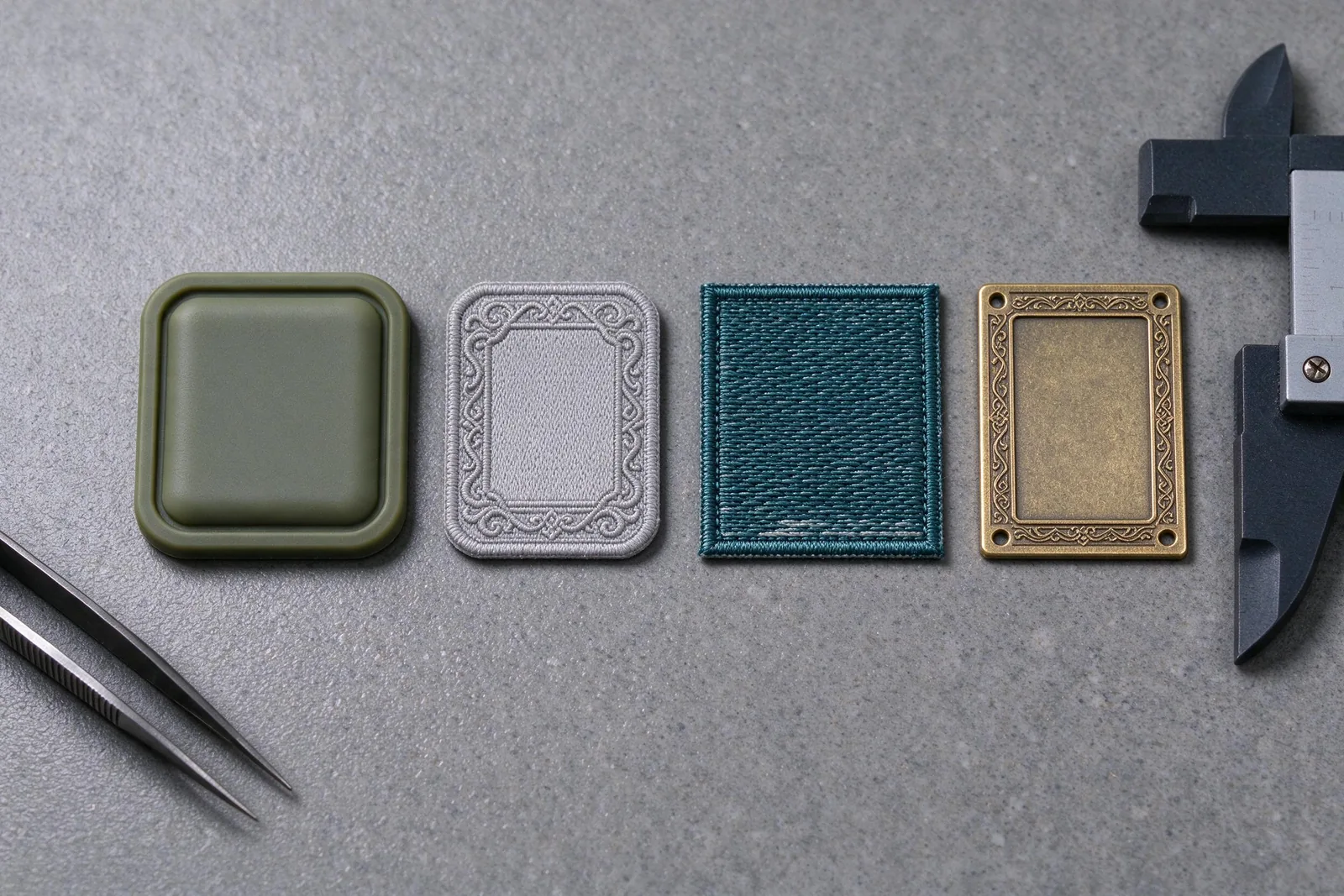
Four of the seven decoration methods, side by side on the sampling bench: moulded rubber, embroidered twill, dense direct embroidery and an etched brass plate. The caliper is there because the thickness of each method decides which one can sit on a curved gusset without puckering.
Seven branding methods, priced at three volumes
Every method below is quoted on the same reference build — the 110 cm long fin bag at USD 18.30 FOB — with the tooling shown separately and then amortised, because that is how the invoice will actually arrive: a one-time tooling charge on the first order, then a per-piece decoration charge on every order after it. Prices exclude the bag.
| Method | Tooling | Unit at 500 | Unit at 2,000 | Unit at 5,000 | Total at 500 incl. tooling | % of FOB at 500 | Durability in service |
|---|---|---|---|---|---|---|---|
| Moulded silicone patch, 2 mm 3D | USD 420 | USD 0.58 | USD 0.44 | USD 0.38 | USD 1.42 | 7.8% | 6,000-cycle abrasion, 96 h salt spray |
| Damask woven main label, 50 × 25 mm | USD 65 | USD 0.13 | USD 0.09 | USD 0.075 | USD 0.26 | 1.4% | Lifetime; no ink to migrate |
| Printed satin care / size label | USD 45 | USD 0.09 | USD 0.07 | USD 0.06 | USD 0.18 | 1.0% | 30 wash cycles; print fades before the tape fails |
| Embroidery, 6,000 stitches, 60 × 40 mm | USD 85 | USD 0.34 | USD 0.26 | USD 0.22 | USD 0.51 | 2.8% | Excellent abrasion, but perforates coated fabric |
| Water-based screen print, 1 colour | USD 60 | USD 0.18 | USD 0.12 | USD 0.09 | USD 0.30 | 1.6% | Grade 4 at 40 rub cycles; one colour only |
| Heat transfer / sublimation panel | USD 90 | USD 0.22 | USD 0.16 | USD 0.13 | USD 0.40 | 2.2% | Full colour; 20 wash cycles, sensitive to heat |
| Etched brass plate, 0.8 mm | USD 180 | USD 0.71 | USD 0.63 | USD 0.58 | USD 1.07 | 5.8% | Lifetime; 42 g of metal per plate |
| Debossed leather patch | USD 240 | USD 0.55 | USD 0.47 | USD 0.42 | USD 1.03 | 5.6% | Ages visibly; avoid the wet zone |
Read the last two columns together and the decision usually makes itself. The brand-carrying methods span 5.5× at 500 pieces — USD 0.26 for a woven label to USD 1.42 for a moulded patch — and the two most expensive are also the two that last longest. That is not a coincidence: a moulded silicone patch is a solid piece of polymer bonded to the panel, and an etched plate is metal, so neither has ink to fade or thread to fray. The cheap methods are not worse, they are simply shorter-lived, and a fin bag lives a hard life of salt water, sand and UV.
What each method is actually good for
- Moulded silicone patch — the default for a brand that wants a premium read. Best on the flat upper panel of a long fin bag. Minimum 40 × 25 mm to keep the mould clean; below that the bevel takes up too much of the face. Cost of the mould is low (USD 420) because it is a single-cavity aluminium tool, so this method is accessible at 500 pieces, which is unusual for anything 3D.
- Woven main label — the legal backbone of the product, not a marketing choice. Damask weave holds fine text and small type that print cannot, which is why care and content information goes here. Sewn into a seam, so it must be placed before the seam is closed.
- Printed satin label — cheapest legible label, fine for size and origin, not for content that has to survive 30 washes.
- Embroidery — the only method that reads as craft. Use it on uncoated 600D or on the strap, never on a PU-backed panel in the wet zone: each needle makes a hole through the coating, and 6,000 stitches make 6,000 holes.
- Water-based screen print — the cheapest way to put a wordmark on a large area. One colour, no gradients, no photographic artwork. On dark 600D it needs a white base coat, which adds a pass and roughly 30% to the unit cost.
- Heat transfer / sublimation — the only method that gives full-colour artwork on fabric without a printed panel. It sits on the surface, so it abrades first; keep it off the base and off the drag zones.
- Etched brass plate — a deliberate luxury signal, and heavy: 42 g per plate on a 1,180 g bag. It needs a flat land and two rivets or four stitches, and it will corrode if specified in the wrong alloy, so we use 316 stainless rivets, never nickel-plated steel.
The stack, not the method. A private label bag almost never carries one decoration. The reference build carries three: a moulded patch, a woven main label and a printed care label. At 500 pieces that stack costs USD 1.86 with tooling amortised and USD 0.62 at 5,000 — a 66.6% fall on identical goods. Budget the stack, not the patch, or the first invoice will be 10.2% of FOB when you planned for 4.9%.
Where a logo can physically go on a fin bag
This is the part of private label that separates a factory that decorates from a factory that has made the bag. A 110 cm fin bag is a long tube with a zip down one face, a mesh drain panel along the bottom edge, two webbing handles and a padded strap. There is less usable flat area than a buyer expects, and the wrong placement fails in service rather than in inspection.
| Zone | Usable area | Allowed methods | Constraint | Failure if ignored |
|---|---|---|---|---|
| Upper front panel | Up to 120 × 60 mm flat | Patch, embroidery, print, transfer, plate | ≥ 8 mm from any seam; ≥ 12 mm above the drain line | Patch lifts at the seam; mould grows under the edge |
| Gusset / side curve | Up to 35 × 20 mm | Woven label, small print | Radius under 60 mm puckers a rigid patch | Patch corners lift within a season |
| Lower mesh panel | Woven tab only, 25 × 15 mm | Woven label | Never a patch or a print — it blocks drainage | Water pools; the bag smells after two trips |
| Handle wrap | 30 × 15 mm | Embroidery, woven tab | Must not sit under the palm contact point | Abrasion of the thread in weeks |
| Strap face | 60 × 20 mm | Embroidery, transfer | Neoprene backing; no rivets through the foam | Rivet tears the foam; strap delaminates |
| Zip garage / puller | 15 × 10 mm | Moulded puller, laser mark | No hanging tag on a salt-water puller | Cord rots and the puller is lost |
| Base panel | None | — | It is the drag surface | Any decoration is gone in one season |
Three rules follow from that table and we apply them to every private label drawing. Nothing goes below the drain line. A patch bonded across the mesh blocks the drainage path that the mesh exists to provide, and a bag that holds two litres of salt water will smell of it permanently. Nothing crosses a seam. A patch that spans a seam is being asked to flex at a rate the adhesive cannot follow; it lifts at the seam first, every time, and the customer reads that as a defective product rather than a misplaced logo. Nothing rigid on a curve. The gusset radius on a 22 cm-wide bag is under 60 mm, so a 2 mm moulded patch will pucker at the corners; a woven label flexes and is the correct answer there.
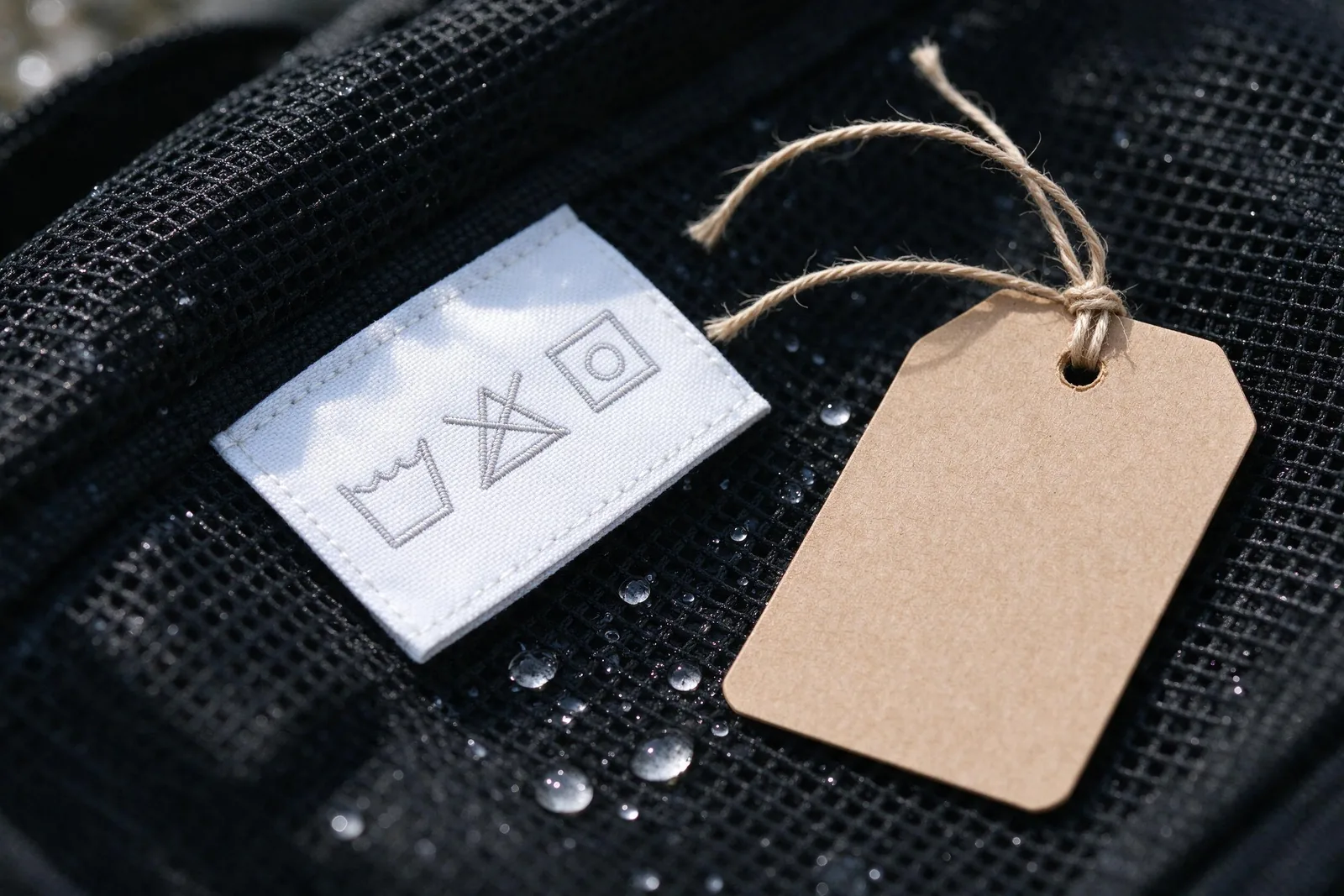
Care and content label sewn into an internal seam, with a kraft hangtag on cotton string. The label is the part of the private label package that carries legal weight; the hangtag is the part that carries the story. Neither is decoration in the optional sense.
Tooling: the USD 990 you pay once
Tooling is the least understood line on a private label quotation, because it is charged once and then disappears from the price, which makes it feel free on the second order and expensive on the first. The full bill for the five methods we use most is USD 990. Amortised, that is USD 1.98 per bag at 500 pieces and USD 0.20 at 5,000 — a factor of ten on the same physical asset.
| Tooling item | One-time cost | Per pc at 500 | Per pc at 1,000 | Per pc at 2,000 | Per pc at 5,000 |
|---|---|---|---|---|---|
| Silicone patch mould | USD 420 | USD 0.84 | USD 0.42 | USD 0.21 | USD 0.08 |
| Brass plate etch tool | USD 180 | USD 0.36 | USD 0.18 | USD 0.09 | USD 0.04 |
| Leather deboss die | USD 240 | USD 0.48 | USD 0.24 | USD 0.12 | USD 0.05 |
| Embroidery punch file | USD 85 | USD 0.17 | USD 0.09 | USD 0.04 | USD 0.02 |
| Woven label loom set | USD 65 | USD 0.13 | USD 0.07 | USD 0.03 | USD 0.01 |
| Total | USD 990 | USD 1.98 | USD 0.99 | USD 0.50 | USD 0.20 |
Three practical notes. Tooling is not a pattern. These figures buy the decoration tooling only; a new bag pattern is a separate cost with a pattern maker and two samples. Tooling has a shelf life. A silicone mould left unused for 24 months may need re-cutting, and we say so in writing rather than discovering it on your reorder. Tooling has an owner. If you pay, the moulds and dies are yours and can be shipped or destroyed at your instruction; if we pay, they stay with us and are licensed to you, which is the normal arrangement for a white label programme at 500 pieces.
Colour: Pantone, lab dips and the ΔE you can hold
Colour is the most common source of a rejected first shipment, and almost always because the tolerance was never written down. “Teal” is not a specification. A Pantone TCX reference, a measurement geometry, a light source and a ΔE limit are a specification.
| What is measured | Tolerance we hold | How it is checked | Why that number |
|---|---|---|---|
| Moulded patch against the approved standard | ΔE ≤ 1.5 | Spectrophotometer, D65 / 10°, patch surface | Silicone pigments batch-disperse; 1.5 is tight but achievable with a fixed compounder |
| 600D fabric against the approved standard | ΔE ≤ 2.0 | Spectrophotometer, D65 and TL84 | Piece-dyed polyester shifts between lots; 2.0 is the practical limit for a repeatable dye house |
| Batch to batch on reorder | ΔE ≤ 1.0 | Against your retained standard, not against the previous lot | Comparing to the last lot lets error accumulate; the standard must be the anchor |
| Visual pass / fail | ΔE 2.3 | Trained eye under a light booth | Above roughly 2.3 a trained observer sees a difference without instruments |
The workflow is three lab dips, not one. We dye to your Pantone reference, send three candidate dips on the actual fabric, you approve one in daylight and under a shop’s fluorescent light, and that approved dip becomes the retained standard for every reorder. Expect 10–15 extra days on the first order when the colour is dyed to a Pantone rather than taken from a stock range, and expect that lead time to apply again if you change the reference. On neoprene the tolerance is wider and should be agreed as such: sheet goods come in lots, and a 5 mm sheet that matches a 3 mm sheet perfectly is not a realistic promise.
One thing we will not do is accept a colour approval from a phone photograph. Screens are calibrated differently, and a customer who approves from a picture has approved a rendering, not a textile.
The label package your retailer will ask for
A private label bag carries five to seven pieces of printed matter, and only one of them is about marketing. The rest are legal statements about the goods. Getting them wrong does not fail an inspection; it fails at the border, or at the returns desk, and the cost lands on the importer.
| Item | What it states | Where it goes | Why it exists |
|---|---|---|---|
| Main brand label (damask woven) | Brand name, sometimes model | Internal seam, visible on opening | Brand identification; also the anchor for the care block |
| Care and content label | Fibre percentages, wash and dry symbols to ISO 3758 | Left internal seam, 80–100 mm from the top | Textile labelling rules in most destination markets; the symbols must match the material actually used |
| Origin label | Made in China, or the origin you instruct | Seam label or printed on the care label | Customs and consumer marking; must be consistent across the shipment |
| Size / model label | Length in cm, or model code | Under the main label | Picking accuracy in your own warehouse; reduces wrong-item returns |
| Barcode | GTIN (UPC-A or EAN-13) or your internal code | Hangtag or retail carton | Retail scan; the quiet zone is part of the specification, not decoration |
| EU responsible person block | Name, postal address, e-mail of the economic operator in the EU | Product, packaging or accompanying document | Required for goods placed on the EU market under the General Product Safety Regulation; the address must be real and reachable |
| Hangtag | Story, care summary, your URL or QR | Attached with cotton string, never nylon | Marketing, and the only label a customer reads before buying |
We print what you specify and we check that the specification is internally consistent, but we are not a testing house, not a notified body and not your authorised representative. Concretely: we do not issue REACH or CPSIA certificates, we do not act as the EU responsible person or the GPSR economic operator, and we do not register EPR obligations in France or Germany on your behalf. What we do provide is a material declaration for the build, a declaration that the PVC-free and PFAS-free statements are accurate for the materials used, and the batch records that let you trace a complaint to a fabric lot. The legal claims on the label remain yours, which is the correct allocation: you know which market you are selling into and we do not.
Two failure patterns are worth naming because they recur. Fibre content that does not match the bag. A label saying 100% recycled polyester on a bag whose lining is virgin 210D is a false statement even if the shell is correct; the care label covers the whole article. A barcode with no quiet zone. A 12 mm margin is required on each side of a UPC-A symbol; artwork that runs the symbol to the edge of a hangtag scans at the factory and fails at the retailer’s till.
Packaging: four levels, one 5.5% decision
Packaging is where private label quietly becomes expensive, because it is the only part of the product that is thrown away and the only part that changes the freight. The four levels below are cumulative on the 110 cm build: each row adds to the one above it.
| Level | Pack cost / pc | CBM / pc | Freight / pc | Total / pc | Added vs bulk | % of FOB |
|---|---|---|---|---|---|---|
| Bulk polybag, 4 pcs per carton | USD 0.06 | 0.01581 | USD 0.430 | USD 0.490 | — | 2.7% |
| + kraft hangtag on cotton string | USD 0.15 | 0.01581 | USD 0.430 | USD 0.580 | USD 0.090 | 3.2% |
| + printed header card | USD 0.29 | 0.01581 | USD 0.430 | USD 0.720 | USD 0.230 | 3.9% |
| + retail colour box, 1 pc per box | USD 0.91 | 0.02138 | USD 0.582 | USD 1.492 | USD 1.002 | 8.2% |
Moving the whole order from bulk to retail boxes adds USD 1.002 per bag, 5.5% of FOB, and it does two things at once: the box itself costs money, and the box is bigger than the polybagged bag, so the container holds 3,180 instead of 4,301 pieces. That is 1,121 fewer bags in the same 40’ HQ, which for a 5,000-piece order means the difference between one container and two. Before specifying retail packaging for a whole production run, price the container.
Our default recommendation is a hybrid, and it is what most dive brands end up choosing: retail packaging on the first 20–30% of the order, which is what reaches shops and customers, and bulk for the rest, which is what reaches your own warehouse and gets re-packed later. The packaging decision is reversible; the container booking is not.
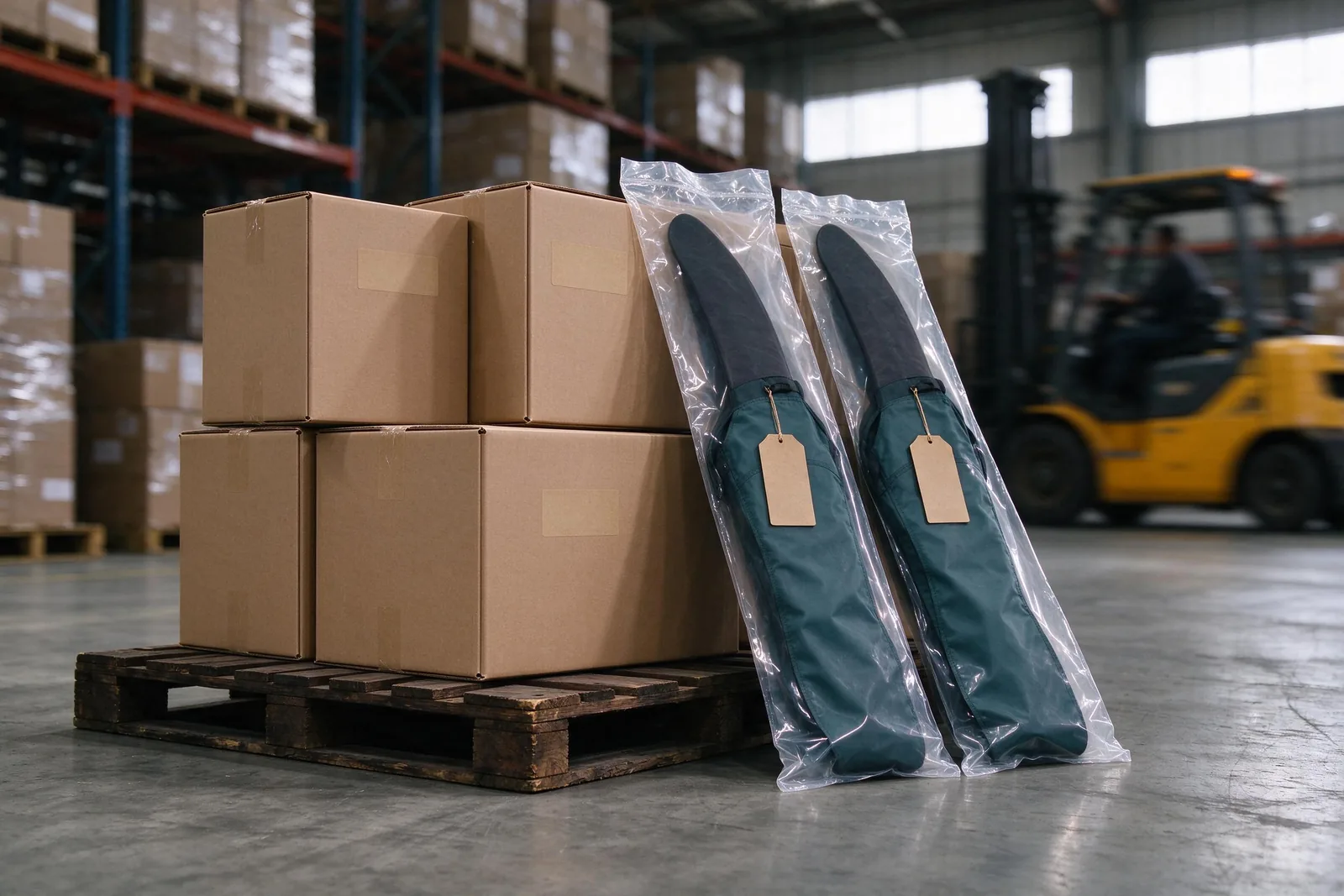
Retail cartons and polybagged fin bags on the export floor. The cartons are labelled, not printed, because the print run for a private label carton is charged per impression and most first orders cannot absorb it across 500 units.
Artwork and the tech pack
The fastest way to lose a week in a private label programme is to send a JPEG of a logo. Artwork that can go straight to a mould maker, an embroidery puncher or a screen maker has to arrive in a specific form, and the specification below is what our suppliers accept without a redraw.
- Vector, not raster: AI, EPS or PDF, all text converted to outlines. A 300 dpi JPEG of a logo cannot be scaled to a 60 mm patch without visible stair-stepping.
- One-colour and multi-colour versions: send both. Screen print and embroidery price per colour; a 4-colour logo on a 500-piece order often becomes a 1-colour version by the second sample, and it is cheaper to decide that before tooling.
- Minimum stroke and gap: 1.2 mm for embroidery, 0.8 mm for a moulded patch, 0.3 mm for a woven label. Below those the method cannot reproduce the detail, and a fine serif becomes a smudge.
- Physical size at 1:1: state the finished width and height in millimetres. “About 5 cm” is not a size.
- Bleed and cut: 3 mm bleed on printed panels, and a dieline if the artwork runs to the edge of a patch or plate.
- Pantone references, not RGB values: an RGB value has no physical meaning on fabric; a TCX reference does.
Alongside the artwork, the tech pack carries the twelve fields that decide whether the first sample is close. Missing any one of them produces a sample round that costs 6–10 days and a courier fee to learn something that could have been written down.
| # | Tech pack field | What goes in it |
|---|---|---|
| 1 | Build and length | Long fin 110 / 95, monofin, gear bag 30 L, camo 95 L, mat bag 45 L |
| 2 | Internal dimensions | Length × width × depth in cm, with the tolerance you will accept |
| 3 | Shell fabric | Denier, fibre, coating, colour reference, recycled content if claimed |
| 4 | Lining and mesh | Lining denier; mesh aperture and yarn if drainage matters |
| 5 | Zip specification | Size, type (coil or VISLON), slider count, length, colour |
| 6 | Hardware | Alloy and finish for every D-ring, hook and buckle; 316 SS where salt is permanent |
| 7 | Decoration plan | Method, artwork, position, size, colour reference, for each of the three label positions |
| 8 | Label content | Fibre percentages, care symbols, origin, size or model code, barcode number |
| 9 | Packaging | Level 1–4, carton mark, pcs per carton, hangtag copy |
| 10 | Compliance statements | PVC-free, PFAS-free, recycled content, any market-specific claim you will print |
| 11 | Order quantities | Total pieces, split by colourway, split by packaging level |
| 12 | Destination | Port or door, incoterm, and whether the cartons must be palletised or floor-loaded |
Sampling: six to ten days, four gates
Sampling is not one event. It is four, and each answers a different question. A buyer who asks for “a sample” and receives one physical bag has usually skipped two of the four and will discover the consequence at the pre-production stage, when changes cost money.
| Gate | Question it answers | Typical days | What you receive |
|---|---|---|---|
| Artwork proof | Is the artwork reproducible in this method at this size? | 2 | Digital proof with stroke and gap warnings |
| Strike-off / lab dip | Does the colour and the decoration look right on the actual material? | 5–7 | Physical patch, label or print on the real fabric; three dips for colour |
| Proto sample | Does the bag work — dimensions, drainage, strap geometry, zip access? | 6–10 | One finished bag, unlabelled or with placeholder labels |
| Salesman / photo sample | Is this what we will photograph and show buyers? | 5–7 | Finished bag with final labels and packaging |
The 6–10 working days we quote for sampling assumes the specification is locked and the materials are in stock. Three things extend it and should be planned for: a Pantone that must be dyed to order (+10–15 days), a new moulded patch tool that must be cut (+5–7 days), and a fabric that is out of stock at the mill (+15–25 days). A strike-off costs USD 45 per round and we normally run three colour rounds on a first programme, which is why the artwork should be right before the first one rather than after the second.
Production: 35 to 50 days, eight stages
Once the sample is approved and the deposit is in, the calendar is arithmetic rather than optimism. The eight stages below sum to 35 days at the fast end and 50 at the slow end, and the decoration stages are the ones that queue behind other orders.
| Stage | Days (min–max) | What can go wrong here |
|---|---|---|
| Material booking, lab dip, plate cutting | 5–8 | Fabric out of stock; Pantone dyed to order adds 10–15 days |
| Cutting | 3–4 | Panel nesting error shows up as a length shortfall after sewing |
| Decoration: print, patch, embroidery | 4–6 | Decoration applied after sewing cannot be repositioned; patch cure time is fixed |
| Sewing | 10–14 | The long builds are the slow ones; a 110 cm bag does not run at the speed of a 30 L bag |
| Hardware, binding, assembly | 3–4 | Wrong alloy supplied by a sub-vendor; salt spray test fails at final |
| Inline QC and final inspection | 3–4 | An AQL failure at this stage means rework, not rework plus air freight, if it is caught here |
| Packing and cartoning | 3–4 | Retail boxes arrive late; the order ships bulk and is re-packed downstream |
| Handover, booking, loading | 4–6 | Space on the vessel, not the factory, is the constraint in the two weeks before Chinese New Year |
Two calendar rules we hold to. Decoration is scheduled before sewing on every panel that is decorated flat, because a patch pressed onto a finished bag cannot be repositioned once the adhesive has cured, and embroidery on an assembled bag distorts the panel. The 35–50 day window excludes Chinese New Year and the National Day holiday, when the factory closes and the mills close earlier; a February order placed in December should be planned against the post-holiday restart, not against the calendar on the wall.
What the branding line costs inside the bag
A BOM is the only honest way to see whether a quotation is expensive or cheap. The reference build — the 110 cm long fin bag — prices out at USD 18.30 FOB, and the ten lines below account for all of it. The percentages are rounded so they sum to exactly 100.0%.
| Line | USD / pc | % of FOB |
|---|---|---|
| 600D rPET body fabric, PU back, 0.42 m² | 4.85 | 26.5% |
| 210D polyester lining | 1.35 | 7.4% |
| #8 acetal coil zip, 2 sliders, 118 cm | 1.20 | 6.6% |
| Webbing, buckles, 316 SS D-rings | 2.15 | 11.7% |
| 5 mm neoprene padded shoulder strap | 1.95 | 10.6% |
| Mesh drain panel + binding | 0.95 | 5.2% |
| Branding consumables: patch + woven main + care + hangtag | 0.89 | 4.9% |
| Polybag + export carton share | 0.86 | 4.7% |
| Labour, 28 min at USD 5.90/h | 2.75 | 15.0% |
| Overhead, tooling amortisation, margin | 1.35 | 7.4% |
| Total FOB | 18.30 | 100.0% |
Materials are 68.0% of the price and labour is 15.0%, which is the normal shape for a sewn bag. Branding consumables are 4.9% — USD 0.89 — and that is the number a brand should carry in its head, because it is the number that a supplier will quietly cut when a buyer pushes for a lower price. A quotation at USD 16.50 for this build is not a better deal; it is the same bag with the 316 stainless replaced by nickel-plated steel, the 5 mm neoprene strap by 3 mm, and the moulded patch by a printed one. That is a legitimate product. It is not the product you specified.
Price ladder: 500, 1,000, 2,000, 5,000
The ladder below is the reference build with the full three-label stack and bulk packaging. It is not a negotiating position; it is the cost curve of the factory, where the fixed costs of setup, cutting and decoration tooling are spread across the run.
| Quantity | FOB / pc | Drop vs 500 | Saving / pc | What changes at this volume |
|---|---|---|---|---|
| 500 | USD 18.30 | — | — | Tooling amortised across one run; single cutting lay |
| 1,000 | USD 17.57 | 4.0% | USD 0.73 | Two cutting lays; fabric booked in one mill lot |
| 2,000 | USD 17.00 | 7.1% | USD 1.30 | Dedicated sewing line; decoration runs continuously |
| 5,000 | USD 16.14 | 11.8% | USD 2.16 | Mill-direct fabric; tooling almost fully amortised |
Between 500 and 5,000 the price falls 11.8%, or USD 2.16 a bag. Compare that with the branding stack, which falls 66.6% over the same range. Volume buys very little on the bag and a great deal on the tooling, which is why the sensible first order is 500 pieces with a cheap decoration plan, and the sensible second order is the same bag at 2,000 with the expensive one.
Quality gates that specifically test branding
Final inspection at AQL 2.5 major / 4.0 minor with zero tolerance on critical defects is the baseline. Branding needs its own tests because a logo fails differently from a seam: it peels, it fades, it migrates, or it is simply in the wrong place.
| Test | Method | Acceptance |
|---|---|---|
| Patch adhesion | Cross-hatch to ISO 2409, then 180° peel at 300 mm/min | No lifting at the score lines; peel strength ≥ 8 N/cm |
| Abrasion on the decorated area | Taber CS-10, 500 cycles | ≤ 0.15 g loss; artwork still legible |
| Colourfastness to rubbing | ISO 105-X12, dry and wet | Grade ≥ 4 dry, ≥ 3–4 wet |
| Light fastness | ISO 105-B02, 300 h | Grade ≥ 5 for outdoor-positioned decoration |
| Salt spray on hardware and plate | Neutral salt spray, 96 h | No red rust on stainless; no white corrosion on plated parts |
| Print rub | 40 cycles, dry and wet cloth | Grade 4 minimum; no transfer to the cloth |
| Label position | Measured against the approved drawing | ±5 mm on position, ±2° on rotation |
| Barcode read | Verifier, three scans at 10–30° | Grade C or better; quiet zone intact |
| Pantone match | Spectrophotometer, D65 | ΔE ≤ 1.5 patch, ≤ 2.0 fabric |
| Wash durability | 30 cycles at 30 °C, then re-inspect | No delamination; care label still legible |
Inspection is ISO 2859-1 general level II, single sampling, which at 500 pieces means 50 units inspected, accept on 3 major and reject on 4. Critical defects — a patch missing entirely, a label stating the wrong fibre, a barcode that will not scan — are zero tolerance at any sample size. Five gates hold the order: incoming fabric, cutting, post-decoration, inline sewing, and final. The post-decoration gate is the one that catches the expensive mistakes, because a patch applied in the wrong position is caught there for the price of a panel rather than after the bag is assembled.
Eight private-label failures we design out
- Patch peeling at the seam. Caused by placing the patch across a seam or within 8 mm of one. Fix: keep a clear 8 mm land and specify a bonded patch with a stitched perimeter above 60 mm width.
- Embroidery through a coated panel. Needle holes break the PU coating and water enters at every stitch. Fix: embroider uncoated panels only, or move the mark to the strap.
- Care label that contradicts the bag. A 100% recycled claim on a virgin lining is a false statement about the article. Fix: the care label covers the whole bill of materials, so it is written after the BOM is locked.
- Print that blocks the drain path. Decoration across the mesh stops the panel doing its job. Fix: woven tab only below the drain line.
- Wrong alloy in salt water. Nickel-plated steel D-rings rust within a season. Fix: 316 stainless, 96 h salt spray on every lot.
- Barcode with no quiet zone. Scans in the factory, fails at the till. Fix: 12 mm clear margin on each side, verified with a scanner not a ruler.
- Colour drift between shipments. Each lot approved against the previous lot instead of the retained standard. Fix: the approved dip is the anchor, ΔE ≤ 1.0 on reorder.
- Mould under a patch in the wet zone. Water wicks under an edge that sits below the drain line and cannot dry. Fix: no decoration below the drain line, and a 12 mm minimum clearance above it.
Six channels, six different label packs
The same bag needs a different package depending on who receives it. This is the part of private label that buyers underestimate, because a label pack that suits a dive centre is wrong for a marketplace listing.
| Channel | What they need on the goods | Packaging | Common mistake |
|---|---|---|---|
| Independent dive shop | Brand label, care label, hangtag with story | Level 2 (hangtag), bulk cartons of 4–6 | Retail box that will not fit the shop’s shelf depth |
| Dive centre rental fleet | Model label with a fleet code, no hangtag | Level 1 bulk, 10 per carton | Hangtags that have to be removed by staff |
| Online DTC brand | Care label, brand label, insert card | Level 3 with a mailer-ready polybag | Box that adds volumetric weight to every parcel |
| Marketplace seller | FNSKU label, polybag with suffocation warning, no price | Level 2, individual polybag | Retail box with a printed price from another market |
| Resort or liveaboard | Brand label plus a discreet property tag | Level 1, low unit count, high SKU count | MOQ per colourway too high for a 40-bag order |
| Distributor | Barcode and carton mark, no hangtag | Level 1, palletised | Missing carton marks, so receiving takes a day longer |
Brand protection: plates, exclusivity, and what we will not do
A private label order creates assets that belong to someone, and the contract should say who. Our default position, stated plainly: the artwork is yours; the tooling is yours if you paid for it; we will not put your artwork on goods sold to another customer; and we will not sell your branded goods to anyone else, ever, including as surplus. What we do not do is clear trademarks. A search for a conflicting mark in your market is your lawyer’s job, and it should happen before the mould is cut, because a mould for a mark you cannot use is USD 420 of scrap.
Exclusivity on a structure is available and is priced as a volume commitment rather than a fee: typically a minimum annual quantity that keeps the line dedicated. Without it, an ODM structure may be sold to another brand, which is normal in this industry and should be understood before it happens rather than after. Plates and dies are retained for 24 months after the last order; if there is no reorder in that window we will ask before scrapping them, because a silicone mould that has sat unused may need re-cutting anyway.
What to send us
Fourteen fields turn an enquiry into a quotation that will survive contact with production. Anything missing from this list becomes an assumption, and assumptions are what the first sample corrects.
- Build and length (long fin 110 / 95, monofin, gear bag 30 L, camo 95 L, mat bag 45 L)
- Quantity, split by colourway (500 per style, 100 minimum per colourway)
- Decoration method and artwork file, vector, 1:1 size
- Pantone TCX references for shell, patch and print
- Label content: fibre percentages, care symbols, origin, size code
- Barcode number and symbology (UPC-A or EAN-13)
- Packaging level 1–4, and the split between retail and bulk
- Carton mark and any palletisation requirement
- Compliance claims you intend to print (recycled content, PVC-free, PFAS-free)
- Destination port or door, and incoterm
- Required delivery window, and whether it sits before Chinese New Year
- Whether you need exclusivity, and at what annual volume
- Who owns the tooling, and whether it must be transferable
- Sample deadline, and who approves the strike-off
Related pages on this site
- Custom freediving bag manufacturer — the range overview
- Long fin bag manufacturer — 90–115 cm builds
- Monofin bag — single-blade geometry
- Mesh dive bag — aperture and drainage engineering
- Waterproof dive bag — dry and wet zones
- Rolling dive bag — wheel set and load path
- Spearfishing gear bag — gun length and catch compartment
- Wetsuit bag — 5 mm neoprene changing mat
- Scuba gear bag — general dive carry
- Dive backpack — two-strap carry
- Wholesale dive bags — load plans and price ladders
- Private label guitar bag — a parallel programme in another category
- OEM vs ODM vs private label — decision guide
- Launching a private label brand — the sequence
- rPET bag manufacturing — recycled content and claims
- Dry bag manufacturing — roll-top sealing
Frequently asked questions
What is the minimum order for private label freediving bags?
500 pieces per style, with a 100-piece minimum per colourway. The 500-piece floor exists because cutting, decoration tooling and line setup are fixed costs; below it the per-unit price rises faster than most first orders can absorb. Tooling for the five common branding methods totals USD 990, charged once on the first order.
What is the difference between private label and white label here?
White label means you take one of our existing builds unchanged and we sew your labels into it. Private label means the build is adapted for you — colour, trim, decoration, packaging, sometimes dimensions — while the underlying pattern stays in the family. OEM means the pattern is yours and arrives as a tech pack. The price difference between white label and private label is usually in tooling and packaging, not in the bag.
How long does sampling take, and what does it include?
6–10 working days from a locked specification, covering the proto sample and the decoration strike-off. A Pantone dyed to order adds 10–15 days, a new moulded patch tool adds 5–7 days, and fabric that is out of stock at the mill adds 15–25 days. A strike-off round costs USD 45.
How long is bulk production after the sample is approved?
35–50 days across eight stages: material booking and lab dip, cutting, decoration, sewing, hardware and assembly, inline and final inspection, packing, and handover. The window excludes Chinese New Year and the National Day holiday, when both the factory and the mills close.
Which decoration method should a first-time brand choose?
A woven main label plus a printed care label, and then one visible mark. At 500 pieces the woven and care labels together cost about USD 0.44 with tooling, and a moulded silicone patch adds USD 1.42. If the brand needs to look premium on the shelf, the patch is the right spend; if it needs to survive a rental fleet, embroidery on the strap and no decoration in the wet zone is more durable per dollar.
Can you put our logo on the mesh panel?
Only as a small woven tab, 25 × 15 mm. A patch or a print across the mesh blocks the drainage path the panel exists to provide, and a bag that holds salt water will smell permanently. This is one of the few placements we will decline rather than quote.
How do you control colour between shipments?
Three lab dips on the actual fabric, one approved in daylight and under shop lighting, and that approved dip becomes the retained standard. Reorders are measured against the standard, not against the previous lot, with a tolerance of ΔE 1.0 batch to batch, 1.5 for a moulded patch and 2.0 for piece-dyed 600D.
What label content is legally required?
At minimum fibre content, care instructions to ISO 3758, country of origin, and — for the EU — the name, postal address and e-mail of the economic operator established in the EU. Marketplace sellers also need a scannable GTIN with an intact quiet zone. The claims are the importer’s responsibility; we print and verify consistency, but we are not a testing house and not your authorised representative.
Do you provide REACH, CPSIA or GPSR certification?
No. We provide a material declaration for the build, written confirmation that PVC-free and PFAS-free statements are accurate for the materials used, and batch traceability. Certification, authorised-representative status and EPR registration in France or Germany are the importer’s obligations, and we say so rather than implying otherwise.
Who owns the tooling?
If you pay for it, you do — moulds, dies, punch files and loom sets, transferable or destructible at your instruction. If we pay, they stay with us and are licensed to you, which is the normal arrangement on a white label order at 500 pieces. Plates and dies are retained for 24 months after the last order.
Will you sell the same bag to another brand?
Not with your artwork, and never your branded goods. On an ODM structure without exclusivity, the same construction can be sold to another brand in another market, which is standard in this industry. Exclusivity is available and is priced as an annual volume commitment rather than a fee.
How much does retail packaging add?
On the 110 cm build, moving from bulk polybag to a retail colour box adds USD 1.002 per bag, 5.5% of FOB, and reduces container load from 4,301 to 3,180 pieces because the box is larger. Most brands take retail packaging on the first 20–30% of the order and bulk on the rest.
Can we mix builds in one order?
Yes, but each style carries its own 500-piece minimum. A mixed order of 500 long fin bags, 500 monofin bags and 500 gear bags is three styles, not one, and the cartons, labels and inspection plan are separate for each. Mixed containers are common once a brand has a range; the first order usually is not.
What artwork format do you need?
Vector AI, EPS or PDF with text converted to outlines, at 1:1 finished size in millimetres, with Pantone TCX references rather than RGB values. Minimum stroke is 1.2 mm for embroidery, 0.8 mm for a moulded patch and 0.3 mm for a woven label. A JPEG cannot be scaled to a 60 mm patch without visible stepping.
What inspection standard applies?
ISO 2859-1 general level II, single sampling, AQL 2.5 major and 4.0 minor, with zero tolerance on critical defects. At 500 pieces that means 50 units inspected. Branding has its own tests: cross-hatch adhesion, Taber abrasion, colourfastness to rubbing and light, 96 h salt spray, and a barcode scan check.
Can you match a sample bag we already sell?
Usually, if we are not copying a protected design. Send the physical bag and we will quote a counter-sample with the differences written down — dimensions, fabric, hardware, decoration. We will not reproduce another brand’s logo or a registered design, and we will tell you at quotation stage rather than at sampling.
Start a private label freediving programme
Send the build, the quantity and the artwork. You will get a quotation with tooling separated from unit price, a decoration recommendation for your volume, and a sampling date — usually within one working day.