
Short answer: wholesale dive bags from Junyuan Bags run at MOQ 500 pieces per style, samples in 6–10 working days, bulk in 35–50 days, final inspection at AQL 2.5 major / 4.0 minor. We are a bag manufacturer established in 2014; our founder has traded bags since 2004. At volume, the FOB price is the small half of the decision. One 40’ HQ holds 722 rolling dive bags or 11,333 mesh dive bags — a 15.7× spread in freight per piece, USD 3.95 against USD 0.25. Between 500 and 5,000 pieces our FOB falls 14.6–15.6% on the five builds on this page, but switching a 95 L spearfishing bag from a bulk polybag to a retail carton adds USD 3.10 per piece, which is 14.4% of its FOB price. This page is the volume document: five reference builds with their cartons, load plans and price ladders, a worked 4,819-piece mixed 40’ HQ for a distributor, the packing decision, the sampling and production calendar, inspection levels, and the 18 fields we need in an RFQ. If you are sourcing one bag type rather than a programme, start from the mesh dive bag or waterproof dive bag engineering page instead.
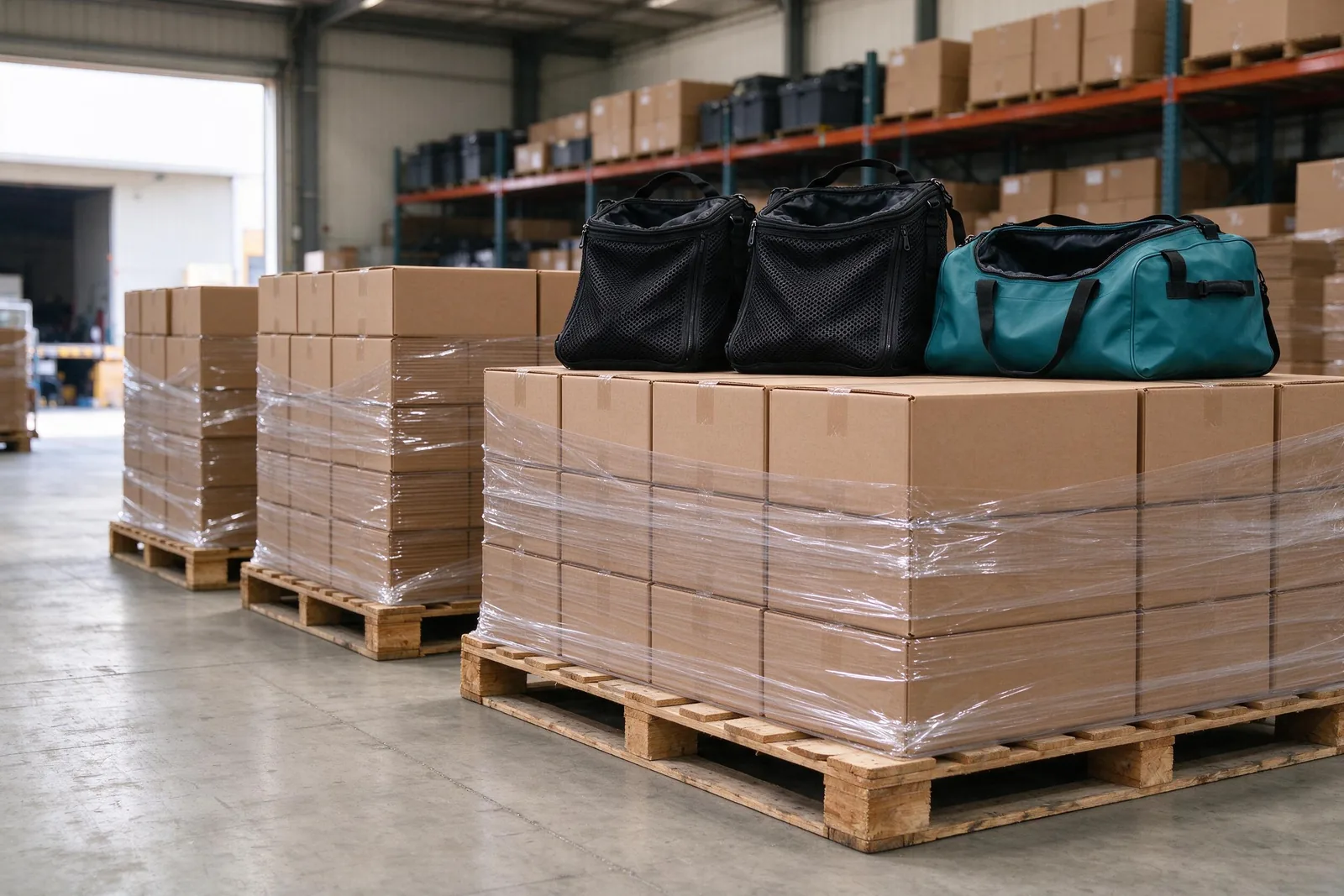
Bulk-packed dive bags on the export floor. Every carton on a wholesale order carries the same three numbers — pieces per carton, cubic metres per piece, and gross weight — because those three decide the freight line on your landed cost sheet, not the FOB price.
Why a wholesale page and not a product page. Our product pages answer “how is this bag built”. This page answers “what happens to the money when you buy 500, 2,000 or 5,000 of them, and what changes in the carton”. The five reference builds below are the five dive bags we quote most often, and every number on this page is computed from their published carton and weight data, not rounded from memory. Take the 90 L rolling bag at USD 26.80 FOB on 500 pieces: ocean freight at USD 2,850 per 40’ HQ adds USD 3.95, which is 14.7% of its FOB price and pushes the landed cost up by 15.7%, while the same USD 2,850 spread across 11,333 mesh bags is USD 0.25, or 1.95% of FOB and 3.0% of landed. Two buyers with identical margin targets, identical retail prices and identical factories will make different money purely because one of them is shipping volume in the wrong bag.
What a Wholesale Dive Bag Order Actually Is — Five Buyer Types
“Wholesale” is used for at least five different commercial relationships, and they do not want the same bag, the same carton or the same payment terms. A dive centre buying 60 rental bags and a distributor buying 4,800 pieces for four countries are both “wholesale” in a search box and completely different in a factory. This is the table we use to route an enquiry before we quote.
| Buyer type | Typical first order | SKU mix | Packing | What to lock first |
|---|---|---|---|---|
| Importer / distributor | 1,500–5,000 pcs across 3–5 SKUs | Mesh + waterproof + one wheeled or long-format SKU | Bulk polybag into export carton | Carton plan and per-SKU MOQ, because a mixed container is priced on cubic metres |
| Dive centre / rental fleet | 40–150 pcs | One or two SKUs, one colour, numbered | Bulk, no retail packaging | Repairability and spares, not price — a fleet bag fails at the handle and the drain |
| E-commerce private label | 500–1,200 pcs per SKU | One hero SKU, then a second colourway | Retail carton, barcode, polybag with warning text | DIM weight and retail carton size, because they set the Amazon or Shopify shipping fee |
| Resort / liveaboard | 100–400 pcs | Branded mesh or wetsuit bags, logo-heavy | Bulk, individual polybag | Logo method and lead time before season opening |
| Promotional / corporate | 500–2,000 pcs | One cheap SKU, one colour | Bulk, master carton marked per drop | Target FOB ceiling and delivery window, in that order |
The order that most often goes wrong is the e-commerce private label buyer who orders at distributor volume and expects distributor packing. A 95 L spearfishing bag in a bulk carton costs USD 2.21 of freight per piece; the same bag in a printed retail carton costs USD 5.32. That is USD 3.10 per piece, 14.4% of a USD 21.60 FOB, spent entirely on cardboard and air. Retail packing is not wrong — it is simply a different product with a different buyer, and it has to be decided before the quotation, not after the carton is printed.
The Price Ladder: What Actually Changes Between 500 and 5,000 Pieces
Our published ladder on the five reference builds is below. The shape is consistent: about 6% off between 500 and 1,000, about 10% at 2,000, and about 15% at 5,000. Buyers regularly ask for the 5,000-piece price at 500 pieces, and the honest answer is that the 5,000-piece price is not a discount — it is a different production event with different fixed costs.
| Reference build | Volume | 500 pcs | 1,000 pcs | 2,000 pcs | 5,000 pcs | Change 500 → 5,000 |
|---|---|---|---|---|---|---|
| Mesh dive bag | 30 L | USD 12.80 | USD 12.03 | USD 11.52 | USD 10.88 | −15.0% |
| Waterproof dive bag | 55 L | USD 18.40 | USD 17.30 | USD 16.56 | USD 15.64 | −15.0% |
| Rolling dive bag | 90 L | USD 26.80 | USD 25.40 | USD 24.25 | USD 22.90 | −14.6% |
| Spearfishing gear bag | 95 L | USD 21.60 | USD 20.46 | USD 19.50 | USD 18.38 | −14.9% |
| Wetsuit bag | 70 L | USD 20.11 | USD 18.98 | USD 18.06 | USD 16.97 | −15.6% |
Four costs move, and only one of them is a discount.
- Tooling amortisation. Cutting dies, weld tools and print screens for one dive bag run USD 2,200–2,800. At USD 2,600 the tooling is USD 5.20 per piece on 500, USD 2.60 on 1,000, USD 1.30 on 2,000 and USD 0.52 on 5,000. That single line explains a third of the whole ladder, and it is why we quote tooling separately so you can see it.
- Fabric booking. Mesh, 600D and 1680D are bought by the roll. A 500-piece order buys part-rolls at a jobber price; a 5,000-piece order books mill-direct at a dye lot, which is 4–7% cheaper per metre and, more importantly, arrives in one shade.
- Cutting efficiency. A 500-piece cut is laid by hand on a short table with 6–8% end waste. At 2,000 pieces the same pattern runs on a straight-knife lay with 3–4% waste, and the marker is nested once instead of twice.
- Learning curve. Sewing minutes per bag fall roughly 8–12% between the first 500 and the fifth 500 on the same line, because the operator stops re-reading the operation breakdown. This is real and it is also why a reorder is cheaper than a first order at identical quantity.
Where the price floor is. On the 90 L rolling build the ten cost lines are: fabric 18.1%, wheel set and trolley 17.2%, sewing labour 12.7%, zips 11.9%, frame and base tray 10.8%, webbing and hardware 8.8%, overheads 7.6%, wet-cell TPU and welding 6.3%, packaging 3.2%, margin 3.4%. Material and labour together are 85.8% of FOB before overheads and margin. A competing quotation for the same written specification that lands 20% below ours — under USD 21.44 at 500 pieces — cannot be buying the same inputs at a better price; something in the build has changed, usually the wheel set, the 2.5 mm backboard, or the 900D shell. That is the comparison worth having, and it is why the specification has to be normalised before prices are compared.
Packing Mode Moves Landed Cost More Than the FOB Price
This is the most under-negotiated line in a dive bag quotation. The bag does not change; only the cardboard, the polybag and the barcode do. On the two long-format builds the retail carton costs more in freight per piece (USD 3.10 and USD 2.21) than the entire 2,000-piece price break is worth (USD 2.10 and USD 2.05) — you can double your order quantity and still lose the saving to a box.
| Build | Bulk pack | CBM per pc | 40’ HQ (bulk) | Freight per pc | Retail carton CBM per pc | 40’ HQ (retail) | Freight per pc | Extra per pc | % of FOB@500 |
|---|---|---|---|---|---|---|---|---|---|
| Mesh 30 L | 12 pcs / ctn | 0.00600 | 11,333 | USD 0.25 | 0.01320 | 5,151 | USD 0.55 | +0.30 | 2.4% |
| Waterproof 55 L | 10 pcs / ctn | 0.01316 | 5,166 | USD 0.55 | 0.03600 | 1,888 | USD 1.51 | +0.96 | 5.2% |
| Rolling 90 L | 2 pcs / ctn | 0.09410 | 722 | USD 3.95 | 0.12770 | 532 | USD 5.36 | +1.41 | 5.3% |
| Spearfishing 95 L | 4 pcs / ctn | 0.05284 | 1,287 | USD 2.21 | 0.12672 | 536 | USD 5.32 | +3.10 | 14.4% |
| Wetsuit 70 L | 4 pcs / ctn | 0.03713 | 1,831 | USD 1.56 | 0.08976 | 757 | USD 3.76 | +2.21 | 11.0% |
Freight is calculated at USD 2,850 per 40’ HQ all-in from Ningbo to a Northern European port, over 68.0 CBM of usable space. The percentages are the same calculation every forwarder runs, and they are the reason a distributor should never accept a retail carton unless the retail carton is part of the product.
The long-format builds are where this bites. A 95 L spearfishing bag is a 156 cm sleeve: it packs four to a carton in bulk, but as a single retail carton it needs 70 × 40 × 45 cm and takes 0.12672 CBM — almost four times the bulk space. If your customer sells on a marketplace that charges by dimensional weight, the retail carton is not optional; but then it should be priced into the retail price at the design stage, not discovered at the shipping quote. We will run both carton plans on any quotation so the number is visible before the order.
40’ HQ Load Plans for the Five Reference Builds
Every load plan below is computed, not estimated: usable volume divided by cubic metres per piece, rounded down, and cross-checked against the carton count. A 20’ GP figure is included because a first order often ships in one.
| Reference build | Volume | Empty weight | CBM per pc | 20’ GP | 40’ HQ | FOB @ 500 | Container value @ 40’ HQ |
|---|---|---|---|---|---|---|---|
| Mesh dive bag | 30 L | 420 g | 0.00600 | 4,666 | 11,333 | USD 12.80 | USD 145,062 |
| Waterproof dive bag | 55 L | 1,450 g | 0.01316 | 2,127 | 5,166 | USD 18.40 | USD 95,054 |
| Rolling dive bag | 90 L | 3,540 g | 0.09410 | 297 | 722 | USD 26.80 | USD 19,350 |
| Spearfishing gear bag | 95 L | 1,980 g | 0.05284 | 529 | 1,287 | USD 21.60 | USD 27,799 |
| Wetsuit bag | 70 L | 1,340 g | 0.03713 | 754 | 1,831 | USD 20.11 | USD 36,821 |
Two observations from the right-hand column. First, a single 40’ HQ of mesh bags is a USD 145,000 order; a container of rolling bags is USD 19,350. Volume in units and volume in money are almost inversely related, so a buyer planning “one container of dive bags” has to decide whether the goal is unit count, order value or freight efficiency — the three answers are different bags. Second, the 30 L mesh bag is the only build on this list where freight is under 2% of FOB; the waterproof bag sits at 2.99%, and the three large builds run 7.8–14.7%. Everything heavier or bulkier than that is a freight decision as much as a product decision.
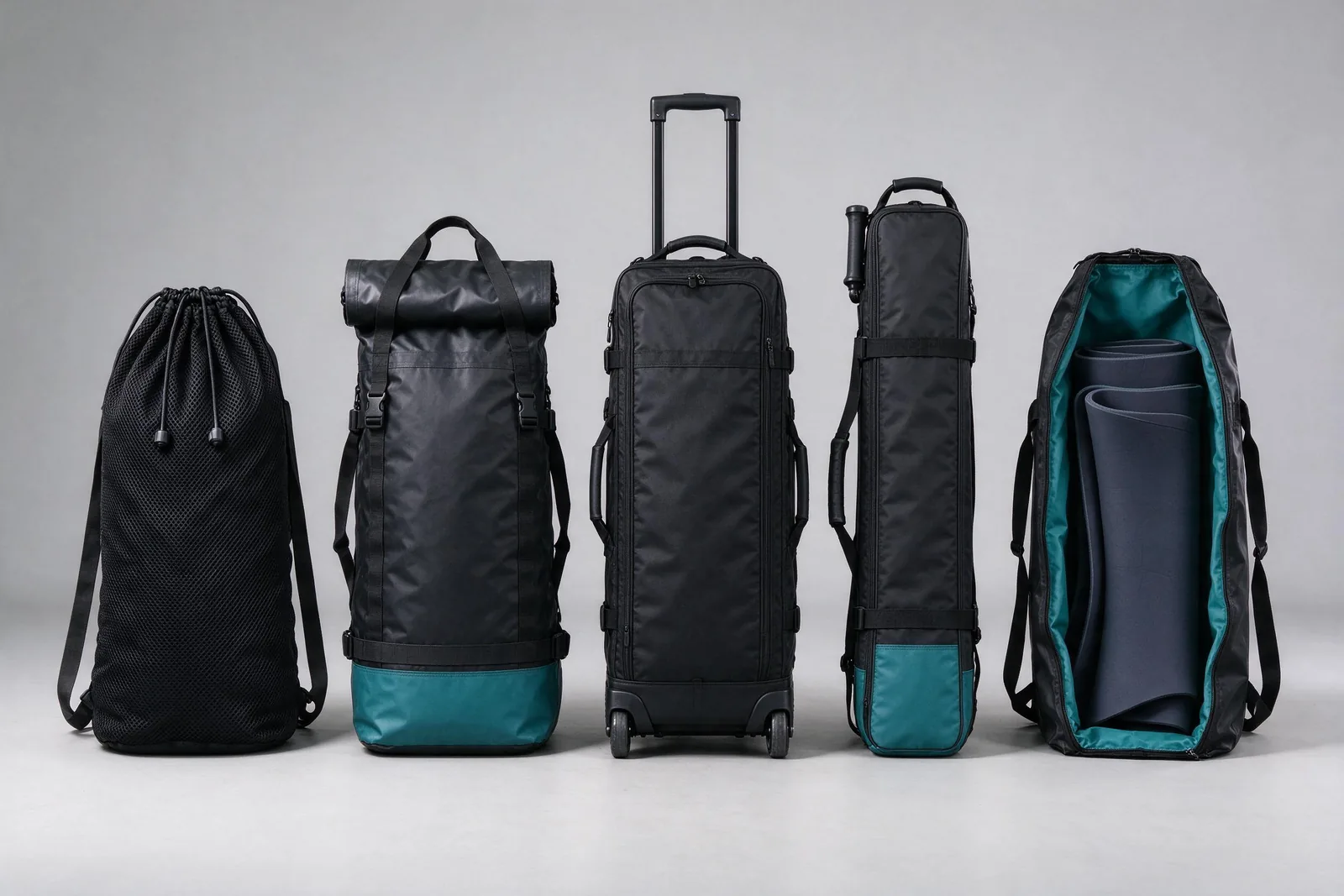
The five reference builds, left to right: 30 L mesh, 55 L waterproof, 90 L rolling, 95 L spearfishing, 70 L wetsuit. Same colour programme, same hardware family, five different carton plans — from 11,333 pieces per 40’ HQ to 722.
A Worked Mixed Container for a Distributor
Most first orders are not one SKU. The plan below is a real shape we quote often: a distributor covering four countries, filling one 40’ HQ with five builds, weighted toward the two fast movers. Cubic metres are allocated first, units are derived from the load plans above, and value is priced at the 1,000-piece level because every SKU clears 1,000 units except the rolling bag.
| Build | CBM share | CBM | Units | FOB each @ 1,000 | Value | Freight |
|---|---|---|---|---|---|---|
| Mesh 30 L | 25% | 17.00 | 2,833 | USD 12.03 | USD 34,081 | USD 708 |
| Waterproof 55 L | 25% | 17.00 | 1,291 | USD 17.30 | USD 22,334 | USD 710 |
| Rolling 90 L | 10% | 6.80 | 72 | USD 25.40 | USD 1,829 | USD 284 |
| Spearfishing 95 L | 20% | 13.60 | 257 | USD 20.46 | USD 5,258 | USD 568 |
| Wetsuit 70 L | 20% | 13.60 | 366 | USD 18.98 | USD 6,947 | USD 571 |
| Total | 100% | 67.93 | 4,819 | avg 14.62 | USD 70,449 | USD 2,842 |
The container fills to 99.9% of usable volume, average FOB is USD 14.62 per piece, and average freight is USD 0.59. Note that the rolling bag is only 72 units — at 0.0941 CBM per piece it is 10% of the container for 1.5% of the units. That is not a reason to leave it out: a distributor needs a wheeled option in the catalogue, and 72 pieces is a sensible test quantity for a new market. It is a reason to plan it as a fill item rather than a volume item.
Two rules make mixed containers work in practice. MOQ applies per style, not per container — 500 pieces each, with colourways at 100 pieces minimum. And the load plan is fixed before production starts, because carton counts drive the booking, and a container that ships at 92% fill has paid for 8% of air.
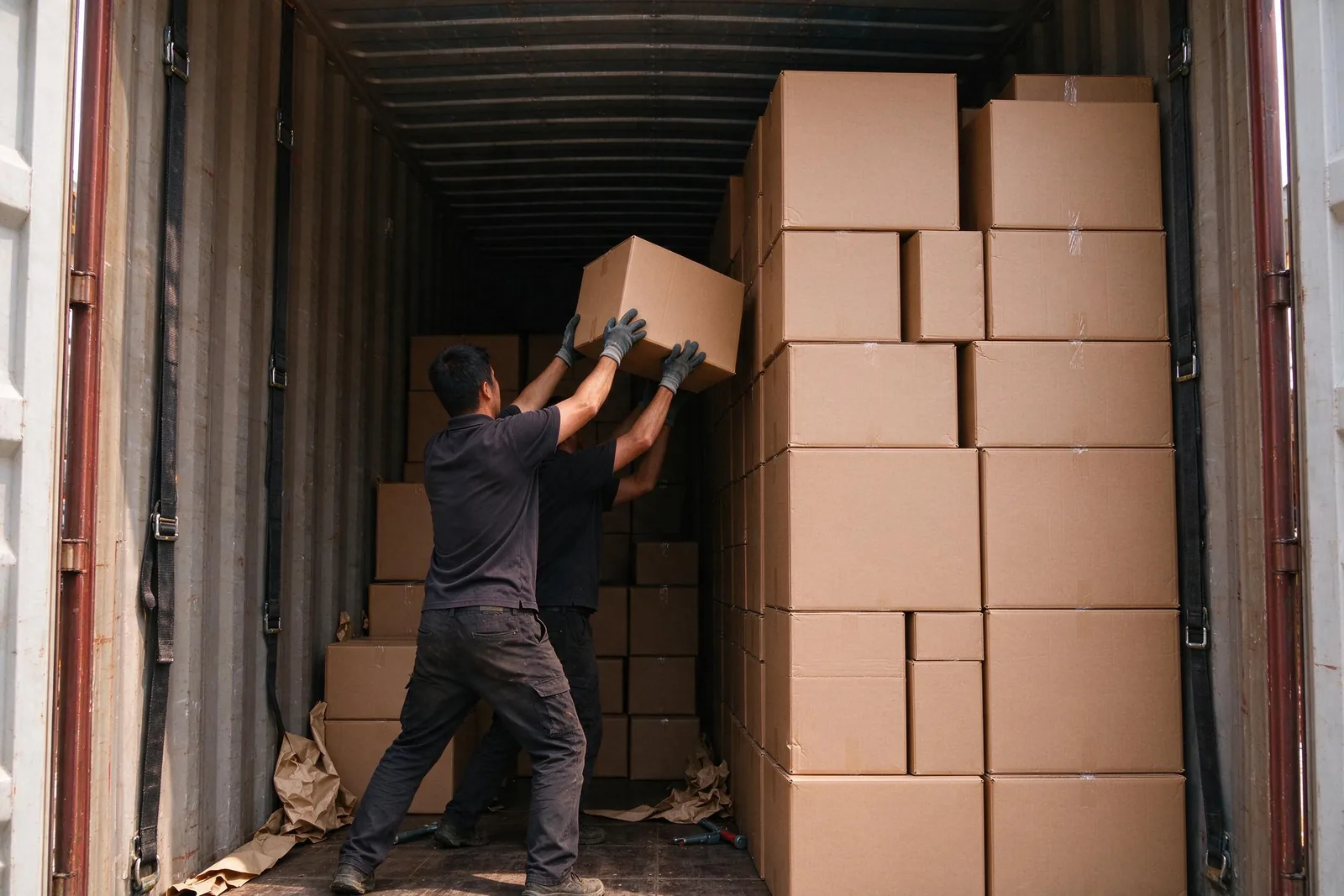
Loading a mixed 40’ HQ. Cartons are sequenced so the heaviest builds sit over the container axles and the long-format cartons go to the nose, where the 156 cm sleeve fits without blocking the door.
What Drives Unit Cost at Volume — and Where to Read the Engineering
This page prices volume; it does not re-explain construction. The five engineering pages carry the material and process detail, and they are the right place to argue about mesh aperture, weld strength or wheel bearings. What matters at volume is which cost lines scale and which do not.
| Cost line | Scales with volume? | Why | Engineering detail |
|---|---|---|---|
| Fabric (mesh, 600D, 1680D, TPU) | Yes, 4–7% | Roll buying and mill-direct dye lots | Material selection |
| Welding and seam sealing | Barely | Machine time per piece is fixed; only setup amortises | Waterproof dive bag |
| Zips and sliders | Yes, 6–9% | Chain is bought in 200 m rolls; sliders in 5,000s | Mesh dive bag |
| Wheel sets, trolley, frame | Yes, 8–12% | Component pricing steps at 1,000 and 5,000 | Rolling dive bag |
| Sewing labour | Yes, 8–12% | Learning curve, not wage cuts | Sample to bulk |
| Tooling, dies, print screens | Falls per piece | Fixed USD 2,200–2,800 per style | Quoted as a separate line on every offer |
| Inspection | Falls per piece | One AQL sample per lot regardless of lot size | Export packaging |
The engineering pages, for the record: mesh dive bags cover 2–10 mm aperture and drainage; waterproof dive bags cover the W0–W4 water-pressure ladder and the dry/wet split; rolling dive bags cover the 30–35 kg load path and wheel geometry; spearfishing gear bags cover gun-length geometry and catch-compartment hygiene; wetsuit bags cover neoprene grades and the changing mat. Every one of them is built in the same plant, on the same AQL, under the same MOQ.
Sampling: 6–10 Working Days, Four Approval Gates
Sampling is the cheapest part of a wholesale order and the only part that can prevent a container of the wrong bag. Our standard cycle is four gates over 6–10 working days from a locked specification, and it includes one round of revision. What we need from you to start is a reference bag or a dimensioned drawing, the volume, the target market and the price band — not a finished tech pack.
| Gate | Working days | What we deliver | What you approve |
|---|---|---|---|
| 1. Brief and tech-pack review | Day 0–1 | Gap list, one page, with every dimension we had to assume | The assumed dimensions, before anything is cut |
| 2. Swatches, lab dips, artwork proof | Day 1–3 | Material card, Pantone match under D65, logo proof at actual size | Shade and logo position |
| 3. First prototype | Day 3–7 | One sewn unit, weighed, with the pattern card | Fit, volume, hardware, carton estimate |
| 4. Fit, function, drop test and revision | Day 7–10 | Revised unit or a signed-off golden sample retained at the factory | The golden sample — the reference for AQL |
Two things about sampling at volume that buyers learn late. First, the sample must be made on the production line by the production team, not by the sample room alone; a sample-room bag and a line bag are different objects, and most “the bulk does not match the sample” disputes trace to that gap. Second, the golden sample is a contractual document. It is the physical definition of the specification that AQL inspects against, and it stays at the factory with your order number on it.
Bulk Production: 35–50 Days, Eight Phases
The 35–50 day window is a calendar, not a promise. It starts when the deposit clears and the golden sample is signed, and it moves for three reasons only: dyed fabric, a new mould, and the lunar new year. Everything else is inside the window.
| Phase | Day | What is happening |
|---|---|---|
| 1. PO, deposit, spec lock | Day 0–1 | Golden sample signed, BOM frozen, carton plan issued |
| 2. Bulk fabric and trim booking | Day 1–7 | Stock colours from the roll; custom dye adds 10–15 days |
| 3. Cutting | Day 8–13 | Lay, marker, straight-knife; 3–4% waste at volume |
| 4. Sewing | Day 10–32 | Starts as the first cut bundles release; runs in parallel with phase 3 |
| 5. Wet-cell welding and seam sealing | Day 20–36 | RF or hot-air weld, 100% air-hold on wet compartments |
| 6. Hardware and final assembly | Day 30–40 | Wheels, trolley, frame, grommets, webbing, branding |
| 7. Inline and final AQL inspection | Day 38–45 | Five gates plus final lot sample; third-party inspection welcome |
| 8. Packing, carton marking, booking | Day 43–50 | Polybag or retail carton, barcode, master-carton marks, container booking |
New tooling adds 18–25 days and custom dye adds 10–15 days, both in front of phase 3, so a first order with a new mould and a custom colour is realistically a 65–80 day project. A reorder on a retained specification is 25–30 days.
Sewing capacity, expressed in the only unit that matters to a planner — hours on the line:
| Build | Sewing minutes per bag | Hours for 500 pcs | Hours for 2,000 pcs | Line-weeks at 450 h/week |
|---|---|---|---|---|
| Mesh 30 L | 22 | 183 | 733 | 1.6 |
| Waterproof 55 L | 26 | 217 | 867 | 1.9 |
| Rolling 90 L | 42 | 350 | 1,400 | 3.1 |
| Spearfishing 95 L | 34 | 283 | 1,133 | 2.5 |
| Wetsuit 70 L | 31 | 258 | 1,033 | 2.3 |
A 450 hour week is ten operators on 45 hours. The point of the table is that 2,000 rolling bags occupy a line for three weeks while 2,000 mesh bags occupy it for under two. When two buyers want the same delivery window in the same month, the wheeled order is the one that has to be booked first — which is why we ask for a ship-by date at enquiry, not at PO.
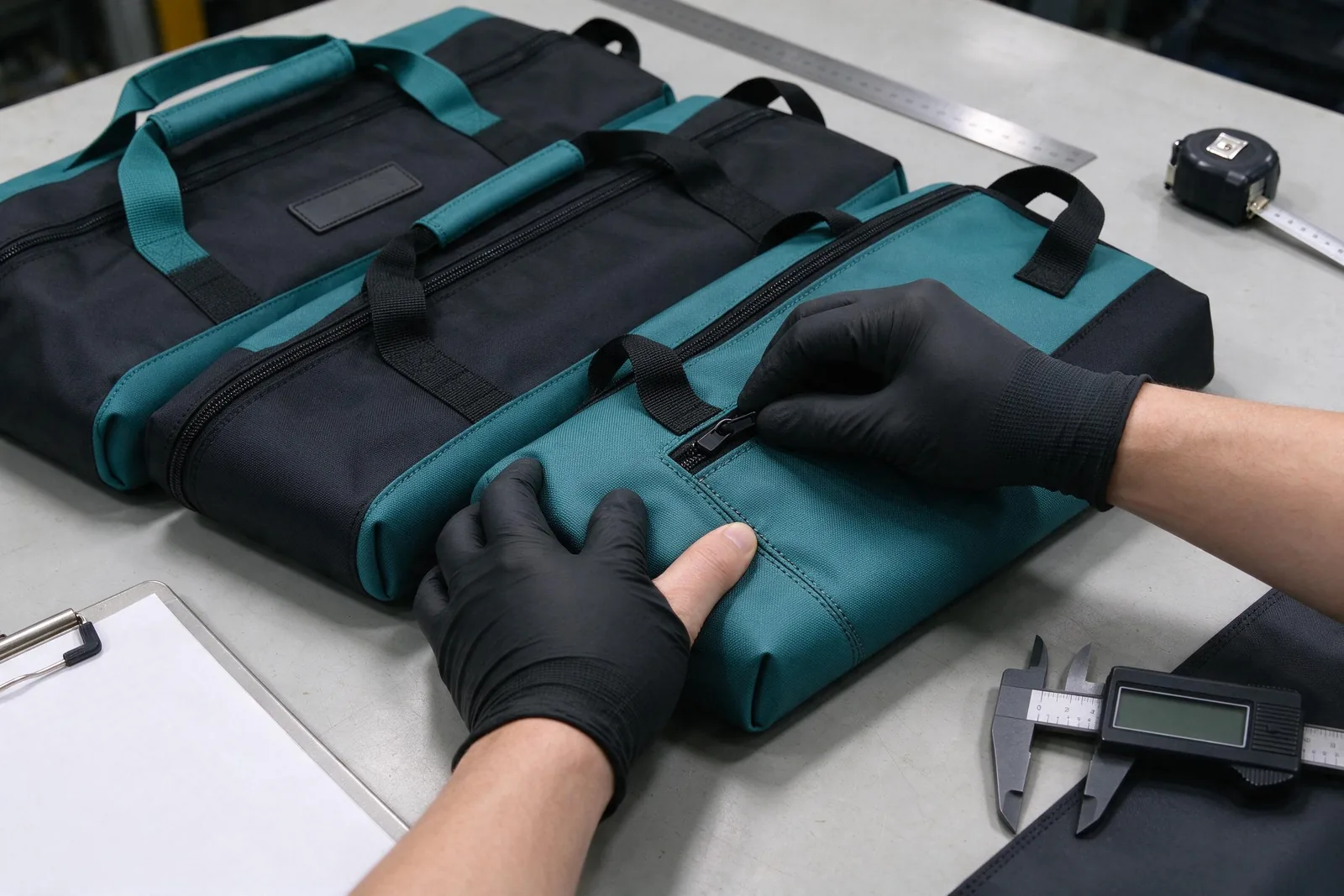
Final inspection on a wholesale lot: the sample size comes from the lot size, not from habit, and the golden sample sits on the bench as the reference for every measurement taken.
Inspection: AQL 2.5 / 4.0, Five Gates, Critical Zero
Final inspection runs to ISO 2859-1, general inspection level II, single sampling, normal: major defects at AQL 2.5, minor at 4.0, and four critical defects at zero tolerance — an open weld on a wet compartment, a torn anchor point, exposed sharp hardware, and a needle left in the bag. The sample size and acceptance numbers depend on the lot, and buyers are regularly surprised by how small the sample is: a 3,000-piece lot is judged on 125 pieces.
| Lot size | Code letter | Sample size | Accept / reject @ 2.5 | Accept / reject @ 4.0 |
|---|---|---|---|---|
| 501–1,200 | J | 80 | 5 / 6 | 7 / 8 |
| 1,201–3,200 | K | 125 | 7 / 8 | 10 / 11 |
| 3,201–10,000 | L | 200 | 10 / 11 | 14 / 15 |
Five gates sit inside production, ahead of the final lot sample: incoming sheet and fabric (weight, coating, shade), cut (dimensions to ±5 mm), weld (100% air-hold on wet compartments), hardware (pull tests on handles and anchors), and packing (carton count, barcode, marks). A third-party inspection is welcome at any gate; we will book the slot and provide the cartons, the golden sample and the packing list. What we will not do is issue a certificate in place of an inspection, or claim an IP rating on a sewn bag — that is a construction limit, not a paperwork gap.
Commercial Terms: Incoterms, Payment, Documents
| Item | Standard | Notes |
|---|---|---|
| Price basis | FOB Ningbo or Xiamen | CIF and DDP quoted on request with a named port |
| Currency | USD | EUR quotations at the rate of the day, valid 7 days |
| Payment | 30% T/T deposit, 70% before shipment | L/C at sight accepted from USD 30,000; net terms only on a history |
| MOQ | 500 pcs per style | Colourways from 100 pcs each; mixed container from 3 styles |
| Tooling | USD 2,200–2,800 per style | Invoiced once, shown as a separate line, retained for reorders |
| Samples | Charged, credited on the first bulk order | Courier at cost |
| Documents | Invoice, packing list, B/L, certificate of origin, REACH SVHC declaration | Fumigation certificate for solid-wood packing only; we use plywood |
| HS heading | 4202.92 — textile-outer travel and sports bags | Duty and import VAT are destination-specific; your broker confirms |
| Compliance | REACH SVHC, Prop 65 material declarations, PVC-free and PFAS-free options | We are not a certification body, an authorised representative or an importer of record |
Landed Cost at 1,000 Pieces — What the Container Adds
Landed cost here is FOB plus 1% for insurance and origin handling plus ocean freight at USD 2,850 per 40’ HQ. It excludes duty, destination charges and inland delivery, which vary by lane and are your forwarder’s number to give.
| Build | FOB @ 1,000 | Freight per pc | Landed | Increase over FOB |
|---|---|---|---|---|
| Mesh 30 L | USD 12.03 | USD 0.25 | USD 12.40 | +3.1% |
| Waterproof 55 L | USD 17.30 | USD 0.55 | USD 18.02 | +4.2% |
| Rolling 90 L | USD 25.40 | USD 3.95 | USD 29.60 | +16.5% |
| Spearfishing 95 L | USD 20.46 | USD 2.21 | USD 22.87 | +11.8% |
| Wetsuit 70 L | USD 18.98 | USD 1.56 | USD 20.73 | +9.2% |
Read the last column against a typical 45–55% wholesale margin and the picture is clear: on the mesh bag, freight is noise; on the rolling bag, freight is a sixth of the cost and worth a design conversation. If your retail price is fixed by the market, the only lever left is the carton — which is why the packing decision belongs in the product brief.
How to Compare Three Quotations Without Being Fooled
Three quotations for “a 90 L dive bag” are not comparable, because the phrase describes a family, not a specification. Normalise six lines before comparing price, and most of the spread disappears.
| Line | What to require in writing | What a vague quotation will hide |
|---|---|---|
| Shell fabric | Denier, coating type and hydrostatic head, e.g. 900D with 0.5 mm TPU back | “Strong polyester” — often 600D with a thin PU coat |
| Base | 1680D plus TPU, or 2.5 mm HDPE board | A single-layer base that abrades through in one season of concrete |
| Wheels and frame | Wheel diameter, bearing type, frame material and thickness | “Good wheels” — 76 mm unsealed wheels on a 30 kg load |
| Zips | Size, chain type, slider brand, whether the main zip is welded at the ends | #8 where #10 is needed; no slider garage |
| Carton | Pieces per carton, carton dimensions, gross weight, CBM per piece | No carton data at all, so the freight surprise arrives at booking |
| Inspection | AQL level, sample size, critical defect list, who inspects | “100% checked” with no definition of a defect |
Then check the arithmetic. A price that is 20% under the field on a like-for-like specification is not a better factory; it is a different bag. Our own floor is visible on this page: on the 90 L build, material and labour are 85.8% of FOB, so a 20% discount has to come out of the wheel set, the backboard or the shell — and it will come out of the first container, not the sample.
Working Backwards from Your Dive Season
Dive retail peaks between May and August in the northern hemisphere, which means the container has to land in April and the order has to be placed in January. This is the calendar we plan against, and it is the reason a February enquiry for a May shelf date is a rush order rather than a normal one.
| Milestone | Date (northern-hemisphere season) | Lead time behind it |
|---|---|---|
| Retail shelf date | 1 May | — |
| Container at destination warehouse | 20 April | 10 days port to warehouse |
| Vessel departure | 15 March | 32–35 days ocean to Europe, 28–32 to US East Coast |
| Goods ready / inspection passed | 5 March | 35–50 days production |
| PO and deposit | 15 January | Golden sample signed |
| Sampling start | 5 January | 6–10 working days |
If the build needs a new mould or a custom dye, move every date above back by four weeks. If you are reordering a retained specification, the whole chain compresses to about ten weeks from PO to shelf.
The RFQ: 18 Fields That Get a Real Quotation in Two Days
Most enquiries we receive cannot be quoted without a second round of questions, which costs a week. Send these eighteen fields and the quotation is a two-day job.
- Bag type and reference — a photo, a link or one of the five builds on this page.
- Volume in litres and the main internal dimension that has to be met.
- Shell fabric and coating, or the target price band if you want us to propose.
- Base construction and expected load in kilograms.
- Wet and dry separation requirement — yes or no, and the split.
- Closure type: drawstring, #10 zip, roll-top or flap.
- Drainage: grommets, mesh panel, or none.
- Carry system: shoulder strap, backpack straps, trolley, or hand carry only.
- Hardware finish and any metal restriction (salt-water market).
- Colourways and how many pieces per colourway.
- Logo method and placement, with artwork or a Pantone reference.
- Retail packing requirement: bulk polybag, retail carton, barcode, hangtag.
- Target FOB and target landed cost, if you have them.
- Order quantity per style and the number of styles in the first order.
- Ship-by date and destination port.
- Incoterm and payment terms you work on.
- Compliance documents your market requires (REACH, Prop 65, PVC-free, PFAS-free).
- Whether a third-party inspection is planned, and at which gate.
Send those and you will get a specification sheet, a carton plan with CBM per piece, an FOB ladder at 500/1,000/2,000/5,000, the tooling cost as a separate line, and a production calendar with your ship-by date marked. If the brief cannot hit your target price, we will say which line has to change rather than quoting a bag that cannot be built.
Frequently Asked Questions
What is the minimum order for wholesale dive bags?
500 pieces per style. Colourways can be mixed inside that 500 as long as each colourway is at least 100 pieces, because below 100 the cutting lay and the fabric booking stop being efficient. A mixed container is accepted from three styles, each at its own 500-piece minimum. There is no “sample quantity at bulk price” tier; a 50-piece trial is quoted as sampling plus a small-lot surcharge, and we will tell you that up front rather than burying it.
How much cheaper is 5,000 pieces than 500?
14.6% to 15.6% across the five reference builds: mesh 30 L from USD 12.80 to USD 10.88, waterproof 55 L from USD 18.40 to USD 15.64, rolling 90 L from USD 26.80 to USD 22.90, spearfishing 95 L from USD 21.60 to USD 18.38, wetsuit 70 L from USD 20.11 to USD 16.97. Roughly a third of that comes from tooling amortisation alone — USD 5.20 per piece at 500 against USD 0.52 at 5,000 on USD 2,600 of tooling.
Can I mix different dive bag styles in one container?
Yes, and most first orders do. Our standard worked example fills a 40’ HQ to 99.9% of usable volume with 2,833 mesh bags, 1,291 waterproof bags, 257 spearfishing bags, 366 wetsuit bags and 72 rolling bags — 4,819 pieces with an average FOB of USD 14.62 and average freight of USD 0.59. The constraint is that each style still has to clear 500 pieces, so a mixed container is normally three to five SKUs rather than fifteen.
How long does a wholesale order take?
35–50 days of bulk production after the deposit clears and the golden sample is signed, plus 6–10 working days of sampling before that. Add 10–15 days for a custom dyed fabric and 18–25 days for new tooling, both of which sit in front of cutting. A first order with a new mould and a custom colour is realistically a 65–80 day project; a reorder on a retained specification is 25–30 days.
What does sampling cost and is it refundable?
Sampling is charged at cost and credited back on the first bulk order. One round of revision is included; a second round is charged again because it means the brief moved rather than the sample being wrong. Courier is at cost. If we cannot build to your brief at all, we will say so at gate 1 and you will not be invoiced for a prototype.
What payment terms do you offer?
30% T/T deposit with 70% before shipment is standard. An L/C at sight is accepted from USD 30,000. Open account terms are only offered against a delivery history — typically after three clean shipments — and we do not accept payment after arrival on a first order, because the factory has already paid for the fabric.
Do you ship DDP?
We quote FOB Ningbo or Xiamen as standard, and CIF or DDP on request with a named port and a named address. DDP is quoted through our forwarder and priced on the destination, so it takes an extra day to prepare. What we do not do is quote a DDP number before knowing the destination — duty and import VAT are destination-specific and a guessed number is worse than no number.
Which dive bag should a rental fleet buy?
A mesh bag or a waterproof bag, not a wheeled bag. A fleet bag is dragged, thrown and left wet, so the failure points are the handle anchor, the drain and the base. Mesh 30 L at 420 g and USD 12.80 is the cheapest bag that survives that treatment, and it drains without a grommet. Order 5–8% spares rather than expecting zero failures — a fleet of 60 bags will lose three or four a season, and a spare in the store room is cheaper than an air freight.
Which bag should an e-commerce private label start with?
Two builds work at 500 pieces: the wetsuit 70 L at USD 20.11 if your customer changes outdoors, and the waterproof 55 L at USD 18.40 if they travel. Both are photographable, both have a clear feature story, and both fit a retail carton without a dimensional-weight penalty. The rolling 90 L is a better product and a harder first SKU: 722 pieces per 40’ HQ and USD 3.95 of freight per piece means the landed cost is 16.5% above FOB before duty.
Can you print our logo on the cartons and polybags?
Yes. Master cartons are printed in one or two colours with your marks, side marks, carton number and barcode; polybags take a printed warning line and a barcode label. Both are part of the quotation if they are specified at RFQ stage, and both become a change order if they arrive after the cartons are printed. Retail-ready cartons with four-colour print need artwork at least 10 days before packing starts.
What certifications can you supply?
Our factory holds BSCI and ISO 9001:2015. We supply REACH SVHC declarations for standard materials, material declarations that feed your own Prop 65 assessment, and PVC-free or PFAS-free options on request. We do not act as a certification body, an authorised representative or an importer of record, and we will not put an IP rating on a sewn bag — only a welded compartment can carry a water-pressure claim, and only for that compartment.
Do you keep stock or ready goods?
No. Every dive bag we ship is made to order. We do not run a stock programme and we do not sell other customers’ cancelled orders, which is why the MOQ is a real 500 rather than a warehouse clearance. The practical consequence is that the ship-by date drives everything, and the time to book capacity is before your season, not during it.
How do reorders work?
The specification, the golden sample, the pattern and the tooling are retained against your order number, so a reorder is 25–30 days and skips sampling entirely. We include 1% spare components on the original order — sliders, grommets, wheels — so a repair in the field does not become a new production run. Reorders are also where the learning curve shows: the same quantity on a second run is typically 3–5% cheaper in labour.
What is the most common reason a wholesale dive bag order fails?
Not price, and not quality. It is a specification that was never written down: the buyer approves a sample, the bulk arrives, and the two sides disagree about whether the base is 1680D or 600D. The second most common is a retail carton decided after the quotation, which turns a 3% freight line into 14%. Both are prevented by one page of specification and one carton plan, signed before the deposit.
Can you consolidate dive bags with tote bags or duffels in one container?
Yes. Dive bags are a family in our plant, not a separate factory, so a container can combine dive bags with wholesale tote bags, custom duffel bags or travel bags. Each style keeps its own 500-piece minimum, and the load plan is built on cubic metres across the whole mix so the container ships full rather than 90% full.
What is the difference between this page and your product pages?
This page is about buying at volume: price ladders, cartons, container maths, sampling, production calendar, inspection and commercial terms. The product pages are about how each bag is built — mesh aperture and drainage, water-pressure classes and dry/wet architecture, wheel and frame load paths, gun-length geometry and neoprene grades. If you are choosing a bag, read those. If you are placing an order, this page has the numbers.
Send Your Dive Bag Programme for a Volume Quotation
Tell us the styles, the quantities, the carton preference and the ship-by date. You will get a specification sheet, a carton plan with CBM per piece, an FOB ladder at 500 / 1,000 / 2,000 / 5,000, tooling as a separate line, and a production calendar with your date on it — within two working days.
Related manufacturing pages
- Custom Mesh Dive Bag Manufacturer
- Custom Waterproof Dive Bag Manufacturer
- Custom Rolling Dive Bag Manufacturer
- Custom Spearfishing Gear Bag Manufacturer
- Custom Wetsuit Bag Manufacturer
- Custom Scuba Gear Bag Manufacturer
- Custom Dive Backpack Manufacturer
- Custom Freediving Bag Manufacturer
- Custom Long Fin Bag Manufacturer
- Custom Monofin Bag Manufacturer
- Custom Dry Bag Manufacturer
- Wholesale Tote Bags
- Wholesale Bags for Online Marketplaces
- Wholesale Bag Factory OEM / ODM
- Export Packaging Standards for Bags
- From Sample to Bulk Production
- How Long to Manufacture a Custom Bag
- TPU vs PVC vs Nylon: Material Selection
- Dry Bag Manufacturing Guide
- Quanzhou Waterproof Bag Manufacturer