
Compliance · Bags
PFAS in Bags: PFHxA Limits, Test Methods and Which Materials Fail
The EU restriction on PFHxA reached clothing and related accessories on 10 October 2026. Bags sit awkwardly inside that scope, and the awkwardness has a cost: a clean shell fabric with a loaded zip tape still fails. Here is where PFAS actually hides in a bag, what the two thresholds measure, and how to specify a finish you can defend.
If your bags carry a water-repellent finish, assume it is PFAS until a test report says otherwise. C6 chemistry — the industry default since C8 was phased out — breaks down to PFHxA, and PFHxA is the substance the EU now restricts.
EU: since 10 October 2026, materials in clothing and related accessories for the general public must stay below 25 ppb for the sum of PFHxA and its salts, and below 1,000 ppb for the sum of PFHxA-related substances — measured in homogeneous material.
California: AB 1817 names handbags and backpacks directly. Total organic fluorine must fall from 100 ppm to 50 ppm on 1 January 2027.
The fix is not a better fabric. It is a fluorine-free finish, specified in writing, tested on the bulk lot, and reported per component.
Where PFAS Actually Sits in a Bag
Buyers usually go looking for PFAS in the wrong place. It is rarely in the base fabric itself. Nylon, polyester, cotton canvas and recycled PET are not fluorinated. The fluorine arrives later, as a finish applied to the face of the fabric.
The DWR finish is the main route
A durable water-repellent finish makes water bead and roll off the surface. On a bag it shows up as the difference between a shell that sheds a shower and one that darkens and wets through in ninety seconds. On polyester and nylon oxford, on taslan and pongee shells, on canvas and on many backpack and travel bag fabrics, that finish has for years been a fluorinated chemistry.
It is the single most common source of PFAS in a bag, and it is also the least visible. Nothing on the bag, and nothing on most fabric sales sheets, tells you what chemistry was used. “Water repellent” and “PFAS-free” are not opposites, and a supplier can honestly describe a fabric as water repellent while the finish behind that performance is C6 fluorotelomer chemistry.
The second route: webbing, lining and trims
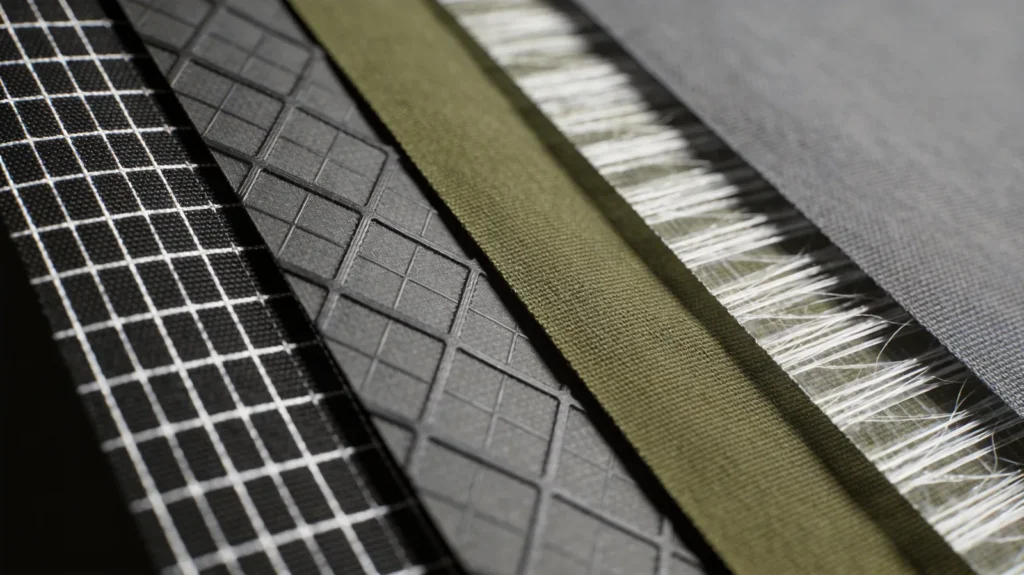
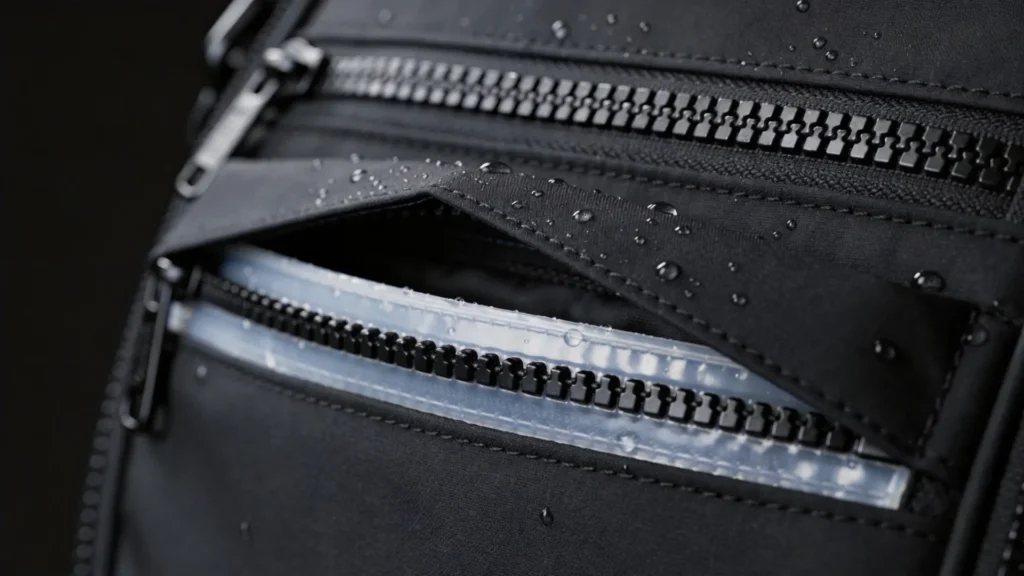
Water-repellent and stain-resistant treatments also turn up on webbing, on linings, on stain-resistant trims, and as a treatment on paper braid and some natural fibres. This matters because of how the EU threshold is measured. It is measured per homogeneous material, which in practice means the shell, the lining, the webbing and the zip tape are each judged on their own.
A bag with a compliant shell and a non-compliant zip tape is a non-compliant bag. That is not a technicality invented by a lab; it is how the entry is written, and it is the most common way a programme that looked clean at fabric-approval stage fails at shipment stage.
What PU coating is not
One point worth clearing up, because it causes unnecessary panic. A polyurethane coating is not fluorinated. A PU-coated waterproof fabric with a fluorine-free face finish raises no PFAS issue from the coating itself.
What matters is whether the outer fabric, webbing or lining also carries a fluorinated repellent finish. Those are separate decisions, made at different suppliers, and they need to be specified separately.
If you are sourcing a waterproof bag and the factory tells you “the coating is PU, so no PFAS,” the answer is incomplete rather than wrong. Ask the follow-up: what finish is on the face of the shell, and what is on the zip tape.
C8, C6 and C0: Why “PFAS-Free” Claims Break Down
Water-repellent finishes are usually described by the length of their fluorinated carbon chain. Understanding the three families explains most of the confusion in this category.
| Family | What it is | Regulatory position | Practical status for bags |
|---|---|---|---|
| C8 | Long-chain perfluorinated chemistry. Associated with PFOA and PFOS. | PFOA, PFOS and PFHxS are listed under the POPs Regulation with near-zero thresholds. | Effectively out. Do not specify. |
| C6 | Short-chain chemistry adopted as the replacement for C8. Its typical breakdown product is PFHxA. | PFHxA is the substance restricted by REACH Annex XVII entry 79. | A C6 finish is not a PFAS-free finish, whatever the fabric sheet implies. |
| C0 | Fluorine-free. Silicone, wax, hydrocarbon or similar chemistries with no fluorinated carbon chain. | Not caught by a fluorinated-chain definition. | The only family that can honestly be called PFAS-free. |
The trap is the middle row. When long-chain chemistry was restricted, much of the industry moved to C6 and treated the problem as solved. A decade later the breakdown product of that replacement is the substance now restricted. A supplier who says “we switched away from the banned chemistry years ago” may be describing a move from C8 to C6 — which is a move into the current problem, not out of it.
Two things follow. First, “PFAS-free” should never be accepted as a phrase without a test report behind it, because the phrase has no settled legal definition across EU law. Second, when you ask a mill what finish they use, the useful answer is a chemistry family and a product name, not an assurance.
The EU PFHxA Restriction: What Entry 79 Actually Says
The instrument is Commission Regulation (EU) 2024/2462 of 19 September 2024, which inserted entry 79 into Annex XVII of REACH. It applies directly in every Member State — no national transposition, no staggered adoption across countries.
The two limits are separate sums
This is the detail that catches people who hold an older test report. The restriction sets two thresholds, and a material fails if it reaches either one:
- 25 ppb (25 µg/kg, or 0.025 mg/kg) for the sum of PFHxA and its salts.
- 1,000 ppb (1 mg/kg) for the sum of PFHxA-related substances.
Both are measured in homogeneous material. A result of exactly 25 ppb fails — the threshold is “equal to or greater than.”
The second sum is the one buyers underestimate. The restriction does not only cover PFHxA itself; it covers a family of substances defined by molecular structure as having the potential to degrade or be transformed into PFHxA. In textiles that means C6 side-chain fluorinated polymers and the residual fluorotelomer compounds they carry. A report showing PFHxA alone is not enough under the new entry. Both sums must be tested and reported separately.
The staggered dates
| Applies from | Scope | Bearing on bags |
|---|---|---|
| 10 April 2026 | Firefighting foams for training, testing and public firefighting | Not applicable |
| 10 October 2026 | Textiles, leather, furs and hides in clothing and related accessories for the general public; footwear; food-contact paper and board; general-public mixtures; cosmetics | Consumer bags are most likely here. The recitals name handbags. |
| 10 October 2027 | The same materials in products other than clothing and related accessories, for the general public — carpets, rugs, curtains, blinds, upholstery, wall coverings, tablecloths, bed linen | Technical and non-consumer bags may fall here. |
| 10 October 2029 | Firefighting foams for civil aviation | Not applicable |
| Exempt | Category III PPE (listed points), medical devices, in vitro diagnostic devices, construction textiles | Do not assume a workwear exemption covers ordinary bags. |
Homogeneous material: the term that decides pass or fail
Entry 79 requires measurement in homogeneous material and does not define the term. The common reading is that shell fabric, lining, sewing thread and zip tape are each judged alone, not averaged across the finished bag. A clean shell with a zip tape over the limit is a failing bag.
Where a coating cannot be separated from its base cloth, ask the laboratory in advance how it will test the composite. Getting that answer before sampling is cheaper than getting it after.
Existing stock is not recalled
Paragraphs 7 and 8 of the entry lift the limits for articles placed on the EU market before the relevant date. Goods already in an EU warehouse can continue to be sold.
The operative moment for a shipment from China is when it clears EU customs and enters free circulation. Goods released after 10 October 2026 fall under the new rules. For goods released before that date, keep the bill of lading, the customs entry and the warehouse records — platforms and authorities do ask, and documentary proof is what settles the question.
A sample approved in July does not protect a bulk shipment that clears customs in December. If the finish was not changed and the material was not tested, the customs release date decides which regime the goods fall under — and it will not be the old one.
What is exempt
Category III personal protective equipment at the listed points, medical devices, in vitro diagnostic devices and construction textiles sit outside the textile restriction. Ordinary workwear fabric is not category III PPE, so the exemption should not be assumed to cover it.
Do Bags Count as “Related Accessories”? The Honest Answer
This is the question every bag buyer asks, and it deserves a straight answer rather than a confident one.
What is settled: the recitals to Regulation (EU) 2024/2462 name handbags explicitly when describing the products the restriction is meant to cover. Bags are not an accident of the drafting.
What is not settled: “related accessories” is not defined in the entry. That leaves genuine ambiguity about whether a given bag belongs in the 10 October 2026 group or the 10 October 2027 group.
The safe assumption: consumer bags sold in the EU are covered now. Two reasons. The recitals name handbags. And the 2027 group is described in terms of furnishing-type textiles — carpets, curtains, upholstery, bed linen — which is not where a backpack or a tote naturally belongs.
Do not plan a bag programme on the 2027 date. If your compliance adviser concludes a specific technical bag sits in the later group, that is a documented position you can hold — but it should be a written position with a reason, not a default assumption made to protect a sampling schedule.
And note the asymmetry: getting this wrong in the 2026 direction costs you a reformulated finish. Getting it wrong in the 2027 direction costs you a customs hold on goods you have already paid to produce.
United States: California Names Bags Directly
The US has no federal PFAS ban on textiles. The rules are set state by state, and the two that matter most for bags name them in the statute rather than leaving it to interpretation.
AB 1817 and what it actually measures
California’s AB 1817, codified at Health and Safety Code §108970 and following, prohibits manufacturing, distributing, selling or offering for sale a new textile article that contains regulated PFAS. “Textile article” is defined broadly and the definition lists handbags and backpacks by name. “Textile” includes anything made wholly or partly of fibre, yarn or fabric, and names nylon and polyester.
Regulated PFAS means either PFAS intentionally added for a functional or technical effect, or PFAS present at or above a threshold measured as total organic fluorine (TOF):
- 100 ppm TOF from 1 January 2025.
- 50 ppm TOF from 1 January 2027.
TOF measures all fluorine bound to organic compounds. It does not identify which substance is present, and it does not ask whether anyone added it on purpose. That makes it a screening measure, and it is why a TOF result alone will not tell you whether you have a C6 finish or a contaminated recycled feedstock.
“Intentionally added” is the operative phrase
Under the California and Maine rules, a C6 finish is non-compliant because it was put there deliberately — however low the measured level. This is a different logic from the EU thresholds, and it catches suppliers who assume a low enough number is a defence.
It also means the practical question is not “how much is in the bag” but “was a fluorinated chemistry used at any stage.” That is a supply-chain question, answered by finish declarations and by knowing which tier applied the treatment.
The certificate of compliance
AB 1817 requires manufacturers to provide anyone selling or distributing their textile articles in California with a signed certificate of compliance stating that the product complies and does not contain regulated PFAS. It also requires manufacturers removing regulated PFAS to use the least toxic alternative, including alternative design approaches.
The certificate is a signed document with an authorised person behind it. That is a different level of commitment from a test report, and it is worth being clear internally about who is entitled to sign one on your behalf.
AB 347 requires the Department of Toxic Substances Control to adopt implementing regulations — including a list of accepted testing methods and third-party laboratory accreditations — by 1 January 2029. So the law is in force while the testing rules are still being written.
That gap does not create a safe harbour. It creates litigation exposure: a violation of state law is independently actionable as an unfair business practice under California’s Unfair Competition Law, which means private claims do not have to wait for DTSC.
Maine, New York and the rest
| Jurisdiction | What is restricted | Key dates | Document |
|---|---|---|---|
| California AB 1817 | Intentionally added PFAS, or TOF at or above the threshold. Definition names handbags and backpacks. | 1 Jan 2025; TOF 50 ppm from 1 Jan 2027 | Signed certificate of compliance |
| Maine 38 MRSA §1614 | Intentionally added PFAS in textile articles. Definition names handbags and backpacks; “textile” includes leather. | 1 Jan 2026; all products from 1 Jan 2032 | Supplier declaration; reporting as required |
| New York | PFAS in apparel | In force for apparel | Varies by channel |
| Other states | Product-specific bans and reporting duties; Washington, Minnesota and Vermont are advancing broader rules | Varies | Varies |
One practical note on the outdoor-apparel carve-out. California defers the ban for extreme and extended-use products for outdoor sports experts until 1 January 2028, with a consumer disclosure requirement in the meantime. That carve-out covers technical garments, not bags. A dry bag for offshore sailing is not a jacket.
France and the Rest of the EU Picture
France has moved on its own track. Loi n° 2025-188 restricts PFAS in cosmetics, clothing textiles (with listed exceptions) and ski wax from 1 January 2026, and extends to all textiles from 1 January 2030.
For a bag programme the French law is usually a secondary consideration, because its 2026 tranche is aimed at apparel rather than accessories. But it signals direction, and a brand selling into France should not treat the EU threshold as the only number that applies to it.
Denmark is worth a separate line in your specification. Danish rules use a total fluorine limit expressed as mg F/kg per article rather than a per-material ppb threshold. A report built to satisfy the EU entry will not automatically answer the Danish question.
The Universal PFAS Restriction Is Not Law Yet
This is where a lot of published commentary is ahead of the actual legal position, and being clear about it saves money.
There is no universal PFAS restriction in force. There is no adopted proposal, no final draft text and no application date. What exists is an opinion process: ECHA’s Committee for Risk Assessment adopted its opinion in March 2026, and the Committee for Socio-Economic Analysis is expected to reach its final opinion around the end of 2026, with a restriction possibly applying from 2027.
Those are expectations, not deadlines. A brand that builds a 2027 plan around a universal restriction is planning against something that may or may not exist on that schedule.
PFHxA under REACH Annex XVII entry 79 — in force for clothing and related accessories since 10 October 2026.
PFOA, PFOS and PFHxS under the POPs Regulation — near-zero thresholds, in force.
California AB 1817 and Maine §1614 — in force, with the California threshold tightening on 1 January 2027.
The universal restriction is a thing to monitor. It is not a thing to plan a shipment around.
Testing: What to Ask the Lab For
Most failures in this category are documentation failures rather than chemistry failures. The finish was changed, the sample passed, and the report still does not answer the question a customs officer or a retailer will ask.
The method
Entry 79 prescribes no test method. The current CEN method is EN 17681-1:2025, which analyses an alkaline extract by liquid chromatography with tandem mass spectrometry. If your lab proposes a method, ask it to state the method reference on the report and confirm it covers both sums separately.
Targeted analysis versus total organic fluorine
These answer different questions and you will usually need both, for different markets.
| Test | What it answers | Where it is the right tool |
|---|---|---|
| Targeted PFAS analysis (EN 17681-1:2025 or equivalent) | Is PFHxA and its salts below 25 ppb, and are PFHxA-related substances below 1,000 ppb, in this material? | The EU question. Also the right tool when you need to know which substance is present, because it names analytes. |
| Total organic fluorine (TOF) | How much organically bound fluorine is in this material in total? | The California and Maine question. Fast screening. Does not identify substances and cannot distinguish intentional addition from contamination. |
The usual sequence that works: use TOF as a screen across the bill of materials to find where fluorine is present at all, then run targeted analysis on the materials that flagged, then repeat targeted analysis on the bulk lot.
Limit of quantification
A 25 ppb threshold is meaningless against a report with a quantification limit of 50 ppb. Ask the laboratory to confirm its limit of quantification sits comfortably below 25 ppb for PFHxA and its salts before you send samples. A report that says “not detected” against an inadequate LOQ is not evidence of compliance, and it will not survive scrutiny.
Sample from the bulk lot
A development sample and a bulk lot can carry different finishes, because the mill that ran the sample may not be the mill that ran the bulk. Test material from the production lot, and record which lot it came from. This is the single most common reason a programme with a clean file still gets a bad result.
Report per homogeneous material
Ask for results listed component by component: shell fabric, lining, webbing, zip tape, thread, trims. A single composite result for “the bag” does not answer the question the entry asks, and averaging is exactly what the per-material rule exists to prevent.
- Method: EN 17681-1:2025 or equivalent, stated on the report.
- Analytes: full list, with the two sums reported separately.
- LOQ: confirmed below 25 ppb for PFHxA and its salts.
- Sample source: production lot, with lot identification.
- Reporting: one line per homogeneous material, not a composite.
- Laboratory: accredited, with the accreditation scope covering the method.
Two Tables Buyers Should Carry
The first table is what a compliance file needs. The second is the one that saves money, because it tells you where to spend the testing budget instead of testing everything at equal depth.
| Market | Limit | Measured in | In force | Test type |
|---|---|---|---|---|
| EU | PFHxA + salts < 25 ppb PFHxA-related substances < 1,000 ppb | Homogeneous material, per component | 10 Oct 2026 (clothing and related accessories) | Targeted, EN 17681-1:2025 |
| California | No intentionally added PFAS; TOF < 100 ppm, then < 50 ppm | Textile article and components | 1 Jan 2025; 50 ppm from 1 Jan 2027 | TOF screen plus declaration |
| Maine | No intentionally added PFAS | Textile article, including components | 1 Jan 2026 | Declaration plus TOF |
| France | PFAS restrictions by product category | Product | 1 Jan 2026 (apparel-led); all textiles 2030 | Per French implementing rules |
| Denmark | Total fluorine < 50 mg F/kg per article | Whole article | In force | Total fluorine |
| EU, POPs | PFOA, PFOS, PFHxS near-zero | Material | In force | Targeted |
| Component | Risk | Why | What to ask for |
|---|---|---|---|
| Shell fabric face finish | High | The main route. DWR on oxford, taslan, pongee and canvas is usually where the fluorine is. | Finish chemistry declaration plus targeted test on bulk lot |
| Zip tape | High | Frequently treated separately from the shell, often at a different supplier. Classic cause of a failing bag with a clean shell. | Separate test line; do not accept a composite result |
| Webbing and straps | Medium | Can carry water-repellent or stain-resistant treatment. | Finish declaration; test if treated |
| Lining | Medium | Stain-resistant linings exist. Plain taffeta usually clean. | Declaration; test if stain-resist claimed |
| PU coating | Low | Polyurethane is not fluorinated. | Confirm no fluorinated additive in the coating formulation |
| Base fabric (nylon, polyester, rPET, cotton) | Low | The fibre itself is not fluorinated. Risk comes from the finish, not the yarn. | Finish declaration only |
| Recycled feedstock | Medium | Contamination in recycled streams is possible and TOF will pick it up without identifying it. | Feedstock declaration plus TOF screen |
| Metal hardware | Low | Not a textile material and outside the fluorinated-chain question. Other rules apply — nickel release, lead. | Separate compliance file |
| Food-contact lining (cooler and lunch bags) | High | Oil and grease repellency is the specific function PFAS chemistry was used for. This is the hardest substitution in the category. | Targeted test plus food-contact declaration |
Fluorine-Free DWR: What You Lose and What You Keep
The honest position is that fluorine-free finishes are not a drop-in replacement for every property. They are a good replacement for some, and a compromise on others. Knowing which is which determines whether your product still works.
Water repellency: largely recoverable
Fluorine-free repellents based on silicone, wax or hydrocarbon chemistry can deliver good water shedding on most bag fabrics. The EU regulation’s own recitals note that alternatives for water-repellent properties appear to be available, which is part of why the restriction was drafted as it was.
What changes is durability and hand feel. Water repellency on a fluorine-free finish typically needs more attention to the wash and abrasion story, and the finish can affect the fabric’s handle. Both are manageable at the specification stage and difficult to fix after bulk.
Oil and stain repellency: the real trade-off
This is where the chemistry is hard to replace. PFAS chemistry repels oil and water at the same time, and fluorine-free alternatives generally do not match the oil-repellent performance. The regulation acknowledges this: the recitals separately reference the loss of oil and stain repellent properties as a functional consideration.
For most bags this does not matter. A backpack shell does not need to repel cooking oil. For a cooler bag or a lunch bag with a food-contact lining, it matters a great deal, and it is the point where a brand should decide whether the product needs a different construction rather than a different finish.
Does this bag need a repellent finish at all? A toiletry pouch needs to survive a leaking bottle. A cable organiser or a packing cube lives inside a suitcase and needs nothing. A washable interior pocket can replace treating the whole exterior.
Carrying a repellency requirement forward from an old specification adds testing obligations in every market for very little functional benefit. Dropping an unnecessary finish is cheaper than substituting it.
If repellency is genuinely required
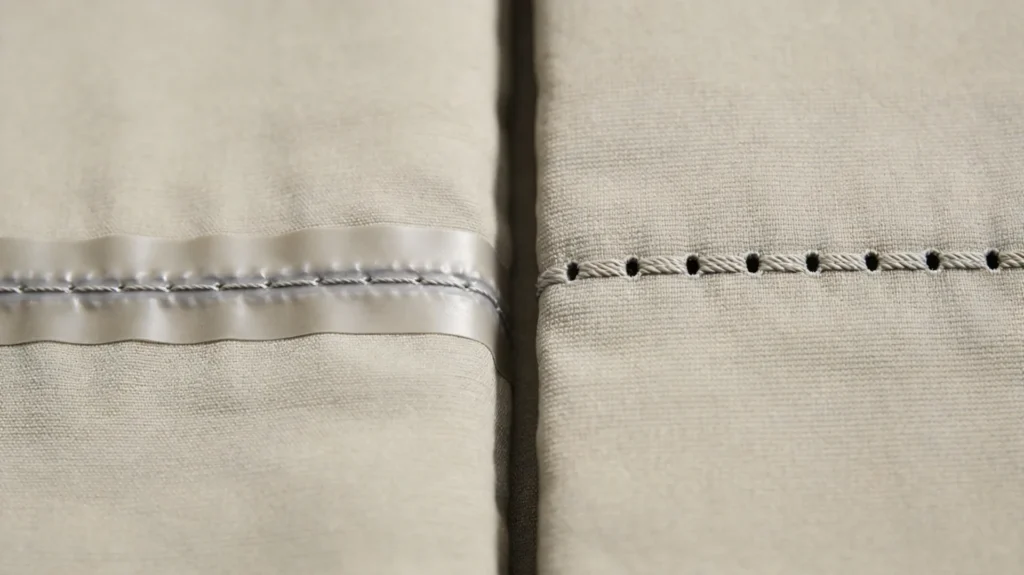
Describe the performance in terms of use rather than chemistry, then verify it on the sample. A spray rating or a hydrostatic head test tells you whether the bag does the job; a chemistry declaration tells you whether you can sell it. You need both, and they are not substitutes for each other.
For construction-level detail on how water resistance is built into a bag — coating choice, seam treatment, zip selection — the technical side is covered on our waterproof bag manufacturing page.
How to Write PFAS Into a Purchase Specification
Most of the value in this article is in this section, because a finish that is not specified in writing will drift. The clauses below can go into a tech pack more or less as written.
Finish. No PFAS-based water-repellent, oil-repellent, stain-resist or soil-release finish on any component. Non-fluorinated repellent only, with the chemistry family stated in writing (silicone, wax, hydrocarbon or other).
Compliance reference. REACH Annex XVII entry 79, Regulation (EU) 2024/2462. Below 25 ppb for the sum of PFHxA and its salts and below 1,000 ppb for the sum of PFHxA-related substances, per homogeneous material.
US market. No intentionally added PFAS. Total organic fluorine below 50 ppm per California AB 1817 from 1 January 2027; Maine 38 MRSA §1614 applies. Signed certificate of compliance required.
Test report. Accredited laboratory, targeted PFAS analysis to EN 17681-1:2025 or equivalent, analytes listed, LOQ confirmed below 25 ppb, sample taken from the bulk lot rather than the development sample.
Separate materials. Shell, lining, webbing, zip tape, thread and trims reported separately. Composite results not accepted.
Change control. Any change of finish chemistry, mill or finishing plant requires re-testing before shipment. No substitution without written approval.
The change-control clause is the one that gets left out and the one that matters most. A programme can pass at development, then fail at shipment, because a mill substituted a finish without telling anyone. Written change control turns that from a surprise into a breach.
What We Can Provide and What We Cannot Sign
Being precise about this saves time in a sourcing conversation, so here is the division of responsibility as we operate it.
What we provide as the manufacturer
- Finish declarations per component — what chemistry was applied to the shell, lining, webbing and zip tape, and by whom.
- Test coordination — arranging accredited-laboratory testing to the method and LOQ your market requires, with samples drawn from the production lot.
- Material substitution — sourcing fluorine-free finishes and, where oil repellency is the driver, proposing a construction change instead of a chemistry change.
- Per-component reporting — results laid out so that each homogeneous material has its own line.
- Change notification — telling you before a finish, mill or finishing plant changes, not after.
What we cannot do
- We cannot sign your certificate of compliance. Under California AB 1817 the certificate is issued by the manufacturer or supplier placing the article on the market, with an authorised person behind it. Where that is you, it is your signature, and we supply the evidence behind it.
- We cannot warrant a result we have not tested. A finish declaration is not a test report, and we will not present one as the other.
- We cannot guarantee a bulk lot matches a development sample without testing the bulk lot. That is what the sampling clause in the specification is for.
- We cannot tell you which scope group your bag falls into. The “related accessories” ambiguity in entry 79 is a legal question for your compliance adviser. We can tell you what finish is on the bag and what the test says; we cannot give you the legal classification.
Switching to a fluorine-free finish is a material change, not a paperwork change. It can affect hand feel, wash durability and, on food-contact linings, oil repellency. We would rather flag that at quotation than at inspection. Standard terms on our OEM programmes run at 500 pcs per style and colour, with sampling at 6–10 days and bulk at 35–50 days, FOB Xiamen.
Frequently Asked Questions
Does the EU PFHxA restriction apply to bags?
The recitals to Regulation (EU) 2024/2462 name handbags when describing the products the restriction is meant to cover, so bags are not an accident of the drafting. However, “related accessories” is not defined in entry 79, which leaves genuine ambiguity about whether a specific bag sits in the 10 October 2026 group or the 10 October 2027 group. The safe planning assumption is that consumer bags sold in the EU are covered now.
Is a C6 finish PFAS-free?
No. C6 is short-chain per- and polyfluoroalkyl chemistry, and its typical breakdown product is PFHxA — the substance restricted by entry 79. Only a fluorine-free (C0) finish can honestly be described as PFAS-free, and that claim should be backed by a test report rather than a declaration.
What are the actual limits?
Below 25 ppb for the sum of PFHxA and its salts, and below 1,000 ppb for the sum of PFHxA-related substances, both measured in homogeneous material. A result of exactly 25 ppb fails, because the threshold is “equal to or greater than.”
Does a PU-coated bag have a PFAS problem?
Not because of the coating. Polyurethane is not fluorinated. The question is whether the outer fabric, webbing or lining also carries a fluorinated water-repellent finish. A PU-coated fabric with a fluorine-free face finish raises no PFAS issue from the coating.
Which component is most likely to fail?
In our experience the shell finish and the zip tape, in that order. Zip tape is the more surprising one and the more common cause of a failing bag with a clean shell, because tape is often treated at a different supplier and reported separately — or not at all.
Do we need to recall stock already shipped?
No. Paragraphs 7 and 8 of entry 79 lift the limits for articles placed on the EU market before the relevant date, so goods already in an EU warehouse can continue to be sold. For shipments from China, the operative moment is customs release into free circulation. Keep the bill of lading, customs entry and warehouse records for goods released before 10 October 2026.
Is there a universal PFAS ban coming?
Not yet. There is no adopted proposal, no final draft text and no application date. ECHA’s Committee for Risk Assessment adopted its opinion in March 2026 and the Committee for Socio-Economic Analysis is expected to reach its final opinion around the end of 2026, with a restriction possibly applying from 2027. That is a thing to monitor, not a deadline to plan a shipment around.
What changed in California on 1 January 2027?
The total organic fluorine threshold for textile articles falls from 100 ppm to 50 ppm. Handbags and backpacks are named in the statutory definition of textile article, so they are in scope. A signed certificate of compliance is required from the manufacturer.
Can a low test result save a C6 finish in California?
No. The California and Maine rules turn on whether PFAS were intentionally added, not on how much is measured. A C6 finish is non-compliant because it was put there deliberately, however low the level. This is a different logic from the EU thresholds and it catches suppliers who assume a low enough number is a defence.
Which test method should we specify?
Entry 79 prescribes no method. The current CEN method is EN 17681-1:2025, analysing an alkaline extract by liquid chromatography with tandem mass spectrometry. Ask the laboratory to state the method reference on the report and to confirm its limit of quantification sits below 25 ppb.
Do we need both targeted analysis and total organic fluorine?
Usually yes, for different markets. Targeted analysis answers the EU question and identifies which substances are present. TOF answers the California and Maine question and works well as a screen across a bill of materials. A common sequence is TOF to find where fluorine is at all, targeted analysis on the materials that flagged, then targeted analysis again on the bulk lot.
Does this affect MOQ, sampling or lead time?
A finish change alone does not change our standard terms: 500 pcs per style and colour, sampling at 6–10 days, bulk at 35–50 days, FOB Xiamen. What it can change is the sampling cycle, because a fluorine-free finish may need a performance re-check on the sample before bulk is released. Where oil repellency is the driver and the chemistry cannot deliver it, we would raise a construction change instead, and that is a separate conversation about tooling and cost.
Sources. This article summarises the rules as they stood in November 2026. It is a manufacturing perspective, not legal advice — confirm the classification of your own products with your compliance adviser.
- Commission Regulation (EU) 2024/2462 of 19 September 2024 amending Annex XVII to Regulation (EC) No 1907/2006 as regards undecafluorohexanoic acid (PFHxA), its salts and PFHxA-related substances — entry 79, staggered application dates and existing-stock provisions.
- Regulation (EC) No 1907/2006 (REACH), Annex XVII.
- California Health and Safety Code §108970 and following (AB 1817), and AB 347 enforcement provisions.
- Maine Revised Statutes, Title 38 §1614 — prohibition on intentionally added PFAS in textile articles, including handbags and backpacks.
- Loi n° 2025-188 (France), PFAS restrictions by product category.
- EN 17681-1:2025, textiles and textile products — determination of fluorinated compounds, alkaline extraction method.
- PFAS in fashion: what REACH bans and what is not law yet — entry 79 scope table and the status of the universal restriction.
- California’s ban on PFAS: the law may be clear, but the rules are not — AB 1817 definitions, thresholds and the AB 347 timeline.
- REACH — European Commission overview — the restriction framework Annex XVII sits inside; entry 79 is the PFHxA entry discussed above.