Want to deliver an outstanding Kickstarter bag project?Choosing the right OEM (Original Equipment Manufacturer) is critical. A reliable OEM ensures high-quality products, on-time delivery, and a smooth production process – key to meeting backer expectations and protecting your brand reputation.Here’s a quick guide to get started:
Straight Answer
MOQ 500 pieces ·Sampling 6-10 days ·Production 35-50 days ·AQL 2.5 inspection ·Sample fee refunded on volume order.JUNYUAN BAGS (QUANZHOU JUNYUAN COMMERCIAL AND TRADING CO., LTD.), an SGS-verified OEM/ODM bag factory (about 200,000 pieces/month, 7 lines, 149 machines, 137 workers) serving 200+ brands in 100+ countries, supports Kickstarter bag projects end to end.
Key Takeaways:
- Define Your Bag Requirements: Specify target audience, materials, dimensions, features, and budget.Precise details prevent miscommunication and wasted resources.
- Evaluate OEMs: Look for experience in bag manufacturing, production capacity, quality control, and certifications like ISO 9001.
- Request Samples: Test prototypes for quality and consistency before committing to large orders.
- Communication is Key: Choose an OEM with clear pricing, fast response times, and a history of meeting deadlines.
- Plan for Logistics: Ensure they offer services like DDP shipping and flexible Minimum Order Quantities (MOQs) to streamline fulfillment.
Why It Matters:
- 9% of Kickstarter projects fail due to manufacturing issues.
- 37% experience delays, often from poor OEM choices.
- A vetted OEM can improve on-time delivery rates by 73%.
By following these steps, you can avoid common pitfalls, keep your campaign on track, and build trust with your backers.
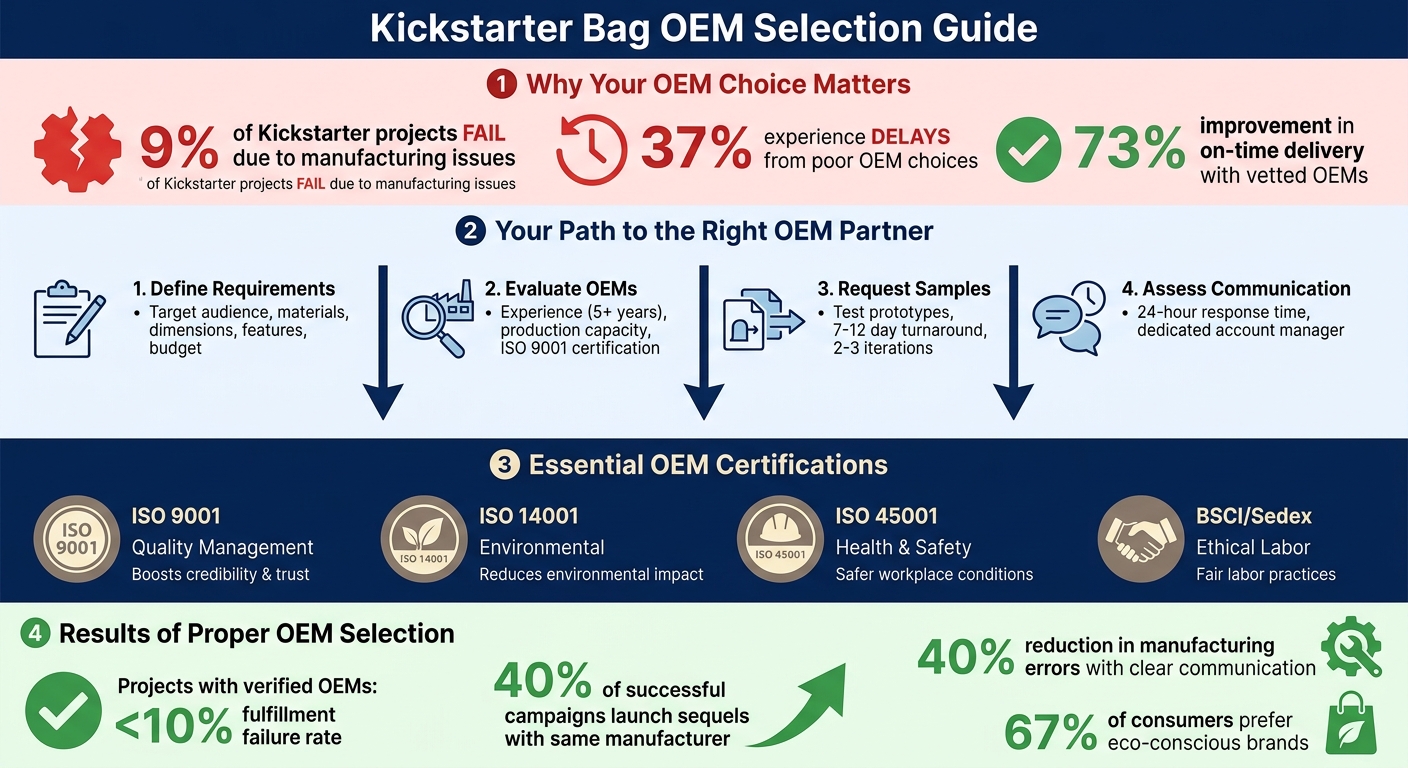
Kickstarter Manufacturing Success Statistics and OEM Selection Criteria
How Premium Handbags Are Made | OEM &ODM Leather Bag Factory Process ✨
sbb-itb-1e6451b
Define Your Kickstarter Bag Requirements
Getting clear on your bag requirements is step one for a successful OEM partnership.Before you even contact a manufacturer, you need to know exactly what you’re creating.Vague ideas lead to miscommunication, wasted samples, and bloated budgets.The more specific you are upfront, the easier it is to find an OEM that can meet your backers’ expectations.
Identify Your Target Market
Your bag’s design should align with the lifestyle and needs of your audience.For example, urban professionals often prefer modular compartments for laptops and tech gadgets, while outdoor enthusiasts look for waterproof materials and durable construction.A great example of this is the Urban Flex Backpack project.It catered to professionals with features like custom laptop sleeves and recycled materials, earning Kickstarter’s "Project We Love"badge and exceeding its funding goal by 428%, with 1,000 backers.
Knowing your audience’s preferences also helps you decide on materials and features.Are you going with waterproof fabrics or lightweight ones?Tech compartments or hydration pockets?Sustainability is also a growing trend.Many backers appreciate eco-friendly options like rPET, recycled nylon, organic cotton, or OEKO-TEX–certified fabrics.
Set Clear Product Specifications
Details matter.Be thorough in specifying dimensions (in inches), fabric choices, zipper styles, strap designs, and pocket layouts.Take inspiration from the Nomad Sling Pack project, which included custom waterproof zippers and a compact design tailored for outdoor use.This level of detail helped the manufacturer deliver exactly what was promised, leading to $380,000 raised from over 1,200 backers.
Ask your OEM for 3D drawings to visualize your design before physical samples are made.During the prototyping phase (which typically takes 7–12 days), plan for 2–3 iterations to fine-tune dimensions and functionality.Catching design flaws early saves time and money later.
Establish Your Budget and Timeline
Pricing your product correctly is key.Aim to price it at 3–5 times your manufacturing cost to account for unexpected expenses.Also, consider your OEM’s Minimum Order Quantity (MOQ).For fully customized bags, the MOQ is usually 50–500 units, while ODM projects often start at 20–100 units.
Your timeline should include prototyping (7–12 days), design iterations (2–3 rounds), and production before launching your campaign.The Nomad Sling Pack used a 50-unit MOQ to manage early-bird rewards while keeping initial costs under control.
Don’t overlook logistics.Ask about DDP (Delivered Duty Paid) shipping services early on so you can accurately calculate fulfillment costs for your reward pricing.Having physical prototypes ready before your campaign launch is also essential for professional photography and building trust with backers.By defining these requirements, you’ll not only streamline discussions with manufacturers but also set a strong foundation for evaluating potential OEM partners.
Key Factors to Evaluate When Choosing an OEM
Once you’ve nailed down your bag specifications, the next step is finding the right manufacturing partner.The quality of your OEM (Original Equipment Manufacturer) can make or break your Kickstarter campaign.With your product requirements in hand, these key evaluation points will help you identify a manufacturer that offers expertise, scalability, and reliable quality control.
Experience in Custom Bag Manufacturing
An OEM with 5+ years of experience in the bag industry is often better equipped to handle design challenges, material limitations, and compliance requirements.
Review their portfolio to see if they’ve worked on projects similar to yours.For example:
- If you’re designing a tech-friendly backpack, look for experience with laptop bags or modular organizers.
- If it’s an outdoor sling pack, confirm they’ve worked with waterproof fabrics and custom hardware.
With 67% of consumers preferring eco-conscious brands, sustainability might be a priority for your backers.In that case, ensure the OEM has experience using materials like recycled polyester (RPET), organic cotton, or vegan leather.
Ask for a "Golden Sample" – a prototype approved by both parties that sets the quality standard for the production run.Prioritize manufacturers with in-house production capabilities.This ensures better quality control and faster turnaround times compared to those who outsource their work.
Production Capacity and Scalability
Your OEM must be equipped to handle both your initial order and any unexpected demand spikes.Ask about their ability to scale production if your Kickstarter campaign generates more orders than anticipated.
"The difficult bit becomes finding out how to make something and where to get it made.And about understanding the scope and constraints of your manufacturing partners."– Rob Hallifax, Product Manager and Designer
Start with a trial order – say 500 units – to evaluate their ability to meet timelines and maintain consistent quality.If your design involves non-standard materials or specialized processes like custom printing or precision cutting, confirm whether the OEM can handle these requirements in-house or if you’ll need to work with multiple partners.
Some manufacturers offer quick turnaround times, such as 15-day sample production and 30-day bulk delivery, which can be crucial for meeting Kickstarter deadlines.If they have U.S.-based warehouses, you can further cut down on delivery times and avoid additional tariffs for your backers.
Quality Assurance and Certifications
Quality control is non-negotiable.Look for OEMs with ISO 9001 certification, which reflects their commitment to effective quality management and customer satisfaction.This certification also indicates they can streamline processes, reduce costs, and manage risks effectively.
Other certifications to look for include:
Ask how they conduct quality checks throughout the production process.Manufacturers that perform real-time inspections at various stages are more likely to catch defects early, saving you from costly rework.
| Certification | Focus Area | Key Benefit |
|---|---|---|
| ISO 9001 | Quality Management | Boosts business credibility and stakeholder trust |
| ISO 14001 | Environmental Responsibility | Tracks and reduces environmental impact |
| ISO 45001 | Health and Safety | Promotes safer workplace conditions |
| BSCI/Sedex | Ethical Labor | Ensures fair labor practices |
Pricing Transparency and MOQ Requirements
Request all-inclusive quotes that detail costs for materials, labor, shipping, and potential duties.Hidden fees can derail your budget and force you to underprice your Kickstarter rewards.Transparent pricing helps you stay on track financially.
Gauge the OEM’s communication skills early on.A manufacturer that responds within 24 hours is more likely to meet your production deadlines.Delayed communication often signals production delays – something you can’t afford during a time-sensitive campaign.
Discuss payment terms, production schedules, and their flexibility on Minimum Order Quantities (MOQs).Some manufacturers are open to negotiating lower MOQs for first-time clients or Kickstarter projects, giving you the flexibility to test the market without overcommitting to large volumes.
Steps to Vet and Select Your OEM Partner
You’ve identified the key qualities to look for in an OEM.Now, it’s time to apply that knowledge.Choosing the right partner requires a structured approach to identify manufacturers who can deliver on their promises – and avoid those who fall short.
Research and Shortlist Potential OEMs
Start by documenting your specific requirements, such as purpose, volume, complexity, and material preferences.For instance, if eco-friendly materials or cost efficiency are priorities, make sure to include those criteria.
Leverage platforms like Alibaba and Thomasnet to compile a list of potential partners.Then, dig deeper by checking online reviews and reputations.Focus on manufacturers with at least five years of experience in custom bag production.This experience often translates to a better understanding of design challenges and compliance with global standards.Request portfolios that highlight similar projects.For example, if you’re designing a tech backpack with laptop sleeves, look for evidence that the manufacturer has worked on comparable designs.
Watch out for warning signs like vague pricing structures, hesitation to sign NDAs, or a lack of a dedicated account manager.Once you’ve narrowed down your options, the next step is to evaluate their product quality directly.
Request Samples and Evaluate Quality
After shortlisting 3–5 manufacturers, request physical samples to move from theoretical evaluations to practical assessments.
Compare each sample to your original tech pack.Look for discrepancies in color, dimensions, and material quality.Test hardware components like zippers, buckles, and straps to ensure they meet durability expectations.Additionally, ask for pre-shipment inspection records or third-party lab test results for the materials used.
Use this phase to gauge the manufacturer’s responsiveness.A reliable partner should proactively provide updates, including factory photos and production timelines.After approving the sample, consider placing a small trial order – around 500 units – to confirm that quality remains consistent when scaling up.
Assess Communication and Responsiveness
Strong communication often reflects strong production capabilities.A manufacturer that responds within 24 hours demonstrates solid organizational discipline.On the other hand, delays during the vetting stage may hint at future timeline issues.
"Delayed responses can derail timelines."– Marvin, Junyuan Bags
Ensure the OEM’s team is fluent in English to minimize misunderstandings about technical specs or contract terms.Ask how they handle design revisions and last-minute changes to assess their flexibility.Also, confirm whether you’ll have a dedicated account manager for your project.This ensures continuity and accountability, which are essential if challenges arise during production.
Verify Compliance and References
Finally, verify the manufacturer’s credentials and track record.Check for certifications like ISO 9001, GRS, or OEKO-TEX, and ensure they meet region-specific standards such as California Prop 65 or EU REACH.Ask for references from past clients to confirm their ability to handle demand spikes and maintain quality.Compliance not only guarantees product standards but also boosts backer confidence, which is critical for your Kickstarter campaign’s success.
Aligning Your OEM Partnership with Kickstarter Goals
Once you’ve carefully chosen your OEM, the next step is to align their production timeline with the milestones you’ve set for your Kickstarter campaign.Backers expect clear communication and timely delivery, so syncing your production schedule with your campaign promises is critical.
Plan for Production Timelines
The speed of your OEM’s production process has a direct impact on the trustworthiness of your campaign.Start by using fast prototyping services that can deliver initial prototypes in as little as 7–12 days.During the pre-campaign phase, plan for 2–3 rounds of design refinements.This involves steps like design creation, 3D visualization, and sample confirmations.Following this workflow ensures you’re prepared for mass production after the campaign, avoiding delays that could frustrate backers.
Choose an OEM with a solid history in crowdfunding.Ideally, look for one that has successfully supported 20 or more campaigns.Confirm they can handle flexible Minimum Order Quantities (MOQs), such as 50 units for early-bird rewards, and scale up to 500 or more for standard tiers.If your project focuses on eco-friendly materials like rPET or OEKO-TEX certified fabrics, ensure these can be sourced without disrupting your timeline.
Once production timelines are mapped out, the next step is to ensure your product presentation reflects your commitment to quality.
Coordinate Packaging and Shipping
Packaging does more than protect your product – it enhances the backer experience.Work with your OEM to create custom, multi-layer packaging.This might include poly bags with silk-screened logos, custom hangtags, and branded cartons.Address these details during the tech pack phase to keep shipping costs efficient while ensuring the packaging is durable enough for transit.
After finalizing packaging, shift your attention to shipping strategies that improve the delivery experience for backers.
Select an OEM that offers Delivered Duty Paid (DDP) shipping to handle customs clearance and prevent unexpected fees for your backers.As Junyuan Bags explains:
"Absolutely.We provide DDP shipping and fulfillment services to deliver directly to your backers, saving you time and logistics hassle."– Junyuan Bags
Make sure your OEM is knowledgeable about export documentation, tariff codes, and labeling requirements for your key backer regions.If you’re using third-party logistics providers or Amazon FBA, coordinate barcode labeling and specific carton markings well before final production.
Maintain Regular Communication
Staying in touch consistently can help you identify and resolve issues before they become major problems.Assign a dedicated account manager to oversee production and ensure regular updates.
Require real-time production updates, along with factory photos, to maintain transparency.Before mass production begins, request a "golden sample"- a pre-approved prototype signed by both parties that serves as the final quality standard.Document all design changes to avoid miscommunication.Regular communication not only helps you catch potential problems early but also strengthens the trust you’ve built with your backers during the campaign.This proactive approach can save you from common mistakes, such as going through multiple rounds of sampling, which can inflate costs and delay timelines by months.
Conclusion
Choosing the right OEM for your Kickstarter bag project isn’t just important – it’s essential.The process requires careful planning, from defining your bag’s specifications and budget to evaluating OEMs based on their experience, production capacity, and pricing transparency.These steps ensure your campaign stays on track and meets backer expectations.
Clear communication plays a huge role in this process.Weekly video calls, shared project dashboards, and securing a "golden sample"before mass production are non-negotiables.The American Society for Quality has found that clear communication can reduce manufacturing errors by up to 40%.As Jane Chen, a Kickstarter hardware expert, emphasized at the 2024 Crowdfundr Summit:
"The OEM you choose is the backbone of your Kickstarter – get it wrong, and your campaign crumbles."
The importance of vetting your OEM cannot be overstated.Request and verify samples to ensure compliance with U.S.standards, and reach out to past clients for references.For example, in June 2022, Peak Design collaborated with OEM Taiga Works on their Everyday Backpack v2, successfully delivering over 25,000 units on time.This approach resulted in 98% backer satisfaction and over $12 million raised.
Aligning your OEM’s capabilities with your Kickstarter timeline is key to maintaining backer trust.Confirm their ability to handle flexible MOQs, such as starting with 50 units for early-bird rewards and scaling up to 500 or more for standard tiers.Ensure they offer DDP shipping to avoid unexpected customs fees for backers.WaterField Designs demonstrated this in April 2021 when they scaled production from 500 to 5,000 units without delays, achieving 100% on-time delivery through clear MOQ terms and consistent updates.
A dependable OEM is the foundation of long-term success.According to BackerKit‘s 2024 State of Crowdfunding report, projects with verified OEMs experience fulfillment failure rates below 10%.Additionally, 40% of successful Kickstarter campaigns go on to launch sequels with the same manufacturer.By investing the time to find the right partner, you’re not just setting up a single campaign for success – you’re building a foundation for a sustainable business.
FAQs
What should I include in a bag tech pack before contacting an OEM?
Before contacting an OEM, it’s essential to create a thorough tech pack that outlines every detail of your bag design.This document should include:
- Drawings or CAD designs: Provide clear visuals of your design.
- Measurements: Specify dimensions for every part of the bag.
- Material details: List the types of materials to be used.
- Color options: Include all color variations.
- Construction specifications: Detail stitching, seams, and finishing requirements.
- Labeling and packaging instructions: Specify how the product should be labeled and packaged.
- Print/embroidery placements: Indicate exact locations for any prints or embroidery.
- Bill of Materials (BOM): Offer a comprehensive list of all components needed.
A well-prepared tech pack ensures smooth communication, reduces the chance of errors, and helps the OEM deliver your design accurately and efficiently.
How can I confirm an OEM can scale after my Kickstarter funds?
To make sure your OEM can handle scaling up once your Kickstarter is funded, it’s essential to evaluate their ability to manage larger production volumes without sacrificing quality or deadlines.Here’s what to look for:
- Delivery Reliability: Check their track record for on-time delivery.Aiming for a 95% or higher reliability rate is a good benchmark.
- Certifications: Look for certifications like ISO 9001, which indicate they meet quality management standards.
- Small-Batch Production Capacity: Ensure they can handle smaller production runs, typically between 50–500 units, as this is often the starting point for scaling.
- Prototyping Speed: Fast prototyping is key.Ideally, they should be able to deliver prototypes within 7–14 days.
- Infrastructure for Growth: Assess whether their facilities and processes are equipped to grow alongside your needs.
If possible, visit their facilities or request product samples.This hands-on approach can help you confirm their ability to deliver on their promises.
What contract terms help prevent delays and quality issues?
To avoid delays and maintain high quality, it’s essential to set clear specifications from the start.Request certifications such as ISO 9001 to ensure the manufacturer meets quality standards.Aim for a manufacturer that can provide prototypes within 7–14 days to keep your project on track.
Choosing manufacturers with small minimum order quantities (MOQs) and flexible production schedules can help reduce risks, especially for smaller or custom orders.Additionally, make sure to communicate your design details thoroughly.Approving a "golden sample"before full production begins is a smart way to ensure consistency and quality throughout the process.
Frequently Asked Questions
Should I negotiate moq and price?
Request an itemized BOM and clarify volume breaks;a transparent price at MOQ 500 beats a vague low opening quote.
How fast should sampling be?
A reliable OEM delivers a physical sample in 6-10 days after the tech pack confirms, before committing to the 35-50 day production run.
How do I protect cost and timeline?
Lock the price, shipping date and QC plan into the contract so the factory is held to your launch schedule.
How do I assess production capacity?
Ask for line count, machine count and current order load.About 200,000 pieces per month capacity with dedicated lines scales with your forecast.
How do I verify quality control?
Confirm an AQL 2.5 inspection plan and ask for a production sample before bulk.Pre-shipment checks catch issues early.
What red flags should I avoid?
Avoid vague quotes, no audited facility, unwillingness to sign an NDA, and unclear sample or production timelines.These increase fulfillment risk.
Does an OEM need a big MOQ?
A startup-friendly MOQ of 500 pieces per design lets you validate and fulfill a campaign without container volumes.Confirm your case early.
How do I choose a reliable OEM for Kickstarter?
Verify registration, SGS or equivalent certification, a video walkthrough and client references.Openness about lines, machines and audits builds trust for a crowdfunding partner.
What questions should I ask a factory?
Ask about MOQ, sampling time, production lead time, QC standard, capacity and confidentiality.Clear answers on these decide whether a factory fits your launch.
How important is a signed NDA?
Very.Protecting your tooling, patterns and specs via NDA is baseline before sharing proprietary design details.
Related Blog Posts