
Short answer: a custom waterproof dive bag programme at Junyuan Bags runs at MOQ 500 pieces per style, samples in 6–10 working days, bulk production in 35–50 days and final inspection at AQL 2.5 major / 4.0 minor. We are a bag manufacturer established in 2014, with our founder working in the bag trade since 2004. “Waterproof dive bag” is the most mis-specified phrase in the dive category, because a dive kit needs two opposite things at once: the wet side has to drain and breathe or the neoprene arrives home smelling of chlorine and salt, while the dry side has to keep a phone, a car key, a spare towel and a logbook bone dry through a boat wash-down. This page is the procurement document for that split — the W0–W4 protection tiers with the test behind each claim, the wet/dry zone ratio across four volumes, welded versus sewn-and-taped seams at their real peel strengths, the #10 laminated zip that costs USD 2.39 and decides whether the bag is IPX7 or IPX4, and the USD 18.40 FOB bill of materials on our 55 L reference build. If you want a sealed sack with no wet zone, that is a different product — start at our custom dry bag line.
Where the money actually goes. Take our standard 55 L hybrid waterproof dive bag — 500D double-side TPU-laminated shell, 210D ripstop TPU dry-zone liner, one #10 and one #8 laminated zip, acetal and 316 stainless hardware, RF-welded dry-zone seams — at USD 18.40 FOB on 500 pieces. Fabric is only 25% of that: shell USD 3.13 plus liner USD 1.47. The two waterproof zips alone are 13%, USD 2.39 — more than the entire liner, and roughly the same as all the hardware, webbing and foam in the bag combined. Labour is 24%, USD 4.42, because a hybrid dive bag is sewn on one line and welded on another: 3.6 m of RF weld, 2.2 m of seam tape, 11.8 m of stitching. The commercial consequence is blunt: on this product the waterproofing bill is 21% of FOB (zips 13%, tape and welding consumables 4%, hardware 6% minus the 2% that is non-water-critical webbing hardware) and the fabric bill is 25%. Cutting the zip to a standard coil saves USD 1.90 a bag and moves the product from W3 to W1 — a 10% cost saving that removes the only reason the bag exists. Freight is the cheapest line: flat-packed 10 pieces per 0.1814 CBM carton, a 40HQ holds 3,740 bags and ocean freight is USD 0.70 per piece at USD 2,600 per 40HQ, under 4% of FOB.
What “Waterproof Dive Bag” Means — and the Five Products Sold Under That Name
A waterproof dive bag is a carrier with two water behaviours in one shell. One compartment is sealed: coated fabric, welded or taped seams, a laminated zip or a roll-top, and it holds the things that must not get wet — phone, keys, wallet, logbook, dry towel, spare mask strap, a change of clothes for the ride home. The other compartment drains: mesh, perforated PVC, or an unsealed coated panel with grommets, and it holds the things that are already soaked — wetsuit, boots, BCD, regulator bag. Everything difficult about the product comes from that marriage. The sealed half wants continuous welded film; the draining half wants needle holes and open weave. They share one seam line, one load path, one price point and one warranty.
That is also why so many “waterproof dive bags” on the market are neither. A sewn bag with a PU coating and a flap is water-resistant, which is a fabric claim, not a bag claim. A dry bag is waterproof but has no wet zone, so the diver either puts a soaking wetsuit inside it and ruins the next day’s dry kit, or carries a second bag. A mesh bag drains beautifully and protects nothing. The product that actually sells in volume to dive retailers is the hybrid, and the engineering question is not “is it waterproof” but “which parts are waterproof, to what pressure, for how long, and how do you prove it on the inspection report”. That question is answered by the tier system in the next section.
Five products arrive on the same purchase order description. Settle which one you are buying before the PO is raised, because the pattern, the BOM and the price differ by a factor of two:
- Waterproof dive bag, hybrid (this page). 35–120 L, one sealed zone plus one draining zone, laminated zip or roll-top on the dry side, mesh or grommeted panel on the wet side. 1,050–2,520 g empty. The volume product for dive retail, liveaboards and rental fleets. Everything on this page describes this build.
- Dry bag / dry sack. A single sealed compartment, roll-top closure, welded seams, no wet zone, no structure. 5–40 L, 180–620 g. Keeps water out of dry cargo; cannot carry a wet wetsuit without becoming a wet bag itself. Engineering detail lives on our custom dry bag page and the dry bag manufacturing guide.
- Mesh dive bag. Drain-through only, no sealed zone at all, 30–110 L, 420–880 g. The cheapest and fastest-drying carrier in the range. Specification is an aperture and open-area problem, covered on our custom mesh dive bag page.
- Scuba gear bag / dive backpack. The structured carrier: padded shell, BCD and regulator compartments, sometimes wheels or a load-bearing harness. It protects gear in transit and in an aircraft hold; its water claim is usually rain resistance, not immersion. See custom scuba gear bag and custom dive backpack.
- Waterproof duffel / waterproof gear bag. A sealed tub with a waterproof zip or a welded roll-top, 40–120 L, sold to kayakers, paddleboarders and expedition crews. It is a dry bag with a duffel shape and a shoulder strap. If the buyer never handles a wetsuit, this is the right product and the hybrid is over-engineered for them.
There is a sixth item that is not a bag and still decides the outcome: the packaging. A waterproof dive bag shipped in a poly bag with a printed hangtag arrives at retail looking identical to a USD 6 promotional duffel. We quote packaging as a separate line for that reason, and it is the cheapest perceived-value upgrade in the whole BOM — see the packing section below.
The W0–W4 Protection Tier System: a Claim You Can Test
“Waterproof” is not a specification. It is a claim that has to be attached to a method, a number and a duration. The industry shorthand is the IPX scale, and it is routinely abused: IPX7 means immersion at 1 m for 30 minutes with the sample at a defined temperature, IPX8 means “deeper than 1 m, conditions declared by the manufacturer”, and IPX4 means splashing from any direction. A dive bag sold as IPX8 with a coil zip and a sewn seam is a false claim, and it is the single most common quality complaint we are asked to fix on incoming reference samples.
We therefore quote every dive bag programme against a five-tier ladder. Each tier has a named test, a measured pass value and a cost delta against the tier below. Pick the tier your customer will actually test, not the tier that reads best on the box.
| Tier | Claim on the label | Test method and pass value | What it survives in real use | Cost delta vs W0 |
|---|---|---|---|---|
| W0 | Water-repellent shell | Spray test, AATCC 22 rating 3 after 5 washes; no hydrostatic requirement | Damp boat seat, brief rain, spray on the transom. Not a puddle, not a rinse tank. | — |
| W1 | Splash-resistant | Hydrostatic head 1,500 mm (14.7 kPa) on the shell; IPX4 splash box, 10 min | Splashes from any direction, wet hands, sitting on a wet deck. Interior stays dry in practice, not on paper. | +USD 0.35 |
| W2 | Rain-proof | Hydrostatic head 5,000 mm (49.1 kPa); 30 min under 12.5 mm/h simulated rain, no ingress | Open boat crossing, monsoon walk from the jetty, a full day of spray. Zip is still a coil zip with a storm flap. | +USD 0.90 |
| W3 | Waterproof dry zone | Hydrostatic head 8,000 mm (78.5 kPa) on fabric and seam; 1 m immersion, 30 min, dry zone loaded with paper towel, zero ingress | Gear bag thrown into the tender, a wave over the gunwale, the bag floating alongside a diver for half an hour. | +USD 2.65 |
| W4 | Submersible | Hydrostatic head 15,000 mm (147 kPa); pressure vessel 3 m, 30 min; air-decay test 0.20 bar held 60 s with no drop | Deliberate dunking, sink entry, liveaboard deck wash-down at pressure. The level where a welded zip and a welded seam are mandatory. | +USD 4.80 |
Two things about that table matter commercially. First, the jump from W2 to W3 is USD 1.75 and it is almost entirely the zip: a coil zip behind a storm flap cannot pass a 1 m immersion no matter how good the fabric is. Second, W4 does not exist without welded seams on the dry zone, because a needle hole is a 0.9 mm hole and no amount of seam tape applied over a sewn seam holds 0.20 bar for a minute. When a brand asks us for W4 at a W2 price, the honest answer is that they are buying W2 with W4 language on the hangtag, and the first returns cycle will find it out.
For reference on where the pressure comes from: 1 m of fresh water is 9.81 kPa, so a 1,500 mm hydrostatic head is a 1.5 m water column, 8,000 mm is 8 m and 15,000 mm is 15 m. A bag is not pressurised on the inside, so the fabric only has to resist the static head at the depth it is immersed to — which is why a 15,000 mm fabric passes a 3 m vessel test with a wide margin. What fails first is never the film. It is the seam, the zip end, the slider and the needle penetration. That is where the next three sections spend their time.
Dual-Zone Architecture: Splitting Wet from Dry
The interior of a hybrid dive bag is a partition problem. There are four ways to build the split, and the choice is driven by what the buyer’s customer carries, not by cost — all four cost within USD 0.60 of each other on a 55 L build.
- Side-by-side vertical partition. Two full-height compartments, one sealed, one draining, separated by a coated panel. Best for duffel-shaped bags and for rental fleets, because a diver can reach the dry side without opening the wet side. Costs one extra panel and 0.9 m of seam.
- End-cap dry pocket. A sealed pocket welded into one end, 8–15 L. Cheapest and lightest, and the one we recommend for 35 L bags. Its weakness is the shared zip end: if the dry pocket zip is short, the slider sits at a stress point and gets salt-crystallised.
- Roll-top dry sleeve inside a drain-through shell. A removable or permanently stitched-in dry sack inside the wet compartment. Highest protection per gram, because the dry sleeve is a genuine W4 dry bag. Best for liveaboard and photography buyers.
- Two-zone zip-off modular. A dry bag that zips onto a mesh bag. Most flexible for retail because it sells as two SKUs, but the coupling zip is a W1 feature on a W3 product and buyers notice within one season.
Our standard range uses the side-by-side vertical partition from 55 L up and the end-cap pocket at 35 L. The ratio matters more than the method. A dry zone smaller than 40% of total volume does not hold a towel, a phone pouch and a logbook at once, and the buyer will complain that the dry side is a gimmick. A dry zone larger than 55% means the wet side cannot take a folded 5 mm wetsuit plus boots, and the diver carries the wetsuit separately — which defeats the product. We build at 45–50% dry.
| Model | Total volume | Dry zone | Wet zone | Empty weight | Flat pack, 40HQ pcs | Typical buyer |
|---|---|---|---|---|---|---|
| WD-35 | 35 L | 15 L (end-cap pocket) | 20 L | 1,050 g | 5,120 | Day boat, resort rental, carry-on dive trip |
| WD-55 | 55 L | 25 L (vertical partition) | 30 L | 1,450 g | 3,740 | Core retail SKU, 3–5 day trips |
| WD-85 | 85 L | 40 L (vertical partition) | 45 L | 1,980 g | 2,460 | Liveaboard, instructor kit |
| WD-120 | 120 L | 55 L (partition + roll-top sleeve) | 65 L | 2,520 g | 1,780 | Rental fleet, dive centre stores |
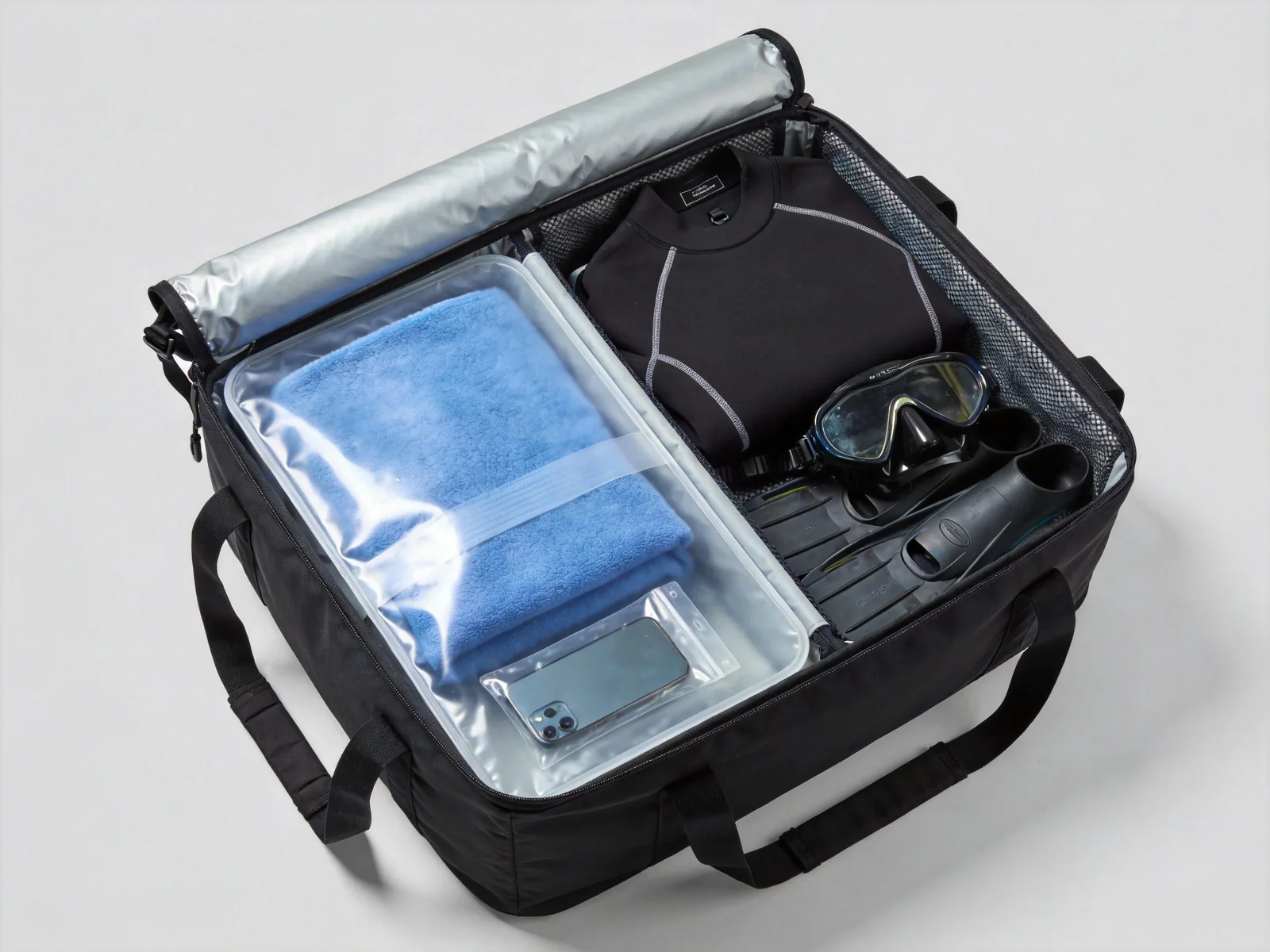
The 55 L reference build: 25 L sealed dry zone on the left with a welded liner and #10 laminated zip, 30 L drain-through wet zone on the right with a grommeted base panel. The partition is a single coated panel welded to both shell sides, so the dry zone has no needle holes on its perimeter.
The wet zone deserves its own paragraph, because it is where the cheapest mistake happens. A wet zone needs a drain path with a defined low point. On a duffel that means a grommeted or mesh base panel, not mesh side walls: side-wall mesh drains only while the bag is upright, and a bag lying in the tender keeps 1–2 cm of water in the bottom for the whole trip. Our standard wet zone uses 2 mm perforated PVC-free TPU on the base (perforation pitch 8 mm, 6% open area, sufficient to pass 4 L/min) plus two 12 mm brass-free acetal grommets at the seam low points. The acetal grommets matter: brass grommets at a wet-zone low point are the first thing to turn green, and the stain wicks into the shell.
Seam Engineering: Welded, Sewn-and-Taped, or Sewn-and-Sealed
Every waterproof claim on a dive bag dies at the seam. There are exactly three ways to join two coated panels, and they differ by a factor of four in labour and by an order of magnitude in water resistance.
Welded (RF or hot-air). The two TPU-coated faces are pressed together and the polymer is melted into one continuous film. There is no thread and no hole. Our dry zones are welded on a 12 kW radio-frequency press with a 6 mm double-weld bead, running at 0.9 m/min. Peel strength on 500D TPU is 38–46 N/25 mm (we specify 35 N/25 mm minimum, tested to ASTM D1876 T-peel), and the weld passes a 3 m pressure vessel test with no decay. Cost: USD 0.34 per linear metre including set-up and 4% scrap.
Sewn and taped. The seam is stitched, then a heat-activated tape is applied over it under pressure and temperature. It is waterproof if the tape wets out the thread line completely and the seam allowance lies flat. Our tape is 20 mm TPU film applied at 150 °C and 3 bar; the pass criterion is 8,000 mm hydrostatic on the seam and no lift after 5 wash cycles. It works well on 210D and 420D liners and poorly on 500D shell curves, where the tape bridges and lifts at the radius. Cost: USD 0.19 per metre plus USD 0.11 of tape.
Sewn and sealed. The seam is stitched and a seam-sealing compound is applied by roller or brush. This is a repair-grade solution. It holds W1 and W2 and it will not hold a 1 m immersion over time, because the compound creeps under cyclic flexing and the thread wicks. We quote it only for non-critical seams on the wet zone, where the requirement is abrasion resistance, not water tightness. Cost: USD 0.08 per metre.
| Method | Peel strength | Hydrostatic on seam | Immersion 1 m / 30 min | Cost per metre | Where we use it |
|---|---|---|---|---|---|
| RF welded, 6 mm double bead | 38–46 N/25 mm | >15,000 mm | Pass, zero ingress | USD 0.34 | All dry-zone perimeter seams, zip ends, dry-zone base |
| Sewn + TPU tape, 20 mm | Seam 260 N/50 mm (stitch) | 8,000–10,000 mm | Pass on flat panels, marginal on 500D radii | USD 0.30 | Liner-to-shell joins, internal pocket seams |
| Sewn + sealant | Seam 260 N/50 mm (stitch) | 1,500–3,000 mm | Fail | USD 0.08 | Wet-zone binding, non-critical hems |
| Sewn only (W0–W1 builds) | Seam 260 N/50 mm (stitch) | Not applicable | Fail | USD 0.05 | Wet zone, handle anchors, decorative panels |
The design rule we apply to every hybrid pattern: the dry zone has no needle holes anywhere on its perimeter. That sounds obvious and it is routinely violated, because the natural way to build a bag is to sew the whole shell and then insert a liner. A welded dry zone has to be built as a bag inside a bag: the sealed liner is completed as a closed, welded vessel with its zip, air-tested, and then attached to the shell only through non-penetrating tabs — welded tabs, or stitch lines placed outside the sealed boundary. Our pattern puts all attachment stitching at least 12 mm outside the weld bead, which is why the dry liner is quoted as a separate sub-assembly in the BOM and why it adds 0.6 m of weld per bag.
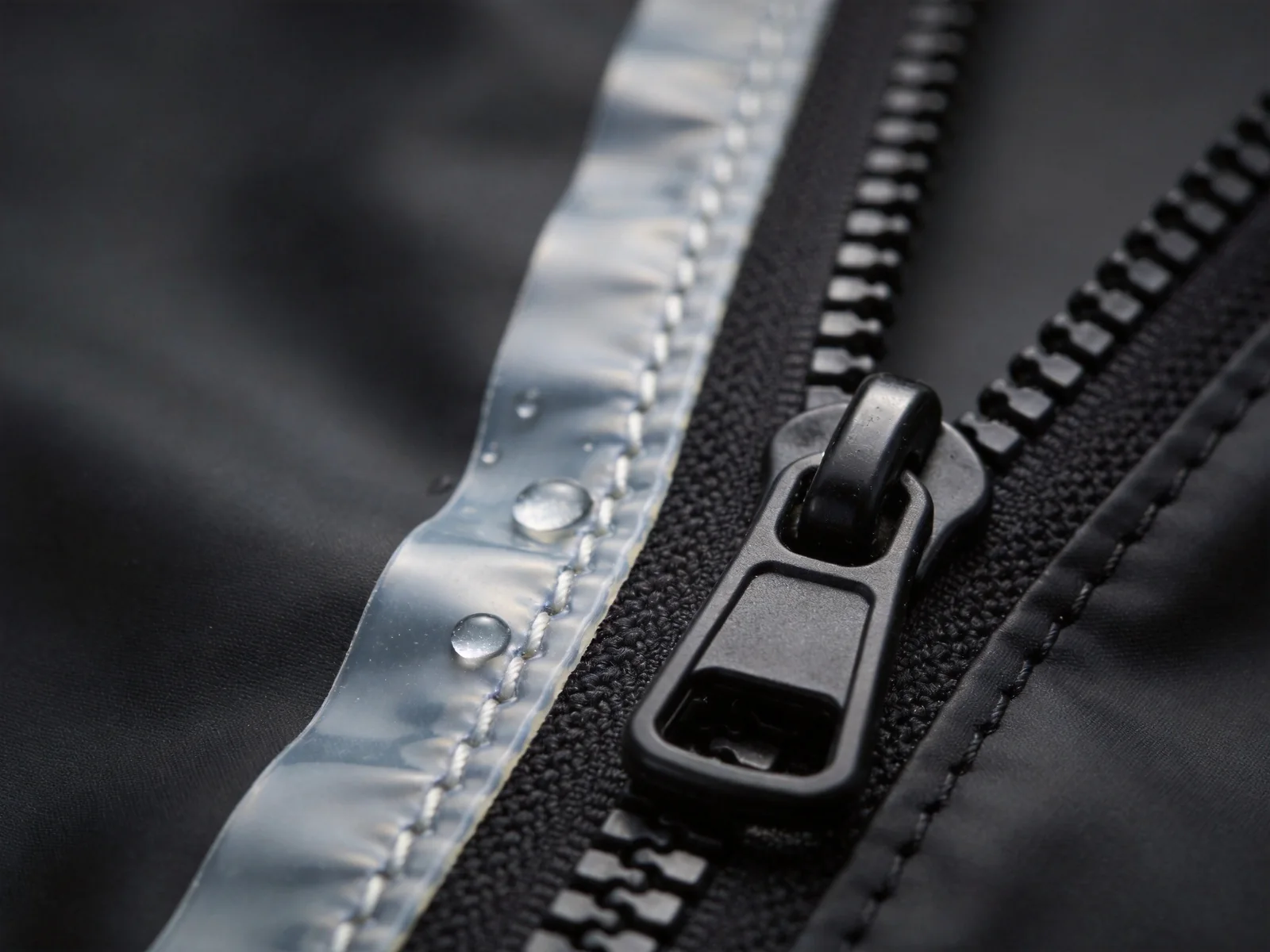
Dry-zone construction detail: the translucent 6 mm RF weld bead runs under the seam tape, and the #10 laminated zip end is welded rather than stitched — the zip end is the second most common leak point after the seam itself.
Zipper Selection: the Single Biggest Waterproofing Decision
On a W3 or W4 dive bag the zip is 13% of FOB and 100% of the water performance. There are five realistic options and only two of them belong on a dry zone.
| Option | Construction | Water performance | Cycle life | Cost, 55 L build | Verdict |
|---|---|---|---|---|---|
| Standard coil #8, storm flap | Nylon coil, PU-coated tape, sewn behind a flap | W1–W2. Splash only; fails 1 m immersion | 3,000–4,000 | USD 0.48 | Wet zone only, or a W1 value SKU |
| Laminated coil #8 | Coil zip with TPU film laminated to both tapes | W2–W3 on a flat run; marginal on curves | 4,000–5,000 | USD 0.92 | Entry dry pocket on 35 L builds |
| Laminated #10, moulded slider | Wider tooth, TPU-laminated tape, sealed slider garage | W3, passes 1 m / 30 min with a welded garage | 5,000–6,000 | USD 1.48 | Our default dry-zone zip |
| Heavy-duty waterproof zip, #10, welded ends | Extruded tooth, laminated, both ends welded into the panel | W4, passes 3 m pressure vessel with air-decay <0.02 bar/min | 6,000–8,000 | USD 2.35 | Liveaboard, photography, expedition |
| No zip: roll-top, 3 rolls + side-release | No closure hardware at all | W4, the highest of any closure | Not applicable | USD 0.31 | Best protection per dollar; worst access |
Three details decide whether the zip you specified behaves like the table says. One: the garage. A laminated zip without a sealed slider garage leaks at the parked slider — the slider body is the only rigid part and it cannot compress the tape. We weld a 45 mm TPU garage over the slider park on every W3 build. Two: the ends. Zip ends must be welded, not stitched; a stitched end puts six needle holes through the tape at the highest-stress point in the bag. Three: the bend radius. A laminated #10 zip will not turn a corner tighter than 80 mm radius without the tape buckling, and a buckled tape is a leak. If your design wants a U-shaped zip opening across the top of the bag, the pattern has to be re-drawn with a wider radius or the zip replaced by two straight runs meeting at a welded junction.
The maintenance reality is worth stating to your customer service team: a waterproof zip is a consumable. Salt crystallises in the tooth roots, the lubricant washes out, and a diver who rinses the bag but never rinses the zip open will see the slider stiffen within 20 dives. Our care label specifies fresh-water rinse with the zip open, dry fully open, and silicone lubricant on the teeth every 10 dives, and that one label line removes most zip warranty claims.
Fabric and Coating: Hydrostatic Head by Construction
All of our dive-bag shells are PVC-free, which is now a purchasing requirement rather than a preference in the EU and increasingly in North American retail. That leaves three families: TPU-laminated polyester, TPU-laminated nylon, and TPU film laminated to a non-woven or 210D ripstop. The relevant numbers are hydrostatic head, tear strength, cold-flex and weight.
| Fabric | Weight | Hydrostatic head | Tongue tear (warp) | Cold flex, −20 °C | Use |
|---|---|---|---|---|---|
| 210D ripstop nylon, 0.15 mm TPU one side | 120 g/m² | 8,000 mm | 18 N | Pass | Dry-zone liner, internal pockets |
| 420D polyester, 0.20 mm TPU both sides | 265 g/m² | 12,000 mm | 42 N | Pass | 35 L shell, value builds |
| 500D polyester, 0.25 mm TPU both sides | 330 g/m² | 15,000 mm | 68 N | Pass | 55 L and 85 L shell, our default |
| 840D polyester, 0.30 mm TPU both sides | 470 g/m² | 18,000 mm | 105 N | Pass | 120 L fleet build, abrasion-first |
| 2 mm perforated TPU, PVC-free | 310 g/m² | 10,000 mm (between holes) | 55 N | Pass | Wet-zone base panel, 6% open area |
| 6 mm polyester mesh, 1.0 mm filament | 185 g/m² | None | — | Pass | Wet-zone side panels on value builds |
Two specification notes that buyers get wrong. Double-side coating is not double the protection — the inside coat is what stops abrasion from the wetsuit and gear, and the outside coat is what stops water; a single-side coated shell with an uncoated interior will pass W3 when new and fail after 30 trips because the interior face has been abraded to the weave. And hydrostatic head is a fabric number, not a bag number: a 15,000 mm shell with a stitched zip and sewn seams is a W1 bag. We quote fabric and bag separately on every specification sheet for exactly that reason. Material trade-offs are covered in more depth on our waterproof bag material selection page, and the seam and zip engineering in isolation on engineering waterproof bag zippers and seams.
The 1,450 g Weight Budget, Assembly by Assembly
A 55 L hybrid dive bag is heavier than a mesh bag by a factor of three and lighter than a structured gear bag by a third. The weight lives in the shell, and the shell weight is set by the coating thickness you chose for the hydrostatic head you need. Our reference build is 1,450 g ±5% (72 g), measured on a calibrated scale at pre-production, and re-weighed at final inspection on five pieces per lot.
| Assembly | Specification | Weight | Share |
|---|---|---|---|
| Shell | 500D TPU both sides, 2.00 m² at 330 g/m² | 660 g | 45.5% |
| Harness and binding | 38 mm shoulder webbing, 25 mm compression, 20 mm binding, 1.9 m total | 210 g | 14.5% |
| Dry-zone liner | 210D ripstop TPU, 1.25 m² at 120 g/m² | 150 g | 10.3% |
| Zips | #10 laminated 620 mm + #8 laminated 300 mm, both with garages | 120 g | 8.3% |
| Foam | 8 mm EVA in shoulder pads and base corners | 100 g | 6.9% |
| Hardware | 6 acetal side-release buckles, 4 welded D-rings, 2 grommets, 1 haul loop | 80 g | 5.5% |
| Seam tape | 20 mm TPU, 2.2 m | 50 g | 3.4% |
| Thread and bar-tacks | Bonded nylon 40/3, 11.8 m; 62 bar-tacks | 40 g | 2.8% |
| Labels and decoration | Woven label, care label, screen print, heat-transfer logo | 40 g | 2.8% |
| Total | 1,450 g | 100.0% | |
The weight lever that matters is the shell coating. Dropping from 500D/0.25 mm TPU to 420D/0.20 mm takes 118 g out of the bag and takes the hydrostatic head from 15,000 mm to 12,000 mm — still W3, still a pass at 1 m. Dropping to 210D takes 300 g out and takes the bag to W2. Airlines are the reason brands ask: a 35 L hybrid at 1,050 g plus a 3 kg regulator set is still inside a 7 kg cabin allowance, and a 55 L at 1,450 g is not, which is why the 35 L is the model that sells into carry-on dive travel.
Load Path: 15 kg Wet, 500 N Anchors, and the Water That Hides Inside Webbing
A loaded dive bag is a 15–22 kg dead weight that gets lifted by one handle, dropped on a deck and dragged over non-slip matting. The load path is shell → weld or stitch → webbing → anchor → handle, and every transition is a stress riser. We build and test to four numbers:
- Haul handle: 250 N (25.5 kg) static, 10 s, no stitch elongation over 3 mm. The handle is a 38 mm webbing loop bar-tacked 12 times through a welded reinforcement patch, not stitched to a single layer of shell.
- Shoulder anchor: 500 N (51 kg) static, 10 s. Anchors are welded D-ring tabs, and the D-ring is 316 stainless with a 4 mm wire section. A stitched D-ring tab on a 500D shell pulls out at 280–330 N in our tests, which is below the standard.
- Base: 30 kg distributed, 24 h, no seam creep and no grommet tear-out. The base panel is a separate welded piece, not a folded continuation of the shell, because the base corner is where every duffel fails.
- Drag: 200 cycles over 80-grit equivalent surface at 8 kg load. Abrasion is the failure mode nobody tests, and the 840D fleet build exists for it.
There is a water-specific load problem that is easy to miss: webbing wicks. A 38 mm polypropylene webbing strap stitched through a dry-zone panel is a capillary path, and it will deliver a measurable trickle into a sealed compartment over a two-hour boat ride. Two rules follow. First, no webbing crosses the dry-zone weld boundary — anchors are welded to the outside of the sealed liner, or the strap terminates on the shell with a welded tab and the liner is suspended independently. Second, where a strap must penetrate (it should not), it gets a heat-sealed webbing end and a TPU patch, and the design is downgraded to W2.
Pressure, Depth and What Immersion Actually Does
Divers assume the bag goes to 30 m. It does not, and the honest engineering position is worth putting in the sales conversation, because it prevents the return.
At 1 m the absolute pressure is 1.1 bar (16 psi); at 10 m it is 2.0 bar (29 psi); at 30 m it is 4.0 bar (58 psi); at 40 m it is 5.0 bar (72.5 psi). A closed bag with 3 L of trapped air taken to 30 m is compressed to 0.75 L — the shell is not loaded, it is sucked inward, and the differential pressure across the dry-zone wall is roughly 3 bar, or 30 tonnes per square metre in the abstract. No coated fabric bag survives that, and none needs to: nobody takes a 55 L duffel to 30 m. The realistic exposure profile is:
| Real-world exposure | Depth / head | Duration | Tier required | Failure mode if under-specified |
|---|---|---|---|---|
| Spray on a moving boat | <0.2 m | Hours | W1 | Damp interior, mould smell |
| Rain during a jetty walk | 0.5 m head | 30 min | W2 | Water at the zip flap |
| Wave over the gunwale, bag sitting in 10 cm of water | 0.1 m, continuous | 2–4 h | W3 | Wicking through webbing and seam ends |
| Bag floating beside a diver for a safety stop | 0.3–0.5 m | 20–40 min | W3 | Zip slider leak without a garage |
| Deck wash-down at hose pressure | 0.5–1.0 bar jet | 2 min | W3–W4 | Seam tape lift at the radius |
| Deliberate dunking / sink entry with the bag | 1–3 m | 30 min | W4 | Air-decay failure at zip ends |
The design consequence is that a dive bag should be vented rather than pressure-rated. Every W3 and W4 dry zone we build gets a one-way vent: a 25 mm TPU vent with a silicone membrane, welded into the liner top, allowing air out at 0.05 bar and blocking water ingress to 1 m. It costs USD 0.42 and it solves the two problems that generate most complaints — a bag that inflates like a pillow when the diver rolls it shut at sea level and then drives up a mountain, and a zip that cannot be closed because the liner is pressurised. The IPX discussion in isolation is covered on our IPX guide; the deep-dive seam work in our factory capability notes on Quanzhou waterproof bag manufacturing.
Hardware, Salt and the 96-Hour Salt Spray
Salt is the reason dive-bag hardware is a different specification from travel-bag hardware. Three rules, no exceptions in our dive range: no nickel-plated steel, no brass at a wet-zone low point, and no zinc-alloy sliders. What we use instead:
| Component | Material | Test | Result | Cost vs plated steel |
|---|---|---|---|---|
| Side-release buckles (6) | Acetal POM, moulded | 500 N pull, 5,000 cycles, 96 h salt spray | No cracking, no corrosion | +USD 0.06 each |
| D-rings (4) | 316 stainless, 4 mm wire | 500 N static, ASTM B117 96 h | No red rust; light tea staining acceptable | +USD 0.09 each |
| Zip sliders | Moulded acetal on laminated #10 | 5,000 cycles in 3% salt solution | Pull force under 25 N throughout | included |
| Grommets (2) | Acetal, 12 mm | 96 h salt spray, 200 N pull | No staining, no tear-out | +USD 0.04 each |
| Adjusters and cord locks | Acetal + polyester cord | 96 h salt spray | No corrosion; cord does not stiffen | +USD 0.03 each |
The cost of doing hardware properly on a 55 L build is USD 1.10 total, 6% of FOB. The cost of doing it with plated steel is USD 0.42, and the failure is visible to the customer in three weeks: a rust bloom at the D-ring that stains the shell, which is a cosmetic defect that cannot be repaired and therefore a full refund rather than a spare part. There is no version of this trade-off worth taking on a salt-water product.
Bill of Materials at USD 18.40 FOB
The reference build is the 55 L WD-55 in black, one colourway, 500 pieces, FOB Quanzhou. Percentages are of FOB; amounts are per piece and reconcile exactly to the total.
| Line | Specification | Share | Amount |
|---|---|---|---|
| Shell fabric | 500D polyester, 0.25 mm TPU both sides, 2.00 m² | 17% | USD 3.13 |
| Waterproof zips | #10 laminated 620 mm + #8 laminated 300 mm, garages, welded ends | 13% | USD 2.39 |
| Webbing, binding, harness | 38 mm and 25 mm PP webbing, 20 mm binding, 1.9 m | 9% | USD 1.66 |
| Dry-zone liner | 210D ripstop nylon, 0.15 mm TPU, 1.25 m² | 8% | USD 1.47 |
| Overheads and packing | Factory overhead, poly bag, hangtag, carton share | 8% | USD 1.47 |
| Hardware | Acetal buckles, 316 SS D-rings, grommets, vent | 6% | USD 1.10 |
| Factory margin | 6% net | 6% | USD 1.10 |
| Foam and padding | 8 mm EVA, shoulder pads and base corners | 5% | USD 0.92 |
| Seam tape and welding consumables | 20 mm TPU tape 2.2 m, RF set-up and scrap | 4% | USD 0.74 |
| Labour | Cut, sew 11.8 m, RF weld 3.6 m, tape, seal, 100% air test, pack | 24% | USD 4.42 |
| Total FOB | 100% | USD 18.40 | |
The labour line is the one to interrogate with any supplier, including us. USD 4.42 covers 3.6 m of RF weld, 2.2 m of taping, 11.8 m of stitching, 62 bar-tacks, and a 100% air-decay test on every dry zone — not a sample, every piece, because a leaking dry zone discovered at retail costs more than the test. A quote that lands at USD 12.50 for the same specification has removed the air test, the garage, the welded zip ends, or all three. The way to compare two quotes honestly is to ask for the seam schedule: metres welded, metres taped, metres stitched, and whether the air test is 100% or AQL sampled.
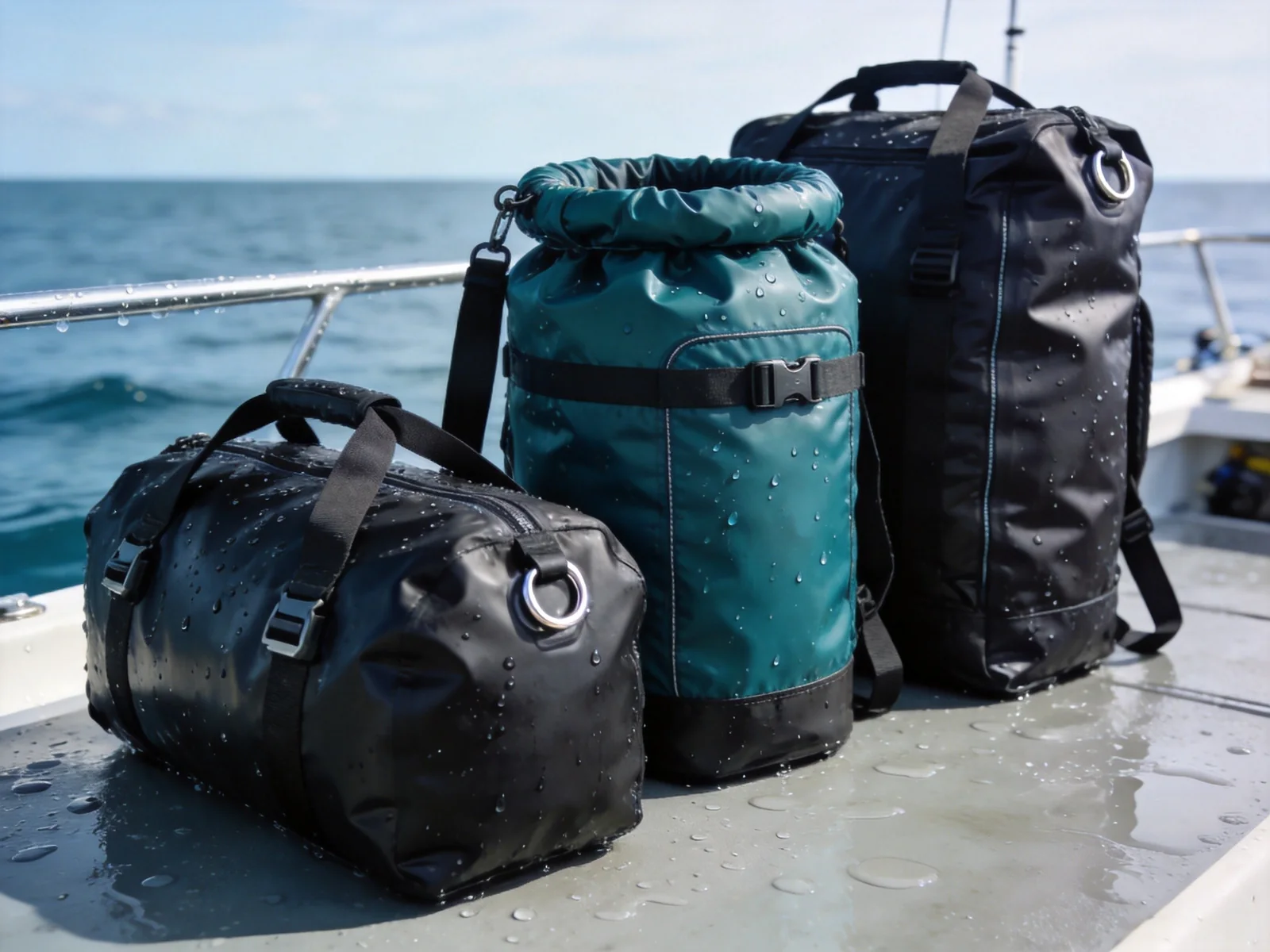
The three core volumes of the range — 35 L, 55 L and 85 L — in 500D TPU. All three share one pattern family, so a brand can launch with the 55 L and add volumes without a second tooling round.
Price Ladder, Tooling and Amortisation
Volume discount on this product is modest, because the cost is dominated by purchased components and direct labour rather than by fabric cutting efficiency. Our published ladder for the WD-55, unchanged specification:
| Order quantity | Unit FOB | Discount | Tooling per piece | Effective first-order unit cost |
|---|---|---|---|---|
| 500 pcs | USD 18.40 | — | USD 5.32 | USD 23.72 |
| 1,000 pcs | USD 17.30 | 6.0% | USD 2.66 | USD 19.96 |
| 2,000 pcs | USD 16.56 | 10.0% | USD 1.33 | USD 17.89 |
| 5,000 pcs | USD 15.64 | 15.0% | USD 0.53 | USD 16.17 |
Tooling is USD 2,660 for a new pattern and it is quoted as a one-time charge, not buried in the unit price: RF welding die for the dry-zone panel USD 1,450, zip-end sealing tooling USD 380, heat-transfer logo plate USD 220, pattern grading and CAD USD 350, immersion and air-pressure test fixtures USD 260. Two of those lines surprise first-time buyers. The RF die is the expensive one because the dry-zone panel is a closed shape and the die has to be machined to the weld bead path, not the panel outline; a new dry-zone geometry means a new die. The test fixtures are charged because we build a dedicated immersion rig and air-decay adaptor for each dry-zone port geometry, and they stay with the programme so that reorders are tested to the same standard.
Colourways do not re-tool. A new colour in the same pattern is a fabric order with a minimum of 300 m per colour, which is roughly 150 bags of 55 L shell — so a 500-piece order can carry three colours comfortably, and a 500-piece order with six colours means either stock fabric or a surcharge. Custom-dyed fabric adds 10–15 days to the lead time and is the single most common reason a first order ships late.
Sampling in 6–10 Working Days
Sampling is quoted at 6–10 working days from a locked specification, and the clock starts when three things exist: the technical drawing signed off, the fabric and zip nominated from stock or approved as a substitute, and the artwork in a vector file with a defined print area. Samples are charged and the charge is credited against the first bulk order at 500 pieces. The four stages:
- Days 1–2: pattern and BOM lock. We grade the pattern from the volume and dry/wet ratio, then issue the seam schedule — metres welded, taped, stitched — and the BOM with each line priced. This is the document that prevents the classic argument six weeks later about whether the dry zone was supposed to be welded.
- Days 3–5: first article. One piece cut and built by the sample room, including the welded dry liner, the zip garages and the vent. Photographed at eight angles and weighed on a calibrated scale against the 1,450 g budget.
- Days 6–8: water test. The sample dry zone goes through the full protocol: hydrostatic head on a fabric swatch and on a seam, 1 m immersion for 30 minutes with a paper towel load, and an air-decay test at 0.20 bar. We send the numbers, not a claim. If it fails, the cause is named — seam, zip end, slider garage or needle path.
- Days 9–10: revision and courier. One revision round is included. The second revision, if the brief changes rather than the workmanship, is charged at cost. Courier is at your account or ours, DHL or FedEx, 3–5 days to the US or EU.
What slows sampling down, in our experience, is not the factory. It is the zip: a laminated #10 with a moulded slider and a garage is a purchased component with a 15–25 day lead time if it is not in stock, and brands routinely specify a zip we do not hold. If your launch date is fixed, nominate the zip first and let everything else follow. A sample built with a substitute zip is not a sample of your product.
Bulk Production in 35–50 Days
Bulk runs 35–50 days after sample approval and deposit, and the variance is almost entirely materials, not capacity. The eight-stage calendar for the WD-55 at 1,000 pieces:
| Stage | Days | What happens | What can go wrong |
|---|---|---|---|
| 1. Deposit and material release | 0–3 | PO confirmed, fabric and zips released to the mill and the zip supplier | Zip not nominated — adds 15–25 days |
| 2. Fabric and zip in-house | 3–12 | 500D TPU and 210D liner arrive, inspected for hydrostatic head and shade | Custom dye lot — adds 10–15 days |
| 3. Cutting | 12–16 | 2.00 m² shell and 1.25 m² liner per bag, nested at 84% utilisation | Shade variation across rolls if not single-lot |
| 4. Dry-zone sub-assembly | 16–24 | Welded liner built as a closed vessel, zip welded in, vent welded, 100% air test | RF die set-up error — caught at air test, not at retail |
| 5. Shell and wet zone | 18–28 | Shell seams, grommeted base, mesh or perforated panel, binding | Grommet placement off the low point |
| 6. Assembly and harness | 28–38 | Liner suspended in shell, straps, anchors, bar-tacks, labels | Stitch line crossing the weld boundary |
| 7. Final inspection | 38–44 | AQL 2.5 major / 4.0 minor, plus water re-test on 5 pieces per lot | Cosmetic rejects on 316 SS staining |
| 8. Packing and handover | 44–50 | Flat pack 10 per carton, or retail single-box, carton marking, loading | Retail packaging artwork approval |
Two scheduling facts worth planning around. Chinese New Year removes 3–4 weeks of effective capacity around the holiday and 2 weeks either side for migrant labour travel; a programme that must land in March has to be cut in November. Golden Week in the first week of October costs 5–7 working days. Both are on our planning calendar and both are the reason a 35-day promise becomes a 55-day reality for a supplier who did not plan for them.
Twelve Tests and Five Inspection Gates
Every dive-bag programme carries the same twelve tests. Ten are laboratory, two are 100% on-line, and the split is deliberate: the two that catch the failures a customer will actually experience are done on every piece.
| # | Test | Method | Pass criterion | Frequency |
|---|---|---|---|---|
| 1 | Hydrostatic head, fabric | ISO 811, rising column | ≥15,000 mm on 500D shell | Per fabric lot |
| 2 | Hydrostatic head, seam | ISO 811 on a welded seam sample | ≥15,000 mm, no leak at the bead | Per lot, 5 samples |
| 3 | Immersion | 1 m, 30 min, paper-towel load in dry zone | Zero ingress | 5 pcs per lot |
| 4 | Air decay | 0.20 bar into sealed dry zone, hold 60 s | No drop; <0.02 bar/min decay on W4 | 100% of pieces |
| 5 | Zip cycle | 5,000 open/close in 3% salt solution | Pull force <25 N throughout, no tooth skip | 3 samples per lot |
| 6 | Salt spray | ASTM B117, 96 h, hardware and zip | No red rust; light tea staining allowed | Per hardware lot |
| 7 | UV ageing | ASTM G154, 200 h, cycle 1 | ≥80% tensile retention, no chalking | Per fabric lot |
| 8 | Peel strength, weld | ASTM D1876 T-peel | ≥35 N/25 mm | 5 samples per lot |
| 9 | Handle and anchor static | 250 N handle, 500 N anchor, 10 s | No elongation >3 mm, no pull-out | 3 pcs per lot |
| 10 | Base load | 30 kg distributed, 24 h | No seam creep, no grommet tear-out | 2 pcs per lot |
| 11 | Drop | ISTA 1A, 10 drops from 760 mm, loaded 12 kg | No functional failure | Per shipment, carton level |
| 12 | Weight and dimension | Calibrated scale and tape | 1,450 g ±5%, dimensions ±5 mm | 5 pcs per lot |
The five inspection gates are incoming material, cutting, dry-zone sub-assembly, final assembly and pre-shipment. The dry-zone gate is the one that earns its keep: it is a 100% air-decay test on a completed welded liner before it is ever attached to a shell, so a bad weld is caught as a USD 1.47 liner rather than as a USD 18.40 finished bag or a retail return. Defect classification is standard: critical (any dry-zone leak, any sharp edge, any hardware corrosion) is zero tolerance and fails the lot; major and minor follow AQL 2.5 / 4.0. Our inspection report lists the air-test count, the immersion results and the number of pieces reworked, and it is issued with the shipping documents rather than on request.
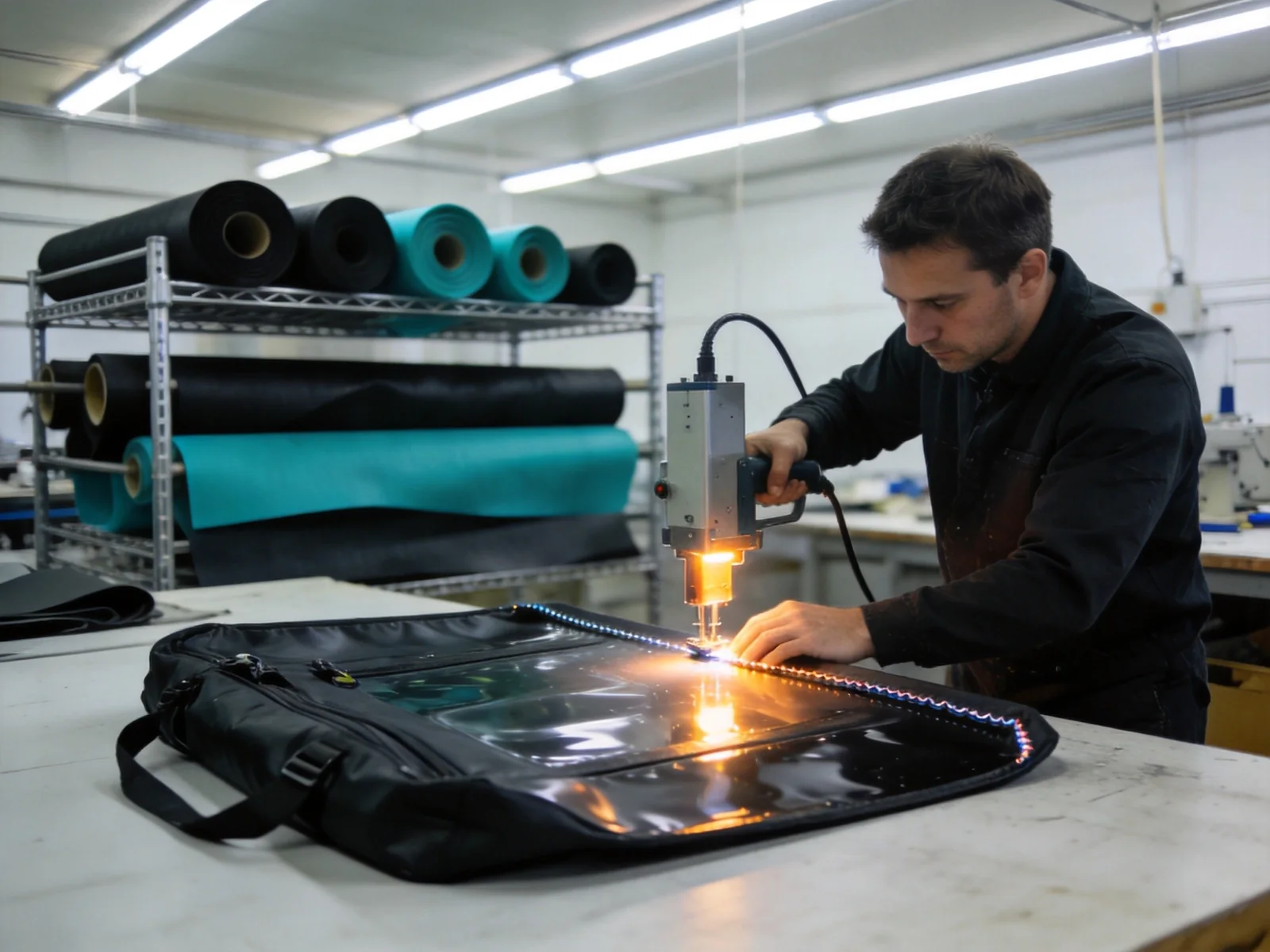
Dry-zone sub-assembly: the welded liner is built as a closed vessel on the RF press, zip and vent welded in, then air-tested before it meets a shell. This is a separate line from the sewing room, which is why the labour line in the BOM is 24%.
Packing, Cubic and Landed Cost
Two packing modes, and the choice changes the freight by 33% per piece. Flat-packed is the default for brands that hold inventory and ship to a warehouse; retail single-box is for marketplace sellers and for accounts that will not accept a poly-bagged bag.
| Mode | Carton | CBM per piece | Pieces per 40HQ | Ocean freight per piece at USD 2,600 | Landed cost, no duty |
|---|---|---|---|---|---|
| Flat pack, 10 per carton | 60 × 36 × 8.4 cm, 0.1814 CBM | 0.0181 | 3,740 | USD 0.70 | USD 19.38 |
| Retail single box, 6 per carton | 62 × 38 × 10.3 cm, 0.1456 CBM | 0.0243 | 2,802 | USD 0.93 | USD 19.61 |
Landed cost above is FOB plus ocean freight plus 1.5% for insurance and inland haulage, and it excludes duty deliberately, because duty on bags is a moving number and quoting it into a 2027 plan is how margin gets lost. At the time of writing the MFN rate plus Section 301 measures applies to Chinese-origin bags into the US, and the exclusion window that many importers were relying on closed on 9 November 2026 — so any landed-cost model built before that date should be rebuilt rather than reused. Our guidance on the origin and duty mechanics is on FOB vs EXW vs DDP for bag imports and in the sourcing walkthrough on how to source waterproof bags from China. We quote FOB as standard, EXW on request, and DDP only through a forwarder you nominate — we will not put our own name on a DDP number we do not control.
Six Channels and How the Specification Changes
The same 55 L bag is a different product in each channel, and the differences are all in the details that cost under USD 1.
- Dive specialty retail. W3, 500D, laminated #10 with garage, 316 SS D-rings, woven label plus a care label that names the zip rinse routine. Retail single-box, hangtag with the tier claim printed as a number. This is the reference build.
- Liveaboard and resort B2B. W4, welded zip ends, roll-top sleeve option, high-visibility interior lining so a divemaster can see a lost mask at the bottom, and a name-tag window. Add USD 1.85 for the lining and USD 0.42 for the window.
- Rental fleet. 840D shell, 120 L, no dry zone at all in most cases (the fleet wants drain-through and abrasion resistance), stencilled fleet number, replaceable shoulder strap. Cheaper per litre than the retail build and 40% heavier.
- DTC e-commerce. 35 L carry-on size, 1,050 g, W3, flat pack for the 3PL, and packaging that survives a parcel network — a poly bag is not enough; add a USD 0.55 mailer box.
- Marketplace (Amazon and regional equivalents). Same product, different compliance load: barcode labelling per unit, poly bag suffocation warning, and a tier claim in the bullet points that matches the test report. Buyers on marketplaces test claims with returns, not with lab equipment.
- Corporate and promotional. W2 is enough, 420D shell, single colour, screen print, 35 L, and the price target is usually USD 11–13 FOB — which is achievable only by dropping the laminated zip. Be explicit that this is a W2 bag when it is quoted.
Private Label, Decoration, ECN and Reorders
Decoration on a coated shell is a technical problem, not a branding one. Five methods, ranked by durability on 500D TPU:
| Method | Durability | Minimum | Cost per piece | Notes |
|---|---|---|---|---|
| Heat-transfer TPU logo | Excellent; bonds to the coating | 500 | USD 0.38 | Default. Plate charge USD 220 |
| Welded TPU patch | Excellent; becomes part of the shell | 500 | USD 0.62 | Best on the dry zone; no needle holes |
| Woven label, stitched | Good, but every stitch is a hole | 500 | USD 0.21 | Place on the wet zone or outside the weld boundary |
| Screen print, water-based | Fair on TPU, poor on flex points | 1,000 | USD 0.19 | Avoid across the zip and the base radius |
| Silicone or TPU moulded badge | Excellent | 2,000 | USD 0.95 | Highest perceived value; tooling USD 480 |
Note what is missing: PVC patches. We do not run them on dive bags, because a PVC-free shell with a PVC badge is a contradiction that a European buyer will find in the material declaration. Use a TPU or silicone badge instead, at a similar price.
Engineering change control is the part of a repeat programme that quietly costs brands money. Our rule: any change to pattern, zip, fabric or hardware requires a 45-day notice before the next production slot, because the RF die, the seam schedule and the air-test fixture are all tied to the geometry. A colour change is 25 days. A logo change is 15 days if the plate exists. Reorders on an unchanged specification run in 25–30 days, faster than the first order, because materials are known and the die is set. We hold 1% spare parts — buckles, sliders, grommets, D-rings — with every shipment, which is the cheapest warranty programme available: a USD 0.09 D-ring posted to a customer saves a USD 19 refund.
Compliance Boundaries — What We Do and What We Do Not
We supply manufacturing and material documentation. We are not a notified body, an authorised representative, or a compliance consultancy, and a purchase order does not transfer regulatory responsibility to the factory. What we provide, on request and per shipment: fabric composition and TPU grade, a REACH SVHC declaration against the current candidate list for the materials we buy, a California Proposition 65 statement limited to the substances we can test for, azo dye and formaldehyde test reports for textiles, and the phthalate statement that a PVC-free claim requires. What we do not provide: CE marking, an EU authorised representative under GPSR, UKCA, or a certification that the finished bag meets a standard we have not tested it to.
Three practical notes for buyers. First, “PVC-free” needs a paper trail — the claim is easy to make and easy to break with a badge, a binding tape or a printed hangtag, so specify the whole bag and not just the shell. Second, fluorine-free water repellency is now a purchasing question in parts of the EU; our TPU film constructions do not rely on a PFAS-based DWR because the film is the barrier, but if your specification includes a DWR finish on a woven face, ask for the C6/PFAS-free statement in writing. Third, packaging is inside the compliance perimeter: poly bags need the suffocation warning, and several markets now require recycled content or specific labelling on the carton.
Twelve Questions to Ask Any Supplier — Including Us
These are the questions that separate a factory that builds waterproof dive bags from one that builds duffels with a waterproof description. Ask all twelve and ask for the numbers in writing.
- What is the hydrostatic head on the shell, and on a welded seam sample? Two numbers. A supplier who gives one number has not tested the seam.
- Is the dry-zone liner a closed welded vessel, or a sewn liner taped afterwards? The second cannot pass a 1 m immersion.
- Do you air-test 100% of dry zones, or sample them? 100% is the only answer that protects a retail launch.
- Which zip exactly — brand, tooth size, lamination, and is the slider garage welded? “Waterproof zip” is not a specification.
- Are the zip ends welded or stitched? Stitched ends are six needle holes at the highest-stress point.
- Does any webbing cross the dry-zone weld boundary? If yes, the bag wicks and the tier claim is wrong.
- What is the empty weight, measured, and what is the tolerance? Ours is 1,450 g ±5% on the 55 L.
- What hardware alloy, and will you show a 96-hour salt spray result? 316 stainless and acetal, or the answer is no.
- How does the wet zone drain, and where is the low point? Base perforation plus grommets; side-wall mesh alone puddles.
- Can I see the seam schedule — metres welded, taped, stitched? It is the fastest way to compare two quotes that differ by USD 6.
- What is your RF welding capacity and who runs the press? A dive-bag programme with no RF line sub-contracts the dry zone, and then nobody owns the leak.
- What happens when a piece fails the air test? Rework with a new liner, or a patch? We scrap the liner and rebuild, and the scrap rate is in our quote.
We answer all twelve on a specification sheet before a sample is cut, and we put the numbers in the inspection report rather than in an email. If a supplier will not commit the numbers to paper, the numbers are marketing.
Frequently Asked Questions
Send the Specification, Get the Numbers
Tell us the volume, the tier you need (W1–W4), the dry/wet split and the channel you sell into. We will come back with a seam schedule, a priced BOM at 500, 1,000 and 2,000 pieces, the tooling list, and a sample slot — typically inside one working day. MOQ 500 pieces, samples in 6–10 working days, bulk in 35–50 days, AQL 2.5 major / 4.0 minor, and a 100% air test on every dry zone.
Related Pages on This Site
- Custom mesh dive bag manufacturer — mesh aperture and drain specification
- Custom scuba gear bag manufacturer — structured dive kit carriers
- Custom dive backpack manufacturer — scuba and freediving backpacks
- Custom freediving bag manufacturer — long-fin and freedive formats
- Custom long fin bag manufacturer — freediving and spearfishing OEM
- Custom dry bag manufacturer — sealed roll-top sacks, IPX7 seams
- Custom waterproof bag manufacturer — roll-top and dry bag OEM
- Quanzhou waterproof bag manufacturer — IPX8 and seam-sealing capability
- TPU vs PVC vs nylon — waterproof bag material selection
- Engineering waterproof bag zippers and seams
- Complete guide to dry bag manufacturing for brands
- Waterproof backpack manufacturing and IPX guide 2026
- Custom equipment bag manufacturer — OEM/ODM sports gear bags
- How to source waterproof bags from China
- FOB vs EXW vs DDP — bag import terms explained