
Complete Guide to Dry Bag Manufacturing for Brands
Target keywords: dry bag manufacturer · custom dry bag OEM · dry bag factory
Quick Answer — Is a dry bag manufacturer worth it for your brand?
Yes, if you sell outdoor, water-sports, marine, fishing, or travel gear in any volume. A dedicated dry bag manufacturer with in-house welding and sealed-seam capability delivers waterproof performance that generic bag factories cannot match — and at MOQ 500 pcs, custom dry bag OEM is realistic for growing brands. For soft-goods brands launching their first waterproof line, commissioning a custom dry bag manufacturer is the fastest, lowest-risk path to an IPX7–IPX8 certified product without paying a license or building your own plant.
TL;DR / What This Guide Covers
If you are a product manager, brand owner, or sourcing buyer considering a custom dry bag program, this is your end-to-end playbook. We explain what a dry bag actually is, how dry bags are manufactured, which materials and closure systems to choose, what a custom dry bag OEM factory should be able to prove, how much you should expect to pay, and how to audit a dry bag manufacturer before you commit a production order. The guide closes with a decision checklist, a pricing framework, and eight frequently asked questions.
What Is a Dry Bag, and Why Does “Waterproof” Matter?
A dry bag is a roll-top, fully submersible storage bag that keeps its contents dry even when submerged or dunked underwater. Unlike a water-resistant backpack, a dry bag is engineered to be genuinely waterproof: the closure is a triple-fold or multi-fold roll-top seal, and the seams are welded or heat-sealed rather than simply sewn. Because air is trapped inside when the top is rolled and clipped, the bag can also float.
For brands, the technical distinction is decisive. In the bag manufacturing industry, “waterproof” versus “water-resistant” is not a marketing difference — it is a measurable engineering standard. According to the IEC 60529 ingress-protection scale, a genuinely waterproof dry bag should target IPX7 (submersible to 1 meter for 30 minutes) or IPX8 (continuous submersion beyond IPX7). Fabric alone cannot deliver this; the entire system — fabric, seam construction, closure, and zippers — must be sealed. A competent dry bag manufacturer optimizes every one of these variables, which is why category-specialist factories significantly outperform generalist bag sewers on waterproof reliability.
The Manufacturing Process: How a Custom Dry Bag Is Made
A reputed dry bag factory runs a repeatable, quality-controlled process. The production sequence below is what you should expect from a professional custom dry bag OEM:
- Material specification and cutting. Waterproof fabrics (TPU, PVC, or coated nylon) arrive in rolls and are cut to pattern with a die cutter. Material grain orientation and seam allowances are controlled so panels fit tightly.
- Layer assembly and layering. Panels are aligned, often with an inner TPU or PVC film layer that becomes the sealing liner. Multi-layer construction is where weight, stiffness, and waterproof grade are set.
- Welding and seam sealing — the core step. Rather than relying on thread that leaves needle holes, the factory welds seams using heat-sealing or high-frequency (RF/ultrasonic) welding. The seam tape is thermally bonded so there are no pinholes. This is the single most important differentiator between a genuine dry bag manufacturer and a bag factory that only claims to be waterproof.
- Closure and hardware installation. The roll-top closure is formed at the open end, and any waterproof zippers (for example YKK AquaGuard or TPU-coated coil zippers) are welded or taped in. Lashing points, D-rings, and valve ports are added where specified.
- Air-pressure and leak testing. Welded dry bags are typically pressurized or immersed to verify the seal. A serious dry bag manufacturer runs air-leak and immersion tests on a sampling rate before shipment.
- Finishing, inspection, and pack out. Straps, buckles, and labels are attached, an AQL inspection is performed, and units are packed for bulk export.
The practical takeaway: when you vet a dry bag manufacturer, you are really vetting their welding capability, seam-sealing equipment, and leak-testing discipline — not just their stitching line.
Material Selection: TPU vs. PVC vs. Nylon for Dry Bags
The material you choose drives cost, weight, durability, and the market position of your product. Here is how a dry bag factory would guide a product manager through the trade-off:
| Material | Waterproof Grade | Weight | Cost Tier | Best Fit | Eco Option |
|---|---|---|---|---|---|
| TPU | IPX7–8 | Lightweight | Premium | Outdoor gear, brand flagships, cold-weather use | Bio-based TPU available |
| PVC / Vinyl Tarpaulin | IPX6–7 | Heavy-duty | Budget | Marine, fishing, industrial, budget dry bags | — |
| Coated Nylon (600D–1680D) | Waterproof with coating | Medium | Mid | Commuter, travel, value dry bags | Recycled rPET available |
TPU is the premium choice: lightweight, flexible in cold temperatures, and fully recyclable in bio-based form. It is the default for brands that want an upmarket feel and long-term durability. PVC, the historical workhorse of the dry bag market, is heavier but very cost-effective and extremely tough for marine and fishing applications. Coated nylon offers a middle ground — lower cost than TPU, lighter than PVC — but its waterproof rating depends heavily on coating quality and seam sealing, so it is best matched with a rigorous welding process.
Your dry bag manufacturer should supply a material sample kit and honest guidance on which substrate hits your target IPX rating and price point, rather than pushing one material for margin alone.
What a Properly Manufactured Dry Bag Looks Like
The images below illustrate the production reality behind a trustworthy dry bag manufacturer: rugged welded construction, clean sealed seams, and real wet-condition testing rather than marketing renders.
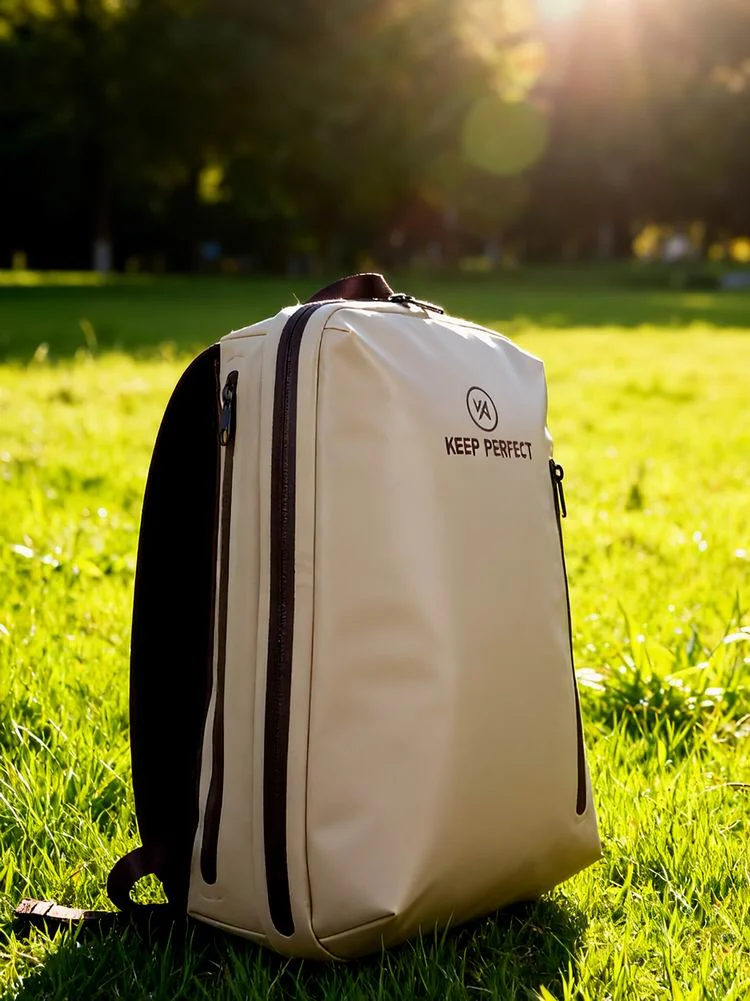
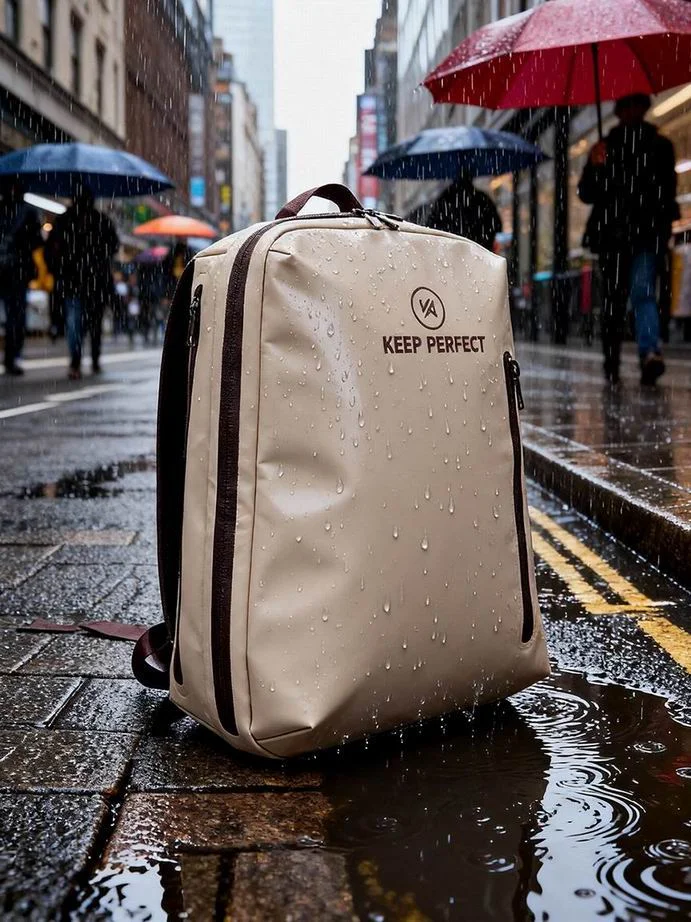


These are the visual cues of a genuine waterproof line: welded seams with no stitching pinholes, sealed zipper access, and a lab that literally submerges bags to prove the IPX rating. When you compare supplier samples, look for these details rather than relying on the product photos alone.
Design & Customization Options from a Dry Bag OEM
A flexible dry bag manufacturer supports the full range of brand customization that outdoor and water-sports labels expect:
- Colors and materials — TPU, PVC, coated nylon, or hybrid builds to hit your target weight and price.
- Sizes and capacities — from small 5L pouches to 40L+ expedition dry bags and roll-top backpacks.
- Closures and hardware — roll-top, dry-zipper access, air-release valves, D-rings, lashing points, and buoyancy options.
- Branding — screen printing, heat transfer, embroidery, custom labels, hang tags, and retail packaging.
- Compliance and eco options — bio-based TPU, recycled rPET, and PFAS-free coatings for demanding EU and North American retail accounts.
Set your specification early. A clear brief on capacity, closure system, material family, and target retail price lets the factory recommend the most cost-effective path to your IPX target before you spend on sampling.
Key Design Decisions Your Custom Dry Bag OEM Must Get Right
Beyond materials, three design systems determine whether your dry bag truly keeps water out:
- Roll-top closure geometry. The number of folds, the stiffness of the stiffener, and the buckle/clip type dictate how watertight and how easy the seal is to operate. A triple-fold seal is the minimum for IPX7.
- Weld quality and seam width. Seam width and weld temperature directly control pinhole risk. Ask a dry bag manufacturer for their weld-quality process documentation and their IPX test results.
- Zipper and valve selection. If your bag carries a waterproof zipper or an air-release valve, the component grade (for example YKK AquaGuard) and the sealing method around it matter as much as the fabric.
Your factory should be able to document all three with test evidence, not just promises.
Cost, MOQ, and Lead Time: Setting Realistic Expectations
Pricing for custom dry bag OEM is driven by material grade, size, closure complexity, and order volume. Ask any serious dry bag manufacturer for a landed-cost breakdown that separates unit price, tooling, and freight — and confirm the numbers rather than assuming them. Tariff rates should always be confirmed against the latest customs schedule and verified by your freight broker; do not rely on a factory quote for duties.
At JUNYUAN BAGS, our standard starting point for custom dry bag programs is:
| Parameter | JUNYUAN Standard |
|---|---|
| MOQ | 500 pcs |
| Sample Lead Time | 7–10 days |
| Monthly Production Capacity | 200,000 pcs |
| Brands Served | many |
| Countries Served | many export markets |
| Certifications | BSCI-audited, ISO 9001-audited, market-specific material test documentation on request |
We have produced dry bags, roll-top backpacks, floating fishing backpacks, and waterproof duffels for brands across North America, Europe, and Asia. Because dry bags are core to our waterproof program, our welding and testing lines are built around this product category.
“Worth It” Analysis: Should You Build a Custom Dry Bag?
For most brands, the answer is yes — but with two conditions. First, your sales channel needs enough projected volume to amortize tooling and reach the dry bag manufacturer’s MOQ of around 500 pcs; small boutique launches can start with a stock-design or semi-custom program instead. Second, you should only work with a factory that can prove waterproof capability through IPX testing and welded-seam process documentation.
Alternatives to full custom dry bag OEM include: stock dry bags with your label applied (fastest, lowest MOQ), semi-custom (choose from proven patterns, add your colors and logo), and full custom (your own pattern, materials, and closing system). Each is appropriate at a different stage of your product roadmap. If a supplier tries to sell you true IPX7 waterproofing without welding equipment or any leak-test step, treat that as a red flag. To see the full range of products a waterproof specialist can produce — from dry bags and roll-top backpacks to tote and duffel programs — review our custom waterproof bag manufacturing overview.
How to Audit a Dry Bag Manufacturer Before You Commit
Use this checklist when evaluating a dry bag factory as your production partner:
- Ask for IPX test reports on the exact bag style you want — not a generic claim.
- Verify welded or heat-sealed seams are part of the standard build, with pinhole controls.
- Request a physical sample and test it yourself — submerge it, roll and unroll the closure repeatedly, and inspect the welds.
- Confirm compliance documentation: BSCI, ISO 9001, and CA PROP 65 where your market requires them.
- Clarify MOQ and sample lead time in writing (a figure such as MOQ 500 pcs and 7–10 day samples is typical of a committed waterproof specialist).
- Confirm your customs duties with a broker against the latest tariff schedule before placing a bulk order.
- Run a small trial order before your flagship program.
Frequently Asked Questions
Q1. What MOQ do custom dry bag manufacturers require?
Most set a starting order of around 500 pcs per style. At this level you can specify colors, logo, material, and closure options while keeping tooling affordable.
Q2. How long do samples take from a dry bag manufacturer?
Plan for 7–10 days of sample lead time, depending on material availability and whether you need printed logos or custom hardware.
Q3. Are dry bags actually 100% waterproof?
A genuinely waterproof roll-top dry bag is engineered for submersion and rated IPX7–IPX8. It is not the same as “water-resistant” — the difference is welded seams and a sealed closure, not fabric alone.
Q4. What is the best material for a dry bag — TPU, PVC, or nylon?
TPU for premium, lightweight performance; PVC for tough marine value; coated nylon for a cost-conscious middle ground. The right answer depends on your price point and target IPX rating.
Q5. Can a dry bag manufacturer do custom logos and branding?
Yes. Screen printing, heat-transfer, and embroidery are common, and you can customize colors, hardware, and tags as part of a custom dry bag OEM program.
Q6. Do I need a mold or tooling fee?
Full-custom patterns may carry a one-time tooling cost, but many semi-custom programs reduce or remove it. Confirm the fee structure with your factory before production.
Q7. How do I verify a dry bag factory is legitimate?
Request IPX test reports, inspect a physical sample, verify BSCI/ISO 9001 compliance, and run a small trial order before committing.
Q8. Are eco-friendly dry bag materials available?
Yes. Many waterproof factories now offer bio-based TPU, recycled rPET nylon, and PFAS-free coatings to meet tightening EU and North American chemical compliance expectations.
Sourcing the Right Dry Bag Manufacturer
Finding the right custom dry bag OEM is about matching a factory’s real capability to your waterproof requirements, then validating the fit with samples and documentation. When you are ready, connect with a specialist who builds dry bags every day and can show you tested, certified results — that is the difference between a bag that looks waterproof and one that actually is.
Explore our custom waterproof bag manufacturing capabilities · See how we compare waterproof fabrics · Learn about waterproof zippers and seams · Review the best dry bags on the market