How to Source Custom Waterproof Bags from China: A Buyer’s Guide
Target keywords: how to source from China · sourcing guide · China manufacturer · custom waterproof bag · waterproof bag supplier
Quick Answer — Is sourcing custom waterproof bags from China worth it?
Yes. China remains the world’s largest and most cost-effective hub for custom waterproof bag manufacturing, and for a growing brand the realistic entry point is a 500 pcs minimum order (MOQ) with a 7–10 day sample lead time from a mature factory. The key is not whether to source from China — it is how you source: which factory tier to vet, what documents to request, what your sample should prove, and how you protect IPX waterproof claims and compliance (BSCI, ISO9001, CA PROP 65) before you commit inventory. Done correctly, a China-manufactured custom waterproof line can land at a landed unit cost that is 30–50% lower than domestic production in most Western markets, without sacrificing build quality.
TL;DR / What This Sourcing Guide Covers
If you are a brand owner, product manager, or procurement lead planning your first (or next) custom waterproof bag program, this article is your end-to-end sourcing framework. We walk through: why China is the default sourcing region, how to shortlist credible waterproof bag manufacturers, the real factory tiers you will encounter, the step-by-step sourcing and sampling process, how to compare quotes and landed costs, how to verify certifications and IPX claims, and the contract and QC guardrails that protect your order. It closes with a decision checklist, practical buyer advice, and eight frequently asked questions. Tariff figures are intentionally not quoted — duty rates change with each tariff schedule and must always be reconfirmed by your freight broker before you lock a landed-cost model.
Why Source Custom Waterproof Bags from China?
China’s position in this category is not accidental — it is structural:
- Concentrated manufacturing cluster. The waterproof bag, dry bag, and coated-backpack supply chain (fabric mills, TPU/PVC coating lines, RF and ultrasonic welding, and bag assembly) is densely clustered in Fujian and Guangdong, so a single sourcing trip can reach fabric, hardware, welding, and assembly in one region.
- Mature OEM/ODM capability. China waterproof bag factories routinely carry brand programs across many export markets, meaning the tooling, welding, leak-testing, and compliance infrastructure you need already exists rather than having to be built.
- Scale economics. At 500 pcs MOQ and up, unit pricing drops quickly because coating, cutting, and welding runs amortize across volume. China factories also sustain large monthly capacity — a mid-tier waterproof line typically quotes around 200,000 pcs of monthly capacity — which supports both sampling speed and later reorders.
- Fast sampling. A credible factory can turn a sample in 7–10 days, letting you validate materials, welding, IPX testing, and your branding before mass production.
The trade-offs are real — language, distance, quality variance across tiers, and freight/import duty — but every one of them is manageable with a disciplined sourcing process, which is exactly what the rest of this guide builds.
How China’s Waterproof Bag Factory Market Is Structured
To source well, you need to understand what you are actually buying into. China’s waterproof bag market splits into three tiers:
| Factory Tier | What They Are Best At | Typical MOQ | Risk Profile | Best For |
|---|---|---|---|---|
| Large export OEM/ODM | In-house welding, leak testing, QC, compliance documentation | 500+ pcs | Low-moderate | Series brands, retail programs, repeat orders |
| Mid-tier specialist | Dry bag / roll-top / coated bag lines, flexible customization | 300–1000 pcs | Moderate | Growing brands, first custom programs |
| Small workshop | Low-cost sewing, limited welding/QC | 100–300 pcs | High | Very early testing, not for branded retail |
Practical note: the line between “tier” is about documentation and process discipline, not just price. A specialist that documents its welding parameters and leak-testing rates is worth more than a large shop that cannot prove IPX. Verify claims with evidence rather than size or price alone.
Whether you engage a large export factory directly or via an agent, the buying-leverage you need is the same: a facility that can show you its welding line, its IPX/leak-test equipment, its QC sampling plan, and its certificate files — not just a catalog.
The Step-by-Step Process: How to Source from a China Waterproof Bag Manufacturer
A disciplined sourcing flow reduces risk and protects your margin. Here is the sequence a professional buyer should run:
- Scope the full specification (before contacting anyone). Write down capacity (liters), product type (dry bag, roll-top backpack, cooler bag, etc.), closure system (roll-top vs. waterproof zipper), material family (TPU, PVC, coated nylon), and target retail price. A precise brief lets factories quote accurately and prevents endless ping-pong.
- Shortlist 3–5 candidates against evidence. Look for factories with demonstrated waterproof-bag output: past product photos, website capability pages, category-specific articles, certifications, and references. Rank them by fit, not by the first price email.
- Request a capability dossier. Send the same brief to each shortlisted factory and ask for: material samples, certificate scans (BSCI, ISO9001, CA PROP 65 where relevant), a sample lead-time commitment (expect 7–10 days), and a unit-price range at your target MOQ of 500 pcs. Compare like for like.
- Order samples from at least two factories. Treat sampling as the real audit. Test the seam welding, the roll-top seal, the zipper/valve sealing, IPX behavior under immersion, and how your chosen material performs in the conditions your customers face. Do not rely on supplied photos.
- Compare quotes on landed cost, not unit price. Build a spreadsheet that stacks: ex-works unit price, tooling/one-off fees, sample cost, freight, insurance, and duty (duty must be confirmed by your broker against the latest schedule). The cheapest ex-works number is rarely the cheapest landed number.
- Agree QC and compliance terms in writing. Define the AQL inspection level, leak-test sampling rate, the reference IPX target, materials and coatings, and the enforcement documents — before you place the production order. A written spec sheet signed by both parties is your protection.
- Run a pre-production and on-line inspection. For your first order, inspect after material and after assembly. Confirm the factory is using the agreed materials and welding process, then approve shipment only against the agreed AQL pass criteria.
- Manage reorders and re-verification. After a successful first order, reorders are faster — but keep material and test documentation on file, and re-verify key certifications annually and before any wholesale account demands updated proof (for example REACH and CA PROP 65 for EU and California retail).
This framework turns “sourcing from China” from a gamble into a repeatable procurement process.
What a Serious China Waterproof Manufacturer Must Prove
Before you send a PO, a credible factory should be able to show you four things. Treat each as a go/no-go gate:
- Welded-seam capability, not just sewing. Waterproof performance comes from RF/ultrasonic welding and seam sealing, not from stitching that leaves needle holes. Ask to see the welding line and the seam-sealing process.
- Leak and IPX testing on record. A serious factory runs air-leak or immersion tests (for example targeting IPX7–IPX8) on a defined sampling rate. Request their test method and recent test records.
- Certifications that match your target market. For export retail, typical asks are BSCI (social audit), ISO9001 (quality management) (EU substance restriction), and CA PROP 65 (California). Confirm the factory holds the ones your buyers require — many China waterproof bag exporters already do.
- Documentation discipline. Materials specs, welding parameters, QC sampling plans, and test reports in writing. Provenance you can put in a file is what protects you in an audit or a retailer’s compliance review.
A factory that can lay all four on the table — welding, test records, certificates, and documentation — is a sourcing partner you can build a program on.
Material Selection for Your China-Sourced Waterproof Bag
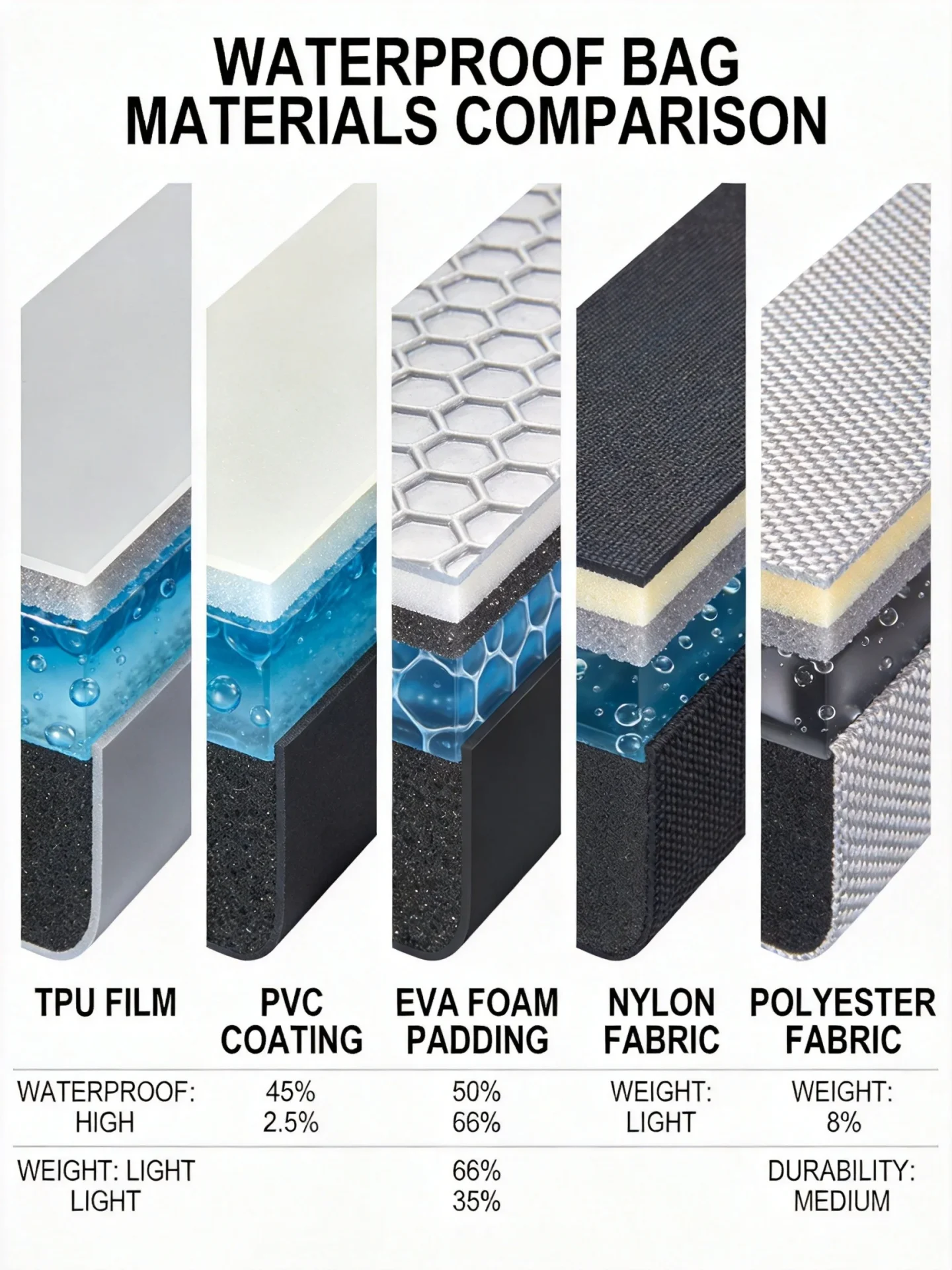
The material decision is where cost and waterproof performance are set. As you compare factories, ask how they can tune each substrate:
| Material | Waterproof Grade | Weight | Cost Tier | Best Fit for Your Line |
|---|---|---|---|---|
| TPU | IPX7–8 | Lightweight | Premium | Outdoor flagships, cold-weather gear, upmarket dry bags |
| PVC / Vinyl Tarpaulin | IPX6–7 | Heavy-duty | Budget | Marine, fishing, industrial, value dry bags |
| Coated Nylon (600D–1680D) | Waterproof with coating | Medium | Mid | Commuter, travel, value segment |
Your China factory should supply a material sample kit and explain how coating quality and welding discipline affect the IPX rating — not push a single material for its own margin. If sustainability is a wholesale requirement, ask about bio-based TPU, recycled rPET, and PFAS-free coatings, which export-oriented factories increasingly offer.
Landed Cost, MOQ, and Reasonable Expectations
Sourcing is ultimately a numbers game, so set honest expectations up front:
- MOQ 500 pcs is the practical floor for a mature factory producing branded, custom-spec waterproof bags. Below that you are paying heavy custom samples or prototyping rates that rarely make sense for a retail line.
- Sample lead time 7–10 days is a fair target once your spec is clear; mass production typically lands in the 35–50 day window depending on material availability and order size.
- Certifications and compliance (REACH, CA PROP 65, etc.) add cost and lead time; include them in your timeline, not as an afterthought.
- Tariff/duty must be broker-confirmed. Do not build a landed-cost model on a quoted percentage; duty applies per the latest customs schedule and your broker’s confirmation is the only reliable number.
When you compare suppliers, ask each for a landed-cost breakdown that separates unit price, tooling, sampling, freight, and duty allocation. The comparison should be on total landed cost at your real MOQ, not on the headline ex-works price.

Is It Worth It, and How Should You Decide?
For most outdoor, water-sports, fishing, travel, and commuter brands, sourcing custom waterproof bags from China is clearly worth it — provided you do the diligence above. Here is the honest decision logic:
- Worth it if: you have a defined spec, realistic volume at or above 500 pcs, and can spend the small effort to sample and verify a factory. China’s cost advantage and mature OEM capability make it the default.
- Better alternatives: for very small test quantities or exploratory prototypes, consider a domestic sample house first, then move production to China once volume justifies. For premium-brand-only, margin-insensitive programs, a domestic or Turkey/Portugal manufacturer may be preferable — but expect materially higher unit cost.
- What to avoid: committing a production order to a factory you have not sampled, skipping written QC terms, or trusting an unverified IPX claim. Those three shortcuts are how sourcing budgets get burned.
The “affordable, fast, quality” triangle applies here: at 500 pcs MOQ and a serious factory, you can realistically hold two of the three — quality and cost — while protecting the third with sampling and QC discipline rather than luck.
Sourcing Checklist (Use This Before Any PO)
A one-page gate list you can reuse on every sourcing round:
- [ ] Full written spec: capacity, closure, material, target retail price
- [ ] Shortlist of 3–5 evidence-based candidates (not price-rank only)
- [ ] Capability dossier: material samples, certificates, sample lead-time, 500-pc MOQ pricing
- [ ] Samples from ≥2 factories, tested for welding, seam, closure, IPX, and material behavior
- [ ] Landed-cost comparison (unit + tooling + sample + freight + broker-confirmed duty)
- [ ] Written QC terms: AQL level, leak-test sampling rate, IPX target, enforcement docs
- [ ] Pre-production and on-line inspections on first order
- [ ] Compliance files (BSCI, ISO9001, CA PROP 65) confirmed and stored
Frequently Asked Questions (FAQ)
1. What is the typical MOQ for custom waterproof bags from China?
A mature factory producing branded, custom-spec waterproof bags typically works to a 500 pcs MOQ. Lower quantities are possible for prototyping or sampling, but unit economics (coating, cutting, welding runs) only become attractive for a retail line at or above that level.
2. How long does sampling take?
With a clear specification, a credible waterproof bag manufacturer can deliver a sample in 7–10 days. Mass production generally takes 35–50 days depending on material availability and order size.
3. How do I know a China waterproof factory can really make bags waterproof?
Ask for evidence rather than claims: the welding line and seam-sealing process, leak-test and immersion records (ideally targeting IPX7–IPX8), and the test method. A factory that documents its welding parameters and leak-testing sampling rate is demonstrating real capability.
4. What certifications should a China waterproof bag supplier have?
For export retail, common requirements are BSCI (social audit), ISO9001 (quality management), REACH (EU substance restriction), and CA PROP 65 (California). Confirm the certificates your specific buyer or target market requires.
5. Should I use a sourcing agent or contact factories directly?
Both work. Direct contact gives you full control but demands more of your time for vetting and QC. An agent saves time but adds cost and an extra layer. For a first program, many brands start direct with one or two specialist factories, then consider an agent at scale.
6. How should I compare quotes from different factories?
Compare on landed cost at your real MOQ — ex-works unit price plus tooling, sampling, freight, insurance, and duty — not on the headline ex-works number. Have your freight broker confirm duty against the latest schedule rather than trusting a quoted percentage.
7. How do I protect my design and IP when sourcing from China?
Use a written, signed specification and QC agreement, keep material and test documentation on file, and where the design is commercially sensitive, consider having a qualified third party or legal counsel confirm what protection is appropriate for your market. Good documentation also deters unauthorized copying.
8. What is the most common sourcing mistake?
Committing a production order before sampling and before agreeing written QC terms — most commonly accepting an unverified waterproof claim or an AQL level that does not protect you. Sampling and written QC terms are the two cheapest forms of insurance in the entire sourcing process.
Bottom Line
Sourcing custom waterproof bags from China is the rational default for most brands: the manufacturing cluster, OEM/ODM maturity, scale economics, and fast 7–10 day sampling make it highly cost-effective at a 500 pcs MOQ. What separates a profitable source from a costly one is process discipline — a tight written spec, a capability dossier you can verify, samples from at least two factories, landed-cost comparison, written QC and compliance terms, and inspections on your first order. Build that framework, choose a factory on evidence rather than the cheapest email, and China becomes a reliable, repeatable source for your waterproof bag line.
For the full technical picture behind your custom line — welding, zippers and seams, and material-by-material waterproof ratings — explore the complete custom waterproof bag manufacturer guide, deep-dive into dry bag manufacturing for brands, review zippers, seams and coatings for a truly waterproof bag, and compare waterproof fabric durability, TPU vs PVC vs nylon.