
Why Ventilation Is a Structural Problem, Not a Fabric Problem
A ventilation system in a sports bag is not a mesh panel bolted onto a sidewall. It is an engineered air path that moves moisture-laden air from the interior to the exterior before that air reaches saturation. Most bags sold as “breathable” fail this test because the mesh is decorative: it is sewn against a non-woven backing, or it opens onto a compartment that has no exhaust, or it sits at the bottom of the bag where warm moist air never travels. The result is a bag that passes a visual inspection and fails after one season of use. Buyers who understand the difference between a mesh window and a ventilation architecture place better orders and get fewer field complaints.
This guide is written for procurement teams, brand owners and sourcing managers who specify sports bags at volume. It covers the four ventilation architectures used in production, the physics of why they work, the test methods that separate a claim from a specification, and the cost and tooling consequences of each choice. If you are still deciding between mesh and nylon as a material, our comparison of mesh versus nylon for sports bag ventilation covers that decision separately. This article assumes the material is already chosen and addresses what happens after.
The Four Ventilation Architectures Used in Production
Across the sports bag programs we run, ventilation designs fall into four families. They are not interchangeable, and they differ substantially in tooling cost, unit cost and field performance.
Mesh Panels
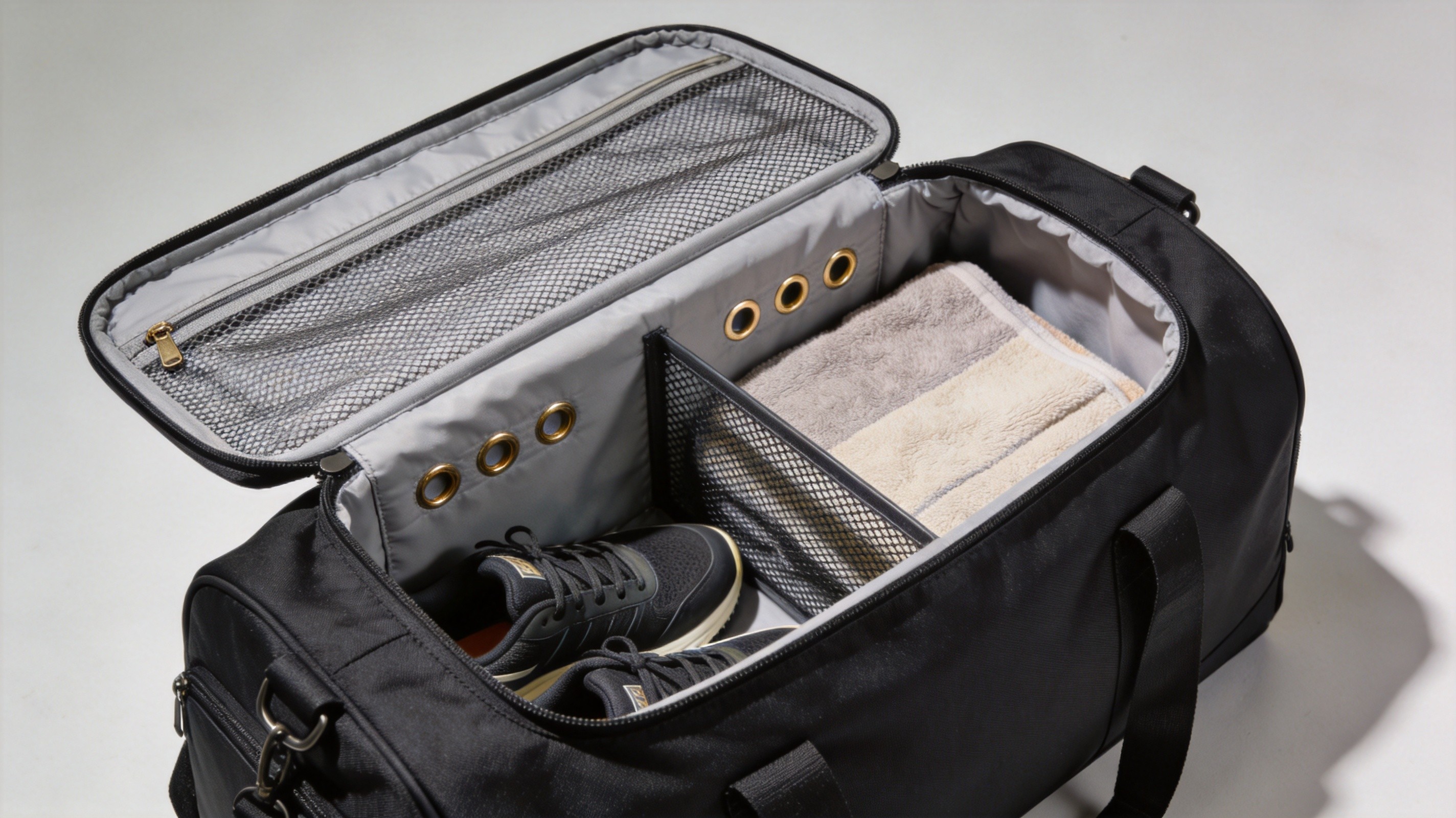
A mesh panel is an open-weave fabric insert sewn into a sidewall, gusset or base. It is the cheapest ventilation option and the most frequently misapplied. Mesh works when three conditions are met: the panel is large enough relative to the compartment volume, there is a second opening elsewhere on that compartment to create a pressure difference, and the panel is not backed by a moisture-retaining lining. Remove any one of those conditions and the panel becomes a decorative element that adds cost without moving air. Mesh is well suited to shoe tunnels and wet pockets where the panel can run the full length of the compartment and the opposite wall is also open.
Gusset and Eyelet Vents
Metal or moulded eyelets set into a gusset create small, high-velocity openings. Their advantage is structural: an eyelet reinforces the fabric around the hole, so the vent does not tear or elongate under load. Their limitation is total open area. A row of six 8 mm eyelets provides a fraction of the open area of a mesh panel and works only where the compartment is small and the moisture load is low, such as a glove pocket or a ball compartment. Eyelets are also the correct choice where the vent must survive abrasion, because the reinforcement ring takes the wear instead of the fabric.
Stand-Off Back Panels
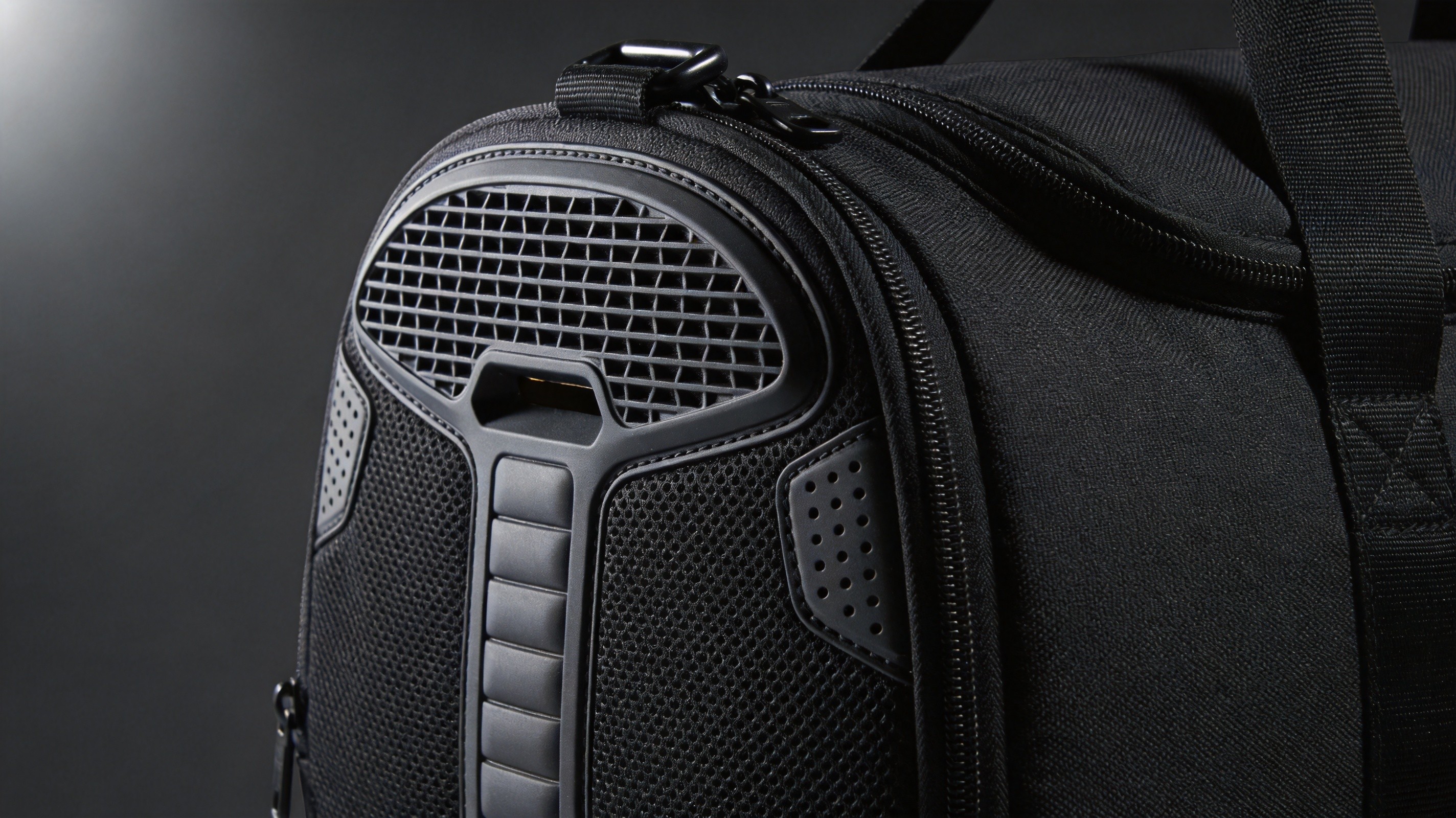
A stand-off panel is a three-dimensional spacer structure, usually a moulded foam or a warp-knitted spacer fabric, held away from the wearer’s back or from the bag body. Air circulates through the gap rather than through the material. This architecture is common on carry systems and is increasingly used on the equipment-facing side of team bags, where the objective is to stop condensation forming between a damp garment and an impermeable bag wall. Stand-off panels are the most effective architecture per unit of open area, and the most expensive, because they consume volume and require dedicated moulds or specialised sewing.
Channeled Air Paths
A channeled design uses baffles, mesh tubes or moulded ribs to direct air along a defined route from an intake to an exhaust. It is the only architecture that produces predictable directional flow. Channeling matters most in large team bags and equipment bags, where compartment volume is high enough that diffusion alone cannot exchange the air. The cost is design and sampling time rather than material: a channeled bag typically needs two or three physical iterations before the flow path is correct, and that iteration has to happen at sample stage, not after the production order is placed.
How Air Actually Moves Through a Bag
Air exchange inside a closed bag is governed by two mechanisms, and the balance between them changes with the size of the air gap. Below a critical gap thickness, moisture moves by diffusion, which is slow and driven by the vapour pressure difference across the fabric. Above that critical thickness, convection takes over: air inside the gap begins to circulate, and the rate of moisture transport rises. Research published through ASTM International on sportswear fabrics using the upright cup method under ASTM E96 found exactly this transition, with water vapour transmission rate falling to a minimum at a critical air gap and then rising again as convection began to dominate. The same study reported a positive, non-linear relationship between water vapour transmission rate and the fabric’s air permeability.
The practical consequence for bag design is direct. A ventilation opening that is flush against the contents has an effective air gap of nearly zero and operates in the diffusion regime, no matter how permeable the material is. A ventilation structure that holds the fabric away from the contents, even by ten or fifteen millimetres, shifts the compartment into the convection regime and multiplies the moisture exchange. This is why stand-off and channeled designs outperform flat mesh panels of equivalent open area, and why the single most valuable change a buyer can make to an existing bag is often to add internal stand-off rather than to enlarge the mesh.
The Moisture and Odor Mechanism Ventilation Addresses
Post-exercise odor is not a fabric problem and it is not solved by deodorising treatments. It is the visible outcome of microbial metabolism. Sweat deposited on textiles is broken down by skin-borne bacteria, and the volatile compounds produced in that process are what the user smells. Mold and mildew follow the same logic in a different regime: spores that settle on a damp surface germinate once relative humidity stays high for long enough, and the resulting growth produces the musty compounds associated with bags that were packed wet and left closed.
Ventilation intervenes at the humidity step. If the interior relative humidity is brought down quickly after use, microbial growth slows and the volatile compounds are not generated in the first place. If it is not, no amount of antimicrobial finishing will compensate, because the finishing acts on the surface while the moisture load sits in the padding, the seam tape and the lining. This is why we specify ventilation and antimicrobial treatment as complementary systems rather than alternatives; the antimicrobial material options for sports bags guide covers the chemistry side, and this article covers the airflow side that keeps that chemistry working.
Two design details drive the outcome more than any other. First, physical separation: a wet garment in direct contact with a dry one transfers moisture by contact, and no vent can undo that. Second, exhaust: an intake without an exhaust produces stagnation, and stagnation is the condition that produces odor. Every ventilated compartment should be checked on the technical drawing for both an intake and an exhaust, and both should be marked.
Test Methods Buyers Should Require
A ventilation claim without a test method is a marketing statement. The following standards are the ones we test to and the ones we recommend buyers write into a purchase specification.
| Standard | What It Measures | Reported Units | What to Specify |
|---|---|---|---|
| ASTM D737 | Air permeability of textile fabrics at a stated pressure differential | cm³/s/cm² (SI); ft³/min/ft² (CFM) | Test at 125 Pa default differential; condition specimens at 21 ± 1 °C and 65 ± 2 % RH |
| ISO 9237 | Air permeability of fabrics, equivalent scope to D737 | mm/s or l/m²/s | Use where the buyer’s market expects ISO reporting |
| ASTM E96 | Water vapour transmission rate through a material | g/h·m² or g/m²/day | State upright or inverted cup method and the air gap used; results are not comparable across methods |
| AATCC TM197 | Vertical wicking of moisture along a fabric strip | mm of rise in a stated time | Applies to linings and contact surfaces, not to mesh panels |
| AATCC TM201 | Drying rate of a saturated fabric | g/h | Most representative of real post-use drying behaviour |
Two cautions apply. First, ASTM D737 results depend on the pressure differential used, so a number quoted without its differential is not a specification. The standard default is 125 Pa, and the standard test atmosphere for textiles is 21 ± 1 °C at 65 ± 2 % RH; both should appear on the report. Second, ASTM E96 explicitly states that results obtained by different methods should not be expected to agree, so a supplier quoting a water vapour transmission rate must also state which procedure and which air gap were used. We have seen purchase orders fail on exactly this point, with the supplier and the buyer each holding a valid test report that disagrees with the other.
Cost, Tooling, and MOQ Impact
Ventilation architecture is one of the larger cost variables in a sports bag specification, and it is frequently underestimated at quoting stage.
- Mesh panels add material and sewing time but no tooling. They are the lowest-cost option and scale to any order quantity.
- Eyelet vents add hardware, a setting operation and a reinforcement step. Cost per unit is low but the labour content is visible at high volume.
- Stand-off panels usually require a moulded component or a spacer fabric, which means tooling. Below roughly 1,000 pieces per colourway the amortised tooling cost becomes difficult to justify.
- Channeled air paths require pattern development and physical sampling. Budget two to three sample rounds before the flow path is signed off.
Our standard terms for custom programs are a minimum order of 500 pieces, sampling in 6 to 10 days, and bulk production in 35 to 50 days from sample approval, FOB Xiamen, inspected to AQL 2.5. Programs that add moulded stand-off components should plan for a longer sample window because the mould has to be cut and trialled before the first article can be sewn.
Design Checklist for OEM/ODM Programs
Before a ventilated design goes to sample, the following points should be resolved on the technical drawing. Each one has caused a rework cycle on a live program at some point.
- Every ventilated compartment has a marked intake and a marked exhaust.
- No ventilation opening is backed by a non-woven or foam layer that blocks airflow.
- Internal stand-off is specified wherever the compartment volume exceeds roughly five litres.
- Wet and dry zones are physically separated by a sealed divider, not by a shared wall.
- Eyelet positions are reinforced, and reinforcement is specified by material and thickness.
- Lining materials are selected for wicking, not only for hand feel.
- Drainage is considered for any compartment that can hold standing water.
- Test method, pressure differential and conditioning atmosphere are written into the specification.
Frequently Asked Questions
What air permeability value should a ventilated sports bag fabric have?
There is no single threshold, because the required value depends on the compartment volume, the moisture load and whether a second opening exists. What matters is that the value is reported under a stated pressure differential, normally 125 Pa under ASTM D737, and under the standard textile atmosphere of 21 ± 1 °C and 65 ± 2 % RH. A supplier that quotes a permeability figure without those conditions has not given you a specification you can enforce. We test candidate fabrics and report the full set of conditions on the technical file.
Does adding mesh panels weaken a sports bag?
It can, if the panel is sewn into a load-bearing seam without reinforcement. Mesh has lower tensile and tear strength than the body fabric, so a panel placed across a shoulder-strap anchor or a base corner becomes the failure point. The correct approach is to keep mesh out of primary load paths, to bind the panel edges, and to back the panel with a reinforcement tape where it intersects a structural seam. Panels placed in the sidewall or the shoe tunnel, away from anchor points, do not reduce the bag’s load rating.
How much does a ventilated bag design add to unit cost?
It depends entirely on the architecture. A mesh panel adds material and a sewing operation and is measurable in cents per unit at volume. Eyelet vents add hardware plus a setting operation. A stand-off panel adds a moulded component or a spacer fabric plus tooling, which is a fixed cost that must be amortised across the order. Channeled air paths add pattern development and sample rounds rather than material. We quote each architecture separately so the buyer can see the fixed and variable components rather than a single blended number.
Can ventilation be added to an existing bag design without new tooling?
In most cases yes, provided the change stays within the sidewall and does not alter a moulded component. Adding a mesh panel, relocating an eyelet row or introducing an internal stand-off divider can normally be done with a pattern revision and a new sample, with no tooling cost. Changes that affect a moulded base, a thermoformed back panel or an injected handle require a mould modification and should be treated as a new development. We review the existing pattern first and tell the buyer which category the change falls into before quoting.
Which sports need the most ventilation?
Demand tracks moisture load and how long equipment stays sealed in the bag. Team sports with padded equipment, swimming and water sports, and any program where wet kit is transported after a session are the highest-demand categories. Racquet sports and gym use sit in the middle. Where the bag is opened and aired promptly after use, a simpler architecture is sufficient. Our guide to designing bags for team sports covers how ventilation requirements change across team categories.
How does ventilation interact with water resistance?
Directly and inversely. Every opening that lets vapour out also lets liquid in, so a ventilated bag is not a waterproof bag and should not be specified as one. The correct resolution is zoning: ventilated compartments for damp kit, sealed and coated compartments for anything that must stay dry. Buyers who need both properties in one product should specify them on separate compartments rather than trying to achieve both on the same panel. Our article on custom-treated materials for sports bags explains which finishes are compatible with an open ventilation structure.
Next Steps for Your Program
If you are specifying ventilation on a new sports bag program, the highest-return change is usually not more mesh. It is a documented air path with an intake, an exhaust, and internal stand-off that keeps the fabric away from the contents. That combination moves a compartment from diffusion into convection and produces a measurable improvement in drying time, which is what the end user actually experiences.
JUNYUAN BAGS was established as a company in 2014, supplying OEM and ODM programs from our facility in Quanzhou, Fujian, and our manufacturing team has been in the bag industry since 2004. We work from technical drawings, test to the standards listed above, and report results before production. To discuss a ventilated design, send your specification or reference sample and we will return an architecture recommendation with the associated tooling and cost implications. Our guide to custom sports bag manufacturing in China explains the full development sequence from drawing to shipment, and the sports bag category lists the programs we currently run. Ventilation is one of several structural requirements that certified protective equipment imposes on the bag carrying it; our article on NOCSAE standards and custom sports bags covers the rest.