On November 9, 2026, at 11:59 p.m. Eastern, 178 Section 301 product exclusions expire. Bags are not on that list. HS heading 4202 has paid the 25% List 3 duty continuously since 2019 and was never covered by those exclusions — so for bag buyers, nothing changes on November 10 at the border.
What actually changes for you is elsewhere: the Section 301 port-fee suspension lapses the same minute, and the EU’s €2-per-category processing fee has been live since November 1, stacked on the €3 duty that began in July. Both land in your landed cost. The exclusion deadline does not.
Two dates, two bills
Most coverage of this deadline is written for importers of pump parts and solar equipment. Bag buyers have a different exposure profile, and it splits across two jurisdictions on two different dates.
| United States | European Union | |
|---|---|---|
| Effective date | Nov 10, 2026 (expiry at 11:59 p.m. ET, Nov 9) | Jul 1, 2026 (€3 duty) · Nov 1, 2026 (€2 fee) |
| What changes | 178 product exclusions lapse; port-fee suspension lapses | Flat duty and per-category processing fee both live |
| Does it touch HS 4202 bags? | Not directly — bags were never excluded | Yes, directly — every consignment, no value threshold |
| Who pays | Importer of record | Platform, seller, or carrier (usually passed through) |
| Amount at stake | No change to the 25% List 3 rate | €3 + €2 = €5 minimum per item category |
| Status | No extension published as of publication | In force, reviewed every two years |
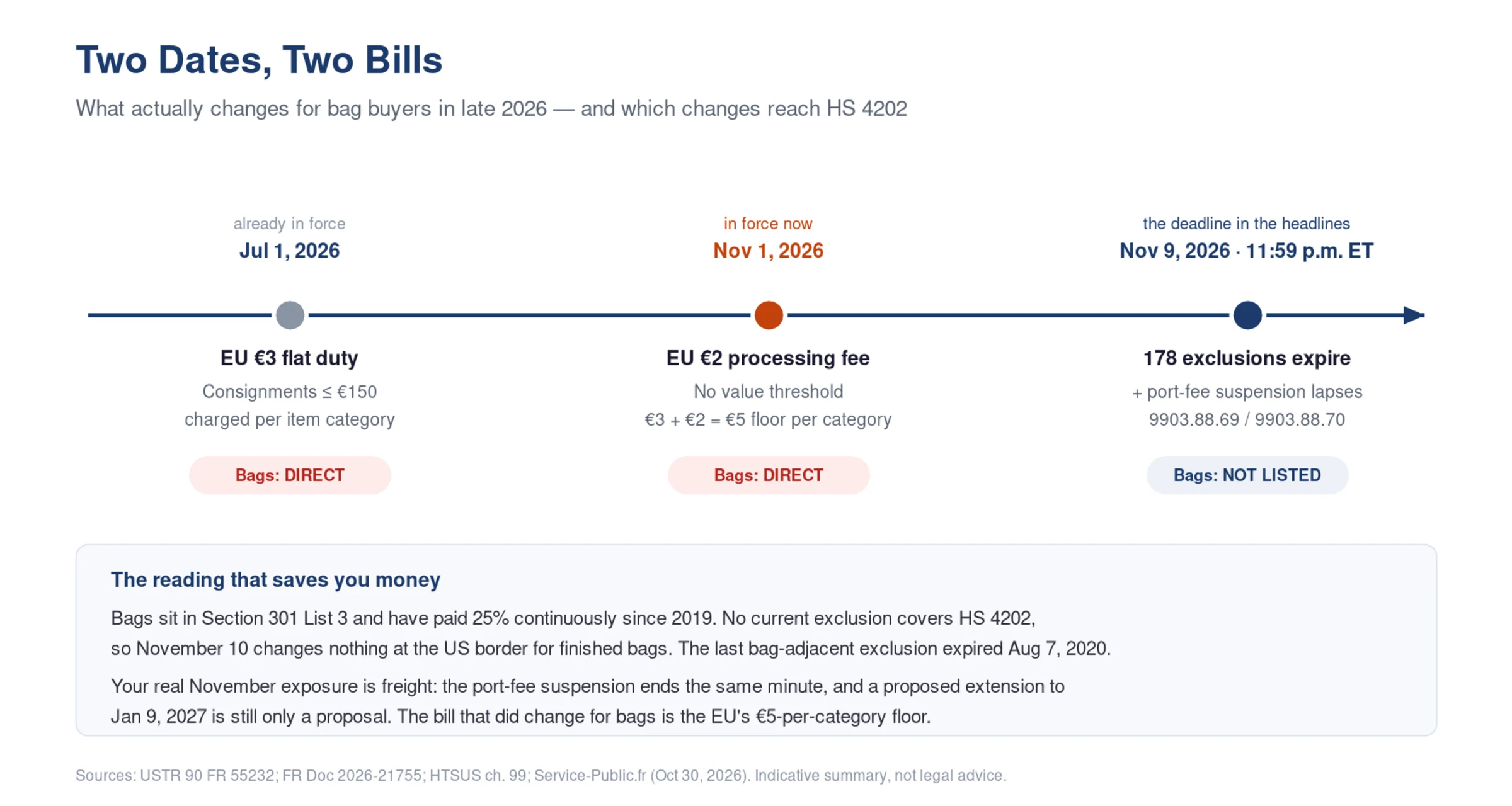
The asymmetry matters. On the US side, bag buyers are spectators to a deadline that dominates the trade press. On the EU side, bag buyers are the direct target of a fee that has received a fraction of the coverage.
If you sell bags B2B into the US, your November 9 task is a verification exercise. If you ship bags DTC into the EU, your November 1 task is a pricing exercise, and you are already late.
The US side: what actually ends on November 9
The 178 exclusions
USTR extended 178 product exclusions through 11:59 p.m. Eastern on November 9, 2026, in a notice published December 1, 2025 (90 FR 55232). The set breaks into two groups:
- 164 exclusions under U.S. note 20(vvv) to chapter 99, claimed at entry under heading 9903.88.69
- 14 exclusions for solar manufacturing equipment under U.S. note 20(www), claimed under heading 9903.88.70
Two subsequent USTR notices — the October 7, 2026 continuation notice (2026-20510) and a conforming amendment (2026-20511, 91 FR 64211) that renumbered five exclusions after USITC changed statistical categories on July 1, 2026 — left the November 9 deadline untouched. Neither extended it. As of this writing, no extension notice has been published.
What the 178 cover: pump casings and bodies, pump covers, certain acrylic terpolymers, polyethylene film rolls, digital clinical thermometers, hunting stands, unfinished plywood chair parts, electric motorcycles under 1,000 W, hydrofluorocarbon mixtures, and the solar and wafer-handling equipment in the second group. Industrial inputs and capital equipment.
What they do not cover: bags. No exclusion in the current 178 addresses heading 4202. The last bag-adjacent exclusion — 9903.88.37 for leather briefcases not exceeding 37 × 45 × 17 cm — expired on August 7, 2020, and was never renewed.
Why bags still pay 25%
Bags sit in the Section 301 tranche applied to roughly $200 billion of Chinese goods, effective September 24, 2018, at 10% and raised to 25% in May 2019. That is List 3, reported at entry under heading 9903.88.03. It has been collected on every covered entry since, without interruption and without an exclusion window for finished bags.
So the November 10 headline — “excluded goods return to the full List rate” — describes a transition that bags already made seven years ago. If a supplier tells you their bag pricing is about to rise because “the exclusion is ending,” ask which exclusion heading they were claiming. There isn’t one for finished bags.
The date that decides your rate
This part is worth knowing regardless of which product you import, because it is where most landed-cost models go wrong.
Under 19 CFR 141.68, the time of entry governs. For goods entered for consumption, that is generally the moment CBP authorizes release. The shipment date and the invoice date are irrelevant. A container that leaves Shanghai on October 20 and is entered on November 12 is assessed at the post-deadline rate. A container that leaves on November 5 and is entered on November 8 keeps the pre-deadline treatment.
A bonded warehouse does not preserve anything. Goods stored before the deadline and withdrawn after it are assessed on the date of withdrawal, not the date of storage. If a broker proposes warehousing as a way to “hold” a rate, the only thing being held is the goods.
For bag buyers this is mostly academic on the exclusion question, since there is no exclusion to lose. It becomes very much not academic on the port-fee question below, and it will matter again if USTR opens a new exclusion round for finished goods.
The second instrument expiring the same minute
The port-fee suspension under Section 301’s maritime, logistics and shipbuilding investigation also runs out at 11:59 p.m. Eastern on November 9, 2026. It covers Annexes I to III — fees on Chinese-operated and Chinese-owned vessels, Chinese-built vessels, and all foreign-built vehicle carriers — suspended for one year in November 2025, together with the 100% duties on Chinese ship-to-shore cranes and intermodal chassis under Annex V.A.
On October 26, 2026, USTR published a proposal (FR Doc 2026-21755) to extend that suspension to January 9, 2027, with comments due October 30. A proposal is not a final notice. Until one publishes, the November 9 end stands.
Why this touches bag buyers even though nobody ships bags on a vehicle carrier: the fees attach to vessel calls, and vessel calls price into freight. Carriers and forwarders with China-built or China-operated tonnage arriving after November 9 are pricing that risk now. If you have November and December bookings, ask in writing how a resumed fee would be billed — a separate surcharge line, or folded into the all-in rate. The answer determines whether your Q1 landed cost has a hidden 3–5% in it.
Four misconceptions worth killing
“The port fee was extended, so the exclusions were too.” They are separate instruments with separate legal bases. The port-fee suspension sits under the maritime and shipbuilding investigation; the 178 exclusions sit under the technology transfer investigation. A final notice on one does nothing to the other. As of publication, neither has been extended.
“The trade truce covers this.” The truce runs to January 10, 2027, per Treasury statements following the late-September state visit. But a cabinet secretary’s verbal statement does not amend the Federal Register, and no executive order or notice has documented the two-month extension. Even if one publishes tomorrow, it addresses the truce — not the 178 exclusions, which expire on their own statutory clock two months earlier. USTR has opened no successor exclusion process and no rolling renewal exists.
“The shipment date is what counts.” Covered above, and it is the single most expensive misconception in this article. Entry date governs. Warehouse withdrawal date governs for bonded goods. Plan backwards from the entry, not forwards from the loading date.
“Bags were excluded, so I have a 25% increase coming.” This is the one that costs bag buyers money in the other direction — not in duty, but in negotiating position. A supplier who frames a price increase as “the exclusion ended” is either misinformed or testing you. The 25% has been in the price since 2019. If your cost is rising now, the cause is freight, the forced-labor duty layer added in July 2026, or raw material — not the November 9 date.
The EU side: the €2 fee is already running
While the US deadline dominates the headlines, the EU change that actually hits bag sellers took effect on November 1 — two days before this article was published.
How the charge stacks
Two separate instruments now apply to low-value consignments entering the EU from outside the customs territory:
- Since July 1, 2026: a flat €3 customs duty on consignments valued at €150 or less, calculated per item category in the package
- Since November 1, 2026: a €2 processing fee, also per item category, with no value threshold at all
The combined floor is therefore €5 per item category. The French public service portal’s own worked examples make the mechanic concrete: a parcel containing 2 toys, 1 coat and 2 bottles of perfume is three categories, so the processing fee alone is €6. A parcel with 3 t-shirts and 1 pair of shoes is two categories — €4.
Categories are defined from the European Combined Nomenclature. That means the tariff classification work you already do for the US entry now also drives an EU per-parcel charge. A backpack and a golf bag in the same box are two categories. Two backpacks of different construction may still be one.
Who actually pays
The processing fee is owed by the platforms and sellers shipping into the EU via distance sales, and where applicable by carriers. Merchants are free to raise prices to pass it through — which is what almost all of them will do, and what you should assume your EU customers are already seeing.
For a B2B bag manufacturer this is not a line on your own invoice. It is a line on your customer’s. If you sell to EU brands and distributors who then ship DTC, their per-order economics just moved by €5 per category at the bottom end, and their willingness to absorb small orders moved with it. Expect two downstream effects: order consolidation (fewer, larger shipments) and pressure on your MOQ conversation.
The compliance number that matters more than the fee
An EU-wide inspection campaign found that more than 60% of the items checked did not comply with European standards. That figure — not the €2 — is the real risk in this package. The fee is designed to fund management, IT, administrative processing and customs controls, and its level will be reviewed every two years to keep pace with the cost of those checks.
Read that as a signal about inspection intensity. For bag sellers, the standards exposure sits in REACH (restricted substances in coated fabrics, plasticisers, azo dyes), POPs (perfluorinated compounds in water-repellent finishes), and general product safety documentation. If you have been shipping coated or waterproofed bags into the EU on the assumption that low-value consignments escape scrutiny, the funding model for that scrutiny just changed.
What a bag actually costs to land
The reason the November 9 story does not move bag buyers is that the bag duty stack has been fully loaded for years. Here is the current arithmetic for the most common construction — a textile backpack or sports bag under HTS 4202.92.31, China origin.
| Layer | Rate | Legal basis | Claimed at entry as |
|---|---|---|---|
| MFN (Column 1 general) | 17.6% | HTSUS 4202.92.31 | Base heading |
| Section 301 — List 3 | +25% | 2018 technology-transfer investigation | 9903.88.03 |
| Section 301 — forced labor | +12.5% | 2026 forced-labor investigation (60 economies) | Chapter 99 forced-labor heading |
| Indicative total | ~55.1% |
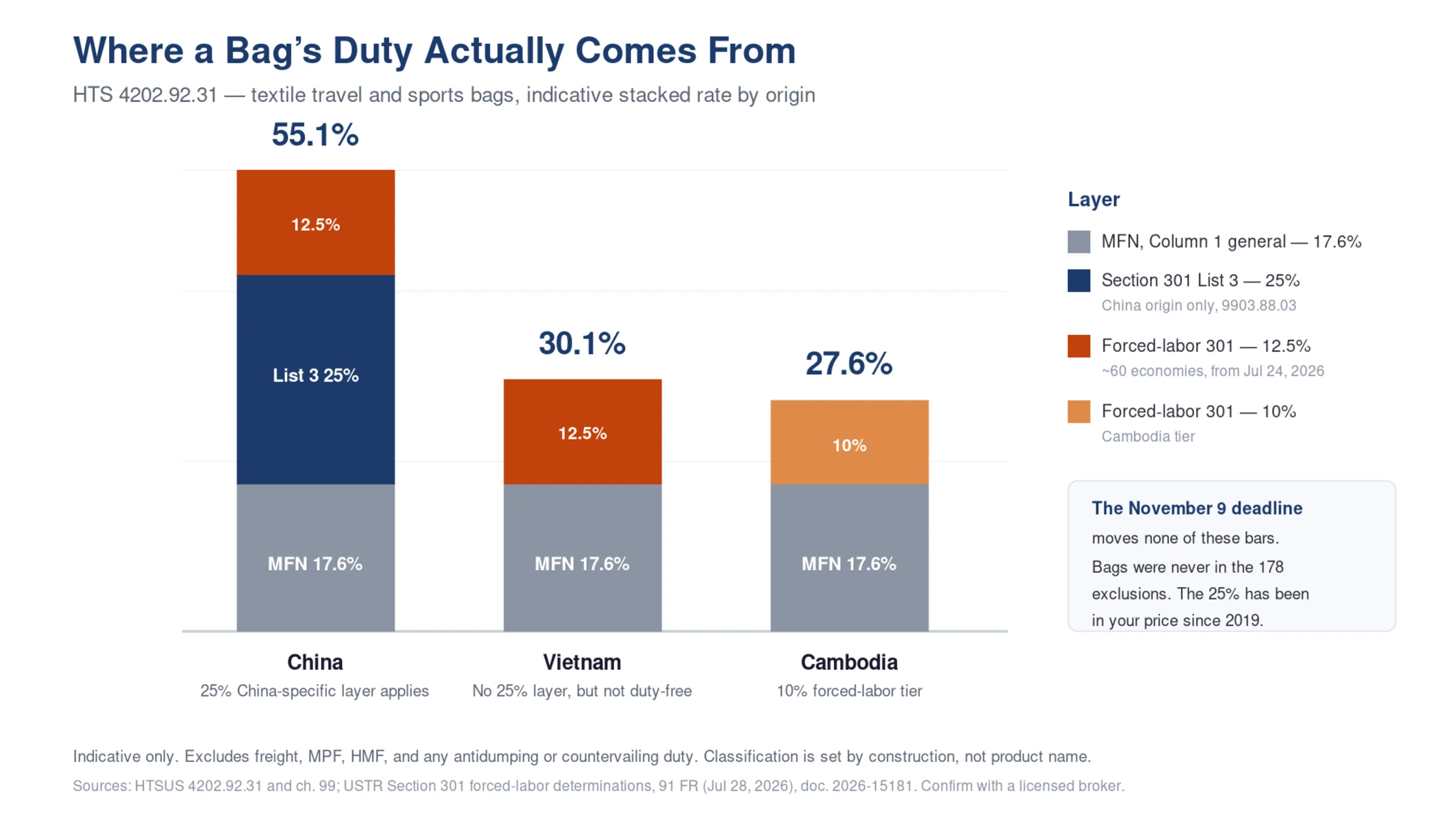
Three things about that table deserve attention.
First, it is not one policy. The 55% is a stack of three separate legal authorities that happen to point the same direction. That matters because they expire, extend and get amended independently — which is exactly what makes November 9 confusing. One layer moving does not move the others.
Second, the forced-labor layer is new and it changed the origin math. Effective July 24, 2026, the Section 301 forced-labor tariffs apply to roughly 60 economies at 10% or 12.5%. China is in the 12.5% tier. Vietnam is also in the 12.5% tier; Cambodia is in the 10% tier. Run the same 4202.92.31 bag from three origins:
| Origin | MFN | China-specific 301 | Forced-labor 301 | Indicative total |
|---|---|---|---|---|
| China | 17.6% | +25% | +12.5% | ~55.1% |
| Vietnam | 17.6% | — | +12.5% | ~30.1% |
| Cambodia | 17.6% | — | +10% | ~27.6% |
The China–Vietnam gap is roughly 25 percentage points, and unlike the pre-2026 situation, Vietnam is no longer close to duty-free either. Origin diversification still saves money; it no longer saves all of it.
Third, these are indicative rates on one subheading. Classification is decided by construction, not by product name. A coated fabric backpack and an uncoated one can classify differently. Zippers, metal frames, leather trim and molded shells all create classification questions, and 4202.92 splits further at the statistical level — 4202.92.31.20 for backpacks, 4202.92.31.31 for other travel and sports bags. Get the classification wrong and every rate above is wrong. Confirm with a licensed broker against your actual bill of materials, not against a competitor’s spec sheet. Our breakdown of custom backpack manufacturing covers which construction choices drive those classification questions.
For a worked example of how these layers translate into a quoted unit price, see our golf bag cost and pricing guide, which walks the same stack from fabric through FOB to landed.
Five things to do this week
1. Verify whether any of your SKUs ever claimed 9903.88.69
Pull your entry summaries for the last 24 months and ask your broker which lines, if any, were filed under 9903.88.69 or 9903.88.70. For a bag program the expected answer is none — but accessories and packaging sometimes ride along on a mixed entry. If something does show up, you have a real November 9 exposure and a real decision to make about entry timing. If you are unsure whether your current supplier would even know the answer, our comparison of a bag manufacturer versus a trading supplier explains why the distinction shows up exactly here.
2. Rebuild your landed cost with the freight risk included
Your duty number is stable. Your freight number is not. Re-run Q1 2027 landed cost with two scenarios: current all-in freight, and current freight plus a resumed port-fee component. Ask each forwarder carrying China-built or China-operated tonnage for a written statement on how the fee would be billed if it resumes. You are not forecasting the policy; you are removing a blank line from your model.
3. Reprice the EU channel before your customer does
If you ship DTC into the EU, the €5-per-category floor has been live for two days. If you sell B2B to EU customers who ship DTC, they are recalculating right now. Get ahead of it: model what a typical order looks like at €5 per category, decide whether your packaging and carton configuration can consolidate categories, and bring the numbers to the conversation. A supplier who shows up with the math already done wins the reorder.
4. Put the entry-date rule in writing, internally
Circulate one paragraph: rate is set by entry date under 19 CFR 141.68; warehouse withdrawal date governs bonded goods; shipment and invoice dates are irrelevant. Then make sure whoever books freight understands that a booking decision in the first week of November can move a duty outcome. This costs nothing and prevents the most common error in the chain.
5. Fix the documentation that inspection will actually look at
Given a 60%+ non-compliance finding across checked items, treat EU-bound documentation as an active risk rather than a filing chore. That means current REACH and POPs declarations for coated fabrics and water-repellent finishes, test reports that match the actual production lot, and a factory audit trail that survives a second look. If you have not had a third-party audit in the last 18 months, our factory audit guide covers what a buyer-side audit should actually verify — and what it usually misses.
One structural note on timing. Because the entry date controls, the practical deadline for a November shipment is not November 9 — it is the last date your broker can confirm release by November 9. Port congestion, ISF filing and exam holds all consume days. Treat the operational deadline as November 4 and you will not be explaining a 25-point swing to your CFO.
Three questions to ask your supplier — and six we get asked
The reverse questions
These are the three questions that separate a supplier who understands the tariff stack from one who is repeating headlines. Ask them in the next call.
“Which Chapter 99 headings appear on our entries, line by line?” A supplier who can answer this is working from entry data. A supplier who answers “we don’t pay the tariff, you do” is technically correct and commercially useless. The answer you want names the headings: 9903.88.03 for the List 3 layer, the forced-labor heading for the 12.5% layer, and nothing else unless there is a genuine exclusion.
“If I moved this program to Vietnam, what changes and what doesn’t?” The right answer is specific: the 25% China layer disappears, the 12.5% forced-labor layer follows the origin and does not disappear, MFN stays, and tooling, MOQ, lead time and sampling all reset. Anyone who quotes a single blended saving number is guessing.
“What in this bag’s construction changes its classification?” This is the question that reveals whether your supplier understands their own product at the tariff level. Coating, lamination, shell material and trim all matter. A supplier who can walk you through which design choices move a bag between statistical lines is a supplier who can protect your landed cost at the design stage, which is the only stage where it is cheap to protect.
FAQ
Do the 178 Section 301 exclusions apply to bags?
No. None of the 178 exclusions addresses HS heading 4202. Finished bags have paid the 25% List 3 duty continuously since 2019. The last bag-adjacent exclusion, covering leather briefcases up to 37 × 45 × 17 cm, expired August 7, 2020.
Will my bag duty go up on November 10, 2026?
Not because of the exclusion expiry. Your List 3 rate is unchanged. What may change is freight, if the port-fee suspension is not extended, and what did change is the 12.5% forced-labor layer that took effect July 24, 2026.
Does the shipment date or the entry date decide the rate?
The entry date. Under 19 CFR 141.68, the time of entry for consumption governs, generally when CBP authorizes release. For bonded goods, the withdrawal-for-consumption date governs. Shipment and invoice dates do not count.
Can I hold the old rate in a bonded warehouse?
No. Goods stored before a deadline and withdrawn after it are assessed on the withdrawal date. A bonded warehouse defers duty; it does not freeze the rate that applies.
How much is the EU charge on a bag shipment now?
A €3 flat duty since July 1, 2026, plus a €2 processing fee since November 1, 2026 — both calculated per item category, with the fee applying at any value. That is a €5 floor per category. A backpack and a golf bag in one parcel are two categories.
Is USTR likely to extend the exclusions again?
Unknown, and no notice has published. USTR proposed extending the port-fee suspension to January 9, 2027, and took comments through October 30, but that proposal covers the maritime instrument only. When USTR last weighed an exclusion extension in 2025, it assessed whether products were available outside China and whether importers were actively shifting sourcing. Watch the Federal Register and CBP CSMS messages rather than press statements.
Sources
- USTR, Notice of Conforming Amendment to Product Exclusion, 91 FR 64211 (Oct 7, 2026), doc. 2026-20511
- USTR, continuation notice for the July and August 2018 China actions, doc. 2026-20510 (Oct 7, 2026)
- USTR, exclusion extension notice, 90 FR 55232 (Dec 1, 2025) — the instrument setting the November 9, 2026 end date
- USTR, proposed extension of the maritime port-fee suspension, FR Doc 2026-21755 (Oct 26, 2026)
- USTR, Section 301 forced-labor determinations, 91 FR (Jul 28, 2026), doc. 2026-15181
- CBP, CSMS #70261629, Updated Guidance: Section 301 China Conforming Amendment (Oct 22, 2026)
- 19 CFR 141.68, Time of entry
- HTSUS heading 4202 and statistical suffixes 4202.92.31.20 / .31; chapter 99 headings 9903.88.03, 9903.88.69, 9903.88.70
- Service-Public.fr (Prime Minister’s office), Imported parcels: new processing fees from November 1, 2026 (Oct 30, 2026)
- European Commission, customs reform on low-value consignments: €3 flat duty from July 1, 2026; €2 per-category processing fee from November 1, 2026
Rates quoted are indicative for the stated subheading and origin and exclude freight, MPF, HMF, and any antidumping or countervailing duty. Classification and rate treatment should be confirmed with a licensed customs broker against your actual bill of materials before you commit to a price.
Junyuan Bags manufactures custom golf bags, backpacks, cooler bags and medical bags through affiliated and partner factories in Fujian, China — established 2014, with our founding team in the bag trade since 2004. MOQ from 500 pcs per style and colour (200 pcs for golf bags), sampling in 6–10 business days, bulk production 35–50 days, AQL 2.5 major / 4.0 minor.
We quote landed cost with the duty stack broken out, so you can see which layer is moving. See how our OEM and ODM bag manufacturing program works, or review our custom golf bag line if your program is cart or stand bag based.
Contact: [email protected] · +86 17750020688