Launching a Kickstarter bag campaign involves five main stages: concept and design, prototyping and material selection, manufacturing and production, campaign launch and backer engagement, and fulfillment and delivery. Each step requires precise planning and collaboration to ensure a smooth process and meet backer expectations. Here’s the key takeaway:
- Concept and Design: Identify the problem your bag solves, prioritize features, and outline specifications like dimensions and materials.
- Prototyping: Test and refine your design through 2–3 iterations, focusing on functionality and material durability.
- Manufacturing: Partner with certified manufacturers like JUNYUAN BAGS to handle production, quality checks, and scalability.
- Kickstarter Campaign: Create a detailed campaign page with photos, videos, and clear reward tiers to attract backers.
- Fulfillment: Plan logistics for global shipping, including customs, packaging, and delivery timelines.
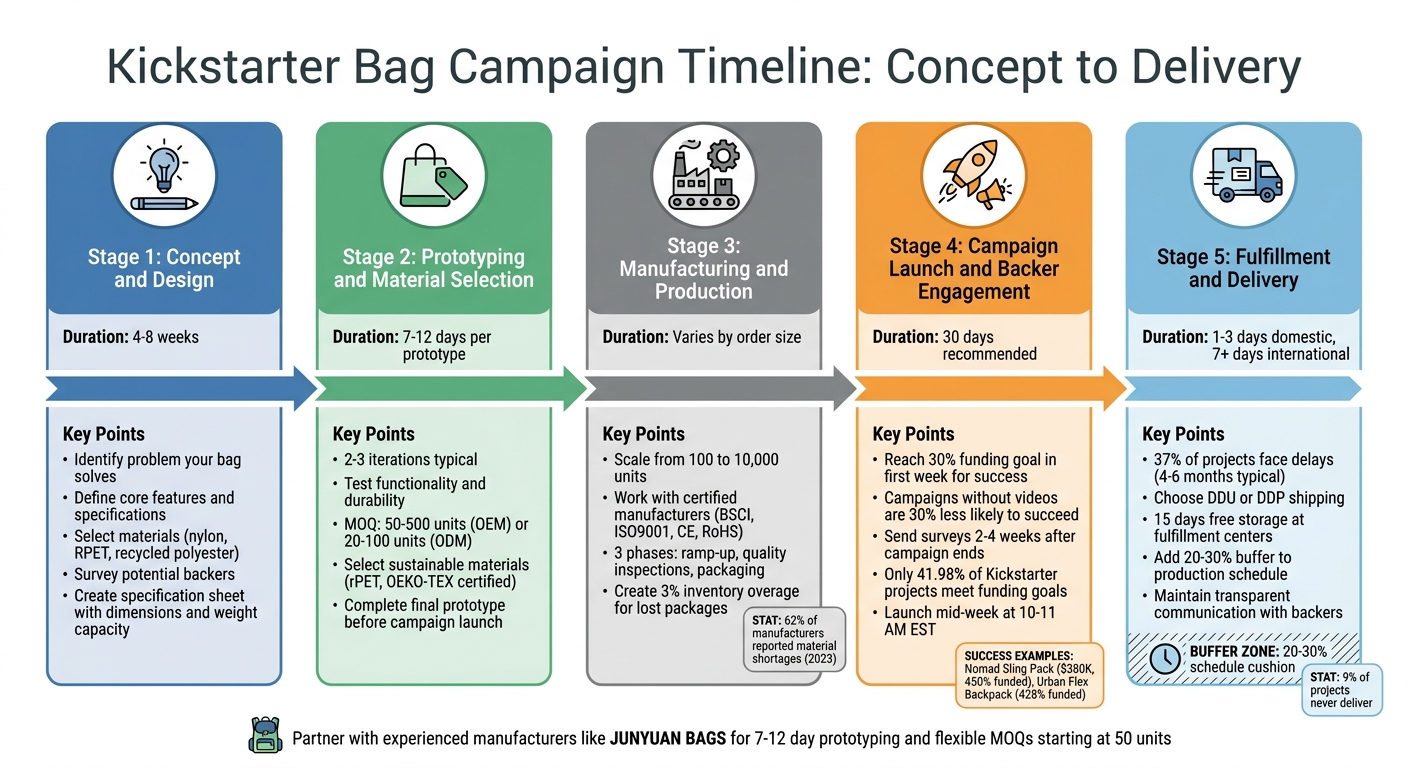
5-Stage Kickstarter Bag Campaign Timeline from Concept to Delivery
What It Really Takes to Make a Backpack ( Hidden Process Revealed )
sbb-itb-1e6451b
Stage 1: Concept and Design
The design phase is where the foundation of your Kickstarter campaign is laid. Before diving into prototyping, it’s crucial to pinpoint the specific problem your bag will solve for your audience. For instance, a golf bag for weekend players will have entirely different requirements than a laptop backpack for daily commuters or an athletic bag for pickleball fans. Each type of bag needs unique features, materials, and durability standards – all of which influence your production costs and the satisfaction of your backers.
Start by outlining your bag’s core functional requirements. For a golf bag, think about how many clubs it should hold, whether it needs a stand, and what kind of weather protection is necessary. For athletic backpacks, focus on ventilation for sweaty gear, easy access to water bottles, and weight distribution for comfort. Document these details in a specification sheet, including dimensions (in inches), weight capacity (in pounds), and prioritized features. This document will serve as your guide when discussing manufacturing options and costs.
As you define the bag’s features, select materials that balance functionality, durability, and sustainability. For example, heavy-duty nylon might be ideal for outdoor use, while RPET (recycled polyester) could resonate with eco-conscious backers. Sustainability is increasingly important in bag design, with many backers gravitating toward products that align with their environmental values. Plan for 4–8 weeks of research, feedback, and refinement before moving on to prototyping.
Once your core ideas are set, focus on defining the essential features and collaborating with your manufacturing partner.
Defining Core Features and Functions
The most effective bag designs come from direct feedback from your audience. Use tools like Typeform or SurveyMonkey to survey potential backers about their frustrations with existing products. Ask specific questions like: What features do they wish current bags offered? What would they be willing to pay extra for? What price range feels fair for a well-made product? Organize the responses into a decision matrix, scoring each potential feature based on user demand and manufacturing complexity.
Sort features into three categories: essential functionality (absolutely necessary for the bag to work), competitive differentiators (features that set your bag apart), and optional enhancements (extras you can include if the budget allows). For example, a pickleball bag might require paddle protection and ball storage as essentials, while a built-in cooler pocket or shoe compartment could serve as differentiators. Prioritizing features this way helps you avoid overcomplicating the design and ensures your product stays within budget while appealing to backers.
Once your features are prioritized, you’re ready to collaborate with JUNYUAN BAGS to bring your vision to life.
Working with JUNYUAN BAGS on Custom Designs
An experienced manufacturer can transform your concept into a tangible, producible design. JUNYUAN BAGS specializes in OEM/ODM design services, assisting creators with custom logos, sizing, and patterns tailored to their campaign goals. Their expertise spans a variety of bag categories – from golf bags and athletic backpacks to laptop carriers and eco-friendly RPET designs – making them a valuable partner in the early stages of your project.
When you meet with JUNYUAN BAGS, present your detailed specifications and audience insights. This helps them provide accurate cost estimates and flag any potential manufacturing challenges, such as complex compartment layouts or expensive material combinations. Their input will help you understand how your design choices affect sample creation timelines and bulk production costs, ensuring your Kickstarter pricing stays realistic while delivering on backer expectations. Use tools like Google Docs or Notion to keep track of design revisions, approvals, and updates throughout the collaboration process.
Stage 2: Prototyping and Material Selection
Prototyping and choosing the right materials are essential steps to ensure your design aligns with production goals and campaign timelines. This stage transforms your concept into a functional, test-ready prototype. Typically, the first prototype takes 7–12 days to complete, and most successful Kickstarter bag projects go through 2–3 iterations before arriving at a final production-ready sample. Each iteration is an opportunity to refine details, such as adjusting strap placement for better weight distribution, reinforcing stress points, or resizing pockets for practicality.
"Plan for everything, from design to fulfillment. I filled notebooks full of designs and drawings before I made my first prototypes."
This advice from Micah Toll, Founder of Maker Batteries, underscores the value of preparation. Keep a detailed record of every adjustment to streamline revisions. You can also capture short videos during testing to share with potential backers, offering them a "behind-the-scenes" look and building trust and engagement before your campaign launches.
Building Your First Prototype
Once your design is finalized, prototyping turns your ideas into tangible samples. This stage not only helps you create a physical model but also establishes your production timeline. JUNYUAN BAGS offers flexibility in prototype development, with minimum order quantities ranging from 50–500 units for OEM projects and 20–100 units for ODM projects.
Each prototype iteration should be rigorously tested under conditions that reflect real-world usage. For instance, test golf bags for weather resistance or athletic backpacks for load distribution. Document what succeeds and what needs improvement, and share these insights with your manufacturer to refine the next version. It’s crucial to complete your final prototype before launching your campaign, so you can showcase high-quality photos and videos of the actual product on your campaign page.
"Make sure that both you and your product are prepared for success and you can fulfill your promises."
Selecting Materials for Durability and Sustainability
The materials you choose will directly influence your bag’s performance and its appeal to eco-conscious backers. Sustainable materials like rPET (recycled polyethylene terephthalate), recycled nylon, and organic cotton are increasingly popular. OEKO-TEX certified fabrics, which guarantee environmental and safety standards, are also a great option for modern crowdfunding campaigns.
While sustainability is important, you’ll also need to balance it with functionality. Features like waterproof zippers, reinforced laptop sleeves, and custom straps add durability and utility but may increase production costs and timelines. During prototype testing, evaluate these components rigorously. For example, if your bag advertises a waterproof compartment, submerge that section in water for 30 minutes to ensure it performs as promised.
Collaborate with JUNYUAN BAGS to source materials that meet your budget while aligning with backer expectations. Thorough testing and careful material selection at this stage will set the foundation for smooth production and a successful campaign.
Stage 3: Manufacturing and Production
Once your prototype is perfected, the next step is scaling up production – a crucial phase for any successful campaign. Moving from a finalized prototype to full-scale production requires a manufacturing partner who can handle varying order sizes, from 100 to 10,000 units, depending on how your campaign performs. Before you launch, make sure to finalize key aspects like material sourcing, assembly steps, and quality control measures. This structured approach ensures a smooth transition from prototype validation to mass production.
Working with Certified Manufacturers
Choosing the right manufacturing partner is essential to safeguarding your brand and maintaining trust with your backers. For instance, JUNYUAN BAGS holds BSCI, ISO9001, CE, and RoHS certifications, which guarantee compliance with industry standards and consistent quality.
Early on, confirm that your manufacturer can deliver to your fulfillment location. Check shipping routes, mail classes, and postage costs in advance to avoid unexpected issues when setting reward tier pricing. Request detailed production estimates tailored to your order size, and establish clear milestones to account for potential delays.
Production Timelines and Key Milestones
With a reliable partner secured, production can be divided into three main phases: ramp-up, quality inspections, and packaging. During the ramp-up phase, your manufacturer will source raw materials and prepare assembly lines. Once your campaign is funded, keep an eye on pledge quantities daily and inform your manufacturer promptly so they can start procuring materials without delay.
Quality inspections are conducted at several stages – after cutting materials, during assembly, and before packaging. For example, JUNYUAN BAGS performs checks at each step to catch issues early, reducing the risk of costly rework. The packaging phase covers everything from labeling and protective wrapping to preparing products for international shipping. Be sure to include extra time for customs clearance, shipping delays, or last-minute changes. This buffer helps you maintain credibility with your backers while ensuring smooth delivery.
Stage 4: Kickstarter Campaign and Backer Engagement
With production partners in place and timelines set, it’s time to launch your Kickstarter campaign. This is a critical phase – success here hinges on your ability to hit the ground running. Research indicates that campaigns reaching 30% of their funding goal within the first week are far more likely to succeed.
A strong launch requires a compelling campaign page that converts interest into pledges.
Creating an Effective Campaign Page
Your campaign page needs to prove that your bag is more than just an idea – it’s ready to be produced and shipped. High-quality photos and videos of physical prototypes are essential. Avoid relying on 3D renders, as campaigns without videos are nearly 30% less likely to succeed. For instance, the Nomad Sling Pack raised $380,000 from over 1,200 backers, achieving a 450% funding rate by showcasing waterproof zippers and custom hardware in action shots. Similarly, the Urban Flex Backpack reached 428% of its goal with 1,000+ backers by highlighting features like modular laptop sleeves and recycled materials. This effort earned it a "Project We Love" badge from Kickstarter.
To encourage pledges, organize your rewards into three clear tiers:
- Entry: A simple tote or accessory.
- Main: The core backpack with all its features.
- Upgrade: Bundles that include matching accessories or premium options.
Be specific about product details. Include specs like waterproof ratings, laptop sleeve dimensions, and sustainability credentials such as rPET, recycled nylon, or OEKO-TEX certified fabrics, which resonate strongly with backers. Transparency is also key – mention manufacturing certifications, low minimum order quantities (MOQs), and provide clear shipping details for major markets like the US, UK, Canada, and EU.
"Backers place trust in people as much as in ideas. Campaigns where entrepreneurs highlight their own qualities and motivations consistently outperform those that only describe the venture." – Stephanie Brooke Escudero, Department of Management, Colorado State University
Start by leveraging your personal network. Entrepreneurs with established online communities often secure early backers more quickly, creating a "snowball effect" that draws in new supporters. Set a funding goal that reflects actual production costs – overly high goals may seem unrealistic, while goals set too low can appear unprofessional to experienced backers. A well-thought-out campaign page reassures potential backers that you’ve planned every detail.
Collecting Backer Feedback Through Surveys
Once your campaign gains traction, take the opportunity to gather feedback from your backers through surveys. Send these surveys two to four weeks after your campaign ends, once Kickstarter’s 14-day payment processing window has passed. You can choose between Kickstarter’s native survey tool or third-party options like PledgeBox or BackerKit. While Kickstarter’s tool is free, it’s limited – once a survey is sent, it cannot be updated. Third-party tools, on the other hand, offer features like address validation, upselling options, and editable responses. For example, PledgeBox charges 3% only on additional funds raised through add-ons, making it a budget-friendly choice for many creators.
Keep your surveys short and focused on fulfillment essentials, such as:
- Reward selections (size, color, style)
- Shipping addresses
- Phone numbers for international deliveries
Use casual, user-friendly language like "Which design would you like?" instead of technical terms like "Confirm SKU selection". Limit product variants to three per item to avoid overwhelming your backers. Set a clear deadline for survey completion and send automated reminders to ensure timely responses – this helps lock in production numbers and avoids delays.
"The survey isn’t just admin work; it’s your main tool for building trust and ensuring a seamless transition from funding to fulfillment." – PledgeBox
With only 41.98% of Kickstarter projects successfully meeting their funding goals, maintaining transparent communication throughout your campaign is crucial. Regular updates about production milestones, material sourcing, and expected retail pricing can keep backers engaged and confident in your ability to deliver.
Stage 5: Fulfillment and Delivery
After completing manufacturing and collecting backer surveys, the next big hurdle is ensuring your products reach supporters worldwide. This stage involves coordinating warehouses, shipping carriers, and customs brokers to get every package delivered on time and in good condition.
Managing Global Shipping Logistics
Before shipping starts, decide on your fulfillment approach. If your project involves fewer than 500 packages, handling fulfillment yourself might work – provided you have enough space and time for packing everything manually. But for larger projects, partnering with a third-party fulfillment company becomes almost unavoidable. These companies handle warehousing, customs, and global distribution, which is why campaigns raising over $1.9 million have relied on their expertise.
Shipping internationally adds layers of complexity. You’ll need to navigate customs requirements and choose between DDU (Delivered Duty Unpaid) and DDP (Delivered Duty Paid) shipping. With DDU, backers pay import duties when the package arrives, which can lead to surprise costs. DDP, while more expensive upfront, covers all duties and taxes in advance, creating a smoother experience for your backers. Some fulfillment centers even offer up to 15 days of free storage for crowdfunding projects, giving you a little breathing room to organize shipments without incurring extra fees.
"Create 3% more inventory as an overage, just in case packages get lost." – Kickstarter
Producing 3% more inventory is a smart move to account for lost or damaged packages. When calculating shipping costs, overestimate bag weights and dimensions, and always validate your numbers with test shipments. If you’re managing fulfillment yourself, it’s a good idea to run a test shipment with prototypes to ensure your packaging and costs are accurate.
Once your logistics plan is in place, the focus shifts to meeting delivery deadlines.
Meeting Delivery Deadlines
Timely delivery is critical once your logistics are finalized. Build some buffer time into your schedule to handle unexpected manufacturing or shipping delays. Keep a close eye on pledge quantities and order raw materials as soon as you hit your funding goal to avoid production bottlenecks.
When delays happen – and they often do – transparency is everything. Backers understand that manufacturing can be unpredictable, but they won’t tolerate being left in the dark. If your timeline changes, use Kickstarter updates to notify supporters immediately and provide a revised delivery estimate. Regular updates help maintain trust. For example, the Wipebook campaign – a zero-waste notebook project – raised over $500,000 and kept backers informed throughout, even surpassing its modest $4,000 goal in just hours. Similarly, GNARBOX, a portable storage device, built a lead list of 20,000 potential customers before launch, raised over $500,000 in 30 days, and used the funds to execute large-scale international shipping.
"Open, honest communication is always preferable to radio silence – and can build long-term trust between you and your backers." – Kickstarter
For U.S. shipments, flat-rate packaging can simplify costs, especially for items weighing under 4 lbs. International shipping typically requires more lead time – plan for 1–3 business days to communicate with domestic carriers and at least 7 business days when working with overseas partners, factoring in time zones and potential language barriers. Also, confirm that your manufacturer can ship directly to your warehouse or destination country, especially if they haven’t shipped to that region before.
Managing Risks and Maintaining Quality Standards
When running a Kickstarter bag campaign, managing risks and ensuring quality are just as important as the design and production process. Production hiccups are almost inevitable – 37% of Kickstarter projects face delays, with bag campaigns typically running 4–6 months late due to manufacturing issues. In 2023, 62% of apparel manufacturers reported material shortages, and 9% of Kickstarter projects never deliver at all. These numbers highlight the need for careful planning and strict quality control at every step.
Planning for Production Challenges
Start by creating a risk matrix to identify and address your biggest challenges. Common risks in bag manufacturing include supply chain delays, material shortages, and quality defects. Assign each risk a probability and impact level, then develop tailored mitigation strategies. To minimize delays, add a 20–30% buffer to your production schedule – this can reduce delay impacts by up to 50%.
Supplier diversification is another key safeguard. Relying on a single supplier can leave you vulnerable. For instance, if your primary fabric source runs out, having a backup supplier ensures production doesn’t grind to a halt. Consider pre-stocking essential components like custom zippers and hardware. You can also include contract clauses that allow for alternative materials. One bag creator successfully switched to recycled polyester during a cotton shortage, staying on schedule while maintaining their eco-friendly promise.
Set aside 10–15% of your budget for unexpected costs like tariffs, equipment breakdowns, or rework. Weekly check-ins with your manufacturer during the production ramp-up phase can help you identify and resolve problems early – campaigns that adopt this practice have cut downtime by 40%. Conduct factory audits before production begins, and use tools like Asana to monitor milestones and keep everything on track.
While managing risks helps keep production moving, maintaining high-quality standards ensures your final product meets backer expectations.
Quality Assurance and Certifications
Working with BSCI and ISO 9001 certified manufacturers can significantly improve your chances of success. BSCI certification ensures ethical labor practices and social compliance, reducing risks like worker strikes or backlash over unethical sourcing. ISO 9001 focuses on consistent quality management processes, leading to more reliable production. Factories with both certifications report 25% fewer product returns and 12% better on-time delivery rates.
Incorporate quality checkpoints throughout the production process. Start with pre-production samples for approval, then conduct in-line inspections at 30% and 70% completion. Finally, perform AQL (Acceptable Quality Limit) testing with a target defect rate of 2.5%. Use detailed checklists to assess stitching, zippers, and material durability. Investing in third-party pre-shipment inspections ($300–$500 per batch) can catch 80% of defects before shipping, saving you from costly returns and unhappy backers. JUNYUAN BAGS, for example, uses a 4-step process that includes strict quality control protocols, ensuring every bag meets campaign specifications.
Track quality metrics like defect rates (aim for less than 1%) and backer satisfaction (target above 95%). Post-prototype and post-delivery surveys can help you identify areas for improvement, cutting revisions by 30% and refining future projects. BSCI-audited factories also report 15–20% fewer labor violations and higher satisfaction ratings from crowdfunding backers, giving you an edge in delivering a product that meets expectations.
Conclusion: Steps to a Successful Kickstarter Bag Campaign
Bringing your Kickstarter bag campaign to life means carefully navigating each stage – from initial design to final delivery. Success hinges on thorough planning at every step: concept and design, prototyping and material selection, manufacturing and production, campaign execution, and fulfillment and delivery. Skipping or rushing through any stage can lead to delays, quality issues, or unhappy backers.
Working with an experienced manufacturer can simplify the process. For example, JUNYUAN BAGS has played a role in over 20 successful crowdfunding campaigns, offering flexible minimum order quantities (MOQs) starting at just 50 units for OEM projects. They also provide rapid prototyping, delivering samples within 7–12 days. These quick prototypes are perfect for creating campaign photos and videos – essential tools for attracting backers. Campaigns that prioritize timely prototyping and manageable MOQs often see higher funding success.
Managing your timeline is just as important as nailing the design and production phases.
"Incorporate worst case scenarios into your estimate so that you can put the most accurate date on your rewards. Make sure that you leave some buffer room for manufacturing and shipping so you can follow through on your promise."
– Jamey Stegmaier, Founder, Stonemaier Games
Work backward from your desired delivery date, building in extra time for unforeseen delays. Timing your campaign launch is also critical. Aim to start mid-week around 10:00–11:00 AM EST, and keep the campaign to 30 days. This approach maintains urgency and helps avoid the dreaded mid-campaign slump. Additionally, partnering with manufacturers that offer DDP (Delivered Duty Paid) shipping simplifies international logistics, ensuring your backers receive their rewards on time.
With careful preparation, a reliable manufacturing partner, and a well-structured timeline, you can deliver high-quality products that not only meet but exceed backer expectations, ultimately boosting your credibility and future opportunities.
FAQs
How do I set a realistic delivery date for my bag?
To determine a realistic delivery date, start by carefully planning your production timeline and staying in close communication with your manufacturer. Break the process into key stages:
- Prototyping: Each round usually takes about 7–14 days.
- Manufacturing: This stage typically requires 30–45 days.
- Shipping: Depending on customs and logistics, shipping could take several weeks.
It’s wise to build in a 10–20% buffer to account for potential delays. For instance, if production is expected to take 6 weeks, aim to set your delivery date at least 8 weeks out. This extra time helps prevent last-minute surprises or missed deadlines.
What should I test on my prototypes before launch?
Before rolling out your prototype, make sure to test key elements like water resistance, weight distribution, seam durability, and overall comfort to ensure it performs as intended. It’s also important to assess the materials, load capacity, and construction quality to guarantee dependability. These checks help confirm that the features you’ve promised function as designed and align with your vision before moving into full production.
How do I avoid surprise customs fees for backers?
To avoid unexpected customs fees, it’s important to carefully plan your shipping approach. One effective option is using DDP (Delivered Duty Paid) shipping, which ensures customs fees are included in the upfront shipping cost. This way, your backers won’t be hit with additional charges when their rewards arrive.
Make sure to clearly outline any potential customs fees in your campaign updates or reward descriptions. By managing expectations early, you can minimize surprises and keep your backers happy.