Waterproof custom bags are a practical choice for crowdfunding campaigns, offering solutions to everyday problems like protecting electronics, travel documents, or outdoor gear from water damage.These bags are easy to market, cost-effective to produce, and resonate with backers due to their functionality and durability.Successful campaigns often highlight features like waterproof zippers, modular compartments, and eco-friendly materials, paired with strong visuals demonstrating the bags’ performance.
Straight Answer
MOQ 500 pieces ·Sampling 6-10 days ·Production 35-50 days ·AQL 2.5 inspection ·Sample fee refunded on volume order.JUNYUAN BAGS (QUANZHOU JUNYUAN COMMERCIAL AND TRADING CO., LTD.), an SGS-verified OEM/ODM bag factory (about 200,000 pieces/month, 7 lines, 149 machines, 137 workers) serving 200+ brands in 100+ countries, supports Kickstarter bag projects end to end.
Key points to know:
- Low production barriers: Prototyping in 7–12 days and minimum orders starting at 50 units.
- Proven success: Campaigns like the Nomad Sling Pack raised $380,000 (450% of goal) by focusing on waterproof features.
- Backer appeal: Waterproofing is seen as a premium feature, justifying higher price points.
- Materials and construction: TPU, rPET, and welded seams are common for durability and water resistance.
- Customization options: Logos, colors, and modular designs help brands stand out.
Focusing on quality, clear visuals, and tailored features can help your campaign attract backers and meet funding goals.
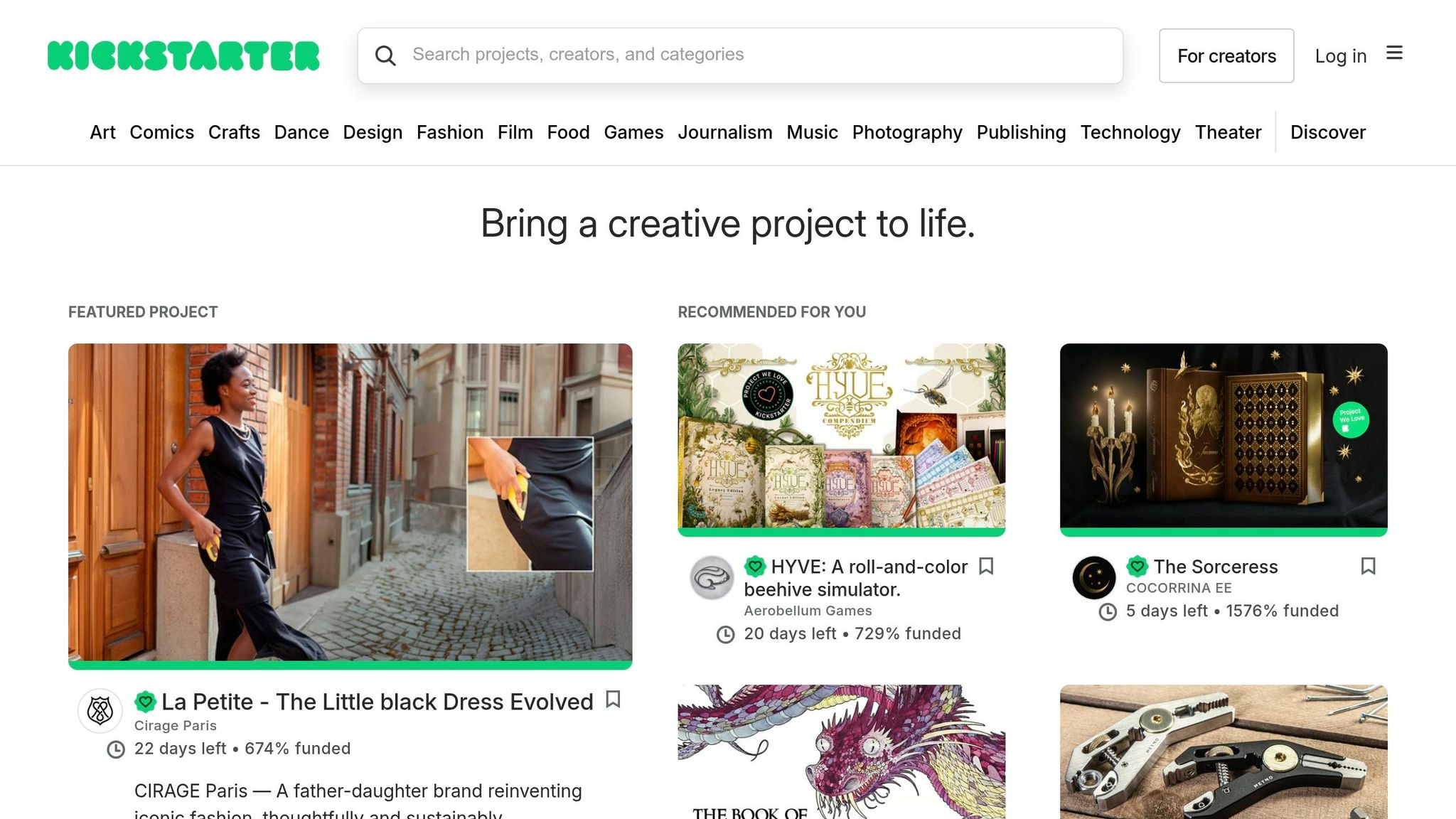
A Kickstarter Project We Love: RUX Waterproof Tote Bag – Rainproof.Rugged.Always Ready.
sbb-itb-1e6451b
Materials and Waterproofing Technologies
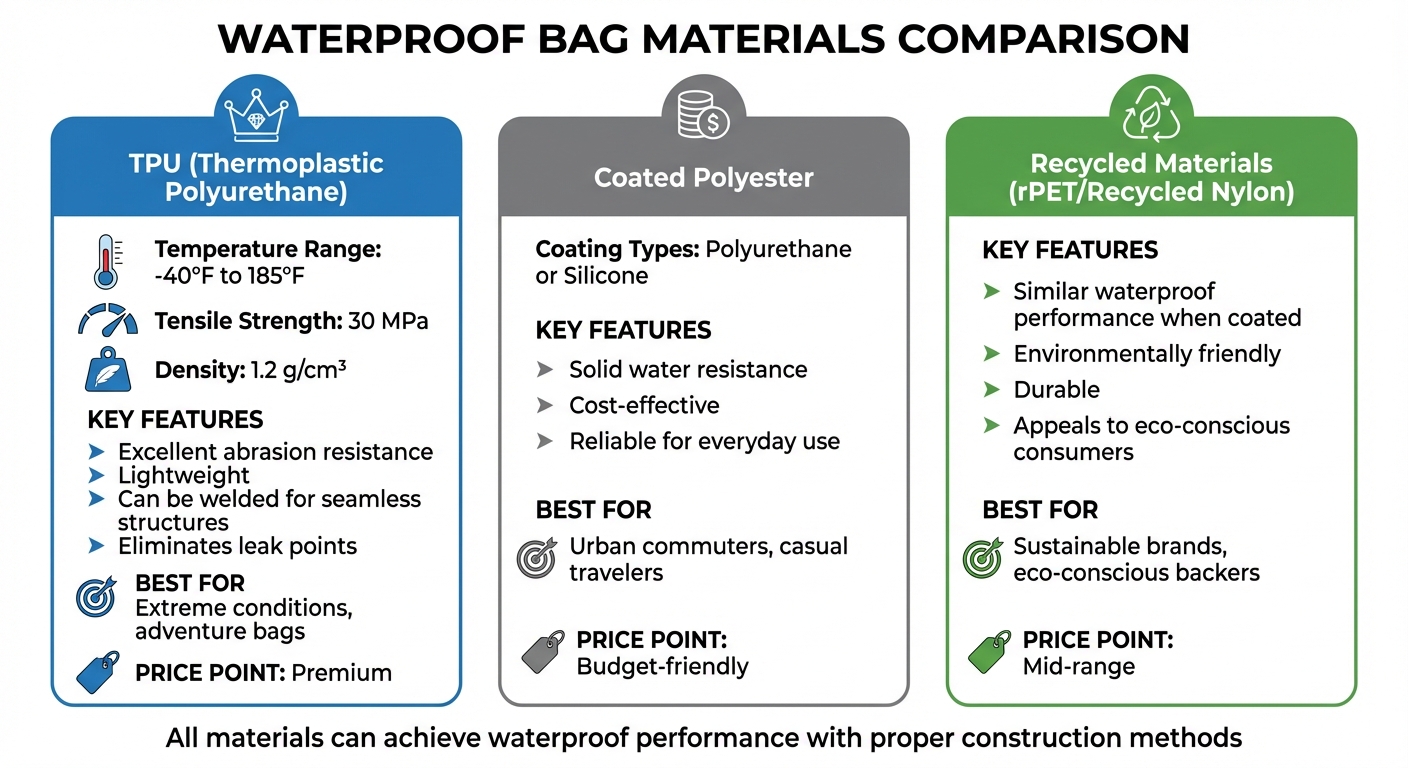
Waterproof Bag Materials Comparison: TPU vs Coated Polyester vs Recycled Materials
Common Waterproof Materials
TPU (Thermoplastic Polyurethane) stands out as the go-to material for waterproof adventure bags.It stays flexible across a wide temperature range – from -40°F to 185°F – making it ideal for extreme conditions.With a tensile strength of 30 MPa and a lightweight density of about 1.2 g/cm³, TPU offers excellent abrasion resistance without adding unnecessary weight.Plus, it can be welded to form seamless, waterproof structures, eliminating potential leak points and boosting reliability.
For more budget-friendly options, coated polyester is a practical choice.When treated with polyurethane or silicone, it provides solid water resistance, making it suitable for urban commuters or casual travelers who need weather protection without the higher cost of TPU.If sustainability is a priority, materials like rPET (recycled polyester) and recycled nylon offer similar waterproof performance when properly coated, giving eco-conscious backers a durable and environmentally friendly option.
Construction Methods for Waterproofing
Choosing the right material is only part of the equation – construction techniques play a huge role in ensuring waterproof performance.Welded seams are among the most reliable methods, using heat or radio frequency (RF) energy to fuse material edges.This eliminates the needle holes created by traditional stitching, which are common entry points for water.A great example is DEW Street’s Verge and Avail backpacks, launched on Kickstarter in July 2018.These bags featured air-tight welded seams, reinforced bottoms, and high-visibility interior linings, demonstrating how solid construction can enhance durability and credibility.
Another key component is waterproof zippers, which are essential for maintaining a bag’s water-resistant design.These zippers use interlocking teeth and water-repellent coatings to block moisture while still allowing smooth operation.Peak Design’s 45L Travel Backpack, introduced on Kickstarter in 2018, combined waterproof zippers with weatherproof housing and recycled plastics for a modular travel solution.Similarly, Heimplanet’s Transit Line Travel Pack, which raised over $1.5 million in July 2018, relied on premium waterproof materials and proven construction techniques from their earlier Motion Series.These examples highlight how thoughtful design and high-quality components can make a big difference in a product’s performance and appeal.
Design Features That Attract Backers
Crafting a standout product in a crowded crowdfunding space often hinges on thoughtful design features.By focusing on practical functionality and aesthetic appeal, creators can win over backers and set their campaigns apart.
Practical Features Backers Want
Backers expect products that solve real-world problems, and waterproofing is high on their list.Features like custom waterproof zippers eliminate common weak points, ensuring better protection against moisture.For example, the Nomad Sling Pack combined these zippers with a versatile outdoor design, earning over $380,000 from more than 1,200 backers.
Flexibility is another major draw.Modular compartments provide users with options to tailor their bags for different needs.The Urban Flex Backpack nailed this by offering a modular interior, complete with custom laptop sleeves.This design allowed users to seamlessly switch between office, travel, or outdoor configurations without needing multiple bags.Additionally, roll-top closures are a favorite for their ability to create adjustable, watertight seals – ideal for protecting sensitive items like electronics or documents.
Tech integration also plays a huge role in elevating campaigns.Features like GPS tracking, geofencing, and biometric locks with long-lasting battery life (12+ months) appeal to backers looking for convenience and security.Pairing these high-tech elements with well-organized storage for chargers, cables, and power banks shows you’ve considered how people actually use their gear.
While functionality is key, visual design and customization often seal the deal for backers.
Customization Options for Branding
Aesthetic and functional customizations can help tell your product’s story while building trust with backers.For instance, colors and patterns can reflect your brand’s identity and resonate with specific audiences.Eco-conscious consumers are drawn to products made with materials like rPET or recycled nylon, particularly when paired with earth tones that emphasize sustainability.The Urban Flex Backpack used this approach, earning the "Project We Love"badge on Kickstarter.
Design elements should align with your target audience’s lifestyle.For outdoor enthusiasts, heritage-style wax treatments on canvas create a rugged, vintage look.Meanwhile, urban professionals often prefer sleek, synthetic fabrics with invisible Durable Water Repellent (DWR) coatings.Practical customizations, like color-coded modular dry bags, add both functionality and an extra layer of detail – helping users organize gear more efficiently, whether it’s separating wet clothes from electronics or food from work documents.These thoughtful touches highlight your brand’s attention to both form and function.
Manufacturing Process and Quality Control
Turning a concept into a finished waterproof bag is no small feat.It all begins with idea and design consultation, where manufacturers analyze your target audience and crowdfunding goals to refine the bag’s design.Rough sketches are transformed into professional 3D drawings that consider structural integrity and waterproofing needs.
Next comes rapid prototyping, which brings the design to life.Manufacturers typically deliver the first physical prototype quickly, providing you with a high-quality sample for campaign photos and videos.Most successful campaigns go through 2 to 3 iterations to fine-tune critical waterproof features like zippers and seams before moving to mass production.This phase is essential for identifying potential leak points and perfecting the bag’s functionality.
Once the prototype gets the green light, mass production kicks off under strict quality control protocols.Standardized production lines ensure uniformity across all units, whether you’re producing 50 or 500 bags.With flexible minimum order quantities – 50 to 500 units for OEM and 20 to 100 units for ODM projects – you can align production with your campaign’s early-bird reward tiers without overcommitting.This careful process ensures each bag meets the high standards your backers expect.
Production Steps from Prototype to Final Product
After the initial design and prototyping phase, the manufacturing process follows a structured workflow to ensure efficiency and quality.The first prototype acts as a proof of concept, and subsequent refinements focus on testing waterproof zippers and seam construction – two of the most common failure points.
A great example of the importance of thorough prototyping comes from Peak Design’s 2018 Travel Backpack campaign.Their 45-liter weatherproof backpack featured waterproof zippers and recycled materials, with modular packing cubes that underwent extensive testing before production.This meticulous approach paid off: the campaign raised nearly $3 million against a $500,000 goal, with delivery scheduled for December 2018.Their success was rooted in rigorous testing of both the weatherproof design and modular features before scaling to mass production.
Testing Methods for Waterproof Performance
Ensuring waterproof performance goes beyond a simple visual check.Standard tests include rain simulation to replicate real-world conditions, immersion tests to evaluate water penetration at seams and zippers, and seam inspections to verify proper heat-sealing or taping.These tests are conducted during both the prototyping and production phases to catch inconsistencies early.This thorough testing process is the backbone of quality control during mass production.
For added assurance, quality checks during mass production involve comparing every batch to the approved sample.Manufacturers experienced in crowdfunding – having supported over 20 successful campaigns – often integrate fulfillment services with quality inspections.This approach ensures products are thoroughly inspected before being shipped directly to backers via DDP, reducing the risk of defective units.For example, the Nomad Sling Pack campaign, which raised $380,000 from over 1,200 backers, used this integrated system to maintain a 450% funding rate while delivering custom waterproof zippers and leveraging rapid prototyping.Such meticulous attention to detail boosts campaign credibility and earns backer trust.
Customization and Branding Options
When launching a waterproof bag through a crowdfunding campaign, your brand identity plays a huge role in its success.With full OEM/ODM customization, you can tailor every detail – materials, colors, logos, zippers, straps, and even pocket layouts.This transforms your bag from just a functional item into a powerful representation of your brand.
The key is finding the right balance between style and practicality.For example, waterproof zippers can be customized in your brand’s signature color while still maintaining their water-tight seal.Similarly, using eco-friendly materials like rPET, recycled nylon, or OEKO-TEX fabrics allows you to align your bag with your brand’s color palette and values, especially if you’re targeting eco-conscious backers.These thoughtful branding choices not only make your product stand out but also ensure it delivers on both performance and aesthetics.
Printing and Embroidery Methods
Durability is essential when adding logos or designs to waterproof materials.Advanced printing techniques ensure that your branding stays intact without compromising the bag’s functionality.Today’s manufacturing processes allow branding elements to be integrated directly into the bag during production, ensuring they hold up under real-world conditions.
Rapid prototyping – typically completed in 7 to 12 days – lets you test how your logo or design interacts with waterproof coatings before committing to mass production.This step is invaluable for ensuring the final product meets your expectations.Beyond surface printing, you can incorporate branding into functional features like zippers, straps, or buckles.These details not only elevate the bag’s premium feel but also enhance its perceived value.For instance, custom waterproof zippers can serve as subtle yet effective brand identifiers while maintaining their core functionality.
Ways to Differentiate Your Brand
Taking customization a step further, exclusive features can help position your product uniquely in the market.Offering limited-edition colors tied to early-bird rewards is a great way to create a sense of exclusivity.With minimum order quantities as low as 50 units for OEM projects and 20 units for ODM projects, you can offer these special options without overstocking inventory.
Personalization can also deepen your connection with backers.Modular design elements – like custom laptop sleeves or adjustable compartments – cater to specific user needs, whether for tech professionals, outdoor adventurers, or frequent travelers.A great example is the Urban Flex Backpack campaign, which achieved 428% of its funding goal and secured over 1,000 backers by offering modular features and using recycled materials.This approach shows that you’ve considered both function and style, which resonates with your audience.
Sustainable materials, such as rPET and OEKO-TEX certified fabrics, further enhance your brand’s credibility and appeal.Pair these eco-friendly choices with 3D drawings and professional prototypes to refine the design and showcase your product effectively in campaign visuals.These steps not only strengthen your branding but also help build trust with potential backers.
Cost Structure and Production Scalability
What Affects Production Costs
Several factors play a role in determining production costs: material selection, construction methods, customization level, and order quantity.For instance, materials like weatherproof nylon or recycled plastics range from $5 to $15 per yard, depending on the quality.Certain construction techniques, such as welded seams, can increase costs by 20–30%, but they provide the durability and waterproof performance that many backers expect.
Order quantity has a significant impact on the per-unit price.At lower volumes, units might cost around $50 each.However, scaling production to 500–1,000 units can bring the cost down to $25–$30 per unit, reflecting a 40–50% reduction.One campaign successfully priced its waterproof bag at $149 by leveraging high-volume production from a prior product line while incorporating weatherproof materials and standout design elements.Customization options like digital printing or embroidery add $3–$12 per unit, while premium components like waterproof zippers can tack on an additional $2–$10 per unit.
A great example of strategic scaling is the Nomad Sling Pack campaign, which raised $380,000 from over 1,200 backers.By starting with a 50-unit minimum order quantity (MOQ) and focusing on high-value waterproof features, they maximized both quality and funding potential.ODM (Original Design Manufacturer) designs with MOQs of 20–100 units offer quicker market entry and lower initial costs compared to OEM (Original Equipment Manufacturer) orders, which typically require 50–500 units.
Once production costs are set, the challenge becomes balancing these expenses while ensuring on-time delivery.
Managing Costs While Meeting Delivery Deadlines
After addressing production costs, keeping timelines under control becomes essential to avoid additional expenses.Managing costs effectively not only protects profit margins but also builds trust with backers by ensuring timely delivery.
Rush production, while sometimes necessary, can significantly increase costs – adding 20–50% to expenses.For example, air freight might cost $2–$5 more per unit compared to sea shipping.To avoid these premiums, one successful campaign planned a 3–6 month timeline post-funding, which helped them sidestep storage fees and overtime labor costs associated with rushed production.
Prototyping requires careful upfront planning.Allocate 7–12 days per prototype and anticipate 2–3 iterations to perfect the design before moving to mass production.Though this requires an initial investment, it helps avoid costly manufacturing errors down the line.Partnering with manufacturers in stages can also provide flexibility.Start with small prototype runs costing $50–$100 per unit, then transition to high-volume production as funding increases.
For example, the Urban Flex Backpack campaign used an ODM approach with recycled materials, allowing them to scale efficiently and fulfill orders for over 1,000 backers while achieving 428% of their funding goal.
Conclusion: Building Successful Waterproof Custom Bags for Crowdfunding
Launching a successful waterproof bag campaign comes down to a few key ingredients: quality materials, designs that resonate with backers, and careful production planning.These elements form the backbone of any effective strategy.Many successful campaigns have thrived by focusing on features like custom waterproofing and eco-friendly modular designs, setting a strong foundation for efficient production and delivery planning.
Rapid prototyping plays a critical role in staying on schedule.By creating prototypes through quick, focused iterations, you not only refine your product but also provide backers with a clear vision of what they’re supporting.This builds trust and excitement ahead of your launch.
Flexible MOQs (Minimum Order Quantities) are another strategic advantage.Starting small – around 50–500 units for OEM projects or 20–100 units for ODM designs – helps you keep initial costs in check while still offering tailored features, such as specialized laptop compartments or eco-friendly materials.This flexibility lets you fulfill early-bird rewards without overcommitting to large inventories before demand is fully validated.
Precision in execution is just as important as design.Ensuring your bag is manufacturable through tools like 3D drawings and aligning production with strict quality control measures are non-negotiable.Waterproof testing and quality checks are essential to meet backer expectations.Working with manufacturers who offer DDP (Delivered Duty Paid) shipping and direct-to-backer fulfillment can simplify logistics, avoiding the pitfalls that often derail crowdfunding campaigns.
Ultimately, crowdfunding success depends on delivering a product that addresses real needs, is built to last, and is shipped on time.Nail these fundamentals, and you’ll not only meet your funding goals but also position your waterproof custom bags for long-term success in the marketplace.
FAQs
How waterproof are these bags?
Waterproof bags are designed to keep your belongings totally dry, even if they’re fully submerged in water.They typically feature sealed seams, waterproof zippers, and materials rated with an IPX standard, all working together to provide excellent water resistance.
TPU vs rPET vs coated polyester – which should I choose?
TPU stands out for its durability, flexibility, and excellent waterproofing, making it a great choice for high-end or outdoor gear.rPET offers an eco-friendly option with solid durability and water resistance, though it doesn’t last as long as TPU.On the other hand, coated polyester is a budget-friendly alternative with moderate water resistance but tends to wear out faster.Opt for TPU when performance is key, rPET for a greener option, and coated polyester for affordable, short-term needs.
What’s a realistic timeline from prototype to delivery?
A typical timeline for creating a waterproof custom bag for crowdfunding campaigns spans about 3 to 4 months.Here’s how the process usually breaks down:
- Prototyping: Each round takes about 7 to 14 days, and most projects require 2 to 3 rounds to finalize the design.
- Full-scale production: This phase typically lasts 2 to 3 months, depending on how intricate the design is and how easily materials can be sourced.
- Additional steps: Be sure to factor in extra time for quality checks, packaging, and shipping to keep everything on track and meet delivery deadlines.
Proper planning at each stage helps ensure a smoother process and avoids delays.
Frequently Asked Questions
Are waterproof custom bags truly waterproof?
We offer water-repellent (DWR or coated) bags for light rain and true waterproof options with TPU-coated or welded seams for heavy conditions.Specify your use case to pick the right grade.
Is a rain cover included?
We can add a stowable rain cover as an optional feature;it is a common high-value add for travel and outdoor Kickstarter bags.
How do I show waterproofing in the campaign?
Use a sample and a short submersion or water-spray video.Demonstrating the seal in a 15-second clip builds backer trust faster than text.
Can only part of the bag be waterproof?
Yes.Many campaigns waterproof the main compartment while leaving outer pockets standard, balancing protection and cost.
How is waterproofing tested?
We test with water-spray and submersion checks at the sample stage and inspect to AQL 2.5 during production so the waterproofing performs consistently.
What materials make a bag waterproof?
TPU or PVC-coated nylon and polyester, plus sealed seams and water-resistant zippers.We build to your water-resistance target at MOQ 500.
Does waterproofing add cost?
Waterproof grades add coating and sealing steps, raising unit cost, but they justify a premium pledge for outdoor and commuter campaigns.We quote the delta in the BOM.
What is the production time for waterproof bags?
35-50 days after sample approval, with AQL 2.5 inspection on seams and zippers to keep the water-resistance consistent.
Do waterproof bags pass carry-on rules?
Bag shape and dimensions matter more than waterproofing.We help you design to airline carry-on limits while keeping the waterproof construction.
How long does a waterproof sample take?
6-10 days after the tech pack and materials confirm, including seam sealing and zipper integration for a functioning water test.
Related Blog Posts