Finding the right bag manufacturer is one of the most critical steps in ensuring your crowdfunding campaign succeeds.Here’s a quick guide to help you navigate the process:
Straight Answer
MOQ 500 pieces ·Sampling 6-10 days ·Production 35-50 days ·AQL 2.5 inspection ·Sample fee refunded on volume order.JUNYUAN BAGS (QUANZHOU JUNYUAN COMMERCIAL AND TRADING CO., LTD.), founded 2014, runs an SGS-verified factory (4,950 m2, 7 lines, 149 machines, 137 workers, ~200,000 pcs/month) serving 200+ brands in 100+ countries.We support Kickstarter bag projects end to end.
- Small-Batch Production: Look for manufacturers offering low minimum order quantities (MOQs) between 50–500 units.This allows you to test demand without overcommitting.
- Prototyping Speed: Choose manufacturers who can deliver prototypes in 7–14 days to keep your timeline on track.
- OEM vs.ODM: Decide between OEM (custom designs with full creative control) or ODM (pre-designed templates with quicker turnaround).
- Quality Assurance: Request certifications like ISO 9001 for quality management or BSCI for ethical labor practices.
- Customization Options: Ensure the manufacturer offers detailed customization, from materials to branding elements like logos and zippers.
- Track Record: Review past projects and client feedback to confirm reliability, quality, and on-time delivery rates (aim for 95% or higher).
- Scalability: Confirm the manufacturer can handle growth as your campaign scales, with consistent quality across production runs.
Start with a detailed tech pack (CAD drawings, Bill of Materials, and tolerances) to avoid miscommunication.Vet manufacturers by requesting samples, visiting trade fairs, and comparing their MOQs, pricing, and timelines.Prioritize a partner who aligns with your needs and can deliver on promises.
Bag Manufacturer Selection Criteria: Complete Comparison Guide for Crowdfunding
Kickstarter Prototype Rules – How to Make a Prototype for Kickstarter
sbb-itb-1e6451b
Finding Manufacturers with Small-Batch Production Capabilities
Traditional factories often require high minimum order quantities (MOQs), which can make it difficult to test the market with a new product.Instead, you need a manufacturing partner who understands that your first production run might only be 100 or 200 units, with the potential to scale up if demand grows.The right small-batch manufacturer will offer flexibility in both order size and pricing, along with quick prototyping capabilities.
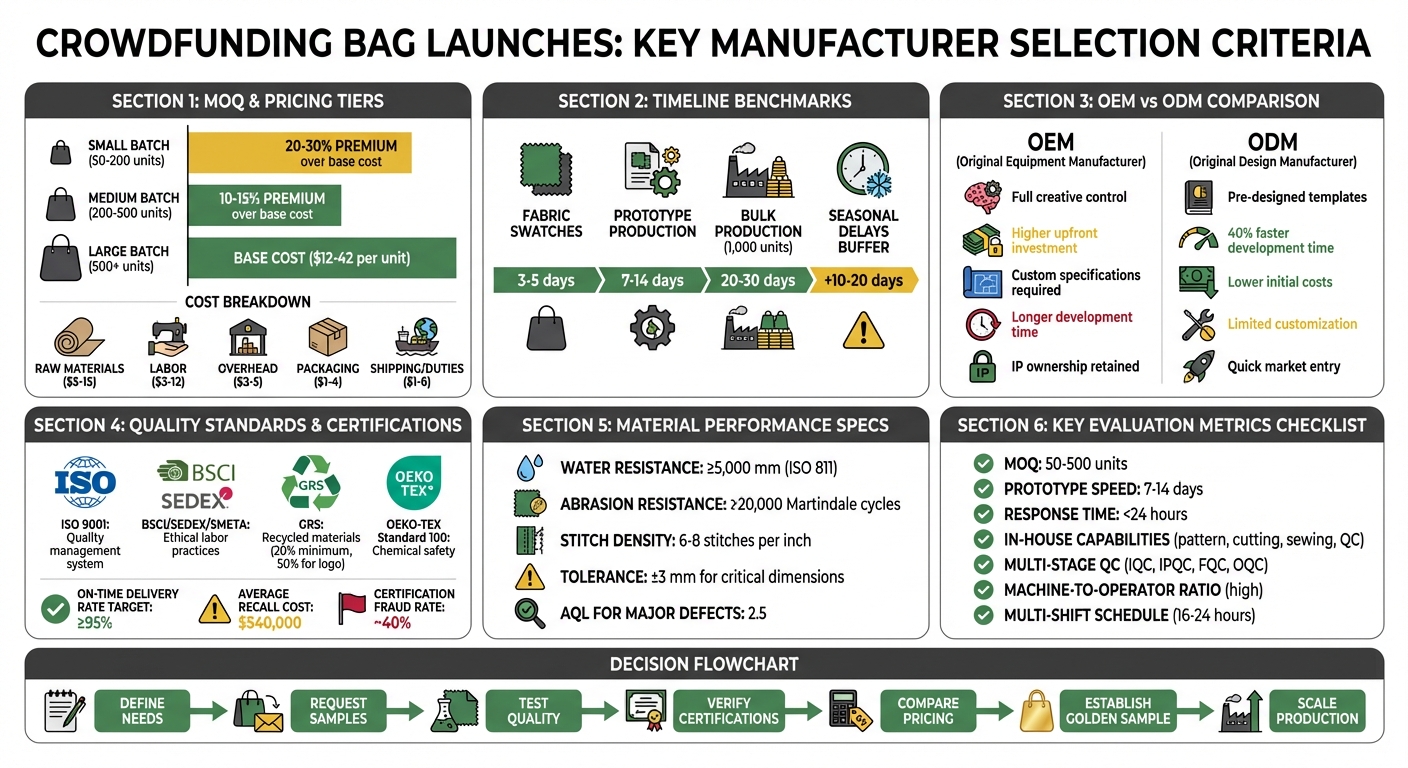
Look for manufacturers with MOQs between 50 and 500 units.These factories usually use tiered pricing models, showing how unit costs decrease as order quantities increase.Be prepared for a 20%–30% premium on per-unit costs for smaller orders.
Speed is just as important as flexibility.Manufacturers experienced with startups can often deliver prototypes within 7 to 14 days – much faster than the weeks-long timelines typical of larger production facilities.Many of these factories have adapted their production lines to efficiently handle smaller, varied orders.They often market themselves as "startup-friendly"or emphasize "flexible MOQ solutions".This adaptability paves the way for deeper collaboration, including design services, to refine your product.
What OEM and ODM Services Mean for Custom Bags
When it comes to custom bag production, understanding the difference between OEM and ODM services is key to deciding how much creative control you’ll have over the final product.
With OEM (Original Equipment Manufacturer) services, the factory produces bags based on your detailed specifications, including technical drawings, material samples, and design files.This approach gives you full ownership of the intellectual property but often requires a higher upfront investment in design and development.
ODM (Original Design Manufacturer) services, on the other hand, provide a quicker and more cost-effective alternative.These factories offer a range of pre-designed products that you can customize with your logo or minor adjustments.This method can cut development time by up to 40% and lower initial design costs, making it a great option if you’re launching a crowdfunding campaign with tight deadlines.However, this approach gives you less control over the design compared to OEM.Choosing between OEM and ODM will depend on your project’s timeline and how much customization you need.
Reviewing Past Projects and Client Work
A manufacturer’s track record is often the best indicator of their reliability.Reviewing their past projects can help you confirm whether they’re capable of handling both small-batch prototypes and scalable production runs.
When evaluating a manufacturer, ask to see at least three examples of completed projects similar to your product.For instance, if you’re developing a travel duffel, request examples of travel duffels rather than unrelated bag styles.This ensures they have the necessary machinery and expertise to meet your specific needs, whether it’s advanced waterproofing techniques or reinforced stitching for extra durability.
It’s also a good idea to look at performance metrics.Reliable manufacturers often maintain on-time delivery rates above 95% and can provide data on defect rates.Additionally, independent review platforms like Trustpilot or Google Reviews can offer insights into recurring issues.For example, one factory might have a reputation for missing deadlines despite claiming flexibility, while another might excel in communication but struggle with quality control.
"Many modern factories…are starting to value the long-term potential of working with small brands from the ground up."– OMASKA
Finally, pay attention to how quickly they respond to your inquiries.Manufacturers that are familiar with working with startups usually reply within 24 hours and assign a dedicated contact to ensure smooth communication throughout the process.
Checking Customization and Material Options
To launch a successful crowdfunding campaign, your product must not only be practical for small-batch production but also deliver the quality and design promised to your backers.Once you’ve confirmed small-batch feasibility, the next step is ensuring your manufacturer offers the customization required to meet those expectations for both aesthetics and performance.
Start by requesting a Bill of Materials (BOM) from potential manufacturers.This document should detail the exact specifications for every component, such as 600D PU-coated polyester for the exterior or 210T nylon taffeta for the lining.A thorough BOM eliminates ambiguities about fabric weight, thread type, or hardware quality, ensuring consistency across production.It also lays the groundwork for selecting materials that prioritize performance and durability.
Selecting Materials for Durability and Function
The right materials can make or break your product’s functionality.For athletic bags, consider options like RPET (recycled polyester), waterproof nylon, breathable mesh, or vegan leather alternatives.These materials address specific needs – waterproof nylon protects contents during outdoor activities, while breathable mesh reduces odor in compartments for shoes or damp gear.
Performance requirements should be clearly defined using industry standards.For instance, aim for a hydrostatic head rating of at least 5,000 mm under ISO 811 testing for water resistance.For abrasion resistance in high-wear areas like the bottom of a bag, specify a minimum of 20,000 Martindale cycles.Before committing to full prototyping, request material swatches to evaluate texture, weight, and durability.Examples might include heavy-duty polypropylene webbing or bonded nylon thread (Tex 135).
Additionally, confirm the factory has the specialized machinery needed for your design’s technical features.If your bag includes waterproof seam sealing, laser-cut ventilation, or bar-tack reinforcement for stress points like shoulder straps, ensure the manufacturer can handle these customizations.Factories experienced in athletic gear often have the necessary equipment and expertise for advanced features like hydration system ports or RFID-blocking pockets.Once your materials are finalized, you can shift focus to incorporating brand-specific elements that set your product apart.
Adding Custom Features That Match Your Brand
Branding should feel like a natural extension of your product.Techniques like embroidery, sublimation printing, or debossing can showcase your brand’s identity.Custom hardware – such as branded zipper pulls or woven labels – adds another layer of distinction.
To avoid confusion during production, include annotated CAD diagrams in your tech pack.These diagrams should detail everything from pocket placements and divider positions to strap lengths.Specify tolerances (usually ±3 mm) to account for material stretch and machine calibration.For crowdfunding projects with tight deadlines, this level of precision minimizes costly revisions during sampling and ensures your custom features are production-ready.
If you’re working with an ODM (Original Design Manufacturer), clarify what aspects of the design can be customized.Some factories may limit changes to logo placement or color, while others offer "full-service"capabilities, including rapid prototyping and material sourcing, which can cut development timelines by up to 40%.Knowing these boundaries upfront prevents unexpected limitations after you’ve committed to a manufacturer.
Confirming Quality Standards, Certifications, and Production Scalability
Ensuring your manufacturer meets recognized quality standards and can handle production growth is crucial.This step safeguards your brand from potential issues like recalls and ensures ethical practices.It also lays the groundwork for evaluating production capacity.
Verifying Certifications for Compliance and Ethics
Certifications act as proof that a manufacturer adheres to industry standards.For example, ISO 9001 certification ensures a documented quality management system is in place, covering everything from raw materials to shipping.To confirm ethical labor practices, look for BSCI (Business Social Compliance Initiative) or SEDEX/SMETA certifications, which verify fair wages, safe working environments, and prohibit child labor.
If your bags are marketed as eco-friendly, the GRS (Global Recycled Standard) certification ensures that recycled materials meet minimum thresholds – 20% recycled content overall, or 50% if the GRS logo is displayed.For products with linings or coatings that touch the skin, OEKO-TEX Standard 100 certification guarantees they are free from harmful chemicals.However, keep in mind that about 40% of certifications in the bag manufacturing industry are either expired, fake, or issued by unreliable bodies.Always verify the validity of certifications and confirm they are accredited by reputable third-party auditors like Bureau Veritas, SGS, or Intertek.
"A proper certification costs us manufacturers a lot of money and time…We do all this because I’ve seen what happens when manufacturers cut corners."– Ben Zhao, Sales Director, Coraggio Bag
This diligence is essential, as the average cost of a product recall is around $540,000.For crowdfunding campaigns operating on tight budgets, such costs could be catastrophic.Certifications are not just about compliance – they’re key to earning backer trust and ensuring a smooth product launch.
Confirming the Ability to Scale Production
While certifications confirm quality and ethics, production scalability ensures the manufacturer can meet growing demand.Start by requesting a detailed machine inventory.A high machine-to-operator ratio and a multi-shift schedule (16–24 hours per day) indicate faster production throughput.
Find out if the factory manages key processes like pattern making, cutting, sewing, and quality control in-house.This internal control ensures consistency when moving from prototypes to full-scale production.Confirm that the same Standard Operating Procedures (SOPs) and machine settings are applied across both sample and bulk production lines to avoid quality issues.For bulk orders, automated CNC cutting systems can improve precision and reduce material waste compared to manual methods.
A typical bulk order of 1,000 units should take 20–30 days to complete.As your campaign grows, the manufacturer must be able to scale production accordingly.Ensure they use a multi-stage quality control system – covering Incoming Quality Control (IQC), In-Process Quality Control (IPQC), Final Quality Control (FQC), and Outgoing Quality Control (OQC) – with traceability records to link raw materials to finished products.This process helps catch defects at every stage of production.
Reviewing Communication, Lead Times, and Pricing
Once you’ve confirmed that a manufacturer can meet your quality and scalability needs, the next step is to evaluate their communication, lead times, and pricing.These factors are critical to keeping your crowdfunding project on track and within budget.
Checking Prototyping and Production Timelines
Understanding a manufacturer’s timeline capabilities is essential for planning around your crowdfunding launch.Ideally, they should deliver fabric swatches within 3–5 days and complete prototype production in 7–14 days.For bulk orders, expect 20–30 days for 1,000 units.However, if the manufacturer outsources tasks like pattern making or material sourcing, these timelines may stretch by several weeks, potentially disrupting your schedule.
To avoid surprises, request a detailed lead-time chart that breaks down each phase: fabric booking, prototyping, bulk production, and quality inspection.This kind of transparency helps you identify potential bottlenecks early.Be mindful of seasonal disruptions like Chinese New Year or summer factory closures, which can add 10–20 days to production schedules.Adding a buffer of 10–20 days to your timeline is a smart way to account for these delays.Manufacturers with in-house capabilities for tasks like pattern making, cutting, and sewing often deliver faster results because they control the entire process internally.
Communication is another critical factor during the prototyping phase.If the manufacturer struggles to translate your specifications into an accurate "golden sample", it’s a red flag for future communication issues during bulk production.Look for manufacturers who maintain prompt and consistent communication.Tools like digital production dashboards or shared timelines, along with time-stamped photos at key stages – such as cutting, sewing, and pre-pack inspection – can provide the transparency you need.
Once you’ve nailed down clear timelines and communication, the next step is to assess pricing to strike the right balance between cost and quality.
Finding the Right Balance Between Cost and Quality
With your prototyping and production timelines confirmed, it’s time to dig into pricing.Transparency here is key for accurate project planning.Ask for a detailed Bill of Materials (BOM) that outlines specifics like fabric denier, hardware brands (e.g., YKK zippers versus generic options), and thread types.This breakdown ensures you know exactly what you’re paying for and helps you spot any cost-cutting measures that might compromise quality.
For custom bags, the typical cost ranges from $12–$42 per unit before markup.This cost includes raw materials ($5–$15), labor ($3–$12), overhead ($2–$5), packaging ($1–$4), and shipping/duties ($1–$6).Keep in mind that Minimum Order Quantities (MOQ) heavily influence pricing.Smaller runs of 50–200 units often come with a 20–30% price premium, while orders of 200–500 units typically see a 10–15% increase over base costs for 500+ units.For crowdfunding campaigns, these higher costs for small batches may be unavoidable as you validate your design before scaling.
To better understand how pricing shifts with volume, request tiered pricing for quantities like 100, 300, and 1,000 units.This helps you plan stretch goals and post-campaign production more effectively.Instead of focusing solely on the lowest unit price, consider the total cost of ownership.Cheap sourcing may seem appealing but can lead to higher long-term costs from returns, defects, or damage to your brand’s reputation.Opting for a manufacturer with a 95% on-time delivery record and certifications like ISO 9001 or BSCI might mean spending slightly more upfront, but it can save you from costly headaches down the line.
Steps for Selecting the Right Manufacturer
Requesting and Testing Product Samples
Start by asking for a sample that matches your tech pack specifications.This should include CAD drawings, a detailed Bill of Materials (BOM), Pantone color codes, and specifics like hardware details (e.g., YKK zippers).Once you receive the sample, put it through rigorous testing.Check for water resistance (ISO 811 standard, ≥5,000 mm), abrasion resistance (Martindale, ≥20,000 cycles), and stitch density (6–8 stitches per inch).If your design includes unique features like waterproof seams or odor-control linings, the sample is your chance to confirm these elements work as intended.
Before moving to mass production, designate one sample as your "golden sample." This serves as your benchmark for quality, ensuring consistency across all units.If your sample requires multiple revisions, consider it a red flag for potential production issues.Keep in mind that creating full-sample bags typically takes 7–14 days, while fabric swatches may take 5–7 days.These timelines should be factored into your project schedule, especially if you’re crowdfunding.
Once the sample meets your expectations, the next step is connecting with manufacturers at trade fairs.
Visiting Trade Fairs and Industry Events
Trade fairs provide an excellent opportunity to meet a range of manufacturers in person and evaluate their offerings.One of the largest events is the Canton Fair in Guangzhou, which features over 25,000 exhibitors.Bag suppliers are usually found in Halls 9.1 to 10.3 during Phase 3, held either in late October/early November or early May.Other noteworthy events include the APLF in Hong Kong and the China International Bag &Luggage Exhibition in Shanghai.
"The Canton Fair is about finding the right partner who aligns with your brand’s values and can support your growth for years to come."- Szoneier Bag Manufacturing
Before attending, do your research.Identify the materials, bag types, and customization options you’re looking for.The Canton Fair mobile app can help you search for suppliers by category and schedule meetings in advance.While at the event, inspect samples for key features such as stitching quality, material durability, smooth zippers, and overall functionality.Ask manufacturers direct questions about their monthly production capacity, quality control measures, and certifications like ISO 9001 or BSCI.After the event, follow up promptly with your shortlisted suppliers to confirm details like pricing and sample agreements.
The insights you gather at trade fairs will help you make informed decisions about potential partners.
Creating Comparison Tables for Decision-Making
When evaluating manufacturers, focus on critical factors like sample quality, communication, and production timelines. Use a scorecard to compare metrics such as MOQ (minimum order quantity), lead time, pricing, customization options, certifications, and on-time delivery rates.Assign weight to each criterion based on your specific needs.For instance, if you’re launching with only 100 backers, a low MOQ might be more important than slight cost differences.
Ask for tiered pricing for quantities such as 100, 300, and 1,000 units to understand how costs scale.Keep in mind that ordering smaller quantities (50–200 units) can raise per-unit costs by 20–30% compared to bulk orders of 500+ units.To avoid dealing with intermediaries, request a Chinese business license and export license to verify that you’re working directly with a factory.Additionally, check the manufacturer’s on-time delivery rate – reliable suppliers should maintain a rate of at least 95% – and ensure they’re willing to sign an NDA (Non-Disclosure Agreement) to protect your design.
Conclusion
Selecting the right bag manufacturer for your crowdfunding launch is all about finding a partner who can handle small-batch production while meeting the quality expectations of your backers.Focus on manufacturers with flexible minimum order quantities (MOQs) and a proven ability to scale.Decide between OEM and ODM models based on whether you need complete design control or prefer a quicker launch using pre-existing templates.
Your tech pack is key – it’s essentially your agreement with the manufacturer.Include CAD drawings, a bill of materials (BOM), and tolerances (e.g., ±3 mm for critical dimensions) to avoid misunderstandings down the line.Before moving to mass production, establish a "golden sample"as the standard for quality.This step ensures consistency and avoids costly disputes.
Lastly, ensure your manufacturer uses ISO 2859-1 sampling plans with an Acceptable Quality Level (AQL) of 2.5 for major defects and maintains an on-time delivery rate of at least 95%.Request certifications like ISO 9001, BSCI, or GRS, and verify their authenticity using official databases.This will help protect your brand’s reputation right from the start.
FAQs
What should I include in a bag tech pack?
A bag tech pack serves as the blueprint for your design, laying out every detail necessary for accurate and consistent production.Here’s what it should include:
- Technical sketches: Provide detailed views of the bag, including the front, back, side, and interior.
- Materials: List all fabrics, zippers, hardware, and other components.
- Measurements: Specify dimensions for every part of the bag to ensure precision.
- Construction details: Include instructions for stitching, reinforcements, and other assembly requirements.
- Branding information: Highlight logo placement, labels, and any other branding elements.
You can also include specifics like color options, hardware finishes, compartment layouts, and any unique features.A well-prepared tech pack minimizes misunderstandings and ensures your bag is manufactured exactly as envisioned.
How do I verify a factory’s certifications are real?
To ensure a factory’s certifications are legitimate, always ask for official documents, such as ISO 9001 or CPSIA certificates.Once you have them, verify their authenticity directly with the issuing organizations or through their official online platforms.Taking it a step further, conducting factory audits or on-site inspections can provide additional assurance of compliance.Make sure the certifications are up-to-date and issued by well-established, credible organizations to steer clear of counterfeit documents.
What are the biggest hidden costs in small-batch production?
Small-batch production might seem like a straightforward choice, but it comes with some hidden costs that can quickly add up.One of the main culprits is setup expenses.Things like creating molds, producing samples, or setting up printing processes cost the same whether you’re making ten units or ten thousand.This means the cost per unit can skyrocket for smaller runs.
Another factor is material sourcing.Buying items like fabrics, zippers, or other components in smaller quantities often means paying higher prices, which makes smaller orders less economical.On top of that, there are operational challenges.Managing multiple small orders, dealing with increased back-and-forth communication, and coordinating production schedules can make everything more time-consuming and labor-intensive compared to large-scale manufacturing.These factors combine to make small-batch production more complicated – and more expensive – than it might initially appear.
Frequently Asked Questions
What should I look for in a bag manufacturer?
Verify capacity, sampling speed, QC and MOQ fit.About 200,000 pieces per month capacity, 7 lines and 149 machines can scale;confirm AQL 2.5 inspection and sample-before-production.
Should I choose OEM or ODM?
OEM if you have your own design made to spec;ODM to start from proven factory designs.Choose based on timeline and design control.
How do I verify a factory is legitimate?
Ask for registration, SGS or equivalent certification, a video walkthrough and client references;openness about machines and audits builds trust.
What hidden costs exist in small-batch production?
Tooling, sample rounds, hardware minimums, packaging and freight.Ask for an itemized BOM and landed-cost estimate at MOQ 500.
How important is English support?
Very.A dedicated English-speaking project manager reduces sampling errors and timeline misses;we assign one who handles tech packs, approvals and QC.
How fast will I get a sample?
6-10 days once materials and tech pack are confirmed.Validate fit, materials and color before production.
How long does production take?
Typically 35-50 days after sample approval.Fix a shipping date in the contract to protect your launch schedule.
Can a small startup meet the MOQ?
Yes, MOQ is 500 pieces per design, achievable for pre-revenue brands and Kickstarter projects.Discuss volumes early.
Do you protect my designs?
Yes, via NDA before sharing specs and confidentiality on tooling, patterns and CAD.
How do I quality-check a batch remotely?
We send pre-shipment photos and videos and inspect to AQL 2.5;third-party or remote inspection is available for larger orders.
Related Blog Posts