
Short answer: most laptop backpack buying mistakes are detectable in under an hour, with a caliper, a tape measure and a kitchen scale. The ten checks below cover the specifications that actually determine whether a bag survives daily use — padding density, compartment geometry, zip grade, base construction, strap anchoring, water resistance — and each one can be verified on a sample before you place an order. Skip them and you inherit the returns.
This guide is written for buyers, brand owners and sourcing teams who need to make a go/no-go decision on a sample, not for shoppers reading a marketing page. Every check includes what to measure, the pass threshold, and the failure mode it prevents.
The ten checks at a glance
| # | Check | Tool | Pass threshold |
|---|---|---|---|
| 1 | Compartment foam thickness and density | Digital caliper | 8 mm EVA minimum, recovers after compression |
| 2 | Internal compartment dimensions | Tape measure | Device plus 15 mm tolerance on each axis |
| 3 | Zip grade and slider branding | Visual, cycle test | Branded slider, reverse-coated tape, 500 cycles clean |
| 4 | Zip configuration | Visual | Double slider on main compartment |
| 5 | Base panel construction | Visual, press test | Reinforced or laminated, no single-layer shell |
| 6 | Strap anchor stitching | Visual, pull test | Box-X stitch, 200 N minimum |
| 7 | Seam coating and taping | Visual, spray test | Coated or taped seams, AATCC 22 rating 3+ |
| 8 | Trolley strap function | Physical test | Fits standard handle, retains under load |
| 9 | Empty bag weight | Kitchen scale | Consistent with tech pack ±5% |
| 10 | Hardware corrosion resistance | Salt spray or supplier report | 24 h NSS, no red rust |
Check 1 — Measure the foam, do not trust the label
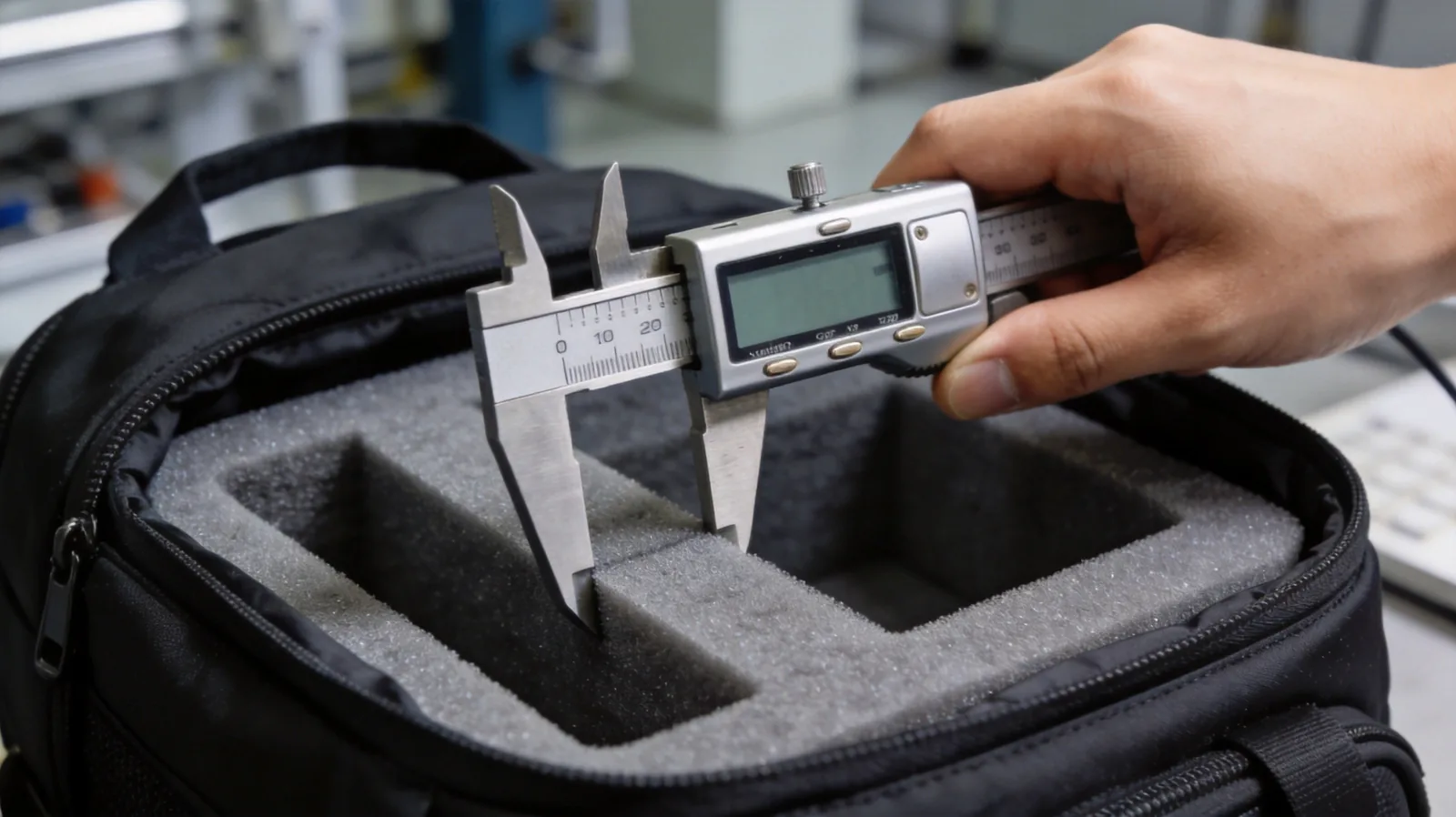
Take a digital caliper and measure the compartment wall at three points: top centre, bottom centre, and one corner. Then do the same on the opposite wall. Six readings, one minute.
What you are looking for: consistency first, absolute value second. A compartment specified at 8 mm that measures 8.1, 7.9 and 8.0 is well made. One that measures 8.2 at the top and 5.4 at the bottom has been padded for the showroom and skimped where the impact actually lands.
Then compress the foam between thumb and forefinger for five seconds and release. EVA springs back immediately. PE foam stays flattened or recovers slowly. A bag that fails the recovery test will lose its protection within months of daily use, regardless of what the spec sheet claims.
Grade matters as much as thickness. 8 mm EVA outperforms 10 mm PE on every impact metric that matters. If a supplier quotes padding in millimetres without naming the material, the number is not meaningful.
Check 2 — Measure internal dimensions, not screen size
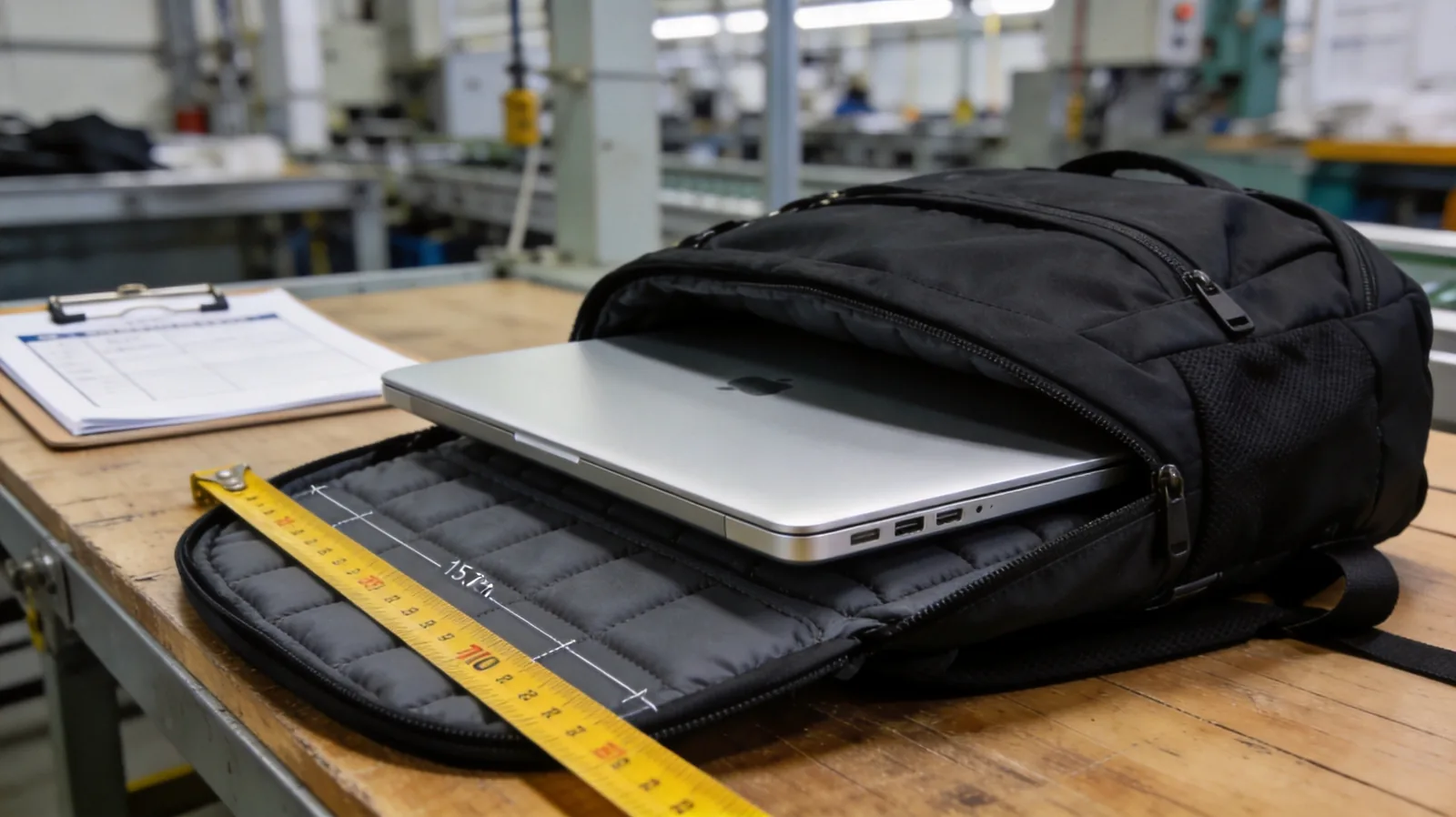
Compartment sizing is the single most common source of returns in this category. Bags are marketed by nominal screen size — “fits 15.6 inch” — but devices in the same size class vary by 20 mm in width and more in thickness once a protective shell is fitted.
How to check: measure the internal width, height and depth in millimetres. Then measure your reference device with whatever case or shell the end user is likely to use. You want at least 15 mm of tolerance on width and height, and 10 mm on depth.
Also check where the device sits. A well-built compartment suspends the device 15–20 mm above the bag base seam. Rest a ruler across the bottom of the compartment and confirm there is a foam shelf, not just shell fabric. If the device rests directly on the base, every ground impact transfers straight into the chassis — this is the highest-value single detail in the entire bag.
Check 3 — Identify the zip grade
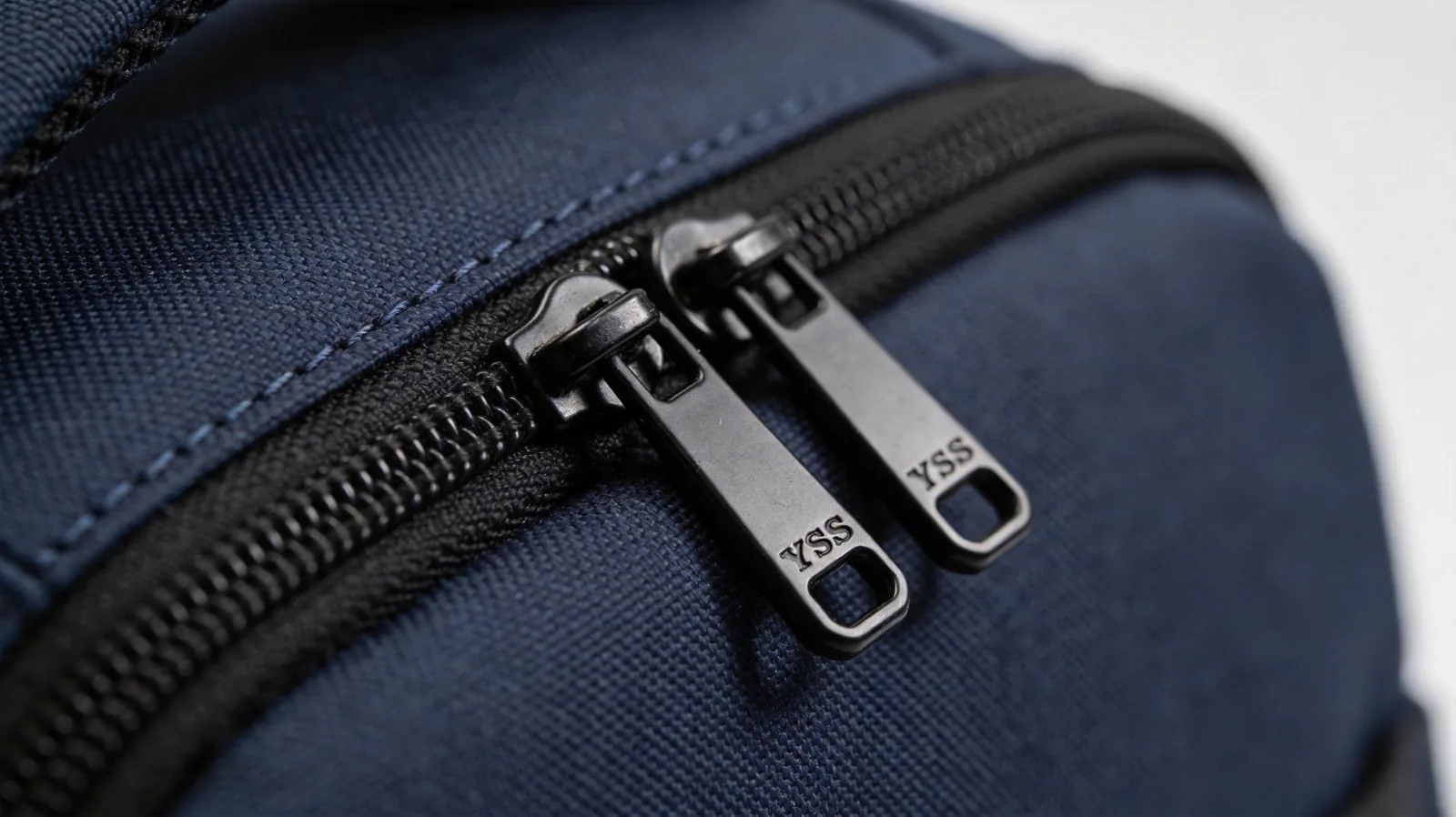
Zips are the first component to fail on a budget laptop backpack, and they are the easiest to assess. Look for three things.
Slider branding. A stamped brand mark on the slider indicates a branded zip — YKK, SBS, YCC or equivalent. Unbranded sliders are a cost signal, not automatically a defect, but they warrant a cycle test.
Tape construction. Reverse-coated or water-resistant tape has a visible polymer coating on the back. Plain woven tape absorbs water and wicks it into the bag. On any bag positioned for outdoor or commuting use, specify reverse-coated as a minimum.
Cycle test. Open and close the main compartment 500 times at a normal pace. A good zip runs smoothly throughout with no increase in resistance, no tape separation at the curve, and no visible slider wear. A poor zip will start catching within 100 cycles.
Check 4 — Zip configuration
A double-slider (two-way) zip on the main compartment lets the user open from either end, which matters when the bag is on a trolley handle or accessed from the side. Single-slider main compartments are a cost reduction that users notice immediately. Also check that the zip pulls are large enough to grip with gloves and that they have a lockable design if the bag is positioned as anti-theft.
Check 5 — Inspect the base panel
The base takes more abrasion than any other part of the bag. Press the base panel firmly with your thumb. A single-layer shell flexes easily and will abrade through within a year of being set down on concrete. Acceptable constructions are a reinforced 1680D panel, a laminated TPU base, or a doubled shell with a drainage eyelet.
While you are there, check whether the base seam is bound or taped. An unbound base seam on a bag that will be set down on wet ground is a guaranteed water path.
Check 6 — Strap anchors and stitching
Grab the shoulder strap where it meets the bag body and pull firmly — roughly the force of lifting a loaded bag by one strap. The anchor should be stitched with a box-X pattern, meaning a rectangle with a diagonal cross inside it. Single-row straight stitching at a strap anchor is a major defect: it concentrates load on one line of thread.
Stitch density should be 8–10 stitches per inch. Sparse stitching (5–6 per inch) on a load-bearing seam is a cost reduction that will fail under weight. Check both the top anchor and the bottom anchor — the bottom one is usually the first to go.
The pull threshold for a laptop-carry bag is 200 N minimum on strap and handle attachment points. Ask the supplier for the test record; a factory that runs this test will have it on file.
Check 7 — Water resistance where it actually fails
Fabric water-repellency ratings are misleading on their own, because water enters through seams and zips before it penetrates the shell. Turn the bag inside out and inspect the seam allowances. Coated or taped seams have a visible polymer strip or binding. Untreated seams are bare woven edge.
Then run a practical test: place a folded paper towel inside the closed bag, stand the bag upright, and pour 500 ml of water over the top and down the front over two minutes. Open immediately and check the towel. Any dampness means the closure or seams are the weak point, and the shell rating is irrelevant.
For reference, a spray rating of 3 or better per AATCC 22 is the normal minimum for this category. For bags marketed as waterproof rather than water-repellent, ask specifically for the IP rating and how it was tested.
Check 8 — Trolley strap
Slide the trolley strap over a standard telescopic handle. It should fit with light resistance, not loosely, and it must not rotate around the handle when the backpack is loaded. A strap that is too wide slides off; one that is too narrow will not clear the handle housing. Confirm the strap is a through-sleeve rather than a stitched-on loop — stitched loops tear at the attachment points.
Check 9 — Empty weight consistency
Weigh the bag on a kitchen scale and compare against the tech pack. Variation beyond ±5% on the same style indicates inconsistent material or hardware between units, which will show up as inconsistency in the field. For travel-oriented bags, empty weight is also a specification in its own right — every 100 g matters against airline cabin limits.
Check 10 — Hardware corrosion
Buckles, D-rings, sliders and logo plates should be anodised or PVD coated, not painted. Ask for the 24-hour neutral salt spray report. Painted hardware shows red rust at scratch points within weeks in coastal or humid markets — a common and entirely avoidable complaint source.
How to read a supplier test report
Suppliers will send test reports when asked. Most buyers skim them. The reports contain three or four numbers that matter and a lot of framing that does not.
| Report | The number that matters | Red flag |
|---|---|---|
| Drop test | Height, orientations tested, and whether the bag was loaded | Empty-bag testing, or a single orientation |
| Zipper cycle | Cycle count completed without failure | Fewer than 300 cycles, or no record of the tape condition after the run |
| Seam tensile | Newtons at failure on strap and handle anchors | Tested on a seam sample rather than the finished anchor |
| Spray rating (AATCC 22) | Rating score and which fabric face was tested | Rating quoted without specifying the face, or tested before coating |
| Salt spray (NSS) | Hours to first red rust on hardware | Tested on plated hardware rather than the production finish |
| Colourfastness | Grey scale rating for rubbing and light | Only light fastness reported, rubbing omitted |
Two rules make the reports usable. First, every report should name the exact style and the exact material batch it applies to. A report that cannot be tied to your tech pack is marketing material. Second, ask for the test method alongside the result — a 76 cm drop and a 1 m drop are not comparable, and a tensile figure without a stated method cannot be evaluated.
For programmes where the bag carries a specific protection claim, ask for the report to be re-run on the production sample rather than the development sample. Sample-room construction and line construction differ more than suppliers usually admit.
From tech pack to approved sample
The ten checks above are only useful if the specification they verify is written down before sampling starts. The sequence that avoids rework looks like this.
- Brief and reference. State the target market, retail band, device size class and any protection claim. Provide reference bags or photographs — verbal descriptions of “premium” or “minimal” are interpreted differently by every factory.
- Tech pack issue. Foam grade and thickness in millimetres and density, internal compartment dimensions with tolerance, zip brand and model, stitch density, hardware finish, shell denier and coating weight. This is the document the ten checks will be run against.
- First sample, 6–10 business days. Expect the sample room to interpret two or three ambiguous lines. That is normal and it is why the tech pack needs to be specific.
- Run the ten checks and mark up. Measure everything, photograph the failures, and return comments against line items rather than in prose. “Foam measured 5.4 mm at the base against 8 mm specified” gets fixed; “padding feels thin” does not.
- Second sample where geometry changed. Any interior layout change needs one more round. Budget for it at the start.
- Golden sample and production sign-off. The approved sample becomes the reference for the pre-shipment inspection, and the tech pack becomes the contractual specification.
Standard timelines for this sequence are 6–10 business days per sample round and 35–50 days for bulk production after approval and deposit, so a programme with one revision should be planned at roughly ten weeks from brief to ship date.
Turning the checks into a purchase specification
The output of these ten checks should be a written tech pack, not a verbal agreement. The line items that most often go unstated, and therefore get substituted, are these:
| Specification line | State it as | Never leave it as |
|---|---|---|
| Compartment padding | 8 mm EVA, density 30–35 kg/m³ | “padded laptop sleeve” |
| Compartment geometry | Internal 265 × 385 × 35 mm, suspended 15 mm | “fits 15.6 inch” |
| Zip | YKK 8VS reverse-coated, double slider | “quality zipper” |
| Base | 1680D reinforced panel, bound seam | “reinforced bottom” |
| Strap anchor | Box-X stitch, 8–10 SPI, 200 N pull | “strong stitching” |
| Shell | 900D polyester, PU back coating 0.15 mm | “water resistant fabric” |
Standard programme terms for custom laptop backpacks are MOQ 500 pieces per style and colour, sampling in 6–10 business days, and bulk production in 35–50 days after sample approval and deposit. Inspection runs at AQL 2.5 major / 4.0 minor, and every bag carries a 12-month warranty against manufacturing defects.
For the commercial side of sourcing — pricing structure, channel fit and order planning — see the wholesale laptop backpack buying guide. For construction and padding standards in more depth, read the OEM padding and compartment design guide. If you are shortlisting suppliers, the list of laptop backpack manufacturers is a useful starting point.
Packaging and retail readiness
The last set of checks happens after the bag is right. These are the items that delay shipments at the very end of a programme because nobody specified them at the start.
- Polybag and desiccant. Specify polybag thickness and whether a desiccant sachet is included. Bags shipped to humid markets without desiccant arrive with corroded hardware.
- Hangtag and label placement. Confirm placement points on the approved sample, not from a drawing. Label position errors are the most common cause of a re-work request after production.
- Carton configuration. How many units per carton, carton dimensions, and whether the bag is flat-packed or stuffed. This drives freight cost more than most buyers expect, particularly on structured briefcase styles.
- Barcode and retail compliance. Confirm barcode format and placement, and for EU-bound programmes confirm the labelling requirements covered in the GPSR guidance.
- Master carton drop test. Confirm the export carton has been drop tested, not just the product. Carton failure in transit produces damaged goods that pass every product-level inspection.
Four mistakes buyers make at the sample stage
- Approving the sample, not the specification. A sample is hand-built by a sample room. Production comes off a line. The tech pack, not the sample, is what governs the order — write down what you measured.
- Testing an empty bag. Every impact and carry test must use a loaded bag with a device surrogate of realistic mass. Empty-bag testing misses the failure modes that generate returns.
- Comparing samples from different grades. If you are evaluating three suppliers, issue the same tech pack to all three. Otherwise you are comparing their assumptions, not their capability.
- Ignoring the second sample round. Interior layout changes almost always need one additional sample. Budget the time at the start rather than discovering it at the ship date.
Why JUNYUAN BAGS
JUNYUAN BAGS has produced custom bags since 2014, working with an affiliated and partner factory network in Quanzhou, Fujian with more than two decades of combined bag-manufacturing experience across laptop, travel, sports and technical categories. Every programme is built to a signed tech pack with specified foam grade, zip brand and stitch density — the same line items this guide tells you to measure.
We sample in 6–10 business days and inspect at AQL 2.5 major / 4.0 minor before shipment, with drop, cycle, tensile and spray test records available on request. If you are developing a laptop range, start with the custom laptop backpack manufacturing page, review the custom backpack capability overview, or read the OEM and ODM service scope. For water-resistant constructions see the custom waterproof bag manufacturing page, and for EU market entry the GPSR compliance guide.
Frequently asked questions
How do I check laptop backpack quality before buying?
Measure foam thickness with a caliper at six points, compress and release the foam to test recovery, measure internal compartment dimensions against a real device, cycle the main zip 500 times, inspect seam coating inside out, pull-test the strap anchors, and pour 500 ml of water over the closed bag with a paper towel inside. These seven checks take under an hour and catch most defects.
What is the minimum foam thickness for a laptop backpack?
8 mm EVA is the practical minimum for daily-use bags. 5–6 mm is acceptable for light or occasional use. Material grade matters more than raw thickness — 8 mm EVA outperforms 10 mm PE foam on impact absorption and recovery.
How can I tell if a zip is genuine YKK?
Look for a stamped brand mark on the slider body, consistent tape weave, and a reverse-coated backing on water-resistant models. Then cycle it 500 times: a genuine branded zip runs smoothly throughout, while counterfeits start catching within 100 cycles.
Should the main compartment have one zip slider or two?
Two. A double-slider configuration allows access from either end, which matters when the bag is mounted on a trolley handle or accessed from the side. Single-slider main compartments are a cost reduction that users notice in daily use.
What does a suspended laptop sleeve mean?
The compartment is designed so the device hangs 15–20 mm above the bag base rather than resting on it. This removes the most common impact path — ground drops transferring load straight through the base into the laptop chassis.
How much water resistance should a laptop backpack have?
For commuting, a water-repellent shell with coated or taped seams and a reverse-coated zip handles normal rain. AATCC 22 spray rating 3 or better is the usual minimum. For sustained heavy rain, specify a water-resistant zip and a roll-top or flap closure.
What stitch density should load-bearing seams have?
8–10 stitches per inch on strap anchors, handles and base seams. Sparse stitching of 5–6 per inch concentrates load on fewer thread points and fails earlier. Strap anchors should use a box-X pattern rather than a single straight row.
How much should a laptop backpack weigh empty?
It depends on the specification, but consistency matters more than the absolute figure. Weigh several units of the same style — variation beyond ±5% indicates material or hardware inconsistency between units.
What is AQL 2.5 in bag inspection?
AQL 2.5 is the acceptable quality limit for major defects in pre-shipment inspection. In laptop backpacks, major defects include underspecified foam, broken strap stitching and non-functional zips. AQL 4.0 typically covers minor cosmetic defects.
How long does sampling take for a custom laptop backpack?
6–10 business days for a first sample. Interior layout changes usually require one additional sample round, so build that into the timeline if compartment geometry is being customised.
What is the MOQ for custom laptop backpacks?
MOQ is 500 pieces per style and colour. Bulk production runs 35–50 days after sample approval and deposit, with payment normally 30% deposit and 70% against B/L copy.
How do I test water resistance without lab equipment?
Place a folded paper towel inside the closed bag, stand it upright, and pour 500 ml of water over the top and front surface across two minutes. Open immediately and check for dampness. It is not a lab test, but it reliably identifies uncoated seams and inadequate closures.
Do painted buckles and sliders cause problems?
Yes, in humid and coastal markets. Painted hardware shows red rust at scratch points within weeks. Specify anodised or PVD-coated hardware and ask for a 24-hour neutral salt spray report.
How do I compare samples from several suppliers fairly?
Issue an identical written tech pack to every supplier, specifying foam grade and thickness, internal dimensions in millimetres, zip brand and model, stitch density and hardware finish. Then run the same ten checks on each sample. Comparing samples built to different assumptions tells you nothing about capability.
Can I customise the compartment layout?
Yes. Compartment geometry, sleeve position, divider count, foam thickness and accessory pocket layout are all defined in the tech pack. Browse the laptop backpack category for reference constructions, or read the custom laptop bag manufacturing overview for the full development process.