What does a wholesale laptop backpack buying guide need to cover? A usable guide covers six locked decisions before you ask for a price: laptop compartment sizing and drop protection, fabric and zipper grade, carry system and load path, branding method, MOQ and tooling, and the inspection standard you will hold the factory to. At JUNYUAN BAGS, standard MOQ is 500 pcs per style and colour, sampling takes 6–10 business days, bulk production runs 35–50 days, and every shipment is inspected to AQL 2.5 / 4.0 across a five-stage QC system. Laptop backpacks ship FOB Xiamen, with DDP available by arrangement.
That paragraph is the whole guide compressed. The rest of this page explains how each decision actually works, what the numbers mean when a supplier quotes you, and where buyers lose money between the approved sample and the container. If your open question is which channel to buy through rather than what to specify, read the companion guide on where to buy wholesale backpacks in bulk first.
What Makes a Laptop Backpack Different From a Daypack?
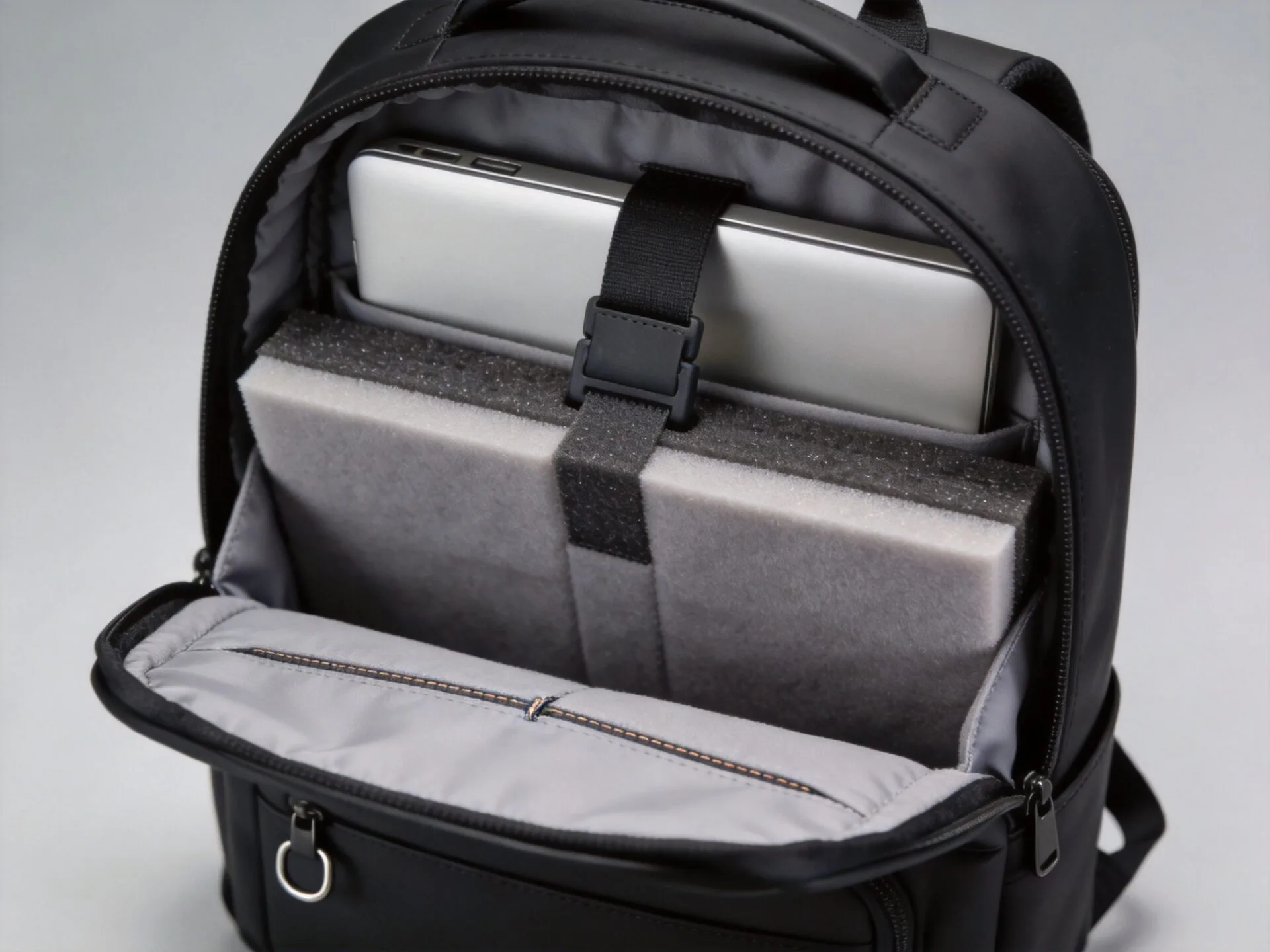
A laptop backpack is a protective device with a bag attached, not a bag with a pocket added. The difference is measurable: the compartment has to hold a specific device size with controlled movement, the back panel has to transfer load without pressing the device into the wearer’s spine, and the whole assembly has to survive a drop that a daypack never sees.
Three structural differences drive cost and specification. The same logic applied to a technical category is set out in our guide to mountaineering backpack manufacturers:
- Suspension and separation. The laptop sleeve cannot sit directly against the back panel. A suspended sleeve keeps the device off the floor of the bag when it is set down — typically 15–25 mm of clearance — and that single detail is the most common omission in cheap wholesale programs.
- Padding density, not thickness. 8 mm of EVA at 45–55 Shore C absorbs more impact than 15 mm of soft sponge. Buyers who specify “thick padding” get soft padding; buyers who specify density get protection.
- Zipper and slider grade. The main compartment zipper on a laptop bag is opened and closed several times a day. A #8 or #10 coil zipper with a branded slider outlasts a #5 generic zipper by a wide margin, and the price difference is measured in cents per unit, not dollars.
Six Specifications You Must Lock Before Requesting a Quote
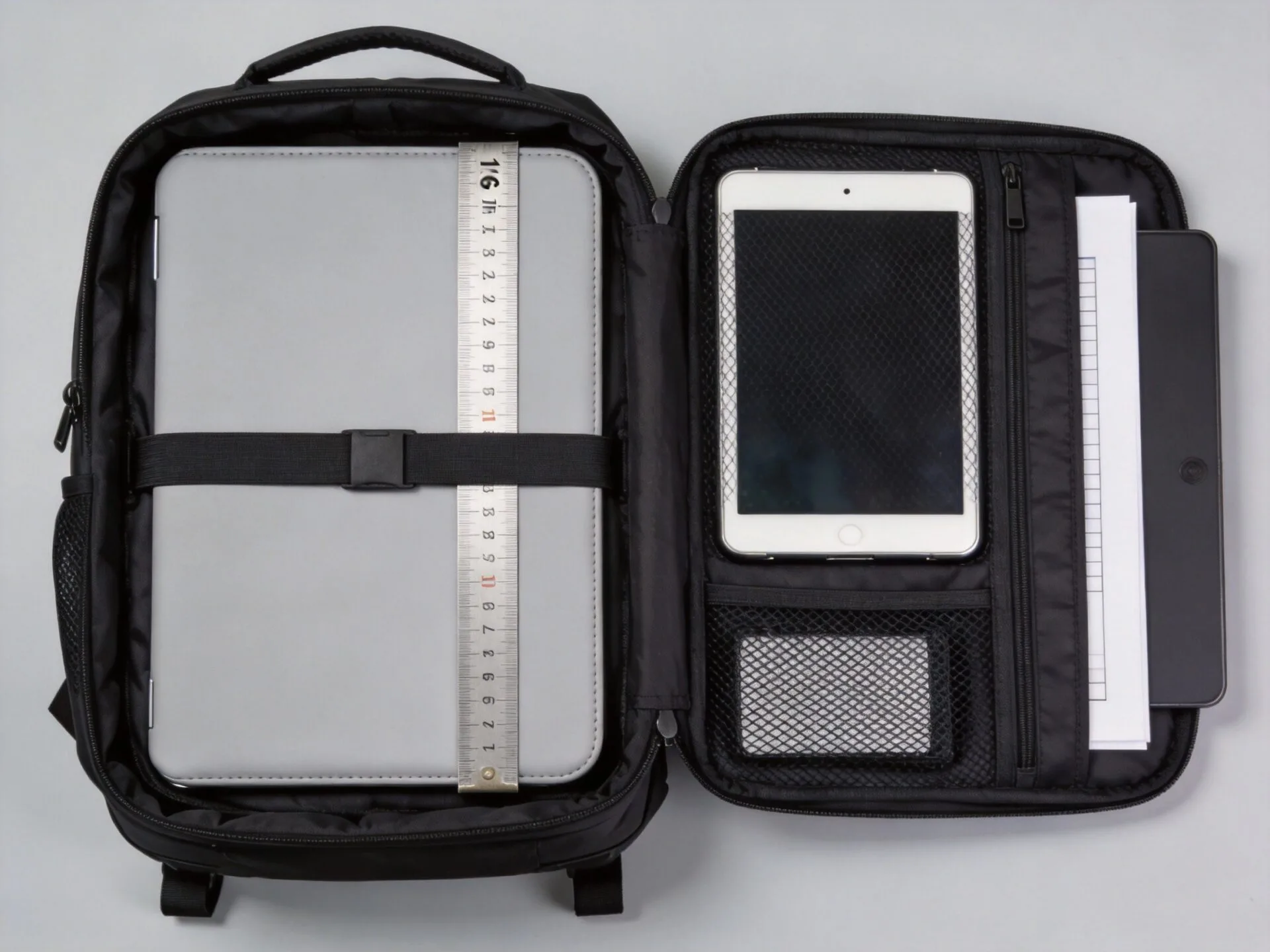
Quotes are only comparable when the specification is identical. These six items are the ones that move a laptop backpack quote by more than 10% each, and the ones most often left vague in a first enquiry.
1. Laptop compartment sizing and tolerance
Specify the device, not the diagonal. “Fits 15.6 inch” is a marketing claim; “internal sleeve 385 × 275 × 30 mm, tolerance ±3 mm” is a manufacturing instruction. A 15.6″ laptop is roughly 360 × 250 mm, a 16″ MacBook Pro is 356 × 248 mm, and a 17.3″ unit runs to about 415 × 285 mm. Build the sleeve 20–30 mm larger than the device on each axis so a protective shell still fits.
The tolerance matters more than the size. Loose sleeves let the device slide and strike the corners; tight sleeves make the bag unusable with a case on. ±3 mm on a sewn textile product is achievable and should be written into the tech pack.
2. Drop protection: EVA foam, PE board, or air mesh
Three materials do three different jobs and buyers frequently pay for the wrong one:
- EVA foam (8–12 mm, 45–55 Shore C) — impact absorption on the back panel and the bottom edge. This is the layer that matters in a drop test.
- PE board (1.5–2 mm) — rigidity. It stops the bag folding around the device when the pack is compressed in a crowded commuter train or a shipping carton.
- Air mesh or 3D spacer mesh — ventilation against the wearer’s back. It contributes nothing to protection and should never be counted as padding in a specification.
A credible protection stack is PE board against the back panel, 8–10 mm EVA between board and sleeve, and a 3–5 mm foam floor pad under the sleeve. Anything less is a fashion bag with a laptop pocket.
3. Fabric grade and denier
Denier is a weight, not a strength rating, and the two are frequently confused in wholesale negotiations. For laptop backpacks the practical ladder runs:
- 210D or 300D polyester — promotional and entry-level retail. Acceptable at low price points, abrades quickly on the bottom panel.
- 600D polyester or 600D recycled RPET — the volume workhorse for corporate and mid-market programs. The right answer for most buyers.
- 900D–1680D ballistic nylon or polyester — premium and business segments. Noticeably heavier, noticeably more abrasion-resistant. CORDURA® brand fabrics sit at the top of this band.
- Coated options — PU coating for water resistance, TPU film for a matte finish and better hydrolysis resistance in humid climates.
Ask for the fabric weight in g/m² alongside the denier. A 600D fabric can range from 180 g/m² to 320 g/m², and the lighter end will feel like a different product in the buyer’s hand.
4. Zipper grade and slider type
Zippers are the single most common warranty failure on laptop backpacks. Specify the size (#5, #8, #10), the type (coil, vislon, metal), and whether the slider is branded — YKK and Duraflex are the two names most buyers specify by default. On the main compartment, #8 or #10 coil with a branded slider is the correct default. On the laptop sleeve, a #5 coil with a lockable double slider is standard for anti-theft positioning.
Water-resistant zippers add cost and add real value only if the bag is genuinely weather-sealed at the seams as well. A water-resistant zipper on an unsealed bag is a marketing line, not a feature.
5. Carry system and load path
Three questions decide the carry system: how heavy will the loaded bag be, how long is it worn at a time, and does the wearer commute by bike or on foot? A 20 L commuter bag carrying 6–8 kg needs contoured shoulder straps with 8–10 mm foam, a sternum strap, and a ventilated back panel. It does not need a hip belt.
A 30 L bag carrying 12 kg or more needs load transfer to the hips, which means a minimal hip belt and a frame sheet. Skipping the frame sheet on a heavy bag is how buyers end up with a product that reviews badly on comfort six months after launch. For the outdoor equivalent of this carry-system specification, see what top-rated hiking backpacks specify.
6. Branding method and logo position
Branding is where tooling cost hides. The four common methods and their typical setup implications:
- Embroidery — no tooling, per-stitch cost, best on unstructured panels. Cheapest entry, highest per-unit labour.
- Screen print — one screen per colour, so a one-colour logo is cheap and a four-colour logo is not.
- Heat transfer / silicone — one transfer plate per design, best for fine detail and small text.
- Metal badge or embossed leather patch — a physical mould, typically the highest tooling cost and the highest perceived value.
Logo position should be specified on the tech pack with measurements from the panel edge, not described in words. “Centred on the front panel” produces a different result at every factory.
Which styles actually sell is a separate question from how to specify them, and it is covered in the five most popular laptop backpack styles and why they sell.
Wholesale Laptop Backpack Price Bands
Price bands below are indicative FOB Xiamen ranges for 500-piece orders and exist to help you sanity-check quotes, not to replace a quotation against your specification. Fabric, hardware and branding move a quote more than capacity does.
| Segment | Typical capacity | Fabric and hardware | Indicative FOB (500 pcs) |
|---|---|---|---|
| Promotional / entry | 18–22 L | 210–300D polyester, #5 generic zipper, no PE board | US$3.50–6.00 |
| Corporate / mid-market | 22–28 L | 600D polyester or RPET, #8 coil, PE board + EVA | US$6.50–11.00 |
| Business / premium | 20–26 L | 900–1680D, branded hardware, USB pass-through | US$11.00–19.00 |
| Technical / anti-theft | 24–32 L | Coated nylon, lockable zippers, cut-resistant panel | US$16.00–28.00 |
| Branded leather or hybrid | 18–24 L | PU or split leather panels, metal badge, custom lining | US$24.00–45.00 |
MOQ, Tooling and What Actually Drives Unit Cost
MOQ is a planning number, not a law of physics. What actually happens at 500 pieces versus 3,000 pieces is a change in how the factory cuts and runs the line, and that change is where the price difference comes from.
| Cost driver | At 500 pcs | At 1,000 pcs | At 3,000 pcs |
|---|---|---|---|
| Fabric purchasing | Stock or short-run dye lot | Standard dye lot | Direct mill order, best price |
| Cutting | Hand or short-run die | Die cutting amortised | Multi-layer die cutting |
| Logo tooling | Fully charged to buyer | Partially amortised | Absorbed |
| Colour ways | 1–2 | 2–3 | 3–5 |
| Sampling rounds | 1–2 typical | 1–2 typical | Pre-production sample only |
| Relative unit cost | Baseline | −6% to −10% | −12% to −20% |
Two practical notes. First, MOQ is usually counted per style and per colour, so a 500-piece order split across three colours may be treated as three 167-piece runs — clarify this in writing before you commit. Second, tooling for logos is a one-time charge that should be quoted separately and itemised, never folded into the unit price where you cannot see it.
Sampling: What the 6–10 Day Window Covers
A 6–10 business day sample window is realistic for a laptop backpack only when the fabric is in stock and the construction is not new. Understanding what happens inside that window tells you what can go wrong.
| Stage | Day | What is produced or confirmed |
|---|---|---|
| Tech pack review | 1–2 | Dimension check, material substitution list, tooling quote |
| Pattern and cutting | 2–4 | Pattern grading, first cut, hardware trial fit |
| Sewing and assembly | 4–7 | Sample room build, sleeve and padding stack fitted |
| Logo application | 6–8 | Embroidery, print or transfer applied and cured |
| Internal review and ship | 8–10 | Dimensional verification, photo set, courier dispatch |
Two things extend this window and both should be planned for: fabric that has to be dyed to a specific Pantone reference, and any new hardware mould. Neither is a delay the factory controls, and both are avoidable if raised before the sample is booked.
Quality Control: The Five-Stage System and AQL 2.5
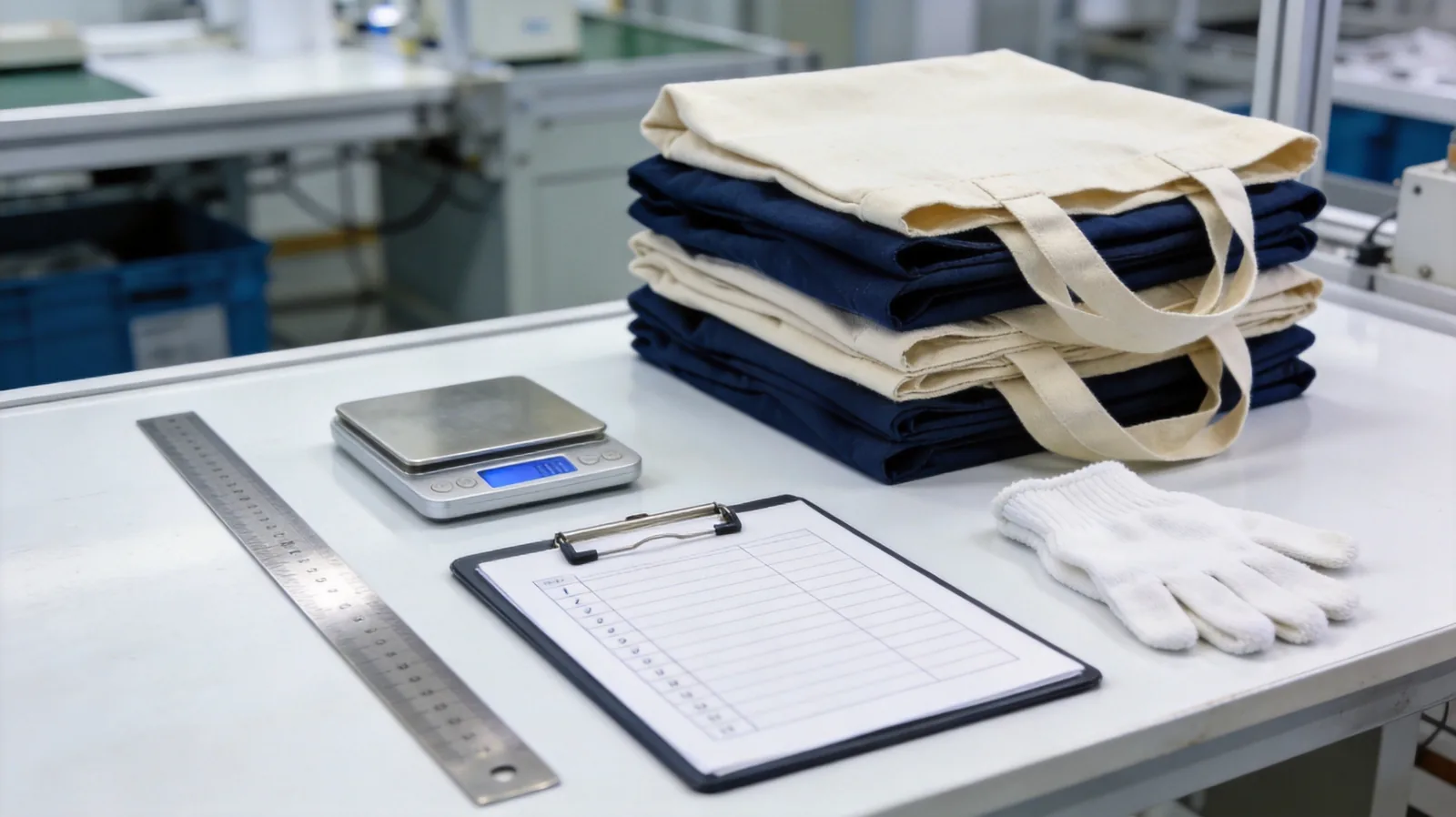
AQL 2.5 is the acceptance quality limit most consumer goods programs run on, and it is defined under ISO 2859-1. It is a sampling standard, not a promise of zero defects, and buyers who treat it as the latter end up in disputes.
At JUNYUAN BAGS every laptop backpack order passes five control points:
| Stage | Timing | What is checked | Failure action |
|---|---|---|---|
| 1. Incoming material | Before cutting | Fabric weight, shade, coating adhesion, zipper and hardware batch | Batch rejected and replaced |
| 2. In-line | During sewing | Sleeve dimensions, padding stack order, seam allowance, stitch density | Station corrected, affected units reworked |
| 3. Pre-shipment | After packing | Function, appearance, logo position, packaging and carton marking | Rework before inspection |
| 4. AQL 2.5 final | Before loading | Random sample to AQL 2.5 / 4.0, critical / major / minor classification | Sort, rework, or re-inspect |
| 5. Pre-loading audit | At container loading | Carton count, condition, marks, loading sequence | Loading held |
The practical value of five stages rather than one is that the earlier a defect is caught, the cheaper it is to fix. A sleeve that is 8 mm undersized is a five-minute pattern correction at stage 2 and a full rework at stage 4.
Landed Cost: The Seven Line Items Beyond FOB
FOB price is the number suppliers quote and the number buyers remember, and it is rarely the number that decides whether a program is profitable. Build a landed cost model before you sign.
| Line item | Typical scale | Notes |
|---|---|---|
| Sample and courier fees | US$50–150 per round | Often credited against the bulk order — confirm in writing |
| Logo tooling | US$80–400 one-time | Screen, plate or mould depending on method |
| Compliance testing | US$200–800 | REACH, CPSIA, or retailer-specific protocol |
| Ocean freight | US$1.50–4.00 per unit | Varies heavily by route and season |
| Duties and VAT | Market-dependent | Calculated on CIF value, not FOB |
| Inland freight and handling | US$0.30–1.00 per unit | Port to warehouse, or DDP to door |
| Bank charges | US$30–60 per transfer | Per transaction, not per unit |
Ask for an itemised landed cost estimate rather than a single FOB number. Suppliers who can produce one are usually the ones who have run enough export programs to know where the surprises live. The same hidden-cost categories appear in this B2B bag customisation FAQ, which is worth reading before your first quotation round.
How to Verify a Wholesale Laptop Backpack Supplier
Verification is not a single document. It is a set of cross-checks that a factory can pass and a trading company usually cannot, and the checks take about a week.
- Business licence scope. Look for “production”, “manufacturing” or “processing” in the scope section. A licence showing only “trade” or “import/export” identifies a trading company. A production licence confirms registration for manufacturing; it does not by itself prove the company owns the specific line your order will run on.
- Production walkthrough. Ask for a live or dated video covering the sewing floor, cutting room, and raw material storage. Refusal is not automatically disqualifying — confidentiality policies exist — but it is a verification gap that needs another form of evidence.
- Product line specialisation. A factory making laptop backpacks and school bags will list a narrow catalogue. A supplier lists everything. Narrow catalogues are a good sign — this is the same distinction set out in this manufacturer-versus-supplier breakdown.
- Sample room independence. Ask whether the sample room is separate from mass production. A dedicated sample room is why a 6–10 day sample window can hold while the line keeps running.
- Inspection access. Confirm in writing that you or a third party may attend final inspection. Suppliers who resist inspection access are telling you something.
- Client references. Ask for two or three references at a similar scale and market, and contact them about on-time delivery and defect rate rather than product quality in general. Reference checks are consistently ranked among the highest-signal verification steps in buyer-side supplier screening guides.
Capacity classification works the same way across categories — the framework we use for the travel range is documented in how to classify travel backpacks.
Common Specification Mistakes That Cost Buyers Money
- Specifying “thick padding” instead of density. You will receive soft foam that compresses to nothing in a season.
- Leaving the sleeve tolerance undefined. Every factory will interpret a nominal dimension differently.
- Not specifying the padding stack order. Board outside foam, or foam outside board, changes both protection and how the bag sits on the back.
- Quoting three suppliers on three different specs. The cheapest quote is usually the thinnest spec, and you will not find out until the sample arrives.
- Treating MOQ as per order rather than per colour. This is the single most common cause of a price that “changed after confirmation”.
- Forgetting carton and packaging specification. Retail-ready packaging, hangtag attachment and carton marking all carry cost and lead time that a bare FOB quote excludes.
If this is your first OEM order rather than your tenth, start with backpack buying tips for first-time buyers and come back to this page once you have a tech pack in hand.
Wholesale Laptop Backpack Questions Buyers Ask
Q1: What is the MOQ for wholesale laptop backpacks?
Standard MOQ at JUNYUAN BAGS is 500 pcs per style and colour. MOQ is normally counted per colourway, so a 500-piece order in three colours may be treated as three separate short runs — confirm the counting rule in writing before you commit. For orders of 5,000 pieces and above, volume pricing applies, and on proven repeat designs the entry point can often be flexed.
Q2: How long does sampling and bulk production take?
Sampling takes 6–10 business days when fabric is in stock and the construction is not new. Bulk production runs 35–50 days after sample approval and deposit. Fabric dyed to a specific Pantone reference and any new hardware mould both extend the sample window and should be planned for.
Q3: What AQL standard is used for inspection?
Every JUNYUAN BAGS shipment is inspected to AQL 2.5 / 4.0 under a five-stage QC system covering incoming material, in-line checks, pre-shipment, AQL 2.5 final random sampling, and a pre-loading audit. AQL is defined under ISO 2859-1 and is a sampling acceptance standard, not a zero-defect guarantee.
Q4: What is the price of a wholesale laptop backpack?
Indicative FOB Xiamen for 500 pieces runs from about US$3.50–6.00 for promotional 18–22 L bags in 210–300D polyester, US$6.50–11.00 for 22–28 L corporate bags in 600D with a PE board and EVA protection stack, and US$16.00–28.00 for technical or anti-theft 24–32 L models. Fabric and hardware move a quote more than capacity does.
Q5: How do I specify the laptop compartment correctly?
Specify the internal dimensions in millimetres with a tolerance, not the diagonal in inches. Build the sleeve 20–30 mm larger than the target device on each axis so a protective shell still fits, and write ±3 mm into the tech pack. “Fits 15.6 inch” is a marketing claim; “385 × 275 × 30 mm, ±3 mm” is a manufacturing instruction.
Q6: Is EVA foam or PE board better for laptop protection?
They do different jobs and a good bag uses both. EVA foam at 8–12 mm and 45–55 Shore C absorbs impact. A 1.5–2 mm PE board provides rigidity so the bag does not fold around the device. A credible stack is PE board against the back panel, EVA between board and sleeve, and a 3–5 mm foam floor pad under the sleeve.
Q7: What fabric should I choose for a laptop backpack?
600D polyester or 600D recycled RPET is the right answer for most corporate and mid-market programs. 210–300D suits promotional price points, and 900–1680D ballistic nylon or polyester suits premium and business segments. Always ask for the weight in g/m² alongside the denier, because a 600D fabric can range from 180 to 320 g/m².
Q8: Which zipper grade should I specify?
#8 or #10 coil with a branded slider on the main compartment, and a #5 coil with a lockable double slider on the laptop sleeve if you want anti-theft positioning. Zippers are the most common warranty failure on laptop backpacks, and the step up from a generic to a branded slider costs cents per unit.
Q9: Can I mix colours within one MOQ?
Usually yes, but the counting rule matters. MOQ is commonly applied per style and per colour, so splitting 500 pieces across three colours can mean three runs below the threshold and a higher unit price. Agree the colour-mix rule and any per-colour minimum in writing at quotation stage.
Q10: What does logo tooling cost and who pays for it?
Screen print requires one screen per colour, heat transfer requires one plate per design, and metal badges require a mould — typically US$80–400 one-time depending on the method. Embroidery needs no tooling but carries higher per-unit labour. Tooling should be quoted as a separate itemised line, never folded invisibly into the unit price.
Q11: How do I compare quotes from different suppliers?
Only compare quotes built on an identical tech pack. Send the same dimensioned specification, the same fabric weight, the same zipper grade, the same padding stack and the same branding method to every supplier, then compare. Otherwise the lowest quote is simply the thinnest specification, and you will not discover the difference until the sample arrives.
Q12: What certifications should a laptop backpack factory hold?
The certification depends on your market and channel. Large retail chains and corporate accounts commonly require social compliance evidence, and eco-positioned programs require recycled-content certification for RPET fabrics. Ask for the current certificate and the audit date rather than accepting a logo on a website, and treat a supplier who cannot produce a recent report as a verification gap.
Q13: Should I visit the factory before placing an order?
For a first order above roughly US$50,000, or any program with complex customisation, a visit or a live video audit is worth the trip. Verify claimed capacity against the floor you see, whether the sample room is active, whether QC stations are staffed, and how raw material is stored. A third-party audit is a reasonable substitute when travel is not practical.
Q14: What are the hidden costs beyond FOB price?
Seven line items: sample and courier fees, logo tooling, compliance testing, ocean freight, duties and VAT calculated on CIF value, inland freight and handling, and bank charges per transfer. Ask for an itemised landed cost estimate rather than a single FOB number — suppliers who can produce one have usually run enough export programs to know where the surprises are.
Start Your Laptop Backpack Program
Send a dimensioned tech pack — device size, sleeve tolerance, fabric weight, zipper grade, padding stack, branding method and target quantity — and JUNYUAN BAGS will return a specification review, a tooling quote and a firm FOB Xiamen price within 12 hours. Sampling starts at 6–10 business days, bulk production at 35–50 days, and every order closes with an AQL 2.5 final inspection you are welcome to attend.
Contact the OEM/ODM team at Contact JUNYUAN BAGS, or review the wider custom backpack manufacturing capability and the company profile and quality control process before you send your first enquiry.