
You can have a perfect bag and a perfect price — and still lose margin to a bad box. Packaging is the quiet variable in every bag import program: get the carton strength, moisture protection, and markings wrong and you face crushed goods, damp cartons, rejected containers, or a customs hold on a technicality. Get it right, and your freight is cheaper, your opens come out clean, and your cartons survive the 20–35 days of ocean transit that bag cargo routinely endures.
This guide covers the real export packaging standards for a bag program shipping from China — the carton specs, the internal moisture lining, the pallet and wooden-case options, the shipping marks and labelling, container-loading optimisation, and the special case of Amazon FBA. Whether you are a brand building a wholesale program or a first-time importer, this is the packaging layer you should spec before you place the order, not after it docks.
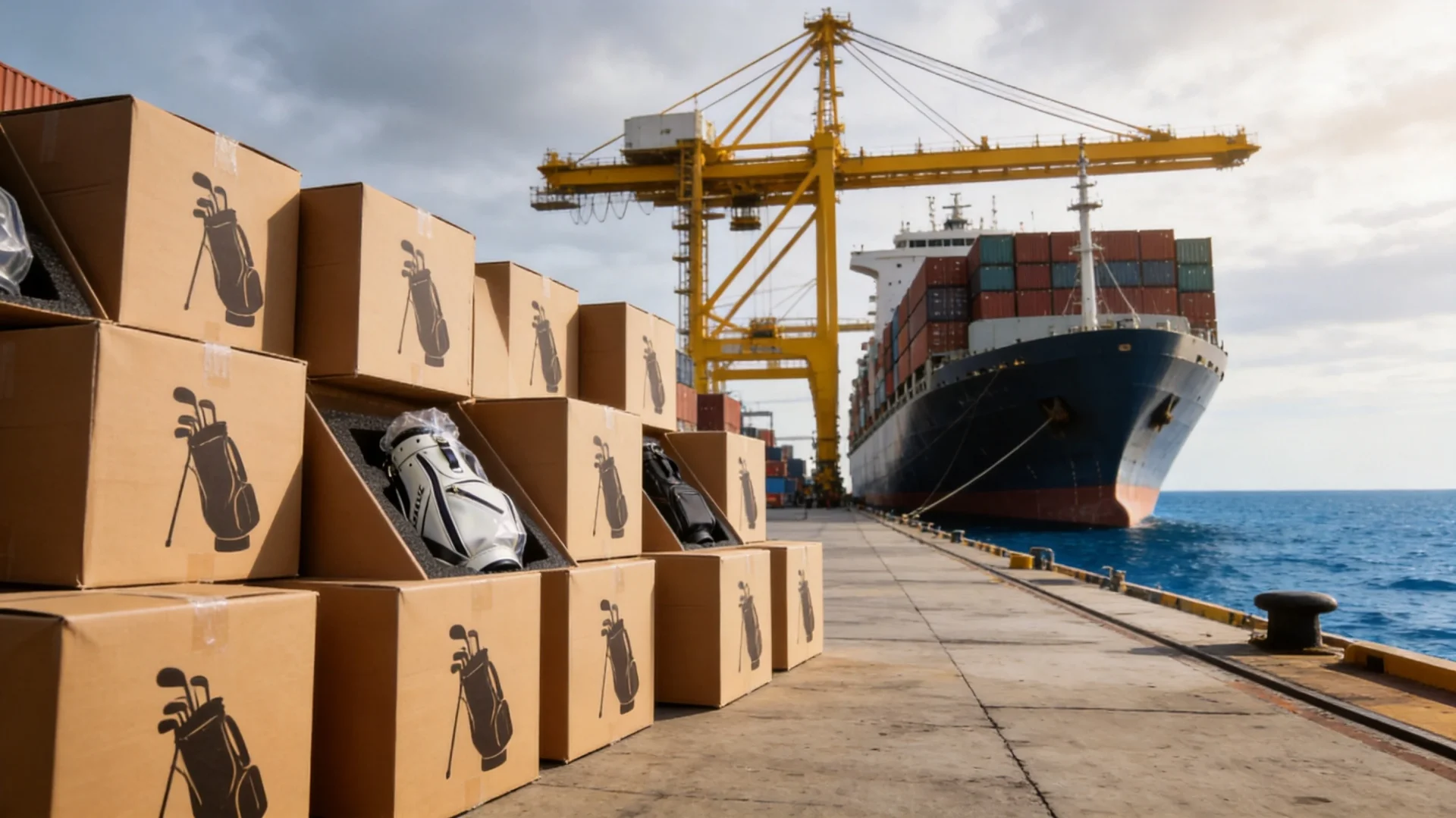
The Core Packaging Build — Export Cartons and the Inner PE Liners
Most B2B bag shipments leave a Chinese factory in single-wall or double-wall corrugated (Kraft) cartons. The box is the primary defence against five threats: crushing (stacking pressure), puncturing (forklifts and jostling), moisture (humidity on a vessel and in transit), abrasion (bag-to-bag and bag-to-box), and dirt. Get the construction and lining right and you solve most of them at low cost.
Choosing the carton strength and flute
For bags — which are voluminous but relatively light — a common and sensible build is a double-wall corrugated box (with a sturdier flute such as BC). The extra wall protects against the compression load when cartons are stacked several high in a container or a pallet. Key spec points to fix with your factory:
- Board strength (ECT / “burst”) — specify a Minimum that matches your stack height and transit weight. Heavier golf bags or wheeled travel bags in dense cartons justify a higher-spec board than a light poly pack.
- Size fit — the carton should fit the folded bag snugly (no slop for movement, no crush pressure on the bag itself). Over-large cartons inflate your shipped volume — and since air freight is billed on chargeable (dimensional) weight, every empty corner of the box is literal money.
- Folded/flat-packed vs assembled — some travel and duffel ranges ship flat to save space; golf bags and structured backpacks often need more rigid internal support.
The inner PE film liner
The single most cost-effective moisture defence is a polyethylene (PE) film liner inside each carton, pulled up over the goods and folded closed before the carton is taped. Bags in transit cross the tropics and sit in humid holds; without a liner, condensation and humidity can reach zippers, hardware, and printed fabrics. Specify:
- A PE film liner folded over the contents, not merely a loose sheet, so it forms a barrier on all interior faces.
- Additional desiccant sachets (silica gel) inside for longer ocean transits or humid destination climates — cheap insurance against mildew on nylon and PU materials.
- A poly bag or PP wrapper around each item inside the carton for high-value or colour-critical stock, so individual opens stay clean.
This “inner PE + per-item wrap” sandwich is the standard that avoids most of the moisture disputes importers never see coming.
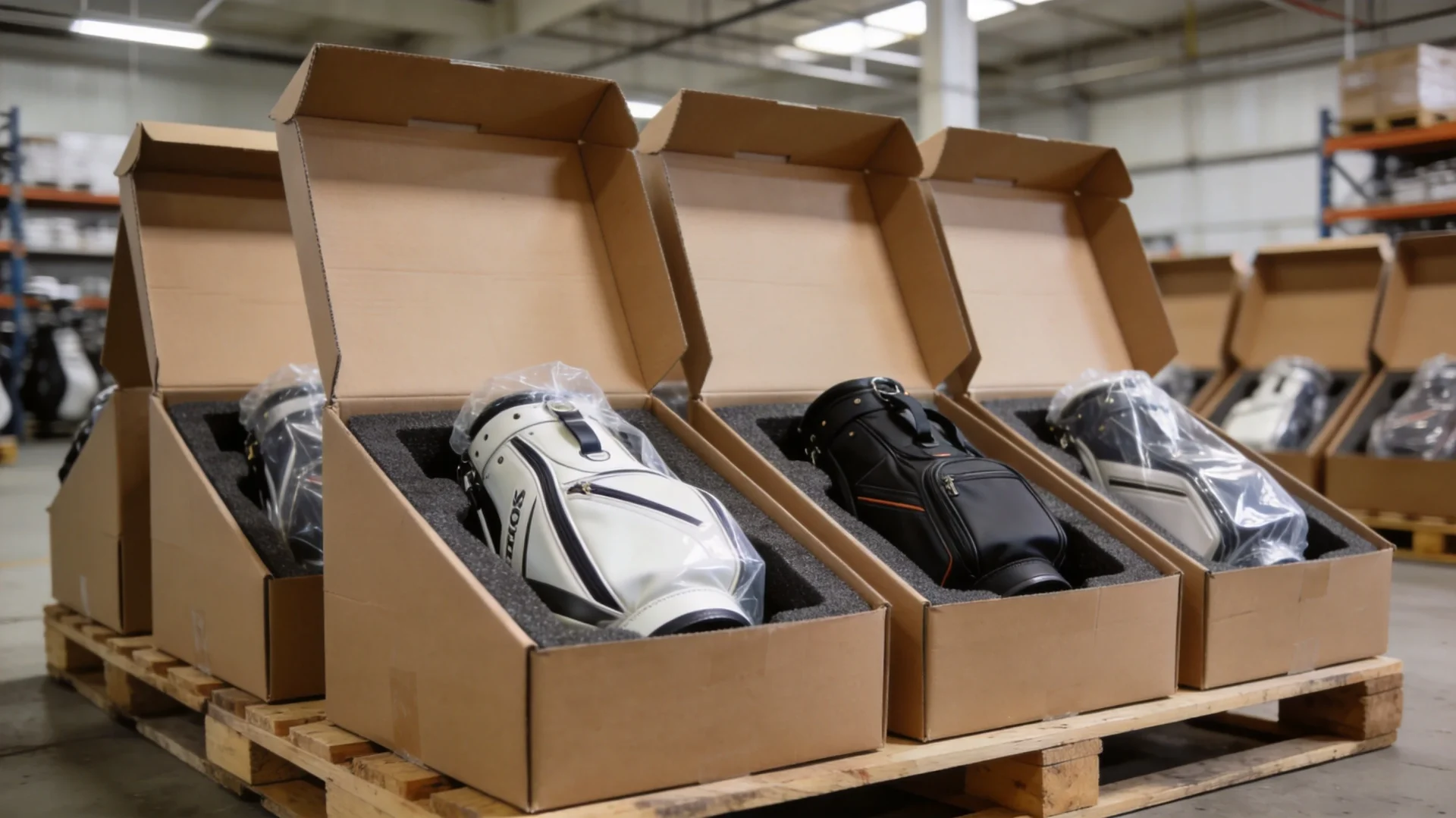
Protection, Palletising and the Wooden-Box Options
Beyond the individual carton, the cargo-level packaging decides whether your containers arrive intact.
Cushioning, dunnage and stacking care
Inside the carton, use soft dunnage (corrugated pads, air bags, foam) rather than scrunched paper for structured items. The rule is: no gaps the bag can slide into, no pressure points that crush foam or hardware. For golf bags with rigid dividers or wheeled travel bags with frames, add corner protectors and reinforced end-caps so a forklift strike on a corner does not crush the top partition. Mark heavier or crush-sensitive cartons clearly.
Palletising — simplify handling and protect cartons
Palletising freight on export-grade pallets (typically heavy-duty, kiln-dried or heat-treated wood, or plastic) protects cartons from floor moisture and makes them forklift/container friendly. When you palletise:
- Stretch-wrap the pallet load tightly so the layers cannot shift in transit — shifting loads cause the majority of carton crush and water ingress complaints.
- Confirm ISPM 15. Wooden pallets (and any solid-wood packaging) must meet ISPM 15 — the international phytosanitary standard that requires heat treatment (HT) or fumigation and a stamped HT logo. Without an ISPM 15 stamp, customs can reject a shipment for invasive-pest risk, especially in the US, EU and Australia. Your supplier should confirm every pallet carries the mark — this is a routine, non-negotiable export requirement.
- Watch weight limits — keep palletised units within container and handling limits, and note that some carriers charge extra on overweight pallets.
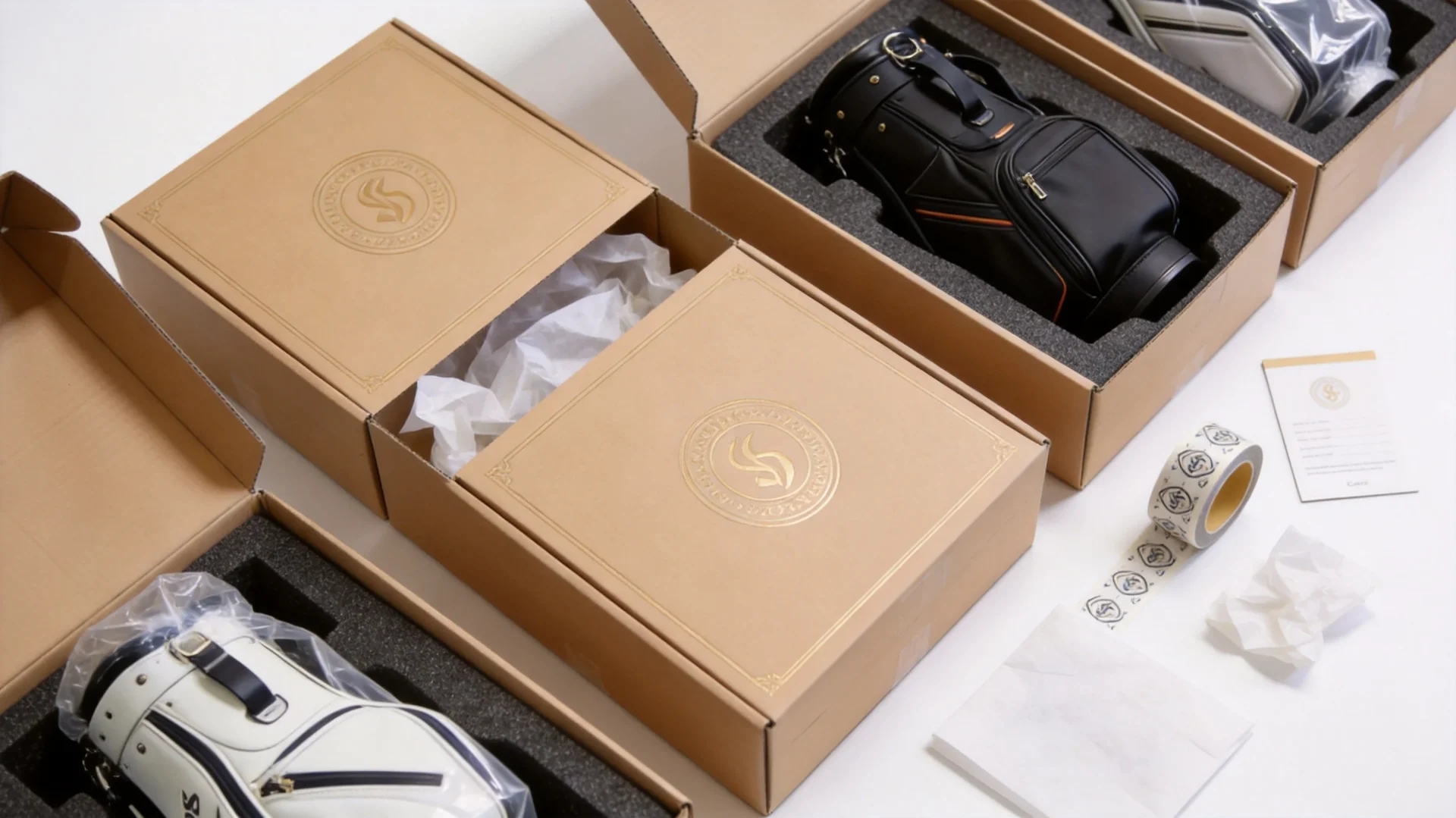
Wooden crates — when to step up from cartons
For very large, heavy, or fragile items — a large rigid-framed travel case, a bulk lot of wheeled luggage, or a consolidated machining of higher-value goods — a wooden crate (with internal bracing and moisture barrier) beats stacked cartons. Crates are more expensive and add dead weight, so reserve them for: heavy frame products, consolidated high-value shipments, or customer-specific requirements. Same rule applies: ISPM 15 on any wood.
Markings, Labels and Shipping Marks — the Documentation on the Box
The shipping mark is the box’s passport. Clear, consistent marking avoids mis-routing, customs queries, and warehouse confusion.
The standard export shipping mark
Every carton should carry a clean shipping mark, ideally including:
- Consignee / destination party abbreviation.
- Port / destination (e.g., Los Angeles, Hamburg, Melbourne).
- Carton number (e.g., “1/40”) — running count over the total.
- Country of origin — “Made in China” should appear on the goods or cartons as required by destination-market rules.
- Gross and net weight, and carton dimensions.
Keep the mark legible, water-resistant, and consistent with the commercial invoice and packing list. Mismatches between the carton mark and the packing list are a classic customs hold — the paperwork and the box must tell the same story.
Handling and caution marks
Add pictogram / text marks where relevant: Fragile, This Way Up (for items with orientation), Keep Dry, Handle With Care, and any stacking limit (e.g., “max 3 high”). These are cheap to apply and materially reduce damage.
Country-of-origin and destination labelling
Beyond the shipping mark, confirm destination-market rules on country-of-origin (“Made in China”) labelling and any required fibre-composition or care labels on the product itself (see our guides on importing into the US and the EU). Origin marking on the carton and the product must not conflict — inconsistent origin claims draw customs scrutiny.
Container Loading — Fit More, Damage Less, Pay Less
For ocean freight, how the cartons are arranged inside the container determines both your freight cost (volume is billed per cube) and your damage rate (a tight, even load ships better than a loose one).
The loading principles
- Fill the footprint, not just the height. Cartons should be loaded in a consistent brick/stacking pattern that fills the container’s width so nothing shifts side to side.
- Stack heavy at the bottom, light on top — a classic, and non-negotiable.
- Fill the void — use dunnage or a few cartons at the tail so the load does not slide toward the doors during braking.
- Secure the door area — blocking and bracing at the door prevents the load from falling out on opening and protects against theft.
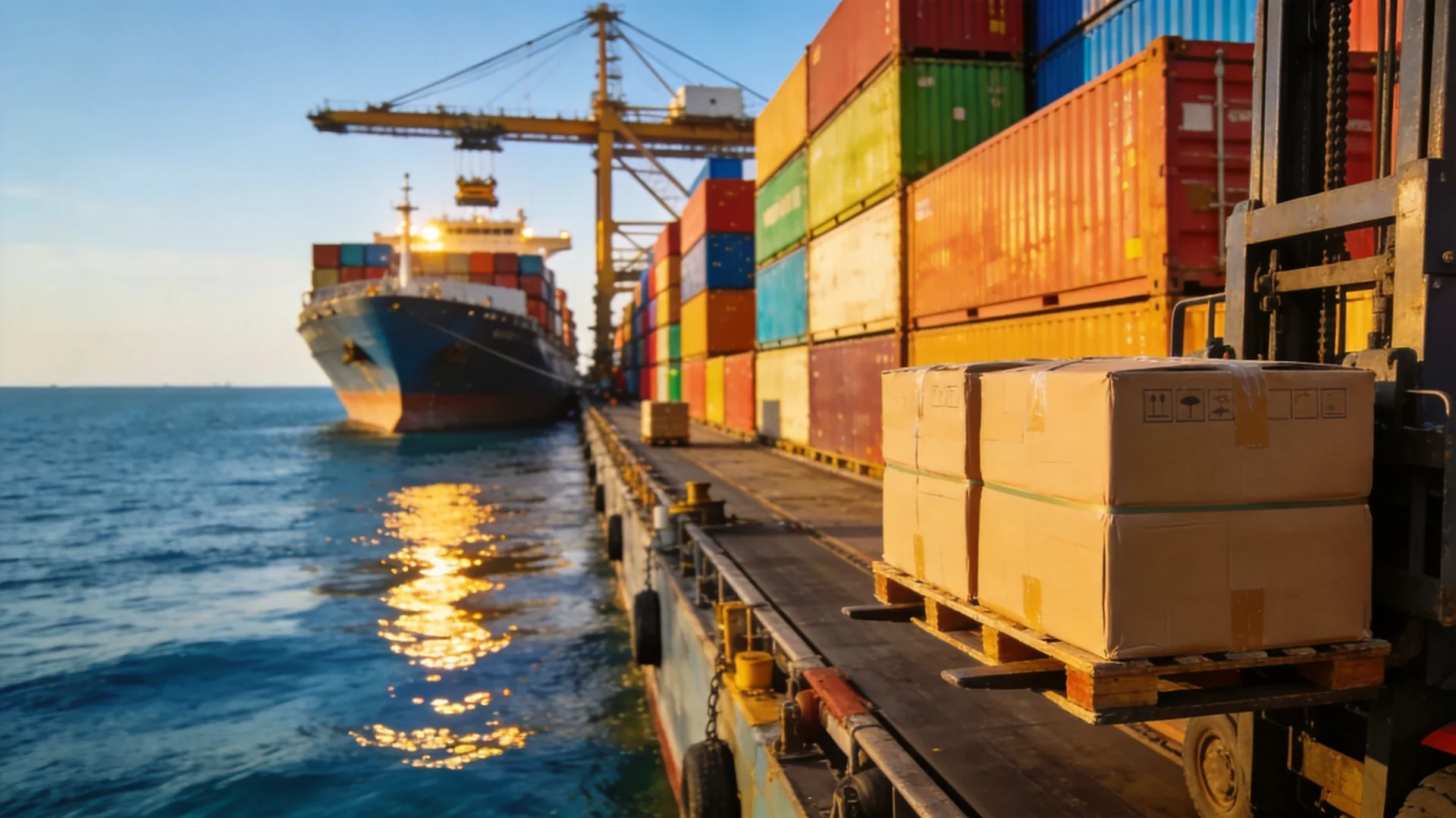
Why packaging directly moves your freight cost
Sea freight bills LCL on cubic meters; air bills on chargeable (volume) weight. Every bit of dead space in a carton and every under-packed corner is volume you pay for twice. Two levers reduce cost without more damage:
- Right-size the carton to the folded bag — no slop.
- Fold/flat-pack where the product allows.
A disciplined packaging spec routinely trims several percent off shipped volume — which, on a repeat program, is real money. Our affiliated factory packs bags to export spec as a matter of course; if you want a bespoke carton brand or FBA-ready labelling, spec it before production so the run is packed that way from the first carton.
Amazon FBA Packaging Requirements — the Special Case
If your bags are headed to Amazon Fulfillment by Amazon (FBA), Amazon enforces its own packaging standards that override generic export practice. The non-negotiable FBA rules that matter for bag sellers:
- Barcode on each unit — every unit must carry the FNSKU barcode (and, if applying, the correct ASIN) scannable at fulfilment.
- Individual units must be sellable units — each bag sealed/marked with the barcode, not shipped loose expecting Amazon to subdivide multipacks.
- Polybags must be barcode-visible and dimension-compliant — if a unit ships in a polybag, the bag must not obscure the barcode, and the polybag must meet Amazon’s acceptance (suffocation-warning labels for small polybags, correct opening size).
- Carton labelling — every FBA carton needs the Amazon FBA Box ID label printed and applied, with the box dimensions and units per box accurately declared in the seller central shipment plan.
- Accepted and prohibited materials — Amazon restricts certain packaging materials and requires durability that survives fulfilment-centre handling; oversize/overweight cartons may incur additional fees.
The pattern is worth repeating: packaging for FBA is decided at order time. If the factory knows from day one that the run is FBA-bound, it can apply unit barcodes and FBA box labels during packaging rather than sending you a restick job at your warehouse.
FAQ
Q: What is the standard export packaging for bags from China?
A: Most B2B bag shipments use double-wall corrugated cartons sized to fit the folded bag snugly, with a polyethylene (PE) film liner inside for moisture protection and often a per-item poly wrapper. Heavier or fragile structured items use corner protectors, reinforcement, and at times wooden crates.
Q: What is ISPM 15, and why does my bag shipment need it?
A: ISPM 15 is the international phytosanitary standard for solid-wood packaging. Any wooden pallet or crate must be heat-treated or fumigated and stamped with an HT mark. Without it, customs (especially in the US, EU and Australia) can reject the shipment over invasive-pest risk.
Q: How do I protect my bags from moisture damage in an ocean container?
A: Use a PE film liner folded over the contents inside each carton, add silica-gel desiccant sachets for longer transits or humid markets, and consider stretch-wrapped, kiln-dried pallets to keep cartons off the container floor. This combination covers most moisture complaints.
Q: What should a shipping mark include?
A: The destination/consignee, port of destination, carton count (e.g., “1/40”), country of origin (“Made in China”), and where useful the gross/net weight and dimensions. Keep the mark legible and consistent with your commercial invoice and packing list.
Q: What packaging does Amazon FBA require for bags?
A: Each unit must carry the FNSKU barcode as a sellable unit; any polybag must be barcode-visible, dimension-compliant and meet Amazon’s suffocation and acceptance rules; and every carton needs the FBA Box ID label with accurate box dimensions and unit counts declared in your shipment plan. Decide FBA packaging before production, not after.
Q: How does packaging affect my freight cost?
A: Sea freight bills on cubic meters and air on chargeable (volume) weight, so dead space in a carton is literally money. Right-sizing the carton to the folded bag and flat-packing where the product allows trims shipped volume and directly lowers freight.
Q: Can the factory pack to my own carton or FBA spec?
A: Yes — spec it before production and the affiliated factory packs to it from the first carton. For a full OEM/ODM program including packaging and export paperwork, see our high-quality bag wholesale factory OEM/ODM overview.
Next Step: Pack Your Program to Export Spec
Packaging should be part of the spec you lock at order time — not a fix you improvise at the warehouse. Tell us your product (backpacks, golf bags, custom travel or duffel lines), your destination market, and whether the order is FBA-bound, and we’ll confirm the carton spec, moisture lining, pallet and marking details with the affiliated factory before production starts.

Start at our quote-request page with your design, volume, and target market. We’ll come back with a complete picture: production timing, export packaging spec, and — where relevant — a thank-you for thinking about the boxes before the bags. Practical, no hard sell, and freight-smart from the first carton.
— Written by Marvin Zhang, JUNYUAN Bags