
A waterproof golf bag costs more than a water-resistant one because of four line items, not because of the logo: the shell coating, the zippers, the seam method, and the testing that proves all three. Strip a bag down and the gap is real but smaller than the retail gap suggests — typically a few dollars of FOB per bag, against a retail step-up of one to two hundred. The premium that survives negotiation is not the material; it is the specification work behind it.
That distinction matters if you are sourcing. A supplier who quotes “waterproof” without naming a coating polymer, a zipper grade, a seam method and a test standard has quoted you a word, not a construction. This breakdown takes the four cost lines apart, prices them against published component data, and uses Sun Mountain’s H2NO line as the reference case — because it is the most clearly documented brand-level waterproof bag programme on the market right now, and it shows exactly what a brand-level claim commits a factory to.
The premium is real, but it is not where buyers assume
Every waterproof bag programme eventually hits the same conversation: the buyer has a water-resistant quote at one number and a waterproof quote at a noticeably higher one, and wants to know what the difference actually is. The honest answer splits into two piles.
Pile one is material and process — coating, zippers, seam sealing, finish, and the yield loss that comes with all four. That pile is measurable, and it is smaller than most buyers expect.
Pile two is risk transfer — the factory accepting liability for a claim it cannot verify, which means test reports, ageing data, batch traceability, and rework. That pile is where the money really sits, and it is also where a cheap quote quietly removes cost by removing proof.
Sun Mountain’s own waterproof collection is a useful benchmark for the scale of the retail premium. The H2NO line runs $350 for the E-2.5 stand bag, $380 for the E-4.5 VLO, $360 for the C-100 cart bag and $400 for the C-130 — against a mainstream non-waterproof cart bag from the same brand family that sells for roughly half. So the consumer-visible waterproof step-up is on the order of one hundred to two hundred dollars. Hold that number; we will come back to it once the BOM is on the table.
Shell coating: TPU versus PVC is a different product, not a cheaper grade
What the coating is actually doing
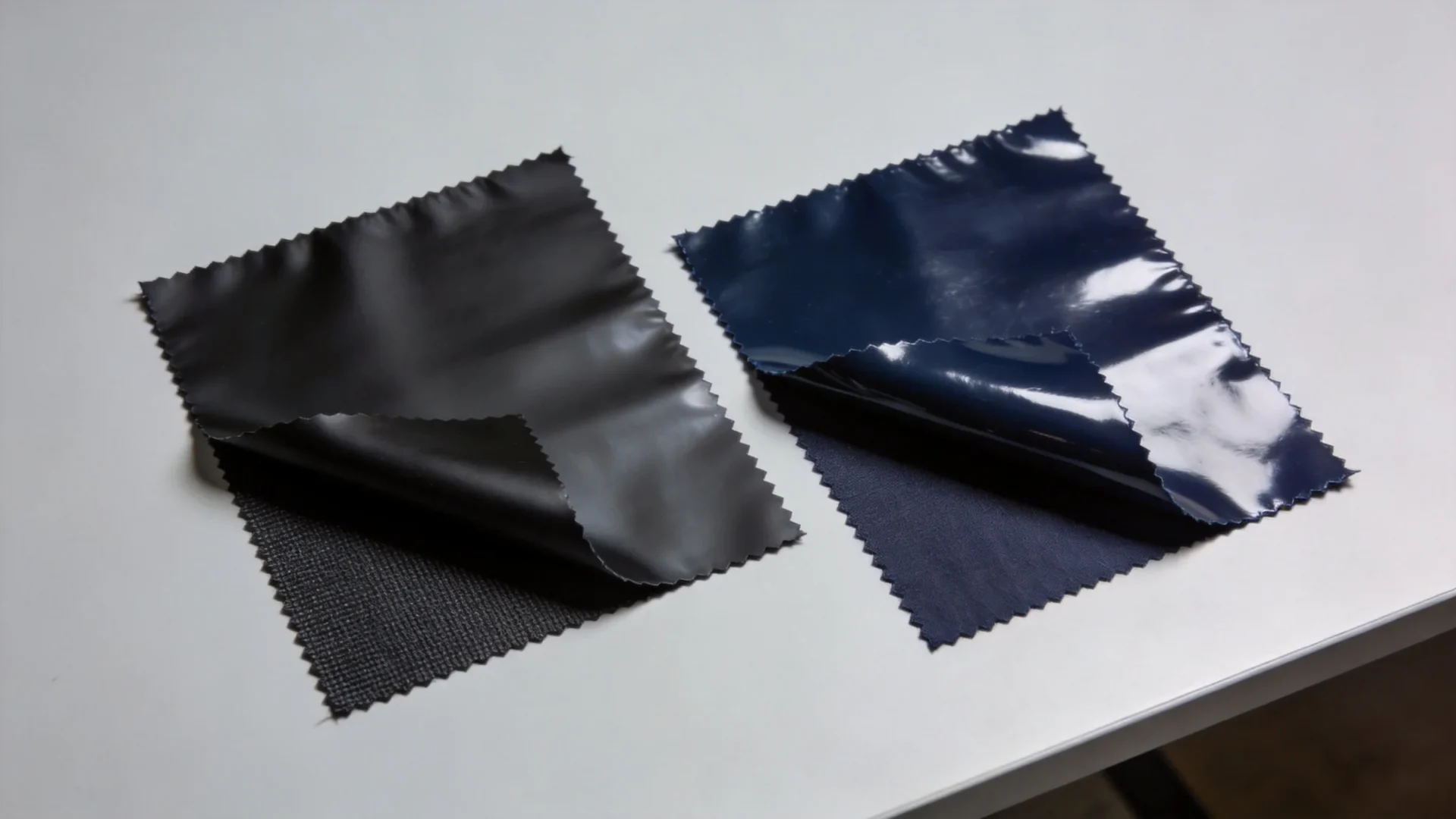
A coated golf bag shell is a woven base fabric — usually 210D to 900D polyester or nylon — with a polymer film bonded or laminated to one or both faces. The base fabric carries the structure and the abrasion load. The polymer film is the barrier. Water does not pass through the film; it passes through the gaps: needle holes at seams, zipper teeth, and the point where the face fabric finally saturates and wicks.
TPU (thermoplastic polyurethane) and PVC (polyvinyl chloride) are the two polymers that dominate this category, and the choice drives weight, cold performance, weldability, recyclability and price all at once. They are not interchangeable at the same cost.
Weight: the number that shows up on the spec sheet first
For the same base fabric denier, TPU coatings run roughly 120–250 GSM while PVC coatings run 180–900 GSM. That is a structural gap, not a rounding difference, and it compounds through the bag: a 30-litre roll-top built from 500D PVC-coated polyester lands around 620 g/m² of shell, while an equivalent build from 840D TPU-laminated nylon lands around 470 g/m² — a finished-bag difference of roughly 270 g on the same pattern, harness and hardware.
On a stand bag, 270 g is the difference between a bag a golfer will carry for eighteen holes and one they will not. It is also why the premium waterproof segment skews TPU: the H2NO E-2.5 is quoted at around 2 kg and the E-4.5 VLO at around 2.6 kg, which is competitive with non-waterproof bags of similar storage — a weight position PVC cannot reach at the same barrier level.
Weathering: cold flex and UV are where PVC gives up
PVC is plasticiser-dependent. Plasticisers migrate, and migration accelerates with heat, UV and flexing, which is why PVC-coated fabric stiffens below roughly 0°C and can crack at the fold line around −20°C. A golf bag lives in exactly the conditions that punish that: a cold trunk, a folded rain hood, a strap crease that flexes every round. TPU stays flexible to roughly −30°C and, in polyether grades, lower.
UV is the second axis. With stabilisers, TPU holds colour and surface integrity far longer; PVC yellows, chalks and can develop surface cracking as plasticiser leaves. Published weathering comparisons put outdoor service life at roughly 5–8 years for polyether TPU against 3–5 years for plasticised PVC before the coating stops behaving like a coating.
This is the single most useful thing to specify and the thing almost no RFQ asks for: not just the initial hydrostatic head, but the head retained after accelerated weathering. A 20,000 mm coating that drops to 6,000 mm after 500 hours of QUV is a two-season bag with a five-season number on the hangtag.
The compliance layer that now decides which markets you can sell into
PVC carries chlorine and requires plasticisers, and several phthalates — DEHP among them — are restricted in the EU. That does not make PVC illegal for a golf bag, but it does mean a PVC programme needs a phthalate declaration and a REACH position, and a TPU programme is a single-polymer system that is recyclable and needs neither.
For a brand selling into the EU or into any retail channel with a chemicals policy, this is frequently the deciding factor rather than the price. It is also the reason “we can do it in PVC, it is cheaper” is the wrong answer to a waterproof brief in 2026 even when it is technically true.
Why PVC still wins some programmes
Two reasons, both legitimate. First, cost: TPU resin runs roughly three to five times the price of PVC resin, and that flows into the fabric price per metre. Second, process tolerance: PVC welds across a wide, forgiving window, while TPU welding needs tighter temperature, pressure and dwell control. A factory without calibrated welding equipment will produce more rejects in TPU — and those rejects are process failures, not design failures, which is a distinction worth writing into the quality agreement.
| Property | TPU coating / lamination | PVC coating |
|---|---|---|
| Coating weight (same base denier) | 120–250 GSM | 180–900 GSM |
| Hydrostatic head range | 3,000–20,000+ mm | 5,000–20,000 mm |
| Breathability | 3,000–8,000 g/m²/24h | Effectively zero |
| Cold flex limit | About −30°C, polyether grades lower | Stiffens below 0°C, cracks near −20°C |
| Outdoor service life | 5–8 years (polyether) | 3–5 years before plasticiser migration |
| UV performance | Good with stabilisers, non-yellowing grades exist | Requires stabilisers, prone to yellowing |
| Weld window | Narrow — needs calibrated equipment | Wide and forgiving |
| Recyclability | Single polymer, recyclable | Difficult — plasticiser content |
| Chemical position | No chlorine, no phthalates | Chlorine; phthalates restricted in EU |
| Raw material cost | Roughly 3–5× PVC resin | Commodity pricing |
Ranges compiled from published coated-fabric specification data. Actual values depend on base fabric, coating thickness and grade; always test the specific lot.
Waterproof zippers: the line item buyers underestimate
What a “waterproof zipper” actually is
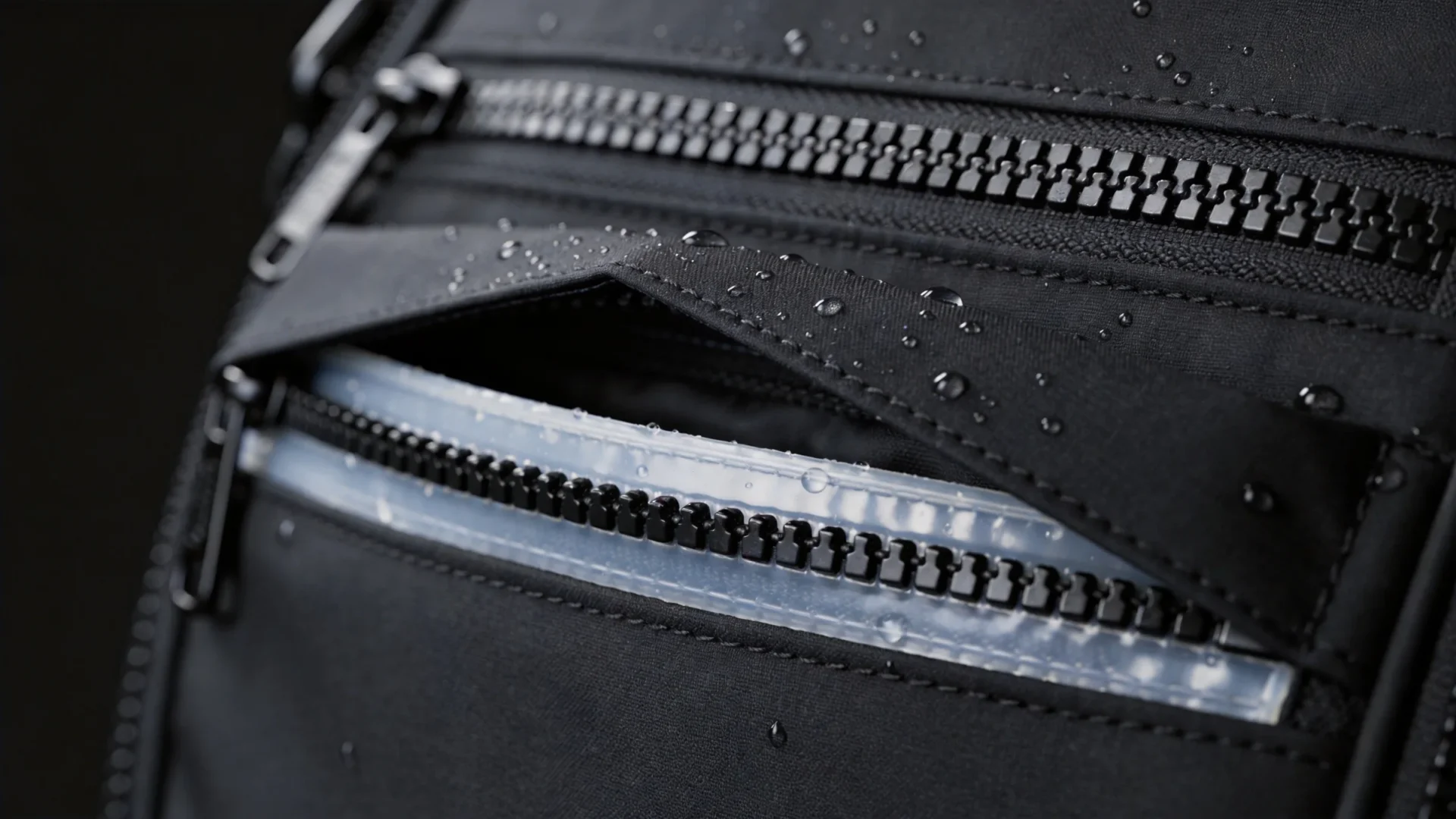
A standard coil zipper is a gap with teeth in it. Water passes through the weave of the tape and between the teeth. Waterproof zippers close that gap in one of two ways: a polyurethane film laminated over the tape to create a continuous surface, or a reverse-coil construction where the smooth flat side of the coil faces outward and water beads off instead of entering the tooth gaps. Most branded water-repellent zippers, YKK AquaGuard included, use one or both.
The cost arithmetic, per bag
Published component pricing puts water-repellent zippers at roughly two to four times the cost of an equivalent non-waterproof zipper, and a standard YKK zipper at roughly 30–60% of the AquaGuard price for the same length. Reference retail pricing for AquaGuard coil runs about $1.50–2.50 for a 25 cm pocket zip, $2–3 for 40 cm, and $4–7 for a 70 cm main zip; heavier storm-flap and watertight constructions sit well above that.
Now multiply by the zipper count. A six-pocket cart bag typically carries six to nine zipper openings — main apparel pocket, valuables, rangefinder, ball pocket, cooler, two side pockets, plus any internal. At six zips averaging 35 cm, the waterproof upgrade alone moves the bag by roughly $1.50 to $4.50 in component cost, before the labour of installing them correctly. That is the number to put in front of a buyer who thinks “waterproof zipper” is a small line item.
The trap: a water-repellent zipper does not make a waterproof bag
This is the part that separates a real waterproof programme from a marketing one. YKK’s own product documentation for AquaGuard states plainly that the zipper is not completely waterproof and recommends a quality check test before use. That is not a hedge; it is accurate. A water-repellent zipper sheds rain striking it, but under sustained pressure and wicking at the slider, water will find the seam where the tape meets the shell.
Which means the zipper only performs as part of a system: a storm flap or zipper garage over the opening, a tape-to-shell seam that is sealed rather than merely sewn, and a slider that does not become the lowest point in the assembly. Specify the assembly, not the part number.
One further detail worth knowing if your design team is chasing weight: YKK explicitly excludes bags from the recommended use of its lightest water-repellent chain, FLATKNIT AquaGuard, on the grounds that sharp objects inside the bag can damage the zip from within. The lightest zipper is not automatically the right zipper for a golf bag full of irons.
| Zipper option | How it keeps water out | Relative component cost | What it does not solve |
|---|---|---|---|
| Standard nylon coil | Nothing — open weave, open teeth | Baseline | Everything |
| Water-repellent coil (PU-laminated tape) | PU film bonded over the tape; reverse coil faces the weather | About 2–4× baseline | Slider gaps, tape-to-shell seam |
| Water-repellent coil + storm flap | Film tape plus a shell flap covering the opening | About 2.5–4.5× baseline plus labour | Pressure at a fully saturated flap |
| Watertight / sealed construction | Continuous sealing element, higher closing force | Well above 4× baseline | Weight, stiffness, cost per opening |
Relative cost indices are indicative planning ratios for RFQ purposes, not quotations. Zipper cost varies with length, slider type, tape colour, quantity and lead time.
Seams: heat-sealed versus sewn and taped
A sewn seam is a row of needle holes. On a waterproof shell, those holes are the leak — typically every 2.5 to 3 mm along the stitch line. There are two ways to close them, and they cost differently.
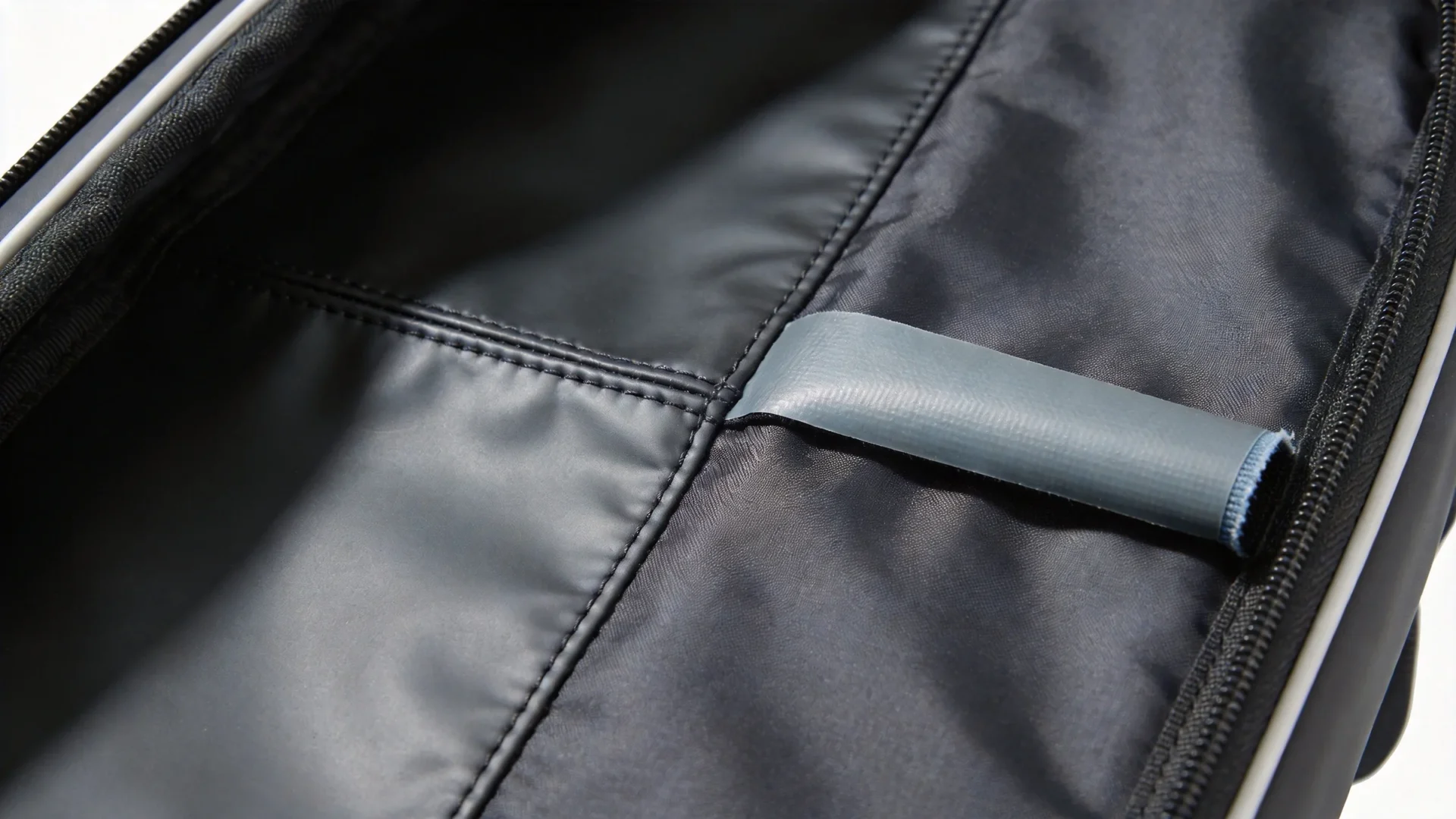
Sewn plus tape. The seam is stitched normally for strength, then a heat-activated tape is applied over the inside. The tape is a film with adhesive that flows under heat and pressure. It works, it is the standard approach for complex geometry, and it adds a taping operation, tape consumption, and a labour step that is hard to automate on curved panels. Its failure mode is adhesion: a tape that lifts at the edge, or a seam that is contaminated with oil or dust before taping, becomes a slow leak that passes final inspection and fails in the field.
Heat-sealed or radio-frequency welded. The two coated faces are fused directly with no needle and no tape. There is no hole to seal because no hole was made. This is the cleaner construction and the more expensive process: it needs platens, fixtures and calibrated temperature and pressure control, and it does not tolerate variation in coating thickness. Its failure mode is a process failure rather than a wear failure — an under-welded seam peels rather than leaks.
In practice a real waterproof golf bag is a hybrid, because not every seam can be welded. Curved pocket panels, multi-layer junctions at the top collar, the base attachment and anywhere the shell meets a rigid frame all tend to be sewn and taped. A supplier who claims “100% welded” on a fourteen-way cart bag is either describing a different product or has not walked the pattern.
When you review a sample, this is a two-minute physical check that tells you more than the spec sheet: turn the bag inside out at the base and at the top collar and look at where the tape ends. Tape terminations are where water gets in.
| Seam method | Mechanism | Leak risk profile | Process cost driver |
|---|---|---|---|
| Sewn, untaped | Needle holes left open | Leaks along the entire stitch line | Lowest |
| Sewn plus heat-activated tape | Tape film bridges and seals the stitch holes | Edge lift and contamination failures; passes new, fails in year two | Tape cost plus a manual taping step |
| Heat-sealed / RF welded | Coating fused, no needle hole created | Under-weld peels; needs calibrated equipment | Fixtures, platens, process control, rejects |
| Hybrid (welded panels, taped junctions) | Welding where geometry allows, tape where it does not | Depends entirely on tape terminations | Both, plus engineering time |
DWR: the finish that decides how long the bag feels waterproof
Durable Water Repellent is a topical finish on the face fabric that makes water bead and roll off. It is not waterproofing and it was never meant to be — it exists to stop the outer fabric saturating, because a saturated face fabric is heavier, colder, and blocks the breathability the coating was chosen for.
It also decays, and it decays faster than anything else in the construction. Published assessment of water-repellent finishes puts performance loss at roughly 50% after 12–15 machine washes, and fluorine-free alternatives lose ground faster — on the order of 70% by the tenth wash — which is the trade-off the industry accepted when it moved off long-chain fluorochemistry.
Abrasion is the dominant driver in real use, and a golf bag has three high-abrasion zones that no wash test models: the shoulder strap contact patch, the cart strap pass-through, and the base. That is why the first place a “waterproof” bag wets out is almost always the panel under the strap.
Two practical consequences for a sourcing brief. First, specify the finish by test result, not by chemistry: initial spray rating and rating after a stated number of washes, on the actual shell. Second, accept that DWR is a consumable and design for it — a bag whose face fabric is a 600D with a good base coating still sheds water after the DWR has gone, whereas a light fabric with no coating underneath becomes a sponge.
Also worth knowing: contamination looks exactly like DWR failure and is reversible. Body oils, sunscreen and cart grease fill the hydrophobic structure and water spreads even though the chemistry is intact. A technical wash restores beading; a fabric softener destroys it permanently. If a customer complains at month eight, the honest first question is how the bag was cleaned.
What H2NO actually is — and what a brand-level claim asks of a supplier
Sun Mountain’s waterproof golf bag line is called H2NO, and it is the cleanest public example of how a brand turns a construction into a proprietary standard. The company’s own collection page describes every bag in the line as built with waterproof fabrics, seam-sealed construction and water-resistant zippers, and states the collection is built to the TQR Standard — Trust. Quality. Reliability.
For 2027 the line has been refreshed across five models: the H2NO E-2.5, E-3.5 and E-4.5 VLO stand bags and the H2NO C-100 and C-130 cart bags — see our stand bag and cart bag programmes for how those two silhouettes differ in construction — all using waterproof fabric with a polyurethane coating, water-resistant seam-sealed zips and a matching rain hood, available through authorised retailers from 1 December. Quoted weights run from about 2.0 kg for the E-2.5 to 2.7 kg for the C-130. See the launch specification for the model-by-model breakdown.
Here is the detail that matters most to a buyer, and it is a gap rather than a feature. H2NO is a construction specification and a trademark. It is not a published test standard with a number attached. The H2NO product pages state fabrics, seam sealing and zipper type — they do not publish a hydrostatic head figure. Yet the same company, writing about its rain jackets, is explicit about what a millimetre rating means and recommends a floor of 10,000 mm for golf, 15,000 mm or higher for steady rain, and 20,000 mm and above for sustained wind-driven rain.
That asymmetry is normal in this industry and it is not dishonest. A bag is a three-dimensional assembly of panels, seams, zips and hardware; a single fabric number would misrepresent it. But it puts the burden on the buyer. When a brand says “waterproof”, the question to ask is not “what is your number” — it is “which test, on which component, before or after ageing, and who signed the report”.
A brand-level claim also transfers obligations down the supply chain that a generic waterproof brief does not. The factory has to hold the same shell lot across production runs, because a coating weight change of 40 GSM is invisible in a photo and decisive in a rain test. It has to keep the zipper grade, because a substitution to save forty cents destroys the claim. And it has to keep records, because the brand will be asked to defend the claim by a retailer or a regulator and will come back to the factory for the evidence.
| What the brand claim says | What it usually means in practice | What to ask for before you sign |
|---|---|---|
| “Waterproof fabric” | A coated or laminated shell above some unstated threshold | Polymer type, coating weight in GSM, hydrostatic head with the test method named |
| “Seam-sealed” | Taped seams, possibly with unwelded junctions | Which seams are welded, which are taped, and how terminations are finished |
| “Water-resistant zippers” | Water-repellent coil with a laminated tape | Zipper grade and slider, whether a storm flap is present, and the tape-to-shell seal |
| “Rain hood included” | A separate cover, sometimes the actual primary defence | Whether the bag is claimed waterproof with the hood off — because that is how it will be judged |
| “Built to [brand] standard” | An internal construction specification | The internal spec document, and the third-party test report behind it |
| A published mm rating | A fabric-level number, usually on new material | The same test after accelerated weathering, and a seam test at the same time |
The test sheet a waterproof golf bag should carry
Test methods in this category are not interchangeable, and the single most common sourcing error is comparing a number produced by one method against a number produced by another. Hydrostatic head can be run to ISO 811, AATCC TM127, ASTM D751 or JIS L 1092, and the results do not map onto each other. The rating also covers fabric only — not seams, not zips, not the hood — and it is normally measured on new material.
Regulation has moved on the same point. In Europe, EN ISO 24232:2025 has superseded EN 343:2019, and its highest waterproof class requires at least 20,000 Pa — roughly 2,040 mm of water column — held after pre-treatment, with seams tested as well as fabric. That is a deliberately low bar next to the marketing numbers in this market, and it is a useful reminder of how little a headline millimetre figure actually certifies.
| Test | Standard | What it proves | What it does not prove |
|---|---|---|---|
| Hydrostatic head, fabric | ISO 811 / AATCC TM127 / ASTM D751 / JIS L 1092 | Barrier pressure of the shell as supplied | Seams, zips, ageing, real-world assembly |
| Hydrostatic head after ageing | Same method, after QUV or hydrolysis pre-treatment | Whether the coating survives UV and humidity | Mechanical abrasion at strap and base |
| Seam hydrostatic / seam integrity | Brand or buyer method on a seamed panel | Whether the seam holds at the same pressure | Tape adhesion over time |
| Rain penetration | AATCC 35 or equivalent spray/rain test | Assembly-level performance under simulated rain | Sustained pressure, immersion, flexing |
| DWR spray rating | AATCC 22, initial and after stated washes | Whether the face fabric still beads | Whether the barrier behind it is intact |
| Zipper water repellency and cycling | Supplier method plus open/close cycling | Whether the zip survives use and stays repellent | Tape-to-shell junction |
| Cold flex | Fold test at rated low temperature | Whether the coating cracks in a cold trunk | Anything at ambient temperature |
| Chemical declaration | REACH SVHC, phthalate declaration | Market access and retailer compliance | Performance of any kind |
Ask for the raw report, not a summary line. A report that names the method, the lab, the sample date and the pre-treatment is worth more than any single number on a hangtag.
Where the money actually goes: an indicative BOM delta
Bring the four lines together on one page and the picture is clarifying. The table below is an indicative planning range for a six-pocket cart bag at 500 pieces per style and colour, expressed as the delta against a commodity 600D/PVC build. It is not a quotation and it is not our cost sheet — it is the shape of the gap, which is what a buyer needs before a first meeting.
| Cost line | Commodity water-resistant build | Waterproof TPU build | Indicative FOB delta |
|---|---|---|---|
| Shell fabric | 600D polyester, light PVC or PU backer | TPU-laminated 420–840D, 120–250 GSM coating | +$1.20 – $2.40 |
| Zippers (6–8 openings) | Standard nylon coil | Water-repellent coil with laminated tape and storm flaps | +$1.80 – $4.50 |
| Seam treatment | Sewn, untaped | Hybrid: welded panels, taped junctions, finished terminations | +$0.90 – $2.20 |
| DWR finish | Basic, unspecified | Specified spray rating, initial and after washes | +$0.15 – $0.40 |
| Rain hood | Optional accessory | Matched, included, sealed | +$0.60 – $1.20 |
| Testing and documentation | None beyond AQL inspection | HH, ageing, seam, rain test, declarations | +$0.30 – $0.80 |
| Yield loss and rework | Baseline | Higher reject rate during welding set-up | +$0.50 – $1.50 |
| Total | +$5.45 – $13.00 per bag |
Read against the retail gap of one hundred to two hundred dollars on a branded waterproof bag, this is the point worth sitting with: the material premium is a small fraction of the retail premium. That is normal in every category, and it is not a scandal — the brand is also buying warranty exposure, marketing, distribution and a claim it has to defend.
But it changes how you negotiate. You will not close a hundred-dollar retail gap by arguing about coating weight. You close it by deciding which of these seven lines your programme actually needs, and by refusing to pay for lines that are not specified. A bag that is welded where it matters, taped where it must be, zipped correctly and tested once properly is a better buy than a bag that claims a higher millimetre number nobody can document.
Three questions to ask before you approve a waterproof sample
- Which seams are welded and which are taped, and how are the tape terminations finished? Turn the bag inside out at the base and the top collar. This is where the leak starts and it is the answer a supplier cannot improvise.
- What is the hydrostatic head of the shell, by which method, and what is it after ageing? One number on new material tells you almost nothing. The second number tells you whether you are buying three seasons or eight.
- Is the bag claimed waterproof with the rain hood off? If the hood is the primary defence, you have bought a water-resistant bag with a cover, and your customer will discover that in a two-hour downpour rather than a shower.
FAQ
Why are waterproof golf bags so much more expensive than water-resistant ones?
Because four line items change at once: the shell moves from PVC or light PU to a TPU lamination, the zippers move from standard coil to water-repellent laminated tape with storm flaps, the seams move from plain stitching to a welded-and-taped hybrid, and the programme adds test reports and ageing data. In planning terms that is roughly five to thirteen dollars of FOB per bag on a six-pocket cart bag — a real gap, but far smaller than the one to two hundred dollars of retail step-up on a branded waterproof model.
Is TPU better than PVC for a waterproof golf bag?
For weight, cold performance and compliance, yes. TPU coatings run 120–250 GSM against 180–900 GSM for PVC at the same base denier, stay flexible to around −30°C where PVC stiffens below 0°C and can crack near −20°C, and are a single recyclable polymer with no plasticiser or chlorine content. PVC still wins on resin cost and on weld tolerance, so it remains viable for high-volume programmes selling into markets without a chemicals policy.
Do I need YKK AquaGuard zippers on a golf bag?
You need a water-repellent zipper of a known grade, installed as a system. AquaGuard is the most widely documented option and runs roughly two to four times the cost of an equivalent standard zipper. But YKK’s own documentation states the zipper is not completely waterproof and recommends a quality check before use — so the zipper only performs with a storm flap over the opening and a sealed tape-to-shell junction behind it.
What is the difference between heat-sealed seams and sewn seams with tape?
A sewn seam creates needle holes every 2.5 to 3 mm, and tape is applied over the inside to bridge them; the failure mode is tape edge lift and contamination under the tape. A heat-sealed or RF-welded seam fuses the coating with no needle hole at all, and the failure mode is an under-welded seam that peels. Real bags are hybrid, because curved panels, the top collar and the base attachment generally cannot be welded.
How long does DWR last on a waterproof golf bag?
Published assessment of water-repellent finishes puts performance loss at roughly 50% after 12–15 machine washes, with fluorine-free finishes losing about 70% by the tenth wash. In real use abrasion drives it faster than washing, and the first zones to wet out are the shoulder strap contact patch, the cart strap pass-through and the base. Contamination from oils and sunscreen looks like DWR failure but is reversible with a technical wash; fabric softener damages it permanently.
Is H2NO a waterproof rating?
No. H2NO is Sun Mountain’s proprietary construction specification and trademark for its waterproof golf bag line — waterproof fabrics, seam-sealed construction and water-resistant zippers, built to what the company calls its TQR Standard. The H2NO product pages describe the construction but do not publish a hydrostatic head figure. The same company does publish millimetre guidance for its rain jackets, recommending 10,000 mm as a floor and 20,000 mm and above for sustained wind-driven rain.
What hydrostatic head should a waterproof golf bag have?
For the shell, 10,000 mm is a sensible floor and 15,000 mm or higher is what holds up in steady rain — but the fabric number is only part of the answer. It excludes seams and zips, it is measured on new material, and results from ISO 811, AATCC TM127, ASTM D751 and JIS L 1092 are not interchangeable. Ask for the same test after accelerated weathering, and for a seam test at the same time.
What is a realistic MOQ for a custom waterproof golf bag?
At Junyuan Bags the standard MOQ is 500 pieces per style and colour, and 200 pieces for golf bags specifically. Waterproof construction adds two constraints worth planning for: welding set-up produces a higher reject rate in the first run, and the shell coating lot has to be held across production, so splitting a colourway into small repeat orders costs more in waterproof programmes than in standard ones.
Sources
- Sun Mountain Sports, Waterproof Collection — H2NO construction, TQR Standard and current USD pricing: sunmountain.com/collections/waterproof-collection
- Golfmagic, “Sun Mountain launches five new waterproof golf bags for 2027”, 2 November 2026 — model list, weights, PU coating, seam-sealed zips, 1 December availability: golfmagic.com
- Sun Mountain Sports, “Best Golf Rain Jackets & Rain Gear for Fall Golf in 2026” — waterproof rating bands in millimetres and what a rating does and does not cover: sunmountain.com
- YKK Digital Showroom, AquaGuard NATULON Coil Zipper No.8 and No.10 — construction notes and the statement that the zipper is not completely waterproof and requires a quality check before use: ykkdigitalshowroom.com
- YKK, FLATKNIT AquaGuard technical sheet — weight and thickness comparison against AquaGuard No.5, and the explicit exclusion of bags from recommended use
- WaterproofJacket.com, “Waterproof Ratings Explained” — what a millimetre rating measures, the non-interchangeability of ISO 811, AATCC TM127, ASTM D751 and JIS L 1092, and EN ISO 24232:2025 superseding EN 343:2019 with a 20,000 Pa top class tested on seams
- Xingye Textile, “TPU vs PVC Waterproof Fabric” — coating weight, hydrostatic head, breathability, cold flex and compliance comparison
- GAF Outdoor, “How TPU and PVC Coatings Transform Standard Fabrics” — resin cost ratio, UV and hydrolysis resistance, and the recommendation to specify retained hydrostatic head after QUV ageing
- MBK, “TPU vs PVC Waterproof Backpacks” — measured shell weight, finished-bag weight, Martindale abrasion life and cold flex limits on matched 30-litre builds
- PTOutwear, “YKK Aquaguard Zippers: The Complete Buyer’s Guide” — laminated-tape and reverse-coil mechanisms, 8,000–12,000 cycle durability, relative cost of two to four times standard, and reference pricing by length
- TextilePulse, “Best Fabric Care for Technical Apparel”, citing Textile Research Journal (2023) — DWR performance loss of about 50% after 12–15 washes, and faster decay for fluorine-free finishes
Product specifications, prices and model availability quoted here are as published at the time of writing and change without notice. Cost ranges are indicative planning figures for RFQ discussion, not quotations, and should be confirmed against your own bill of materials. Test values depend on the specific fabric lot, coating grade and construction; always request the raw report.
Junyuan Bags manufactures custom golf bags, backpacks, cooler bags and medical bags through affiliated and partner factories in Fujian, China — established 2014, with our founding team in the bag trade since 2004. MOQ from 500 pcs per style and colour (200 pcs for golf bags), sampling in 6–10 business days, bulk production 35–50 days, AQL 2.5 major / 4.0 minor.
If you are specifying a waterproof programme, we will quote the construction line by line — coating polymer and weight, zipper grade and count, which seams are welded and which are taped, and the test reports behind each. Start with our custom waterproof bag manufacturing programme, or look at the custom golf bag line if your programme is cart or stand bag based. For a wider view of barrier construction across categories, see the OEM and ODM bag manufacturing service.
Contact: [email protected] · +86 17750020688