A bag manufacturer established in 2014, with our founder in the industry since 2004. We build private-label fire-resistant document bags, cash and money pouches, passport wallets, photo and keepsake bags, and multi-pocket file organizers on silicone-coated fiberglass, aluminized reflective film and needle-punch insulation — for home-safety brands, office and stationery suppliers, insurance and document-storage channels, promotional distributors and Amazon private-label sellers.
Looking for a custom fireproof bag manufacturer? Junyuan Bags has been making bags since 2014 — our founder has worked in the bag industry since 2004 — and today we produce private-label fire-resistant document bags, fireproof money pouches, passport and cash wallets, photo storage bags and multi-layer file organizers for home-safety brands, office-supply and stationery distributors, insurance and records-management channels, promotional programs and Amazon private-label sellers across North America, Europe, the UK and Australia. Every bulk order is inspected to AQL 2.5 major / 4.0 minor, with MOQ 500 pieces per style, sampling in 6–10 business days, and mass production in 35–50 days. A typical four-layer A4 document bag runs 480–720 g, uses 0.4–0.6 mm silicone-coated fiberglass as the heat barrier and closes with a 50 mm full-width hook-and-loop flap — the three variables that decide whether a bag survives a real fire or only looks like it would. Combined capacity across our affiliated and partner factories covers programs from 500 to 50,000 pieces per style, quoted within 24–48 hours of a complete specification.
- Heat barrier: 0.4–0.6 mm silicone-coated fiberglass cloth, 430–600 g/m², continuous service to about 250 °C with short excursions well above that
- Reflective layer: 12–25 µm aluminized PET or aluminum foil laminate, reflecting the majority of radiant heat before it reaches the documents
- Insulation: 3–8 mm needle-punch felt or ceramic-fibre mat, the layer that buys minutes once the outer shell is compromised
- Closure: 50 mm full-width hook-and-loop flap, double-folded, because a metal zipper is a heat bridge straight into the document compartment
- Seams: double-stitched with aramid (para-aramid) thread at 8–10 stitches per inch, bound edges in fiberglass or heavy cotton tape
- Inspection: AQL 2.5 major / 4.0 minor on stitch density, seam strength, hook-and-loop peel, layer alignment, dimensions and labelling
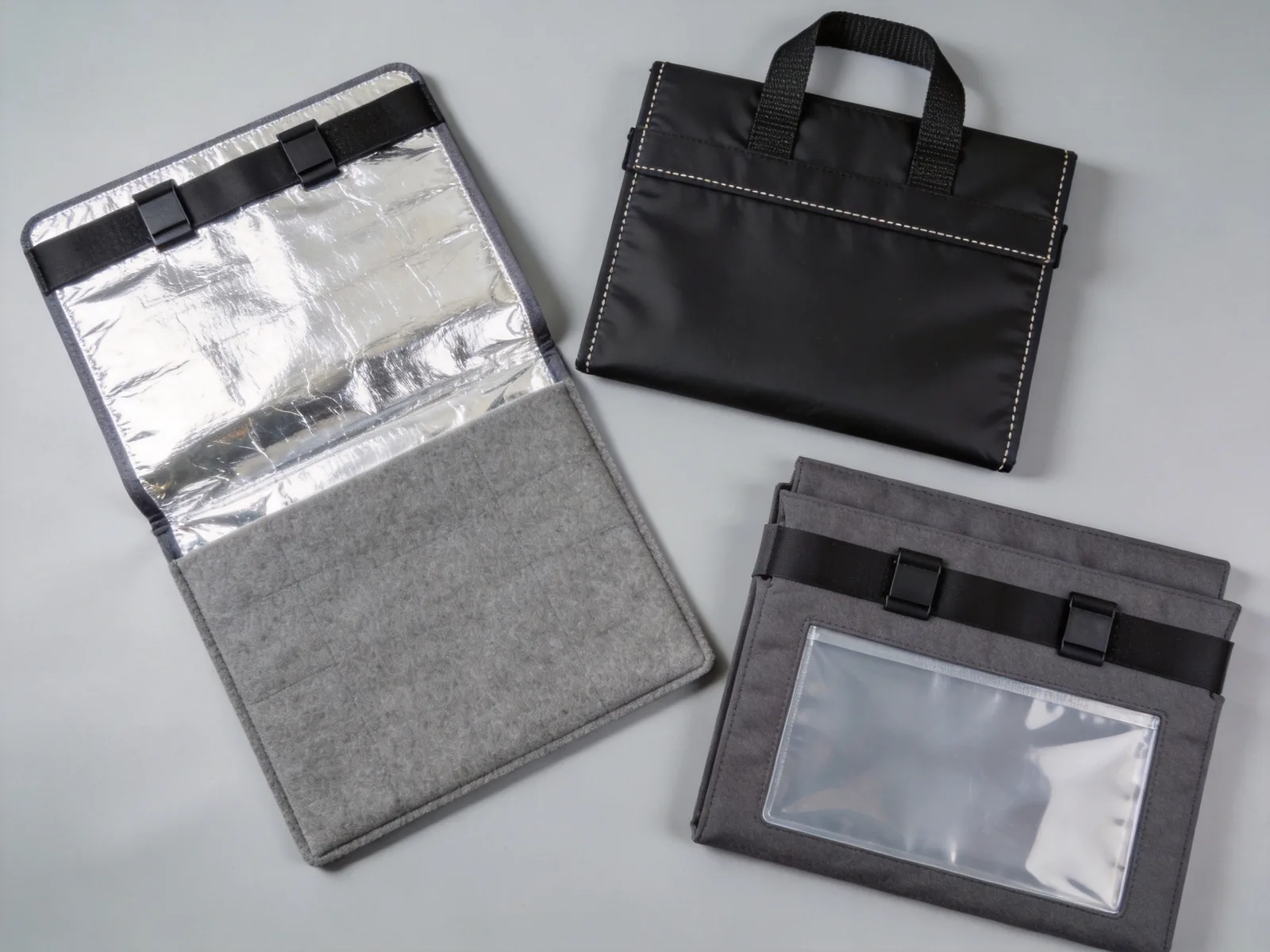
What a Fire-Resistant Document Bag Actually Does — and What It Cannot Do
A fire-resistant document bag is a soft, portable thermal barrier. Its job is to keep the inside of the bag below the point where paper chars, currency fuses or a passport laminate deforms, for a defined period, while a house fire passes over it. That is a measurable engineering claim, and it is completely different from the claim a fireproof safe makes. Buyers who understand the difference make better products and get fewer returns; buyers who treat the two as interchangeable end up with one-star reviews that say “the papers were burnt” after a real fire.
Paper ignites and chars at roughly 230–233 °C (450 °F). Currency notes degrade and become unverifiable well below that. A standard fire test following the ASTM E119 time-temperature curve reaches about 538 °C at five minutes and 927 °C (1,700 °F) at one hour. So the engineering target is not “resist fire” in the abstract — it is “hold the internal temperature below the paper-protection threshold for 30, 60 or 120 minutes while the outside of the bag is being cooked at up to 927 °C.”
What a soft bag can do well: sit inside a drawer, a filing cabinet, a suitcase or a go-bag; protect documents through a fast-moving room fire or a car fire; be carried out of a building in one hand. What it cannot do: survive a prolonged, fully developed structural fire the way a rated insulated safe does, or protect against direct flame impingement on the same spot for an extended period. When a brand sells a fireproof bag, the honest and legally safer framing is fire-resistant, with a stated test basis, not an unqualified “fireproof.”
That is also where a manufacturer earns its keep. The layers are commodity materials; the performance comes from layer order, thickness, closure geometry, seam integrity and the way the bag behaves when it is folded, dropped or compressed in a drawer. A bag with a perfect material stack and a 25 mm single-stitched flap will fail long before a bag with a 50 mm double-folded flap and bar-tacked corners. We quote and build to that logic.
Fireproof Bag vs Fireproof Safe: Choosing the Right Product for a Brand Line
Most of the brands we work with sell both, or sell one and get asked for the other. The two products serve different purchase occasions, different price points and different channels, and the comparison below is the one we walk buyers through before a quote is written.
| Factor | Fire-resistant document bag | Rated fireproof safe / chest |
|---|---|---|
| Typical retail price band | USD 15–45 | USD 90–600 |
| Shipping weight | 0.4–1.2 kg | 12–60 kg |
| Portability | Carried by hand, fits in a go-bag or suitcase | Fixed installation, often bolted |
| Heat protection basis | Multi-layer flexible barrier; rating depends on build and test | Rigid insulated body with intumescent door seal |
| Water protection | Optional — coated shell plus storm flap, splash-resistant only | Usually sealed; some models submersible for a stated period |
| Theft protection | None | Locking boltwork, pry resistance |
| Best use case | Documents you must grab and leave with; travel; secondary protection inside a safe | Documents and valuables left behind; home office; small business records |
| Manufacturing route | Cut-and-sew, soft goods, low tooling cost, fast colour and logo changes | Metal forming, casting, insulation fill, high tooling cost |
| Private-label barrier | Low — 500 pcs per style, 6–10 day samples | High — tooling, certification and MOQ in the thousands |
The commercially useful insight: the bag is not a cheaper safe, it is a different product with a different job. Brands that position it as “grab-and-go document protection” — for wildfire zones, apartment buildings, rental properties, small offices, and travel — sell it consistently and get reviews that match the claim. Brands that position it as “replaces a safe” fight refunds forever.
The Four-Layer Build: Materials That Decide the Rating
Almost every credible fire-resistant document bag on the market is a laminate of four functional layers. The differences between a USD 12 bag and a USD 40 bag are thickness, layer quality, and how honestly the layers are bonded and finished.
| Layer | Typical material | Weight / thickness | Job in the build | Watch-outs |
|---|---|---|---|---|
| Outer shell | 600D–1680D polyester or nylon oxford, PU or silicone coated; 16 oz waxed canvas for a heritage look | 220–420 g/m² | Abrasion resistance, shape retention, brand surface for print and labels | Thin uncoated shell scorches and stiffens; coating must not melt and drip |
| Heat barrier | Silicone-coated fiberglass cloth (E-glass weave); aramid (meta-aramid) blend for premium lines | 0.4–0.6 mm, 430–600 g/m² | Primary thermal block; will not melt or drip; E-glass softens around 830 °C | Bare glass fibre irritates skin — must be fully encapsulated |
| Reflective layer | Aluminized PET film, aluminium foil laminate, or metallised nonwoven | 12–25 µm | Reflects radiant heat before conduction begins | Creping and pinholes cut performance; must be protected from abrasion |
| Insulation / liner | Needle-punch polyester felt, ceramic-fibre mat, or aramid felt | 3–8 mm | Slows conduction, cushions documents, hides the glass fibre from the user | Too thin and the bag fails early; too thick and it will not fit a drawer |
Two more material options appear in premium and niche programs. Intumescent coatings swell into a char barrier when heated and are useful on the flap and seam edges, where a fire finds the weakest point. Vermiculite-filled silicone is an endothermic compound used in rigid safe walls; in a soft bag it adds mass and cost quickly, so we usually recommend it only for a “vault insert” style product. RPET shells and recycled felt liners are available for brands with a sustainability claim, and they do not compromise the thermal stack because the shell and liner are not the functional heat barrier.
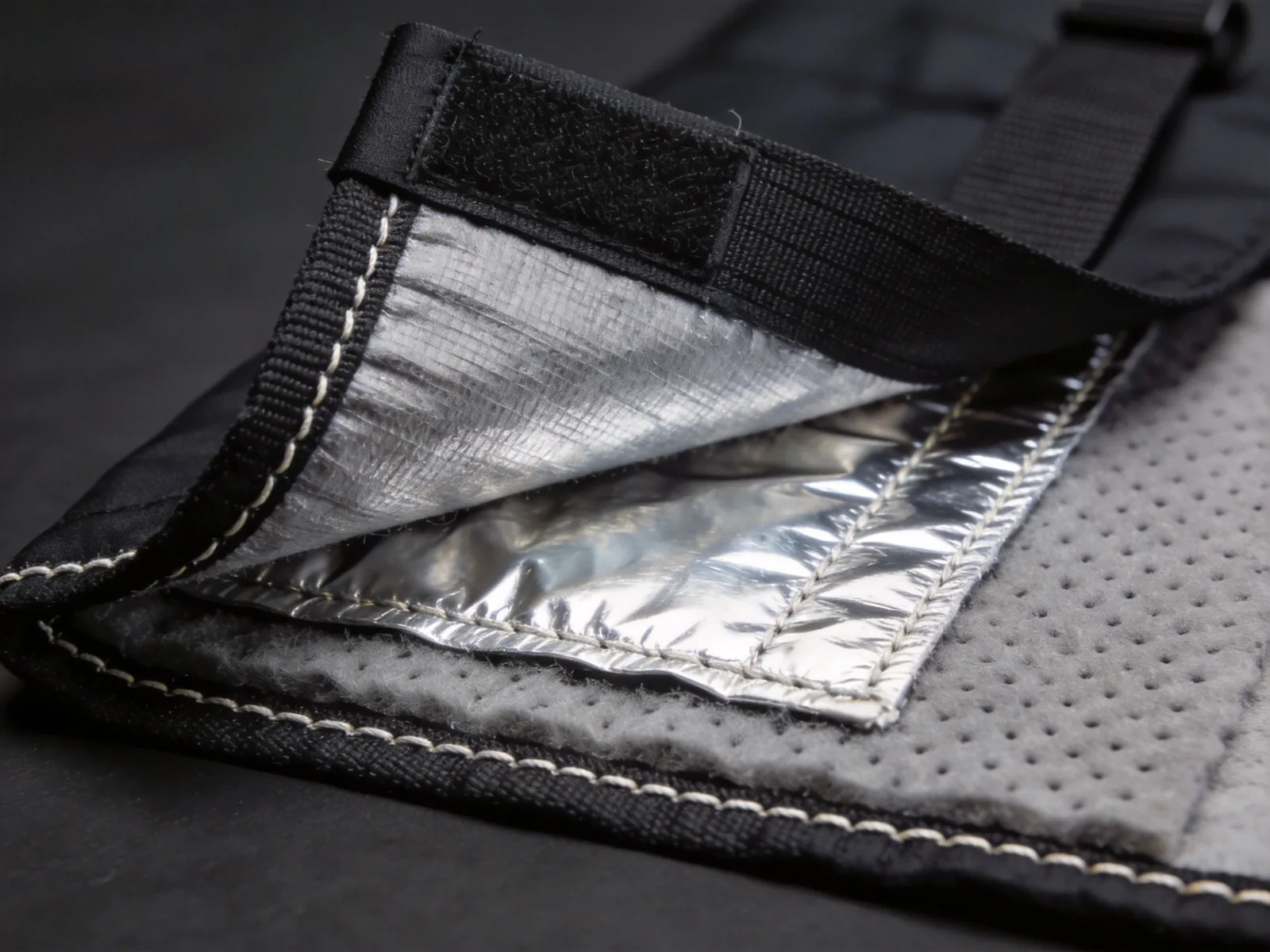
Construction Details That Fail First in a Real Fire
When a fire-resistant bag fails a test, it is almost never the middle of a panel. It fails at an edge, a seam, a closure or a hardware point. These are the seven decisions we review with every buyer, because they are the difference between a bag that passes and a bag that only photographs well.
1. The closure is the whole product
A metal zipper running across the mouth of a document bag is a conductive path from the fire straight into the compartment, and the coil or teeth deform as they heat. Our default is a 50 mm full-width hook-and-loop flap, double-folded so the fold itself is a barrier, with the hook side on the flap and the loop side on the body. Where a brand insists on a zipper for perceived security, we specify it on an outer accessory pocket only, never on the document chamber, and add an overlapping storm flap behind it.
2. Seams need thread that survives
Polyester thread softens around 250 °C and snaps. Aramid thread holds far longer and does not melt, which is why every structural seam on our fire-resistant builds is stitched with aramid thread, Tex 70–135, at 8–10 stitches per inch. Seams are double-stitched, and load points — handle anchors, flap corners, gusset junctions — get bar-tacks or box-X stitching. Bound edges use fiberglass or heavy cotton tape so the raw glass edge never becomes an exposed, fraying failure line.
3. No metal where the heat goes
D-rings, rivets, snaps, eyelets and metal sliders all conduct. On fire-resistant models we keep metal out of the document chamber entirely: plastic side-release buckles or sewn webbing loops for the handle, and if a brand needs a hanging loop, it is a webbing loop, not an eyelet.
4. Flap geometry beats flap size
A flap that is wide but short leaks at the corners. We build flaps that overhang the mouth by 35–50 mm on all three sides and wrap around the corner radius, so hot gas has to travel a folded path rather than finding a straight edge. The gusset depth is limited to what the documents need — an over-deep gusset creates a chimney.
5. Layer registration at the edge
If the aluminized film and fiberglass cloth shift during sewing, the edge becomes a thin spot. Panels are cut with a 3–5 mm registration allowance, assembled on a jig, and quilted or edge-tacked at intervals of 120–150 mm so the stack cannot migrate in use.
6. Handling and stiffness
A bag that creases permanently at the fold line cracks its reflective layer within weeks. We tune the felt density and the shell coating so the bag folds with a radius rather than a crease, and we specify the fold line in the pattern rather than letting the user find it.
7. Water is the second failure mode
Fire response usually involves water. A fire-resistant bag is not a dry bag, but a PU-coated shell, a storm flap over the closure and bound seams keep sprinkler water and hose spray out long enough for documents to be recovered. If a brand wants a genuine water claim, we build it as a separate IP-rated dry-bag construction and do not mix the two claims on one SKU.
Standards, Test Protocols and How We Quote a Rating
This is the part of the conversation where a supplier’s honesty matters most. We are a bag manufacturer, not a testing laboratory: we build to a specification and a third-party laboratory issues the certificate. Any supplier who promises a “UL certified” fireproof bag without a test report and a scope statement is selling a story.
| Standard / protocol | What it actually measures | How it applies to a soft bag |
|---|---|---|
| UL 72 (Class 350, 1 hour) | Internal temperature stays below 177 °C (350 °F) and humidity below 85% during a 1-hour fire exposure, then impact and reheat | Written for rigid record containers; some labs adapt the fire phase for flexible products — the scope statement matters |
| EN 1047-1 (S 60 P / S 120 P) | Paper-protection classes for 60 or 120 minutes: internal temperature and humidity limits during fire and impact testing | The clearest European framework for a document-protection claim; useful for EU and UK retail |
| ASTM E119 | The time-temperature curve itself: about 538 °C at 5 minutes, 927 °C at 60 minutes | The reference fire every lab test is compared against; we use it to set layer thickness |
| NFPA 232 | Protection of records: storage, handling and protection practice | Guides how a records-management buyer specifies the product, not the bag itself |
| UL 94 V-0 | Flammability of plastic components | Applies to buckles, films and coatings — specify V-0 where a brand wants a defensible components claim |
| ISO 1182 / EN 13501-1 | Non-combustibility and reaction-to-fire classification of materials | Useful evidence for the fiberglass and felt layers in a technical file |
| Internal oven test | Sample held in a muffle furnace at a set temperature with a thermocouple inside | A screening test during development; it is not a substitute for a certified fire test and we never present it as one |
Practically, a brand program runs in three stages. Stage one is a development build: we agree the layer stack, thickness and closure, then run an internal screening test so nobody spends money on a lab test for a design that was never going to pass. Stage two is third-party testing at a lab the brand chooses — we supply the sample sets, the technical file and the material declarations. Stage three is production to the frozen specification, with a golden sample sealed and kept at both ends so a future batch can be compared. If a brand only needs a marketing claim of “fire-resistant materials, tested to EN 1047-1 methodology,” that is a different (and much cheaper) conversation than a certified rating, and we will say so before a purchase order exists.
The Product Line We Manufacture
Nine shapes cover most of the market. All of them can be built on the same thermal stack; what changes is the pattern, the closure and the accessory set. Sizes below are the internal dimensions we tool for most often, and any of them can be adjusted within the pattern without new tooling.
| Model | Product | Internal size (mm) | Typical build | Usual buyer |
|---|---|---|---|---|
| FB-01 | Fire-resistant document bag, A4 | 330 × 240 × 30 | 4-layer, 50 mm hook-and-loop flap, webbing handle | Home-safety and office retail brands |
| FB-02 | Fire-resistant document bag, legal / foolscap | 380 × 260 × 35 | 4-layer, wider flap, reinforced corners | US and AU office channels |
| FB-03 | Fireproof money / cash pouch | 250 × 160 × 25 | 3-layer, 40 mm flap, gusseted | Cash-handling, retail, travel accessory |
| FB-04 | Fire-resistant passport and cash wallet | 220 × 140 × 20 | 3-layer, elastic or hook-and-loop closure, card slots | Travel and EDC brands |
| FB-05 | Multi-pocket file organizer | 350 × 260 × 60 | 4-layer body, 6–12 internal dividers, zip or flap | Records-management and small business |
| FB-06 | Photo and keepsake bag | 320 × 240 × 40 | 4-layer, acid-free inner sleeve, rigid insert option | Photo and memory-keeping brands |
| FB-07 | Jewellery and heirloom pouch | 200 × 150 × 60 | 4-layer, velvet or felt inner, drawstring or flap | Gift, bridal and insurance channels |
| FB-08 | Vault insert / safe liner bag | 400 × 300 × 80 | 5–6 layer, 8 mm insulation, no hardware | Safe brands adding a soft insert SKU |
| FB-09 | Fire-resistant document envelope with window | 340 × 250 × 20 | 4-layer, PVC-free clear window, flap closure | Stationery and mail-order office supply |
Two adjacent products we build on request and deliberately keep separate: LiPo battery safety bags, where the requirement is flame containment from an internal cell failure rather than heat exclusion from outside, and document wallets with RFID-blocking layers, where the functional layer is metallised mesh and the fire claim is dropped. Mixing claims on one SKU is how brands end up in a compliance argument.
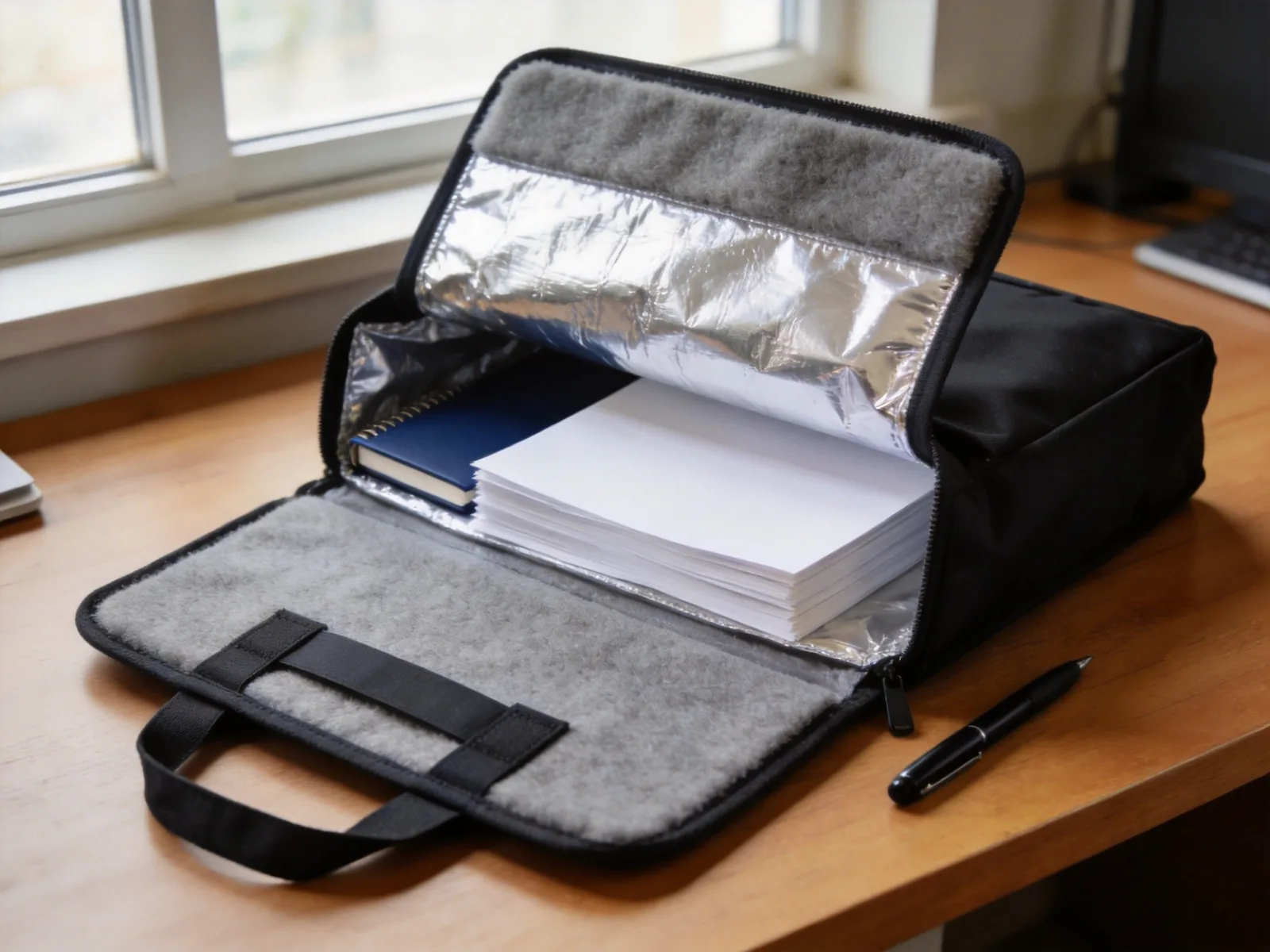
Customization: Branding, Colours, Inserts and Retail Packaging
Because a fire-resistant bag is a cut-and-sew product, customization is fast and cheap compared with a rigid safe. There is no tooling to amortise beyond the pattern and any print screens or embroidery files. What we can change on a 500-piece order:
- Size and proportion — pattern adjustments within the existing construction; new pattern and sample in 6–10 days
- Shell colour and texture — 600D/1680D oxford in stock colours, PU or silicone coating, waxed canvas, RPET; Pantone matching on volume colour runs
- Branding — silicone transfer print, heat-transfer label, woven label, embroidered logo, rubberised patch, debossed leather patch on heritage lines, printed interior lining
- Closure and hardware — hook-and-loop width, double flap, side-release buckle, webbing handle or none, hanging loop, D-ring on the outer pocket only
- Interior — document dividers, card slots, elastic pen loops, acid-free photo sleeves, velvet or felt lining, key hook
- Retail packaging — printed belly band, hangtag with the test-basis wording, polybag with a warning label, colour box, mailer-ready carton
- Documentation — material declaration sheet, care and warning insert, and a spec sheet the brand can hand to a lab
One caution we repeat to every buyer: whatever the bag says on the outside must match what the technical file says inside. If the hangtag claims a 60-minute rating, the file needs a test report with that scope. We will write the marketing wording with you, and we will refuse to print a claim the build cannot support — that is the part of the relationship that protects a brand from a marketplace takedown two years later.
Quality Control: What We Inspect and How
Inspection is where a fire-resistant product differs from a cosmetic one: several of the critical characteristics are inside the bag and cannot be seen after assembly. Our answer is process control plus a documented inspection plan at four points — incoming material, in-line, end-of-line and pre-shipment.
| Checkpoint | What is measured | Method / frequency | AQL or control |
|---|---|---|---|
| Incoming fiberglass cloth | Weight (g/m²), thickness, coating coverage, weave integrity | Roll sample, 3 readings per roll | Reject roll outside ±5% weight |
| Incoming reflective film | Thickness, pinholes, adhesion | Visual + micrometer, per lot | Zero pinholes in the document area |
| Cut panels | Dimensions, layer registration allowance | Template check, first 5 and every 50 | ±2 mm; AQL 2.5 |
| Stitching | Stitch density, seam type, thread type, bar-tack presence | In-line, every 20th piece | 8–10 SPI; AQL 2.5 major |
| Seam strength | Pull test on a destruct sample | 3 samples per batch | Record and retain; no seam failure below spec |
| Hook-and-loop | Peel and shear after 500 open/close cycles | 3 samples per style per batch | Retains ≥80% initial peel |
| Layer alignment | No thin spots or exposed glass edge | 100% visual at end-of-line | Zero tolerance on exposed fibre |
| Dimensions and weight | Finished size, unit weight | Pre-shipment sampling | AQL 4.0 minor |
| Labelling | Care label, warning text, SKU, barcode, country of origin | 100% visual | AQL 2.5 major |
| Packaging | Carton count, drop test on a master carton | Per shipment | 1.2 m drop, 6 faces |
Every batch ships with an inspection report, a photo set of the sealed golden sample against the production piece, and a measurement record. If a brand uses a third-party inspection company, we book the slot and prepare the AQL plan with them rather than around them. Acceptance is AQL 2.5 major / 4.0 minor on all soft-goods criteria, and critical defects — exposed glass fibre, a missing heat-barrier layer, a wrong thread type — are zero-tolerance regardless of the sampling plan.
MOQ, Sampling and Production Timeline
The commercial terms are deliberately simple, because most of our buyers are running a first or second production order and need predictability more than flexibility.
- MOQ: 500 pieces per style. Colourways can be mixed inside that 500 — typically up to three shell colours in one order, with branding applied per colour.
- Sampling: 6–10 business days from a confirmed spec and artwork. Pre-production samples are charged and the sample fee is credited back against the first mass-production order at full quantity.
- Mass production: 35–50 days after sample approval and receipt of the deposit, depending on layer complexity, print method and packaging.
- Payment: 30% deposit with the order, balance against the pre-shipment inspection report and copy of the shipping document. Terms for long-standing accounts are discussed case by case.
- Shipping: FOB Xiamen or Shenzhen by default; EXW, CIF and DDP quotes on request. A 500-piece A4 program typically loads into 2–3 master cartons per 100 pieces depending on packaging format.
For a first order we recommend a two-step approach: a paid sample in the final construction, then a 500-piece run in one colourway with the branding the brand is most confident about. Once the construction is proven, colour extensions and size extensions are cheap and fast — the pattern already exists, so only the cut file and the material order change.
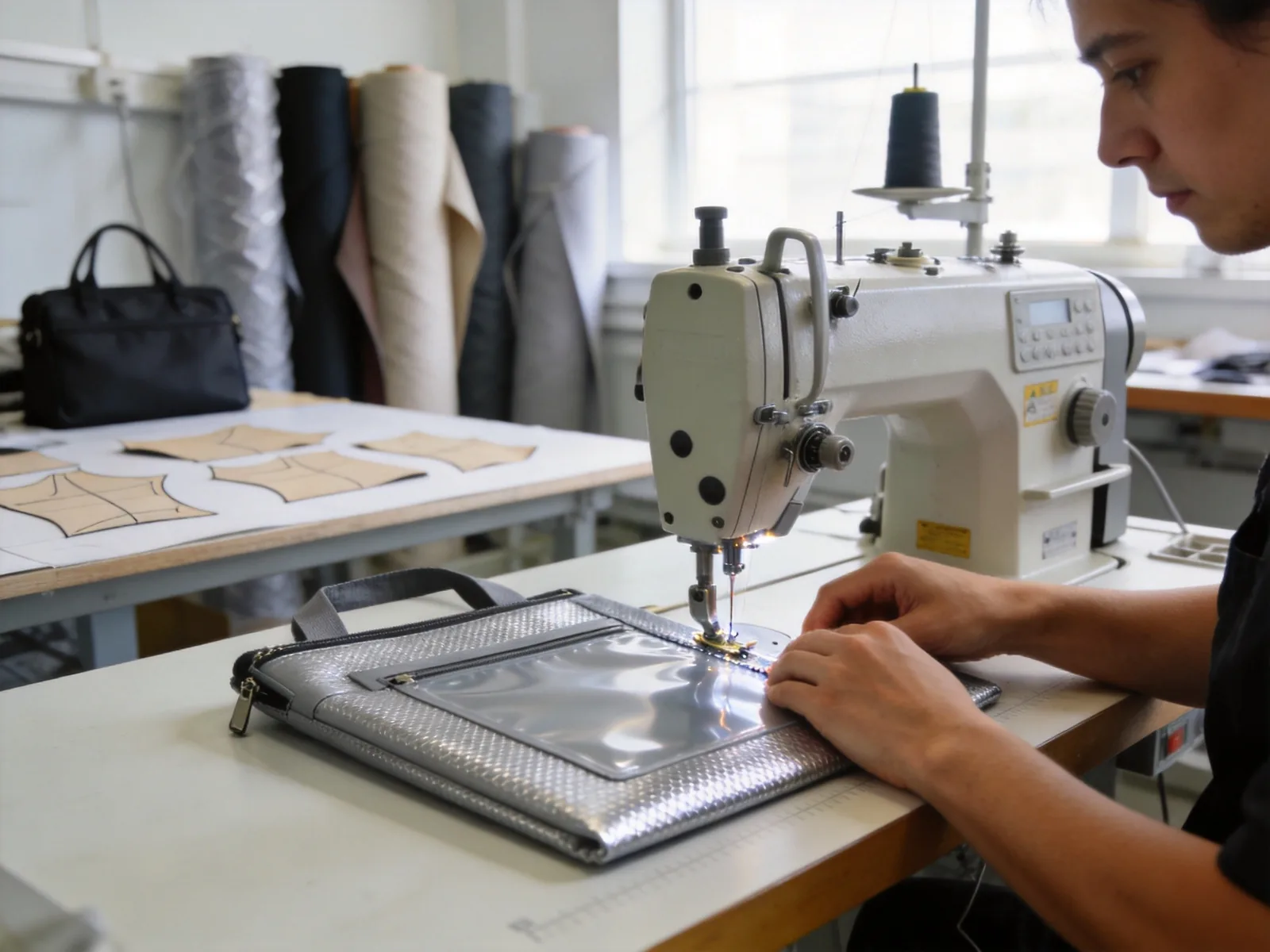
Compliance, Labelling and the Skin-Contact Question
Three compliance topics come up in almost every fire-resistant bag program, and all three are solvable at the design stage rather than the argument stage.
Skin contact and glass fibre. Fiberglass cloth is the functional heat barrier and it is also an irritant when handled directly. The fix is construction, not chemistry: fully encapsulate the barrier between the shell and the liner, bind every raw edge, and specify a needle-punch or brushed liner wherever a hand goes into the bag. We also add a care line — “wipe clean, do not machine wash” — because washing breaks down the coating and releases fibre. A bag built this way passes a hand-feel review comfortably, which matters for retail returns.
Chemical and material declarations. Our standard package for EU and UK buyers includes REACH SVHC statements for the shell, coating, film and felt, RoHS for any electronic component (relevant only on adjacent SKUs), and a California Prop 65 assessment for the US. Azo dye, phthalate and heavy-metal declarations are available on request from the material suppliers. For a brand selling into marketplaces, we supply the documentation pack as a single PDF with the SKU list so it can be uploaded against the listing.
Claims and labelling. The label has to state what the product is, what it protects and what it does not. We recommend wording along these lines, and we will not print a stronger claim than the technical file supports: “Fire-resistant document bag. Designed to protect paper documents from heat and smoke damage during a short-duration fire. Tested to [standard] — report [number]. Not a fireproof safe; does not protect against theft or prolonged direct flame.” That paragraph, printed on a hangtag, prevents most of the customer-service problems this category generates.
Why Brands Consolidate Fireproof Bags With Us
Most of our fire-resistant programs sit inside a wider bag range, and the practical advantage is that a brand can place one purchase order instead of four. The document bag ships alongside the laptop bag, the briefcase and the tool bag in the same container, on the same inspection plan, with the same AQL standard and the same labelling format. Colour and material consolidation across SKUs also reduces the material minimums a brand has to carry.
On the technical side, the four things that make the difference are unglamorous: a layer stack that is specified rather than assumed, a closure that does not conduct heat, seams that survive the temperature, and documentation that matches the claim. We have been building bags since 2014, our founder has been in the industry since 2004, and the fire-resistant line exists because buyers kept asking for a document product with the same discipline as their technical bags.
Frequently Asked Questions
Start a Fire-Resistant Bag Program
Send us your size, layer expectation, branding and target quantity. You will get a specification recommendation, an FOB quotation and a sampling date within 24–48 hours.
Related Manufacturing Pages
- Custom Bag Manufacturer — OEM/ODM Hub
- Custom Tactical Bag Manufacturer
- Custom EVA Case Manufacturer
- Custom Camera Bag Manufacturer
- Custom Laptop Bag Manufacturer
- Custom Briefcase Manufacturer
- Custom Waterproof Bag Manufacturer
- Custom Dry Bag Manufacturer
- Custom Packing Cubes Manufacturer
- Custom Lunch Bag Manufacturer
- Custom Makeup Bag Manufacturer
- Custom Tool Bag Manufacturer