

So, How Much Do People Actually Spend on Bags?
Most shoppers spend far less than designer window displays suggest: the typical consumer is comfortable spending roughly $125–$145 on a handbag, and the handful who routinely drop four figures do so deliberately — on a single, long-term bag rather than a constant stream of purchases. That is why the lawyer in the reader comment who hesitated over a $2,100 purse wasn’t being cheap — she was being normal. For scale, the global handbag market was valued at about USD 86.9 billion in 2025 and is projected to reach roughly USD 146 billion by 2033 (a 6.8% CAGR), according to Grand View Research, and handbags within the leather-goods category alone were worth about USD 43.6 billion in 2025, heading to roughly USD 84 billion by 2033 per the same firm. Below, readers weigh in on what they really spend and how they justify it.
How much do you spend on bags? After our discussion on Tuesday regarding whether a reader should spend $2100 on a bag that she was different from what she normally carried, reader E wrote in with this comment:
After reading your post yesterday regarding expensive, professional bags, I wonder who out there can afford such a bag? I am a lawyer at a big firm and live in DC. My firm pays the standard scale — I currently make $185,000 and will soon get a raise to $210,000. While I realize I may be somewhat conservative when it comes to clothes (I tend to buy designer clothes on sale or through Gilt or Ideeli), I am definitely not cheap. I would buy a $350 purse, but that is a far cry from $2100! Like most lawyers I know, I have student loans and a mortgage. However, I don’t save that much money (though I do pay extra on my loans). So my question is, who pays $2100 for a purse? Are these people who have no loans? Who have married money? Or am I just not investing enough in my wardrobe? I am interested in getting your (and other readers) opinion(s).
This is a great question, and we haven’t discussed this since the big discussion on how much people generally spend on clothes a few years ago.* (Pictured.) I’m curious to hear what readers say here, but for my own $.02, this is how I look at it:
– The vast majority of my bags are in the $300-$600 price range. Many were purchased for below $200, though, either at sample sales, online sales, or through flash sales (some of where I had “referral points” from recommending different flash sale sites on the blog).
– When I bought my most expensive bag (my LV), I used money from my aunts/grandmother., I used money from my aunts/grandmother.Splurge vs. Everyday: The Big-Purchase Mindset
– That said: I have way too many bags. When I was working I tried to switch purses once every few weeks or so, to keep them in rotation. (For my current lifestyle, I almost never see the vast majority of my collection — I keep pictures of them all so I can easily remember what I have and want without having to rifle through the bags on the tippy top shelf of my closet, mostly covered in dustbags.)
(Um: because I am insane, I thought I’d share some of those pictures with you below… I’m obviously not a professional photographer or Photoshopper!)
Looking back, I probably could have/should have saved up the money I was spending on various small purse purchases, and instead bought one really nice purse once a year. Four $300 purses = One $1200 purse. I think the majority of women who spend Big Money on one bag do so with the acknowledgement that they don’t like to switch bags and the intention to carry that single bag for two or three years.
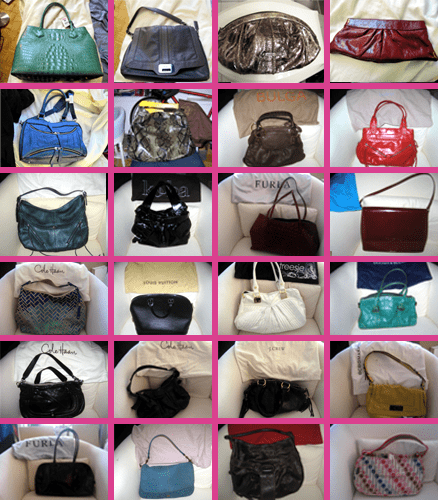
Ultimately: do I spend a lot on bags? Sure. Do I spend a lot less than some of my friends do? Yep. Do I spend a lot more than some of my other friends do? Yep. (Just to be totally clear: The collection below goes back as far back as law school in some cases, so this is almost 10 years of purse purchases.
When the vast majority of these were purchased, I was a single girl with a lot of extra income — I thought they were a good investment, and I liked that purses “fit” no matter what size I happened to be that morning. I purchase far less bags these days, if only because it’s harder to justify the expense with a baby. And yes, you probably do recognize some of these from Coffee Break postings and other blog posts.)
– Update: I just remembered that Jean at Extra Petite had a great video about how she’s saved money on Chanel bags over the years by taking advantage of store-wide discounts and store credit card offers (e.g., sign up for a credit card, get 15% off all day)… so keep in mind that $2100 could quickly become less than that if you’re smart about it.
Readers, how much do you spend on bags, generally? Whatever the price range, how often do you switch bags — and how does that affect your purchasing decisions? If you’re spending Big Money on the bag, how do you justify it to yourself?
* Fun story: in the “how much do you generally spend on clothes” post in 2009, I listed the price ranges that I generally expect to see for clothing that I wore to work, and neglected to make clear that those were the ticket prices, not the prices I actually pay [you guys KNOW I love a good sale].
Anyway: this was 2009, so I was still anonymous as a blogger, and had a big conference/charity dinner for the day job when the post went live, so I totally missed the fact that commenters were incensed re: some of my “normal” price ranges. A good friend, who knew my deep dark blogging secret (as well as the fact that I generally turn up my nose at anything less than a 35% sale), happened to be at the event, tracked me down, and said, YOU MUST FIX THIS NOW. So: huddling behind a big round charity dinner table, using my friend’s Blackberry, I posted the update.)
Bag Spending: FAQ
How much do people really spend on bags?
Most shoppers are comfortable spending in the $125–$145 range on a handbag, while premium and luxury pieces sit far above that. Four-figure purchases are the exception, not the norm, and are usually made deliberately on a single long-term bag.
Is it normal to spend $2,100 on a purse?
Not for most people. At $2,100 you are in entry-level luxury territory, which a small share of shoppers buys intentionally — typically on one bag they plan to carry for two or three years rather than a constant rotation.
Why do some people justify spending thousands on one bag?
Usually because they buy one high-quality piece infrequently and use it heavily over several years, which on a per-wear basis can be cheaper or comparable to buying many mid-range bags that are replaced often.
How can I save money on an expensive bag?
Wait for store-wide discounts, sign up for store credit-card offers, buy during sample or flash sales, or use referral/cash-back points — the same tactics that can turn a $2,100 purchase into something closer to its real, discounted value.
Is an expensive bag worth the investment?
Only if you genuinely use it and value the quality, durability and fit. If you switch bags constantly, several mid-range pieces may serve you better than one costly heirloom item.