
Custom Golf Den Caddy Manufacturer | OEM/ODM Den Caddy for Golf Carts & Pro Shops
A custom golf den caddy costs roughly USD 3–15 per unit depending on size, material and logo method, with MOQ from 200 pieces, 10–15 day sampling and 30–40 day bulk production at JUNYUAN Bags (AQL 2.5 final inspection). This buyer-focused guide explains exactly what a den caddy is, how to spec your custom caddie organizer for golf carts and pro shops, and how to get a quote that protects your margin.
Bottom line up front: a golf den caddy is a compact, cylindrical organizer that clips to a golf cart or sits on a bench to hold golf balls, tees, gloves and small accessories — and it is one of the lowest-cost, highest-margin add-on products a golf brand or pro shop can private-label. Because it uses the same materials, panels and trimming as a full golf bag, the SGS-verified JUNYUAN / Yingming affiliated plant produces custom den caddies on the same Quality-Inspection system that governs our golf bag lines, usually without a separate tooling charge.
Golf Den Caddy Market at a Glance
The global golf equipment and accessories market continues to grow as more than 66 million golfers play worldwide. Golf bags alone were valued at roughly USD 1.6 billion in 2026 and are projected to reach about USD 2.3 billion by 2030 (a CAGR near 9.5%), led by North America at roughly 50.8% of the market. Den caddies ride this wave as a low-ticket accessory that golfers buy alongside a new bag, or that pro shops and distributors add to a “golf gift” basket at checkout. For a buyer, a custom den caddy is a fast win: short sampling, low MOQ relative to bags, and a high perceived value per dollar.
Even a modest US golf pro shop or a top-1,000 Amazon golf accessory seller can move hundreds of den caddies per season under their own brand. Because they are small, den caddies cost far less to warehouse and ship than full golf bags, which makes them an excellent first private-label product for a new golf brand testing the category before committing to a full 200-piece golf bag run.
What Is a Golf Den Caddy?
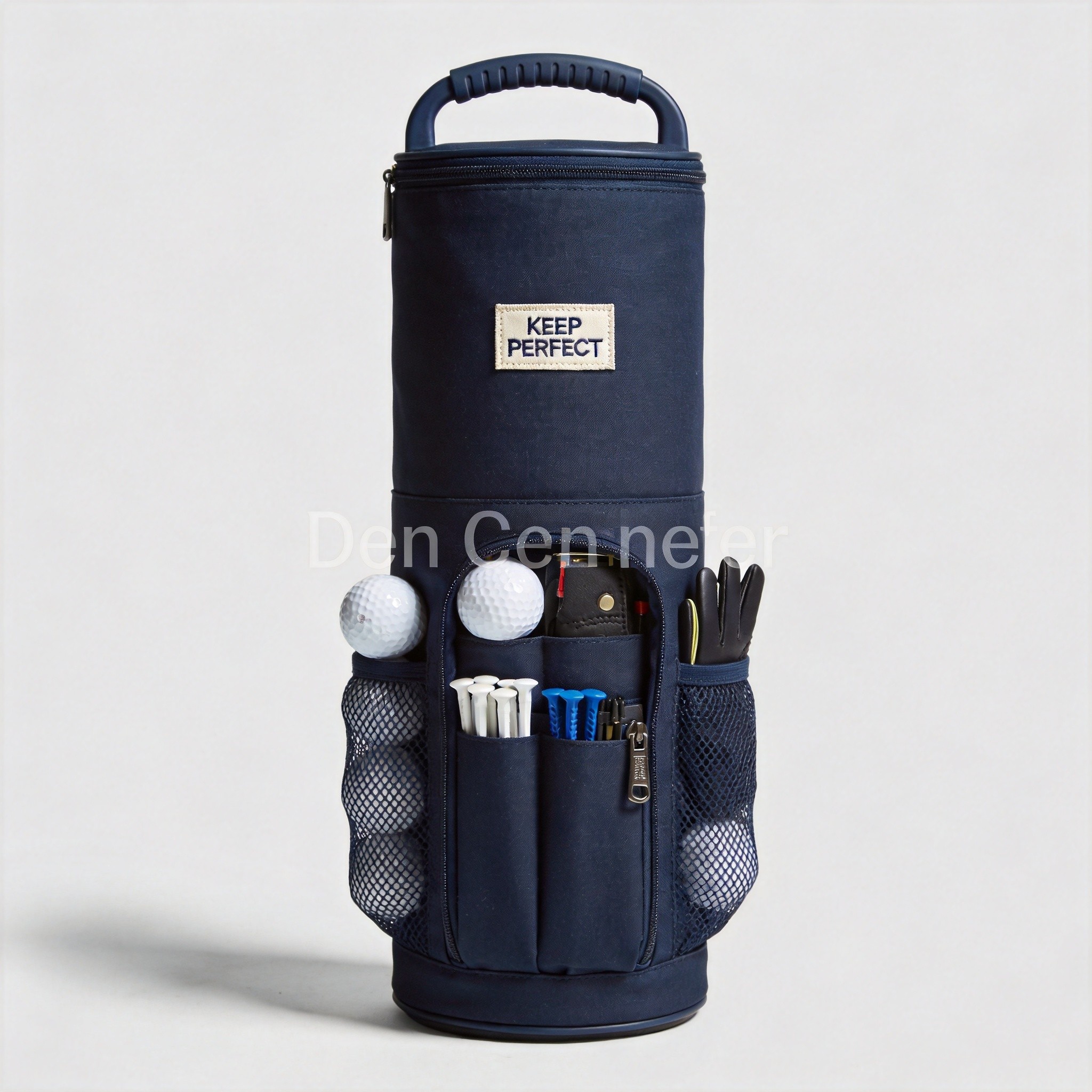
A golf den caddy (also spelled “den caddie” or called a “golf ball caddy capacity organizer”) is a portable, bucket-style or cylindrical organizer designed to keep golf balls, tees, ball markers, gloves and small accessories tidy. It typically features a reinforced carry handle, an open top or trapdoor ball access, a front zip or pocketed compartment for tees and gloves, and a sturdy base that lets it stand upright on a cart, bench, bag room shelf or clubhouse desk.
The word “den” comes from the original use as a home or office organizer that sat in a lounge (“the den”) so a golfer always had a tidy place to drop golf balls and tees. Modern versions have moved onto golf carts via a strap or clip, making them an everyday carry accessory rather than a stationery item. There are three main formats buyers order today:
| Format | Typical Use | Typical Size | Est. Unit Cost* |
|---|---|---|---|
| Cart-mount den caddy (strap/rail clip) | Attaches to golf cart side rail or bag | Ø 14–20 cm × 25–35 cm H | USD 4–9 |
| Bench / bag-room den caddy | Stands upright; ball & tee storage | Ø 20–28 cm × 30–45 cm H | USD 6–12 |
| Mini den caddy / desk caddie | Home, office, clubhouse display | Ø 10–16 cm × 12–22 cm H | USD 3–7 |
*Ex-factory estimate at MOQ 200 in standard 600D polyester; actual pricing depends on material, hardware, logo method and quantity. Request a line-by-line quotation from JUNYUAN for a firm number.

Why Brands and Pro Shops Choose a Custom Den Caddy
There are five commercial reasons a custom den caddy makes sense as an OEM/ODM product, independent of its low cost per unit.
- Branding surface: the cylindrical body, front panel and zip flap give you several clean areas for a logo, embroidery or full-color print — more visible real estate per dollar than most accessories.
- Accessory attach rate: a den caddy is an easy upsell at checkout or a free-with-purchase gift that raises average order value without heavy freight cost.
- Low MOQ path into golf: at MOQ 200, a new brand can validate its logo and audience before committing to a full golf bag MOQ.
- Fast sampling: 10–15 day sampling means you see physical product quickly and can iterate on hardware and trim in the same quarter.
- Shared supply chain: the same fabrics, zippers and stitching standards as golf bags, so quality is already proven at the factory level.
Customization Options
Materials
Most custom den caddies are built in 600D or 900D polyester for a balance of cost, weight and abrasion resistance. Upgrades include 1680D ballistic nylon for a premium feel, PVC-backed waterproof lining for damp climates, or rPET recycled polyester for sustainable brand lines (GRS-certified options available). We recommend matching the fabric family of your existing golf bag line so the caddy reads as part of the same set.
Logo & Branding
Den caddies accept most golf-bag branding methods. The three most common are:
| Method | Best For | Relative Cost |
|---|---|---|
| Embroidery | Small curved logos, canvas/600D bodies | Low–medium |
| Heat-transfer / PVC logo | Full-color, complex artwork | Low |
| Screen / pad printing | Flat panels, typography | Low |
| Woven label patch | Premium look, torch/velvet patches | Medium |
Structure & Hardware
- Ball access: open top, trapdoor, or snap-down flap.
- Carry: rigid top handle, webbing loop, or padded handle.
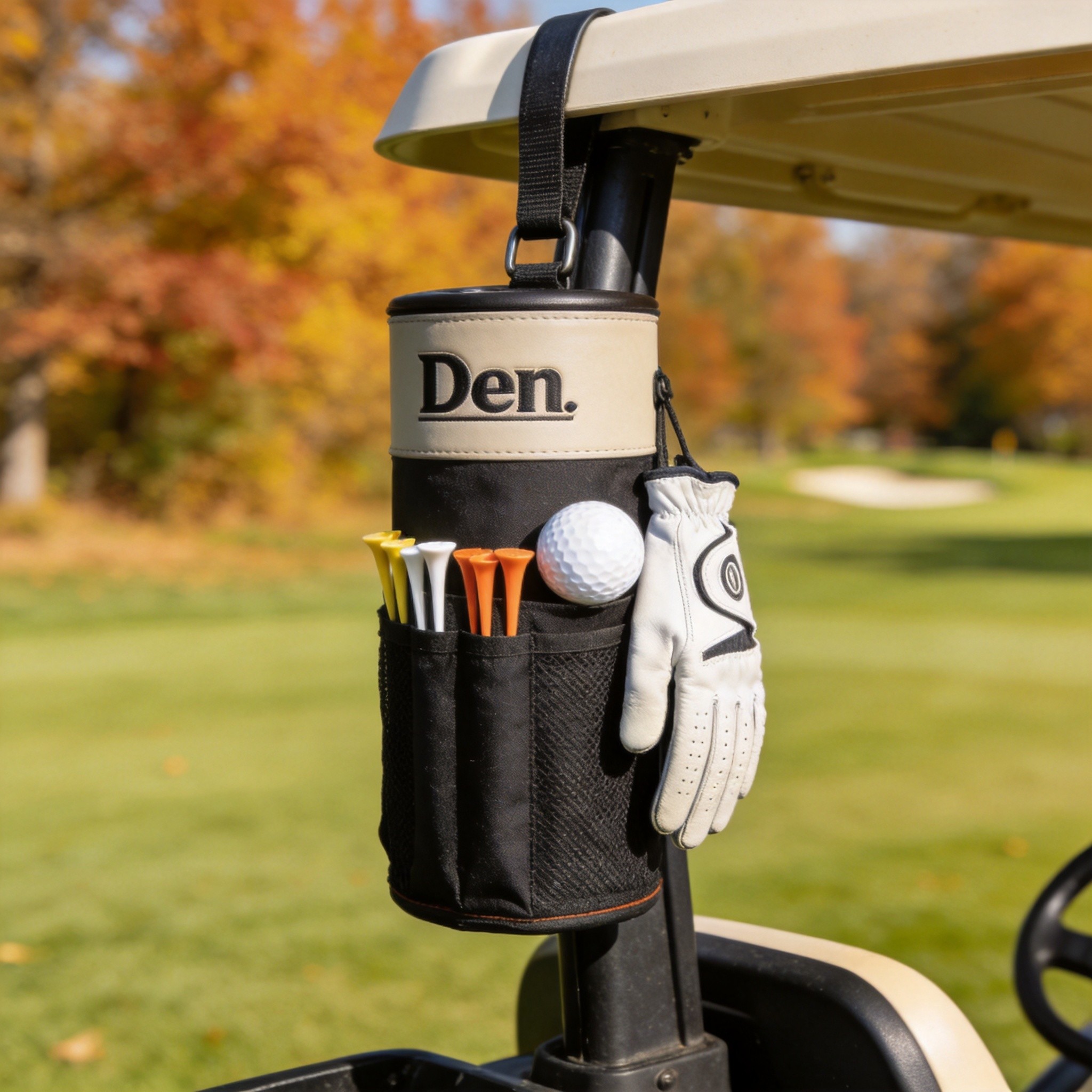
- Mounting: cart rail strap, carabiner / D-ring, or via a hook-and-loop wrap for the bag itself.
- Compartments: front zip pocket, side mesh or nylon pockets for tees and gloves, and an internal divider for ball rows.
- Base: reinforced flat base with feet so it stands steady on a cart floor or bench.
OEM / ODM Process and Lead Time
Our custom den caddy workflow mirrors our golf bag lines. Because den caddies reuse the affiliated plant’s existing pattern libraries and material stock, the first-order timeline is shorter than a from-scratch bag:
| Stage | Typical Duration | What Happens |
|---|---|---|
| Brief & tech pack review | 1–3 days | We confirm size, fabric, hardware, logo art and MOQ |
| Sampling | 10–15 days | Prototype / golden sample built, approved to your spec |
| Bulk production | 30–40 days | Mass production, inline QC and final inspection |
| Shipping | FOB Xiamen or CIF | Air or sea, per your freight needs |
For ODM orders, our in-house design desk can prepare a spec sheet, pattern and mock-up from your reference image or logo alone, removing the need for you to hold a full technical pack in the first order.
MOQ, Pricing and How to Reduce Cost
Standard MOQ for a custom golf den caddy is 200 pieces. In practice most first orders are 200–1,000 units, with repeat private-label programs moving to 3,000–5,000 units per season. COMO (cost per unit) ranges roughly:
| Qty | 600D Polyester (est. FOB) | Ballistic / rPET (est. FOB) |
|---|---|---|
| 200–500 | USD 4–8 | USD 7–12 |
| 501–2,000 | USD 3.5–6.5 | USD 6–10 |
| 2,001+ | USD 3–5.5 | USD 5–8.5 |
Five practices reliably reduce unit cost: (1) standardize on one fabric and one logo method; (2) reuse an existing pattern instead of a new tool; (3) consolidate decoration on the front panel only; (4) increase quantity to amortize sample and freight; (5) book a sea-freight delivery instead of air for repeat orders.
Quality Control
Every custom den caddy order runs through the same QC discipline as our golf bags: incoming material inspection, inline stitching checks on the 7 production lines, and a final AQL 2.5 inspection before packing. We check stitch density, zipper operation, handle pull strength, logo alignment and overall dimensional tolerance against the approved golden sample. On first orders we recommend a pre-shipment inspection report and a sealed sample retained at the plant for reference on repeat runs.
Size and Specification Guide

Getting the specification right on the first order is what separates a smooth 30–40 day run from a sample-heavy back-and-forth. The table below is the specification sheet our pattern desk uses for den caddy orders; if you fill these fields in your inquiry, we can move straight to sampling without clarifying rounds.
| Spec Field | Typical Range / Options | Why It Matters |
|---|---|---|
| Diameter (Ø) | 10–28 cm | Drives fabric consumption and ball-row capacity |
| Height | 12–45 cm | Determines cart fit vs. bench display use |
| Fabric weight | 600D / 900D / 1680D / rPET | Sets durability, hand feel and unit cost |
| Lining | None / 210D / PVC-backed | Waterproofing and internal finish |
| Ball access | Open top / trapdoor / flap | Affects pattern complexity |
| Compartments | 1–4 pockets / dividers | More pockets = more labor and cost |
| Handle | Rigid / webbing / padded | Rigid handle costs more but reads premium |
| Mount | Strap / clip / carabiner / wrap | Sets cart compatibility |
| Logo method | Embroidery / PVC / print / patch | Main cost driver after fabric |
| Base / feet | Flat / feet / none | Stability on cart floor or bench |
| Colorways | Solid / contrast / set match | Match your bag line for a cohesive family look |
If you do not have a technical pack, tell us the intended use (cart mount vs. bench) and paste a reference photo — our ODM desk will convert it into a pattern and cost sheet for you at no charge.
Materials Deep Dive
600D Polyester (standard)
600D polyester is the workhorse for most custom den caddies. It is lightweight, abrasion-resistant enough for a golf cart environment, easy to print and embroider, and inexpensive. At MOQ 200 in 600D you get the most favorable unit cost and the widest choice of colors. If you plan to start with one colourway to test the market, 600D is the lowest-risk entry.
900D Polyester
900D is a denser, heavier weave that drapes with a more substantial feel and holds its shape better. It is a small cost step up and a good middle option when you want a caddy that feels closer to a full golf bag without jumping to ballistic nylon.
1680D Ballistic Nylon
1680D ballistic nylon is the premium choice. It is highly abrasion- and tear-resistant, has a matte technical sheen that reads “premium golf,” and pairs naturally with a carry handle and metal hardware for a high-end private-label look. It is the fabric we recommend when the den caddy is a gift or a flagship accessory rather than a commodity add-on.
rPET Recycled Polyester
GRS-certified rPET recycled polyester lets a brand make a sustainability claim on-pack and in marketing while keeping the price within a few percent of virgin polyester. It is increasingly expected by US and EU retailers and by tournament organizers running sustainability-led events. We can source rPET in the same colorways as your core line so the launch looks seamless.
Waterproof / PVC-Backed Options
For damp climates, beverage-cart fleets or caddies that live on an open cart day-round, a PVC-backed or TPU-coated lining keeps tees and balls dry and protects the fabric from repeated moisture. This adds a modest per-unit cost but improves perceived quality and product life.
As a sourcing rule of thumb: match the den caddy fabric family to your existing golf bag line. A 900D stand bag with a 600D den caddy looks off; a cohesive fabric story across products makes the whole range look intentional and higher-end.
Branding Methods in Detail
The logo is where a den caddy earns its margin, so picking the right decoration matters as much as the fabric. Here is how the main methods compare on a cylindrical accessory.
Embroidery
Machine embroidery is the most golf-native method and the most durable. It looks premium on canvas and 600/900D fabric, and it handles a curved logo on the front panel beautifully. Limitations: fine text and gradients do not reproduce well, and large fills can distort on a curved body. We recommend embroidery for a single front logo up to about 7–8 cm wide and, if needed, a small woven label on the side.
Heat-Transfer / PVC Logo
This method presses a pre-made PVC or heat-transfer emblem onto the fabric. It supports full colour, gradients and complex artwork with a clean edge, and it is one of the lowest-cost options. The trade-off is durability on heavy abrasion; we typically suggest PVC only when the logo area is not the primary wear zone, or when paired with a tough fabric.
Screen / Pad Printing
Flat panels and simple typography print cleanly and cheaply. On a curved cylindrical body, printing is best limited to the front panel or a flat label piece rather than wrapped around the full circumference.
Woven Label Patch / Badge
A woven or embroidered patch sewn onto the front gives a premium, collectible feel — think club crests and tournament favours. It is a medium-cost upgrade that suits pro-shop retail and corporate gifting more than commodity programmes.
Many buyers combine two methods in one design: an embroidered front logo plus a printed or heat-transfer side/back label. Specify both and we will optimise the layout for the curved surface.
Packaging, Payment and Shipping
Packaging Options
Den caddies ship compressed or flat-packed to save freight. Standard options include polybag with header card, individual colour box, or bulk carton for wholesale. For retail-ready private label, a printed colour box dramatically improves shelf presentation; for e-commerce FBA, we recommend polybag + barcode label to avoid dimensional-weight surprises.
Payment Terms
Standard terms for first orders are typically 30% deposit and 70% balance before shipment (T/T), with L/C or Western Union available on larger or repeat volumes. Payment structure is agreed in writing on the proforma invoice before sampling begins. We can discuss adjusted terms for established private-label programmes after the first two successful orders.
Shipping Methods
We quote FOB Xiamen, CIF or DDP destinations. For a small accessory like a den caddy, air freight is economical on first or urgent orders, while sea freight on repeat orders dramatically lowers landed cost. Share your target port or fulfillment centre and we will recommend the most cost-efficient method for your quantity.
Seasonality and Order Planning
Golf has two distinct demand windows that drive when you should place a den caddy order.
- Spring / pre-season (Jan–Mar): pro shops and clubs replenish accessories ahead of the playing season; tournament favour orders also cluster here.
- Holiday / gifting (Sep–Nov): golf gifts, corporate year-end and tournament prizes drive accessory demand.
Because sampling takes 10–15 days and bulk production 30–40 days, you should place an order roughly 8–12 weeks before you need stock in hand on the East or West Coast. For a holiday drop targeting September–November retail, that means locking the order by early summer. Planning two drops a year lets you run one mould / pattern across both colourways and keeps freight consolidated for better rates.
A Sourcing Checklist for First-Time Den Caddy Buyers
Before you send an inquiry, run through this checklist so the quotation you get is accurate and the sample matches what you expect:
- Decide the primary use: cart mount, bench/bag-room, desk, or retail shelf. This sets size and mounting hardware.
- Confirm ball quantity to be held (identity standard golf ball rows you need in the compartment).
- Choose one fabric family (600D, 900D, 1680D, or rPET) and one or two colourways.
- Pick one primary logo method and, if desired, one secondary label method.
- Set your first-order quantity (at or above MOQ 200) and target retail/wholesale price so we can also sanity-check margin.
- Decide packaging: polybag, colour box, or bulk carton.
- Select shipping: FOB Xiamen, CIF, or DDP to your destination.
- Request a pre-shipment inspection (AQL 2.5) and a sealed golden sample common on first orders.
Providing these details up front is the single fastest way to shorten the 1–3 day brief review and get straight to sampling.
Common Mistakes to Avoid When Ordering
Most den caddy issues are avoidable and come down to specification clarity rather than factory capability. The five mistakes we see most often:
- Undersizing for cart hardware: a cart mounts differently than a bench; confirm the rail/clip geometry up front so the strap and D-ring land where you expect.
- Over-decorating a curved surface: full-wrap printing on a cylinder can distort; keep complex art on the front panel or a separate label.
- Ignoring fabric family cohesion: launching a caddy in a different fabric/colour from your bag line fragments the brand story at retail.
- Not reserving margin for freight: the FOB unit cost is only half the story; air freight on a bulky accessory can double landed cost, so consolidate or ship sea.
- Skipping the sealed sample: without an approved golden sample retained at the plant, repeat runs can drift on colour or logo placement.
Den Caddy as Part of a Golf Accessory Range
For brands that already sell or plan to sell golf accessories, the den caddy slots into a broader range we produce under one supply chain: staff bags, cart bags, stand bags, headcovers, golf towels, umbrellas, club covers and shoe bags. Ordering multiple accessory SKUs together lets you:
- Amortise freight and trim across the range;
- Keep one fabric and colour palette for a cohesive collection;
- Place a combined MOQ that unlocks better per-unit pricing;
- Ship one consolidated pallet to a single warehouse or FBA destination.
If you are designing a full golf accessory line, tell us the complete list and we will quote the range together and stagger sampling so you can launch everything in one season.
Application Scenarios

- Golf cart mount: the most popular format — a strap or clip fix to the cart rail keeps balls and tees at arm’s length.
- Pro shop retail: a branded shelf display that double as clubhouse décor and a small impulse purchase.
- Bag room / locker room: tidy, labeled storage for members’ essentials.
- Corporate & tournament gifting: a printed private-label caddy is a distinctive tournament favor with long brand carry.
- Home / office (“den”) display: the original use — an attractive organizer for a golfer’s gear at home.
Hardware and Construction Standards
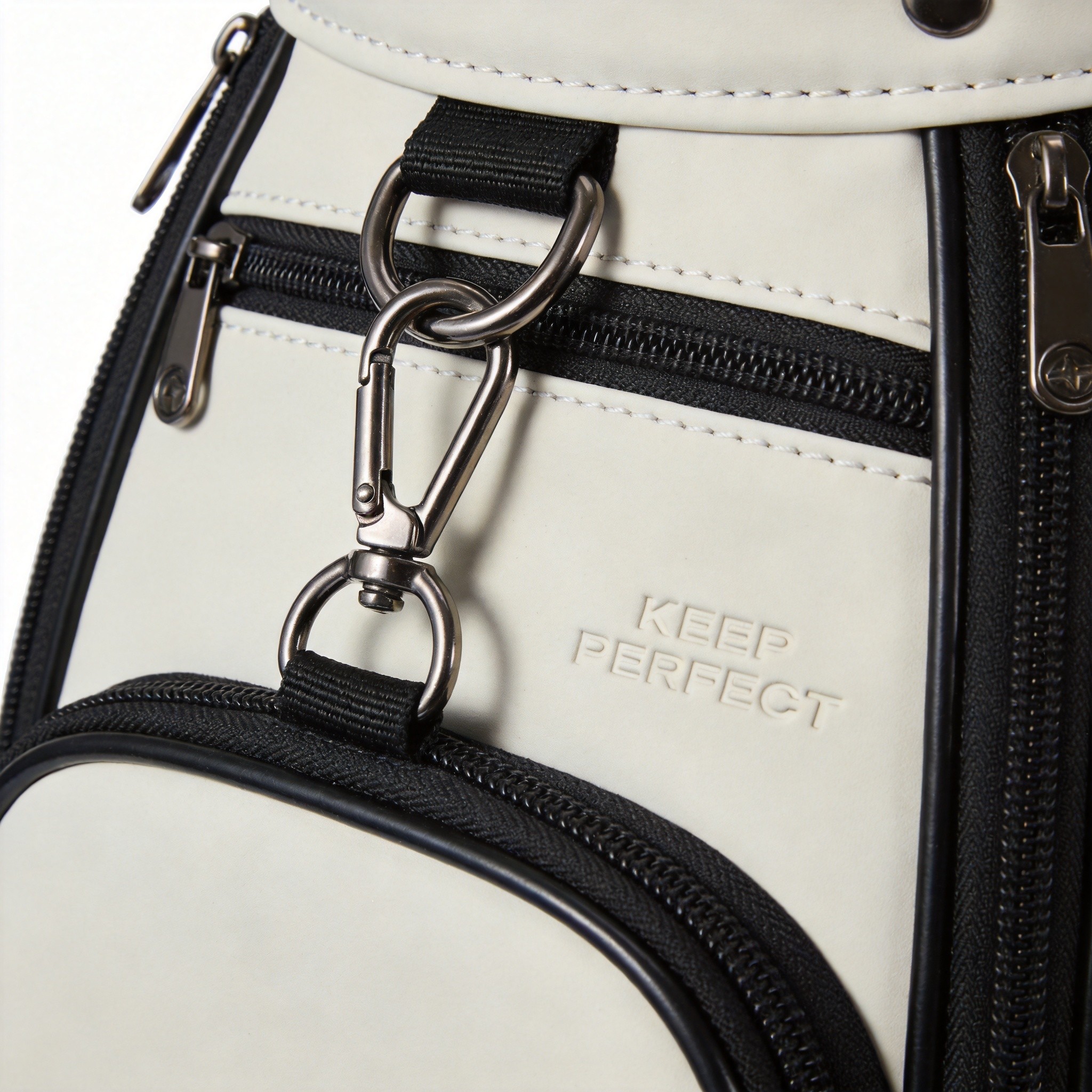
The difference between a cheap gift-shop den caddy and a durable private-label accessory is in the small hardware details. These are the construction standards our affiliated plant holds to on every den caddy order, and the ones you should ask any supplier about:
- Zippers: YKK or equivalent-brand nylon or metal #3–#5 zippers with smooth action; the zipper on the ball-access flap and front pocket is a top failure point on cheap caddies, so we test operation on every piece.
- Handle construction: webbing handles are bar-tacked at both ends for pull strength; rigid handles use a reinforced core so they do not flex or tear under repeated carrying.
- Stitching / thread: lock-stitch construction with reinforced bartacks at stress points (handle ends, strap anchors, pocket corners) and consistent stitch density in the 3–4 stitches/cm range.
- Metal hardware: carabiner clips, D-rings and swivel snap hooks are tested for corrosion resistance and gate strength; marine-grade or coated options are available for coastal or damp environments.
- Base reinforcement: the base carries the weight of up to 20+ balls, so it is reinforced with a stiffener and, where needed, rubber feet to keep the caddy standing steady.
- Edge binding / piping: bound edges and piped seams protect fabric from fraying and give the caddy a finished, premium edge.
How to Match Your Den Caddy to Your Golf Bag Line
The strongest private-label golf programmes treat accessories as a family, not a collection of unrelated items. When you order a den caddy alongside (or after) a stand or cart bag, we recommend matching on three axes:
| Axis | How to Match | Effect |
|---|---|---|
| Fabric | Use the same fabric family (e.g., 900D) for bag and caddy | Cohesive texture and hand feel |
| Colourway | Repeat the bag’s primary + trim colour on the caddy | Instantly recognisable “set” at retail |
| Logo | Reuse the same embroidery / patch on both | Brand consistency and native fit |
If you share a reference of your existing bag line, our ODM desk will spec a den caddy that matches its fabric, colour and trim — so when a shopper sees the caddy beside the bag, it reads as one deliberate collection, which lifts perceived value and average order size.
Case Study: Launching a Private-Label Den Caddy for a Pro Shop
To make the process concrete, consider a typical first order we quote. A US golf pro shop wants a branded den caddy to sell at checkout and to use as a free-with-purchase gift on a new stand bag.
- Spec: 900D polyester, ø 18 cm × 32 cm H, open top with trapdoor ball access, one front zip pocket, webbing handle, cart-rail strap, embroidered club logo on the front, 300 pieces, colour box.
- Sampling: 12 days to a physical golden sample; the club approved the sample with one trim-colour change.
- Production: 35 days, then AQL 2.5 final inspection and pre-shipment photo report.
- Freight: one consolidated sea-freight carton to the club’s state-side warehouse on a repeat load with a bag order.
- Result: the caddy retailed at a strong margin against a modest ex-factory unit cost, and the embroidered logo reinforced the club’s brand every round.
This is the most common pattern we see: den caddies are sold as the first accessible private-label product precisely because the offshore unit cost and MOQ are low enough that a pro shop can commit without a large capital outlay.
Den Caddy vs. Alternative Accessories
Buyers sometimes compare a den caddy to other golf accessories when deciding where to spend a first-order budget. Here is how it stacks up:
| Accessory | Typical Unit Cost | Branding Surface | Best Margin Use |
|---|---|---|---|
| Den caddy | USD 3–12 | Large cylindrical body | High margin add-on / gift |
| Headcover | USD 2–8 | Small cover | Brand identifier on the club |
| Golf towel | USD 1–4 | Full towel face | High-volume brand carry |
| Umbrella | USD 5–15 | Canopy panels | Weather-proof seasonal item |
| Golf shoe bag | USD 4–10 | Front panel | Packable accessory |
Because a den caddy combines a large branding area with a low unit cost and a practical everyday use, it has one of the best “brand impressions per dollar” of any golf accessory — reason enough to include it in your range even if it is not your hero product.
MOQ Flexibility and Combination Orders
Our standard MOQ for a custom den caddy is 200 pieces per design. We hold to that floor for one simple reason: below it, the fixed cost of pattern, material cutting and QC set-up makes the per-unit price inefficient for you. That said, we are flexible on two fronts:
- Mixed colourways within one design can be combined toward the 200-piece MOQ, so you are not forced to order 200 of a single colour.
- Combination accessory orders (e.g., 100 den caddies + 100 headcovers) can be quoted together — when the combined SKUs clear our minimums, we can amortise set-up and freight across them.
If your first order is a small market-test run, tell us and we will advise the most efficient way to size it, including which mix of colours gives you the best read on your audience.
Quality Assurance Programme at JUNYUAN Bags
Quality control is where cheaper accessory suppliers cut corners, so it is worth spelling out the programme that backs a JUNYUAN den caddy order:
- Incoming material inspection: fabric, zippers, hardware and thread are checked against the approved spec (fabric weight, colour fastness, hardware gauge) before cutting.
- Inline process control: the 7 production lines perform stage checks on stitching, zipper installation and handle attachment; QC (8 staff) catches defects at the source rather than at final packing.
- AQL 2.5 final inspection: an independent final inspection samples to AQL 2.5 covering dimensional tolerance, stitch quality, logo alignment, hardware function and packaging integrity.
- Golden sample retention: an approved sealed sample is retained at the plant as the reference for repeat runs, preventing colour and logo drift order over order.
- Pre-shipment report: available on request with photos and a checklist, so you see exactly what ships before it leaves the factory.
This is the same Quality-Inspection discipline that runs across our golf bag lines, so a den caddy order benefits from production systems already proven at scale.
Certifications and Compliance
Depending on your market, you may need documentation that a custom den caddy order meets common retail and customs requirements. Where relevant to your destination, we can support:
- Material certificates: GRS for recycled polyester, OEKO-TEX / REACH for textile safety, and child-safety compliance where the item or its packaging is sold into kids’ lines.
- Corporate social responsibility: the affiliated plant and company status are aligned with SGS verification and common CSR frameworks (ISO 9001 quality systems, BSCI, SMETA posture), useful for US and EU retail compliance reviews.
- Customs / export documents: commercial invoice, packing list, COO and, where required, export licences under the company’s China Customs registration.
Tell us the target market (US, EU, UK, AU, JP, KR, etc.) and the retail channel, and we will confirm which certifications and documents your den caddy order should carry so the launch is not held up at customs or a retailer’s compliance desk.
How to Get an Accurate Den Caddy Quotation
The fastest way to an accurate line-by-line quotation is to send the following in your first message to [email protected] or WhatsApp +86 17750020688:
- Target use (cart mount / bench / desk / retail).
- Approximate size (or paste a photo / link of the style you want).
- Material preference (600D, 900D, 1680D, rPET, or “recommend for me”).
- Logo method (embroidery, PVC, print, patch) and artwork if ready.
- Quantity and target colourways.
- Destination and preferred shipping (FOB Xiamen, CIF, or DDP with port/zip).
With those six fields we can return an FOB quotation, a sampling date, and a production lead time usually within one business day — and a confirmed specification sheet so there is a written baseline for the sample.
Den Caddy as a First Product for a New Golf Brand
If you are launching a golf brand and are deciding which product to make first, the den caddy deserves serious consideration — not despite being small, but because it is small. A first order of 200–500 den caddies is a fraction of the capital and risk of the same quantity of stand or cart bags, yet it gives you everything you need to validate a market: a real product in hand, a logo that customers see weekly, and real sales data on pricing and demand.
New golf brands typically face three unknowns when they start: will the design sell, will the price hold, and will the factory deliver on quality and time. A den caddy is the lowest-cost experiment that answers all three. Once you have confidence from a caddy run, you scale the same branding, supplier and materials into a full bag MOQ with far less risk than starting with the bag.
There is also a merchandising angle: a small, affordable, useful accessory lowers the barrier to a “first purchase” for a new brand. A customer who might hesitate to spend on a full custom bag will readily buy a USD 29 branded den caddy — and every one of those customers becomes a walking advertisement for your logo, most of them on a golf course or at a club where your target buyers are.
- Testing price points: because den caddies carry high margin, you can test two price levels without eating a large inventory loss.
- Building audience: low-cost accessories convert cold traffic into first buyers who join your list and repurchase.
- Funding growth: cash flow from a caddy programme can help fund the larger capital outlay of a bag order.
- Brand runway: a useful daily accessory extends your brand’s presence far beyond a single round.
In short, a custom den caddy is the classic “MVP” of the golf merchandise world — a low-risk, high-margin first product that de-risks everything that comes after it.
Ordering Workflow, Step by Step
If you have never placed a custom accessory order offshore, here is the exact step-by-step path we follow so you know what to expect and when:
- Inquiry (Day 0): send size, fabric, logo and quantity to [email protected] or WhatsApp +86 17750020688.
- Quotation & spec (Days 1–3): we return an FOB line-by-line price, a specification sheet and a proposed sampling date.
- Order confirmation: you approve the proforma invoice; a 30% deposit secures the sample slot and material booking.
- Sampling (Days 4–18): our pattern desk builds a physical golden sample; on approval we lock the spec for bulk.
- Bulk production (Days 19–58): the 7 production lines run the order with inline QC; you can request progress photos.
- Final inspection: AQL 2.5 inspection and a pre-shipment report confirm the load before packing.
- Balance & shipment: 70% balance is settled, and we ship FOB Xiamen, CIF, or DDP to your destination.
- Repeat & scale: with the sealed golden sample as reference, repeat runs are faster and often cheaper per unit.
Because the flow is identical to our golf bag programmes, working with us on a den caddy first gives you a dry run of the whole supplier relationship before you place a larger order.
Den Caddy vs. Full Golf Bag: A Sourcing Comparison
For buyers deciding whether to start with a den caddy or a full golf bag, the comparison is clear on cost and speed:
| Dimension | Custom Den Caddy | Custom Golf Bag |
|---|---|---|
| MOQ | 200 pcs | 200 pcs (our golf line) |
| Sampling | 10–15 days | 10–15 days |
| Bulk lead time | 30–40 days | 30–40 days |
| Typical unit cost | USD 3–12 | USD 30–120+ |
| Warehouse footprint | Small, low freight | Large, higher freight |
| Retail / wholesale margin | High per-unit margin | Higher total value |
Many of our private-label customers launch with a den caddy program, prove the design and audience, then roll the same branding into a stand bag or cart bag. Because we keep a shared material and color palette, the caddy and bag read as one cohesive product family.
Why Buyers Choose JUNYUAN Bags
JUNYUAN Bags (Quanzhou Junyuan Commercial and Trading Co., Ltd., founded 2014) is a China-based OEM/ODM bag exporter led by a founder with bag-industry experience dating from 2004. Production runs through an affiliated factory, SGS-verified for Alibaba.com in March 2026 at 4,950 sqm, 7 production lines, 149 machines and 137 staff, with a monthly line capacity of 200,000 pieces. We have produced custom bags for 200+ brands across 100+ countries, with email [email protected] and WhatsApp +86 17750020688 for your inquiry.
For golf accessories in particular, our team has long run dedicated golf bag, staff bag, cart bag, stand bag, headcover, towel, umbrella and club-cover programs, so a den caddy is a natural extension of an established golf supply chain rather than a one-off accessory experiment.
FAQ
Q1. What is a golf den caddy used for?
A golf den caddy is a compact organizer that holds golf balls, tees, ball markers, gloves and small accessories. It stands upright on a cart, bench or clubhouse surface, or clips to a cart rail, so a golfer always has gear tidy and within reach.
Q2. What is the MOQ for custom golf den caddies?
Our standard MOQ is 200 pieces per design for custom golf den caddies. Higher volumes lower the per-unit price, and repeat private-label programs typically run at 3,000–5,000 units per season.
Q3. How long does a custom den caddy sample take?
Sampling takes 10–15 days, including pattern confirmation and a physical golden sample that we approve to your spec before bulk production starts.
Q4. How long is bulk production for a den caddy order?
Bulk production takes 30–40 days at our affiliated plant, followed by a final AQL 2.5 inspection and shipping (FOB Xiamen, CIF or DDP available).
Q5. How much does a custom golf den caddy cost?
Depending on size, material and logo method, unit cost is roughly USD 3–12 (ex-factory at MOQ 200 in 600D polyester). Request a quotation for exact pricing on your spec and quantity.
Q6. Can you put my logo on a den caddy?
Yes. We offer embroidery, heat-transfer/PVC logos, screen printing and woven label patches. You can combine two methods (for example, an embroidered front logo plus a printed side label).
Q7. What materials are available?
Standard options are 600D and 900D polyester, with upgrades to 1680D ballistic nylon, waterproof PVC-backed lining, and GRS-certified rPET recycled polyester.
Q8. Can a den caddy mount on a golf cart?
Yes. We offer a strap or rail-clip mount, a carabiner/D-ring option, and a hook-and-loop wrap that fastens to the bag itself. Specify the mounting type on your tech pack.
Q9. Does the den caddy fit standard golf balls?
Yes. Standard den caddies hold regulation golf balls in one or two stacked rows; we can adjust the internal divider and ball-row capacity to your preferred count.
Q10. Do you offer ODM design services?
Yes. Our design desk can build a spec sheet and pattern from your reference image or logo alone, so you can launch a branded den caddy without a full technical pack.
Q11. What quality control is used?
Every order runs inline QC plus a final AQL 2.5 inspection covering stitching, zipper operation, handle pull strength, logo alignment and dimensional tolerance against the approved sample.
Q12. What shipping options are available?
We ship FOB Xiamen, CIF or DDP destinations via air freight or sea freight. For custom golf accessories we typically recommend sea freight on repeat orders to lower landed cost.
Q13. Can I start with a den caddy before a full golf bag?
Yes. Many private-label brands validate their logo and market with a den caddy programme first because it has a low MOQ and unit cost, then extend the same branding to stand or cart bags.
Q14. Are environmentally friendly options available?
Yes. GRS-certified rPET recycled polyester is available, along with water-based printing on the front panel for sustainable brand lines.
Q15. How do I get a quote?
Email [email protected] or WhatsApp +86 17750020688 with your target size, fabric, logo method and quantity; we will return a line-by-line FOB quotation and sampling lead time.
Sales Channels and Where Den Caddies Move
Understanding where the demand comes from helps you decide sizing, quantities and packaging. Custom den caddies sell through several overlapping channels, and each has different ordering habits:
| Channel | Demand Driver | Typical Order Shape |
|---|---|---|
| Golf pro shops | Checkout add-on, gift-with-bag | 100–500 pcs, branded, colour box |
| Online / marketplace sellers | Accessory ASIN, free-shipping attached item | 500–3,000 pcs, polybag + barcode |
| Clubs & resorts | Member amenity, p… house branding | 200–1,000 pcs, embroidered crest |
| Tournaments & corporate gifting | Favour, prize, client gift | 100–1,000 pcs, printed or patched |
| Wholesalers / distributors | Catalogue diversification | 1,000–5,000 pcs, bulk carton |
Each channel changes what you should specify. A pro shop selling on a shelf wants a retail colour box and a crest that looks premium; a marketplace seller wants lightweight polybag packaging and a barcode label for FBA scan efficiency; a distributor wants bulk cartons to maximise pallet density and lower per-unit freight. Telling us your primary channel up front lets us recommend the packaging and decoration that fit, rather than paying for a configuration you do not need.
Seasonality matters too. In the US and EU golf markets, the spring pre-season and the Q4 gifting window are the two peak accessory periods. If you are aiming at marketplace Q4 sales, you should have stock at the fulfilment centre by September; for a spring pro-shop launch, place the order in the late previous year. We can help you back-schedule sampling and production from your on-shelf target date so you never miss the window.
Budget Planning for a Den Caddy Programme
A clear budget protects you from surprise costs and helps us quote accurately. Beyond the ex-factory unit price, budget for these line items when you plan a den caddy programme:
- Sampling: a physical golden sample and, on first orders, a pre-shipment sample; ask whether the sample fee is credited against the order on your first programme.
- Tooling (if any): most den caddy runs reuse existing patterns, but a fully custom shape may carry a one-time pattern or mould fee; we confirm any such cost before you commit.
- Decoration set-up: embroidery or printing set-up is a small one-off per logo per method, amortised over the first order.
- Packaging: polybag, colour box, or bulk carton each carry a different per-unit cost and freight impact.
- Freight: the largest variable after unit cost; air is fast but expensive, sea is efficient on volume — we give you both options with landed-cost estimates.
- Inspection & certification: a pre-shipment inspection and any destination-specific certificates are accounted for at quotation time so there are no late surprises.
We quote transparently on a line-by-line basis, so you can see exactly where each dollar goes and decide where to add or trim. Most buyers find that a den caddy in 600D with a single embroidery and polybag packaging is the leanest launch configuration, with margin to upgrade colour box and premium fabric once the programme is proven.
What Makes a High-Converting Den Caddy Listing or Shelf Story
Once your custom den caddy exists, the photograph and story are what convert. If you are selling online or on a pro-shop shelf, a few proven angles lift conversion:
- Show real golf balls inside: a caddy full of balls reads immediately — it tells the shopper what it is for in one glance.
- Show it mounted on a cart: the cart-rail or strap shot answers the “how does it attach” question that stops hesitant buyers.
- Highlight the logo: a close-up of the embroidery or patch is both a detail shot and a brand statement.
- List the spec honestly: diameter, height, capacity and material — specificity builds trust for a functional accessory.
- Use lifestyle context: a tee box or bag-room setting with soft course background lifts perceived value versus a floating product shot.
We can supply studio-quality product images of your approved den caddy on request, including the ball-filled and on-cart angles, so you have clean assets for marketplace listings, catalogue pages or retail sell-sheets without a separate photoshoot.
More Den Caddy Questions
Q16. Can you make a den caddy in my exact brand colour?
Yes. We can match your brand colourway across 600D, 900D, 1680D or rPET fabric, including a primary and a trim colour, so the caddy matches your bag line and identity.
Q17. Do you provide a sample before bulk production?
Yes. We build a physical golden sample in 10–15 days and approve it to your spec before any bulk production starts. First-order sample fees are confirmed up front, and on many programmes the sample cost is credited against the order.
Q18. Is there a tooling or mould charge?
Usually no — most den caddy shapes reuse existing patterns. A fully custom shape may carry a one-time pattern or mould fee, which we confirm in writing before you commit to anything.
Q19. What is the minimum order for a colour box?
Colour-box packaging is available from the 200-piece MOQ. It adds a small per-unit cost but materially improves pro-shop and retail shelf presentation.
Q20. Do you consolidate a den caddy order with other accessories?
Yes. We can combine a den caddy with headcovers, towels, umbrellas, shoe bags or golf bags on one order and one consolidated shipment, sharing set-up and freight to lower your total landed cost.
Get Started With Your Custom Den Caddy
Tell us the size, material and logo you have in mind and we will send a spec sheet, a quotation and a sampling date. Whether you are a golf brand launching a private-label line, a pro shop restocking accessories, or a distributor diversifying a catalogue, JUNYUAN Bags can produce a custom golf den caddy that protects your margin and carries your brand.
Email JUNYUAN Bags for a den caddy quote →