
Custom Golf Stand Bags – OEM & ODM Manufacturer
Short answer: a custom golf stand bag programme from Junyuan Bags starts at MOQ 200 pieces per style, samples in 6–10 days, runs 35–50 days in bulk and is inspected to AQL 2.5 before shipment. We are a bag manufacturer established in 2014, with our founder in the golf and bag trade since 2004, and we build the three parts that decide whether a stand bag survives a walking season: the stand mechanism, the divider system and the weight budget. Carry weight lands between 1.4 kg and 2.8 kg, and roughly 60% of field failures trace back to the leg assembly and the base plate — both of which are specified here, not left to the factory floor.
- Custom logo, embroidery, print and woven labels on request
- Retractable auto-return stand legs with tested hinge and spring assemblies
- Water-resistant nylon, heavyweight polyester or premium PU leather
- In-house audited quality system, independently inspected production
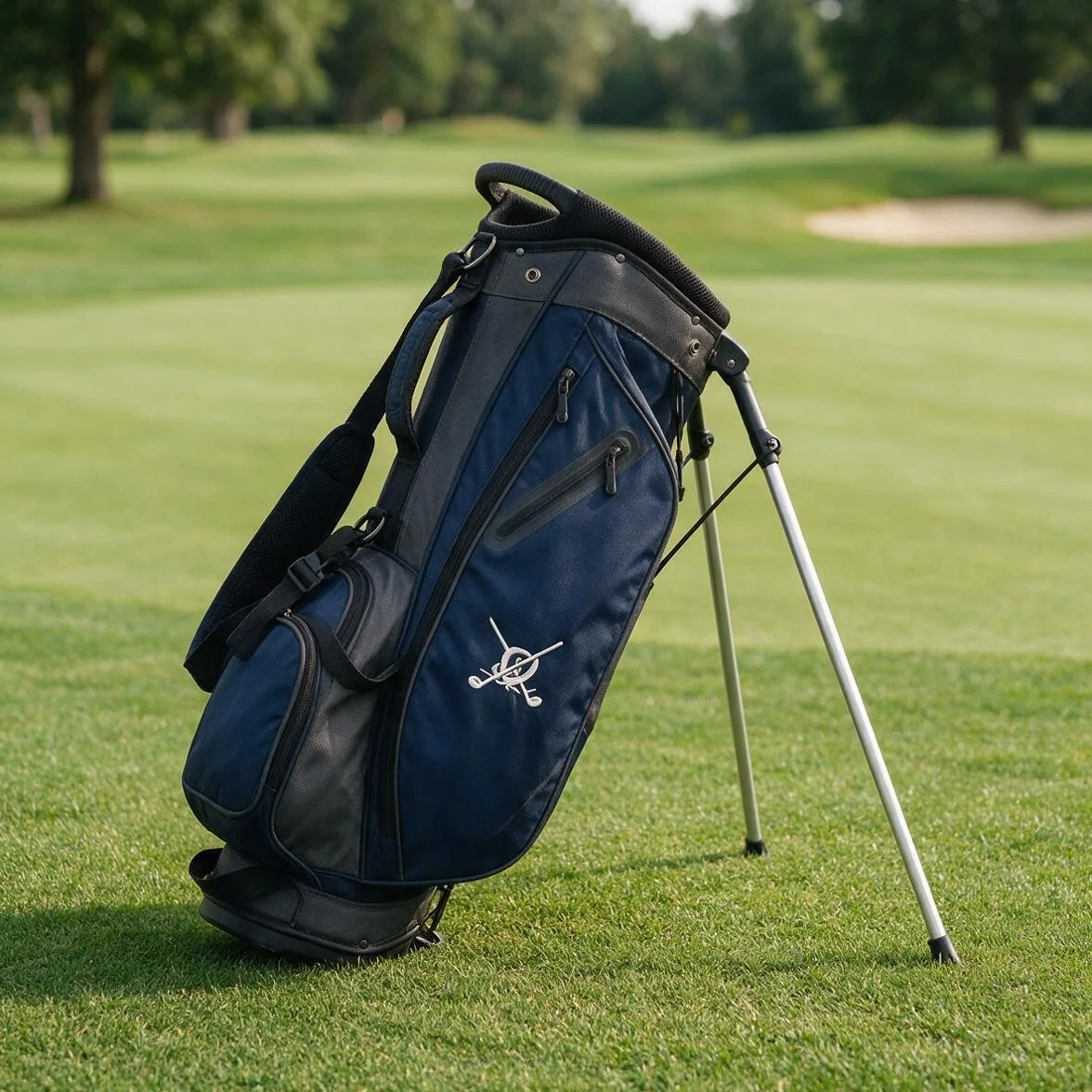
Explore our custom golf stand bag builds — walk-ready, branding-ready and engineered for the course.
Custom Golf Stand Bags Market at a Glance
Stand bags sit at the intersection of two purchasing motives that rarely appear in the same product: the golfer who carries wants less weight, and the brand that sells wants more perceived value. Getting both into one bag is a manufacturing problem before it is a design problem, and it is where most sourcing projects stall.
Market research published by Grand View Research puts the global golf bags market in the region of USD 1.6 billion, with North America holding roughly half of that value and the category growing at a high single-digit CAGR. Participation data from golf’s governing bodies consistently reports more than 60 million golfers worldwide, and walking rounds remain a meaningful share of play in Europe, Japan and Korea — the three regions where stand bags outsell cart bags outright.
For a brand or distributor, the practical implication is narrower than the market headline. Stand bag buyers compare on four attributes: carry weight, stand reliability, divider layout and pocket architecture. Three of those four are decided in the factory, not in the design file. A supplier who cannot control leg spring tension, hinge tolerance and fabric weight per square metre will deliver a bag that photographs well and fails in month three.
Stand Bag, Cart Bag or Staff Bag: Which One Are You Actually Buying?
Before a single material is specified, the bag category has to be settled. The three shapes are not styling variants — they carry different frames, different hardware and different cost structures, and a brand that sells the wrong one to the wrong buyer will see returns regardless of build quality.
| Attribute | Stand Bag | Cart Bag | Staff Bag |
|---|---|---|---|
| Frame | Internal frame with hinged leg assembly | Rigid tubular or moulded frame, no legs | Heavy rigid frame, cart-only |
| Typical weight | 1.4–2.8 kg | 2.5–4.5 kg | 4.0–6.0 kg |
| Divider options | 4, 5, 6 or 14-way | 14-way standard | 6 to 14-way, oversized top |
| Pocket count | 4–8 | 6–12 | 8–14 |
| Primary use | Walking rounds, push carts, travel | Riding carts, club competitions | Tour caddies, club professionals |
| Main failure point | Leg hinge, spring fatigue, base plate | Frame bend, pocket zip pull-out | Weight stress at handle and base |
| MOQ with us | 200 pcs | 200 pcs | 200 pcs |
Most first-time buyers order a stand bag because it is the most versatile shape and the easiest to sell across channels. That is a reasonable default. The complication is that a stand bag carries roughly 15% more component count than a cart bag at the same retail price, so the engineering margin is thinner. If your target price is aggressive, the stand mechanism is where the cost pressure lands first — and where cheap components show up fastest.
If you are still deciding between shapes, our custom golf cart bag programme covers the cart side in the same level of engineering detail.
The Anatomy of a Stand Bag: Nine Parts That Decide Whether It Lasts
A stand bag is a system of nine sub-assemblies. Each one has a distinct failure mode, and each one is priced and specified independently. Buyers who understand the list negotiate better and specify more accurately.
| # | Sub-assembly | What it does | Typical failure |
|---|---|---|---|
| 1 | Top collar / divider top | Holds club shafts apart, carries the stand hinge mounts | Cracked collar, pulled hinge insert |
| 2 | Divider system | Separates clubs, full-length or split | Torn fabric baffles, club tangle |
| 3 | Internal frame | Keeps the bag’s shape under load | Frame bend at shoulder point |
| 4 | Leg assembly | Two legs, hinge, spring, actuator | Spring fatigue, hinge wear, leg bend |
| 5 | Base plate | Triggers the legs, sits on the ground | Deformation, wear-through |
| 6 | Body panels | Main fabric, coating, seam construction | Coating peel, seam failure |
| 7 | Pocket architecture | Storage, insulation, valuables, cooler | Zip pull-out, lining tear |
| 8 | Carry system | Dual strap, hip pad, top handle | Strap anchor tear, pad compression |
| 9 | Hardware and trim | Zips, buckles, D-rings, piping | Corrosion, buckle cracking |
In our sampling reviews, roughly six out of ten field failures trace back to items 4 and 5 — the leg assembly and the base plate. Both are cheap to build correctly and expensive to fix in the field. That is the single most useful fact a buyer can carry into a stand bag project.
The Stand Mechanism: The Engineering That Makes or Breaks the Bag
This is the part that separates a stand bag supplier from a bag supplier. The mechanism has six components working as one kinematic chain, and any single weak link disables the whole system.
1. Legs
Fibreglass, aluminium or carbon-fibre tubes. Wall thickness between 0.8 mm and 1.2 mm. Thinner tubes save weight and bend on the first careless drop; 1.0 mm aluminium is the practical default for mid-price programmes.
2. Hinge assembly
Where the legs pivot on the top collar. Nylon, glass-filled nylon or zinc alloy. Glass-filled nylon is the value sweet spot; zinc alloy belongs on premium builds where the bag is expected to last five seasons.
3. Spring element
Torsion spring or bungee. Torsion springs give a crisper snap but fatigue faster if under-specified; stainless steel outperforms coated carbon steel in humid climates and coastal markets.
4. Actuator rod
The link that transfers force from the base plate to the legs. Rod diameter and material determine whether the legs deploy fully when the bag is set down on uneven ground.
5. Base plate
The trigger. Moulded EVA or reinforced polymer. It must flex enough to actuate and stay rigid enough not to deform permanently after a season of being dropped.
6. Foot pads
The contact points. Replaceable pads extend service life; bonded pads are cheaper but turn a two-dollar repair into a bag replacement.
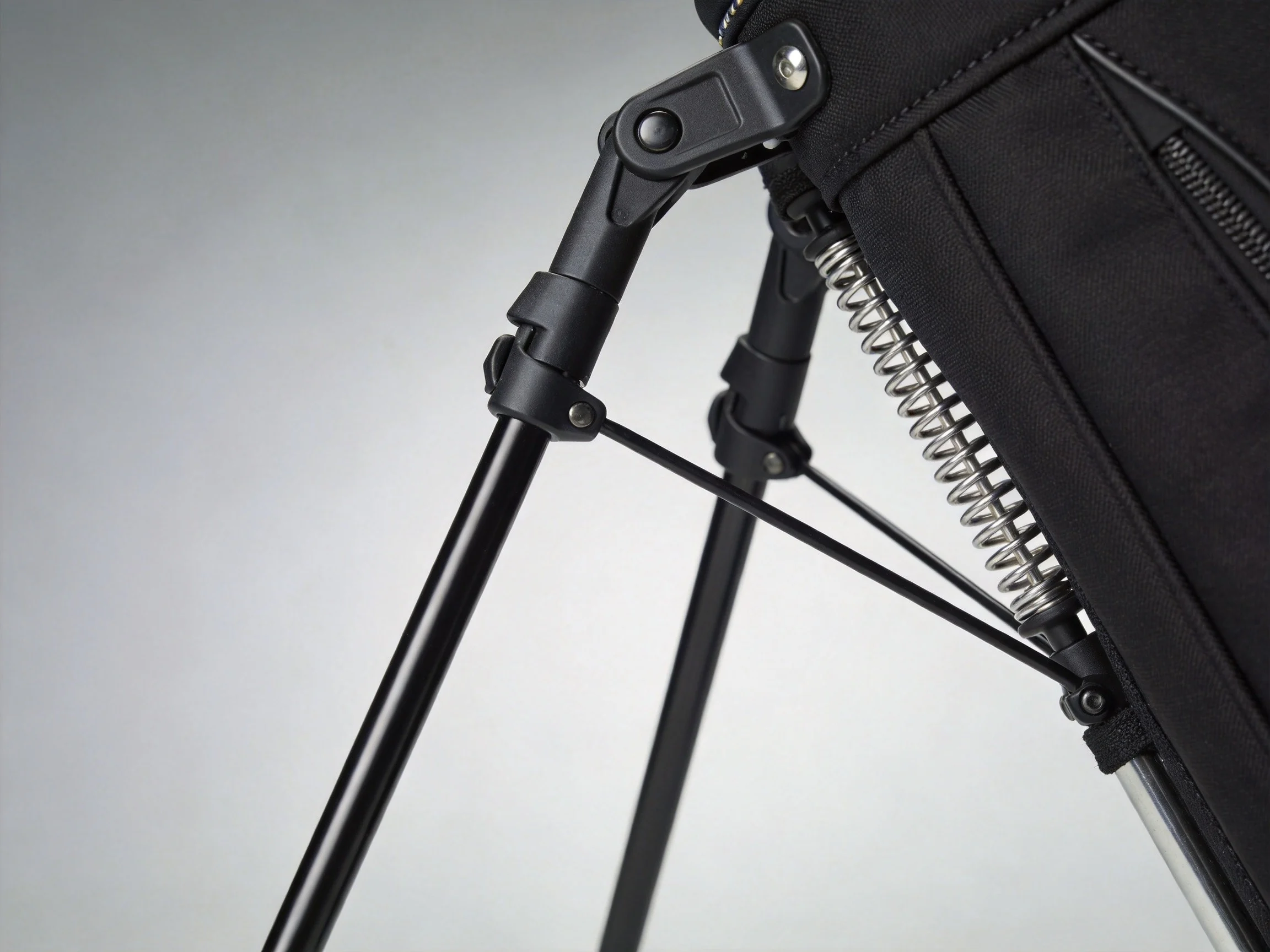
The kinematic chain in close-up — leg tube, hinge collar and spring preload are the three tolerances we hold tightest on every stand bag build.
How the chain works: setting the bag down loads the base plate, the plate pushes the actuator rod upward, the rod rotates the hinge, and the legs swing out to form a tripod with the bag body. The mechanism is passive — no springs are compressed by the user — which is why tuning matters more than component quality alone. A perfectly good spring on the wrong preload will deploy late or not at all.
What we test before bulk, and what you should require from any supplier:
| Test | Method | Pass criterion |
|---|---|---|
| Deployment cycle | Repeated set-down and lift, mechanical rig | 5,000 cycles minimum; 10,000 on premium builds |
| Deployment angle | Measured leg spread at full extension | Consistent tripod, no more than 5° variance across units |
| Static load | Loaded bag, legs deployed, weighted top | No leg splay or hinge deformation at rated load |
| Base plate fatigue | Repeated impact on hard surface | No permanent deformation, actuation still reliable |
| Corrosion | Salt-spray exposure on hardware and spring | No functional degradation in the test window |
If a supplier cannot describe how they tune spring preload and actuator length for different bag weights, they are assembling a kit rather than engineering a mechanism. Ask the question directly — the answer tells you more than any sample photo.
Divider Systems: 4-Way, 6-Way, 14-Way and What Actually Changes
The divider is the second most common source of returns, and it is frequently mis-specified because buyers compare on divider count rather than divider construction.
- 4-way: Lightest option. Fine for a 10-club Sunday set. Clubs of similar length will still touch, and irons will rattle on a walking round.
- 5-way and 6-way: The volume sweet spot for stand bags. Enough separation to prevent shaft wear, minimal weight penalty.
- 14-way: Individual slots, one club each. Eliminates tangle entirely. Adds weight, adds cost, and needs a larger top collar — which changes the bag’s silhouette.
- Full-length vs split: Full-length baffles run the entire depth of the bag and genuinely stop grip-to-head contact. Split baffles stop short, save weight and cost, and let clubs cross at the bottom. For premium programmes, specify full-length.
- Top collar diameter: 8.5 inch is compact, 9 inch is standard, 9.5 inch accommodates oversized grips and putter heads comfortably.
One detail worth specifying in writing: baffle material and attachment. Stitched nylon baffles are the norm; glued baffles fail at the seam under repeated club insertion. Ask for the baffle attachment method in the spec sheet, not the marketing sheet.
Materials: What Survives a Walking Season
Fabric choice drives three things at once — weight, water behaviour and perceived value. The table below reflects what we actually run on stand bag programmes, not a catalogue of everything available.
| Material | Weight class | Best for | Watch out for |
|---|---|---|---|
| 210D polyester, PU coated | Lightest | Entry price points, ultra-light carry bags | Lower abrasion resistance; needs reinforcement at base and strap anchors |
| 420D nylon, PU coated | Light | Core stand bag programmes | Colour fastness on bright shades needs verification |
| 600D polyester, PU coated | Mid | Volume retail programmes | Slightly heavier hand feel |
| 1680D ballistic nylon | Heavy | Premium and tour-inspired builds | Weight penalty; usually paired with lighter pockets |
| PU leather | Mid to heavy | Lifestyle and fashion-forward lines | Hydrolysis in hot humid storage; specify hydrolysis-resistant grade |
On water resistance, be precise in your own product copy. Water-resistant means the coated fabric sheds rain; water will still enter through seams and zips. Waterproof requires sealed seams, waterproof zips and a construction that closes every entry point — it is a different build, not a different fabric.
Zips deserve their own line item. Standard coil zips are adequate for accessory pockets; main-compartment zips should be at least size 8 with a metal slider, and waterproof programmes need welded or taped zip construction. Specify the zip brand and size, or you will receive whatever is cheapest that week.
The Weight Budget: Every Gram You Cut Has a Cost
Stand bag weight is the most over-promised and least specified number in the category. A useful engineering target is to build the budget before the design, not after.
| Sub-assembly | Share of total weight | Where the weight goes |
|---|---|---|
| Fabric body and lining | 20–25% | Denier, coating, panel count |
| Internal frame and top collar | 25–30% | Tube diameter, collar moulding |
| Leg assembly | 10–15% | Tube material and wall thickness, hinge material |
| Pockets and dividers | 15–20% | Pocket count, baffle construction |
| Carry system | 5–8% | Strap padding density, hip pad |
| Hardware and base | 5–10% | Base plate material, zip and buckle selection |
Realistic build targets: 1.4–1.7 kg for a genuine ultralight carry bag, 1.9–2.3 kg for a mainstream stand bag with six pockets, 2.5–2.8 kg for a premium build with 14-way dividers and leather trim. Anything below 1.4 kg with a full pocket set and a reliable stand mechanism is either using a lighter frame than the load case supports, or is measuring the bag without straps.
The trade-offs are predictable. Cutting fabric denier reduces abrasion resistance at the base and strap anchors. Cutting leg wall thickness reduces impact tolerance. Cutting frame tube diameter reduces resistance to being dropped on a cart path. Each of those is a legitimate engineering choice — as long as it is a choice and not a surprise discovered in the returns data.
What We Customize in a Golf Stand Bag
Materials
Water-resistant nylon, heavyweight polyester or premium PU leather, with PU-coated liners, YKK-standard zippers and welded seams where required.
Capacity & Layout
4/5/6-way or 14-way full-length dividers, 14-club capacity, and moulded or soft base profiles matched to your retail specification.
Branding
Logo embroidery, heat transfer, screen print or woven label, plus colour-matched piping and custom lining for a finished brand look.
Stand System
Retractable auto-return legs, padded hip pad, dual shoulder strap and reinforced foot pads, tuned to the finished bag weight.

Golf Stand Bag Build Options
| Option | Spec / Range | Notes |
|---|---|---|
| Club dividers | 4, 5, 6 or 14-way full top | Full-length or split baffles; profile per your design |
| Top collar | 8.5 in / 9 in / 9.5 in | Drives silhouette and maximum grip diameter |
| Stand system | Retractable legs, replaceable foot pads | Auto-return, spring preload tuned to bag weight |
| Leg material | Aluminium, fibreglass, carbon fibre | Wall thickness 0.8–1.2 mm |
| Pockets | 4–8, optional insulated cooler and valuables | Water-resistant zips on exposed pockets |
| Straps | Dual shoulder strap, top handle, side handle | Padded, non-slip, anchor-reinforced |
| Frame / base | Moulded EVA or rigid polymer base | Auto-return profile available |
| Water resistance | Water-resistant or fully waterproof | Waterproof requires sealed seams and waterproof zips |
| Rain hood | Included or optional | Matched fabric and trim |
| Packing | Poly bag, hangtag, retail carton, master carton | Retail-ready or bulk export packing |
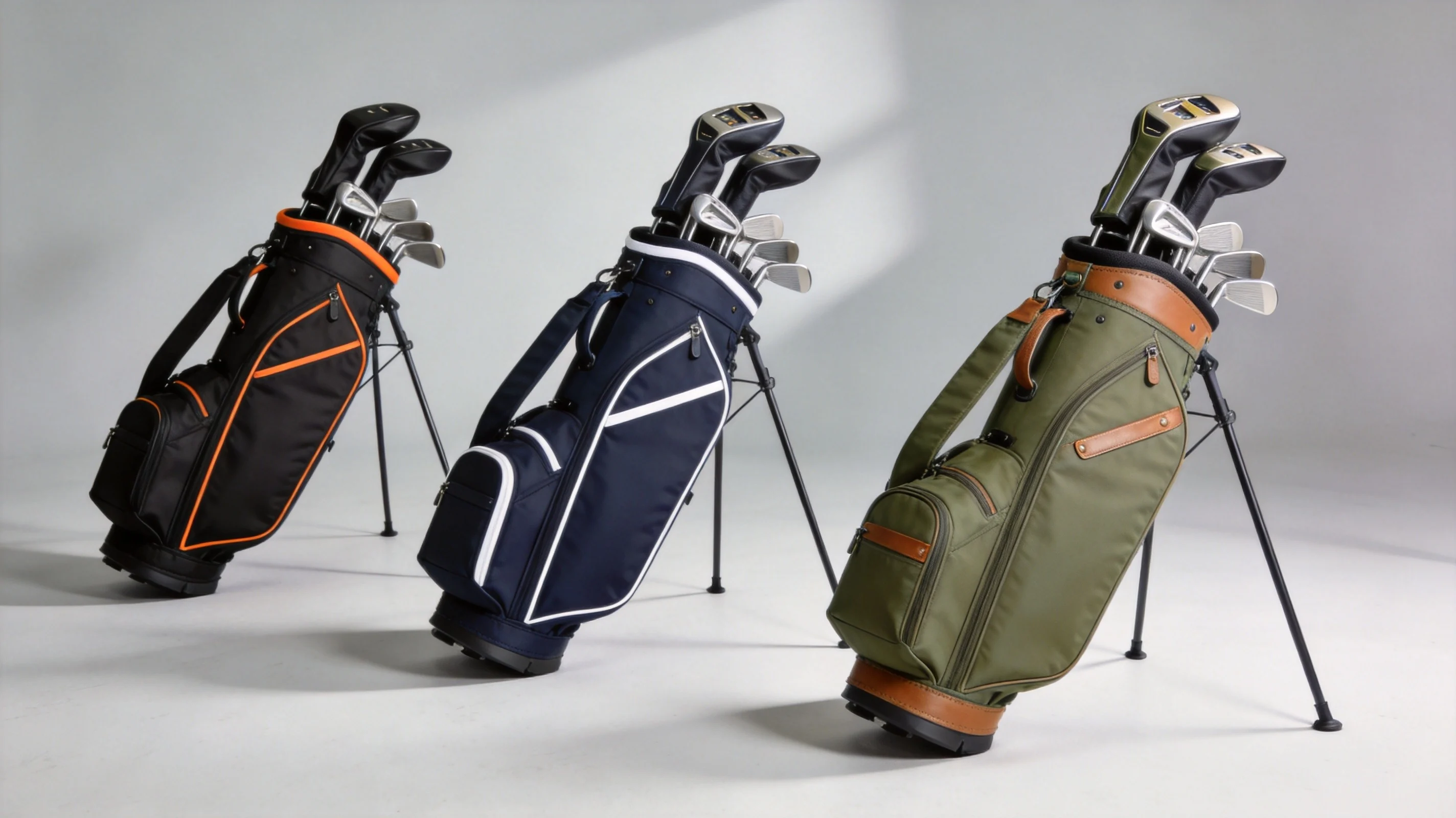
Three stand bag programmes built on the same frame: colourway, trim, divider top and pocket layout change; the stand mechanism and base geometry stay validated.
Branding Methods Compared
| Method | Best applied to | Durability | Typical use |
|---|---|---|---|
| Flat embroidery | Fabric panels, pocket fronts | High | Logo, monogram, club crest |
| 3D puff embroidery | Single-layer fabric, no seams | High | Premium logo treatment |
| Heat transfer | Smooth coated fabric | Medium | Multi-colour graphics, fine detail |
| Screen print | Flat panels, high volume | Medium | Repeat graphics, simple marks |
| Woven label | Anywhere a sewn patch fits | Very high | Brand tags, size and spec labels |
| Metal badge / plaque | Leather and heavy nylon | Very high | Luxury and limited editions |
| Silicone transfer | Curved and technical panels | Medium to high | Sport styling, rubberised marks |
Two practical notes. First, embroidery on a curved or padded panel distorts unless the artwork is digitised for that surface — request a sew-out before approving. Second, Pantone matching on coated fabric drifts between dye lots; specify a tolerance and approve a physical lab dip, not a screen colour.
Quality Gates: What Gets Checked, and When
Quality is a sequence of gates, not a final inspection. These are the gates we run on stand bag programmes.
- Incoming material: fabric weight per square metre, shade against approved standard, coating adhesion, zip pull strength, webbing tensile.
- Cutting: die accuracy, grain direction on directional fabrics, panel count against the bill of materials.
- Sewing in-line: stitch density, skipped stitches, seam allowance, thread tension, bartack placement at all stress points.
- Stand assembly: deployment smoothness, spring preload, leg spread consistency, actuator travel, foot pad retention.
- Finished goods: loaded static test, deployment cycle sample, dimension check against spec, hardware function, label and hangtag accuracy.
- Pre-shipment: AQL sampling on the agreed level, carton drop, packing configuration verification, barcode and shipping mark check.
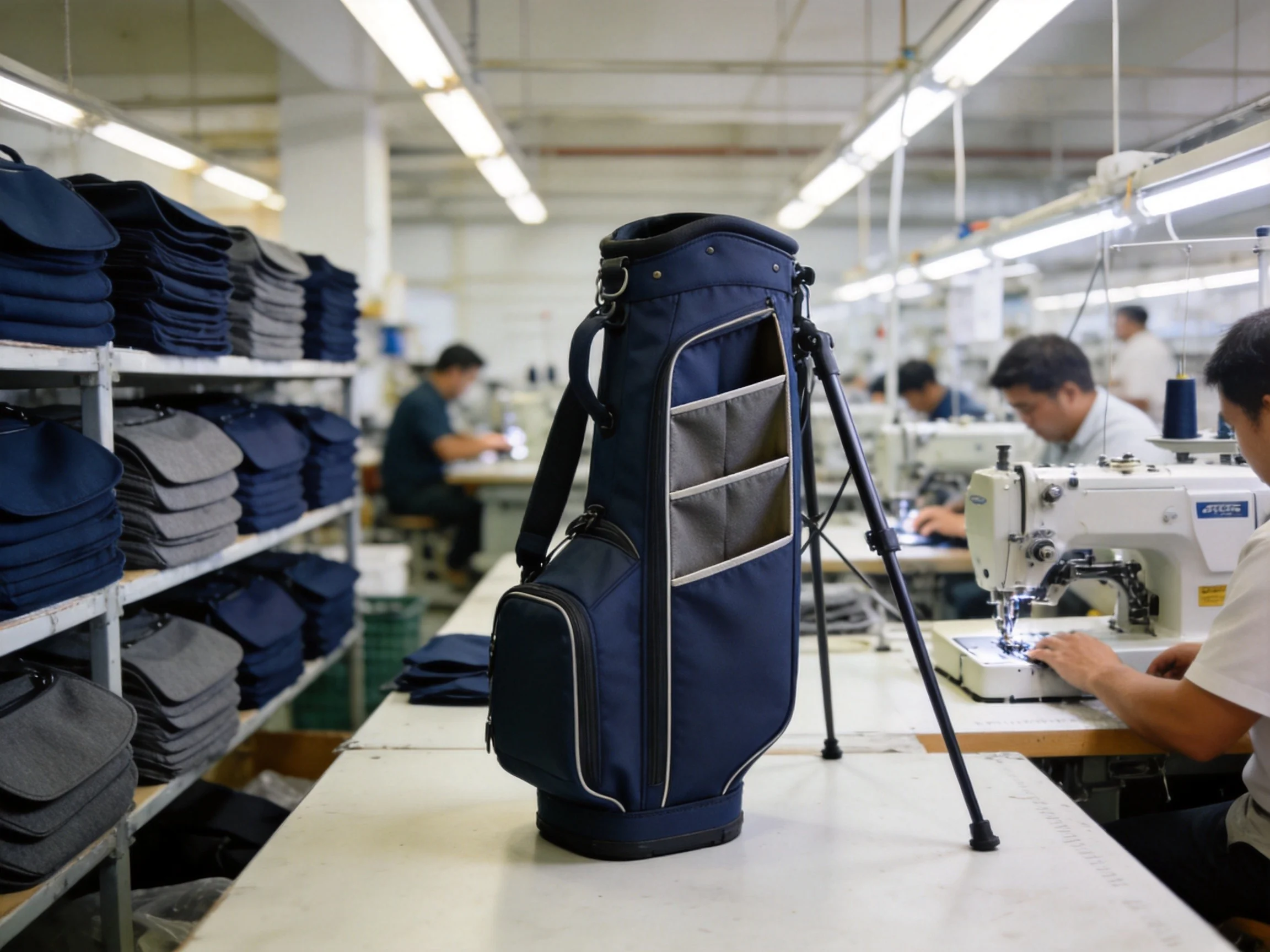
Cut panels staged beside the line, in-line sewing under a single supervisor, then stand assembly and cycle testing before packing.
Ask for the inspection report at each gate, not only at pre-shipment. A pre-shipment report tells you a defect exists; gate reports tell you where it entered, which is the difference between a fixable process and a recurring cost.
Why Source Golf Stand Bags From Junyuan Bags
- Engineered stand systems: we tune spring preload and actuator length to each bag weight rather than assembling a generic kit, and we sample the mechanism before bulk.
- 12 years of OEM manufacturing: pattern, grading, cutting, sewing, stand assembly, finishing and QC under one roof at our affiliated partner factory in Quanzhou.
- In-house audited quality system with independently inspected production and monthly capacity of 200,000 pieces.
- Fast sampling: working prototype with 3D design feedback within 24 hours, physical sample in 6–10 days.
- Low MOQ: start at 200 pieces per style, which lets you test a new market or a new colourway without a large upfront commitment.
- Export-ready terms: FOB Xiamen, T/T or L/C, retail-ready or bulk export packing.
Explore related capabilities: custom golf bags · custom golf cart bags · custom stand & sunday bags · custom golf headcovers · custom golf bag accessories.
Sampling & Production Timeline
- Brief (Day 0): share your spec sheet, artwork, target price and target weight. If you have no spec sheet, we work from reference bags and build one with you.
- Design feedback (within 24 hours): 3D rendering and a bill-of-materials draft, including the stand mechanism specification and the weight budget.
- Sample (Day 6–10): physical working sample with the stand mechanism assembled and cycle-tested, plus a sew-out for any embroidery.
- Sample revision (as needed): fit, weight and mechanism adjustments before sign-off. Revisions are expected, not exceptional.
- Bulk production (Day 35–50): production run after sample sign-off, with gate inspections through the run.
- Pre-shipment and dispatch: AQL inspection, export packing, FOB Xiamen.
These windows assume an approved sample and materials in stock. Custom fabric development, Pantone-specific dyeing or new tooling for a moulded collar will extend them, and we flag that before the project starts rather than after.
Frequently Asked Questions
What is the MOQ for custom golf stand bags?
Our MOQ is 200 pieces per style for custom golf stand bags. That threshold applies to a single colourway and a single specification, and it is low enough to test a new market without a large upfront commitment.
How long does a sample take?
Physical samples take 6–10 days from brief approval, and you receive 3D design feedback within 24 hours of the brief. Bulk production runs 35–50 days after the sample is confirmed.
Can you add our logo or change the colour?
Yes. We offer logo embroidery, 3D puff embroidery, screen print, heat transfer, woven labels and metal badges, plus fully colour-matched piping and custom lining. For Pantone matching we approve a physical lab dip rather than a screen colour, because coated fabrics drift between dye lots.
Do you support low-volume or first orders?
Yes. Start at 200 pieces per style. We routinely support distributors and emerging brands scaling from a pilot order to a full line, and the tooling and pattern work carries over.
Can you build the retractable stand mechanism?
Yes, and it is the part we spend the most engineering time on. We specify leg material and wall thickness, hinge material, spring type and preload, actuator length and base plate construction — then cycle-test the assembly before bulk. We tune the mechanism to the finished bag weight rather than using a generic kit.
What materials do you recommend for stand bags?
Water-resistant nylon and lightweight polyester balance durability against carry weight for most programmes. 420D nylon is the practical core; 210D polyester suits ultralight builds where you accept lower abrasion resistance; 1680D ballistic nylon and PU leather belong on premium lines where the weight penalty is part of the value proposition.
How much does a custom golf stand bag weigh?
Realistic targets are 1.4–1.7 kg for an ultralight carry bag, 1.9–2.3 kg for a mainstream stand bag with six pockets, and 2.5–2.8 kg for a premium build with 14-way dividers and leather trim. We build a weight budget by sub-assembly before design starts, so the target is engineered rather than aspirational.
What is the bulk production lead time?
35–50 days after sample sign-off, depending on material availability and decoration complexity. Custom fabric development or new tooling extends the window, and we flag that before the project begins.
What is the difference between a stand bag and a cart bag?
A stand bag carries an internal frame with a hinged leg assembly and is built for walking rounds and push carts; typical weight is 1.4–2.8 kg. A cart bag has a rigid frame with no legs, more pockets and a 14-way divider as standard, and is built for riding carts at 2.5–4.5 kg. A stand bag carries roughly 15% more component count, so the engineering margin is thinner at the same retail price.
Can you match a specific Pantone colour?
Yes, on fabric, webbing, piping, thread and trim. We dye to a physical lab dip that you approve before bulk, and we state a tolerance in the specification because coated fabric shades drift between dye lots.
What quality control do custom golf stand bags come with?
Six gates: incoming material, cutting, in-line sewing, stand assembly, finished goods and pre-shipment AQL inspection. We share the inspection report at each gate rather than only at pre-shipment, so a defect is traced to the process that produced it.
How do I start a custom golf stand bag project?
Send a spec sheet, artwork, target price and target weight to [email protected] or message us on WhatsApp. If you do not have a spec sheet, send reference bags or reference images and we build the specification with you. You receive 3D design feedback and a bill of materials within 24 hours, and a physical sample in 6–10 days.
Do you supply spare legs, hinges and foot pads after delivery?
Yes. Replaceable foot pads are standard on our stand bags, and complete leg sets, hinge collars and actuator rods can be supplied as service parts at cost from 50 sets per order, packed with the bulk shipment or sent separately. We keep the tooling and the fabric record for each programme, so a replacement part ordered two seasons later still matches the original specification. If your channel includes warranty support, ask for a spare-parts ratio in the quotation — 1–2% of order quantity is the usual allowance for retail programmes.
Can you build to a target FOB price and a target carry weight?
Yes, and it works better as a two-number brief than as a design brief. Send the target FOB and the target finished weight, and we return a specification that fits both: leg material and wall thickness, hinge material, divider top construction, pocket count, lining weight and carton configuration. Weight and cost move together — dropping 200 g usually costs 4–8% of FOB through lighter fabric, thinner leg walls or a moulded rather than assembled divider top. We quote the trade-off explicitly rather than promising both targets at once.
Ready to Build Your Custom Golf Stand Bag?
Send us your spec sheet or artwork — our engineers reply within one business day with a quote, a stand mechanism specification and a sampling plan.

Email: [email protected] · WhatsApp: +86 17750020688
Explore Related Manufacturing Programmes
Golf bag lines, sourcing guides and programme pages that sit alongside this stand bag page.
- Custom golf bag manufacturer — the full golf range and programme overview
- Custom golf cart bags — the cart-side product range
- Cart bag sourcing & BOM cost breakdown — tooling, cost structure and inspection gates
- Stand & Sunday golf bags — the lighter carry formats
- Custom golf staff bags — tour and staff silhouettes
- Staff bag private label — white-label programmes for brand partners
- Custom leather golf bags — PU and leather constructions
- Golf bag accessories — headcovers, towels, umbrellas and matching add-ons
- Custom golf den caddy — the indoor and retail display format
- Custom golf bag cost & pricing guide — what moves FOB on a bag programme
- Golf bag divider systems — 4, 6 and 14-way construction detail
- Golf bag material selection — fabric, coating and weight trade-offs
- Golf bag quality control — inspection gates and AQL sampling
- Waterproof golf bag cost breakdown — TPU vs PVC, zips and seams
- Custom logo golf bags — embroidery and branding methods
- Custom golf bag manufacturing guide — brief to bulk delivery
- OEM & ODM service — programme scope, sampling workflow and MOQ terms