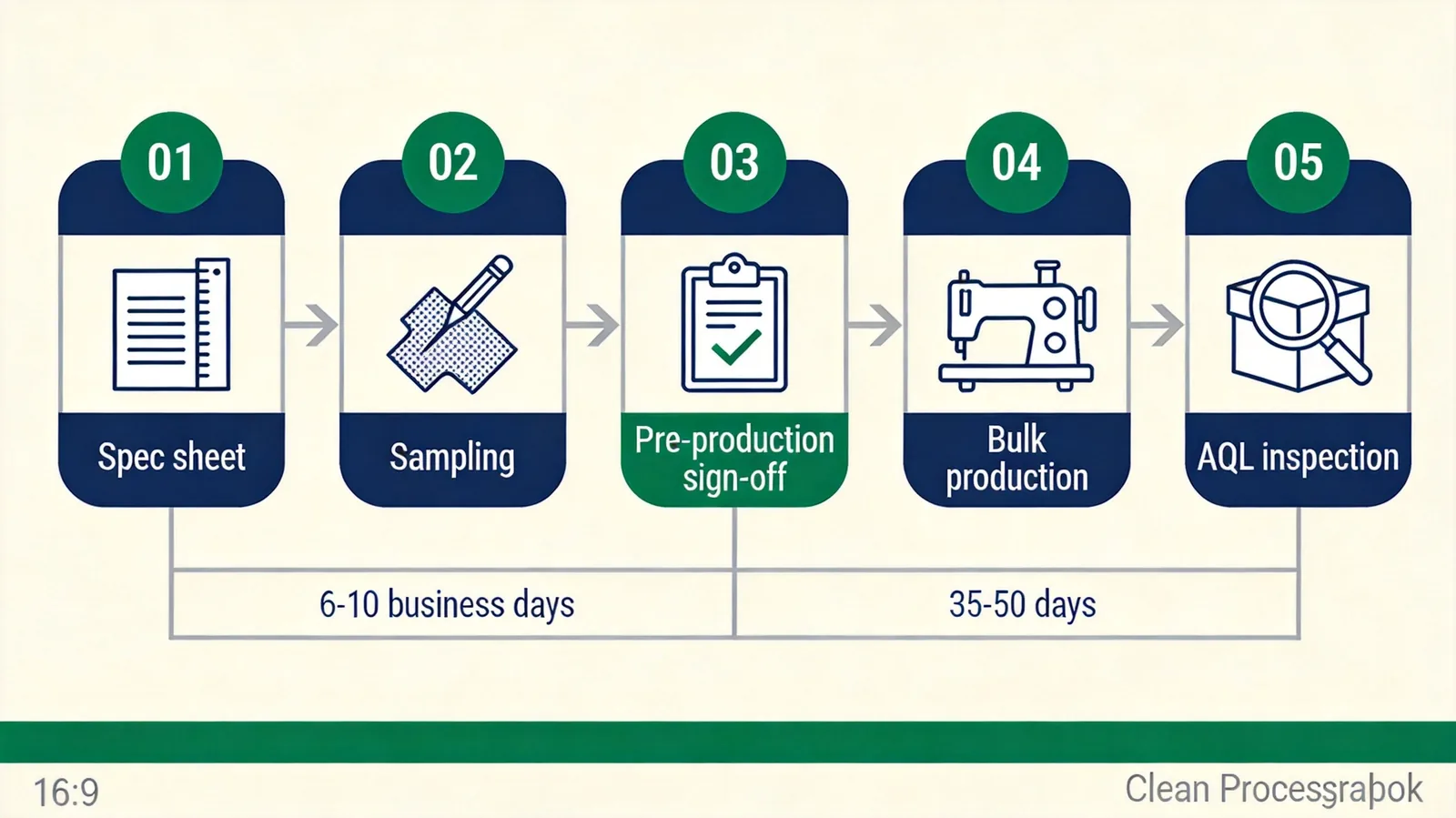
Where should a brand buy wholesale backpacks in bulk? There are four channels and each one wins under different conditions: a direct factory wins on unit cost and specification control above roughly 500 pieces per style; a B2B marketplace wins on discovery and small trial runs; a physical wholesale market wins on speed and low minimums for stock designs; and a trading company wins when you need several bag categories on one invoice. For custom OEM/ODM backpacks, JUNYUAN BAGS runs standard MOQ at 500 pcs per style and colour, sampling in 6–10 business days, bulk production in 35–50 days, and AQL 2.5 / 4.0 inspection on every shipment, FOB Xiamen with DDP available by arrangement.
The channel decision is upstream of the price negotiation, and getting it wrong costs more than any discount you will win later. A buyer who sources a 500-piece custom program through a marketplace pays a platform margin and loses specification control. A buyer who sources a 50-piece trial run direct from a factory pays a short-run premium and waits longer than the order justifies.
What Are the Four Ways to Buy Wholesale Backpacks in Bulk?
The four channels differ on five axes that matter: who owns the production line, who carries the specification risk, what the minimum order really is, how long the lead time runs, and who you have recourse against when something goes wrong.
- Direct factory — you contract with the entity that cuts and sews. Highest control, lowest unit cost at volume, highest minimum.
- B2B marketplace — you contract through a platform listing. Broadest discovery, escrow and dispute mechanisms, but the entity behind the listing may be a factory, a trading company or a reseller.
- Physical wholesale market — you buy stock from a stall or warehouse cluster. Fastest, lowest minimum, no customisation beyond a logo on stock shapes.
- Trading company or sourcing agent — you contract with an intermediary who coordinates multiple factories. Best when your order spans categories, worst on unit cost.
Channel 1: Direct From the Factory
Direct factory sourcing is the correct default for any custom backpack program above a few hundred pieces per style — including technical categories such as mountaineering backpack manufacturers and volume categories such as top-rated hiking backpacks. The reason is not price alone — it is that the factory owns the pattern, the sample and the production record, so a specification question has one answer instead of three.
What you gain:
- Specification control. Fabric weight, zipper grade, padding stack and tolerance are negotiated with the party that executes them.
- Sample-to-bulk consistency. The same sample room and the same line produce the approved sample and the bulk order.
- Inspection access. You or a third party can attend final inspection, which is where most disputes are prevented rather than resolved.
- Unit cost at volume. No intermediary margin, and tooling is amortised across your own order rather than shared.
What you give up: a higher minimum order, a longer lead time, and the work of verification. A factory will not usually run 50 pieces of a custom design, and it will not hold your hand through a tech pack.
The trade-off is documented across buyer-side sourcing guides: the custom backpack manufacturer sourcing framework reaches the same conclusion — that specification match, approval process and QC responsibility matter more than headline unit price. What those guides rarely say plainly is that all three of them are only available direct.
Channel 2: B2B Marketplaces
Before you use a marketplace to benchmark, it helps to know which styles actually move — see the most popular laptop backpack styles for a worked example of stock-shape demand.
Marketplaces such as Alibaba and Made-in-China are discovery tools first and transaction tools second. Their real value is comparative: you can see forty suppliers quoting the same stock shape in an afternoon, which is useful intelligence even if you never place the order there.
What marketplaces are genuinely good for:
- Trial runs and stock designs. Listed MOQs of 2–50 pieces are real, and for a first market test that matters.
- Price benchmarking. The quoted spread across verified suppliers tells you what a category actually costs before you negotiate.
- Supplier shortlisting. Filtering by years active, verification level and reorder rate produces a usable list quickly.
What they are not good for:
- Specification control. Listings describe a stock shape, not your tech pack. Custom work moves off-platform quickly, and once it does the platform’s dispute mechanism no longer applies.
- Entity certainty. The company behind a listing may be a factory, a trading company, or a reseller quoting a factory it does not control. Verification level confirms the legal entity, not the production line.
- Consistency across orders. A stock shape sourced twice may come from two different factories. If you build a brand on it, you will find out at the second reorder.
The practical rule: use marketplaces to learn the market and to run a first small test, then move to a direct relationship once the design is proven.
Channel 3: Physical Wholesale Markets
Physical markets work best for categories where stock shapes are acceptable, such as standard travel backpack formats. The bag clusters around Guangzhou, Baigou and Yiwu, and the wholesale districts in destination markets — still serve a real function for buyers who need stock now and cannot wait for production.
What they do well:
- Immediate availability. You can inspect and take delivery of stock the same week.
- Very low minimums. Single-digit quantities per style are normal.
- Physical inspection before payment. You see and touch the actual goods, which no platform listing allows.
Where they fail a brand program:
- No specification control. You buy what exists. A logo can usually be added; a dimension, a padding stack or a zipper grade cannot.
- No traceability. The stall is a seller, not the producer. If the product sells well and you reorder in three months, the same goods may not be available.
- Inconsistent quality between lots. Stock goods are bought in lots. The second lot is a different lot.
Physical markets are a reasonable channel for a market test or a promotional run where the product itself is not the differentiator. They are the wrong channel for anything you intend to build a brand on.
Channel 4: Trading Companies and Sourcing Agents
Trading companies are frequently dismissed in sourcing guides and frequently misused in practice. They have a genuine role, and it is narrower than most agents claim.
A trading company is the right choice when:
- Your order spans several bag categories — backpacks, duffels, cooler bags, totes — and you want one invoice, one inspection and one shipment.
- Your customisation is limited to logo, colour or packaging on stock shapes, so no new pattern is required.
- You need a single point of contact for documentation and logistics and are willing to pay a margin for it.
A trading company is the wrong choice when:
- The product is structurally custom. Every structural change requires the intermediary to coordinate with a factory, which adds a hand-off and adds time.
- Unit cost drives the business case. The intermediary margin is real, and on a resale model it comes straight out of your gross margin.
- You need to control the production record. You will not have direct access to the factory’s inline QC data or the ability to attend inspection without coordination.
One practical test: ask the trading company to name the production factory in writing, and to give written notice if it changes factories between orders. A supplier who will not name the line is asking you to accept an unquantified risk.
If this is your first sourcing cycle, the first-time buyer checklist covers the questions to ask before you choose a channel at all.
Channel Comparison: Cost, Control and Risk
| Factor | Direct factory | B2B marketplace | Wholesale market | Trading company |
|---|---|---|---|---|
| Typical MOQ | 500 pcs per style/colour | 2–500 pcs depending on listing | 1–50 pcs | 300–1,000 pcs |
| Unit cost at 500 pcs | Lowest | Low to mid, plus platform friction | Mid, stock shapes only | Highest |
| Customisation depth | Full OEM/ODM | Logo and colour on stock shapes | Logo only | Logo, colour, packaging |
| Lead time | 35–50 days bulk | Stock ships in days; custom reverts to factory | Days | 40–60 days |
| Specification control | Full | Minimal | None | Indirect |
| Inspection access | Direct, buyer welcome | Platform or third party only | Goods in hand | Coordinated |
| Who owns the risk | Shared, documented | Split, weakly documented | Buyer | Intermediary |
Which Channel Fits Your Order Size?
| Order profile | Best channel | Why |
|---|---|---|
| Under 50 pcs, stock shape, logo only | Wholesale market or marketplace | Below any factory minimum; speed matters more than unit cost |
| 50–300 pcs, testing a design | Marketplace, then direct | Learn the market cheaply, then move to a factory once proven |
| 500–3,000 pcs, one custom style | Direct factory | Factory minimum is met; specification control is worth more than the effort |
| 3,000+ pcs, multi-style program | Direct factory, multi-year agreement | Volume pricing, tooling amortisation, production planning |
| Multiple categories, one shipment | Trading company | Consolidation value exceeds the margin cost |
| Retail chain with compliance requirements | Direct factory with audit trail | Social compliance and inspection records must be traceable |
What Each Channel Actually Costs
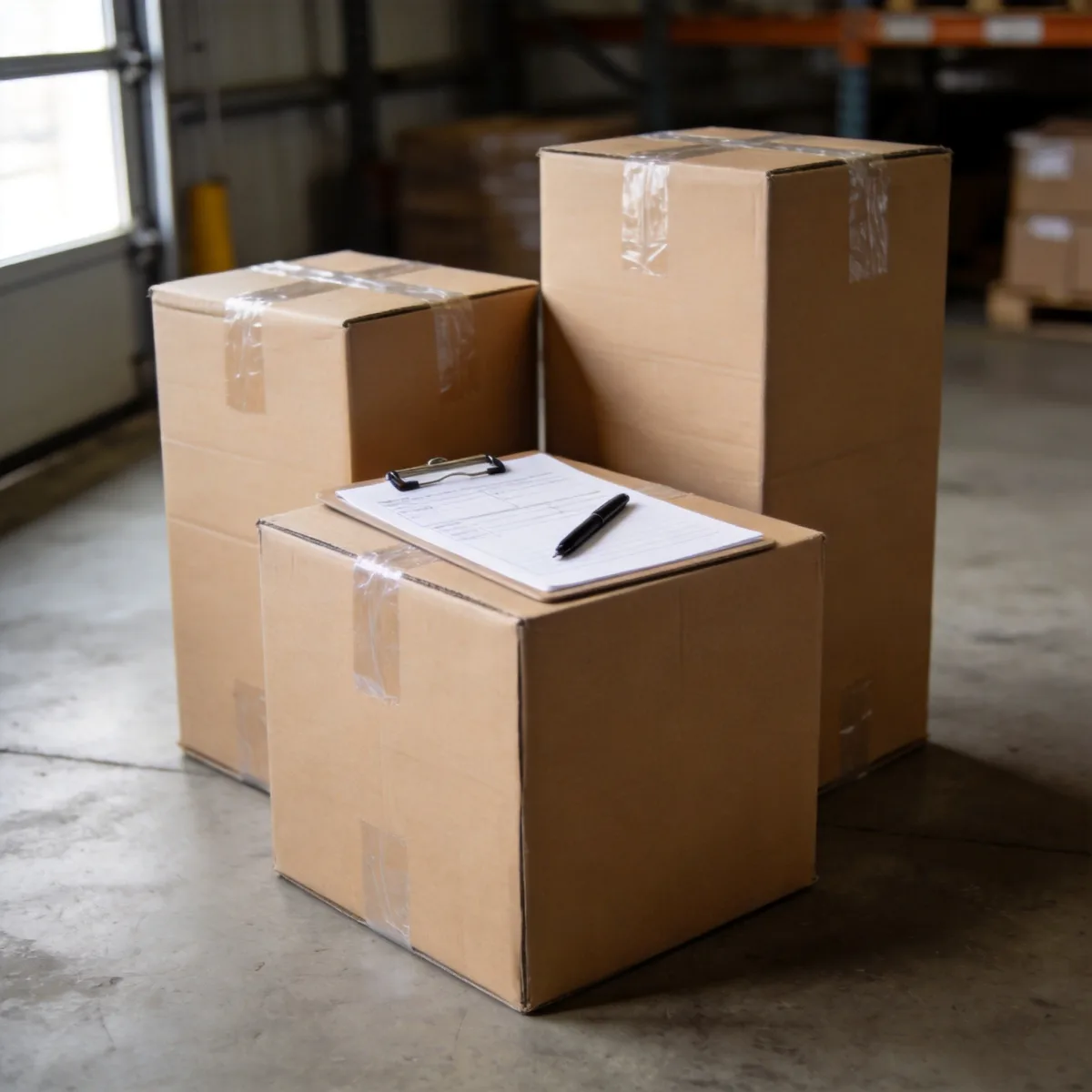
Unit price is the visible number and the smallest part of the difference. The channel-specific costs below are the ones that decide whether a program is profitable.
| Cost item | Direct factory | Marketplace | Wholesale market | Trading company |
|---|---|---|---|---|
| Tooling and logo setup | Itemised, one-time, yours | Often hidden in unit price | Per-piece charge | Itemised with margin added |
| Sample cost | US$50–150, often credited | Varies, rarely credited | Not applicable | Marked up |
| Inspection | Included to AQL 2.5 | Third party at your cost | Your own time | Coordinated, charged |
| Rework risk | Low — caught in-line | Mid — caught at final only | High — caught by your customer | Mid |
| Replenishment risk | Low — same line, same pattern | High — source may change | High — lot may be gone | Mid |
| Communication overhead | Direct | Platform messaging | In person | One layer removed |
How to Verify a Supplier on Each Channel
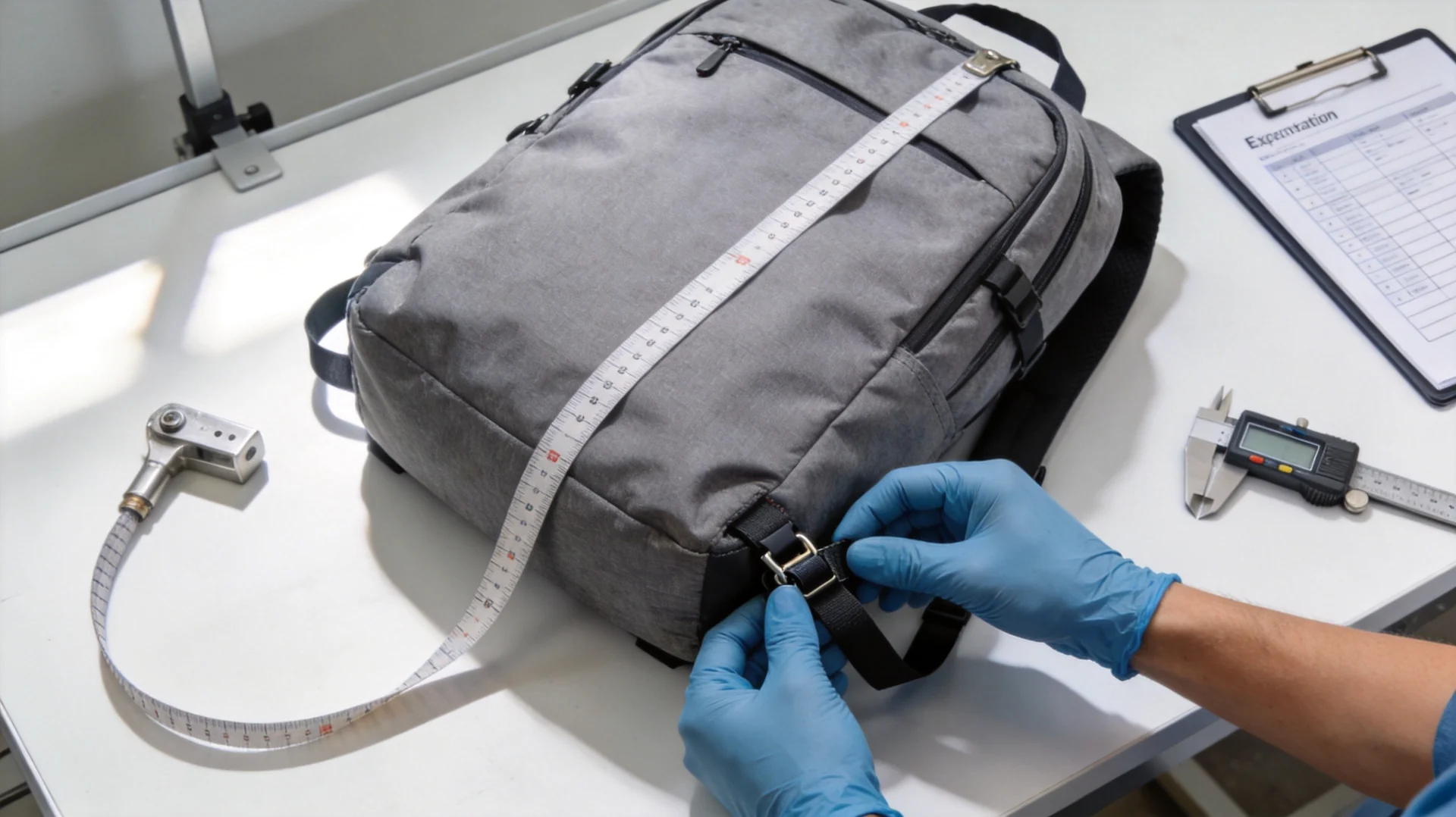
| Channel | Primary check | Secondary check | What cannot be verified |
|---|---|---|---|
| Direct factory | Business licence scope shows production or manufacturing | Live or dated production walkthrough, sample room independence | Whether your specific order will run on the line shown |
| B2B marketplace | Verification level and years active | Reorder rate and on-time rate where displayed | Whether the listing entity owns the factory |
| Wholesale market | Goods in hand | Whether the same lot can be reordered | Who produced the goods, and to what standard |
| Trading company | Written factory name and address | Written notice clause for factory changes | Day-to-day production control |
A production licence confirms registration for manufacturing; it does not prove the company owns the specific line your order will run on. Treat every single check as one piece of evidence rather than a verdict, and combine at least three before committing a deposit. Buyer-side screening guides consistently reach the same position — the 2026 supplier screening guide puts QC process evidence and reference calls ahead of certificates, and the B2B bag customisation FAQ recommends an on-site or video audit above US$50,000 first orders.
The Five Mistakes Buyers Make When Choosing a Channel
- Optimising for unit price at the wrong volume. At 200 pieces, the factory short-run premium can exceed the trading company margin. Do the arithmetic at your actual quantity, not at 5,000.
- Treating a marketplace listing as a factory. Verification level confirms a legal entity. It does not confirm who cuts and sews your order.
- Buying a brand-defining product from a wholesale market. Stock goods cannot be reordered reliably, which is fatal to any product you intend to build on.
- Using a trading company for a structural custom design. Every structural change becomes a three-party conversation, and the schedule absorbs the friction.
- Skipping verification because the sample looked good. A good sample proves the sample room, not the production line. The gap between the two is where most launch failures originate.
Red Flags by Channel
Most channel mistakes are visible before money moves, if you know what to look for. These are the signals that should stop a negotiation rather than slow it down.
| Channel | Red flag | What it usually means |
|---|---|---|
| Direct factory | Refuses inspection access | Inline QC is not documented, or the order will be subcontracted |
| Direct factory | Cannot show the sample room separately | Samples are made by a different team than bulk production |
| Direct factory | MOQ “changes after confirmation” | MOQ is counted per colour, not per order — get the rule in writing |
| B2B marketplace | Will not move custom work to a direct contract | The listing entity is not the producer |
| B2B marketplace | Photos are reused across several storefronts | Stock images from a factory the sellers do not control |
| Wholesale market | Cannot state the producer | No reorder path, no standard, no recourse |
| Trading company | Will not name the production factory | Unquantified substitution risk between orders |
| Any channel | Will not itemise tooling and sample costs | Those costs are embedded in the unit price where you cannot audit them |
Sourcing Channel Questions Buyers Ask
Q1: Where is the cheapest place to buy wholesale backpacks in bulk?
Unit cost is lowest buying direct from the factory at or above its minimum order, because no intermediary margin and no platform fee is added. At 500 pcs per style and colour, a direct factory is normally the cheapest compliant channel. Below roughly 200 pieces the short-run premium can make a trading company or marketplace cheaper in total, even at a higher unit price.
Q2: What is the minimum order for wholesale backpacks?
It depends entirely on the channel. Physical wholesale markets sell from 1–50 pieces. B2B marketplace listings range from 2 pieces to 500 depending on the supplier. A direct factory running a custom OEM/ODM backpack program typically sets MOQ at 500 pcs per style and colour — JUNYUAN BAGS standard MOQ is 500 pcs, with volume pricing from 5,000 pieces and flexibility on proven repeat designs.
Q3: Is Alibaba reliable for wholesale backpacks?
Alibaba is reliable for discovery and for small trial orders where escrow protection applies. It is weaker for custom programs, because the specification conversation moves off-platform and the platform dispute mechanism no longer covers it. Use it to benchmark prices and shortlist suppliers, then verify the production entity directly before committing to a custom run.
Q4: How do I tell a factory from a trading company?
Start with the business licence scope: “production”, “manufacturing” or “processing” indicates registration for manufacturing, while “trade” or “import/export” indicates a trading company. Then check product-line breadth — a factory usually lists a narrow catalogue, a trader lists everything. Finally, ask whether the sample room is separate from mass production; a dedicated sample room is a strong factory signal.
Q5: Should I use a sourcing agent in China?
Use an agent when your order spans multiple bag categories and you want one invoice, one inspection and one shipment. Do not use one for a structurally custom single-category program, where the agent adds a coordination layer without adding capability. If you do use one, require the production factory to be named in writing with notice of any change.
Q6: How long does it take to get wholesale backpacks?
Stock goods from a wholesale market or marketplace can ship in days. Custom OEM/ODM production at JUNYUAN BAGS runs 6–10 business days for sampling and 35–50 days for bulk production after sample approval and deposit, plus ocean freight. Fabric dyed to a specific Pantone reference and new hardware moulds both extend the front end.
Q7: Can I buy a small trial order before committing to bulk?
Yes, and you should. Most factories will quote a paid sample or a small pilot run before a full order. Expect the pilot run to carry a higher unit price than bulk, because the setup cost is spread across fewer units. Confirm in writing whether the pilot cost is credited against the bulk order — it often is.
Q8: What payment terms are normal for bulk backpack orders?
Common structures are 30% deposit with 70% before shipment, or a letter of credit for larger orders. Escrow and trade assurance mechanisms are available on some marketplaces for smaller orders. Whatever the structure, make the payment terms, inspection rights and rework liability explicit in the purchase order rather than relying on the proforma invoice alone.
Q9: How do I compare quotes from different channels?
Compare landed cost, not FOB price, and compare it against an identical specification. A marketplace quote for a stock shape and a factory quote for your tech pack are not comparable numbers. Build the landed cost model — samples, tooling, testing, freight, duty, inland handling, bank charges — and compare totals at your real quantity.
Q10: What is AQL 2.5 and why does it matter when choosing a channel?
AQL 2.5 is the acceptance quality limit used in most consumer goods inspection programs, defined under ISO 2859-1. It matters to the channel decision because only a direct factory relationship gives you the right to attend final inspection and to see inline QC records. On marketplaces and wholesale markets, inspection is something you arrange and pay for separately, after the goods exist.
Q11: Do wholesale markets in China sell export quality?
They sell what exists in the lot, which may or may not meet an export market’s requirement. The constraint is not capability but traceability: a stall is a seller, not the producer, so you cannot confirm the standard the goods were built to, and you cannot reliably reorder the same goods. For anything you intend to brand, this is disqualifying.
Q12: How much does shipping add to the unit cost?
Ocean freight typically adds US$1.50–4.00 per unit depending on route, season and carton efficiency, and inland handling adds roughly US$0.30–1.00 per unit. Duties and VAT are calculated on CIF value rather than FOB, which is why a landed cost model is the only comparison that holds across channels.
Q13: Can I mix products from several factories in one shipment?
Yes, but it requires a consolidation step, which is exactly what a trading company or sourcing agent provides. Doing it yourself means coordinating several factories’ ready dates against one vessel booking, and accepting that one late factory delays the whole container. The margin an intermediary charges for this is often cheaper than the delay risk.
Q14: What is the biggest risk when choosing a channel?
Replenishment risk. A channel that cannot deliver the same product from the same line on the second order is a channel that cannot support a brand, no matter how good the first shipment was. Before committing, ask how the second order will be produced, by whom, and against which approved sample.
Start a Bulk Backpack Sourcing Conversation
If your order is a custom program at 500 pieces or more, the channel decision is already made — go direct. Send JUNYUAN BAGS a dimensioned tech pack; the reply within 12 hours carries a specification review, a tooling quote and a firm FOB Xiamen price, with sampling at 6–10 business days and AQL 2.5 final inspection you are welcome to attend.
Read the companion guide on what to specify in a wholesale laptop backpack program, or review the custom backpack manufacturing capability, the company profile and QC process, and contact the OEM/ODM team.