When launching a Kickstarter bag campaign, speed in sample production is critical. A physical prototype builds trust with backers, highlights design flaws early, and ensures production readiness. Typically, the sampling phase takes 2–4 weeks, with 2–3 rounds of revisions needed to perfect the design. Choosing the right materials, manufacturers, and collaboration tools can cut costs by up to 50% and reduce development time by 30%. Here’s what you need to know:
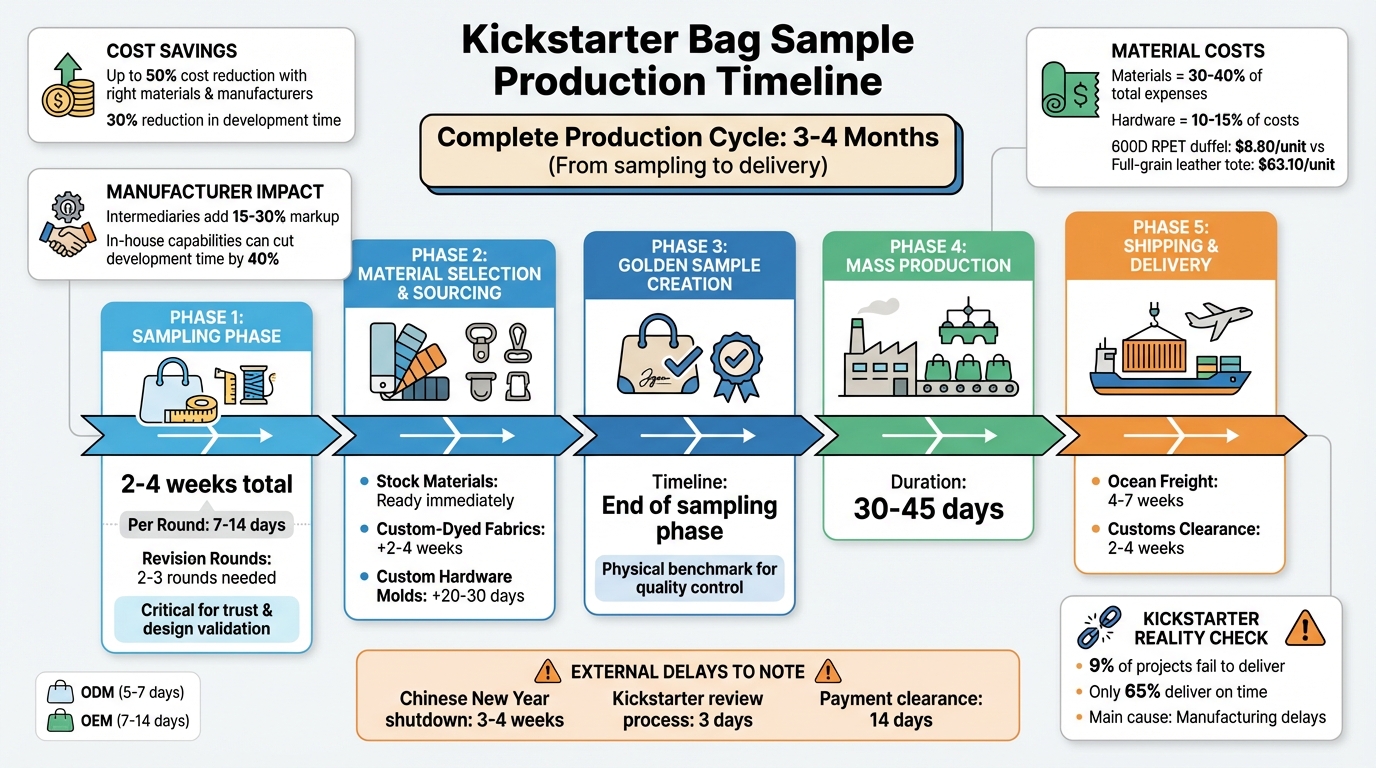
- Timeline: Plan for a 3–4 month production cycle, with sampling taking 7–14 days per round.
- Manufacturers: Work with specialized factories, avoid intermediaries, and verify certifications.
- Materials: Start with stock materials to save time; custom-dyed fabrics or hardware can add weeks.
- Golden Sample: Create a signed, physical benchmark to ensure consistent quality in mass production.
- Common Issues: Material errors, unsuitable factories, or late design changes can derail timelines.
Kickstarter Bag Sample Production Timeline and Key Milestones
Backpack Prototype: Funded on Kickstarter!
sbb-itb-1e6451b
Working with Manufacturers for Faster Prototyping
Choosing the right manufacturing partner can drastically speed up your prototyping process. A direct relationship with a factory gives you more control over production timelines, while intermediaries often add a 15–30% markup and may lack visibility into the actual production floor. This is especially important for meeting Kickstarter deadlines and reducing prototyping cycles. Before committing to a manufacturer, ensure they have the capability to execute your specific bag design.
How to Find Reliable Bag Manufacturers
Start by confirming that the manufacturer operates its affiliated factory. A live video tour can help verify this. For instance, a factory focused on rigid luggage might not have the equipment, like cylinder bed sewers, needed for crafting soft leather handbags. Ask for photos of similar products to confirm their expertise in bag production.
Communication is key. Favor manufacturers who respond within 24 hours and maintain an on-time delivery rate above 95%. Also, check for valid certifications like ISO 9001, BSCI, or Sedex. Don’t just accept a PDF copy – verify the certificate ID in the official database to ensure authenticity.
Material availability is another critical factor. Factories with established relationships with fabric suppliers or access to "market stock" materials can shorten lead times and reduce minimum order quantities. However, custom-dyed materials may add 2–4 weeks to your timeline.
Sally Peng, Senior Director of Production & Textile Engineering at LeelineBags, explains it well:
"The cheapest quote is rarely the lowest landed cost. Vetting the best handbag manufacturers in China prevents expensive rework and hidden fees".
Once you’ve identified a reliable manufacturer, consider using OEM/ODM services to further accelerate the prototyping process.
Using OEM and ODM Services to Speed Up Sample Creation
Original Design Manufacturer (ODM) services can produce samples in as little as 5–7 days by using pre-existing patterns. On the other hand, Original Equipment Manufacturer (OEM) services allow for full customization, with samples typically ready within 7–14 days. While ODM limits you to modifying elements like logos, colors, or packaging, it’s a practical option for meeting tight Kickstarter deadlines. OEM, however, requires more time upfront for tasks like pattern creation and material sourcing.
Partnering with full-service factories that handle R&D, pattern making, and prototyping can cut development times by as much as 40%. These factories streamline processes, from structural engineering to logo application, and often maintain steady supply chains for materials like RPET, vegan leather, and high-denier nylon, speeding up sourcing.
Before paying a deposit, finalize your tech pack to avoid issues like "pricing drift" or material substitutions during sampling. Once you approve a sample, designate it as your "Golden Sample." This physical benchmark ensures consistent quality during bulk production. As Sally Peng highlights:
"The Golden Sample (sealed sample) is your legal benchmark for quality. Without a signed physical standard, you cannot enforce QC later".
Material Selection for Fast Production and Quality Results
Choosing the right materials is a game-changer when it comes to production speed and costs. For soft bag production, materials typically make up 30–40% of total expenses, with hardware adding another 10–15%. Making smart choices here can save you weeks and ensure your Kickstarter campaign stays on track. Let’s dive into the materials commonly used for bag projects.
Common Materials for Kickstarter Bag Projects
Popular materials for custom bags include vegan leather, nylon, canvas, and polyester. Each has its strengths:
- Nylon: Lightweight, water-resistant, and ideal for travel or sports bags. It also speeds up prototyping.
- PU leather: A budget-friendly alternative to genuine leather, offering a similar look at a fraction of the cost.
- Canvas: Known for its durability, making it a solid choice for rugged designs.
- Polyester: Great for linings due to its resilience and ability to hold color well.
For example, creating a duffel bag from 600D RPET (recycled polyester) costs about $8.80 per unit in materials, while a full-grain leather tote comes in at $63.10 per unit.
However, not all materials are created equal. Take PU leather: high-quality versions can last over five years, but lower-grade options may start to degrade after just six months. If you opt for PU, ensure manufacturers use the right tools – like Teflon-coated presser feet – to prevent sticking during production. For structural bags, aim for shell thickness between 1.4mm and 2.0mm, reinforced with EVA foam or Salpa board. Softer styles typically need thinner materials, around 0.9mm to 1.2mm.
Finding the Right Balance Between Quality, Cost, and Sustainability
Striking the right balance between quality, cost, and sustainability is key to efficient prototyping. To speed things up, start your first prototype with stock materials already available at the factory. This allows you to test the shape and size before committing to custom-dyed fabrics, which can add an extra 2–4 weeks to your timeline. Similarly, custom hardware molds can delay production by 20–30 days, so it’s smart to approve the bag structure using generic stock hardware while the molds are being made.
For campaigns with a focus on sustainability, certifications matter. Look for labels like OEKO-TEX Standard 100 (non-toxic textiles), GOTS (organic fibers), or GRS (recycled content). But don’t just take a certificate at face value – request batch-specific Transaction Certificates and verify them through the Textile Exchange database.
To streamline the process, consolidate trim colors and hardware choices. This approach can help you meet minimum order quantities and avoid sourcing delays during sampling. By finalizing your material and hardware decisions early, you can lock in accurate pricing and avoid setbacks during the crucial 3–4 week prototyping phase. Thoughtful material selection is the foundation for faster sampling and, ultimately, a successful Kickstarter bag project.
Meeting Kickstarter Deadlines with Your Sample Timeline
Creating Realistic Production Schedules
When planning your Kickstarter bag project, timing is everything. A well-thought-out timeline that covers every production stage is crucial. Did you know that 9% of Kickstarter projects fail to deliver rewards, and only 65% of backers receive their rewards on time? The most common stumbling block? Manufacturing delays. The initial 4–8 weeks are often spent ordering and reviewing samples before mass production even kicks off.
To avoid these pitfalls, build some breathing room into your schedule by starting early. A great example is Moment’s "The Everything Bags" campaign. Launched in June 2023, they shipped to 589 backers just two months after the campaign ended in September 2023. Their secret? Leveraging an existing supplier network and initiating production before the campaign even closed. Brandon Rollins, Director of Marketing at Fulfillrite, puts it perfectly:
"If you fund early and you are in touch with manufacturers during the back half of your campaign… you might be able to start manufacturing sooner and put some slack in your timeline early".
Don’t forget to account for external delays. For instance, the 3–4-week Chinese New Year shutdown, ocean freight that takes 4–7 weeks (plus 2–4 weeks for customs), and even Kickstarter’s 3-day review process can all impact your timeline. Early planning helps you navigate these challenges smoothly.
Once you’ve factored in potential delays, focus on keeping your design process efficient to stay on track.
How to Refine Sample Designs Efficiently
A realistic timeline is just the first step. The next challenge is refining your designs without derailing your schedule. One way to do this is by prioritizing features that fit within your delivery goals. Take the Minaal team, for example. In March 2022, they responded to backer requests for a hip belt by designing a removable padded attachment instead of overhauling the bag’s internal structure. This clever, modular tweak met user demands without pushing back their delivery timeline. As they explained:
"Our line in the sand is that we won’t do anything that would jeopardise our current timeline for delivery to you".
To keep things running smoothly, finalize a single prototype and use it as your production standard. Be cautious about adding stretch goals or making design changes after the campaign ends – these are common culprits behind delays. Instead, lock in your specifications during the campaign or within Kickstarter’s 14-day payment clearance period. This way, production can begin as soon as funds are received.
Real Examples of Fast Sample Production
Proven Methods for Quick Sample Turnaround
Real-world examples show how smart strategies can lead to faster sample production. Take the case of a boutique brand that partnered with Milo Leather in Guangzhou over 18 months, ending in March 2026. They started with a modest test batch of 100 leather handbags and wallets but scaled up to a 10,000-unit production run. Their secret? Investing in custom steel cutting dies and acrylic stitching jigs. These tools eliminated manual cutting errors and ensured every bag matched the prototype perfectly, achieving a flawless 100% zero-defect rate throughout production.
ALPAKA‘s 7ven Messenger project offers another example. Starting in early 2015, co-founder Jin Li and his team developed 25 prototypes in just 10 months. They relied heavily on digital tools like Adobe Illustrator to create precise specifications and used Skype to communicate with a factory located 10,000 km away. Before launching their Kickstarter campaign, they produced 150 bags and distributed them to influencers for real-world testing. This not only validated their design but also built early momentum. As Jin Li explained:
"Our backpack failure taught us a crucial lesson, which was to keep the design simple, not adding extra features that had no value to our target customer".
Jeff Sheldon of Ugmonk approached the process differently but was equally successful. After reaching out to over 40 manufacturers, he found a Portland-based partner through Maker’s Row. This manufacturer accepted low minimum orders and offered hands-on guidance. Using digital mockups to communicate dimensions – despite having no formal pattern-making experience – Sheldon launched his first production run in July 2014. The result? His initial stock sold out within two weeks. These examples highlight the importance of precision, collaboration, and avoiding common mistakes during the prototyping phase.
Avoiding Common Sample Production Mistakes
While success stories offer valuable lessons, understanding common pitfalls is just as important. One major mistake is allowing factories to alter your design for easier production. Marcus, founder of Minted New York, learned this the hard way. Between February 2023 and April 2024, he spent over $8,000 on failed prototypes with factories in LA and Detroit. These factories modified his postal-inspired bag design, compromising its unique features. Frustrated, Marcus moved production to a local NYC Garment District factory, where he could oversee adjustments closely. Reflecting on the experience, he shared:
"The biggest issue for us was that we let the factory change the pattern to make things easier to produce, which… meant that we would lose many aspects of the bag that made it unique".
Another common misstep is skipping the physical prototype stage. Jeff Sheldon emphasized this point:
"It’s hard to know exactly how the sketches will translate to physical form until you create the first physical prototype".
Initially, Sheldon chose a canvas material that turned out to be too thin and lacked the necessary structure. Only by creating a full bag could he identify and resolve this issue before moving to production.
Sally Peng, Senior Director of Production & Textile Engineering at LeelineBags, underscores the importance of treating bag design as an engineering challenge rather than just an artistic endeavor. She explains:
"A beautiful sketch is useless if a factory cannot build it. Founders often fail because they treat the handbag design process as art… successful brands treat it as engineering".
Her advice? Create detailed tech packs with precise measurements, material specs, and construction notes. This approach can cut sampling rounds and costs by nearly 50%.
Conclusion: Main Points for Fast Sample Production
When it comes to Kickstarter bag projects, speed is crucial – but not at the expense of quality. Successful creators approach sample production like solving an engineering problem, rather than treating it as purely a creative endeavor. Partnering with manufacturers that offer in-house patterning and sampling services can significantly cut development time, sometimes reducing it to just 3–5 days. Depending on your priorities, you can choose between ODM services (which use pre-existing factory designs for faster results) or OEM services (which allow for full customization).
Material selection plays a big role here, too. By specifying technical details like "1.2mm leather", you can minimize miscommunication and avoid costly errors. Opting for common materials such as nylon, polyester, or PU leather often speeds up sourcing. However, if you’re considering sustainable options like RPET fabrics, keep in mind that certified supply chains might stretch your timeline.
Another key step is creating a "Golden Sample." This sample becomes your benchmark for quality, ensuring factories don’t mistakenly revert to earlier, rejected prototypes. Experts suggest that using comprehensive tech packs and paper mock-ups can reduce the number of sampling rounds – and cut associated costs by up to 50%.
Proper timeline planning is also essential. Allow for 2–3 sampling rounds over a 3–4 month period before your Kickstarter launch. Sampling itself typically takes 7–14 days, and mass production can require an additional 30–45 days. To avoid unnecessary delays, stick to stock hardware during this phase.
Action Steps for Kickstarter Creators
Here’s how to put these insights into practice:
- Develop a detailed tech pack: Include multi-view flats, a bill of materials, and precise millimeter measurements. This document will guide your production process from start to finish.
- Test your design early: Create a cardstock mock-up to identify structural issues before committing to expensive materials.
- Vet manufacturers carefully: Ask to see three similar SKUs from their portfolio to ensure they can handle your specific product type. For instance, a factory specializing in nylon backpacks may not be equipped for leather totes.
- Choose manufacturers with in-house capabilities: Look for partners that handle pattern making, cutting, and sewing internally to avoid delays caused by outsourcing.
- Set up quality control checkpoints: Inspect at key stages – cutting, in-line sewing, and pre-packing – to catch issues early.
- Test your approved sample rigorously: For example, zip and unzip it 50 times to check for snags, load it with 6.5–11 lbs to test strap durability, and perform a damp-rub test on inner seams to ensure colorfastness. These tests can prevent large-scale defects in production runs of 500–1,000 units.
- Use version control for tech packs: Label file updates clearly (e.g., v1.1, v1.2) and avoid overwriting earlier versions. Once your Golden Sample is finalized, sign it with a permanent marker and use it as your reference throughout production.
FAQs
What should I include in a bag tech pack to avoid extra sample rounds?
When preparing for production, it’s crucial to include detailed technical drawings, a complete Bill of Materials (BOM), and standard dimensional tolerances (usually ±5 mm for soft goods). Be as precise as possible – outline stitch types, seam details, reinforcement areas, hardware placements, and material choices. This level of preparation ensures your design is communicated clearly to the manufacturer, helping to avoid misunderstandings and expensive delays.
When should I choose ODM vs OEM for my Kickstarter bag prototype?
Choosing ODM (Original Design Manufacturer) works best when you need a quicker and more straightforward process. It relies on pre-existing designs that can be adjusted slightly, making it a great option when time is a top priority. On the other hand, if you’re aiming for a completely customized product, OEM (Original Equipment Manufacturer) is the way to go. It offers full control over every detail of the design but requires more time for development due to its complexity. Your choice should depend on how much time you have and how tailored your design needs to be.
How can I verify a factory is legit and can meet my timeline?
To confirm a factory’s legitimacy and ensure they can meet your deadlines, start by reviewing their business license and relevant certifications, such as ISO 9001 or CPSIA. Customer reviews can also provide insight into their reliability and performance.
Request product samples and test certificates to evaluate quality firsthand. It’s also a good idea to discuss their lead times and production capacity, and order a "golden sample" to set a clear standard for your expectations.
Maintain clear communication and establish agreed-upon terms for quality control, such as inspections and AQL (Acceptable Quality Limit) reports. These steps can help ensure the factory delivers both reliable service and products on time.
Related Blog Posts
- From Concept to Delivery: A Step-by-Step Walkthrough of Our Custom Bag Production Process
- Prototyping vs Sampling: Key Differences
- Fast-Track Production: How We Deliver 10,000 Custom Bags in 30 Days
- The Ultimate Guide to Custom Bags for Kickstarter Creators
? Related: Looking for a comprehensive guide to bag sample development? Check out our Complete Guide to Bag Sample Development & Prototyping — covering sample types, design process, testing, timeline, costs, and common mistakes.